
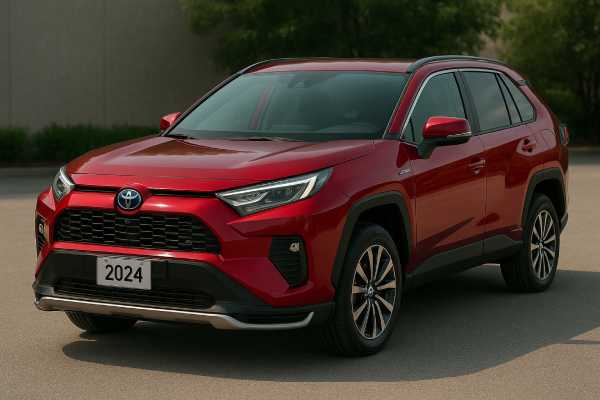
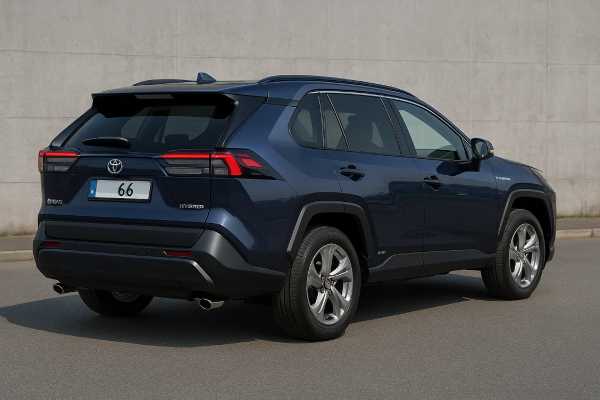
The fifth-generation Toyota RAV4 Hybrid (XA50) with AWD-i blends a high-efficiency 2.5-liter A25A-FXS engine with electric drive at both axles to deliver family-friendly utility and standout economy. The 2022 facelift sharpened styling, improved multimedia and driver-assist tech, and, in North America, kept the same robust hybrid powertrain that has proven durable since model year 2019. Owners value its real-world 40 mpg-class economy (5.9–6.5 L/100 km mixed), uncomplicated maintenance, roomy cargo area, and the confidence of electric all-wheel drive in poor weather. Note on outputs: North American models list 219 hp combined; widely published European figures quote 222 hp for the same system—both refer to the AWD hybrid with the A25A-FXS engine. With a 1,750-lb (794-kg) tow rating, generous ground clearance, and a flat, quiet highway demeanor, the facelifted RAV4 Hybrid remains a top pick for buyers who want a compact SUV that just works—winter after winter, mile after mile.
Fast Facts
- Strong economy: real-world ~40 mpg combined (US) ≈ 5.9 L/100 km; stable at highway speeds.
- AWD-i traction: instant rear-axle assist improves snow starts and mid-corner stability.
- Packaging win: ~37.5 ft³ cargo (SAE) seats up and nearly 70 ft³ seats folded; flat load floor.
- Caveat: several service campaigns exist (e.g., rear motor/underfloor harness corrosion on early years); always run a VIN recall check.
- Routine: oil/filter every 10,000 mi/12 months (0W-16); tire rotation every 5,000–6,000 mi.
Explore the sections
- RAV4 Hybrid AWD-i in detail
- Specs and technical data (RAV4 Hybrid)
- Trims, options, and safety tech
- Reliability, issues and service actions
- Maintenance and buyer’s guide
- Driving and performance
- How it compares to rivals
RAV4 Hybrid AWD-i in detail
The facelifted (2022–present) RAV4 Hybrid leans on Toyota’s proven “Dynamic Force” 2.5-liter A25A-FXS Atkinson-cycle four-cylinder paired with Toyota Hybrid System II and an electronic continuously variable transaxle (eCVT). In practical terms, that means the engine spends more time in its efficient operating window while two front electric motor-generators (one for propulsion, one for starting/generation/split-power control) and a compact rear motor (MGR) provide seamless, on-demand all-wheel-drive without a mechanical prop shaft. The rear axle only draws energy when needed—launches on slick surfaces, mid-corner balance, or low-speed maneuvers—so it avoids the parasitic loss of a conventional AWD system.
The headline figures vary slightly by market. North American models list a combined system output of 219 hp (163 kW). European spec sheets quote 222 DIN hp (164 kW) for AWD. In either tune the character is the same: stout low-speed torque from the electric motors, steady pull to typical highway speeds, and a quiet cruise at 70–75 mph thanks to tall eCVT “virtual gearing” and the engine’s efficient combustion cycle. Cold-weather fuel economy remains a RAV4 Hybrid strong suit; expect a mild winter penalty relative to EPA numbers if most trips are short—use of seat heaters, defrost, and cabin warm-up all add load—and little penalty on longer highway runs once the powertrain is at temperature.
The 2022 update brought crisper headlamp designs (with available projector LEDs on upper trims), expanded driver-assist capability, and a better-sorted infotainment UX with improved screen sizes and snappier responses. In 2023, the Woodland Edition arrived, demonstrating a niche the RAV4 Hybrid covers unusually well: light overlanding/forest-road use without the fuel-economy hit of aggressive tires and torque-vectoring hardware. Ground clearance remains generous for the class, approach/departure angles are respectable, and the car’s compact footprint makes it easy to place on narrow trails or snow-clogged city streets.
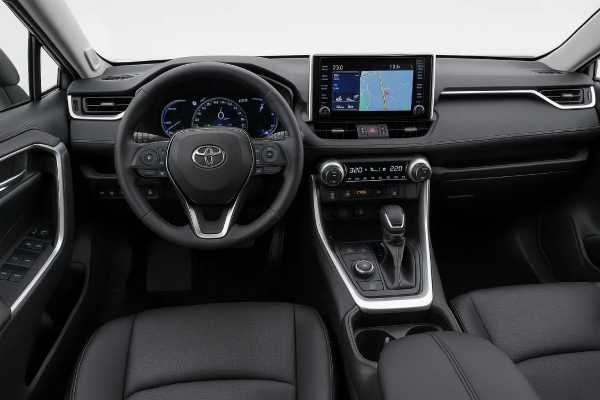
Inside, the RAV4 Hybrid prioritizes function. Big, rubberized climate and drive-mode knobs, a low dash cowl, and plentiful small-item storage make daily use simple. The rear bench folds almost flat with a two-position cargo floor, yielding a nearly level load bay. Families appreciate back-seat vents, an abundance of USB ports, and the long cargo opening that swallows strollers or mountain bikes without drama. On the road, the hybrid’s extra curb mass versus a gas LE actually helps ride quality; the suspension tuning—MacPherson strut up front, multi-link rear—keeps body motions tidy without being harsh.
If you are cross-shopping, note that Toyota tunes brake-by-wire blending between regenerative and friction braking well; pedal feel is easy to modulate after a day of acclimation. The eCVT can flare revs under full throttle on long grades; using Sport mode or manual steps (where fitted) can help the engine settle sooner after passing. Otherwise, the RAV4 Hybrid’s character is consistent: efficient, unfussy, and confidence-inspiring across a wide range of conditions.
Specs and technical data (RAV4 Hybrid)
Powertrain & Efficiency
| Item | Detail |
|---|---|
| Code | A25A-FXS (engine) + THS II (hybrid) |
| Engine layout & cylinders | Transverse I-4, DOHC, 16-valve; Dual VVT-iE (intake) / VVT-i (exhaust) |
| Bore × stroke | 87.5 × 103.4 mm (3.44 × 4.07 in) |
| Displacement | 2.5 L (2,487 cc) |
| Induction | Naturally aspirated, long-stroke Atkinson cycle |
| Fuel system | D-4S direct + port injection |
| Compression ratio | ~14.0:1 |
| Electric motors | Front MG2 traction + MG1 generator; rear MGR traction (AWD-i) |
| System voltage | ~650 V nominal (hybrid system) |
| Traction-battery chemistry | Nickel-metal hydride (most NA trims; regional variations exist) |
| Max combined power | 219 hp (163 kW) NA; 222 hp (164 kW) EU figure |
| Max engine torque (reference) | ~221 Nm (163 lb-ft) (engine) |
| Rated economy (hybrid AWD) | EPA 41/38/40 mpg (city/hwy/combined) = 5.7/6.2/5.9 L/100 km |
| Real-world highway @ 75 mph (120 km/h) | ~6.3–7.1 L/100 km (37–33 mpg US) depending on tires, temp, and load |
| Aerodynamics | Cd ~0.31–0.33 (trim/tire dependent) |
Notes: Toyota lists combined net power for the hybrid; individual motor torque ratings are not always published for this model. The EU-quoted 222 hp refers to AWD.
Transmission & Driveline
| Item | Detail |
|---|---|
| Transmission | eCVT transaxle (planetary power split; P710 family) |
| Drive type | AWD-i (front hybrid transaxle + independent rear e-motor) |
| Final drive ratio(s) | Not published as discrete “gears”; eCVT varies ratio continuously |
| Differential(s) | Open (front); rear e-axle with reduction gear; brake-based torque management |
| Replenishment time | Refuel to full: ~5–7 minutes (typical) |
Chassis & Dimensions
| Item | Detail |
|---|---|
| Platform | TNGA-K |
| Suspension (front/rear) | MacPherson strut / multi-link |
| Steering | Electric rack-assist; quick on-center, light at low speed |
| Brakes | 4-wheel discs; front ventilated ~305 mm (12.0 in), rear solid ~281 mm (11.1 in) |
| Wheels/Tires | 17–19 in rims; common sizes 225/65R17, 225/60R18, 235/55R19 |
| Ground clearance | ~206 mm (8.1 in) typical hybrid; varies slightly by trim |
| Length / Width / Height | ~4,595 / 1,855 / 1,700 mm (180.9 / 73.0 / 66.9–67.2 in) by trim |
| Wheelbase | 2,690 mm (105.9 in) |
| Turning circle (curb-to-curb) | ~11.0 m (36.1 ft) |
| Curb weight | ~1,700–1,735 kg (3,750–3,825 lb) trim-dependent |
| GVWR | ~2,260–2,300 kg (4,980–5,070 lb) |
| Fuel tank | 55 L (14.5 US gal / 12.1 UK gal) |
| Cargo volume (SAE) | ~1,062 L (37.5 ft³) seats up / ~1,977 L (69.8 ft³) seats folded |
Performance & Capability
| Item | Detail |
|---|---|
| 0–60 mph / 0–100 km/h | ~7.5 s / ~7.9 s (typical tests, AWD) |
| Top speed | ~180 km/h (112 mph) electronically limited |
| Braking 100–0 km/h | ~37–40 m (typical tire/trim; independent tests vary) |
| Towing capacity | 794 kg (1,750 lb) braked |
| Payload | ~475–520 kg (1,050–1,150 lb) by trim |
| Roof load | 75 kg (165 lb) with factory rails/crossbars |
Fluids & Service Capacities
| System | Spec / Capacity |
|---|---|
| Engine oil | SAE 0W-16 (API, ILSAC-approved); ~4.5–4.8 L (4.8–5.1 US qt) with filter |
| Engine coolant | Toyota Super Long Life Coolant (pink); premixed; change by interval, capacity varies by VIN |
| Transaxle (eCVT) | Toyota ATF WS; drain-and-fill quantity varies (~3–4 L); condition-based service in severe duty |
| Rear e-axle reduction gear | Factory-filled; no routine service specified; inspect for leaks/noise |
| A/C refrigerant | R-1234yf; charge ~0.47–0.55 kg (varies with HVAC optioning) |
| A/C compressor oil | ND-11 (POE), quantity per service procedure |
| Key torque | Wheel lug nuts 103 Nm (76 lb-ft); oil drain plug ~40 Nm (30 lb-ft) |
Always verify specs by VIN in the official service literature; minor variations exist by model year and package.
Electrical
| Item | Detail |
|---|---|
| 12 V battery | AGM/EFB compact case (cargo area); ~45–50 Ah typical (check label) |
| DC-DC converter | Integrated; subject to recall/service campaign on certain VINs |
| Spark plugs | Iridium; long-life interval; gap ~0.7–0.8 mm (inspect/replace per schedule) |
Safety & Driver Assistance
| Area | Summary |
|---|---|
| Crash ratings (IIHS) | Strong overall with “Good” results in most tests; “Moderate overlap front (updated)” is Marginal on some years; available headlights rate Good on properly equipped trims. |
| Headlights | Vary by trim; projector LEDs with auto high-beam can earn Good. |
| ADAS suite | Toyota Safety Sense (generation varies by MY): pre-collision with pedestrian/cyclist detection, lane departure warning with steering assist/lane tracing, full-speed adaptive cruise, road sign assist; blind-spot monitor and rear cross-traffic alert commonly fitted; rear auto braking available. |
Trims, options, and safety tech
Trim walk (North America, 2022–present): LE, XLE, XLE Premium, SE, XSE, and Limited form the core RAV4 Hybrid range. In 2023, the Woodland Edition joined as a special-edition hybrid with mild trail hardware (TRD-tuned springs/dampers, bronze-finish wheels, all-terrain-style tires, raised crossbars, and underbody protection accents). All hybrids are AWD-i.
Mechanical distinctions by trim:
The hybrid system, eCVT, and AWD-i are shared across trims. The XSE rides on sport-tuned suspension calibrations and larger wheels/tires that sharpen transient response at the expense of minor impact harshness. Woodland Edition uses unique springs/dampers and tire spec optimized for unpaved surfaces; its tire compound can add a 2–3 mpg highway penalty versus the standard hybrids.
Wheels and tires:
- LE/XLE commonly 17-inch with 225/65R17 all-seasons.
- XLE Premium/SE/XSE often 18-inch 225/60R18.
- Limited and select appearance packages: 19-inch 235/55R19.
- Woodland Edition: off-road-leaning all-terrain tires on bronze wheels.
Infotainment and audio tiers (vary by MY):
- 8-inch or 10.5-inch center displays appear post-facelift, with faster processors and improved voice agents.
- 7-inch or 12.3-inch driver cluster displays by trim/year.
- Audio: base six-speaker, mid-tier “Audio Plus,” and premium JBL® with subwoofer on upper trims.
Convenience and cold-weather options:
Heated front seats and heated steering wheel are widely available (standard on many northern packages), with ventilated fronts on Limited. Power liftgate arrives mid-range; hands-free kick sensor on top trims. Weather Package and Advanced Technology Package bundle heated elements, parking assist with automatic braking, digital rearview mirror, and wireless charging depending on year.
Seating and interior identifiers:
SofTex-trimmed seats appear on XLE Premium and up; XSE adds blue stitching accents; Limited emphasizes light-tone interiors with contrast piping. Quick tells include wheel size, headlamp internals (XSE vertical elements), and badging (Woodland script, bronze wheels).
Year-to-year highlights:
- 2022: Facelift with headlamp/bumper updates; multimedia and TSS improvements; XSE lighting signature.
- 2023: Woodland Edition debuts; expanded screen sizes on many trims; interface speed and camera quality improved.
- 2024–2025: Feature mix and safety-assist refinements; continued 219-hp hybrid; option/package content adjusted across trims.
Safety ratings snapshot:
The RAV4 Hybrid’s structure and restraints perform well across most IIHS tests, with Good small-overlap and original moderate-overlap results. The newer updated moderate-overlap adds tougher rear-passenger injury metrics where some configurations score Marginal; it remains a competitive performer overall. Headlight performance depends on the exact lamp option—seek trims with projector LEDs rated Good when night driving is a priority.
ADAS calibration notes after service:
- Windshield replacement (camera-equipped) and radar sensor bracket work require camera/radar calibrations.
- Rear radar (BSM) alignment needed if rear bumper beam/brackets are disturbed.
- After four-wheel alignment or steering angle sensor work, verify lane-tracing performance on a marked road.
Reliability, issues and service actions
Overall pattern: The XA50 RAV4 Hybrid’s engine, hybrid transaxle (P710 family), and AWD-i system have excellent field durability when serviced on time. Most issues owners encounter are peripheral (harnesses, modules, sealing) rather than core powertrain failures.
Common → Rare map (with cost/severity guidance):
- Common, low–medium cost
- 12-V battery aging (3–5 years): Slow cranking of ancillary systems, intermittent warning lights after sitting. Cause: compact AGM/EFB battery in cargo area ages with short trips. Fix: test and replace; ensure DC-DC converter software up to date; check parasitic draw (dashcams).
- Brake noise at low speed / surface rust: Hybrids rely on regen; pads can glaze if the car does mostly light stops. Fix: periodic firm manual braking to clean rotors; pad deglaze or replacement if persistent.
- Windshield camera/ADAS warnings after glass work: Missing post-repair calibration or dirty camera field. Fix: proper camera calibration; ensure OEM-grade glass and brackets.
- Occasional, medium cost
- Roof rail water leaks (2019–2021 build range): Damp headliner or drip marks after rain. Cause: deterioration at roof rail mounting clips. Fix: Toyota Customer Support Program replaces clips/seals; inspect and remediate water damage.
- Rear e-axle (MGR) harness/under-floor corrosion on early years: AWD warning lights or reduced rear-axle assistance. Fix: inspection; replace affected harness and components per service program; underbody protection as specified.
- HV battery cooling path contamination in dusty use: Elevated battery temps on long grades. Fix: inspect intake and ducting; clean filter/screen; educate on not blocking vents with cargo.
- Occasional–rare, medium–high cost
- DC/DC converter internal fault on certain VINs: Warning lights, 12-V charging issues. Fix: recall replacement of converter assembly; verify wiring and software state afterward.
- VSC default-on noncompliance (software) on certain builds: Indicator state not resetting as required. Fix: ECU reflash per campaign; verify calibration ID.
- Wheel-bearing or hub noise (high-mileage, severe winters): Growl that changes with road speed. Fix: replace affected hub assembly; inspect dust shields and tone rings.
ICE/hybrid specifics:
- Timing system: Chain-driven; no scheduled replacement. Inspect for chain-stretch correlation codes or abnormal noise only.
- Oil consumption: Generally minimal on A25A-FXS when using 0W-16 and 10k-mile intervals; heavy towing or extreme heat may justify 5k-mile intervals.
- Cooling system: Single service loop with electric pumps; watch for trapped air after service; always use Toyota SLLC (pink).
Software & calibrations that matter:
- Powertrain ECU updates that refine engine stop/start and EV↔ICE blending.
- ADAS ECU calibrations (camera, radar) after windshield, bumper, or alignment work.
- DC-DC converter and ABS/vehicle stability control updates per campaign.
Recalls/TSBs and extended coverage (selected examples):
- HV floor under-wire harness and rear traction motor cable corrosion (selected 2019–2022 AWD hybrids): inspection and parts replacement under a Customer Support Program; phased owner letters.
- DC/DC converter replacement (selected 2021–2023 hybrids): remedy involves replacing converter assembly; verify zero DTCs after repair.
- VSC software noncompliance (selected 2022 builds): software ensures VSC returns to “ON” at restart.
Pre-purchase checks to request:
- Full service history with oil filter part numbers and 0W-16 usage.
- VIN recall/campaign printout showing completion of any HV-harness, DC-DC, or VSC campaigns.
- Recent brake service (pad thickness, rotor condition) and tire date codes.
- Underside inspection for harness corrosion, damaged splash shields, and winter corrosion at subframe seams.
- 12-V battery test and scan for hybrid/battery DTCs; ensure charge-air paths for the HV battery are unobstructed.
Maintenance and buyer’s guide
Practical maintenance schedule (distance/time = whichever comes first):
- Engine oil & filter: Every 10,000 miles / 12 months (16,000 km / 12 months) with SAE 0W-16 meeting Toyota specs. Severe service (short-trip winter, dusty towing): consider 5,000-mile (8,000-km) interval.
- Engine air filter: Inspect every 10,000 mi / 12 mo; replace 30,000–45,000 mi depending on dust.
- Cabin filter: Replace 15,000–20,000 mi / 12–18 mo; sooner if HVAC flow drops.
- Coolant (SLLC, pink): First replacement commonly 100,000–120,000 mi (160,000–192,000 km) or 10 years, then 50,000–60,000 mi thereafter. Always verify by VIN.
- Spark plugs (iridium): Typically 120,000 mi (192,000 km); inspect earlier if misfire or harsh environments.
- Serpentine/accessory belt: Inspect 60,000 mi / 6 years; replace on cracks/glazing.
- Hybrid transaxle (ATF WS): Toyota does not require routine changes; many owners service at 60,000–100,000 mi as preventive care—use only ATF WS, torque fill/drain correctly, and avoid over-filling.
- Rear e-axle reduction gear: No routine service; inspect for leaks/noise at each rotation.
- Brake fluid: Replace 3 years / 36,000 mi in humid climates; 4–5 years in arid regions.
- Brake pads/rotors: Inspect each rotation; mixed driving often yields 50,000–80,000 mi pad life thanks to regeneration.
- Tire rotation & alignment checks: Rotate 5,000–6,000 mi; alignment yearly or after pothole impacts; AWD longevity benefits from even wear.
- Differentials/transfer case (gas AWD only): Not applicable on the hybrid (rear axle is electric).
- 12 V battery: Test annually from year 3; plan replacement year 4–5 in cold climates.
- HV system checks: Keep battery cooling intake clear; have the dealer run basic battery health checks during scheduled services if offered.
Fluid references and capacities (quick list):
- Oil: SAE 0W-16; ~4.8 US qt with filter (confirm by VIN).
- Fuel tank: 14.5 US gal.
- A/C: R-1234yf refrigerant; ND-11 compressor oil; charge varies by HVAC package.
- Torque basics: Lugs 103 Nm (76 lb-ft); oil drain plug ~40 Nm (30 lb-ft).
When in doubt, defer to the exact values in the official service manual for your VIN and market.
Buyer’s checklist (used or new):
- Exterior & structure: Inspect roof-rail mounts (water traces), windshield (chips/cracks near camera), undertray and splash shields (snow or curb damage).
- Undercarriage: Look for corrosion at subframe seams and the rear e-axle harness routing on early builds; ask for campaign proof if in range.
- Driveline: On a road test, listen for rear-axle whine above 40 mph on steady throttle; verify AWD-i engages by accelerating on loose gravel or a wet surface.
- Electronics: Confirm camera/radar functions (lane tracing, adaptive cruise) and that no sensor warnings appear after highway driving.
- Tires/brakes: Check even wear; measure pad thickness; feel for any vibration during moderate downhill braking (warped rotor).
- Records: Oil change receipts (0W-16), cabin and engine filters, and any hybrid system checks; campaign letters closed.
Which years/trims to target:
- Sweet spot: 2022–2025 XLE Premium or XSE for features and updated infotainment without heavy wheel/tire penalties; Limited if you value ventilated seats and the best headlamps.
- Special use: Woodland Edition (2023–) if you want mild-trail hardware from the factory and can accept the small mpg trade-off.
- Avoid? No “avoid” year stands out; for early VINs within campaign ranges, prioritize vehicles with documented completion of the HV-harness/DC-DC/VSC actions.
Long-term outlook:
With routine fluids, clean cooling paths, and gentle warm-ups, the A25A-FXS and Toyota’s hybrid transaxles are known to exceed 200,000–300,000 miles with minimal degradation. Suspension bushings and electronic modules are more likely wear points than the engine or hybrid drive.
Driving and performance
Ride, handling, and NVH:
The hybrid’s extra mass (vs. gas LE) helps suppress small-bump chatter. On 17- or 18-inch wheels, impacts are rounded and cabin noise is well controlled through 75 mph (120 km/h). The multi-link rear keeps the back of the car calm over broken pavement, and the front MacPherson struts resist brake dive better than many rivals. The Woodland Edition’s tires add tread hum on certain surfaces; the XSE’s sport tune sharpens turn-in and mid-corner support but slightly increases busy-ness over expansion joints.
Steering and braking:
Steering is light at parking speeds and builds modest weight around center; it’s accurate enough for easy lane placement and relaxing highway stints. Brake-by-wire tuning—blending regeneration with friction—is a Toyota strong suit; after a day you’ll modulate smooth stops unconsciously. Long descents reveal one hybrid bonus: the car harvests energy early and keeps pedal effort consistent as the pack fills; once regen is saturated, friction brakes step in seamlessly.
Powertrain character:
From a stop, the rear MGR contributes immediately, giving the RAV4 Hybrid a confident launch in the wet. Mid-range passing is brisk up to about 50–60 mph, after which the A25A-FXS’ efficient but modest peak power means the eCVT must let revs climb to sustain acceleration. Sport mode favors slightly higher engine speed and faster power response; Eco mode dulls tip-in to stretch mpg around town. ICE↔EV transitions are unobtrusive when warm; in very cold weather, the engine will run more to maintain coolant and cabin heat.
Real-world efficiency:
- City: Many owners report 40–45 mpg US (5.2–5.9 L/100 km) with relaxed driving and strategic coasting.
- Highway (65–75 mph): 34–40 mpg (6.9–5.9 L/100 km) depending on temp, wind, and tire spec.
- Mixed: 38–42 mpg (6.2–5.6 L/100 km).
Cold snaps and short trips can pull winter tanks into the mid-30s mpg; long highway trips at legal speeds often match the EPA combined figure.
Traction and control:
AWD-i’s quick rear-axle assist is most noticeable starting on ice or slush where it reduces front-wheel scrabble. In corners, it trims understeer by nudging the rear outside wheel. Snow modes relax throttle and adjust braking strategy to keep momentum; all-season tires remain the limiting factor—dedicated winter tires transform foul-weather confidence.
Loads and towing:
At the 1,750-lb (794-kg) tow rating, the RAV4 Hybrid remains composed with a small pop-up or a pair of trail bikes; the eCVT keeps engine speed in the torque band on grades, and coolant/oil temps stay in check with sensible throttle. Plan on a 10–25% fuel-economy penalty when towing or fully loaded at highway speeds.
Key performance metrics (typical test setups):
- 0–60 mph: ~7.5 s (XLE/XSE on 18s).
- 50–80 mph passing: ~6.0–6.5 s depending on grade and load.
- 100–0 km/h braking: ~37–40 m on mainstream all-season tires.
- Turning circle: ~36 ft curb-to-curb.
How it compares to rivals
Honda CR-V Hybrid (AWD): A smooth, efficient rival with excellent packaging and a refined cabin. EPA combined typically 37–40 mpg depending on wheel/tire. The Honda’s two-motor system favors a more EV-like feel around town; highway NVH is similarly low. Toyota counters with longer hybrid lineage, a broader dealer network, and generally lower long-term parts costs; CR-V’s infotainment and some ADAS behavior feel more polished.
Ford Escape Hybrid (AWD): Quick step-off and high efficiency (especially FWD), with an engaging chassis. Ford’s infotainment is feature-rich; long-term reliability is less time-proven than Toyota’s, and real-world winter mpg tends to be a touch lower in AWD form. RAV4 offers a sturdier cargo area and a simpler ownership experience in snow belts.
Kia Sportage Hybrid (AWD): Roomy interior and striking design, with a torquier feel from its turbo-hybrid setup and competitive EPA numbers. Kia bundles lots of tech per dollar. Toyota keeps its edge in resale value and a reputation for minimal hybrid hassles at high mileage; Kia’s ride can feel busier depending on wheels, and dealer density varies.
Subaru Forester (non-hybrid in NA): Balanced chassis and excellent visibility with standard AWD, but gasoline economy trails the hybrid pack. Forester’s X-Mode traction programming is superb off pavement; RAV4 Hybrid wins on fuel cost, power, and long-haul quiet.
RAV4 Prime (PHEV): If you like the RAV4 but want EV commute capability, the Prime adds robust electric range and much stronger acceleration. It costs more and is heavier; if you can plug in, it’s the quickest, quietest RAV4. If you can’t, the regular Hybrid is the simpler, thriftier choice.
References
- Gas Mileage of 2023 Toyota RAV4 2023 (EPA data)
- 2024 Toyota RAV4 2024 (Safety Rating)
- 2019 Toyota RAV4 Product Information 2018 (Product Information)
- 2025 Toyota RAV4 Hybrid 2024 (Product Page)
- TECHNICAL INSTRUCTIONS FOR CUSTOMER SUPPORT PROGRAM 22TE09 HV FLOOR UNDER WIRE HARNESS AND REAR TRACTION MOTOR CABLE CORROSION 2023 (Customer Support Program)
Disclaimer
This guide is for informational purposes and is not a substitute for professional diagnosis, repair, or the official service literature. Specifications, torque values, capacities, features, and maintenance intervals vary by VIN, model year, market, and equipment. Always verify details against your vehicle’s owner’s manual, the official service manual, and current technical bulletins or recalls.
If you found this helpful, feel free to share it with fellow owners and enthusiasts on Facebook, X/Twitter, or your favorite forum—thanks for supporting xcar’s work.