
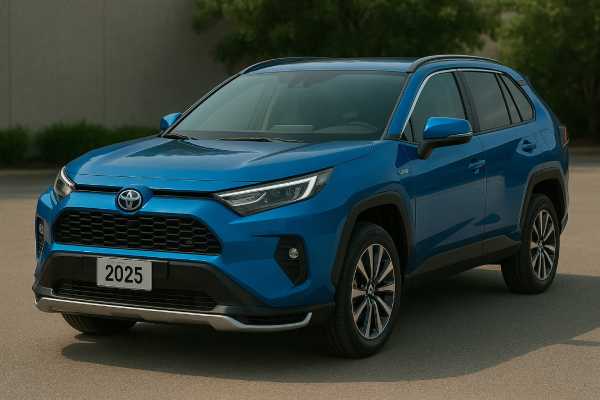
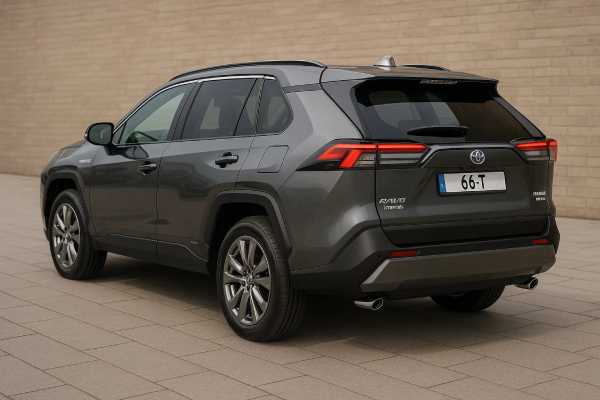
The Toyota RAV4 Plug-in Hybrid—known as RAV4 Prime through 2024 and renamed “RAV4 Plug-in Hybrid” for 2025—combines everyday SUV practicality with genuinely quick performance and class-leading electric range. Built on Toyota’s GA-K platform (XA50), it pairs the A25A-FXS 2.5-liter Atkinson-cycle four-cylinder with dual electric motors and a lithium-ion battery. Net system output is 302 hp, good for mid-5-second 0–60 mph runs while still delivering long EV commutes when charged and excellent hybrid economy when the battery is depleted. Standard AWD-i adds a dedicated rear e-axle for confident traction in poor weather. Inside, it retains the RAV4’s upright, useful layout with adult-friendly rear seating and a flat cargo floor, while higher trims layer in large displays and a robust ADAS suite. If you want one compact SUV that can commute on electricity, road-trip on gasoline, and shrug off winter, this is the sweet spot.
Fast Facts
- Strongest plug-in SUV in class pace: 302 hp, ~5.5 s 0–60 mph.
- Long EV range for the segment: up to 42 mi (68 km) when fully charged.
- Practical AWD-i with 2,500 lb (1,134 kg) tow rating and 8.0 in (203 mm) clearance.
- Watch for DC-DC converter recall completion on 2021–2022 vehicles; confirm dealer paperwork.
- Typical Level-2 charge: ~2.5 h (6.6 kW OBC) or ~4.5 h (3.3 kW OBC); rotate tires every 5,000–6,000 mi (8,000–10,000 km).
What’s inside
- RAV4 Plug-in Hybrid in detail
- RAV4 Plug-in specs and data
- RAV4 Plug-in trims and safety
- Reliability, issues, and fixes
- Maintenance schedule and buying guide
- Driving, performance, and efficiency
- RAV4 Plug-in vs rivals
RAV4 Plug-in Hybrid in detail
Toyota’s plug-in RAV4 takes the already efficient RAV4 Hybrid and scales up output and battery size to create a versatile PHEV that can cover a typical commute on electricity yet behave like a thrifty hybrid on road trips. The foundation is the A25A-FXS 2.5-liter Dynamic Force engine running an efficient Atkinson cycle. Two permanent-magnet motors (front traction motor integrated into the eCVT transaxle; separate rear e-axle) and a high-voltage lithium-ion pack round out the system. Total system output is 302 hp (225 kW), and the power delivery feels immediate in everyday driving thanks to generous motor torque and smart eCVT calibration.
AWD-i makes winter confidence a given. The rear e-axle engages proactively at launch and variably under low-grip conditions, and it contributes a natural “push” effect in corners that keeps the nose from washing wide. Braking blends strong regen with friction seamlessly in normal use; pedal feel firms up under hard stops with good stability. The steering is light but accurate, and body motions are tidy for a family SUV. With 33.5 ft³ (949 L, SAE) of cargo space behind the second row and 63.2 ft³ (1,790 L) with seats folded, the RAV4 Plug-in remains a highly practical daily driver.
Charging is straightforward via the J1772 AC port: most cars have a 3.3 kW onboard charger (OBC), while certain trims/option packages fit a 6.6 kW OBC that halves Level-2 time. There is no DC fast-charging provision on 2022–2025 models, so plan around home/work L2 or longer L1 top-offs. Real-world EV range varies with speed and temperature; expect roughly city-biased commutes to exceed 40 miles in mild weather, while steady 70–75 mph freeway stretches will consume range faster. Once depleted, the RAV4 Plug-in reverts to familiar hybrid operation in the high-30s mpg combined, preserving overall trip economy even when you cannot plug in.
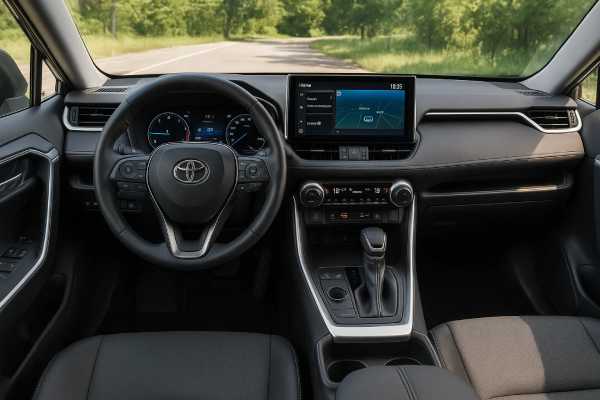
The cabin is recognizable RAV4: upright seating, good outward visibility, large physical controls for climate, and durable materials. Later model years bring Toyota’s newer multimedia with larger touchscreens and wireless smartphone integration. Toyota Safety Sense (TSS) includes automatic emergency braking with pedestrian/cyclist detection, adaptive cruise with lane centering, and traffic-sign assist; blind-spot monitoring and rear cross-traffic alert are widespread. Towing capacity is a useful 2,500 lb (1,134 kg) when properly equipped, and the 8-inch ground clearance keeps trailheads in play.
RAV4 Plug-in specs and data
Powertrain & Efficiency
| Item | Detail |
|---|---|
| Code | A25A-FXS + dual PM motors (AWD-i) |
| Engine layout & cylinders | Inline-4, DOHC, 16-valve; 4 cyl; 87.5 × 103.4 mm (3.44 × 4.07 in) |
| Displacement | 2.5 L (2,487 cc) |
| Induction | Naturally aspirated (Atkinson cycle) |
| Fuel system | D-4S (direct + port injection) |
| Compression ratio | ~14.0:1 |
| ICE max output | ~176 hp (131 kW) @ ~6,000 rpm; ~227 Nm (168 lb-ft) @ ~3,600 rpm |
| Traction motors | Front PM synchronous (primary); rear PM synchronous (e-axle) |
| System voltage | ~355.2 V nominal |
| Battery | Lithium-ion, liquid-cooled; ~18 kWh class |
| Net system power | 302 hp (225 kW) |
| Rated efficiency | 94 MPGe combined (electric); 38 mpg combined (gas only) |
| EPA EV range | 42 mi (68 km) |
| Real-world highway @ 75 mph | Typical 30–35 mi EV; charge-sustaining ~34–37 mpg (conditions dependent) |
| Aerodynamics | Cd ~0.33; frontal area ~2.6 m² (27.9 ft²) |
Transmission & Driveline / Charging
| Item | Detail |
|---|---|
| Transmission | eCVT (planetary), transaxle family P710 |
| Drive type | AWD-i (front e-CVT + independent rear e-axle) |
| Differential | Open; brake-based torque control |
| Onboard charger (AC) | 3.3 kW standard on many SE; 6.6 kW available on selected XSE/packages |
| Replenishment time (typical) | L2 240 V 16 A (3.3 kW): ~4.5 h 0–100%; L2 240 V 32 A (6.6 kW): ~2.5 h; L1 120 V: ~12 h |
Chassis & Dimensions
| Item | Detail |
|---|---|
| Suspension (front/rear) | MacPherson strut / multi-link |
| Steering | Electric power steering (EPS) |
| Brakes | Vented front discs ~305 mm (12.0 in); solid rear discs ~282 mm (11.1 in) |
| Wheels/Tires | SE: 18 in (often 235/60R18); XSE: 19 in (often 235/55R19) |
| Ground clearance | 203 mm (8.0 in) |
| Length / Width / Height | ~4,600 / 1,855 / 1,700 mm (~181.0 / 73.0 / 67.0 in) |
| Wheelbase | 2,690 mm (105.9 in) |
| Turning circle | ~11.4 m (37.4 ft) |
| Curb weight | ~1,920–1,990 kg (4,230–4,385 lb) by trim/options |
| Fuel tank | 55 L (14.5 US gal / 12.1 UK gal) |
| Cargo volume (SAE) | 949 L (33.5 ft³) seats up / 1,790 L (63.2 ft³) seats down |
Performance & Capability
| Item | Detail |
|---|---|
| 0–100 km/h (0–62 mph) | ~5.8 s (0–60 mph ~5.5 s) |
| Top speed | ~179 km/h (111 mph); EV-only speed typically lower |
| Towing capacity | 1,134 kg (2,500 lb) braked |
| Payload (typical) | ~500–540 kg (1,100–1,190 lb) |
| Roof load | ~75 kg (165 lb) with rails/crossbars |
Fluids & Service Capacities
| System | Spec & Capacity (approximate; verify by VIN) |
|---|---|
| Engine oil | Toyota 0W-16, API SP / ILSAC GF-6B; ~4.5 L (4.8 qt) with filter |
| Engine coolant | Toyota Super Long Life Coolant (SLLC, pink), ~50/50; ~7–8 L total across loops |
| Transaxle (eCVT) | Toyota ATF WS; ~3.5–4.0 L service fill |
| Rear e-axle reduction gear | Toyota ATF WS; ~0.8–1.0 L |
| A/C refrigerant | R-1234yf; charge ~0.55–0.65 kg (19–23 oz) |
| A/C compressor oil | ND-Oil 11 (or Toyota equivalent); ~120 mL (4 fl oz) |
| Key torque specs | Wheel lugs ~103 Nm (76 lb-ft); oil drain ~40 Nm (30 lb-ft) |
Electrical
| Item | Detail |
|---|---|
| 12 V battery | AGM/lead-acid, ~45–60 Ah (group size varies by trim) |
| Alternator | N/A (DC-DC converter charges 12 V) |
| Spark plugs | Long-life iridium; typical gap ~0.8 mm (0.031 in) |
Safety & Driver Assistance
| Item | Detail |
|---|---|
| IIHS (2025 Plug-in Hybrid) | Strong results across most categories; updated side test Acceptable; headlights Good (trim-dependent); LATCH ease Good |
| NHTSA (example 2024) | Overall 5-Star, with 4-Star rollover |
| ADAS suite (TSS) | AEB with pedestrian/cyclist detection (std), adaptive cruise (std), lane tracing assist (std), blind-spot monitor & RCTA (widely std), rear auto braking (available), traffic sign assist (std); camera/radar calibrations required after some repairs |
Notes: Dimensions, curb mass, fluid fills, and specific ADAS availability vary by trim, option package, and model year. Always verify by VIN and in the official service literature.
RAV4 Plug-in trims and safety
Trim walk (North America):
- SE: The entry grade, but already well-equipped: LED lighting, heated front seats, power driver’s seat, 18-inch wheels, smart key, and Toyota Safety Sense. Most SEs carry the 3.3 kW OBC. Option bundles may add a power liftgate, moonroof, and more driver aids (rear cross-traffic braking, parking assist).
- XSE: Adds 19-inch wheels, two-tone exterior availability, SofTex-trimmed seats (often ventilated when optioned), larger infotainment displays, and more advanced convenience tech. The 6.6 kW OBC is widely available on XSE via packages and is prized by frequent chargers.
Quick identifiers:
- Badging: “Prime” nameplates on 2022–2024; “Plug-in Hybrid” badging from 2025.
- Wheels: 18-in multi-spoke (SE) vs 19-in machine-faced (XSE).
- Cabin tells: SofTex with red stitching and larger center screen commonly signal XSE; SEs use fabric and smaller wheels.
- Build codes/VIN: XA50 platform; engine family A25A-FXS; trim and equipment packages visible on the window sticker or dealer build sheet.
Year-to-year changes that matter (facelift era, 2022–present):
- Infotainment hardware and screen sizes grow over time, with later models adopting Toyota’s newer multimedia interface and larger displays.
- Safety refinements include headlight improvements and expanded standard ADAS content in later years.
- The 2025 model adopts the RAV4 Plug-in Hybrid name, clarifying powertrain identity while carrying forward key specs (302 hp, ~42-mi EV range).
Safety ratings snapshot:
- IIHS: The plug-in model aligns closely with the standard RAV4 body structure and earns strong marks in small-overlap tests and headlights. In the newer side test it typically rates Acceptable, which remains competitive in the class.
- NHTSA: Recent examples show a 5-Star overall score with robust side-impact performance.
- Child seats: LATCH anchors are accessible; as always, confirm fitment for rear-facing seats and boosters and heed airbag/anchor guidance.
ADAS content and calibration notes:
- Standard AEB detects vehicles, pedestrians, and cyclists in daylight; performance can vary in low-contrast or inclement weather.
- Adaptive Cruise + Lane Tracing Assist helps on highways but requires centered lane markings; curves and cut-ins may prompt mild oscillation—keep hands on the wheel.
- After windshield replacement, front bumper repairs, or structural work, radar/camera calibrations are required; budget time and cost at a qualified shop.
- Blind-spot monitoring and rear cross-traffic alert sensors sit in the rear quarters; body repairs in that region may need post-repair checks.
- Parking sensors, rear automatic braking, and a digital rearview mirror appear with option packages; verify operation after bumper repairs.
Reliability, issues, and fixes
Toyota’s hybrid components have an excellent track record, and many RAV4 Plug-in owners report uneventful service beyond routine maintenance. Still, a few themes deserve attention:
Common / Medium severity
- 12 V battery aging (3–5 years): Intermittent “low battery” messages, slow locks, or infotainment resets. Remedy: Replace with correct AGM size and perform memory-save; check that the DC-DC converter’s charge voltage is in spec.
- Brake feel changes (pads/rotors glazed): Light pedal vibration or reduced bite after long EV-heavy use. Remedy: Occasional firm brake applications to keep rotors clean; replace pads/turn rotors as needed and ensure proper regen/friction blending after service.
- Tire wear / alignment drift: High torque loads and heavier curb weight can feather front edges. Remedy: Rotate at 5–6k mi intervals; request alignment if inner/outer wear appears.
Occasional / Medium–High severity
- DC-DC converter defect (2021–2022): Potential internal module damage could short and overheat. Symptoms: Warning lights, burning smell, electrical malfunction. Remedy: Safety recall—converter replacement; verify by VIN and dealer records.
- Hybrid ECU logic (selected early MY): Rare shut-down with warning messages. Remedy: Software update under recall or service campaign; record the calibration ID post-flash.
- Roof rail water intrusion (certain early builds): Damp headliner or A-pillar. Remedy: Customer support program—updated clips/seals; inspect headliner harnesses for corrosion.
Rare / Low–Medium severity
- Sunroof rattle (specific build ranges): Noise with roof tilted. Remedy: Bulletin-guided shim and clip adjustments.
- EVAP valve or tank pressure sensor DTCs: MIL with P2451/P1450 variants. Remedy: Per TSB, inspect canister, lines, valves; replace affected component and clear adapts.
High-voltage battery health
- The liquid-cooled lithium-ion pack is robust when kept within normal temperature ranges. Expect modest capacity loss over years; heavy high-speed freeway use in extreme heat can accelerate it. The traction battery carries lengthy hybrid warranty coverage (terms vary by state/province and MY; check the Warranty & Maintenance Guide).
- Best practices: Avoid sitting at 100% SOC in hot sun for extended periods; use scheduled charging so the pack reaches full near departure; keep cabin and pack cool in heat with pre-conditioning; drive the car regularly.
Verifications before purchase (used):
- VIN check for all recalls/service campaigns; ask for converter recall proof on 2021–2022.
- Full service history with oil/filters at the proper interval and coolant at time/mileage.
- Brake inspection for rotor corrosion if prior owner did short EV trips.
- 12 V battery test and charge-system check.
- Wheel alignment & tires for even wear; verify correct load index.
- Charging hardware (EVSE) condition; confirm OBC size (3.3 vs 6.6 kW) on the build sheet.
- SOH report (if available) or at minimum HV system scan for codes/voltage deviation.
Maintenance schedule and buying guide
Practical maintenance schedule (baseline guidance; confirm by VIN/manual):
- Engine oil & filter: Every 10,000 mi / 12 months with 0W-16 (severe service or frequent short trips: 5,000–7,500 mi).
- Engine air filter: Inspect 10,000–15,000 mi; replace 30,000–45,000 mi or as needed.
- Cabin filter: 12 months or 15,000–20,000 mi; sooner in dusty/pollen-heavy regions.
- Coolant: Toyota SLLC initial long interval (e.g., ~100,000 mi / 10 years), then ~50,000 mi / 5 years; hybrid/inverter loop follows similar guidance—verify by manual.
- Spark plugs: Long-life iridium—typically ~120,000 mi / 12 years; check gap and replace early if misfire counters climb.
- Drive belts & hoses: Inspect annually from year 5; replace on condition.
- eCVT transaxle fluid (ATF WS): Not always specified as a routine service; many owners change at 60,000–100,000 mi for longevity.
- Rear e-axle reduction gear oil (ATF WS): Similar optional proactive change at ~60,000–100,000 mi.
- Brake fluid: 3 years, then every 2–3 years (moisture test acceptable); ensure linear solenoid bleed per procedure.
- Brake pads/rotors: Inspect every 10,000 mi; city EV use can glaze rotors—periodic firm stops help.
- Tires / alignment: Rotate every 5,000–6,000 mi; check alignment annually or with any uneven wear.
- 12 V battery: Test annually after year 3; typical lifespan 4–6 years.
- HV battery & cooling: Keep intake paths clear; inspect cabin filters regularly; follow Owner’s Manual for battery health checks during scheduled service.
- Charging port & EVSE: Inspect for debris/corrosion; ensure cover seals well; replace worn latch gaskets.
Fluid specs & capacities (decision highlights):
- Oil: Toyota 0W-16 (SP/GF-6B), ~4.5 L with filter.
- Coolant: Toyota SLLC pink, premix ~50/50.
- ATF: Toyota WS for transaxle and rear drive unit.
- A/C: R-1234yf; ND-Oil 11.
- Wheel lug torque: ~103 Nm (76 lb-ft).
Buyer’s guide (what to look for):
- Best value trims: SE for value commuters; XSE with 6.6 kW OBC for frequent chargers.
- Options worth having: Heat-pump-assisted HVAC in colder climates (where fitted), heated steering wheel/seats, all-around parking sensors with rear automatic braking for urban use, digital rearview mirror if you carry tall cargo.
- Avoid / caution: 2021–2022 cars without proof of DC-DC converter recall completion; vehicles with uneven tire wear or strong pull (possible alignment/suspension wear); signs of water intrusion at roof rails.
- Ownership costs: Routine maintenance is modest; brake components can last very long due to regen if rotors are kept clean. Tires may wear a bit faster on aggressive drivers due to torque. Insurance and registration are mainstream-SUV typical.
Durability outlook: With regular service and clean, correct fluids, the A25A-FXS hybrid system and eCVT have shown excellent longevity. The liquid-cooled HV pack is designed for a long service life; even after capacity fade, the car remains a capable hybrid. Expect a long, low-drama run—especially if you keep software up to date and complete recall work promptly.
Driving, performance, and efficiency
Ride, handling, and NVH: The RAV4 Plug-in feels planted, with well-damped body control and confident straight-line stability. On 18-inch wheels it rides comfortably over broken pavement; 19s add crispness at the expense of some sharp-edge thump. Wind and road noise are low by class standards at city speeds; on coarse freeways the square-shouldered tires transmit a bit more hum, but conversations remain easy.
Powertrain character: Step-off is brisk in EV mode; the car surges forward with smooth, linear torque. The handoff to the gasoline engine under heavy throttle is immediate and well isolated, with a muted growl that rises under sustained uphill loads. The eCVT’s logic prioritizes electric boost to avoid “rubber-band” sensations; kickdown is quick, and Sport mode sharpens response without becoming abrupt. In cold weather, remote pre-conditioning helps preserve EV range and cabin comfort.
Real-world economy:
- EV commuting: 35–45 mi (56–72 km) in mixed routes is achievable in temperate weather.
- Highway (70–75 mph / 113–120 km/h): Expect ~30–35 mi EV before charge-sustaining hybrid operation.
- Charge-sustaining hybrid: Mid- to high-30s mpg (US) on mixed routes; low- to mid-30s mpg at fast freeway pace or with winter tires.
- Cold-weather deltas: Range reductions of 15–35% are typical below freezing, depending on HVAC use and speed; seat/wheel heaters are more energy-efficient than blasting cabin heat.
Charging performance (AC):
- 3.3 kW OBC: ~4.5 hours from empty on a 240 V / 16 A circuit—a good overnight top-off and easy lunchtime partials.
- 6.6 kW OBC: ~2.5 hours on a 240 V / 32 A circuit—ideal for turnaround charging between errands or for drivers with limited dwell time.
- 120 V / 12 A: Roughly overnight. Use a dedicated, properly rated outlet.
As with any PHEV, battery temperature affects charge rates; in very cold or hot conditions, you may see thermal management run before or during charging.
Key performance metrics:
- 0–60 mph: ~5.5 s on all-season tires; passing thrust remains strong from 30–70 mph thanks to electric assist.
- Braking: Confident, consistent stops; the blending of regen and friction is smooth, with predictable pedal feel once pads are bedded.
- Traction: AWD-i apportions torque quickly; Snow and Trail modes help in low-µ starts, and a judicious throttle keeps wheelspin minimal even on all-seasons.
Towing and load:
- Rated to 2,500 lb (1,134 kg) with trailer sway control; with a small camper or pair of dirt bikes, expect a noticeable but manageable fuel-economy penalty (20–35% in hybrid mode). Use a transaxle-friendly driving style on grades, and watch tongue weight to preserve ride height and headlight aim.
RAV4 Plug-in vs rivals
Hyundai Tucson PHEV / Kia Sportage PHEV: Smooth drivetrains and generous warranty support, but outputs (261 hp) and EV ranges (~33 mi) trail the RAV4 Plug-in. FWD-biased AWD is competent; they ride softly but feel less eager when hustled. Interior tech is slick; cargo space is a bit tighter under the floor.
Mitsubishi Outlander PHEV: Unique among mainstream PHEVs for offering DC fast-charging and available three-row seating. EV range is competitive (high-30s miles), and S-AWC allows torque-vectoring tricks. It’s larger and heavier; acceleration is milder, and third row is tight. If you need occasional DCFC and extra seats, it’s the alternative to consider.
Ford Escape Plug-In Hybrid: Strong value and efficient as a commuter, but FWD only—no AWD option—and EV range (~37–44 mi depending on year) varies. The RAV4’s standard AWD-i, tow rating, and performance make it the better all-weather and all-purpose choice.
Jeep Wrangler 4xe / Compass 4xe (where offered): Off-road capability leads, but EV range and efficiency are lower. Ride/handling and NVH are more utilitarian. Unless you truly need trail credentials, the RAV4 Plug-in is calmer, quicker, and cheaper to run.
Bottom line: If your priorities are long EV range, standard AWD, top-tier reliability, and strong resale, the RAV4 Plug-in Hybrid remains the benchmark. Rivals nibble at features (DCFC, third row, ultra-tech cabins), but few match this Toyota’s balanced, real-world versatility.
References
- 2025 Toyota RAV4 Plug-in Hybrid – Toyota USA Newsroom 2024 (Press Release)
- 2024 Toyota RAV4 Prime 4WD 2024 (Fuel Economy)
- 2025 Toyota RAV4 Plug-in Hybrid 2025 (Safety Rating)
- Part 573 Safety Recall Report 23V-478 2023 (Recall Report)
- Part 573 Safety Recall Report 23V-041 2023 (Recall Report)
Disclaimer
This article is for informational purposes only and is not a substitute for professional diagnosis or repair. Specifications, torque values, service intervals, procedures, and safety ratings can vary by VIN, model year, market, trim, and equipment. Always verify details against your vehicle’s official Owner’s Manual, Warranty and Maintenance Guide, and service documentation before performing work.
If you found this guide useful, please share it with fellow owners on Facebook, X/Twitter, or your favorite forum—your support helps xcar continue producing detailed, independent resources.