
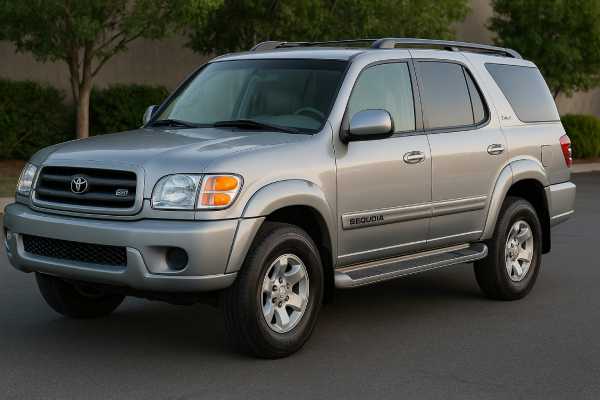
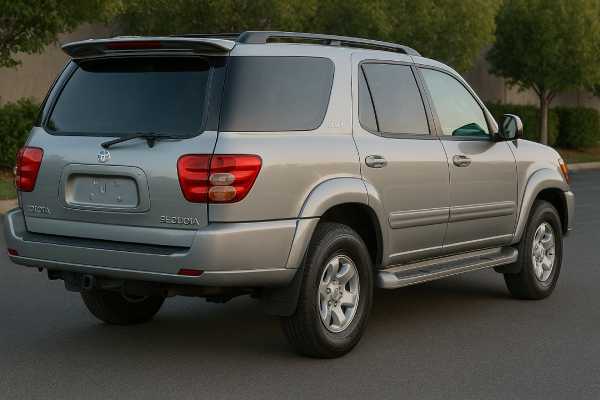
The first-generation Toyota Sequoia 4WD (UCK45) combines a robust truck-based chassis with a multi-mode four-wheel-drive system and Toyota’s 2UZ-FE 4.7-liter V8. Built on a modified Tundra frame, it was aimed squarely at families and owners who needed three rows, real towing ability, and dependable off-road traction.
Power comes from a cast-iron-block V8 making roughly 240 hp and 315 lb-ft, paired with a 4-speed automatic and a transfer case that offers 2WD, full-time 4WD, and low range for tougher terrain. The 4WD hardware adds weight and complexity versus the 2WD UCK35, but also provides significantly more confidence in snow, mud, and on unpaved roads.
Today, 2000–2004 Sequoia 4WDs are old enough that condition matters more than mileage. Frame rust, front suspension recalls, and the Vehicle Stability Control (VSC) campaign all need careful verification, yet well-maintained examples can still serve as reliable, long-life tow and adventure vehicles.
Owner Snapshot
- Full-size SUV with 4.7-liter 2UZ-FE V8, multi-mode 4WD, and genuine low range for towing and mild off-roading.
- Comfortable eight-seat interior, smooth ride, and relatively simple early-2000s electronics that tend to age well.
- 4WD models typically tow up to about 6,200 lb (versus around 6,500 lb for 2WD) and weigh a few hundred pounds more.
- Critical ownership caveats include front lower ball-joint recalls, VSC ECU updates on some 2003 models, and thorough frame corrosion inspections.
- A realistic timing-belt and water-pump replacement interval is about every 90,000 miles or 7–9 years, often paired with coolant and accessory-belt service.
What’s inside
- Toyota Sequoia UCK45 4WD fundamentals
- Engine, 4WD system and core specifications
- Sequoia 4WD grades, equipment and safety
- Long-term reliability and known problems
- Service schedule and purchasing advice
- On-road and off-road driving experience
- Sequoia 4WD versus competing SUVs
Toyota Sequoia UCK45 4WD fundamentals
The first-generation Sequoia 4WD, chassis code UCK45, was Toyota’s answer to full-size American SUVs in markets like the United States and Canada. It uses body-on-frame construction closely related to the first-gen Tundra pickup, with a boxed frame, independent front suspension, and a solid rear axle. This foundation gives the Sequoia a truck-like feel in terms of strength and towing behavior, but Toyota tuned the suspension for quieter, more compliant family use.
All 2000–2004 4WD Sequoias share the 2UZ-FE 4.7-liter V8 and a 4-speed automatic. The 4WD versions add a transfer case and front differential with a multi-mode system. Drivers can run in rear-wheel drive, engage full-time 4WD for wet or mixed conditions, or lock the center to create a traditional 50/50 torque split in high or low range for loose surfaces. This “multi-mode” approach blends the benefits of all-wheel drive and a conventional truck 4×4.
Size-wise, the Sequoia is firmly full-size. Length is about 5,180 mm (203.9 in), width near 1,980 mm (78 in), and wheelbase 3,000 mm (118.1 in). Curb weight for a typical 4WD SR5 or Limited is roughly 5,270–5,295 lb, depending on trim and equipment. The 4WD hardware adds around 150–200 lb over an equivalent 2WD model and slightly reduces payload and rated towing capacity.
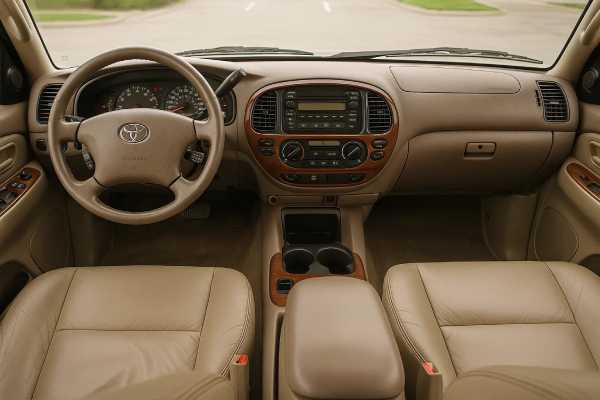
Inside, the Sequoia emphasizes practicality rather than luxury. Most UCK45s seat eight in a 2-3-3 layout. The second row folds and tumbles for third-row access, and the third row can be folded or removed to open up a substantial cargo area well over 2,000 L when configured for hauling. The dashboard design is simple, with large rotary climate controls and clearly labeled buttons—useful in a vehicle that may see work gloves, winter gloves, or off-road conditions.
Ownership-wise, the 4WD Sequoia targets families, outdoor enthusiasts, and tow-vehicle buyers who prefer a naturally aspirated V8 and simple 4-speed automatic rather than more complex modern drivetrains. It appeals to people who want a long-lived platform that can be serviced almost anywhere, while accepting fuel consumption closer to older full-size trucks than to modern crossovers.
Engine, 4WD system and core specifications
The Sequoia UCK45 4WD models largely share mechanical specs with the 2WD UCK35, but there are important differences in driveline layout, weight, and towing figures. The tables below focus on a typical 2001–2004 North American 4WD Sequoia; exact details can vary slightly by year, trim, and market, so always verify against your VIN and local documentation.
Engine and performance data
| Item | Specification (typical 4WD Sequoia 2000–2004) |
|---|---|
| Engine code | 2UZ-FE V8 |
| Layout | 90° V8, DOHC, 32 valves |
| Block / head | Cast-iron block, aluminum heads |
| Displacement | 4.7 L (≈4,664 cc) |
| Bore × stroke | 94.0 × 84.0 mm (3.70 × 3.31 in) |
| Compression ratio | ≈9.6:1 (pre-VVT-i) |
| Induction | Naturally aspirated |
| Fuel system | Sequential multi-port electronic fuel injection |
| Max power | ≈240–243 hp (≈179–181 kW) @ 4,800 rpm |
| Max torque | ≈315 lb-ft (427 Nm) @ 3,400 rpm |
| Recommended fuel | Regular unleaded (87 AKI) |
| Timing drive | Toothed rubber timing belt with idlers and tensioner |
| Emissions / testing | Meets early-2000s EPA standards for light trucks |
In independent tests and owner reports, 4WD Sequoias typically achieve 0–60 mph between about 9 and 10 seconds, depending on weight, tyres, and test conditions—adequate for towing and highway merging, if not quick by modern SUV standards.
4WD system, transmission and driveline
| Item | Specification |
|---|---|
| Transmission | 4-speed automatic (Aisin A340-series) |
| Drive type | Part-time/multi-mode 4WD with 2WD, 4HI, 4HI locked, 4LO |
| Transfer case | Two-speed, electronically actuated |
| Center differential | Planetary-type center differential in early years |
| Rear differential | Open, with limited-slip available on some models |
| Typical final drive | Around 3.9:1 (varies slightly by year/trim) |
| 4WD control | Dashboard selector with indicator lamps for 4HI, 4LO, and center diff lock |
Owners can select 2WD for dry-road efficiency, 4HI with an open center for slippery pavement, and locked-center modes or 4LO for off-road and deep snow. Locked modes should not be used on high-traction pavement to avoid driveline wind-up.
Chassis, dimensions and capacities
| Item | Approximate specification (4WD, early 2000s) |
|---|---|
| Front suspension | Double wishbone with coil springs and stabilizer bar |
| Rear suspension | 5-link solid axle with coil springs and stabilizer bar |
| Steering | Power-assisted rack-and-pinion |
| Brakes | 4-wheel discs with ABS and EBD |
| Typical wheels/tyres | 16-inch alloys with 265/70R16 tyres; some trims 17-inch |
| Length | ≈5,180 mm (203.9 in) |
| Width | ≈1,980 mm (≈78 in) |
| Height | ≈1,870–1,895 mm (73–74.5 in), depending on trim |
| Wheelbase | 3,000 mm (118.1 in) |
| Ground clearance | Around 260 mm (≈10.2 in) |
| Curb weight | ≈2,390–2,400 kg (5,270–5,295 lb) |
| GVWR | ≈2,950 kg (≈6,500 lb) |
| Fuel tank | ≈98–99 L (≈26 US gal) |
| Towing capacity | About 2,812 kg (6,200 lb) for many 4WD configurations |
Fuel economy and real-world consumption
EPA figures for early-2000s 4WD Sequoias with the 4.7 V8 and 4-speed automatic are around:
- 14 mpg combined
- 13 mpg city
- 16 mpg highway
In real use, owners commonly report 12–15 mpg (US) depending on tyre size, roof racks, load, terrain, and driving style. Sustained 4LO usage, oversized all-terrain tyres, or frequent towing can push consumption into the single digits.
Fluids, electrical and key service data (typical)
| System | Specification | Capacity / notes (approximate) |
|---|---|---|
| Engine oil | 5W-30, API SL/SM or better | ≈6.2 L (6.6 US qt) with filter |
| Coolant | Toyota Super Long Life (pink) | ≈12–13 L full system |
| ATF | Toyota T-IV / Dexron III-equivalent per manual | ≈3–4 L drain/refill; ≈10–13 L dry |
| Front differential | 75W-90 GL-5 | ≈1.2–1.5 L |
| Rear differential | 75W-90 GL-5 | ≈3.4 L |
| Transfer case | Gear oil/ATF to spec | ≈1.3–1.5 L |
| Alternator | ≈100–130 A, depending on equipment | |
| 12V battery | Group 27F/24F, often 70–80 Ah and 600+ CCA |
These numbers are guidelines; always confirm with the correct owner’s or service manual for your exact vehicle.
Sequoia 4WD grades, equipment and safety
During 2000–2004, the 4WD Sequoia line in North America is built around two main trims: SR5 and Limited. Both trims could be ordered in UCK45 4WD form, and both share the same V8/automatic/transfer-case combination. Differences are primarily in convenience features, appearance, and some wheel and suspension packages.
SR5 4WD models typically include:
- Cloth interior with manual or basic power seat adjustment
- 16-inch wheels with all-season tyres
- A straightforward audio system with CD and, in early years, cassette
- Manual or single-zone automatic climate control (varies by year)
- Available tow package, roof rack, and rear air conditioning
Limited 4WD models usually add:
- Leather seating and power-adjustable front seats, often heated
- Upgraded audio with more speakers and steering-wheel controls
- Automatic climate control, often with separate rear controls
- Larger alloy wheels (16 or 17 inch depending on year)
- Additional chrome trim, body-color cladding, and more sound insulation
Visually, Limited trucks tend to have more chrome, body-colored mirrors, and more intricate wheel designs. Inside, wood-look accents and leather are common, though actual equipment depends on year and options. Mechanically, a key distinction is whether a particular vehicle has the factory tow package: that brings a receiver hitch, wiring, often a higher-output alternator, and an auxiliary transmission cooler—important for longevity when towing frequently near the rated 6,200 lb.
Year-to-year changes across 2001–2004 are gradual. The core drivetrain remains the same. Option packaging shifts, and in some markets features such as side airbags, stability control, and rear entertainment systems become more widely available or standard over time.
From a safety perspective, every UCK45 includes:
- Dual front airbags
- Three-point seatbelts for all outboard positions
- Lower anchors and tethers for child seats (LATCH) in the second row
- Four-wheel ABS with electronic brake-force distribution and brake assist
Vehicle Stability Control (VSC) and traction control are widely equipped. Certain 2003 Sequoia models were recalled because the original VSC programming could apply brakes too aggressively at low speeds, hampering acceleration and possibly stability; the remedy is a skid-control ECU software update or replacement.
Side and curtain airbag coverage varies by year and trim. Early trucks may have only dual front airbags, while later and better-equipped trims add front side airbags and, in some cases, side-curtain coverage. Because the first-gen Sequoia predates modern crash-test programs, public crash ratings for specific model years are limited, and 4WD versions were not always tested separately. Buyers should review official NHTSA and IIHS data for the exact year while remembering that this is an early-2000s design without modern crash structures or advanced driver-assistance systems.
From a child-safety point of view, the wide rear doors, tall roofline, and LATCH points make installing child seats straightforward in the second row. The third row often lacks full LATCH anchors and works best for older children or adults using standard seatbelts.
Long-term reliability and known problems
The Sequoia UCK45 4WD shares its core drivetrain with the Tundra and some Land Cruiser–family models, and that heritage shows in long-term reliability. The 2UZ-FE V8 is widely respected for durability, and many examples pass 300,000 miles with limited internal engine work when maintenance is kept up. The main risks now are age-related: neglect, corrosion, and a handful of significant recalls.
Engine and cooling issues
Timing belt, idlers and water pump
The timing belt is a wear item. A sensible replacement interval is about 90,000 miles or 7–9 years. Because access is labor-intensive, most owners and technicians replace the belt, tensioner, idlers, and water pump as a package, and often add a thermostat and front seals. A failed belt or pulley can cause major engine damage, so deferring this service is risky.
Cooling system wear
Radiators can clog, plastic tanks can crack, and fan clutches weaken with age. A marginal cooling system may perform acceptably in light use but struggle when towing or climbing in hot weather. Overheating can lead to warped heads and head-gasket problems on any aluminum-head engine, so coolant quality and flow are critical.
Oil leaks
Valve-cover gaskets, cam seals, and the front crankshaft seal are common seep points once the engine has aged. These leaks are typically manageable but should be fixed before oil contaminates belts, bushings, or ignition components.
4WD system, transmission and driveline
The Aisin 4-speed automatic is conservative but robust when serviced regularly. Problems such as shift flare, shudder, or delayed engagement often trace back to old, overheated fluid or a sticking valve body rather than hard part failure. Trucks that have spent years towing at or near capacity without auxiliary cooling deserve extra scrutiny.
The transfer case and 4WD actuators can give trouble if seldom exercised or exposed to heavy corrosion. Symptoms include flashing 4WD lights, slow or incomplete engagement, or refusal to switch between modes. Regularly cycling through 2WD, 4HI, and 4LO on appropriate surfaces helps keep the system healthy. Front and rear differentials usually last a long time with periodic fluid changes, but CV joints and boots on the front axle should be checked closely for tears or grease leakage.
Suspension, steering and rust
A major safety and reliability concern is the front lower ball-joint issue that led to a recall on certain early-2000s Sequoias. Defective ball joints can wear prematurely, causing looseness, clunks, and, in extreme cases, separation and loss of steering control. Many vehicles have already had updated ball joints installed, but you should still verify recall completion and check for play.
Other common wear points include:
- Front control-arm and rear trailing-arm bushings
- Sway-bar links and bushings
- Shocks and struts, often tired by 150,000+ miles
- Steering racks that may develop leaks or internal play
Rust can be a decisive factor in long-term viability. Road-salt regions are particularly harsh on:
- Frame rails and crossmembers
- Suspension mounting points
- Brake and fuel lines
- Spare-tire hoist and rear bumper supports
Some Sequoias were covered by extended frame-corrosion programs in certain markets, including inspections and, in severe cases, frame replacement. That history makes it especially important to inspect the structure thoroughly before purchase.
Electronics and VSC
Electronics in these trucks are simpler than in newer SUVs but still age. Typical issues include:
- Individual ignition coils failing and causing misfire codes
- Aging alternators, especially on vehicles that tow or run heavy electrical loads
- Power-window regulators and door-lock actuators that slow down or fail
- Rear hatch latch and window mechanisms that may need repair
The VSC calibration defect on some 2003 models is noteworthy. It could cause the system to apply brakes too aggressively at low speeds, restricting acceleration and creating odd handling. The official fix is a skid-control ECU reflash or replacement under recall, so confirming that this update has been done is important on 2003 trucks.
Pre-purchase reliability checklist
When evaluating a used Sequoia UCK45, ask for or check:
- Documentation of timing-belt and water-pump replacement at least once, and preferably twice by now
- Evidence of regular oil, coolant, transmission, and differential-service intervals
- Written confirmation of ball-joint and VSC-related recall completion
- A clean frame inspection, preferably on a lift, with photos if buying remotely
- 4WD system operation in all modes, including 4LO, with no abnormal noises or warning lights
A 4WD Sequoia that passes these checks and shows minimal rust can be a strong candidate for a long-term, reliable SUV.
Service schedule and purchasing advice
Because 2000–2004 Sequoia 4WDs are now firmly in “aging truck” territory, a practical maintenance plan is essential. Below is a sensible roadmap that blends factory-style intervals with real-world experience for V8 4WD vehicles of this type.
Practical maintenance roadmap
Use whichever comes first: mileage or time.
- Engine oil and filter – Every 5,000 miles (8,000 km) or 6–12 months, using 5W-30 oil meeting current API standards. Shorter intervals make sense for frequent towing, high-heat climates, or mostly short trips.
- Engine air filter – Inspect yearly; replace about every 30,000 miles (48,000 km), or more often in dusty regions.
- Cabin air filter – Replace every 15,000–20,000 miles (24,000–32,000 km) or two years.
- Spark plugs – Replace long-life plugs around 90,000–120,000 miles (145,000–190,000 km), or sooner if misfires or rough running appear.
- Fuel filter – On many Sequoias, the main filter is integrated with the in-tank pump and is not a routine service item; instead, focus on good fuel quality and clean tank conditions.
- Timing belt, idlers, tensioner, water pump – Replace at about 90,000 miles or 7–9 years. This is one of the highest-priority services on the 2UZ-FE.
- Accessory belts and coolant hoses – Inspect annually; replace typically every 60,000–90,000 miles or when you see cracking, glazing, or noise.
- Coolant – Use Toyota Super Long Life coolant; first change often at 100,000 miles or 5 years, then every 50,000 miles or 5 years.
- Automatic-transmission fluid – Drain and refill every 30,000–60,000 miles depending on load and towing. Include filter servicing where applicable.
- Differential oils (front and rear) – Replace around every 60,000 miles (100,000 km) or sooner for heavy towing/off-roading.
- Transfer-case fluid – Change at a similar 60,000-mile interval; more often if you frequently use 4LO.
- Brake fluid – Flush every 2–3 years, regardless of mileage.
- Brakes – Inspect pads, rotors, and calipers at each tire rotation; replace pads before they approach minimum thickness.
- Tyre rotation and alignment – Rotate every 5,000–7,500 miles; align whenever steering feels off, after suspension work, or when wear patterns appear.
- 12V battery – Load-test yearly after 4–5 years; plan on replacement every 5–7 years depending on climate and usage.
Fluid and torque references (high-level)
Approximate decision-making values:
- Engine oil – 5W-30, about 6.2 L with filter; drain-plug torque typically around the 30–40 lb-ft range.
- Differentials and transfer case – Use the specified GL-4/GL-5 or ATF; fill and drain plugs on Toyota trucks are often torqued in the high-20s to mid-30s lb-ft range.
- Wheel lug nuts – Commonly around 80–85 lb-ft on similar Toyota SUVs and pickups.
These figures are not a substitute for a proper torque chart; always confirm values in official documentation.
Used-buying guide: key inspection points
Rust and structure
- Inspect frame rails, crossmembers, rear control-arm mounts, and the area around the fuel tank.
- Check brake and fuel lines for corrosion and past repairs.
- Look at the spare-tire cradle, rear bumper mounts, and trailer hitch for heavy scale or cracks.
Suspension, steering and wheels
- Listen for clunks, rattles, or knocks over bumps.
- Check for play in lower ball joints, tie rods, and control-arm bushings.
- Inspect tyres for even wear; cupping or one-sided wear can signal alignment or suspension issues.
Drivetrain and 4WD operation
- On a test drive, shifts should be smooth and consistent, with no delay when selecting D or R.
- Engage 4HI and 4LO on suitable surfaces; confirm indicator lights stop flashing and the truck moves without binding.
- Listen for whining, grinding, or clunking from the front axle and transfer case.
Interior, controls and electronics
- Test all windows, locks, mirrors, HVAC modes, rear climate controls, and any rear entertainment system.
- Check that ABS, VSC, and SRS (airbag) warning lamps illuminate briefly at key-on and then go out.
Which Sequoia 4WD is best?
There is no universally “best” year, but:
- 2001–2002 trucks can have simpler equipment and fewer electronic add-ons, but they are older, which can increase rust risk.
- 2003 models sit squarely in the VSC recall window; verifying the ECU update is crucial.
- 2004 vehicles usually benefit from incremental refinements and are closer in spec to later 2005–2007 models.
Ultimately, the best Sequoia UCK45 4WD is the one with the cleanest frame, the most complete maintenance history, and full recall documentation, regardless of its exact year or trim.
On-road and off-road driving experience
Behind the wheel, the Sequoia UCK45 feels like a classic full-size SUV with a refined edge. The 2UZ-FE V8 is smooth, with very little vibration transmitted into the cabin. Power delivery is linear and predictable rather than sudden; the engine builds useful torque early and holds it through the midrange, which suits towing, climbing, and everyday traffic.
The 4-speed automatic is tuned for smoothness and durability more than outright speed. In normal driving, upshifts are unobtrusive, and the transmission tends to keep revs low. Kickdown from highway speeds takes a moment but is consistent, and on long grades the gearbox usually holds gears rather than hunting excessively. When towing or descending steep hills, manually selecting “3” can improve control and reduce transmission heat.
Ride quality is a strong point. The coil-sprung solid rear axle and long wheelbase help smooth out broken pavement, expansion joints, and gravel-road washboard. Body roll is noticeable in tight corners, as expected for a tall body-on-frame SUV, but the suspension tuning is progressive and predictable. Steering is light and somewhat numb, with less road feedback than modern electric-assist systems, yet straight-line stability at highway speeds is good, especially on stock or modestly upsized tyres. Wind and road noise are moderate; not as quiet as a new unibody SUV, but comfortable for long trips.
Fuel economy is the main compromise. Real-world figures around 13–15 mpg (US) in mixed driving are common. Gentle highway cruising at 65–70 mph on original-style tyres can reach the high teens, while short trips, city traffic, oversized tyres, roof racks, and aggressive driving can drop the average into the low teens or worse.
Off-road, the Sequoia’s strengths and limitations reflect its purpose. Ground clearance and underbody strength allow it to handle rutted dirt roads, snow-covered tracks, and mild trails. The multi-mode 4WD system is particularly useful:
- 2WD for dry pavement and best economy
- 4HI (open center) for rain, light snow, or mixed traction
- 4HI locked or 4LO locked for deep snow, mud, sand, or steep loose climbs
With suitable all-terrain tyres, the UCK45 can confidently reach remote campsites, boat ramps, and trailheads. However, its size and weight work against it on very tight or technical trails. Approach and departure angles are modest, and the rear bumper or tow hitch can scrape on sharp breakovers. It is better described as a highly capable “overland and access-road” SUV than as a dedicated rock crawler.
When towing, the 4WD Sequoia feels stable so long as tongue weight is set correctly and trailer brakes are properly adjusted. The long wheelbase and weight help control sway. Nonetheless, towing near the 6,200 lb rating at highway speeds strongly affects fuel consumption—single-digit mpg is not unusual—and places added stress on the cooling and braking systems. Regular inspection of brakes, tyres, and fluids is essential for tow-focused owners.
Sequoia 4WD versus competing SUVs
When new, the Sequoia 4WD was positioned directly against other full-size SUVs like the Ford Expedition, Chevrolet Tahoe/GMC Yukon, and later the Nissan Armada. Today, buyers comparing used vehicles in this segment still weigh many of the same factors: towing capability, interior space, reliability, and running costs.
Against the Chevrolet Tahoe and GMC Yukon of the early 2000s, the Sequoia trades variety for simplicity. GM offered multiple V8 engine options and sometimes slightly higher tow ratings, along with different gearing and a variety of interior trims. Those trucks can deliver comparable or occasionally slightly better fuel economy in some configurations. However, they also have their own well-known issues, such as certain transmission and electrical problems. The Sequoia’s 2UZ-FE V8 and Aisin automatic are widely considered very robust when serviced on schedule, which appeals to buyers planning to keep the vehicle for many years.
Compared to the Ford Expedition, the Sequoia feels slightly smaller and more straightforward. The Expedition’s modular V8 engines and independent rear suspension give it a different character and strong towing credentials, but rust and drivetrain issues on certain generations can be more severe. The Sequoia’s traditional solid rear axle and conservative engine tuning appeal to owners who value common-sense engineering and a broad knowledge base among independent mechanics.
Relative to the Nissan Armada, which arrived later in the early 2000s, the Sequoia looks conservative. The Armada offers more power and often more up-to-date styling and features for its time, but early examples have a more mixed track record for long-term reliability, particularly regarding transmissions, rear suspension components, and electronics. For buyers prioritizing durability over outright performance, the Sequoia often feels like the safer bet.
One of the Sequoia’s lasting advantages is its shared ecosystem with Tundra and Land Cruiser–related platforms. This means:
- Good availability of OEM and aftermarket parts
- Widespread familiarity among independent shops and dealership technicians
- Active owner communities with documented repairs, DIY guides, and known failure patterns
On the downside, the Sequoia 4WD faces:
- High fuel consumption compared with newer V6 or diesel SUVs
- An absence of modern driver-assistance features such as automatic emergency braking, adaptive cruise control, or blind-spot monitoring
- Aging interiors and basic infotainment by current standards
For a buyer today, the UCK45 4WD Sequoia makes the most sense if you prioritize durability, mechanical simplicity, and real towing or off-pavement capability. It rewards owners who are willing to invest in preventative maintenance and who choose a structurally solid, recall-complete example with clear service history. In that context, it compares very favorably to many similarly aged full-size SUVs and can still deliver years of dependable service.
References
- Gas Mileage of 2003 Toyota Sequoia 2024 (Fuel Economy Data)
- Front Suspension Lower Ball Joint 2002 through early 2004 Tundra and Sequoia 2005 (Recall Notice)
- A0G – Certain 2003 Model Year Toyota Sequoia Vehicles – Vehicle Stability Control System 2010 (Safety Recall Letter)
- Look up Safety Recalls & Service Campaigns by VIN 2024 (Recall Database)
- 2004 Toyota Sequoia Owner’s Manual – Towing capacity 2004 (Owner’s Manual Excerpt)
- 2003 Toyota Sequoia Specs, Features and Options 2024 (Specifications Summary)
Disclaimer
This article is for informational purposes only and is not a substitute for professional diagnosis, repair, or official service procedures. Specifications, torque values, maintenance intervals, and repair steps can vary by model year, market, trim level, and individual VIN. Always confirm data and procedures using your vehicle’s owner’s manual, factory service manual, and current manufacturer bulletins, and follow appropriate safety practices when working on any vehicle.
If this guide helped you understand the Toyota Sequoia 4WD (UCK45), you are welcome to share it on platforms such as Facebook or X/Twitter to support xcar’s work and to help other owners find accurate, model-specific information.