
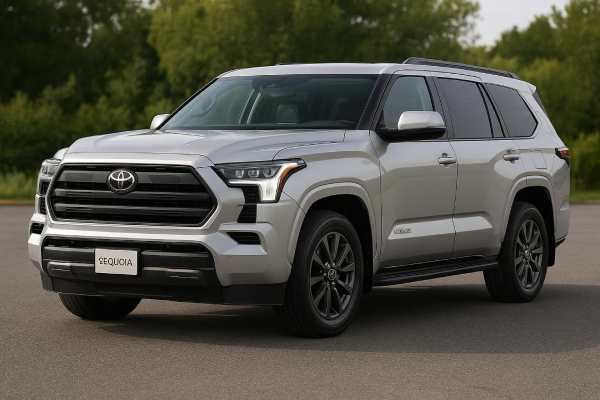
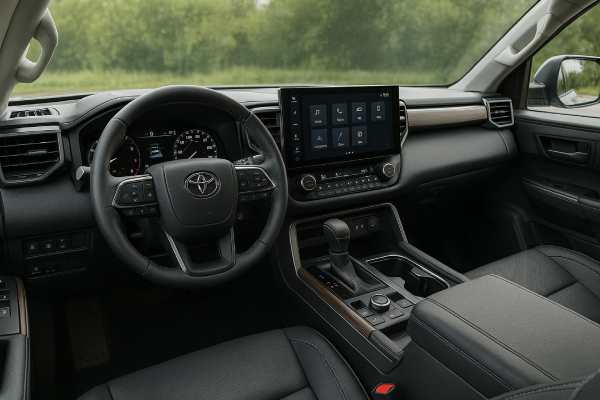
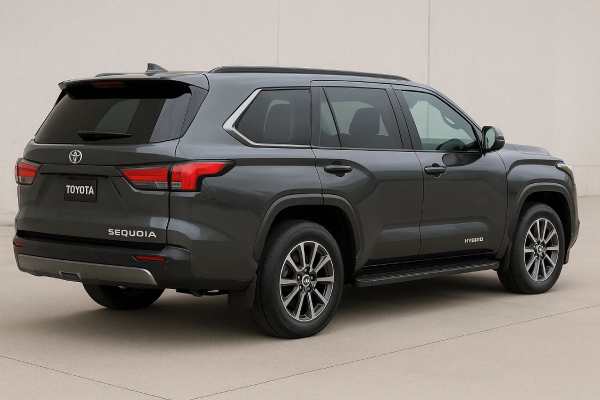
The third-generation Toyota Sequoia RWD (VXKH80) is a major step forward from the old V8 model. Toyota replaced the 5.7-litre naturally aspirated engine with the i-FORCE MAX hybrid system: a 3.4-litre twin-turbo V6 paired with an electric motor and 10-speed automatic. The result is 437 hp, impressive low-rpm torque and fuel consumption that finally looks reasonable for a full-size SUV.
Underneath, the Sequoia moves to Toyota’s TNGA-F body-on-frame platform, shared with vehicles like the latest Tundra and Land Cruiser. The chassis is stiffer, the suspension is more sophisticated, and the cabin packaging is modernised with better infotainment, seating and driver-assistance systems.
The RWD configuration is aimed at buyers who mainly drive on paved roads, tow regularly and want the simplest, lightest mechanical layout. You lose the deep-snow and off-road security of 4WD, but gain slightly better efficiency, higher tow ratings and fewer driveline parts to service over time.
Fast Facts
- i-FORCE MAX hybrid combines a 3.4-litre twin-turbo V6 with an electric motor and 10-speed auto for 437 hp and strong low-rpm torque.
- RWD VXKH80 models offer the best Sequoia fuel economy and some of the highest tow ratings in the range, with a simpler driveline than 4WD trims.
- Complex turbo-hybrid hardware and new-generation electronics make strict adherence to software updates and coolant/oil service intervals more important than on the old V8.
- A sensible baseline for oil and filter changes is around every 10,000 miles or 12 months in normal use, or closer to 5,000 miles if you tow frequently or do lots of short trips.
Navigate this guide
- Hybrid Sequoia RWD Overview
- Sequoia Hybrid Specs and Data
- Trims, Options and Safety
- Reliability and Common Issues
- Maintenance and Buying Guide
- Driving Impressions and Performance
- Sequoia RWD versus Rivals
Hybrid Sequoia RWD Overview
The VXKH80 Sequoia is the rear-wheel-drive version of Toyota’s latest full-size SUV, introduced for the 2023 model year and continuing through today. Rather than offering multiple engines, Toyota went all-in on a single powertrain: the i-FORCE MAX hybrid. This combines a 3.4-litre twin-turbo V6 (often marketed as a “3.5-litre”) with an electric motor and a 10-speed automatic transmission. Power flows to the rear wheels only in the VXKH80, without a transfer case or front differential.
Moving to hybrid power fundamentally changes how the Sequoia behaves. The electric motor sits between the engine and transmission, adding torque at low speeds and smoothing gearshifts. That means brisk acceleration even when fully loaded, with the engine staying at lower revs in everyday driving. Compared with the old V8 Sequoia, owners notice far less noise on the highway and better response from a standstill, especially with a trailer attached.
Underneath, the Sequoia now uses the TNGA-F body-on-frame architecture. Key points:
- Boxed frame rails with extensive high-strength steel for stiffness.
- Double-wishbone front suspension with coils.
- Multi-link rear suspension with coils, plus optional rear air springs and adaptive dampers on higher trims.
The hybrid battery is a relatively compact nickel-metal hydride pack mounted under the rear seats, which preserves cargo space and protects the pack from road debris. It is sized for assistance rather than long EV-only driving, so the vehicle behaves like a conventional hybrid, not a plug-in.
Inside, the Sequoia RWD is a huge step forward from the previous generation. Depending on trim, you can get:
- A large central touchscreen (up to around 14 inches) with Toyota’s newest infotainment software.
- Wireless Apple CarPlay and Android Auto.
- A digital instrument cluster on higher grades.
- 7- or 8-passenger seating with either a second-row bench or captain’s chairs.
Toyota Safety Sense 2.x driver-assistance features are standard across the range, and every model includes blind-spot monitoring and rear cross-traffic alert. The cabin materials and design vary by grade, but even the SR5 is more modern than the old Sequoia’s top trims.
For many owners, the VXKH80 RWD offers a “sweet spot”: it preserves the traditional body-on-frame feel and towing ability, but adds hybrid smoothness and significantly better fuel economy, with fewer off-road parts to maintain.
Sequoia Hybrid Specs and Data
This section summarises the key technical data for the Toyota Sequoia RWD (VXKH80) hybrid. Figures can vary slightly by model year and equipment, so always confirm against the specific vehicle’s documentation.
Powertrain and Efficiency
Engine and Hybrid System
| Item | Specification |
|---|---|
| Engine code | V35A-FTS i-FORCE MAX |
| Configuration | 60° V6, twin-turbocharged, DOHC, 24 valves |
| Displacement | ~3,445 cc (3.4 l) |
| Induction | Twin turbo with intercooler |
| Fuel system | Direct injection with port assist (D-4ST) |
| Compression ratio | Around 10:1 (varies by calibration) |
| Maximum system power | 437 hp (engine + motor combined) |
| Maximum system torque | About 583 lb-ft |
| Hybrid motor type | Permanent-magnet synchronous motor |
| Hybrid battery | Nickel-metal hydride, high-voltage pack under rear seats |
The hybrid system functions like a “power assist” rather than a plug-in. It cannot be externally charged and instead harvests energy during braking and coasting, then uses it for acceleration and to smooth gear shifts.
Fuel Economy (Typical for RWD Hybrid)
Exact ratings depend on year and test cycle, but the RWD hybrid Sequoia tends to achieve:
- City: roughly low-20s mpg.
- Highway: low- to mid-20s mpg.
- Combined: around 22 mpg.
These numbers are dramatically better than the previous V8 Sequoia, especially in city and stop-start use.
Transmission and Driveline
| Item | Specification |
|---|---|
| Transmission type | 10-speed electronically controlled automatic (ECT-i) |
| Gear count | Ten forward gears, one reverse |
| Drive type | Rear-wheel drive (4×2) |
| Rear differential | Conventional open differential |
| Tow/haul mode | Yes, with optimised shift logic for towing |
Compared with 4WD versions, the RWD VXKH80 lacks a transfer case and front differential, which reduces weight and driveline losses, helping both performance and fuel economy.
Chassis and Dimensions
Approximate dimensions for a typical RWD Sequoia hybrid:
| Item | Specification |
|---|---|
| Platform | TNGA-F body-on-frame |
| Suspension (front) | Independent double-wishbone, coil springs |
| Suspension (rear) | Multi-link, coil springs; optional air suspension and adaptive dampers |
| Steering | Rack-and-pinion with electric power assist |
| Brakes | 4-wheel ventilated discs (front and rear) |
| Wheelbase | ~3,100 mm (about 122 in) |
| Overall length | Around 5,280–5,300 mm (approx. 208 in) |
| Width | Around 2,020 mm (approx. 80 in) |
| Height | Around 1,890–1,950 mm, depending on suspension and roof equipment |
| Curb weight | Roughly 5,600–6,000 lb, depending on trim and options |
| Seating capacity | 7 or 8 passengers |
Wheel and tyre sizes range from practical 18-inch packages to larger 20- and 22-inch wheels on premium trims. Smaller wheels with taller sidewalls usually give a better ride and lower replacement cost.
Performance and Capability
| Metric | Typical Value |
|---|---|
| 0–60 mph | Around 5.7–6.0 seconds (unladen) |
| Top speed | Electronically limited (varies by market) |
| Maximum towing (properly equipped RWD) | Roughly 9,000–9,500 lb |
| Typical payload | Roughly 1,600–1,900 lb, depending on trim |
Thanks to the hybrid torque and 10-speed gearbox, the Sequoia RWD feels strong when merging or overtaking, even with passengers and cargo. Under heavy towing, fuel economy will drop sharply (often into single-digit mpg), but performance remains competitive with V8-powered rivals.
Fluids and Electrical (Typical Planning Values)
Always confirm exact specifications for your VIN, but as a planning guide:
- Engine oil: 0W-20 synthetic meeting Toyota specifications; capacity roughly 7–8 US quarts including filter.
- Engine and hybrid coolant: Toyota Super Long Life Coolant (pink); multiple loops, with long-life change intervals.
- Automatic transmission fluid: Toyota WS (World Standard) ATF; sealed but serviceable.
- Rear differential: High-quality gear oil (e.g., 75W-85 or 75W-90), according to spec.
- A/C refrigerant: R-1234yf on late-model vehicles.
- Spark plugs: Long-life iridium, typically around 0.8 mm gap.
- 12-V battery: Standard automotive AGM or flooded battery, size depends on trim and equipment.
Safety and driver assistance are covered by Toyota Safety Sense 2.x, as well as stability control, traction control, multiple airbags and advanced sensing hardware for features like lane keeping and adaptive cruise control.
Trims, Options and Safety
The Sequoia hybrid lineup includes several trims, with RWD available on most non-off-road models. Exact availability varies slightly by model year, but the general structure is consistent.
Main RWD Trims
Typical RWD-eligible grades include:
- SR5 (RWD):
The entry-level trim, with cloth seats, smaller wheels (often 18-inch), an 8-passenger bench layout and the core hybrid powertrain. It includes the full Toyota Safety Sense suite, large touchscreen infotainment and the tow-ready frame wiring. SR5 is often the value choice for buyers planning aftermarket wheels or suspension. - Limited (RWD):
Adds SofTex or leather-like upholstery, heated and ventilated front seats, more convenience features and generally nicer interior trim. It is a sweet spot for families who want comfort without the full luxury price. - Platinum (RWD):
Brings full leather, more advanced audio, sometimes a panoramic sunroof, additional interior lighting and comfort features for the second row. It also opens up more technology options such as rear entertainment or premium sound, depending on market. - Capstone (RWD, where available):
The range-topping luxury specification with semi-aniline leather, more chrome and exterior detailing, 22-inch wheels and the richest interior materials. It is aimed at buyers cross-shopping high-end American and European full-size SUVs.
The off-road-focused TRD Pro trim is typically 4WD-only and not available as VXKH80 RWD.
Option Packages and Mechanical Differences
Option packages on RWD Sequoias can include:
- TRD Sport or visual packs (where offered):
Stiffer suspension tuning, appearance upgrades and larger wheels. - Tow package:
Integrated trailer brake controller, upgraded cooling and hitch hardware. Some RWD Sequoias reach their highest tow ratings only when this package is present. - Luxury and technology packages:
Larger digital instrument clusters, head-up displays, rear-seat entertainment, panoramic roof and premium audio systems.
Mechanically, RWD trims use the same basic engine, hybrid system and 10-speed auto as 4WD models. Differences lie in the absence of front-axle components and transfer case, and sometimes in final-drive ratios and wheel/tyre fitment.
Safety Ratings and Equipment
All trims include:
- Multiple airbags (front, side, curtain and often driver’s knee airbag).
- LATCH/ISOFIX anchor points for child seats in the second row.
- Electronic stability and traction control.
- Anti-lock brakes with brake assist.
Toyota Safety Sense 2.x adds:
- Pre-collision system with pedestrian and cyclist detection (within certain speed ranges).
- Lane departure alert with steering assist and lane-tracing assist.
- Adaptive cruise control.
- Road sign recognition and automatic high beams.
Higher trims and options can add:
- 360° surround-view cameras.
- Digital rear-view mirror.
- Parking assist with automated braking.
- Front and rear parking sensors.
Because this generation is still relatively new, not all markets have complete crash-test data for every configuration and model year. When comparing vehicles, it is worth checking the latest entries for the specific year and drivetrain you are considering.
ADAS Calibration Considerations
Modern driver-assistance systems rely on:
- Radar sensors in the grille or behind badges.
- Cameras near the rear-view mirror.
- Ultrasonic sensors in bumpers.
After windshield replacement, front-end collision repair, suspension modifications or bumper changes, these systems may require recalibration using factory-level tools and procedures. This is important for correct operation of lane-keeping, adaptive cruise and pre-collision braking. If you plan lift kits, custom bumpers or significant wheel/tyre size changes, budget for potential dealer or specialist calibration work.
Reliability and Common Issues
The Sequoia VXKH80 is still early in its lifecycle, so long-term patterns are only beginning to emerge. However, we can outline likely strengths and areas to watch, drawing on Toyota’s general hybrid experience and the shared hardware with other TNGA-F vehicles.
Overall Reliability Outlook
- Engine and turbo system:
The V35A-FTS engine is relatively new, but Toyota has decades of experience with turbo and direct-injection petrol engines. When serviced on schedule with high-quality oil, it is expected to be durable. However, turbocharged engines are sensitive to oil quality and heat; extended oil changes under heavy towing or hot-climate use are not advisable. - Hybrid system and battery:
The hybrid pack is smaller than in a plug-in or pure EV and uses proven NiMH chemistry. Toyota hybrids typically show slow, predictable degradation rather than sudden failures, and battery warranties are often generous. Thermal management and clean cooling paths are the key. - 10-speed automatic and rear axle:
The 10-speed transmission is used across multiple Toyota truck applications. Early issues, where present, tend to be shift quality or calibration related rather than hard mechanical failure. Rear axles on RWD trucks are robust if fluid is changed according to heavy-use schedules.
Common or Emerging Issues (by Category)
Note: prevalence levels are approximate for this relatively new model line.
1. Low to Moderate Prevalence, Low to Medium Cost
- Software and sensor glitches:
- Symptoms: random warning messages for lane-keeping, cruise control or parking systems; infotainment freeze; reversing camera blank screens.
- Likely cause: software bugs, sensor alignment tolerance, or connectors.
- Remedy: dealer software updates, module resets and, occasionally, sensor recalibration.
- Minor turbo or intake seepage:
- Symptoms: faint oil smell, light oil film near turbo feed lines or charge-air hoses.
- Likely cause: early ageing of seals or hose clamps.
- Remedy: inspection, cleaning, retightening or replacement of gaskets and clamps; typically covered under warranty if discovered early.
2. Occasional, Medium Cost
- 10-speed shift quality complaints:
- Symptoms: hesitation, gear “hunting” at low speeds, or a slight shudder on light throttle.
- Likely cause: software calibration or adaptation values rather than hardware failure.
- Remedy: updated TCU software, adaptation reset, and ensuring correct fluid level and condition.
- Suspension component wear (heavy use):
- Symptoms: clunks over bumps, vague steering, uneven tyre wear.
- Likely cause: worn bushings, ball joints or control-arm components under heavy loads and rough roads.
- Remedy: component replacement and proper wheel alignment; using correct load-rated tyres.
3. Rare but High Impact
- Cooling system problems under severe load:
- Symptoms: temperature warnings on long mountain grades while towing, gradual power reduction.
- Likely cause: partially blocked radiators, under-filled coolant loops or auxiliary coolers restricted by debris.
- Remedy: thorough cleaning of cooling packs, inspection of coolant levels and bleeding procedures; use of tow/haul mode and appropriate gearing.
- Hybrid or high-voltage issues:
- Symptoms: multiple warning lights, “hybrid system malfunction” messages, reduced performance.
- Likely cause: sensor faults, inverter problems or cooling issues rather than battery cell failure in early years.
- Remedy: dealer diagnostics, software updates or component replacement; this is specialist work, not DIY.
Recalls, TSBs and Service Campaigns
For a new generation, it is normal to see:
- Software updates via TSBs for engine, hybrid and transmission modules.
- Infotainment updates to fix bugs and add features.
- Occasional recalls for camera performance, wiring harness concerns or airbag control units.
A smart buyer or owner will:
- Check the VIN in official recall databases regularly.
- Ask for a dealer printout of completed recalls and service campaigns.
- Request proof of completed TSBs that relate to drivability, shift quality or safety systems.
As the model ages, Toyota may introduce extended coverage programs for specific components if they see patterns, especially on hybrid or electronic systems.
Maintenance and Buying Guide
Because the Sequoia RWD (VXKH80) combines a twin-turbo engine, hybrid system and heavy-duty chassis, a structured maintenance approach is essential. Below is a practical schedule you can adapt based on your manual and usage.
Practical Maintenance Schedule (Typical Pattern)
Every 5,000–7,500 miles (or 6 months):
- Rotate tyres and check pressures, including the spare.
- Inspect brakes, steering and suspension components.
- Check engine oil level and condition.
- Inspect underbody for leaks or damage, especially if towing.
Every 10,000 miles or 12 months (normal service):
- Replace engine oil and filter with 0W-20 synthetic meeting Toyota specs.
- Inspect engine air filter; replace if dirty.
- Replace cabin air filter every 10,000–20,000 miles depending on environment.
If your driving involves frequent towing, heavy loads, short trips or dusty conditions, treat 5,000-mile oil intervals as your baseline.
Every 30,000–40,000 miles:
- Perform a more thorough brake inspection; consider preventive pad and hardware service if you tow often.
- Inspect transmission fluid condition; discuss partial fluid changes with a trusted technician.
- Inspect the rear differential fluid; replace if dark or contaminated.
Around 60,000–100,000 miles (depending on manual):
- Replace spark plugs (long-life iridium).
- Replace engine coolant and, where specified, hybrid/inverter coolant.
- Change rear differential oil if not already done under heavy-use schedule.
- Consider a transmission fluid service if not previously performed.
Every 3–4 years:
- Replace brake fluid to control moisture content and protect ABS/ESC components.
- Test the 12-V battery; replace proactively if marginal, as hybrids rely on it for system start-up.
There is no timing belt to replace on the V35A-FTS; it uses timing chains. However, chain systems still require clean oil and proper intervals to avoid premature wear of guides and tensioners.
Key Fluid and Torque Considerations
- Use only coolants and lubricants that meet Toyota specs; mixing aftermarket formulas without confirmation can cause compatibility issues.
- Torque wheel nuts with a calibrated torque wrench, following the values in the owner’s manual; overtightening can warp brake rotors.
- When towing frequently, consider shorter service intervals for engine oil and differential fluid.
Buyer’s Checklist for a Used Sequoia RWD (VXKH80)
When viewing a used example:
- History and paperwork:
- Ask for full service records, including oil changes and any hybrid system checks.
- Confirm recall and service campaign completion via official channels.
- Exterior and underbody:
- Inspect frame rails, suspension mounts and brake lines for corrosion.
- Look for evidence of off-road scrapes or towing damage at the hitch and rear bumper.
- Interior and electronics:
- Check that all screens, cameras and driver-assistance features operate correctly.
- Test all seat adjustments, HVAC zones and window/sunroof functions.
- Road test:
- Listen for clunks or rattles over broken pavement.
- Ensure the 10-speed shifts smoothly in all modes.
- Check for straight tracking on the highway and no vibration under braking.
- Towing clues:
- Look for worn hitch receivers, aftermarket brake controllers and wiring.
- Towing itself is not a red flag if the fluids were serviced; lack of maintenance is.
Long-Term Durability Outlook
Given Toyota’s history with hybrids and trucks, the Sequoia VXKH80 RWD should age well if maintained properly. The main long-term cost risks are:
- Complex turbo-hybrid powertrain components if oil and coolant care are neglected.
- Electronics and infotainment hardware outside warranty.
- Suspension and braking system wear if heavy towing and rough-road use are common.
Buying with a strong service history, keeping up with fluids and software updates, and using quality tyres and alignment services will go a long way toward making this a 10- to 15-year vehicle.
Driving Impressions and Performance
The hybrid Sequoia RWD drives differently from traditional V8 SUVs and also from many crossovers. It combines the feel of a large, body-on-frame truck with the smooth assistance of an electric motor.
Ride and Handling
On typical roads:
- Ride quality:
The multi-link rear suspension and, where fitted, adaptive dampers give a more controlled, less “floaty” ride than the previous generation. Small bumps are better absorbed, and body movement settles quickly after larger undulations. - Steering:
Steering is light to medium in weight with predictable on-centre feel. It will not feel sporty, but it is easy to keep in lane on the highway and manoeuvre in parking lots. - Body control:
In corners, there is still notable roll (it is a tall SUV), but the chassis responds predictably. The RWD layout keeps steering effort clean of driveline reactions, and stability-control systems intervene smoothly if you push too far.
Tyre choice makes a big difference. Large-diameter wheels with low-profile tyres sharpen response but can add harshness. Smaller wheels with more sidewall are friendlier to passengers and rims when encountering potholes.
Powertrain Character
The i-FORCE MAX system gives the Sequoia a distinct driving character:
- At low speeds, the electric motor fills in torque, so you get quick, smooth get-aways even if you are not aggressive with the throttle.
- The twin-turbo V6 stays at relatively low revs in city driving, which helps refinement and fuel economy.
- Under hard acceleration or towing up grades, the engine and turbos make themselves heard, but without the constant high-rpm roar of older V8 SUVs.
- The 10-speed transmission usually aims for high gears early, but Tow/Haul and Sport modes hold gears longer and respond more eagerly to throttle inputs.
Some owners notice occasional gear “hunting” in gentle suburban driving, as the 10-speed balances power and economy. Using Normal or Sport mode, or applying slightly more decisive throttle, can reduce this sensation.
Real-World Fuel Economy
In practice, you can expect:
- City / short trips: high-teens to low-20s mpg, depending on traffic and climate.
- Highway at 65–75 mph: low- to mid-20s mpg in favourable conditions.
- Mixed driving: around 18–22 mpg for many owners.
Driving style, wheel size, tyre type and cargo all influence these numbers. Increasing speed above about 70 mph tends to reduce economy quickly.
Towing and Load Behaviour
RWD Sequoias with the tow package can comfortably handle medium-to-large travel trailers and boats:
- The hybrid torque makes merging and overtaking easier than older naturally aspirated engines.
- The 10-speed gearbox can hold lower gears on grades for engine braking, reducing brake fade.
- Integrated trailer sway control and, where fitted, trailer brake controllers help keep combinations stable.
Under heavy towing, expect:
- Noticeably slower fuel economy (often half the unladen figure).
- Higher engine revs on long climbs.
- The need for careful temperature monitoring in hot climates and mountainous terrain.
With passengers and cargo but no trailer, the RWD Sequoia remains composed. Rear air suspension, when equipped, helps maintain a level stance and consistent headlight aim.
Sequoia RWD versus Rivals
The Toyota Sequoia RWD (VXKH80) competes with a range of full-size SUVs, including Chevrolet Tahoe/Suburban, GMC Yukon, Ford Expedition and Nissan Armada. Each has its own strengths; here is how the Sequoia RWD positions itself.
Key Advantages of the Sequoia RWD Hybrid
- Standard hybrid powertrain:
While many rivals rely on large V8 engines, the Sequoia’s hybrid setup offers strong torque with significantly better fuel economy, especially in city use. - Toyota reliability reputation:
For long-term ownership and resale value, Toyota trucks and hybrids tend to hold up well when maintained properly. - Safety and driver assistance:
Comprehensive driver-assistance suites are standard on all trims, whereas some competitors reserve key safety features for higher trims or option packages. - Towing with efficiency:
For buyers who tow but also want reasonable fuel costs, the hybrid Sequoia offers an attractive compromise between traditional petrol and diesel options.
Areas Where Rivals May Lead
- Cargo space behind the third row:
The Sequoia’s high cargo floor and sliding third row mean that, with all seats in use, cargo space can feel tighter than in some rivals. - Third-row room and egress:
Some competitors, particularly those with boxier rear sections, have easier access and more headroom in the third row. - Powertrain simplicity:
Buyers who prioritise a simpler mechanical layout, and who do not care about fuel economy, may still prefer a naturally aspirated V8 from a rival brand for perceived long-term simplicity. - Incentives and pricing:
Depending on market conditions, domestic brands sometimes offer more aggressive discounts, which can offset fuel-economy advantages for high-mileage drivers.
Who Should Choose the Sequoia RWD (VXKH80)
The Sequoia RWD hybrid is a strong fit if you:
- Want a full-size SUV that tows well but uses less fuel than traditional V8 competitors.
- Spend most of your time on paved roads and highways rather than deep off-road trails.
- Plan to keep the vehicle for many years and value Toyota’s reputation for durability and resale.
- Prefer to have advanced safety features standard rather than shopping complex option packages.
If you live in regions with heavy snow, regularly drive off-road or on unpaved roads, or prioritise maximum cargo space behind the third row, comparing Sequoia 4WD and rival models side by side is worthwhile.
References
<a href="https://www.toyota.com/sequoia/">2023 Toyota Sequoia Full-Size SUV | Toyota.com</a> 2023 (Model Page)<a href="https://www.toyota.com/owners/resources/owners-manuals">Toyota Online Owners Manuals and Warranty | Toyota Owners</a> 2023 (Owner’s Manual Portal)<a href="https://fueleconomy.gov/feg/bymodel/2023_Toyota_Sequoia.shtml">2023 Toyota Sequoia 2WD Fuel Economy</a> 2023 (Fuel Economy Data)<a href="https://www.nhtsa.gov/">National Highway Traffic Safety Administration Vehicle Safety</a> 2023 (Recall and Safety Database)<a href="https://www.iihs.org/ratings">IIHS Crash Test and Safety Ratings</a> 2023 (Safety Rating Overview)
Disclaimer
This article is intended for informational purposes only and is not a substitute for professional diagnosis, repair advice or safety guidance. Specifications, torque values, fluid types, maintenance intervals and procedures can vary by model year, market, trim level and individual VIN. Always confirm all technical information using your vehicle’s official owner’s manual, warranty and maintenance guide, and factory service documentation, and consult a qualified technician before performing any service or repairs.
If you found this guide helpful, please consider sharing it on platforms such as Facebook or X/Twitter to support xcar’s work and help other owners make better decisions about their Toyota Sequoia.