
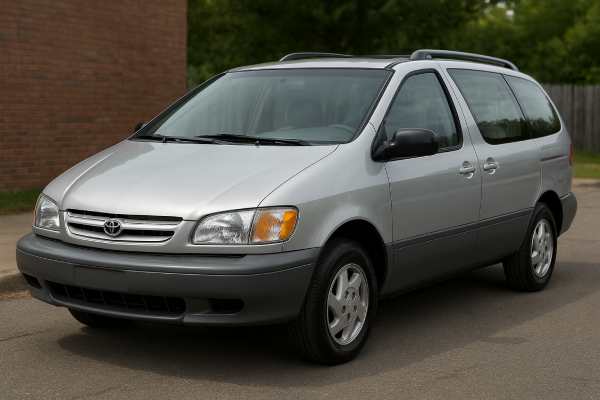
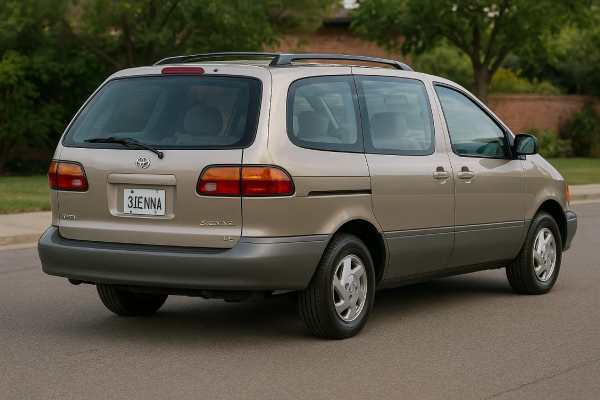
The first generation Toyota Sienna 2WD (chassis code XL10) marked Toyota’s shift from the unusual, mid-engine Previa to a more conventional, Camry-based front wheel drive minivan. Sold in North America for the 1998–2000 model years, it used the 1MZ-FE 3.0 litre V6, a smooth and refined engine shared with the Camry and Avalon. Power is modest by modern standards at around 194 hp, but enough for confident highway use and family road trips.
Owners value this Sienna for its straightforward mechanical layout, excellent safety scores for the era and a cabin that feels more like a big car than a small bus. Sliding doors, removable rear seats and a long wheelbase make it a genuinely practical hauler. At the same time, age and mileage now matter more than model year, and issues like oil sludge, timing belt neglect and body rust separate good examples from tired ones. Understanding the strengths, weaknesses and service needs is the key to making this van work for you today.
Fast Facts
- 3.0 litre 1MZ-FE V6 gives quiet, smooth power and relaxed highway cruising for seven passengers.
- Camry-derived chassis offers car-like ride and handling with a long wheelbase for stability and comfort.
- Strong crash test performance for its time, with dual front airbags and available ABS on most trims.
- Watch for engine oil sludge, overdue timing belt service and worn sliding door hardware on older vans.
- Aim for engine oil and filter changes every 5,000 miles (around 8,000 km) or 6 months to protect the V6.
What’s inside
- Toyota Sienna XL10 in depth
- Sienna XL10 specs and data
- Sienna XL10 trims and safety
- Sienna XL10 reliability and issues
- Maintenance and buyer guide tips
- Driving impressions and performance
- How Sienna compares to rivals
Toyota Sienna XL10 in depth
The XL10 generation Sienna arrived for the 1998 model year as Toyota’s answer to American-style family minivans. Instead of the quirky, rear-drive Previa, Toyota moved to a front wheel drive layout and based the Sienna on an extended Camry platform. That brought familiar mechanical parts, better fuel economy and packaging that made more sense to North American buyers.
All early Sienna 2WD models used the 3.0 litre 1MZ-FE V6 paired with a four speed automatic. There was no four-cylinder option and no all wheel drive in this generation, which simplifies both ownership and maintenance. The V6 is aluminium-block, 60-degree, with dual overhead cams and 24 valves, designed for smoothness rather than outright power. With around 194 hp and 209 lb-ft, it feels strong enough for loaded family use without being overstressed.
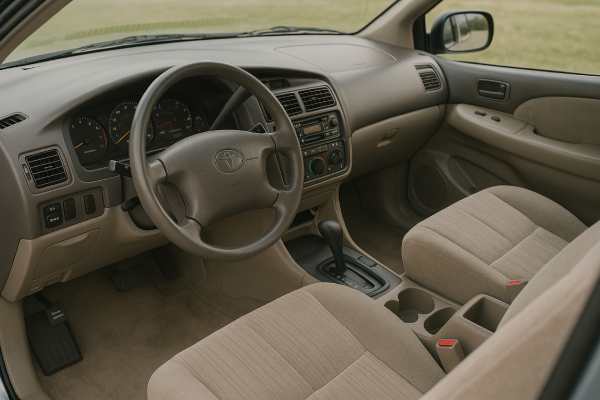
Inside, the XL10 offers seating for seven with removable rear seats. The second row can be captain’s chairs or a bench depending on trim, and the third row lifts out entirely. With all seats in place there is still useful luggage space; with rows removed, the van can carry bulky loads like furniture, appliances or building materials. The flat floor and wide rear opening make it easy to use the full volume.
Toyota targeted comfort and safety more than novelty. The body shape is rounded and aerodynamic, without the large glass area of some rivals, which keeps wind noise down at speed. Safety equipment includes dual front airbags and available anti-lock brakes on most trims, plus a strong safety cell that gave the Sienna excellent crash results for its time.
As a used vehicle today, the XL10’s appeal lies in its combination of robust mechanicals and simple electronics. There are no high-voltage hybrid systems or complex driver aids to maintain, and most service work can be handled by any competent independent shop. On the downside, every surviving van is now old enough that prior maintenance and rust history overshadow design-level reliability. A carefully maintained, rust-free Sienna can still be a dependable family hauler; a neglected or rusty one is best avoided.
Sienna XL10 specs and data
This section gathers the key technical data for the Toyota Sienna 2WD (XL10) with the 1MZ-FE 3.0 litre V6, as sold in North America from 1997–2000 model years.
Engine and performance
| Item | Data |
|---|---|
| Engine code | 1MZ-FE V6 |
| Configuration | 60° V6, aluminium block and heads |
| Valvetrain | DOHC, 4 valves per cylinder (24 valves total) |
| Displacement | 3.0 l (2,995 cc) |
| Bore × stroke | Approximately 87.5 × 83.0 mm |
| Compression ratio | Around 10.5:1 (market-dependent) |
| Induction | Naturally aspirated |
| Fuel system | Sequential multi-port fuel injection |
| Maximum power | About 194 hp @ ~5,200 rpm |
| Maximum torque | About 209 lb-ft @ ~4,400 rpm |
| Recommended fuel | Regular unleaded; premium not required |
| Timing drive | Rubber timing belt, driving camshafts and water pump |
| Emissions standard (period) | Tier 1 / LEV depending on market |
| Typical fuel economy (US EPA) | Around 18 mpg city / 24 mpg highway (about 13.1 / 9.8 l/100 km) |
These figures vary slightly by model year and certification standard, but all XL10 2WD vans share the same basic powertrain.
Transmission and driveline
| Item | Data |
|---|---|
| Transmission type | 4-speed automatic, electronically controlled with overdrive |
| Gearbox layout | Transaxle (combined gearbox and differential) |
| Drive type | Front wheel drive only |
| Final drive ratio | Around mid-3s (varies slightly by calibration) |
| Differential | Open front differential |
| Towing capacity (with tow package) | Up to about 3,500 lb (≈ 1,600 kg) braked |
| Unbraked tow limit | Typically around 1,000 lb (≈ 450 kg) |
The towing package usually adds a transmission cooler and specific wiring. Without that package, it is wise to tow lighter loads and service the transmission fluid more frequently.
Chassis, suspension and brakes
| Item | Data |
|---|---|
| Front suspension | MacPherson struts, coil springs, anti-roll bar |
| Rear suspension | Torsion beam axle with trailing arms and coil springs |
| Steering | Power assisted rack-and-pinion |
| Front brakes | Ventilated discs |
| Rear brakes | Drums or solid discs, depending on trim and options |
| Wheels and tyres | Typically 15-inch wheels with 205/70R15 or 215/65R15 tyres |
| Parking brake | Foot-operated, acting on rear wheels |
This layout prioritises durability and space efficiency rather than sharp handling, but parts availability and service procedures are straightforward.
Dimensions and capacities
Figures below are approximate and can vary slightly by trim, model year and equipment.
| Item | Data |
|---|---|
| Overall length | About 4,900–4,910 mm (≈ 193 in) |
| Overall width | About 1,845–1,860 mm (≈ 72–73 in) |
| Overall height | Around 1,710–1,730 mm (≈ 67–68 in) |
| Wheelbase | 2,900 mm (≈ 114.2 in) |
| Ground clearance | Around 150–160 mm (≈ 6 in) |
| Curb weight | Roughly 1,700–1,800 kg (3,750–3,970 lb) |
| Fuel tank capacity | Around 79 l (≈ 21 US gal) |
| Seating capacity | 7 passengers |
| Cargo volume, all seats in use | Roughly 1.3 m³ (≈ 1,300 l) behind third row |
| Cargo volume, rear seats removed | Up to around 4.0 m³ (≈ 4,000 l) |
Performance and capability
| Item | Data |
|---|---|
| 0–60 mph (0–97 km/h) | Roughly 9–10 seconds, depending on load and test conditions |
| Top speed | Around 110–115 mph (≈ 175–185 km/h) where legal |
| Braking performance | Respectable for the era; depends heavily on pad, rotor and tyre condition |
| Roof load | Typically around 75–100 kg with factory rails (check label) |
While not quick by modern standards, the Sienna XL10 feels confident in everyday driving and has enough power in reserve for highway merging and two-lane passing when driven sensibly.
Fluids and electrical (typical values)
Always confirm exact specifications and volumes for your VIN and market.
| System | Specification (common) | Approximate capacity |
|---|---|---|
| Engine oil | 5W-30, API SJ or later | About 4.5–5.0 l with filter |
| Engine coolant | Long-life ethylene glycol, Toyota-compatible | Around 9–10 l total |
| Automatic transmission fluid | Toyota Type T-IV or equivalent | 3–4 l drain/refill (more if fully empty) |
| Brake fluid | DOT 3 (DOT 4 acceptable if mixed correctly) | As needed for flush (around 1 l) |
| Power steering | ATF-type fluid | Under 1 l |
| 12 V battery | Group size similar to 35, around 550–650 CCA | — |
| Alternator output | Roughly 80–100 A depending on equipment | — |
Sienna XL10 trims and safety
Trims and options overview
In North America, the early Sienna range centred on three main trims: CE, LE and XLE. All used the same basic powertrain, but equipment levels and some mechanical details differ.
CE
- Entry-level trim aimed at value and fleet buyers.
- Cloth seats, basic stereo, manual climate control.
- Right-side sliding door, usually manual.
- Steel wheels with covers, smaller tyre sizes.
- ABS and cruise control may be optional depending on year and package.
LE
- The most common family choice.
- Upgraded cloth, more sound insulation and nicer interior trim.
- Power windows, power locks and better audio.
- Often dual-zone front and rear air conditioning.
- Alloy wheels or styled steel wheels on many examples.
- Optional power right sliding door.
XLE
- Top trim with an upscale focus.
- Leather or premium cloth upholstery.
- Power driver’s seat, premium audio and more convenience features.
- Automatic climate control on many vehicles.
- Alloy wheels and additional exterior trim details.
- Some models bundled traction control and tow prep.
Quick visual identifiers: CE models usually have plainer bumpers and wheel covers; LE and especially XLE versions often have body-colour bumpers, alloys and more brightwork. Inside, XLE vans stand out with leather, wood-style trim and more steering-wheel and centre console controls.
Year-to-year, changes between 1998 and 2000 are subtle. Option packages and colour choices shift slightly, and equipment that was optional in the first year may become more common later, but there are no drastic powertrain or structural revisions within the 2WD XL10 range.
Safety equipment
For its era, the Sienna XL10 offered strong passive safety fundamentals:
- Dual front airbags standard.
- Front seat belt pretensioners and force limiters.
- Three-point belts for most seating positions.
- Child-seat friendly rear bench layout with provision for tether anchors (on some early vans, these are added via dealer kits).
- Rigid passenger cell and carefully managed crumple zones.
Anti-lock braking (ABS) was widely available and standard on many LE and XLE vans. Traction control appeared on some better-equipped models later in the run, usually bundled with ABS and higher trim levels. Stability control systems and side curtain airbags were not yet common in this era and are not part of the XL10 feature set.
Crash test and rating summary
The first-generation Sienna earned strong crash test scores when new, often cited as one of the safer minivans on the market at the time. Independent tests of frontal crashes showed well-managed cabin intrusion and low measured injury risk for the driver and front passenger.
Side impact performance depends more on equipment and impact scenario, since side airbags were not yet available, but the basic structure performed well compared with many peers. Rollover risk, as for most minivans, is higher than for a sedan simply due to height and track width, but careful design and a low, car-like floor help stability.
For buyers today, the takeaway is that an XL10 in sound structural condition still provides reasonable passive safety for its age, but it lacks later technologies like curtain airbags, electronic stability control and advanced driver assistance systems. If you expect modern active safety features, a newer generation Sienna may be a better fit.
Sienna XL10 reliability and issues
Overall reliability picture
The Sienna XL10 generally has a good reputation for durability, especially compared with many domestic minivans from the same period. Many vans have exceeded 200,000 miles when properly maintained. However, there are several specific weak points you should understand before buying or planning long-term ownership.
Engine-related issues
Oil sludge formation
The 1MZ-FE V6 is known to develop oil sludge if oil changes are neglected or extended too far, particularly with lots of short-trip driving or poor-quality oil. Sludge can restrict oil return passages, reduce lubrication and lead to noisy lifters, higher oil consumption and, in severe cases, bearing damage.
- Typical symptoms: black, tar-like deposits under the oil cap, blue smoke at start-up, low oil pressure warnings and noisy top end.
- Prevention: regular oil and filter changes at sensible intervals, a working PCV system and avoiding repeated short trips where the engine never reaches full operating temperature.
- Remedy: in early or moderate cases, careful cleaning and more frequent oil changes may stabilise the situation; advanced cases can require major engine work or replacement.
Timing belt and water pump
The 1MZ-FE uses a timing belt that also drives the water pump. If the belt fails, the engine will stop immediately and may suffer internal damage.
- Replace the timing belt, tensioner, idlers and water pump on schedule or when history is unknown.
- Oil leaks from cam or crank seals can shorten belt life and should be addressed during belt service.
Cooling system
Radiators, hoses and thermostats age over time. Overheating is especially risky on an older aluminium V6.
- Look for dried coolant traces, low coolant level, staining around hose clamps and evidence of past overheating.
- A cooling system service at purchase (new coolant, fresh thermostat and inspection of hoses) is often money well spent on an older Sienna.
Transmission and driveline
The four speed automatic is robust if fluid is kept clean and the van is not abused, but several problems can appear on high-mileage or neglected units:
- Harsh shifts, delayed engagement when selecting drive or reverse.
- Shift “flare” where revs rise between gears.
- Shudder under light throttle at certain speeds.
Often, these issues are worsened by old or incorrect fluid. A gentle drain and refill with the correct ATF can improve behaviour, but long-term abuse may require rebuild or replacement. Vans that have towed regularly without an auxiliary cooler are more at risk of thermal damage.
The front driveshafts and CV joints are otherwise typical. Clicking on turns or vibration under acceleration usually indicates worn joints or shafts, which are relatively straightforward to replace.
Body, doors and corrosion
Sliding doors
One of the most common complaints on older Siennas involves sliding doors:
- Sticking or hard-to-move doors.
- Doors that do not latch fully or open unexpectedly on steep ground if not latched correctly.
- Broken interior or exterior handles.
Causes include worn rollers and guides, dry or dirty tracks, worn latches and fatigued handles. Many of these parts are still available, and careful cleaning, lubrication and replacement of worn components can restore smooth operation.
Rust and structural issues
Rust patterns vary heavily by climate. In salt-belt regions, look closely at:
- Rear subframe and suspension mounting points.
- Fuel and brake lines along the underside.
- Wheel arches, door bottoms and tailgate lip.
Surface rust is common and manageable; deep scaling on load-bearing structures can be a serious safety and repair cost concern.
Electrical and other faults
Typical age-related electrical issues include:
- Oxygen sensor and catalytic converter faults leading to check-engine lights.
- Intermittent instrument cluster behaviour in very hot or cold weather.
- Ageing window regulators or door-lock actuators.
- Steering rack seepage and front suspension wear causing play or clunks.
These issues are generally fixable with standard diagnostic methods and parts; the important thing is to budget for some catch-up work on any newly purchased older van.
Recalls and service actions
Over its life, the XL10 Sienna has been subject to several recalls and service campaigns, mostly related to safety systems, door hardware and corrosion in specific climates. Any individual van should be checked by VIN through official channels to confirm which campaigns apply and whether the work has been completed. When in doubt, dealer service histories and printed recall completion records are very helpful.
Maintenance and buyer guide tips
Practical service schedule for aging XL10s
For a minivan of this age, a conservative and regular maintenance schedule is more important than stretching official intervals. The following is a practical baseline:
- Engine oil and filter: every 5,000 miles (8,000 km) or 6 months, whichever comes first. Use a quality oil and filter to limit sludge risk.
- Engine air filter: inspect yearly; replace every 30,000 miles (50,000 km) or sooner in dusty conditions.
- Cabin filter (if fitted): check annually and replace when dirty; not all early vans have one.
- Coolant: replace every 5 years or 100,000 miles (160,000 km), then every 3 years afterwards, using the correct long-life coolant.
- Spark plugs: inspect around 60,000 miles (96,000 km); replace by 90,000–100,000 miles. Use the correct long-life plugs.
- Timing belt and water pump: treat 90,000 miles or 7–8 years as a sensible replacement interval, especially if history is unclear.
- Serpentine belt and hoses: inspect yearly; replace if cracked, glazed or swollen.
- Automatic transmission fluid: drain and refill every 30,000–40,000 miles (48,000–64,000 km) with the proper ATF. Avoid aggressive flushes on high-mileage units.
- Brake fluid: flush every 2–3 years regardless of mileage.
- Brakes: inspect pads, rotors and drums at least yearly; more often if towing or driving in hilly areas.
- Power steering fluid: inspect yearly; partial change when dark or burnt-smelling.
- Alignment and tyres: rotate tyres every 5,000–7,500 miles; check alignment annually or when unusual wear appears.
- 12 V battery: test annually after about 4–5 years in service; many last 5–7 years.
Because the XL10 lacks modern electronic driver aids, there are no camera or radar calibrations to worry about after routine bodywork, but ABS and airbag systems still demand professional care if repairs are needed.
Buyer’s checklist
If you are considering a used Sienna XL10 today, approach it methodically:
Paperwork and history
- Look for a thick file of service records, especially showing regular oil changes and at least one timing belt replacement.
- Confirm mileage from records rather than relying only on the odometer.
- Check for evidence of recall work and any major repairs (engine, transmission, structural rust).
Engine and transmission
- Inspect under the oil cap for heavy sludge or thick deposits.
- Start the engine from cold and listen for knocks, rattles or extended lifter noise.
- After warm-up, check idle smoothness and response to gentle throttle blips.
- On the test drive, ensure the transmission engages smoothly, shifts cleanly and does not flare between gears.
Cooling and fluids
- Look for coolant residue around the radiator, hoses and water pump area.
- Check coolant colour in the reservoir; brown or oily coolant is a bad sign.
- Inspect ATF colour and smell; very dark or burnt fluid suggests neglect.
Chassis, brakes and steering
- Drive over rough surfaces and speed bumps, listening for clunks or rattles.
- Check steering for play or wandering at highway speeds.
- Perform a few controlled hard stops to judge braking strength and pedal feel (ensure safe conditions).
Body and interior
- Examine the underside, wheel arches and door bottoms for rust, especially in regions where winter road salt is used.
- Open and close both sliding doors several times from inside and outside. They should slide smoothly and latch firmly.
- Test all power windows, locks, mirrors, HVAC controls and seat adjustments.
Which years and trims to target
Because the 1998–2000 2WD XL10s are mechanically very similar, condition and history matter more than specific year. In general:
- Well-kept LE and XLE trims often make the best all-rounders, thanks to better equipment and frequently more careful original ownership.
- A basic CE in excellent mechanical and structural condition is preferable to a tired XLE loaded with issues.
- Vans with fresh timing belt service, recent cooling system work and documented transmission fluid changes are particularly attractive.
Long-term outlook
With the right example, you can expect many more years of service, provided you stay ahead of maintenance and inspections. Replacement engines and transmissions are still available, and many independent shops are familiar with the design. On the other hand, if the van already shows severe rust, heavy sludge or major transmission problems, it is often cheaper to walk away and find a healthier starting point than to restore a poor one.
Driving impressions and performance
Everyday driving character
The Sienna XL10 was never aimed at enthusiasts, but it delivers a pleasant, relaxed driving experience that still holds up reasonably well. The 1MZ-FE V6 is the highlight: it starts quietly, idles smoothly and pulls with a broad, easygoing torque curve. There is enough power to merge onto highways confidently, pass slower traffic and climb grades with a full load, as long as the transmission is in good condition and the van is maintained.
The four-speed automatic favours smoothness over speed. It usually upshifts early to keep revs low, which helps quietness and fuel economy. When you press harder, it will downshift promptly but not abruptly. There are no sport modes or paddles to worry about, which many drivers appreciate in daily use. On steep hills or when towing, using the “2” or “L” positions to hold lower gears can prevent hunting and reduce heat buildup.
Ride, handling and noise
The Camry-derived platform gives the XL10 a distinctly car-like feel compared with boxier, truck-based vans of the early 1990s:
- Ride quality is soft and comfortable, with the long wheelbase smoothing out most bumps. Broken pavement still comes through, especially if the original dampers are worn, but good shocks and quality tyres keep it controlled.
- Handling is predictable. The van leans in corners but grips acceptably within sensible speeds. The front end tends to push wide if you enter a corner too fast; easing off the throttle brings it back in line.
- Steering is light at parking speeds and reasonably weighted on the highway, though feedback is not particularly detailed.
Noise levels are low for the class. Road and wind noise are well contained at urban speeds; at modern freeway speeds some wind rush from the mirrors and roof rack can be heard, but conversation in the back rows is still easy. LE and XLE trims with more sound insulation feel noticeably calmer than basic CE models.
Real-world fuel economy
Actual consumption depends heavily on driving style, load, terrain and climate, but owners commonly report:
- Around 15–18 mpg (US) in heavy city use.
- Around 22–25 mpg (US) on open highways at moderate speeds.
- Around 18–21 mpg (US) in mixed commuting.
These figures translate roughly to 15.7–13.1 l/100 km in city driving and 10.7–9.4 l/100 km on the highway. Cold winters, roof boxes, aggressive acceleration and heavy trailers can push numbers lower.
With a fuel tank of roughly 79 litres, real-world range generally falls between about 350 and 450 miles (560–725 km) per tank, depending on conditions.
Load and towing behaviour
Under load, the Sienna XL10 remains composed when driven within its limits:
- With seven passengers and luggage, the suspension settles slightly but the van remains stable and predictable. Proper tyre pressure and good rear dampers are important.
- When towing within the rated limit and equipped with a tow package, the Sienna is capable but you will feel the extra weight in both acceleration and braking.
On long grades, keep an eye on engine and transmission temperatures if you have gauges, or at least be alert for signs of overheating. Manually selecting lower gears can help keep the engine in its power band and reduce strain on the transmission. Braking distances increase significantly with a loaded trailer, so plan extra space and consider trailer brakes mandatory for heavier loads.
City manoeuvring and parking
Despite its length, the XL10 is not intimidating in town. The relatively tight turning circle for a minivan, light steering and good outward visibility make it manageable in parking lots and urban streets. The dash-forward design helps you judge the front corners, though the rear corners require more care when reversing. Most vans from this era lack parking sensors or cameras, so aftermarket aids may be worth considering if you are used to more modern vehicles.
How Sienna compares to rivals
When it launched, the Sienna XL10 entered a crowded minivan market. Looking at it today against period rivals helps clarify where it still shines and where it falls short.
Honda Odyssey (late 1990s–early 2000s)
The second-generation Honda Odyssey, introduced for 1999, is often the Sienna’s closest rival.
- Space and seating: The Odyssey is slightly larger inside, and later versions introduced fold-into-floor third-row seats that make cargo reconfiguration easier than lifting seats out, as you must in the Sienna XL10.
- Driving feel: The Odyssey has a more powerful V6 and a slightly more athletic chassis tune, making it feel a bit livelier.
- Reliability: Both have strong reputations, but some model-year Odysseys suffer from automatic transmission problems. The Sienna’s main Achilles’ heel is oil sludge and, in rust-belt regions, corrosion.
For a buyer prioritising simple, long-term ownership, a clean Sienna XL10 with documented maintenance is often a safer bet, whereas an Odyssey may appeal more to those who value extra space and a bit more power.
Chrysler vans (Caravan, Voyager, Town & Country)
Chrysler’s minivans dominated sales for many years and offer a different value proposition.
- Strengths: Widely available, clever seating (especially in later generations), often very affordable on the used market and usually well-equipped.
- Weaknesses: More frequent issues with engines, transmissions, electrical systems and rust.
A well-kept Chrysler van can be very comfortable, but the odds of encountering significant issues are generally higher than with a well-maintained Sienna. If you want to minimise surprises and workshop visits, the Toyota’s simpler drivetrain and strong reliability record are compelling.
Ford Windstar
The Ford Windstar, another contemporary rival, emphasised soft ride and safety but has its own set of concerns.
- Pros: Comfortable seats, smooth ride and competitive safety ratings at the time.
- Cons: Known problems with subframe rust, transmissions and various sensors and modules on older examples.
In regions where rust is a concern, many Windstars have structural issues by now, while Siennas of the same age may still be solid if they were rust-proofed and cared for. This makes the Sienna a more realistic long-term option in many used markets.
Nissan Quest and others
The Nissan Quest and its cousin, the Mercury Villager, offer smaller footprints and pleasant V6 engines but suffer from age, parts availability and less robust corrosion protection in some years. Against these, the Sienna’s parts support, knowledge base and longevity record make it easier to recommend.
Where the XL10 still fits
A Toyota Sienna 2WD (XL10) makes sense today if you:
- Need a practical, seven-seat vehicle on a modest budget.
- Value mechanical simplicity and proven reliability over the latest features.
- Are prepared to invest in catch-up maintenance and rust prevention.
It is less ideal if you require modern active safety aids, maximum cargo flexibility without lifting seats, or live in a very harsh climate where even well-cared-for vehicles rust quickly. In those cases, a newer Sienna generation or a more recent rival may be worth the extra cost.
References
- Toyota Official Website 2025 (Owner’s Manual and Specifications)
- National Highway Traffic Safety Administration 2025 (Crash Tests and Recalls)
- Insurance Institute for Highway Safety 2025 (Safety Ratings)
- FuelEconomy.gov Official U.S. Government Source for Fuel Economy Information 2025 (Fuel Economy Data)
- Toyota Technical Information System 2025 (Service and Repair Information)
Disclaimer
This article is for informational purposes only and is not a substitute for professional diagnosis, repair or safety advice. Specifications, torque values, fluid types, service intervals and equipment details can vary by VIN, production date, market and installed options. Always verify critical information using the official Toyota service documentation, owner’s manuals and current technical bulletins for your specific vehicle, and consult a qualified technician before performing maintenance or repairs.
If you found this guide useful, you are welcome to share it on social platforms such as Facebook or X/Twitter to help other owners and support xcar’s work.