
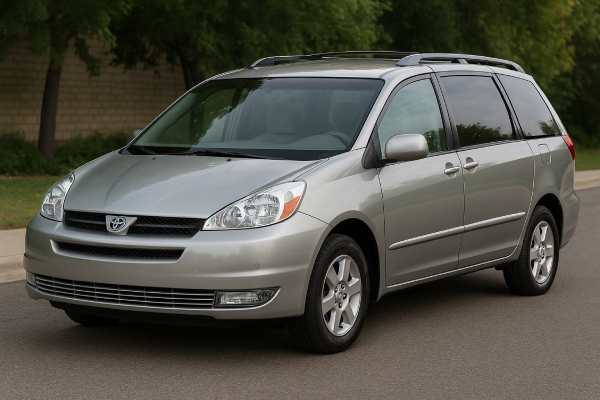
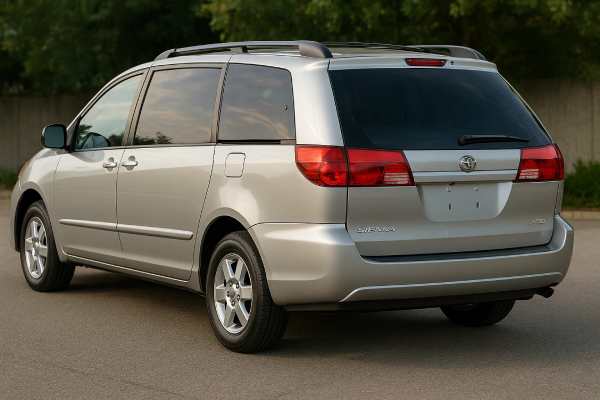
The second generation Toyota Sienna AWD (XL20) with the 3.3 litre 3MZ-FE V6 was aimed at families who needed year round traction without giving up comfort. It combines a strong all aluminium V6, a 5 speed automatic transmission, and full time all wheel drive with stability control, so it feels secure on wet, snowy, or unpaved roads. With about 230 hp and 242 lb ft of torque, the van accelerates confidently even with all three rows occupied.
Compared with the first generation, the XL20 Sienna grew in size and refinement. The cabin gained more space, better noise insulation, and a genuinely useful fold into floor third row. Underneath, the drivetrain is based on Toyota’s familiar MZ series V6 and U series transmissions, which are well proven when serviced correctly.
At the same time, the AWD layout, run flat tyres, and age related wear on items like sliding doors, steering racks, and subframes mean buyers should understand long term costs and maintenance before committing. This guide focuses on the AWD XL20 from roughly 2003–2005 production, covering specs, reliability, safety, servicing, and how it compares with other minivans of its era.
Top Highlights
- 3.3 l 3MZ-FE V6 (about 230 hp, 242 lb ft) and full time AWD give confident acceleration and winter traction for seven passengers.
- XL20 body brings a bigger, quieter cabin with a flat folding third row and comfortable ride on long trips.
- Crash performance and available curtain airbags make this one of the safer early 2000s minivans.
- AWD hardware, run flat tyres, and sliding door mechanisms add cost; budget for driveline fluids, tyres, and door repairs on older vans.
- Treat 90,000–100,000 miles (145,000–160,000 km) or about 7–8 years as a sensible timing belt and water pump interval.
Navigate this guide
- Detailed overview of the AWD Sienna XL20
- Specifications and technical data
- Trims, options, safety and driver assistance
- Reliability, common issues and service actions
- Maintenance and buyer’s guide
- Driving and performance impressions
- How the Sienna AWD compares to rivals
Detailed overview of the AWD Sienna XL20
The XL20 Sienna represented a major redesign over the original XL10. It grew in almost every dimension and moved to a more refined, carlike chassis with a long 3030 mm wheelbase and overall length of about 5080 mm. That extra size went directly into cabin space, especially the third row and cargo area, making the Sienna feel much closer to a full size minivan while still fitting in normal parking spaces.
The 3MZ-FE 3.3 litre V6 is central to the AWD Sienna’s character. It is an all aluminium 60 degree V6 with dual overhead cams, four valves per cylinder and variable valve timing on the intake side. In Sienna tune it produces roughly 230 hp at 5600 rpm and about 242 lb ft of torque around 3600 rpm. Those numbers give the AWD van a relaxed, unhurried feel even when fully loaded, and the engine is known for smoothness and low noise when maintained.
The AWD system is full time. Power flows through a U151F 5 speed automatic transaxle with an integrated transfer assembly that sends torque to a rear differential. There is no driver selectable mode; instead, the system quietly sends torque to the rear whenever the front tyres begin to slip. Electronic helpers such as traction control and stability control support the mechanical layout and are particularly valuable on slick surfaces.
One distinctive aspect of the AWD XL20 is its tyre and spare arrangement. These vans were supplied with 17 inch wheels and run flat tyres rather than a conventional spare. This allowed Toyota to package the AWD hardware without sacrificing interior space for a spare wheel well, but it does mean tyre replacement costs are higher and careful pressure monitoring is important.
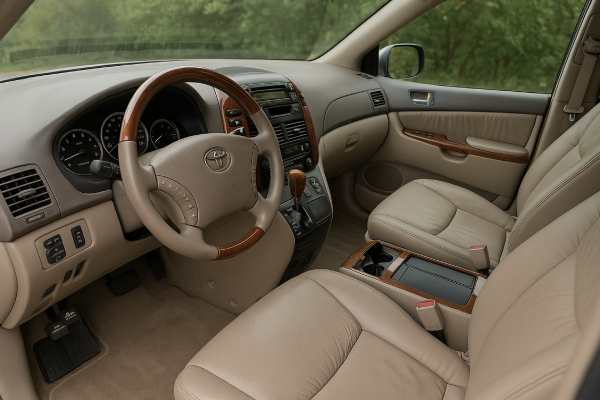
Inside, the XL20 brought the Sienna into the modern minivan era. A highlight is the “Split & Stow” third row that folds down into the floor, turning the rear of the van into a flat cargo area without removing heavy seats. Second row seating may be captain’s chairs or a bench, depending on trim and market. Materials and ergonomics improved significantly over the first generation, with better sound insulation, clearer instruments and more effective climate control.
For owners, the AWD XL20 offers a blend of strong winter capability, flexible interior space and typical Toyota durability, balanced against the extra complexity of the AWD hardware and the higher running costs tied to tyres and fuel.
Specifications and technical data
This section compiles key technical data for the second generation Toyota Sienna AWD with the 3MZ-FE 3.3 litre V6 from roughly 2003–2005 production. Numbers can vary slightly by model year and market; always verify against the information for your specific vehicle.
Engine and performance
| Item | Specification |
|---|---|
| Engine code | 3MZ-FE |
| Configuration | 60° V6, aluminium block and heads |
| Valvetrain | DOHC, 4 valves per cylinder, intake VVT-i |
| Displacement | 3.3 L (3310 cc) |
| Bore × stroke | 92.0 mm × 83.0 mm |
| Compression ratio | Around 10.8 : 1 |
| Induction | Naturally aspirated |
| Fuel system | Sequential multiport electronic fuel injection |
| Maximum power | Approx. 230 hp (172 kW) @ 5600 rpm |
| Maximum torque | Approx. 242 lb ft (328 Nm) @ 3600 rpm |
| Recommended fuel | Unleaded petrol; regular grade usually acceptable |
| Emissions classification | Low Emission Vehicle (period US rating) |
Indicative fuel economy for AWD models:
| Cycle | City | Highway | Combined |
|---|---|---|---|
| Typical US test values | ~16 mpg US | ~22 mpg US | ~18 mpg US |
| Approximate L/100 km | ~14.7 | ~10.7 | ~13.1 |
Real world consumption depends heavily on driving style, climate and load, but many owners report around 13–15 L/100 km (18–15 mpg US) in mixed use.
Transmission and driveline
| Item | Specification |
|---|---|
| Transmission | 5 speed automatic (Super ECT) |
| Common code | U151F |
| 1st / 2nd / 3rd / 4th / 5th | 4.235 / 2.360 / 1.517 / 1.047 / 0.756 |
| Reverse | 3.378 |
| Final drive ratio | Around low 3s (varies with year/market) |
| Drive type | Full time AWD with rear differential |
| Traction aids | Traction control and stability control standard on AWD |
The AWD driveline includes a transfer case integrated with the transaxle and a rear differential mounted on a subframe. Dedicated fluid changes for both assemblies are important for long life.
Chassis, suspension and dimensions
| Item | Specification |
|---|---|
| Platform | Dedicated minivan platform |
| Front suspension | MacPherson strut, coil springs, stabiliser bar |
| Rear suspension | Torsion beam axle, coil springs, stabiliser bar |
| Steering | Power assisted rack and pinion |
| Front brakes | Ventilated discs with ABS and brake assist |
| Rear brakes | Solid discs with ABS and electronic brake force distribution |
| Tyres (AWD) | P225/60R17 run flat all season tyres |
| Wheels | 17 inch aluminium alloy on most trims |
Key dimensions:
| Item | Metric | Imperial |
|---|---|---|
| Overall length | ~5080 mm | ~200.0 in |
| Overall width | ~1965 mm | ~77.4 in |
| Overall height | ~1750 mm | ~68.9 in |
| Wheelbase | ~3030 mm | ~119.3 in |
| Ground clearance | ~176 mm | ~6.9 in |
| Turning circle (kerb to kerb) | ~11.2 m | ~36.8 ft |
Weights, capacities and cargo space
| Item | Metric | Imperial |
|---|---|---|
| Curb weight (typical AWD) | ~1950–2000 kg | ~4300–4400 lb |
| GVWR | ~2580 kg | ~5680 lb |
| Fuel tank capacity | ~79 L | ~21 US gal (approx.) |
| Seats | 7 (most AWD trims) | |
| Cargo volume behind 3rd row | ~1.24 m³ | ~43.5 ft³ |
| Cargo volume behind 2nd row | ~2.7 m³ | ~95 ft³ |
| Cargo volume behind front seats | ~4.2 m³ | ~149 ft³ |
| Maximum towing capacity | Up to ~1587 kg | Up to 3500 lb (with tow package) |
Fluids, service capacities and electrical (typical)
Always confirm for your exact year and market.
- Engine oil: about 4.7–5.0 L with filter; usually 5W-30 or 5W-20 meeting Toyota specifications.
- Cooling system: roughly 8–9 L of Toyota long life or super long life coolant.
- Automatic transmission: around 7–8 L total fill of the specified ATF; a single drain and refill replaces part of this.
- Transfer case and rear differential: typically a total of 1–2 L of 75W-90 GL-5 gear oil.
- Brake fluid: DOT 3 or DOT 4; about 0.8–1.0 L for a complete flush.
- A/C refrigerant: R-134a, charge specified on under bonnet label.
- 12 V battery: mid size group with around 550–650 cold cranking amps, depending on market.
- Alternator: roughly 130–150 A output on many trims.
- Spark plugs: long life iridium plugs, gap around 1.0–1.1 mm, 6 plugs total.
Trims, options, safety and driver assistance
In many markets, AWD was reserved for mid and upper trim levels of the XL20 Sienna. Instead of a base CE with AWD, you usually find LE AWD and XLE AWD variants, with the most luxurious features often bundled on XLE Limited versions.
LE AWD
Typical LE AWD equipment includes:
- 17 inch alloy wheels with run flat tyres.
- Tri zone climate control and rear air conditioning.
- Power windows, mirrors and locks, plus cruise control.
- Cloth upholstery with a seven seat layout (often with captain’s chairs in the second row).
- One or two power sliding doors, depending on options.
- Audio system with CD and multiple speakers, sometimes with steering wheel controls.
XLE and Limited AWD
XLE and Limited trims build on this with:
- Leather upholstery, heated front seats and more elaborate interior trims.
- Power sliding doors on both sides and a power tailgate on many examples.
- Power driver’s seat (and sometimes passenger seat) with memory settings.
- Premium audio, optional rear seat entertainment, and sunroof or dual sunroofs.
- Extra sound insulation and convenience features such as automatic headlights.
Mechanically, the AWD versions of LE and XLE are very similar; the differences are mainly in weight and wheel/tyre packages rather than engine or brakes. Tow packages with a larger radiator, transmission cooler and hitch were available and are worth seeking if you plan to tow regularly.
Safety equipment
Standard safety features on AWD XL20 Siennas typically include:
- Dual stage front airbags.
- Front seatbelt pretensioners and force limiters.
- Anti lock braking system with electronic brake force distribution and brake assist.
- Three point seatbelts for all seating positions.
- LATCH/ISOFIX style lower anchors and top tether points for child seats in the second and third rows.
Many AWD vans also have:
- Front seat side airbags and curtain airbags covering all three rows.
- Active front head restraints to help reduce whiplash.
- Stability control (often standard with AWD) and traction control.
Crash performance and driver assistance
In independent crash tests, this generation Sienna performed very well in moderate overlap frontal impacts, with strong passenger compartment integrity and low injury measures. Side impact ratings are particularly good for models with side and curtain airbags, offering solid protection for both front and rear occupants. Government test programmes generally rated frontal and side impact performance at four or five stars for most configurations, with rollover ratings around four stars, reflecting a reasonably low risk for a tall vehicle.
Advanced driver assistance technology is limited by modern standards. Most vans lack autonomous emergency braking, lane keeping or camera based systems. Some higher trims were offered with radar or laser cruise control in certain markets, but the core driver aids are anti lock brakes, brake assist, stability control and traction control. These systems are tuned conservatively and intervene early and smoothly, helping keep the van stable in emergency manoeuvres or poor conditions.
From a safety standpoint, the most desirable AWD XL20 Siennas are those with curtain airbags, stability control and a clean accident history. Verifying airbag labels on seat bolsters and pillars, and checking build sheets or VIN information, is worthwhile when comparing individual vans.
Reliability, common issues and service actions
The AWD XL20 Sienna has a generally strong reputation, but like any 20 year old minivan, long term reliability depends heavily on maintenance and environment. Some issues are common enough that they should be considered routine checks rather than surprises.
Engine and cooling system
The 3MZ-FE V6 is capable of high mileage when treated to regular oil changes and timely timing belt service. Common points include:
- Valve cover gasket leaks and occasional cam or crank seal seepage, especially near timing covers. These can drip oil onto belts or exhaust components if ignored.
- Age related radiator and hose failures, particularly at plastic end tanks and hose joints. A replacement radiator and new hoses after many years is sensible preventive maintenance.
- Thermostat and coolant temperature sensor ageing, leading to slow warm up, overcooling or irregular temperature gauge behaviour.
- Throttle body and idle air passages accumulating deposits, causing unstable idle or hesitation; cleaning often restores smoothness.
Timing belt and accessories
Ignoring the timing belt service interval is one of the bigger risks. If the belt, tensioner and idlers are left in place far beyond the recommended mileage or years, a failure can result in major engine damage. Ideally, you want documentary proof of timing belt, tensioner, idler and water pump replacement, or you should plan to have the work done soon after purchase. Accessory belts and tensioners also wear, making noise or slipping when loaded.
Transmission, AWD system and differentials
The U151F 5 speed automatic is generally robust if fluid is kept clean and cool:
- Old or overheated ATF can lead to harsh shifts, flare between gears or delayed engagement. Periodic drain and refill is preferred over aggressive flushing on high mileage units.
- Solenoid issues or internal wear are less common but can appear at very high mileages or after severe use. Early signs are worth addressing before more serious damage occurs.
The AWD hardware adds its own maintenance needs:
- Transfer case and rear differential fluid should be changed at reasonable intervals. Neglect can lead to bearing noise, whine or vibration.
- Rear driveshaft universal joints and CV joints can wear, especially in salty or gritty environments, causing vibration or clicking noises under load.
- Wheel bearings, particularly at the rear, may develop humming or rumbling noises that increase with speed.
Suspension, steering and brakes
A typical XL20 at this age will benefit from suspension refresh work if it still has original components:
- Front struts and rear dampers can become weak, leading to floaty ride and poor control over bumps.
- Control arm bushings, ball joints and stabiliser links often wear, resulting in clunks and vague steering.
- Power steering racks are known to seep or leak fluid with age, leaving damp subframes and eventually requiring a rack replacement.
Brakes are conventional but work hard on a loaded AWD van on long descents. Caliper slide pins can seize if never cleaned and lubricated, leading to uneven pad wear, noise and increased stopping distances.
Body, doors and interior
Sliding doors are a known wear point:
- Manual doors can have worn rollers and dirty tracks, making operation heavy or noisy.
- Power doors may suffer from cable or motor failures, misaligned latches or damaged wiring in the door harness area. These issues can be costly to fix if left until a full failure.
Corrosion depends heavily on climate and maintenance but should not be ignored. Areas to check include wheel arches, lower door edges, tailgate seams, rear subframes and suspension mounts.
Inside, typical age related issues include worn seat fabrics or leather, sagging headliners in hot climates, intermittent window switches and door lock actuators, and ageing backlighting for climate and audio controls.
Recalls and service campaigns
Over its life, the XL20 Sienna has been subject to recalls and service campaigns related to sliding door latches, fuel system components, suspension hardware and, like many vehicles, certain airbag components. When buying or assessing one, use the vehicle identification number with the relevant official database in your region to confirm recall status, and ask a dealer to print out any completed or outstanding campaigns.
Taken as a whole, the AWD XL20 Sienna rewards owners who stay ahead of timing belts, fluids, cooling system care and corrosion control. Most costly failures are linked either to deferred maintenance or severe climate, rather than inherent design flaws.
Maintenance and buyer’s guide
Because the AWD XL20 Sienna is now an older vehicle, a proactive maintenance plan is more important than simply following the original schedule. The intervals below are practical guidelines; adjust for your usage and local conditions.
Core maintenance schedule
- Engine oil and filter: every 5000–8000 miles (8000–12,000 km) or 6 months. Short trip use, towing or extreme temperatures justify shorter intervals.
- Engine air filter: inspect annually and replace around every 30,000 miles (50,000 km), or earlier in dusty areas.
- Cabin air filter: every 15,000–20,000 miles (24,000–32,000 km) or 1–2 years, depending on dust and pollen levels.
- Spark plugs (iridium): about every 100,000 miles (160,000 km), or earlier if misfires or poor economy appear.
- Coolant: replace every 5 years or 80,000–100,000 km on an older van, even if long life coolant is used.
- Automatic transmission fluid: gentle drain and refill every 30,000–40,000 miles (50,000–65,000 km).
- Transfer case and rear differential fluid: every 40,000–50,000 miles (65,000–80,000 km).
- Brake fluid: flush every 2–3 years regardless of mileage.
- Brake pads and rotors: inspect at least once a year; more often if towing or driving in mountains.
- Power steering fluid: inspect annually; change if dark or contaminated.
- Timing belt, tensioner, idlers and water pump: every 90,000–100,000 miles (145,000–160,000 km) or roughly 7–8 years.
- Serpentine belt and hoses: inspect at each oil change; replace when cracking, glazing, swelling or stiffness is evident.
- Tyre rotation: every 6000–8000 miles (10,000–12,000 km), keeping tread depths closely matched on all four corners.
- Wheel alignment: at least every two years, or whenever tyres are replaced or uneven wear appears.
- 12 V battery: test annually after about four years in service; replace when capacity drops or cranking slows.
Fluid specifications
As a rule of thumb:
- Engine oil: 5W-30 or 5W-20 that meets Toyota’s specification for petrol engines of the era.
- Coolant: Toyota red or pink long life or super long life coolant; avoid mixing different coolant types.
- ATF: the specific ATF grade listed for the U151F transmission for your model year; do not mix with other types.
- Gear oil: quality 75W-90 GL-5 for transfer case and rear differential unless specified otherwise.
Buyer’s checklist
When shopping for an AWD XL20 Sienna:
- Documentation
- Look for proof of timing belt and water pump replacement.
- Check for regular oil changes and transmission fluid services.
- Confirm any recalls have been completed.
- Engine condition
- Listen at cold start for tapping, knocking or rattling.
- Inspect for oil leaks at valve covers, timing covers and the rear main seal area.
- Check coolant level and colour, looking for oil contamination or rust.
- Transmission and AWD system
- From cold, make sure gear engagement is quick and shifts are smooth.
- Listen for whine or rumble from the transfer case or rear differential at steady speeds.
- Check for vibrations under load that could indicate worn CV joints or driveshaft issues.
- Suspension and steering
- Drive over mixed surfaces; note any clunks, rattles or wandering.
- Inspect tyres for cupping or uneven wear, which suggests alignment or suspension problems.
- Brakes
- Check pedal feel and stopping ability. Pulsation, pull, or noise indicates rotors, pads or caliper issues.
- Body, rust and doors
- Look carefully at wheel arches, sills, rear subframes and floor seams for corrosion.
- Test both sliding doors repeatedly, checking for smooth travel, solid latching and proper power operation if fitted.
- Interior and electronics
- Verify all windows, locks, mirrors, seat adjusters, HVAC functions and audio components.
- Check for water leaks around the windscreen, doors and tailgate, especially if there are odours or damp carpets.
Which AWD Sienna to choose
The most desirable examples tend to be LE or XLE AWD models with curtain airbags, complete service history and minimal rust. It is usually better to buy a higher mileage van with excellent records and a recently done timing belt than a lower mileage example with missing history, overdue fluids and visible corrosion. When treated as a long term family vehicle and maintained accordingly, the AWD XL20 Sienna can deliver many more years and kilometres of service.
Driving and performance impressions
On the road, the AWD Sienna XL20 prioritises comfort and security over sharp responses. The long wheelbase and relatively wide track help it feel stable at speed, while the suspension tuning focuses on soaking up bumps rather than carving corners. Around town, the steering is light and the turning circle is fairly tight for such a large van, so manoeuvring into tight parking spots is less stressful than the dimensions suggest.
The 3.3 litre V6 is smooth and quiet. There is plenty of torque from low to mid range, which means the van moves smartly away from lights and merges easily onto highways, even with several passengers and luggage. Only under heavy acceleration does the engine become prominent, and even then the sound is more of a muted growl than a harsh roar. The five speed automatic shifts early and unobtrusively in normal driving, keeping revs low and helping with cabin quietness.
At highway speeds, the Sienna tracks straight and resists crosswinds well when suspension components are in good condition. Body roll is noticeable in faster bends, but it is progressive and predictable, which is what you want in a family vehicle. Stability control steps in if you attempt sudden avoidance manoeuvres or encounter slippery patches mid corner, trimming power and, if needed, applying brakes at individual wheels to keep you on line.
All wheel drive engagement is seamless. On dry roads you may never notice it working; in rain, snow or on gravel, the van simply feels more sure footed than a comparable front wheel drive version, especially when accelerating from a stop or climbing hills. With proper winter tyres, the AWD Sienna is a capable winter family vehicle, though it still needs extra stopping distance due to its weight.
Braking performance is solid for a people mover. Pedal feel is firm enough to modulate in traffic, and the ABS system is tuned to avoid overly long pulsation cycles. Under repeated hard braking, especially when heavily loaded, some fade can appear; this is a good reason to choose quality pads and rotors and to keep calipers in good condition.
In everyday use, fuel economy is acceptable but not outstanding. Expect higher consumption than a front wheel drive Sienna, mainly due to extra weight and driveline losses in the AWD system. For many owners, the trade off for extra traction is worthwhile, especially in regions with long winters or frequent bad weather.
How the Sienna AWD compares to rivals
When new, the AWD XL20 Sienna stood in a competitive field of minivans. The closest rivals included front wheel drive Honda Odyssey models, Dodge and Chrysler vans, Ford’s Freestar, and, in some markets, other Japanese and Korean minivans. At the time, relatively few offered full time AWD with comparable refinement.
Compared with the Honda Odyssey of the same era, the Sienna AWD trades a slightly more agile, carlike feel for the extra traction and security of all wheel drive. The Odyssey generally has sharper steering and marginally better fuel economy, while the Sienna offers quieter operation and, in AWD form, better point and shoot ability on slippery surfaces. Transmission reliability concerns on some Odyssey years also tilt long term ownership calculus in the Sienna’s favour for cautious buyers.
Against Dodge and Chrysler minivans, the Sienna AWD tends to lead in powertrain durability, interior material longevity and resale value. Domestic vans can often be purchased cheaper and may offer features such as certain folding seat systems that simplify cargo conversions, but they are more likely to have rust, electrical issues or transmission problems at high mileage.
Compared with SUVs of similar vintage, the Sienna AWD offers lower step in height and a more usable third row, with better access and a flatter cargo floor when the rear seats are folded. Ride comfort, especially on long highway drives, often surpasses that of body on frame SUVs from the same period. On the other hand, traditional SUVs may provide greater ground clearance and heavier duty four wheel drive systems for serious off road use, which is outside the Sienna’s design envelope.
Against front wheel drive Sienna XL20 models, the AWD version’s main advantages are traction and stability in poor conditions. The trade offs are higher purchase price, somewhat higher fuel consumption, more expensive tyres and slightly more complex maintenance due to the extra drivetrain components. For drivers in mild climates who rarely face snow or steep unpaved roads, a well equipped FWD XL20 can be the more economical choice; for those in snow belt regions or mountain areas, the AWD version offers real peace of mind.
In the current used market, a well maintained AWD XL20 Sienna still makes a strong case as a family vehicle that can handle year round duties. It appeals especially to buyers who value practicality and reliability over the latest technology, and who are willing to stay on top of preventive maintenance to keep a complex but well engineered minivan in good health.
References
- 04-SE_Bro-E_V5 WEB 2003 (Features and Specifications)
- Gas Mileage of 2004 Toyota Sienna 2004 (Fuel Economy Data)
- 2004 Toyota Sienna Minivan 2004 (Safety Rating)
- Vehicle Detail Search – 2004 TOYOTA SIENNA 5 HB AWD/RWD 2004 (Safety Rating)
- Toyota U transmission 2024 (Transmission Data)
Disclaimer
This article is for informational purposes only and is not a substitute for professional diagnosis, repair, or safety advice. Specifications, torque values, fluid types, service intervals, and procedures can vary by VIN, production date, market and equipment level. Always confirm critical information using the official Toyota owner’s manual, service manual and technical bulletins for your specific vehicle, and consult a qualified technician before performing maintenance or repairs.
If you found this guide helpful, you are welcome to share it with other owners and enthusiasts on platforms such as Facebook or X/Twitter to support xcar’s work and help more people keep their vehicles safe and reliable.