
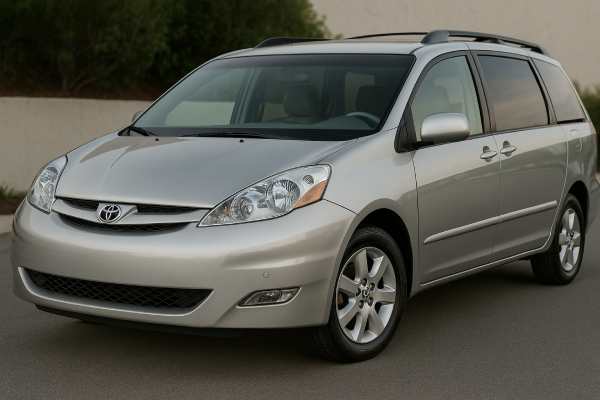
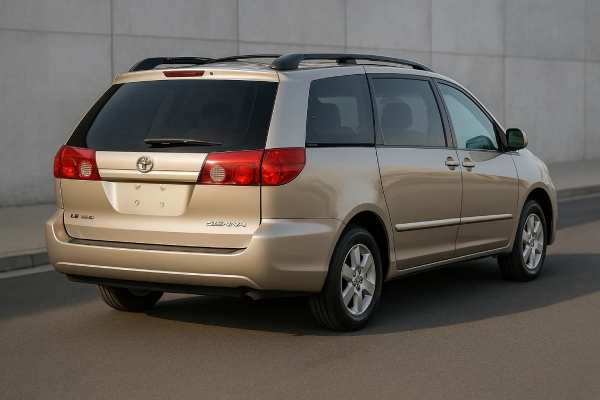
The 2006 Toyota Sienna FWD facelift is one of those rare family vans that combines quiet comfort, strong V6 performance, and long-term durability. Built on the second-generation XL20 platform, this facelift year refined the earlier 3.3-litre Sienna with revised power ratings, more standard safety equipment, and small but meaningful interior updates.
Under the hood, the 3MZ-FE 3.3-litre V6 remains the key attraction: smooth, torquey and reasonably efficient for a seven- or eight-seat minivan. The five-speed automatic and front-wheel drive layout keep running costs lower than the AWD versions, while still towing a small camper or utility trailer without drama.
For families and shuttle duty, the Sienna’s flexible seating, sliding doors and wide cargo opening make everyday use simple. From an ownership perspective, the XL20 Sienna is known more for consumables and preventative maintenance than for catastrophic failures, provided oil changes and cooling system care are not neglected. This guide walks through the 2006 FWD Sienna’s specifications, reliability patterns, maintenance strategy, and how it stacks up against rival vans of the same era.
Quick Specs and Notes
- Strong 3.3-litre V6 (3MZ-FE) with 215 hp and good low-rpm torque for loaded driving and light towing
- Comfortable, quiet ride and spacious cabin with flexible seven- or eight-seat configurations
- Facelift year adds standard side curtain airbags and better crash protection for family use
- Watch for transmission fluid condition, power sliding door issues, and liftgate struts on higher-mileage vans
- Aim for engine oil and filter changes every 8,000–10,000 km or 6 months, with ATF inspection every 30,000–40,000 km
Guide contents
- Toyota Sienna XL20 FWD snapshot
- Sienna FWD 3.3 technical details
- Facelift trims, equipment and safety
- Reliability issues and service actions
- Maintenance planning and buyer advice
- Driving manners and performance feel
- Sienna FWD rivals comparison guide
Toyota Sienna XL20 FWD snapshot
The 2006 Toyota Sienna FWD facelift sits at an interesting point in minivan history. It predates the widespread use of direct injection, turbos and complex transmissions, yet already offers strong safety scores and the practicality modern buyers expect. For owners who want a dependable, traditional V6 minivan without the complexity of later designs, this XL20 Sienna is a sweet spot.
The XL20 platform, introduced for 2004, brought a larger body, much more interior space and a more refined chassis than the first-generation Sienna. By 2006, Toyota had already addressed early run issues such as fuel tank recalls and side-impact protection improvements, and side curtain airbags had become standard on most trims. The facelift year also coincides with updated SAE power rating methods, which is why you will often see both 230 hp and 215 hp quoted for essentially the same 3.3-litre V6. For practical purposes, output and performance feel are unchanged.
In day-to-day use, the front-wheel drive Sienna is easier on running costs than AWD versions. There is no transfer case or rear differential to service, no dedicated run-flat tyres to replace, and fuel consumption is slightly lower. That makes the FWD XL20 a strong candidate for families that primarily drive on paved roads and deal with mild winters.
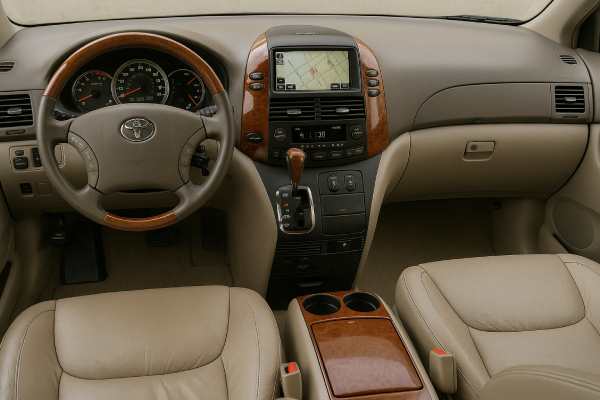
Inside, the cabin is all about usability rather than flash. Sliding second-row seats, available eight-seat layouts, and a low, flat floor make child-seat installation and cargo loading straightforward. Noise levels are low for the class, especially on highway trips. The chassis tuning favours comfort over sharp handling, which is appropriate for the van’s mission.
From a long-term ownership standpoint, the 3MZ-FE engine and U151E automatic transmission have a good durability record when fed clean oil and coolant. The more common issues relate to consumables (struts, brakes, rubber bushings), power sliding doors and ageing liftgate struts. Corrosion resistance is generally good, but vans in heavy salt regions still deserve a thorough under-body inspection.
If you want a 2000s minivan that still feels modern enough to use daily, while remaining easy to service with basic tools and widely available parts, the 2006 Sienna FWD facelift is an appealing choice.
Sienna FWD 3.3 technical details
This section gathers the key technical data for the 2006 Toyota Sienna FWD facelift with the 3MZ-FE 3.3-litre V6 and five-speed automatic transmission. Values can vary slightly by market and trim, so always confirm against the under-hood labels and official service information for a specific VIN.
Engine and performance (3MZ-FE V6)
| Item | Specification |
|---|---|
| Engine code | 3MZ-FE |
| Configuration | 60° V6, aluminium block and heads |
| Valvetrain | DOHC, 4 valves per cylinder, VVT-i on intake |
| Displacement | 3.3 L (3,311 cc) |
| Bore × stroke | Approx. 92.0 × 83.0 mm |
| Induction | Naturally aspirated |
| Fuel system | Multi-point port fuel injection |
| Compression ratio | ~10.8:1 (market-dependent) |
| Max power (facelift rating) | 215 hp (about 160 kW) @ ~5,600 rpm |
| Max torque | Around 222 lb-ft (301 Nm) @ ~3,600 rpm |
| Recommended fuel | Unleaded, typically 87 AKI / 91–92 RON (check market label) |
| Timing drive | Chain-driven camshafts (no scheduled belt replacement) |
| Emissions standard | EPA Tier 2 / Bin level by market year |
Real-world fuel economy for a healthy Sienna FWD typically falls in the 12–14 L/100 km range in mixed use, with highway figures in the high 9s to low 10s L/100 km when driven gently. City-heavy use, short trips and heavy loads can push consumption higher.
Transmission and driveline
| Item | Specification |
|---|---|
| Transmission | 5-speed automatic (U151E) |
| Drive type | Front-wheel drive (FWD) |
| Torque converter | Lock-up, with electronic control |
| ATF type | Toyota ATF Type T-IV |
| Approx. ATF capacity | ~9.3 US qt total fill; ~3.5–4.0 qt typical drain-and-fill |
| Final drive | Integrated into transaxle; ratio varies by market, around mid-3s |
| Differential | Open front differential |
For longevity, it is wise to treat the automatic transmission fluid as a service item rather than “lifetime” fluid, especially if the van tows or sees hot-climate use.
Chassis and dimensions
| Item | Specification |
|---|---|
| Platform | XL20 Sienna (second generation) |
| Front suspension | MacPherson strut, coil spring, anti-roll bar |
| Rear suspension | Torsion beam / trailing arm with coil springs |
| Steering | Rack-and-pinion with power assist |
| Front brakes | Ventilated discs |
| Rear brakes | Solid discs (varies by trim in some markets) |
| Typical tyre size | 215/65 R16 or 225/60 R17, load-rated for minivan duty |
| Length | ~5,105 mm (about 201 in) |
| Width | ~1,965 mm (about 77–78 in) |
| Height | ~1,750 mm (about 68–69 in) |
| Wheelbase | ~3,030 mm (119.3 in) |
| Ground clearance | ~175 mm (6.9 in) |
| Fuel tank capacity | ~79 L (about 21 US gal) |
| Curb weight (FWD) | Roughly 1,880–2,020 kg (4,140–4,460 lb) depending on trim |
| Cargo volume | About 1,230 L (≈43–44 ft³) behind 3rd row; much more with seats folded/removed |
Performance and capability
| Item | Approximate figure |
|---|---|
| 0–100 km/h (0–62 mph) | Around 8.5–9.0 s when lightly loaded |
| Top speed | Limited for family use; in practice around 180 km/h (112 mph) |
| Braked towing capacity | Typically up to about 1,600 kg (3,500 lb) with proper equipment |
| Unbraked towing | Commonly around 450–700 kg (1,000–1,500 lb); check local regs |
| Roof load | Around 75–100 kg (165–220 lb) including rack, depending on system |
Towing ratings depend strongly on market and equipment (tow package, cooling upgrades). Always check the specific vehicle’s compliance label and local regulations.
Fluids, capacities and key torque values
| System | Specification |
|---|---|
| Engine oil grade | 5W-30 API-rated oil is typical for this year; some markets allow 5W-20 |
| Engine oil capacity | ~4.75 L (5.0 US qt) with filter |
| Coolant type | Long-life ethylene glycol, silicate-free, phosphate-based (Toyota Super Long Life Coolant or equivalent) |
| Coolant capacity | ~11.7 L (about 12.4 US qt) for full system refill |
| Automatic transmission | Toyota ATF Type T-IV |
| Power steering | ATF-type fluid (Dexron II/III equivalent in many manuals) |
| Drain plug torque (engine oil) | Around 45 Nm (≈33 lb-ft) |
| Wheel lug nuts | Typically about 103 Nm (≈76 lb-ft) – verify per manual |
Electrical and ignition
| Item | Specification |
|---|---|
| Alternator output | Roughly 130–150 A depending on trim |
| 12 V battery | Group size suited to minivan bay; around 550–650 CCA typical |
| Spark plug type | Long-life iridium plugs (NGK or Denso OE equivalents) |
| Spark plug gap | About 1.1 mm (0.044 in) |
Facelift trims, equipment and safety
For 2006, the Sienna FWD line continued with a familiar trim structure, often labeled CE, LE and XLE in North America. Exact naming can differ slightly in other regions, but the logic is similar: a functional base model, a comfort-biased mid-grade and a more luxurious top trim.
Trims and equipment overview
CE (or base models)
- Seven- or eight-passenger seating, fabric upholstery
- Manual sliding doors, often without power assist
- Steel wheels with covers, smaller audio head unit, fewer power features
- Air conditioning, basic audio, and key safety equipment still standard
LE (volume trim)
- Power windows, locks and mirrors
- Options for power sliding door(s), upgraded audio, and eight-seat layouts
- Alloy wheels available, more storage and convenience features
- Often the best cost-to-equipment balance on the used market
XLE / Limited and regional equivalents
- Leather or premium cloth seating, power driver seat
- Dual power sliding doors, power rear hatch on many examples
- Tri-zone climate control, better audio with more speakers
- Available sunroof, premium wheel designs and additional trim details
Mechanical differences across trims are modest. Most FWD facelift vans share the same 3MZ-FE engine and U151E transmission. Tow package coverage can vary; better-equipped vans are more likely to include factory tow preparation such as an engine oil cooler, alternator rating changes and a larger radiator.
Quick identifiers include wheel designs, interior trim colours, steering wheel material (plain urethane vs leather) and the presence of power door buttons on the dash and B-pillars. The build label in the door jamb and the VIN plate under the windshield can be used to confirm trim and factory options when decoded.
Safety equipment and ratings
By 2006, the Sienna was designed to meet strong family-vehicle safety expectations:
- Front dual-stage airbags
- Standard side curtain airbags covering three rows for many markets
- Front seat-mounted side torso airbags
- ABS (anti-lock brakes) and brake assist
- Vehicle Stability Control (VSC) with traction control on many trims
- LATCH/ISOFIX anchor points for child seats in the second row
In crash testing, the second-generation Sienna scored well in moderate-overlap frontal and side-impact testing. Side airbags became standard by the 2006 model year in major markets, improving protection for occupants in real-world collisions. Head restraint ratings, while adequate, are not on the same level as many newer designs, so proper headrest adjustment remains important.
NHTSA and similar agencies also list several safety and defect investigations affecting 2004–2006 Sienna models, including issues with power liftgate struts and possible fuel system concerns on early production. These are addressed through recalls or service campaigns and should be checked via official VIN lookup tools or national databases before purchase.
ADAS and driver assistance
Advanced driver assistance systems (ADAS) were still limited in 2006:
- No factory adaptive cruise control, lane keeping or autonomous emergency braking
- Basic cruise control available on many trims
- Rear parking sensors or a basic camera system only on some higher-spec models or dealer-installed kits
In practice, safe driving in a 2006 Sienna relies more on good visibility, large mirrors and driver awareness than on electronic aids. The upright driving position and large glass area help, but blind-spot checks are still essential, especially when fully loaded.
Reliability issues and service actions
The 2006 Sienna FWD enjoys a strong reputation for reliability, but like any ageing vehicle it has patterns of wear and known trouble spots. Understanding them helps you prioritise inspections and budget for reconditioning.
Engine and cooling system
1. Oil sludge history (earlier Toyota V6s)
Toyota’s older 3.0-litre engines were known for sludge problems in severe service. The 3.3-litre 3MZ-FE is less prone, but poor oil change habits can still cause deposits, sticky piston rings and varnish.
- Symptoms: Ticking on cold start, blue smoke, high oil consumption, varnished internals.
- Root cause: Extended oil change intervals on conventional oil, high-heat operation.
- Mitigation: Consistent 8,000–10,000 km or 6-month oil changes with quality oil and filters, verifying PCV valve function.
2. Minor coolant leaks and neglected flushes
Age and mileage can lead to radiator end-tank seepage, hose cracking or water pump weeping.
- Symptoms: Sweet smell, slow coolant loss, pink or white crust at joints.
- Root cause: Ageing plastics, seals and coolant, sometimes mixed coolant types.
- Mitigation: Replace suspect hoses and clamps, inspect water pump at timing-chain end, use manufacturer-approved coolant, flush around 160,000 km or 8–10 years if not done sooner.
Automatic transmission and driveline
The U151E automatic is generally robust but responds poorly to overheated or never-changed fluid.
- Common concern: Harsh shifts, flare between gears or delayed engagement after selecting Drive or Reverse.
- Typical mileage band: Often appears beyond 200,000 km if fluid has never been serviced.
- Mitigation: Regular drain-and-fill with the correct ATF T-IV every 50,000–60,000 km for preventative care. If issues already exist, a cautious fluid service and adaptation reset may improve behaviour but cannot reverse severe internal wear.
Sliding doors, liftgate and body hardware
Power sliding doors
- Symptoms: Door stops part-way, beeps and reverses, or refuses to engage power operation.
- Root causes: Dirty tracks, worn cables, misadjusted latches, broken door check arms.
- Remedy: Clean and lubricate tracks, inspect cable assemblies and rollers, adjust latches and check arms. Some failures require new cables or motors.
Power liftgate and gas struts
Certain 2004–2006 Sienna models equipped with power liftgates were subject to campaigns related to gas strut durability. Even without a campaign, worn struts are common at this age.
- Symptoms: Liftgate fails to stay up, slams shut, or opens sluggishly.
- Remedy: Replace both gas struts as a pair; if power functions are erratic, inspect liftgate motor and hinge wiring.
Suspension, steering and brakes
After nearly two decades, many Siennas will need chassis refresh work:
- Front struts and top mounts: Clunking over bumps, floaty ride and uneven tyre wear suggest tired dampers.
- Rear shocks: Excessive body motion on highway undulations or when towing.
- Bushings and ball joints: Creaks, knocks and wandering steering point toward worn lower control arm bushings, sway bar links and, in some cases, outer tie rods.
- Brakes: Pulsation under braking can indicate warped rotors or uneven pad deposits; seized slide pins are common where corrosion is an issue.
Corrosion and body
The XL20 Sienna resists rust better than many contemporaries, but use in harsh salt climates can still produce:
- Surface rust on rear axle beam and suspension arms
- Corrosion at exhaust joints and hangers
- Rust at rear hatch bottom lip and door edges if drainage is blocked
A careful visual inspection and, if possible, a lift inspection are recommended before purchase.
Recalls, TSBs and extended coverage
2004–2006 Sienna models have been subject to various service actions over the years, including:
- Campaigns concerning power liftgate struts on power-equipped vans
- Investigations and fixes for potential fuel tank and underbody components on early production
- Supplemental tyre warranty or service bulletins for run-flat tyre wear on certain AWD and mobility versions
To verify status on a specific van:
- Use official manufacturer recall lookup sites with the VIN.
- Check national safety agency databases for recall and complaint history.
- Ask a dealer to print the campaign and recall completion history from the manufacturer system.
A prospective buyer should request documentation of recall completion when possible.
Maintenance planning and buyer advice
A 2006 Sienna FWD can deliver many more years and hundreds of thousands of kilometres of service if maintained methodically. Below is a practical maintenance framework; always adjust to local recommendations and the vehicle’s history.
Core service intervals (typical guidance)
- Engine oil and filter: Every 8,000–10,000 km or 6 months, whichever comes first. Short-trip or heavy-load use justifies the shorter end.
- Engine air filter: Inspect yearly, replace around 30,000–40,000 km or as needed.
- Cabin air filter: Replace every 20,000–30,000 km or annually in dusty climates.
- Coolant: Replace around 160,000 km or 8–10 years if factory long-life coolant is still in place; then every 80,000–100,000 km.
- Spark plugs (iridium): Typically around 160,000 km; inspect earlier if misfire or rough idle appears.
- Fuel filter: Integrated with the fuel pump module on many models and usually serviced only when symptoms or pump replacement occur.
- Auxiliary (serpentine) belt: Inspect from 100,000 km onward; replace at first signs of cracking, glazing or noise.
- Automatic transmission fluid (U151E): Drain-and-fill every 50,000–60,000 km as a preventative measure, especially if towing.
- Brake fluid: Flush every 2–3 years regardless of mileage.
- Brake pads and rotors: Inspect at every tyre rotation; replace when below minimum thickness or if pulsation persists after cleaning and bedding.
- Tyre rotation and alignment: Rotate every 10,000–12,000 km; align whenever tyres are replaced or if uneven wear appears.
- Steering and suspension inspection: Annually, or sooner if clunks, pulling or uneven tyre wear occur.
- 12 V battery testing: Test yearly after 5 years of age; many last 5–7 years depending on climate.
The camshafts are chain driven, so there is no fixed timing belt interval. However, listen for chain rattle on cold starts or timing-related trouble codes. If present, chain, guides and tensioners may need attention.
Fluid choices and capacities (decision-level summary)
- Engine oil: 5W-30 synthetic or synthetic-blend meeting API requirements; about 4.75 L with filter.
- Coolant: Phosphate-based long-life coolant compatible with Toyota formulations; full system around 11.7 L.
- ATF: Toyota ATF Type T-IV for the U151E. Use drain-and-fill with level check at the correct temperature, rather than power-flushing.
- Power steering: ATF-type fluid; avoid mixing random formulations and confirm compatibility.
Pre-purchase inspection checklist
When evaluating a used 2006 Sienna FWD, it is wise to:
- Check service history: Look for evidence of regular oil changes, at least one coolant service, and any transmission fluid changes.
- Verify recall status: Use official VIN lookup tools for open recalls and campaigns.
- Inspect underbody: Check for corrosion on the rear axle beam, front subframe, brake lines and exhaust.
- Assess suspension: Road-test for clunks, knocks and wandering; visually inspect struts, shocks, bushings and ball joints.
- Evaluate brakes and tyres: Look for uneven tyre wear (alignment or suspension issue) and remaining pad/rotor life.
- Test power doors and liftgate: Operate sliding doors and the rear hatch repeatedly; intermittent operation can signal upcoming repairs.
- HVAC and electronics: Confirm proper operation of all climate zones, rear blower, audio, windows and locks.
Which Sienna FWD to choose?
For most buyers, a well-maintained LE or mid-grade equivalent is the sweet spot. You typically gain useful comfort features (power sliders, better audio, often stability control) without the maximum complexity of the highest-spec variants.
Avoid vans with:
- Evidence of neglected maintenance (dark ATF, sludge, overdue coolant)
- Serious rust on structural members
- Unresolved check-engine lights, especially related to catalyst efficiency or transmission faults
A Sienna FWD with solid history, clean underside and smooth driveline can be a very long-lived family vehicle, with parts availability and independent shop familiarity working strongly in its favour.
Driving manners and performance feel
The 2006 Sienna FWD is first and foremost a family transporter, but its road manners are better than many expect from a large minivan of this era.
Ride, handling and NVH
Ride quality is tuned for comfort. On typical roads:
- Small bumps and expansion joints are absorbed without harshness.
- Body motions are controlled but slightly soft, which keeps occupants comfortable on long trips.
- With fresh dampers and good tyres, the van feels stable and predictable at highway speeds.
In corners, the Sienna leans noticeably if driven aggressively, but grip levels are appropriate for the class. The steering is light at parking speeds and weights up modestly on the highway, though feedback is muted. Noise, vibration and harshness are well suppressed; wind and road noise are modest for a 2000s minivan, especially with good door seals and quality tyres.
Powertrain character
The 3.3-litre 3MZ-FE delivers power in a smooth, linear way:
- Strong low-to-mid-range torque makes it easy to merge, climb hills and accelerate with a full load.
- The engine revs willingly but rarely needs to be pushed to redline in normal use.
- The five-speed automatic generally shifts smoothly, with sensible gear choice and decent kickdown response.
With healthy fluid and no internal wear, the U151E transmission moves unobtrusively through its ratios. At steady highway speeds, engine rpm settles into a relaxed range that keeps fuel use reasonable and noise low.
Real-world efficiency
Owners often report:
- City driving: Around 14–16 L/100 km in stop-and-go use, depending on load and climate.
- Highway driving: Around 9.5–11 L/100 km at typical freeway speeds when lightly loaded.
- Mixed use: Roughly 11–13 L/100 km for many drivers.
Cold weather, roof boxes, towing and heavy passenger loads can increase consumption. Conversely, careful driving, proper tyre pressures and synthetic engine oil can nudge figures slightly lower.
Load carrying and towing
With the third row in use, cargo space is still respectable thanks to the deep well behind the seats. Folding or stowing the third row and sliding or removing the second row greatly increases carry capacity. The low floor and wide opening make loading large items simpler than in many SUVs.
When towing within the rated limits and equipped with an appropriate hitch and wiring:
- The Sienna FWD remains stable at moderate speeds.
- Braking feel depends heavily on the trailer having its own brakes; unbraked loads near the limit are not recommended.
- Engine and transmission temperatures remain reasonable if the fluid is fresh and the cooling system is healthy.
Frequent towing justifies more aggressive transmission fluid change intervals and regular inspection of the cooling fans, radiator and transmission cooler lines.
Winter and wet-weather behaviour
With good all-season or dedicated winter tyres, the FWD Sienna copes well with rain and light snow. The vehicle stability control and traction control help manage wheelspin on slippery surfaces, but they cannot compensate for worn or unsuitable tyres. For regions with steep hills and heavy snow or ice, some drivers may still prefer the AWD variant, but for many climates, the FWD version is entirely adequate.
Sienna FWD rivals comparison guide
When it was new, the 2006 Toyota Sienna FWD competed mainly with the Honda Odyssey, Chrysler Town & Country / Dodge Caravan, Kia Sedona and various domestic vans. Understanding how it compares helps frame its strengths as a used purchase.
Versus Honda Odyssey (2005–2007)
Strengths of the Sienna FWD:
- Generally lower incidence of serious transmission failures in this generation.
- Softer, more isolated ride that some families prefer on long trips.
- Simpler powertrain tuning with fewer complaints of engine noise at highway speeds.
Odyssey advantages:
- Sharper steering and more engaging handling.
- Often slightly more premium interior feel in higher trims.
- Some trims offer more advanced features for the era, such as power tailgates and rear entertainment options.
For buyers prioritising rock-solid long-term durability and comfort over sporty dynamics, the Sienna FWD tends to edge out the Odyssey of the same era.
Versus Chrysler/Dodge vans (Town & Country, Grand Caravan)
Chrysler and Dodge vans of the mid-2000s are widely available and often cheaper to buy.
- Sienna strengths: Better overall long-term reliability, usually fewer major engine/transmission failures, and stronger resale value.
- Chrysler/Dodge strengths: Lower purchase prices, simple mechanicals in base trims, and a large used-parts supply.
If you are willing to take on more potential repair risk for a lower upfront cost, a domestic van might appeal. If you want a lower-stress ownership experience, the Sienna makes a compelling case.
Versus Kia Sedona and other value-focused vans
Kia Sedona and similar vans often undercut the Sienna on initial purchase price and sometimes include more features for the money.
- Sienna strengths: More established long-term durability record, stronger parts and service network in many markets, and better retained value.
- Sedona strengths: Attractive pricing and, in some years, high feature content.
On the used market, a well-maintained Sienna will typically outlast a similar-age value-brand van with fewer major repairs, which is why many buyers gladly pay a little more upfront.
Where the 2006 Sienna FWD fits today
In today’s market, the 2006 Sienna FWD facelift appeals to:
- Families wanting a budget-friendly, spacious hauler with a track record for durability
- Shuttle, rideshare or community service use where easy access and flexible seating are important
- Owners who prefer proven naturally aspirated engines and conventional automatics over more complex modern drivetrains
Against newer rivals, its main weaknesses are age-related: fewer advanced safety aids, older infotainment and the possibility of accumulated wear. However, for buyers who prioritise reliability and practicality over technology, a clean 2006 Sienna FWD remains a strong, rational choice.
References
- Gas Mileage of 2006 Toyota Sienna 2024 (Fuel Economy Data)
- 2006 Toyota Sienna 2024 (Safety Rating)
- Vehicle Detail Search – 2006 TOYOTA SIENNA 2024 (Recall Database)
- Recalls & Campaigns Lookup 2024 (Recall Database)
Disclaimer
This article is for informational purposes only and is not a substitute for professional diagnosis, repair advice or official service documentation. Specifications, torque values, fluid capacities, service intervals and procedures vary by VIN, market, production date and equipment level. Always confirm all values and procedures using the official owner’s manual, workshop manual and technical bulletins applicable to your specific vehicle.
If you found this guide useful, you are welcome to share it with other owners or enthusiasts on social media platforms such as Facebook or X/Twitter to help support xcar’s work and make reliable technical information easier to find.