
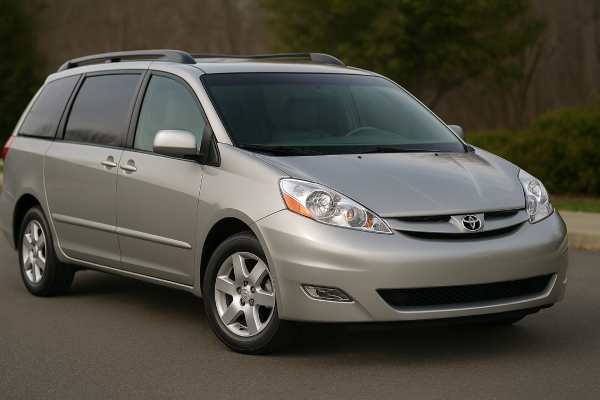
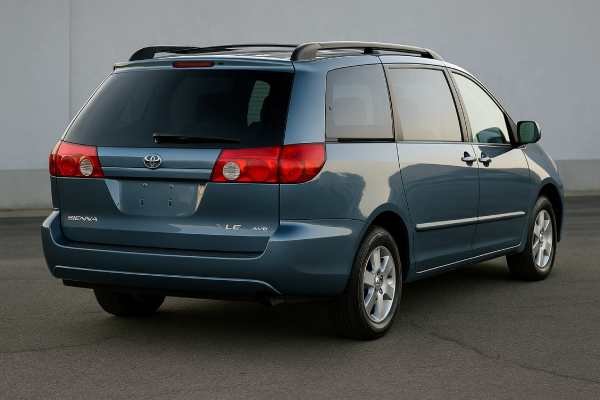
The 2006 Toyota Sienna AWD (XL20) facelift sits in a sweet spot for many family buyers: modern enough to feel safe and refined, but old-school enough to be straightforward to own and service. Powered by the 3.3-liter 3MZ-FE V6 and paired with a five-speed automatic and full-time all-wheel drive, this short-run facelift combines extra safety updates and equipment tweaks with a familiar, proven powertrain. In day-to-day use it delivers the things minivan owners care about most: predictable reliability, strong cabin practicality, and comfortable highway manners.
This guide focuses specifically on the 2006 AWD facelift model with the 215 hp rating, explaining how it differs from earlier 230 hp versions, what to expect in fuel economy and performance, and which maintenance items deserve priority as the vehicle ages. It is written for current owners, DIY enthusiasts, and shoppers who want a clear, technically grounded picture rather than marketing language.
Essential Insights
- Strong 3.3-liter V6 delivers smooth power and enough torque for full family and luggage.
- AWD system adds foul-weather security and traction on wet, snowy or unpaved roads.
- Flexible seating, flat load floor, and sliding doors make it easy to live with every day.
- Watch for aging cooling components and transmission fluid condition by 150,000–200,000 km.
- Plan engine oil changes every 8,000–10,000 km or 6–12 months, depending on usage pattern.
What’s inside
- AWD Sienna XL20 overview
- 3.3 AWD drivetrain data
- Facelift AWD trims and safety
- Reliability of 2006 Sienna AWD
- Maintenance plan and buying tips
- On-road performance and AWD feel
- How this Sienna AWD compares
AWD Sienna XL20 overview
The second-generation Sienna (XL20) moved the model firmly into “quiet family highway cruiser” territory, and the AWD variant doubles down on that mission. It shares the same XL20 platform as front-drive models but adds a transfer assembly on the transaxle, a prop shaft to the rear, and an independent rear differential. Combined with the torquey 3MZ-FE 3.3-liter V6, it gives the van secure, all-weather traction without the complexity of a truck-style 4×4 system.
For 2006, the facelift brought mild exterior tweaks (lights, grille details, trim changes) and, more importantly, a revised power rating: what had previously been advertised around 230 hp was now rated at 215 hp under updated SAE measurement standards. In practice, the driving feel is essentially unchanged; the re-rating reflects a different test procedure rather than a major mechanical change. Owners stepping from an earlier XL10 or pre-facelift XL20 will notice more sound insulation, a more upscale cabin, and better crash-protection design.
The AWD Sienna’s mission is straightforward:
- Carry up to seven or eight people in comfort.
- Handle poor weather or steep driveways with less drama than a FWD van.
- Tow a modest trailer or small camper within its rated limits when needed.
Practical touches stand out: a low step-in height, wide sliding-door apertures, and a flat cargo floor with the third row folding into the floor. Many AWD examples were sold in higher trims (LE, XLE) with power doors, power tailgate, and upgraded audio, so used shoppers often find relatively well-equipped vehicles.
With proper maintenance, these vans are capable of very high mileages. The core engine and gearbox are shared with other Toyota products, and most weak points are related to age, fluids, and consumable components rather than catastrophic design flaws. That said, the AWD hardware and run-flat tyre requirement on many trims do add cost and complexity, so it is worth understanding them before you buy.
3.3 AWD drivetrain data
This section summarizes key technical details for the 2006 Sienna AWD 3.3-liter facelift. Values may vary slightly by market and trim, but the overall picture is consistent.
Engine and performance
| Item | Specification (2006 AWD 3.3) |
|---|---|
| Engine code | 3MZ-FE V6, petrol |
| Layout | 60° V6, transverse, DOHC, 24 valves |
| Displacement | 3.3 l (3,310 cc) |
| Bore × stroke | approx. 92.0 × 83.0 mm |
| Compression ratio | around 10.8 : 1 |
| Induction | Naturally aspirated |
| Fuel system | Multi-port electronic fuel injection |
| Rated output | 215 hp (approx. 160 kW) @ ~5,600 rpm |
| Rated torque | about 328 Nm (242 lb-ft) @ ~3,600 rpm |
| Timing drive | Chain-driven camshafts |
| Emissions standard (NA) | Tier 2 / LEV-equivalent depending on state |
In real-world use, the 3MZ-FE is known for smoothness and a broad mid-range, with enough low-rpm torque to move a full load without constant downshifts. Owners typically see mixed fuel economy in the 11–13 l/100 km range (18–21 mpg US), with highway figures slightly better and city use slightly worse, especially in short-trip or cold-weather driving.
Transmission and AWD system
| Item | Specification |
|---|---|
| Transmission | 5-speed automatic (U151F family) |
| Drive layout | Full-time AWD, front-biased |
| Center coupling | Active coupling to rear differential (on-demand torque transfer) |
| Rear differential | Open differential |
| Traction aids | ABS, traction control, stability control depending on trim/year |
| Final drive (front) | Approx. low-3.xx : 1 (varies slightly by trim) |
AWD in this Sienna is tuned for security rather than off-road work. Under normal cruising it behaves like a front-drive van; when slip is detected, torque is sent rearward through the coupling. There is no low-range, and ground clearance remains minivan-typical, so think “snow and wet-grass ally” rather than “rock crawling.”
Chassis, dimensions, and weights
| Item | Value (typical AWD model) |
|---|---|
| Body style | 5-door MPV / minivan |
| Length | ~5,085 mm (200.2 in) |
| Width | ~1,965 mm (77.4 in) |
| Height | ~1,750–1,755 mm (69.0–69.1 in) |
| Wheelbase | 3,030 mm (119.3 in) |
| Curb weight | roughly 2,050–2,120 kg (4,520–4,675 lb) depending on trim |
| Fuel tank | about 79–80 l (~21 US gal) |
| Seating | 7 or 8 seats (second-row bench or captain’s chairs) |
| Cargo volume | generous, with fold-into-floor third row and removable/tilt-out second row |
Suspension is by MacPherson struts up front and a torsion-beam or trailing-arm layout at the rear, tuned more for comfort than sharp handling. Steering is power-assisted rack-and-pinion. Brakes are four-wheel discs with ABS; many AWD trims use slightly larger front discs than base FWD vans.
Fluids and service-related specs (typical)
- Engine oil: 5W-30 API SL or better; capacity around 5.0–5.5 l with filter.
- Coolant: long-life ethylene glycol; roughly 7–8 l for full system depending on spec.
- Automatic transmission fluid: Toyota-spec ATF (often T-IV or WS depending on build); expect 3–4 l on a simple drain and refill, more for full exchange.
- Differentials and transfer: hypoid gear oil meeting GL-5 spec; capacities are modest but changes are important for AWD longevity.
Always verify exact fluids and capacities for your VIN in official service information, as running changes and market differences exist.
Facelift AWD trims and safety
In 2006, the AWD option was generally paired with mid- to upper-level trims rather than the most basic grade. Exact naming varies by region, but in North America you typically see LE AWD and XLE AWD, sometimes with Limited or package codes on top. These higher trims bring:
- Power sliding doors (often both sides) and sometimes a power tailgate.
- Upgraded audio, steering-wheel controls, and available rear entertainment.
- Trip computer, more comprehensive gauge cluster, and additional interior storage.
- Alloy wheels and, on some models, self-sealing or run-flat tyres (more common on AWD).
Mechanically, the AWD trims share the same core engine and gearbox as FWD counterparts but differ in:
- Addition of the AWD transfer unit, prop shaft, and rear differential.
- Slightly higher curb weight and, on some trims, different rear suspension tuning.
- Tyre fitment: certain models used run-flats and deleted the spare wheel well to accommodate the AWD hardware.
From a safety perspective, the XL20 Sienna brought a newer crash structure compared with the original XL10. In independent crash testing, the 2004–2010 Sienna series (which includes the 2006 facelift) achieved high ratings in frontal and side-impact tests when equipped with side airbags, reflecting the strength of its basic body shell and restraint systems. ([IIHS HLDI][1])
Key passive-safety features, depending on trim and market, include:
- Dual front airbags and front side airbags.
- Side curtain airbags for all three rows on many mid/high trims.
- Energy-absorbing steering column and pedal design.
- LATCH/ISOFIX child-seat anchor points in the second row and top-tether anchors in the third row.
Electronic safety and driver-assistance systems on the 2006 AWD facelift are simpler than modern vans but still useful:
- Four-channel ABS with electronic brakeforce distribution.
- Traction control that limits wheelspin on slippery surfaces.
- Stability control (Vehicle Stability Control) present on many AWD higher trims.
- Tyre-pressure monitoring on certain markets and packages.
Advanced driver-assist features like automatic emergency braking, adaptive cruise, or lane-keeping were not part of this generation, so expectations should be kept in line with early-2000s design. The upside is fewer sensors and cameras to calibrate after repairs, lowering complexity and long-term cost.
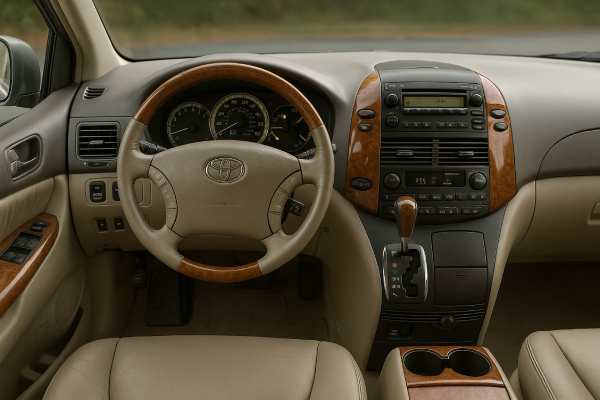
Visually, trims can often be identified by wheel design, roof-rack style, and interior finish (wood-look trim and leather on XLE/limited models; simpler cloth and plastics on LE). Checking the build plate and option codes or using an online VIN decoder can clarify original trim and safety equipment for a specific van.
Reliability of 2006 Sienna AWD
The 3MZ-FE Sienna AWD has a solid reputation when serviced on time, but these vans are now approaching or past two decades old, so age-related issues matter more than original warranty statistics. Below is a practical map of what tends to go wrong, and when.
Engine and cooling
Common to occasional:
- Valve-cover and oil-filter housing leaks – Gaskets harden with age and heat, leading to oil seepage onto the block or exhaust. Symptoms are burning-oil smells and damp areas around covers. Remedy: replace gaskets and clean mating surfaces; cost is mostly labour.
- Cooling system wear – Radiator plastic end tanks, hoses, and thermostat housings can crack or leak in the 10–15-year window. Overheating is the big risk, so any coolant smell, low coolant, or visible crust should be taken seriously. Preventive replacement of original parts by ~200,000 km is wise.
The timing system is chain-driven and generally robust, so there is no scheduled belt change. However, noisy chains, startup rattle, or timing-correlation codes should prompt inspection of guides and tensioners, especially on engines that have seen extended oil-change intervals.
Transmission and AWD hardware
The five-speed automatic is durable if fluid has been changed reasonably often. Problems that show up on poorly maintained units include:
- Harsh or flaring shifts between certain gears.
- Delayed engagement when shifting from Park to Drive or Reverse.
- Shudder at light throttle in higher gears.
Often, a series of drain-and-refill services with the correct ATF improves behaviour; badly neglected boxes may need valve-body work or a rebuild.
On the AWD side, the main concerns are:
- Transfer and rear-diff fluid neglect – When never serviced, fluids degrade and can lead to bearing or gear wear. Inspect for whining or humming that changes with road speed.
- Prop-shaft and CV joints – Torn boots and worn joints show up as vibration or clunks on acceleration or at full steering lock.
Suspension, steering, and brakes
At this age, most Siennas will benefit from:
- Front strut and top-mount replacement, especially if ride has become floaty or noisy.
- New lower control-arm bushings and ball joints to remove clunks and vague steering.
- Rear bushings and possibly rear dampers, particularly on heavily loaded or tow-used vans.
Wheel bearings can also fatigue, particularly in harsher climates or where salt is used on the roads. A growling noise that increases with speed and changes when you gently swerve left/right is typical.
Body, electrical, and corrosion
Minivans live hard lives. For the XL20 Sienna:
- Sliding doors – Check for misalignment, stiff operation, and failing power mechanisms. Dirty tracks, worn rollers, or broken wiring in the door-jamb can all contribute.
- Tailgate struts – Weak struts allow the tailgate to sag or fall, an inexpensive but important safety fix.
- Corrosion – Inspect rear subframe, fuel-filler area, and lower door edges, especially in regions with winter road salt.
Electrical issues are usually minor: window switches, door-lock actuators, and interior-lighting quirks rather than major ECU failures.
Recalls and service actions
XL20 Siennas have been subject to various recalls over their life cycle, including sliding-door and seat-mount campaigns. Later model years (not the 2006 facelift) are involved in Takata airbag inflator recalls, demonstrating why it is crucial to run a VIN check even if your specific year is not widely mentioned in the news. ([NHTSA][2])
For any candidate van, have the seller provide proof that recall work has been completed where applicable, and then verify that information using the official VIN-lookup tools provided by safety authorities and Toyota’s owner portals.
Maintenance plan and buying tips
A 2006 Sienna AWD can still be an excellent family workhorse if you treat maintenance as an investment rather than an afterthought. Below is a practical schedule; always adapt to your climate, usage, and official documentation.
Core maintenance schedule (typical)
- Engine oil and filter
- Every 8,000–10,000 km or 6–12 months, whichever comes first.
- Use quality 5W-30 meeting or exceeding the original specification.
- Engine air filter
- Inspect every 20,000 km; replace by 40,000 km or sooner in dusty use.
- Cabin air filter
- Replace every 20,000–25,000 km or annually to keep HVAC efficient.
- Coolant
- Long-life coolant typically first change around 160,000 km or 8–10 years from new, then every 80,000–100,000 km or 5 years. For a used van with unknown history, baseline it sooner.
- Spark plugs
- Iridium plugs often last 160,000 km; on a high-mileage used van, plan replacement if there is no record.
- Fuel filter
- Many are “lifetime” in-tank units; in practice, consider replacement if you have the tank down for pump work or if fuel-delivery problems appear.
- Automatic transmission fluid
- Drain-and-refill every 50,000–60,000 km is a good target, more frequently for heavy towing or city service.
- AWD transfer case and rear differential fluid
- Replace every 60,000–80,000 km; this is cheap insurance for expensive hardware.
- Brake fluid
- Flush every 2–3 years regardless of mileage to prevent internal corrosion.
- Brake inspection
- Inspect pads, rotors, and sliding pins at least annually.
- Belts and hoses
- Inspect at each service; expect to replace original-style belts and main hoses by 150,000–200,000 km or 10–12 years.
- Tyres and alignment
- Rotate tyres every 10,000–12,000 km; check alignment after suspension work or if you notice uneven wear. Run-flats, if fitted, may wear differently and cost more to replace.
- 12 V battery
- Test yearly after about 4–5 years of age; pre-emptive replacement is sensible in harsh climates.
For torque-critical jobs (wheel nuts, suspension, engine mount bolts), use a calibrated torque wrench and the values from official workshop data.
Buyer’s checklist
If you are shopping for a 2006 Sienna AWD:
- Service records – Look for consistent oil changes and at least some documented transmission and coolant service.
- AWD health – On a test drive, listen for whines or hums at steady speeds and check for clunks when accelerating, coasting, and turning; these can indicate driveline wear.
- Cooling system – Inspect the radiator, expansion tank, hoses, and water-pump area for leaks or staining. Watch the temperature gauge closely on a long test drive.
- Brakes and suspension – Feel for vibrations under braking and excessive float or wallow over bumps; budget for struts, bushings, and tyres if the van feels loose.
- Doors and tailgate – Operate every sliding door (manually and via power switches). A healthy van should open and close smoothly without unusual noises or hesitation.
- Interior wear – Check seat tracks, fold-into-floor mechanisms, and child-seat anchors; heavy family use can leave them sticky or damaged.
Which examples to prefer
- Vans with complete records, especially for ATF and cooling system, are worth a premium.
- Higher trims (LE/XLE AWD) often bring more safety equipment and comfort features but may also have more complex power doors to maintain.
- Avoid vans with visible rust on subframes or structural areas unless you are prepared for welding and ongoing corrosion management.
Long-term, a well-maintained 2006 Sienna AWD can still offer many reliable years. Parts availability remains good, and many independent shops are familiar with the platform.
On-road performance and AWD feel
Despite its size and age, the 2006 Sienna AWD does not feel sluggish. The 3MZ-FE pulls cleanly from low revs, and the five-speed automatic keeps the engine in its torque band without constant hunting. In typical trim, you can expect 0–100 km/h (0–62 mph) in the high-8-second to low-9-second range, depending on load and conditions. Passing power from 80–120 km/h (50–75 mph) is adequate for safe highway merges and overtakes when you plan your moves.
Ride quality is tuned for comfort. The suspension soaks up expansion joints and rough city surfaces well, especially on the stock-size wheels and tyres. On long trips, the combination of soft seats, low wind noise, and a relaxed engine makes for low fatigue. Body roll is noticeable if you push hard into bends; this is a tall, heavy minivan, not a sport wagon, and it drives best when you treat it that way.
Noise, vibration, and harshness (NVH) are reasonably well controlled for an early-2000s design. At highway speeds, most noise comes from tyres and wind; the engine hums quietly in the background at low rpm in top gear. Worn door seals, aged suspension, or budget tyres can increase cabin noise, so condition matters a lot.
The AWD system’s behaviour is mostly transparent. In dry conditions, you may not notice it at all except for slightly heavier fuel consumption compared with FWD. In rain or snow, the van feels more planted when pulling away from junctions or climbing hills, especially when fully loaded. Stability-control interventions are generally smooth rather than abrupt; they step in if you enter a corner too fast on slippery pavement, trimming power and applying brakes to keep the van on line.
Real-world fuel consumption for AWD models is typically 0.5–1.0 l/100 km worse than comparable FWD vans due to extra driveline losses and weight. On long highway runs at 100–120 km/h, many owners report mid-20s mpg US (around 9–11 l/100 km) when driving gently; city consumption in stop-and-go conditions can drop into the mid-teens mpg US (around 13–15 l/100 km). Tyre choice, roof-rack use, and load have noticeable effects.
Towing up to the rated limit is realistic for occasional use, provided the transmission is serviced, the cooling system is healthy, and you drive conservatively. Expect a significant fuel-economy penalty and more heat load on long grades; a separate transmission cooler is a worthwhile addition for frequent towing. With a full cabin and luggage but no trailer, the Sienna AWD remains stable and predictable as long as tyres are in good condition and correctly inflated.
How this Sienna AWD compares
When new, the 2006 Sienna AWD competed mainly with:
- Honda Odyssey (FWD only in this era).
- Chrysler Town & Country / Dodge Grand Caravan (some AWD variants in earlier years, then FWD).
- Nissan Quest and other regional minivans.
Compared with the Honda Odyssey, the Sienna AWD trades a slightly more engaging steering feel and marginally better fuel economy (for Honda) for the security of all-wheel drive and, in many owners’ eyes, a more relaxed, quieter ride. The Odyssey’s V6 and five-speed automatic are strong, but some model years have more prominent transmission-reliability stories, whereas the Sienna’s issues tend to be more about neglect than design.
Versus the Chrysler vans of the same period, the Sienna AWD usually wins on long-term durability of powertrain and interior trim. Chrysler’s Stow ’n Go seating was more flexible in some configurations, but their transmissions and electrical systems were more failure-prone. The Sienna’s AWD hardware is also less complex than some earlier Chrysler AWD attempts and tends to age more gracefully if serviced.
Against other Japanese alternatives like the Nissan Quest, the Sienna offers a more conservative interior but generally better resale value and a larger support network among independent shops. AWD availability is a key differentiator; if you live in a snowbelt region or regularly travel to mountain areas, the Sienna’s all-weather capability is a tangible advantage over front-drive-only rivals.
For budget-minded buyers, the Sienna AWD may cost a little more to purchase and fuel than a comparable FWD minivan, but it often repays that premium in fewer major mechanical surprises and a stronger used-market reputation. If you prioritize sheer interior cleverness and sliding-seat systems, some competitors are more adventurous. If you want a straightforward, robust van that quietly handles bad weather and long trips, the 2006 Sienna AWD facelift remains a strong choice.
References
- Toyota Sienna 2004-10 – IIHS-HLDI crash testing and highway loss data 2023 (Safety Rating)
- Toyota Sienna II 3.3 V6 4WD (230 Hp) Automatic Technical specs 2022 (Technical Specs)
- Fuel Economy of the 2006 Toyota Sienna 2023 (Fuel Economy Data)
- 2006 Toyota Sienna Owner’s Manual 2006 (Owner’s Manual)
- ◄ IMPORTANT UPDATE ► 2019 (Recall / Takata Background)
Disclaimer
This article is for informational purposes only and is not a substitute for professional diagnosis, repair, or safety advice. Specifications, torque values, service intervals, and procedures can vary by VIN, market, production date, and installed equipment. Always confirm details against the official service manual, technical bulletins, and parts information for your specific vehicle before performing any work.
If you found this guide helpful, consider sharing it with other owners and enthusiasts on social platforms such as Facebook or X/Twitter to support xcar’s work and help more people maintain their vehicles safely and effectively.