
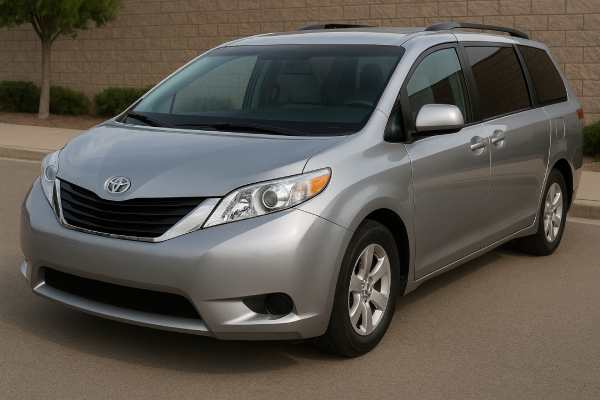
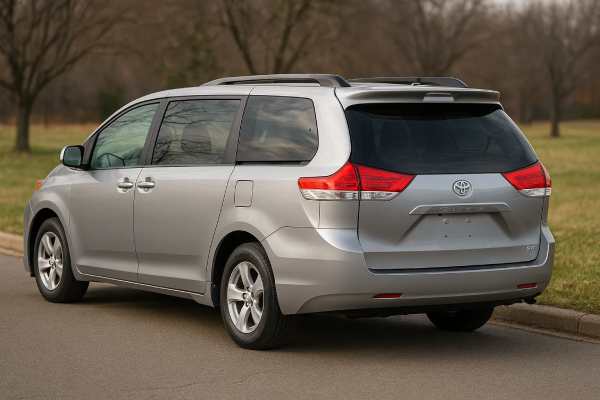
The third-generation Toyota Sienna (XL30) arrived for the 2011 model year with a clear mission: carry families in comfort while being quieter, safer, and more efficient than the second-generation van. At the bottom of the range sat the front-wheel-drive 2.7 litre four-cylinder, using the 1AR-FE engine with 187 hp. It was aimed at buyers who valued lower purchase cost and fuel consumption over maximum performance, and who typically drove unladen or mostly in town.
Paired with a 6-speed automatic and a well-tuned suspension, the 2.7 Sienna feels more modern than earlier four-cylinder vans. You get a rigid body shell, standard stability control, three-row curtain airbags, and crash performance that helped the XL30 earn strong safety scores. At the same time, this is a heavy van with a relatively modest engine, so expectations about acceleration and towing need to be realistic.
If you understand that trade-off and maintain the vehicle correctly, the 2.7 FWD Sienna can be a durable, low-drama long-term family hauler.
Top Highlights
- Four-cylinder Sienna XL30 offers lower fuel use and purchase price than V6 models, with simple non-turbo hardware.
- Spacious three-row interior with flexible seating and one of the largest cargo volumes in its class.
- Strong safety performance with multiple airbags and standard stability control for 2011–2012 models.
- Watch for age-related sliding door issues and recalls; verify completion through an official VIN check.
- Typical service rhythm: 0W-20 oil and filter every 10,000 miles or 12 months, with more frequent changes under severe use.
Section overview
- Toyota Sienna XL30 2.7 overview
- XL30 1AR-FE specs and data
- XL30 FWD trims and safety features
- XL30 2.7 reliability and issues
- Maintenance plan and buyer guide
- Driving performance and efficiency
- How Sienna 2.7 compares
Toyota Sienna XL30 2.7 overview
When Toyota launched the XL30 Sienna, the 2.7 litre front-wheel-drive variant became the entry ticket to the range in North America. Mechanically, it combines a transverse-mounted 1AR-FE inline-four with a 6-speed automatic and conventional FWD layout. There is no all-wheel drive pairing with this engine; AWD was reserved for the 3.5 litre V6.
The 1AR-FE is a modern all-aluminium, chain-driven DOHC engine with dual variable valve timing. It was designed more for smoothness and efficiency than outright power. In the Sienna, it makes 187 hp at around 5800 rpm and about 186 lb-ft of torque near 4100 rpm. Those numbers are adequate in a midsize crossover, but in a seven- or eight-seat van weighing over two tons, they produce only modest acceleration, especially with a full complement of passengers.
Where the 2.7 FWD Sienna redeems itself is in running cost and mechanical simplicity. Compared with the V6, it tends to consume less fuel in gentle use, has easier access around the engine bay, and places less stress on the automatic transmission under light loads. If you mostly run suburban errands, carry a couple of passengers, and rarely tow, the four-cylinder powertrain can feel perfectly acceptable.
The XL30 chassis marked a real step forward over the earlier XL20. You get a stronger body shell, improved noise insulation, and a more refined suspension tune. Front MacPherson struts and a torsion-beam rear axle keep the layout simple, but Toyota spent time on bushing tuning so the van rides with more composure on broken pavement. Electric power steering reduces parasitic drag and allows light effort at parking speeds.
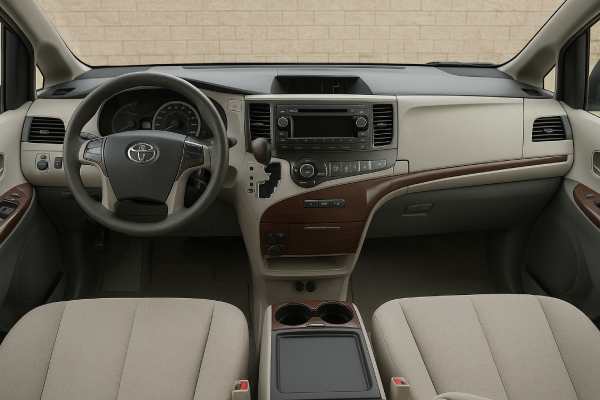
Inside, the Sienna offers three-row seating with either seven or eight seats, depending on trim. Even the base four-cylinder models gain the key structural safety features, three-row side curtain airbags, and stability control. Higher trims add conveniences like power sliding doors, upgraded audio, and navigation, but the basic cabin layout is shared.
For buyers considering a 2011–2012 Sienna FWD 2.7 today, the key is matching expectations: it is a practical, safe, comfortable people mover with low complexity, but not a performance or heavy-towing van.
XL30 1AR-FE specs and data
This section focuses on the 2011–2012 Toyota Sienna XL30 with the 2.7 litre 1AR-FE engine and front-wheel drive. Values can vary slightly by market and trim, so always verify against the build data for a specific VIN.
Engine and performance
| Item | Specification |
|---|---|
| Engine code | 1AR-FE |
| Layout and cylinders | Inline-4, transverse, DOHC, 16 valves |
| Valves per cylinder | 4 |
| Displacement | 2.7 l (approx. 2670 cc) |
| Bore × stroke | 90.0 mm × 105.0 mm (3.54 in × 4.13 in) |
| Induction | Naturally aspirated |
| Fuel system | Port fuel injection (sequential multi-point) |
| Compression ratio | Around 10.0:1 |
| Max power | 187 hp (about 139 kW) @ 5800 rpm |
| Max torque | ~252 Nm (186 lb-ft) @ 4100 rpm |
| Timing drive | Chain-driven camshafts |
| Emissions / standard | Typically ULEV-II / Tier 2 Bin 5 in North America |
| Recommended fuel | Regular unleaded gasoline (87 AKI) |
| Rated economy (EPA, FWD 4-cyl) | Approx. 19 mpg city / 24 mpg highway / 21 mpg combined |
| Rated economy (metric equivalent) | ~12.4 / 9.8 / 11.2 l/100 km (approximate) |
| Real-world highway @ 120 km/h | Commonly 9–11 l/100 km (21–26 mpg US), depending on load and conditions |
| Aerodynamic drag coefficient (Cd) | Around 0.31–0.32 in 4-cyl FWD form |
Transmission and driveline
| Item | Specification |
|---|---|
| Transmission | 6-speed automatic, Electronically Controlled (ECT-i) |
| Typical transmission code | U760E (FWD) |
| 1st gear | ~3.30:1 |
| 2nd gear | ~1.90:1 |
| 3rd gear | ~1.42:1 |
| 4th gear | 1.00:1 |
| 5th gear | ~0.71:1 |
| 6th gear | ~0.61:1 |
| Reverse | ~4.15:1 |
| Final drive (FWD 4-cyl) | Around 4.35:1 (varies slightly by build) |
| Drive type | Front-wheel drive only with 2.7 engine |
| Differential | Open front differential |
Chassis and dimensions
| Item | Specification |
|---|---|
| Front suspension | MacPherson struts, coil springs, stabilizer bar |
| Rear suspension | Torsion-beam axle with coil springs |
| Steering | Electric power steering (rack-and-pinion) |
| Front brakes | Ventilated discs with ABS, EBD, Brake Assist |
| Rear brakes | Solid discs with ABS, EBD, Brake Assist |
| Standard wheels/tyres | 17 in rims, approx. 235/60 R17 tyres on base FWD models |
| Overall length | ~200.2 in (about 5085 mm) |
| Overall width | ~78.1 in (about 1984 mm) excluding mirrors |
| Overall height | ~68.9 in (about 1750 mm), depending on roof options |
| Wheelbase | ~119.3 in (3030 mm) |
| Ground clearance (4-cyl FWD) | Around 6.7 in (170 mm) |
| Turning circle (kerb-to-kerb) | About 37 ft (≈11.3 m) |
| Curb weight (typical 4-cyl FWD) | Roughly 4250–4400 lb (1928–1996 kg), depending on trim |
| Fuel tank | About 20 US gal (76 l) |
| Cargo volume (SAE, approx.) | ~39 cu ft behind 3rd row, ~87 cu ft behind 2nd row, ~150 cu ft behind front seats |
Performance and capability
| Item | Specification |
|---|---|
| 0–60 mph (2.7 FWD, typical tests) | Approximately 9.5–10.5 s, strongly load-dependent |
| 0–100 km/h | Roughly 10–11 s |
| Top speed (governed) | Around 180–190 km/h (≈110–120 mph) |
| Braking 100–0 km/h | In the 38–42 m range when new, depending on tyres and trim |
| Towing capacity | Official tow rating often limited and primarily associated with V6 plus tow prep; 2.7 is best for light trailers only |
| Roof load | Check door-jamb label; typically around 75–100 kg (165–220 lb) including rack system |
Fluids and service capacities (approximate, always verify by VIN)
| System | Specification and capacity |
|---|---|
| Engine oil | 0W-20 synthetic, roughly 4.4–4.7 qt (4.2–4.5 l) including filter |
| Engine coolant | Toyota Super Long Life coolant, premixed; around 9–10 l total system |
| Automatic transmission | Toyota WS (World Standard) ATF; drain-and-fill typically 3–4 l, full capacity higher |
| Power steering | Electric (no conventional fluid reservoir) |
| Brake fluid | DOT 3 or DOT 4, as specified |
| A/C refrigerant | R-134a on these years; charge weight varies by system, confirm label under hood |
Electrical
| Item | Specification |
|---|---|
| Alternator output | Typically around 130–150 A, depending on trim and equipment |
| 12 V battery | Group size and capacity vary; commonly around 550–600 CCA |
| Spark plugs | Iridium long-life type, fine-wire, service interval roughly 120,000 miles (192,000 km) under normal conditions |
Safety and driver assistance
| Item | Specification |
|---|---|
| Airbags | Front, front side, driver knee, full-length side curtain for all three rows (availability may vary slightly by market) |
| Stability control | Vehicle Stability Control (VSC) standard |
| Traction control | TRAC integrated with VSC |
| ABS and brake aids | 4-wheel ABS with EBD and Brake Assist |
| Tire pressure monitoring | TPMS standard |
| IIHS rating (2011–2012 Sienna) | Good in major crash tests and named a Top Safety Pick for these years |
| Advanced driver aids | Basic for this generation; some higher trims could add features like parking sonar or optional pre-collision systems on V6 Limited, but 2.7 FWD models are typically simpler |
XL30 FWD trims and safety features
For 2011–2012, the 2.7 litre FWD Sienna was positioned as the entry powertrain, usually paired with lower and mid-level trims. Exact naming varied by market, but the structure in North America looked roughly like this:
- Base / Sienna (7-passenger FWD) – commonly the only trim you could get with the 2.7 in the US.
- Some early LE 8-passenger configurations in certain markets shared similar mechanicals but more equipment.
- Higher trims (SE, XLE, Limited) were typically bundled with the 3.5 V6 rather than the 2.7.
Trim and equipment differences
On 2.7 FWD models, you can expect:
- Wheels and tyres: 17-inch alloys or steel wheels with covers, depending on trim.
- Seating:
- 7-passenger with second-row captain’s chairs, or
- 8-passenger with a removable centre seat in the second row in some markets.
- Interior features: cloth upholstery, manual front seats, basic audio, and manual or tri-zone HVAC depending on trim.
- Exterior: manual or power sliding doors; power rear liftgate usually reserved for higher trims or packages.
Mechanical hardware remains similar across four-cylinder trims: same 1AR-FE engine, front-wheel drive, and 6-speed automatic, without sport-tuned suspension or larger brakes that appeared on some SE V6 variants.
Quick visual identifiers
To confirm you are looking at a 2.7 FWD XL30 and not a V6:
- Badging: the base 2.7 Sienna often lacks “V6” badges on the tailgate or front fenders that some V6 trims carry.
- Exhaust: many 2.7 models use a single, more basic tailpipe, whereas some V6 trims have a slightly more stylized exhaust finisher.
- Wheels and body kit: if the van has 19-inch wheels and sporty body cladding, it is almost certainly an SE V6, not a 2.7.
- VIN and build plate: engine code 1AR-FE will be shown in build data; the VIN engine digit can be decoded via dealer or manufacturer resources.
Safety equipment by trim
The XL30 Sienna was designed so that even base models have robust passive safety:
- Standard across the range (including 2.7 FWD):
- Front airbags, front side airbags, driver knee airbag.
- Three-row side curtain airbags.
- Active head restraints in front seats on many trims.
- Vehicle Stability Control, traction control, ABS, EBD, Brake Assist.
- LATCH/ISOFIX-style anchors in the second row and provisions in the third row.
- Higher trim or package-dependent items (more common on V6 models):
- Parking sensors front and rear.
- Blind-spot mirrors or indicators on later models.
- More advanced pre-collision or radar cruise systems, typically bundled in limited technology packages.
Since the 2011–2012 Sienna line earned strong crash results and a Top Safety Pick award at launch, even a lightly-equipped 2.7 FWD benefits from the same basic body structure and airbag strategy as higher trims.
For buyers, the main decision on a 2.7 FWD is not safety hardware but cabin convenience: whether you need power doors, upgraded infotainment, or eight-passenger seating. Mechanically and structurally, all XL30 four-cylinder FWD vans are very similar.
XL30 2.7 reliability and issues
The 1AR-FE four-cylinder and the XL30 platform as a whole have a good reputation, but by now these vans are more than a decade old. Reliability depends heavily on maintenance history, usage pattern, and climate.
Common and occasional issues
Below is a practical map of issues by likelihood and impact for the 2.7 FWD XL30:
Engine and ancillaries
- Oil seepage and minor leaks (occasional, low–medium cost):
- Symptoms: faint burning-oil smell, dampness around valve cover or timing-chain cover.
- Cause: ageing gaskets and seals.
- Remedy: reseal affected covers; often combined with spark plug service when the upper engine is already apart.
- Water pump wear (occasional, medium cost):
- Symptoms: coolant traces around pump, noise, or slow coolant loss with no obvious external leak.
- Remedy: replace water pump and gasket; flush coolant if contaminated.
- Carbon build-up on throttle body (common, low cost):
- Symptoms: slightly unstable idle, sluggish throttle response, sometimes a throttle-body cleanliness code.
- Remedy: clean throttle body and perform idle learn; this is often done as preventative maintenance.
The 1AR-FE does not have the widespread oil consumption issues associated with some earlier Toyota four-cylinders, but high-mileage engines that have seen infrequent oil changes can still suffer from ring sticking. Blue smoke on startup or high oil use between services demands further investigation.
Transmission and driveline
- Harsh or delayed shifts (occasional, medium cost):
- Symptoms: flare between gears, delayed engagement when shifting from Park to Drive, occasional shudder around lockup speeds.
- Likely causes: aged ATF, dirty valve body, or solenoid wear.
- Remedy: staged drain-and-fills with correct Toyota WS fluid, and, if needed, valve body cleaning or solenoid replacement.
- Driveshaft or CV joint wear (age-related, medium):
- Symptoms: clicking on full lock, vibration under load, or grease leakage from boots.
- Remedy: replace affected drive axle(s) or reboot if caught early.
Body, sliding doors, and corrosion points
- Power sliding door cable and hardware issues (common on higher trims with powered doors, medium–high cost):
- Symptoms: beeping and refusal to fully open or close, stiff movement, or inoperative power function.
- Cause: corrosion and wear of door cables, guides, and pivots over years of use.
- Remedy: follow applicable technical bulletins; replacement cables and components may be required.
- Spare tire carrier corrosion (region-dependent, medium):
- Symptoms: difficulty lowering the spare, visible rust on cable and carrier, or recalls/field actions noted in records.
- Remedy: inspect and replace carrier assembly if corroded; confirm any relevant campaigns have been performed.
- Tailgate struts and sliding door rollers (common wear items, low–medium cost):
- Symptoms: tailgate dropping, doors sliding roughly, or noise when opening and closing.
- Remedy: replace gas struts and worn roller assemblies.
Suspension and steering
- Strut top mounts and bushings (common with age, medium):
- Symptoms: clunks over bumps, light steering knocks, or vague front-end feel.
- Remedy: renew strut mounts, control arm bushings, and stabilizer-bar links as needed.
- Wheel bearings (occasional, medium):
- Symptoms: humming noise that changes with speed; often grows worse when loading one side in a turn.
- Remedy: replace affected hub/bearing assembly.
Recalls and service campaigns
2011–2012 Siennas experienced several safety campaigns, some of which affect four-cylinder FWD vans as well as V6 models. Examples include:
- Stop lamp switch bracket location (2011 models): risk of damage from parking brake use; remedy involves inspecting and replacing bracket assemblies.
- Tire and loading information labels (certain 2011–2012 vehicles): incorrect labels related to accessory fitment and loading specifics.
- Power sliding door safety recall (broad 2011–2016 coverage): risk of the sliding door opening under certain conditions; remedy includes updated components and wiring.
For any candidate van, request a printout from a dealer or use the official VIN lookup to verify recall completion status.
Pre-purchase reliability checks
When assessing a used 2.7 XL30 Sienna, it is worth:
- Reviewing complete service records, especially oil change intervals and any transmission fluid services.
- Checking documentation for recall and service campaign completion.
- Inspecting the sliding doors, hatch, and spare tire carrier for smooth operation and corrosion.
- Listening for suspension knocks and verifying steering precision on a test drive.
- Confirming there are no warning lights for ABS, stability control, or airbag systems.
Overall, the 2.7 FWD XL30 can be a very robust van when serviced on time, and its naturally aspirated engine and conventional transmission make long-term ownership relatively predictable.
Maintenance plan and buyer guide
A clear maintenance strategy is essential to keep a 2.7 Sienna dependable into high mileage. The schedule below is a practical guide that balances Toyota’s official intervals with real-world experience, especially for older vehicles.
Practical maintenance schedule (approximate)
Assuming mixed driving in a temperate climate:
- Engine oil and filter (0W-20 synthetic):
- Normal use: every 10,000 miles (16,000 km) or 12 months.
- Heavy short-trip, towing, or extreme climates: consider 5,000 miles (8,000 km) or 6 months.
- Engine air filter: inspect at 15,000 miles and replace about every 30,000 miles, sooner in dusty regions.
- Cabin air filter: replace every 15,000–20,000 miles or two years, more often if airflow declines.
- Spark plugs (iridium): around 120,000 miles (192,000 km), or earlier if misfire history exists.
- Coolant: Toyota Super Long Life coolant is long-life, but on an older van it is sensible to drain and fill around 100,000 miles (160,000 km) or 10 years, then every 5 years.
- Automatic transmission fluid (Toyota WS):
- Toyota often lists this as “lifetime” under normal conditions. For longevity, many owners choose drain-and-fill every 60,000–80,000 miles (96,000–128,000 km), especially if the van tows or runs hot.
- Brake fluid: replace roughly every 3 years regardless of mileage.
- Brake pads and rotors: inspect at least annually; replace pads when friction material approaches the minimum thickness or if there is vibration under braking.
- Serpentine/auxiliary belt: inspect at each oil change after 60,000 miles; replace at the first sign of cracking, glazing, or noise.
- Suspension components: check shocks/struts, control arm bushings, and stabilizer links every 30,000–40,000 miles. Replace worn items to maintain ride comfort and tyre wear.
- Tyres, rotation, and alignment: rotate every 5,000–7,500 miles; align if uneven wear or pulling is observed.
- 12 V battery: test annually after year 4; expect replacement around the 5–7 year mark depending on climate.
Because the 1AR-FE uses a timing chain, there is no scheduled timing belt replacement. The chain, guides, and tensioner should be inspected if there are rattle noises on cold start, timing correlation errors, or metal in the oil.
Fluid and torque notes (decision-level, not a full workshop guide)
- Engine oil: API SN or later, ILSAC GF-5 or newer in 0W-20 viscosity is typical.
- Drain plug torque: commonly around 30–40 Nm (22–30 lb-ft), but always verify against the manual.
- Wheel lug nuts: typically around 100–110 Nm (74–81 lb-ft) for OEM alloys.
Use these numbers only as planning reference; for work on a specific vehicle, always confirm the exact spec for the model year and region.
Buyer’s guide: what to inspect
When viewing a used 2011–2012 Sienna 2.7 FWD:
- Body and corrosion
- Look under the rear for rust on the spare tire carrier, suspension arms, and exhaust hangers.
- Check door bottoms, tailgate seams, and around the windshield for bubbling paint.
- Doors and tailgate
- Test both sliding doors in manual or power modes, depending on equipment. They should move smoothly without binding or loud grinding.
- Confirm the tailgate holds itself up and does not drop.
- Interior
- Inspect seat tracks and folding mechanisms for smooth operation and latch security.
- Verify rear HVAC functions correctly and that blower speeds work at all settings.
- Powertrain
- On cold start, listen for abnormal rattles or knocks.
- During the test drive, note shift quality, especially 1–2 and 2–3 shifts, and watch for flares or shudder.
- After the drive, check for fluid leaks and examine engine oil and ATF condition where possible.
- Electronics and safety systems
- Ensure ABS, VSC, and airbag lights illuminate at key-on and then go out once the engine starts.
- Check backup camera, parking sensors, steering-wheel controls, and any power seat or door functions.
Recommended and avoidable combinations
- Worth seeking out:
- 2.7 FWD vans with full service records, modest mileage, and evidence of regular oil changes.
- Vehicles from milder climates with clean underbodies and functioning sliding doors.
- Approach cautiously:
- Vans with neglected sliding door recalls or visible door cable corrosion.
- Units with harsh shifting that persists after a fresh ATF change.
- Heavy rust on structural components or spare tire carriers.
With sensible maintenance, the XL30 2.7 Sienna can comfortably exceed 200,000 miles, but repair cost can escalate quickly if previous owners deferred basic upkeep.
Driving performance and efficiency
The driving character of the 2.7 XL30 Sienna is defined by its balance between adequate power and a focus on refinement and efficiency rather than speed.
Powertrain character
Around town, the 1AR-FE four-cylinder feels smooth and quiet. At low and medium throttle openings, the engine pulls cleanly and the 6-speed automatic keeps revs modest. The wide gear spread allows the transmission to drop several ratios for passing, but this also means frequent downshifts when the van is loaded or climbing hills.
- Light to moderate load:
- Acceleration to urban speeds feels fine, with quick enough response for merging if you anticipate your moves.
- The torque peak at mid-rpm supports relaxed cruising in 4th, 5th, or 6th.
- Full load or steep grades:
- Expect the van to feel noticeably slower; the gearbox will hold lower gears and rev the engine into the mid- and upper-rpm range.
- Noise rises but remains generally well controlled, thanks to decent isolation.
Compared with the 3.5 V6 Sienna, passing at highway speeds takes more planning in the 2.7, particularly when the van is full of passengers and luggage. For drivers coming from smaller cars, it may still feel acceptable; those used to strong V6 minivans will notice the difference.
Ride, handling, and NVH
The XL30 chassis has a comfortable, composed ride. The 2.7 FWD models often run on 17-inch tyres with taller sidewalls, which actually benefit ride comfort over rough pavement compared with some V6 trims on larger wheels.
- Ride: soft but controlled, with good absorption of expansion joints and urban potholes.
- Handling: safe and predictable; the van understeers gently at the limit and the stability control system intervenes early and smoothly.
- Steering: light at parking speeds and stable on the highway; feedback is filtered but sufficient to place the van accurately.
- Noise: wind and road noise are well managed for the age of the design. Engine noise is subdued at cruise but more audible when revved hard in lower gears.
Braking performance is appropriate for a family van. Pedal feel is usually firm and easy to modulate; any pulsing or vibration on a test drive points to rotor wear or uneven pad deposits and is straightforward to correct with fresh rotors and pads.
Real-world fuel economy
Owners of 2.7 FWD Siennas commonly report:
- City driving: roughly 17–20 mpg US (14–12 l/100 km), depending on traffic and load.
- Highway at 60–70 mph (100–115 km/h): around 23–27 mpg US (10–8.7 l/100 km) in steady conditions.
- Mixed use: about 20–23 mpg US (11.8–10.2 l/100 km).
Cold climates, roof boxes, aggressive driving, and frequent short trips can lower these numbers significantly. Conversely, gentle highway touring in mild weather can exceed the official combined rating.
Load and light towing
The 2.7 FWD Sienna can carry a full family and luggage, but performance and fuel economy will suffer when fully loaded:
- With all three rows occupied and cargo onboard:
- Expect slower acceleration, more downshifts on hills, and slightly longer braking distances.
- It becomes even more important to keep tyres properly inflated and brakes in top condition.
- Towing:
- The robust tow rating in brochures is associated with V6 models fitted with a dedicated tow package.
- For the 2.7, light trailers (small utility or lightweight camper) may be feasible, but regular heavy towing is not ideal.
- Transmission and cooling systems will thank you if you keep trailer weights conservative and service intervals tight.
Overall, the 2.7 FWD XL30 Sienna is best understood as a calm, efficient family hauler that trades some performance for lower running costs and mechanical simplicity.
How Sienna 2.7 compares
When cross-shopping the 2011–2012 Sienna 2.7 FWD, most buyers also look at:
- Honda Odyssey (similar years).
- Dodge Grand Caravan / Chrysler Town & Country.
- Kia Sedona / Hyundai Entourage.
- The V6 Sienna variants from the same XL30 generation.
Each option has its own strengths; the four-cylinder Sienna’s position in the landscape is fairly specific.
Versus Sienna V6 (XL30)
Advantages of the 2.7 FWD:
- Lower purchase price on the used market.
- Slightly better fuel economy in real-world, lightly loaded driving.
- Less complex driveline: no AWD hardware, slightly less stress on the automatic transmission under light use.
Disadvantages versus the V6:
- Noticeably slower acceleration, especially with a full load or at altitude.
- Less suitable for frequent towing or mountain routes.
- Many desirable features and trims (SE, XLE Limited, AWD) were V6-only, so equipment choice is narrower.
If you regularly carry five or more adults, tow anything heavy, or live in hilly terrain, the V6 Sienna is usually the better match. For lighter daily use and budget-conscious ownership, the 2.7 can make sense.
Versus Honda Odyssey
The Odyssey of this era offered strong V6 performance, sharp steering, and a more car-like feel, but automatic transmission issues have been a concern on some years. Relative to that:
- The Sienna 2.7 trades performance for a simpler four-cylinder engine and straightforward 6-speed auto.
- Odyssey’s cabin often feels a bit more upscale; Sienna counters with simpler controls and Toyota’s long-term parts availability.
- If reliability with modest running cost is the priority and you can live with slower acceleration, the Sienna 2.7 is attractive.
Versus Dodge Grand Caravan / Chrysler Town & Country
Chrysler’s vans in this window usually offer:
- Very competitive purchase prices on the used market.
- Innovative seating (Stow ’n Go) but mixed long-term reliability, especially for transmissions and electrical systems.
Compared with them, the Sienna 2.7:
- Often costs more up front but tends to need fewer major repairs over time if maintained.
- Lacks fold-flat second-row seating but offers robust build quality and strong resale.
- Provides a more conservative driving feel, with fewer “clever tricks” but more emphasis on durability.
Versus Kia Sedona / others
The Kia Sedona of the same era offers good performance from a V6 and respectable safety scores, often at lower purchase prices. However, parts availability and long-term durability can be more variable depending on region and service history.
The Sienna 2.7 distinguishes itself by:
- Combining the reputation of Toyota’s engineering with a relatively simple drivetrain.
- Offering one of the roomiest interiors and largest cargo capacities in the class.
- Delivering very strong crash performance and a well-proven safety structure.
Who the 2.7 FWD Sienna suits best
A 2011–2012 Sienna XL30 FWD 2.7 is a smart choice if:
- You mostly drive in town or on moderate-speed highways.
- You prioritize low running costs, long-term reliability, and space over straight-line performance.
- You rarely tow and only occasionally carry a full load of adults.
It is less ideal if you demand brisk acceleration regardless of load, tow frequently, or want the most feature-rich trims. In those cases, a V6 Sienna or another strong V6 minivan may be a better fit.
References
<a href="https://assets.sia.toyota.com/publications/en/om-s/OM11C2QG/pdf/2011_Sienna_QRG_lr.pdf">SIENNA</a> 2010 (Owner’s Manual Quick Reference Guide)<a href="https://media.toyota.ca/en/whats-new/2010/highlights-2011-toyota-sienna.html">HIGHLIGHTS: 2011 TOYOTA SIENNA</a> 2010 (Manufacturer Specifications Overview)<a href="https://www.fueleconomy.gov/feg/bymodel/2011_Toyota_Sienna.shtml">2011 Toyota Sienna</a> 2011 (Fuel Economy Data)<a href="https://www.iihs.org/ratings/vehicle/toyota/sienna-minivan/2011">2011 Toyota Sienna</a> 2011 (Safety Rating)<a href="https://static.nhtsa.gov/odi/rcl/2010/RCONL-10V620-1111.pdf">Certain 2011 Model Year Sienna Vehicles Brake Light (Stop Lamp) Switch Bracket</a> 2010 (Recall Notice)
Disclaimer
This article is intended for general informational purposes only and does not replace professional diagnosis, repair advice, or the official service literature for your specific vehicle. Specifications, torque values, fluid capacities, and maintenance intervals can vary by VIN, market, production date, and installed equipment. Always confirm critical data against your vehicle’s owner’s manual, official service manual, and current manufacturer bulletins, and consult a qualified technician before performing repairs or modifications.
If you found this guide useful, you are welcome to share it on social platforms such as Facebook or X/Twitter to help other Toyota Sienna owners and support xcar’s work.