
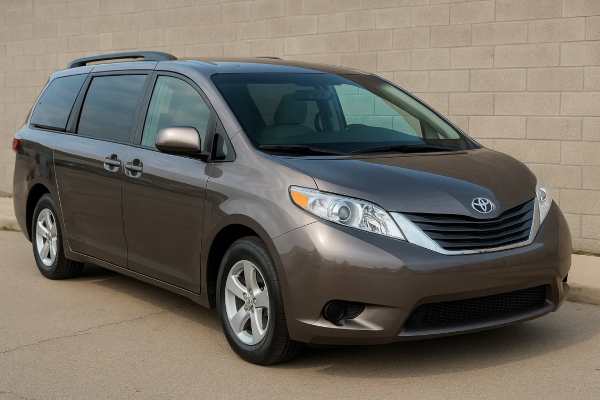
The 2014–2016 Toyota Sienna AWD (XL30 facelift) is one of the few minivans that blends real all-weather traction with traditional Toyota durability. With its 2GR-FE 3.5-litre V6, six-speed automatic, and on-demand all-wheel drive, it is aimed at families who deal with snow, steep driveways, or rough back roads but still want a quiet, comfortable people mover.
This generation’s facelift brought a tidier dashboard, better materials, and more safety tech, while keeping the same underlying platform that had already proven reliable. The AWD hardware adds weight and complexity, but also confidence on winter days when rivals stay parked.
If you are considering a used Sienna AWD from these years, it helps to understand the underlying engineering, known service issues, and how it stacks up against rivals like the Honda Odyssey, Kia Sedona, and Chrysler Town & Country. The guide below takes you through specs, reliability, maintenance, driving impressions, and buying tips in practical detail.
Owner Snapshot
- Strong 3.5 l V6 and AWD traction make the Sienna confident on snow and wet roads.
- Spacious, quiet cabin with flexible 7-seat layouts and good long-distance comfort.
- Proven drivetrain but watch for power sliding door issues and cooling or water-pump leaks as mileage climbs.
- Run-flat tyres on many AWD trims ride firmer and cost more to replace than conventional tyres.
- Engine oil and filter: plan 5,000–10,000 mile (8,000–16,000 km) changes, or every 6–12 months depending on use.
What’s inside
- Toyota Sienna AWD essentials
- Sienna AWD 3.5 V6 specs
- Sienna AWD trims safety tech
- AWD Sienna reliability and faults
- Maintenance tips and buyer guide
- Driving feel and winter ability
- How Sienna AWD compares
Toyota Sienna AWD essentials
The XL30 Sienna facelift (2014–2016) is the last pre-hybrid Sienna and the final one with the 2GR-FE 3.5-litre V6 rated at 266 hp. The AWD variant uses an electronically controlled on-demand system that normally drives the front wheels, sending torque to the rear through an electromagnetic coupling when slip is detected or during hard acceleration.
For many buyers, the key advantage is simple: at the time, the Sienna was the only minivan sold in North America with available all-wheel drive. That made it attractive in snow-belt regions and mountainous areas where families wanted minivan practicality without switching to a larger SUV.
The AWD system lives in the same unibody shell as FWD versions. Ground clearance is around 168 mm (6.6 in), so this is still a road-focused van rather than a trail vehicle. There is no low-range gearbox, and the rear differential is designed mainly for slippery pavement, gravel, and light off-road access tracks.
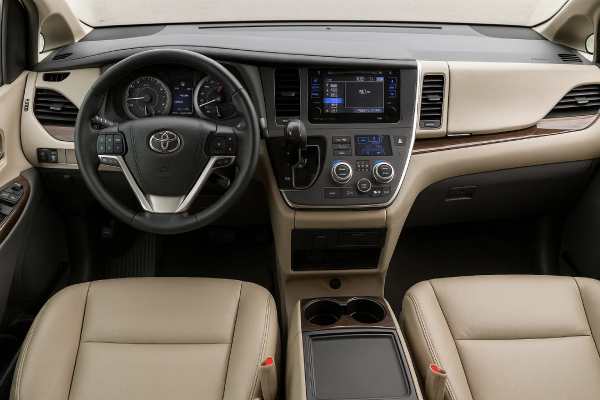
Inside, the 2015 facelift brought a much-improved dashboard with clearer climate controls, a larger central touchscreen on many trims, and better materials on frequently touched surfaces. Second-row captain’s chairs are common on AWD trims, keeping seating at seven rather than eight. The floor is flat enough that moving around the cabin is easy, and the third row folds into the floor to create a long, almost flat load area.
The 2GR-FE V6 is smooth and quiet at cruise but will raise its voice when revved. Coupled to a six-speed automatic, it provides brisk acceleration for a large van, and it can tow up to about 1,585 kg (3,500 lb) with the proper equipment. Fuel economy is where the AWD version pays a penalty: EPA ratings are roughly 16 mpg city, 23 mpg highway, and 19 mpg combined, a bit lower than FWD models.
Overall, the 2014–2016 Sienna AWD is best viewed as a comfortable highway cruiser and winter specialist rather than a sports van. Families who prioritise traction, space, and long-term durability tend to find it a reassuring choice.
Sienna AWD 3.5 V6 specs
This section focuses on the AWD 3.5-litre V6 XL30 Sienna from the 2014–2016 facelift years. Figures can vary slightly by market and trim, so use them as a technical guide and confirm details against a specific VIN.
Engine and performance
| Item | Detail |
|---|---|
| Engine code | 2GR-FE |
| Layout | 60° V6, transverse, DOHC, 24 valves |
| Displacement | 3.5 l (3,456 cc) |
| Bore × stroke | 94.0 × 83.0 mm (3.70 × 3.27 in) |
| Valvetrain | Dual VVT-i, chain-driven camshafts |
| Induction | Naturally aspirated |
| Fuel system | Multi-point port fuel injection |
| Compression ratio | ~10.8 : 1 |
| Max power | 266 hp (≈198 kW) @ 6,200 rpm |
| Max torque | 245 lb-ft (≈332 Nm) @ 4,700 rpm |
| Firing order | 1-2-3-4-5-6 (typical 2GR-FE) |
| Emissions / fuel | Gasoline, regular unleaded recommended |
Efficiency and aerodynamics (AWD, gasoline)
| Item | Value |
|---|---|
| EPA rating (city / hwy / comb.) | ~16 / 23 / 19 mpg US |
| Approx. L/100 km (city / hwy / comb.) | ~14.7 / 10.2 / 12.4 L/100 km |
| Aerodynamic drag coefficient | ~0.30 Cd |
Real-world mixed driving often lands around 11–13 L/100 km (18–21 mpg US), depending on load, climate, and driving style. Short trips and heavy city use push consumption higher.
Transmission and driveline
| Item | Detail |
|---|---|
| Transmission | 6-speed automatic, torque converter (U660F family) |
| Gear ratios (approx.) | 1st 3.30, 2nd 1.90, 3rd 1.42, 4th 1.00, 5th 0.71, 6th 0.61, Reverse 4.15 |
| Final drive ratio | ~3.68 (varies slightly by trim/market) |
| Drive type | On-demand AWD (front biased) |
| AWD hardware | Front transaxle, prop shaft, rear differential with multi-plate coupling |
| Differential type | Open front and rear, electronically controlled coupling to rear axle |
| Traction aids | ABS, traction control, stability control, brake assist |
Chassis and dimensions (typical AWD)
| Item | Value |
|---|---|
| Suspension front | MacPherson strut, coil springs, anti-roll bar |
| Suspension rear | Torsion beam / trailing arm (AWD with modified layout for rear diff) |
| Steering | Electric power-assisted rack and pinion |
| Front brakes | Ventilated discs |
| Rear brakes | Solid discs |
| Tyre size (common) | P235/60R17 (run-flat on many AWD trims) |
| Length | ~5,085 mm (200.2 in) |
| Width | ~1,984 mm (78.1 in) |
| Height | ~1,796 mm (70.7 in) |
| Wheelbase | 3,030 mm (119.3 in) |
| Ground clearance | ~168 mm (6.6 in) |
| Turning circle (kerb-to-kerb) | About 11.4 m (≈37.5 ft) |
| Curb weight (AWD) | ≈2,090–2,155 kg (4,610–4,750 lb) depending on trim |
| GVWR | ≈2,720–2,740 kg (≈5,990–6,040 lb) |
| Fuel tank | ~76 l (20.0 US gal) |
| Cargo volume | ≈1,107 l (39.1 ft³) behind 3rd row; much larger with seats folded |
Performance and towing
| Item | Value (approx.) |
|---|---|
| 0–100 km/h (0–62 mph) | Around 8.0–8.5 s when lightly loaded |
| Top speed | Electronically limited, ~180 km/h (≈112 mph) |
| Towing capacity | Up to 1,585 kg (3,500 lb) with tow package |
| Tongue weight | Typically 350 lb (≈160 kg) max |
| Roof load | Commonly around 75–100 kg (165–220 lb) including rack (check label) |
Fluids and service capacities (approximate)
Always verify with an official service manual for your exact vehicle.
| System | Spec / Type | Capacity (approx.) |
|---|---|---|
| Engine oil | 0W-20 full synthetic, API SN or later | ~6.1 l (6.4 US qt) with filter |
| Engine coolant | Toyota Super Long Life pink | ~9–10 l (9.5–10.5 US qt) total |
| Automatic transmission | Toyota WS ATF | ~6–7 l (6.3–7.4 US qt) total; drain/refill less |
| Rear differential | 75W-85 or 75W-90 gear oil (Toyota spec) | ~1.0–1.2 l (≈1.1–1.3 US qt) |
| Transfer / AWD coupling | Similar gear or ATF fluid per manual | ~0.5–0.8 l |
| Brake fluid | DOT 3 or DOT 4 | As required; usually ≤1 l for full flush |
| A/C refrigerant | R-134a | Charge amount labelled under hood |
| Spark plugs | Iridium, long-life | Gap approx. 1.0–1.1 mm |
Electrical basics
| Item | Detail |
|---|---|
| Alternator output | Typically 130–150 A depending on equipment |
| 12 V battery | Group 24F or similar, ~55–65 Ah, 500–600 CCA |
| Spark plug service interval | Often 120,000 km / 75,000–120,000 miles (check market spec) |
Safety and driver assistance (hardware level)
Crash structure, airbag count, and advanced driver aids are covered in more depth in the next section, but at a high level the 2015 Sienna range achieved strong crash-test results and, with optional front crash prevention, qualified for high safety awards in this era.
Sienna AWD trims safety tech
In North America, AWD was available on selected trims rather than across the entire lineup. Exact naming can vary by market, but typical AWD-compatible trims for 2014–2016 include:
- LE 7-Passenger AWD – entry AWD variant, cloth seats, basic audio, power sliding doors on many examples.
- XLE 7-Passenger AWD – leather, power tailgate, more comfort features.
- Limited / Limited Premium AWD – top-spec, with premium audio, navigation, and luxury touches.
Because AWD requires space for the rear differential, most AWD Siennas use 7-seat layouts with captain’s chairs in the second row. Eight-seat benches are largely FWD-only in these years.
Trim and equipment differences (AWD-relevant)
- Wheels and tyres: AWD trims often came with 17-inch alloys and run-flat tyres. The run-flats allow deletion of a spare wheel but are more expensive and can ride more firmly. Some owners convert to conventional tyres and add a compact spare or repair kit.
- Tow prep: Higher trims may include a factory tow package (upgraded cooling, alternator, and wiring). If you plan to tow near the 3,500 lb limit, confirm that the vehicle has this package.
- Interior features: XLE and Limited AWD models add heated front seats, tri-zone climate control, power sliding doors and tailgate, upgraded audio, and available rear-seat entertainment.
Quick ways to identify AWD Siennas
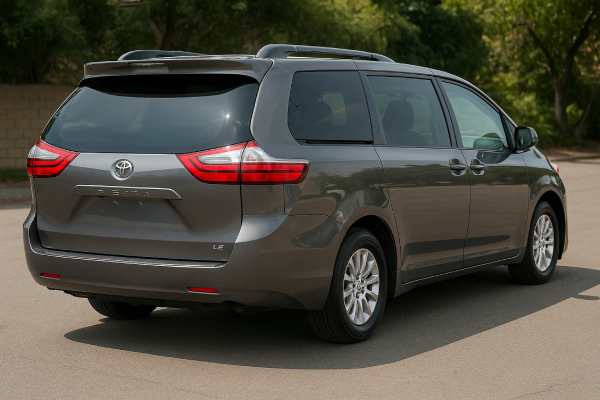
- Badging: “AWD” emblem on the rear tailgate.
- Wheel and tyre combo: Many AWD vans left the factory on 17-inch run-flat tyres with no visible spare underneath.
- Underbody hardware: Rear differential and driveshaft visible under the vehicle.
- VIN / build plate: The drivetrain code and option list (dealer can decode) confirm AWD.
Safety ratings
For the 2015 model year, the Sienna (including AWD versions) scored well in major crash tests:
- IIHS: Generally “Good” in moderate overlap front, side, roof strength, and head restraints. Driver-side small overlap front was rated “Acceptable.” With the optional forward collision warning and automatic braking, certain trims earned a Top Safety Pick+ designation.
- Frontal and side airbags performed well, contributing to strong occupant protection scores.
- NHTSA: Overall 5-star ratings in many configurations, with four or five stars in individual categories depending on test.
Always check the exact combination of year, trim, and options you are looking at, as safety awards were sometimes linked to specific packages (e.g., forward collision warning).
Safety features and ADAS by trim
For 2014–2016 Sienna AWD, Toyota’s modern “Safety Sense” suite had not yet become standard, so availability of advanced features is more limited than on later generations:
- Standard on all trims:
- Front airbags, front seat side airbags, full-length side curtain airbags for all three rows
- Driver’s knee airbag on many markets
- ABS, electronic brake-force distribution, brake assist
- Vehicle stability control and traction control
- Tyre pressure monitoring system
- Rear-view camera
- Commonly optional or trim-dependent:
- Blind Spot Monitor (BSM) with Rear Cross-Traffic Alert (RCTA) – widely available on SE, XLE, and Limited.
- Parking sensors (front and rear) on upper trims.
- Pre-Collision System with forward collision warning and partial braking (Limited, Limited Premium with certain packages).
- Lane Departure Alert and Automatic High Beams appeared as part of packages late in the run or in specific markets.
From a service perspective, note that any windshield replacement, front bumper repair, or suspension alignment on vehicles equipped with camera or radar sensors may require ADAS recalibration using manufacturer procedures. Buyers should ask for calibration proof after major repairs.
AWD Sienna reliability and faults
The 2GR-FE V6 and basic XL30 platform have a good reputation when maintained, but age and mileage are now high enough that patterns of wear are visible. Below is a practical breakdown for 2014–2016 AWD vans.
Engine and cooling system
- Water pump seepage or leaks
- Symptoms: Coolant smell, pink crust around pump, slow coolant loss, occasional squeak from pump bearing.
- Cause: Age-related seal wear on the belt-driven water pump.
- Remedy: Replace pump, serpentine belt, and often the thermostat while access is open.
- Timing chain system
The 2GR-FE uses a timing chain, so there is no scheduled replacement interval. Chain stretch or tensioner issues are rare if oil is changed on time. - Warning signs: Rattling on cold start that persists when warm, cam timing correlation codes.
- Action: Investigate promptly; ignored problems can lead to expensive repairs.
- Oil leaks (timing cover, valve covers)
- Symptoms: Oil sweating down the front of the engine, burning oil smell on exhaust, drops on driveway.
- Prevalence: Occasional on higher-mileage vans; often more of a nuisance than a crisis if minor.
- Remedy: Resealing timing cover is labour intensive; factor this into purchase price if seepage is significant.
Fuel and induction
- The 2GR-FE in the Sienna uses port injection, so it avoids the heavy intake valve carbon buildup seen on some direct-injection engines. Fuel injector issues are relatively rare; most drivability concerns trace to dirty throttle bodies, aging oxygen sensors, or ignition components.
Transmission and AWD system
- Automatic transmission (U660F)
- Generally robust if fluid is kept clean.
- Potential issues: Harsh or delayed shifts, flare between gears, shudder around lock-up speed.
- Remedies: Fluid exchange with correct Toyota WS ATF often improves behaviour; in persistent cases, a valve body overhaul or software update may be needed.
- AWD driveline wear
- Rear differential and transfer coupling: Can develop leaks or bearing noise if fluid is never changed.
- Symptoms: Humming or whining that changes with road speed, oil mist around seals, or clunks when loading/unloading the drivetrain.
- Prevention: Regular fluid changes (e.g., every 60,000 miles / 100,000 km or so) with correct gear oil.
Chassis and body
- Suspension bushings and front struts
- Heavy vehicles, rough roads, and winter salt mean front control arm bushings, strut mounts, and sway-bar links can wear by 100,000–150,000 miles.
- Symptoms: Clunks over bumps, wandering steering, uneven tyre wear.
- Wheel bearings
- Front wheel bearings sometimes become noisy at high mileage. Listen for a growl that changes when you steer left/right.
- Corrosion
- The Sienna generally resists rust well, but in heavy-salt regions check: rear subframe, brake lines, lower door hems, and the area around the tailgate latch.
Electrical and sliding doors
- Power sliding door recall and support program
- Some 2011–2016 Siennas experienced issues where power sliding doors could fail to latch or might open unexpectedly after being stuck (for instance, frozen shut).
- Toyota issued a recall and later a Customer Support Program extending coverage for specific sliding door cable and mechanism issues.
- What buyers should do: Run a VIN check through a dealer or official recall database and confirm recall and support-program work has been completed.
- Door contact switches and latches
- Age, dust, and misalignment can cause door-ajar warnings or intermittent operation of power doors. Cleaning contacts and adjusting latches usually helps; sometimes a new switch or latch is required.
Severity and cost tiers (overview)
- Low cost: Spark plugs (long life but eventually due), coil packs, oxygen sensors, minor suspension links, door switches.
- Medium cost: Water pump replacement, front struts, control arm bushings, wheel bearings, engine mount replacements.
- Higher cost (less common but important): Timing cover reseal, transmission overhaul, severe AWD system failures, or corrosion repair on subframes in harsh climates.
Pre-purchase reliability checks
When inspecting a used Sienna AWD from this era, ask for and/or verify:
- Full service history with evidence of regular oil changes using 0W-20.
- Coolant and transmission fluid service at sensible intervals.
- Documentation for sliding door recall/Customer Support Program work.
- Any transmission software updates or earlier TSB fixes (dealers can check against the VIN).
- A road test that includes highway speeds, tight parking-lot manoeuvres, and a full-lock turn to listen for drivetrain noises.
Maintenance tips and buyer guide
A well-maintained Sienna AWD can easily serve as a long-term family vehicle. The challenge today is finding a van with honest mileage, clean history, and evidence of preventive care rather than pure “run it until it breaks” use.
Suggested maintenance schedule (typical North America; adapt for local guidance)
Always follow the service schedule for your region, but as a practical baseline:
- Engine oil and filter
- Toyota often lists 10,000 miles / 12 months with synthetic oil for normal use, and 5,000 miles / 6 months for severe use.
- Many owners choose to stay closer to 5,000–7,500 miles (8,000–12,000 km), especially with lots of short trips or towing.
- Engine air filter
- Inspect yearly; replace around 30,000 miles (50,000 km), more often in dusty areas.
- Cabin air filter
- Replace every 15,000–25,000 miles (24,000–40,000 km) or two years.
- Coolant
- Toyota Super Long Life coolant typically has a long initial interval (e.g., 100,000 miles / 10 years), then shorter intervals thereafter. On a used vehicle of this age, a complete coolant change is often a good starting point.
- Spark plugs
- Iridium plugs may be rated for up to 120,000 miles (≈190,000 km). If the history is unknown and the odometer is near or beyond that, budget to replace them.
- Automatic transmission fluid (ATF)
- “Lifetime” in some literature, but many experienced owners change WS ATF around 60,000–90,000 miles (100,000–150,000 km) to keep shifts smooth and extend life.
- AWD fluids (rear differential and transfer unit)
- Sensible to refresh around every 60,000 miles (100,000 km) or sooner if towing or seeing heavy winter duty.
- Brake fluid
- Replace roughly every 3 years regardless of mileage to prevent internal corrosion and maintain pedal feel.
- Brake pads and rotors
- Inspect at least annually. Heavy city use or mountain driving can wear front pads relatively quickly.
- Serpentine/aux belt
- Inspect at each service, replace if cracking or glazing appears, often around 100,000 miles.
- Tyres and alignment
- Rotate every 5,000–7,500 miles (8,000–12,000 km).
- Run-flat tyres on AWD models may wear faster and are more expensive, so check tread and budget accordingly.
- 12 V battery
- Many factory batteries last 4–6 years. Test annually from year four; replace pre-emptively if marginal and you depend on power sliding doors and keyless systems.
Buyer’s inspection checklist
When shopping for a 2014–2016 Sienna AWD:
- Exterior and structure
- Look for mismatched paint, uneven panel gaps, or overspray indicating accident repairs.
- Check underbody for rust, especially rear subframe, brake lines, and exhaust hangers.
- Interior and electronics
- Test every power function: doors, tailgate, windows, seat adjustments, climate controls (front and rear), and infotainment.
- Confirm backup camera and any parking sensors or blind-spot indicators behave correctly.
- Drivetrain
- Cold start: engine should settle to a smooth idle with no persistent rattles.
- Drive: feel for transmission flare, harsh shifts, or shudder.
- Tight turns in a car park: listen for clicking or groaning from axles and AWD components.
- Suspension and tyres
- Uneven tyre wear can signal alignment, bushing, or strut issues.
- On a test drive, note clunks over small bumps or vibration at highway speed.
- Paperwork
- Service records showing regular oil changes and periodic coolant/ATF changes.
- Proof of recall and Customer Support Program work on sliding doors and any other campaigns.
- For ex-rental or fleet vehicles, weigh lower price against heavier use.
Which years and trims to target
- 2015–2016 facelift AWD models are often preferred due to updated interior, improved crash structure for certain tests, and more available safety tech compared with early 2011–2013 vans.
- XLE AWD strikes a good balance of comfort, features, and price on the used market.
- Limited AWD adds luxury features but also more complex equipment to maintain; great if well cared for, but watch for infotainment and power seat issues.
If you value long-term ownership, favour vans with lower mileage, clear maintenance documentation, and minimal rust over a slightly newer but neglected example.
Driving feel and winter ability
Despite its size, the Sienna AWD drives more like a large, soft-riding car than a commercial van. The 2GR-FE V6 has enough power that, when you press the throttle, the van responds confidently rather than feeling strained.
Ride and handling
On typical 17-inch wheels, the ride is compliant but slightly firmer on AWD versions fitted with run-flat tyres. Over broken pavement you may feel more sharp edges than in a FWD Sienna on conventional tyres. Once up to highway speeds, the van settles into a relaxed, steady gait with good straight-line stability and modest body roll in corners.
Steering is light and accurate enough for easy parking, but not especially communicative. It suits the role: this is a family hauler, not a sports wagon. The turning circle is manageable for tight car parks, though you will still be aware of the van’s length when manoeuvring.
Braking performance is adequate for the vehicle’s weight. Pedal feel is typically progressive, and fade resistance is reasonable in normal use. Prolonged mountain descents with a full load can warm the brakes, so using lower gears to assist with engine braking is wise.
Powertrain character
The 3.5-litre V6 builds torque smoothly from low revs. Around town, it pulls away cleanly and can feel surprisingly brisk when unladen. On-ramps and passing manoeuvres are handled with confidence; the six-speed automatic drops a gear or two quickly when you ask for more power.
Noise levels are mostly low. You will hear the V6 under heavy acceleration, where its note can be described as coarse rather than sporty, but it quiets once you reach cruising speed. Wind and road noise are well controlled, especially on XLE and Limited trims with additional insulation and acoustic glass.
Real-world efficiency
In everyday use:
- City driving: Often in the mid-teens mpg (US) – around 15–17 mpg, depending on traffic and climate.
- Highway (100–120 km/h or 60–75 mph): Many owners report 21–24 mpg US (≈10–11.5 L/100 km) when cruising steadily with moderate load.
- Mixed use: Around 19–21 mpg US (≈11–12.5 L/100 km) is typical.
Cold winters, short trips, roof racks, heavy loads, and higher speeds all push consumption upward. Compared with the FWD Sienna, expect roughly 1–2 mpg penalty for AWD.
Winter and low-grip performance
This is where the AWD Sienna stands out among minivans of its era:
- The on-demand AWD system continuously monitors wheel slip and can send torque rearward without driver input. In practice, this makes starts on snow or wet leaves much easier than in FWD rivals.
- With good winter tyres, the Sienna AWD feels secure on packed snow and icy side streets, helped by stability control interventions that are firm but not overly intrusive.
- Some trims display real-time torque distribution on the instrument cluster, which can be useful feedback when learning how the system behaves.
Keep in mind:
- Ground clearance is still modest; deep snow can pack under the van.
- The stock run-flat tyres may be all-season types that compromise winter grip; dedicated winter tyres on separate wheels are a significant improvement.
Load and towing behaviour
With passengers and cargo aboard, the Sienna remains composed. The long wheelbase helps it track straight, and rear suspension tuning manages typical family loads without feeling wallowy.
When towing within its 3,500 lb (1,585 kg) rating:
- Acceleration remains acceptable, but you’ll work the engine and transmission harder on long grades.
- Transmission and coolant temperatures stay under control if the van has the tow prep package and you use lower gears sensibly.
- Fuel consumption can rise by 30–50% depending on trailer shape and speed, so plan fuel stops accordingly.
Overall, the Sienna AWD offers a confident, predictable driving experience with particular strengths in poor weather. It is not the sharpest handler in the segment, but it is one of the most reassuring when conditions are less than ideal.
How Sienna AWD compares
When these 2014–2016 AWD Siennas were new, the main rivals were the Honda Odyssey, Kia Sedona, and Chrysler Town & Country/Dodge Grand Caravan twins. Today, shoppers might also cross-shop three-row crossovers like the Toyota Highlander or Honda Pilot.
Against other minivans of the era
- Honda Odyssey
- Pros: Slightly sharper handling, efficient V6, flexible interior, strong safety results including small overlap crash performance.
- Cons: No AWD option, some years known for transmission issues, particularly on earlier generations.
- Takeaway: If you live in a mild climate and value handling and crash scores above all, the Odyssey is compelling. In snow-belt regions, the Sienna AWD’s traction advantage is hard to ignore.
- Kia Sedona
- Pros: Attractive pricing on the used market, decent comfort, and good feature content.
- Cons: No AWD, and long-term reliability is not as consistently strong across all model years as Toyota’s.
- Takeaway: Good for budget-conscious buyers who are less concerned about all-weather capability and long-term resale value.
- Chrysler Town & Country / Dodge Grand Caravan
- Pros: Clever Stow ‘n Go seating, often very inexpensive used, strong parts availability.
- Cons: No AWD, older platform, more varied reliability, especially in transmissions and electrical systems.
- Takeaway: Great cargo flexibility and low entry price but higher risk of repairs as they age, making the Sienna AWD more attractive for long-term ownership.
Against three-row crossovers
Many families now consider crossovers instead of minivans. Compared to typical three-row SUVs:
- Space and usability
- The Sienna offers more usable third-row space and a larger, more accessible cargo area.
- Sliding doors are a huge advantage in tight parking spaces and home garages.
- Traction
- Modern crossovers offer sophisticated AWD systems and sometimes better ground clearance. If you frequently drive rough roads or unploughed tracks, a SUV may be better.
- For paved winter roads, the Sienna AWD is very competitive, particularly with proper tyres.
- Driving feel and image
- Crossovers often have a more upright driving position and a more fashionable image.
- The Sienna is less about style and more about practicality, comfort, and ease of loading passengers and cargo.
Running costs and resale
- Fuel economy: The Sienna AWD’s consumption is similar to or slightly worse than some V6 crossovers but better than older body-on-frame SUVs.
- Tyres: Run-flats are a cost item to watch. Switching to conventional tyres plus a spare can reduce costs over time, but must be planned properly.
- Depreciation: Historically, Sienna residual values are strong. AWD models in snow-belt markets often command a premium over FWD versions.
Who the Sienna AWD suits best
- Families in regions with regular snow, ice, or heavy rain who still prefer a minivan’s space and access.
- Owners planning to keep the vehicle for many years and willing to follow a sensible maintenance schedule.
- Buyers who prioritise safety ratings, all-weather capability, and practicality over sporty handling or cutting-edge infotainment.
If you are willing to accept slightly higher fuel and tyre costs in exchange for greater traction and peace of mind in bad weather, the 2014–2016 Toyota Sienna AWD remains one of the most appealing used family vans on the market.
References
<a href="https://www.fueleconomy.gov/feg/bymodel/2015_Toyota_Sienna.shtml">Gas Mileage of 2015 Toyota Sienna</a> 2024 (Fuel Economy Data)<a href="https://www.iihs.org/ratings/vehicle/toyota/sienna-minivan/2015">2015 Toyota Sienna</a> 2015 (Safety Rating)<a href="https://www.autoevolution.com/cars/toyota-sienna-2014.html">TOYOTA Sienna (2014-2017) Photos, engines & full specs</a> 2014 (Specifications Overview)<a href="https://www.toyota.com/owners/warranty-owners-manuals/vehicle/sienna/2015/">2015 Sienna - Owners's Manual</a> 2015 (Owner’s Manual)<a href="https://static.nhtsa.gov/odi/tsbs/2019/MC-10162786-9999.pdf">Customer Support Program Bulletin</a> 2019 (Sliding Door Cable Coverage)
Disclaimer
This article is intended for general informational purposes only and is not a substitute for professional diagnosis, repair, or official service information. Specifications, torque values, service intervals, and procedures can vary by VIN, model year, market, trim level, and optional equipment. Always confirm critical data against the official owner’s manual, workshop manual, and current technical bulletins for your specific vehicle, and consult a qualified technician before performing maintenance or repairs.
If you found this guide useful, you are welcome to share it with other owners or prospective buyers on social platforms such as Facebook or X/Twitter to help support xcar’s work and make this information easier for others to find.