
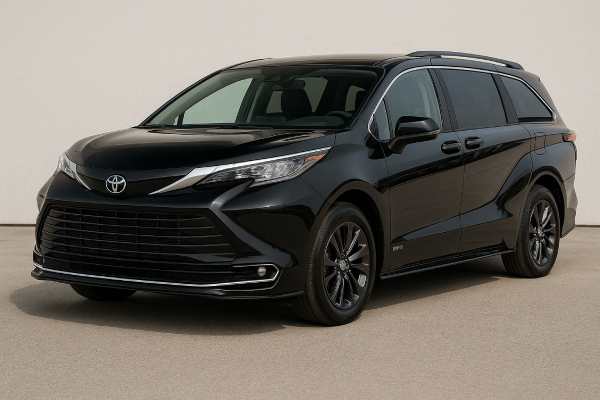
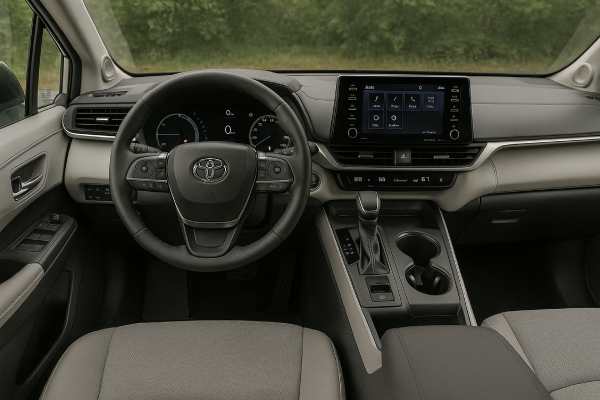
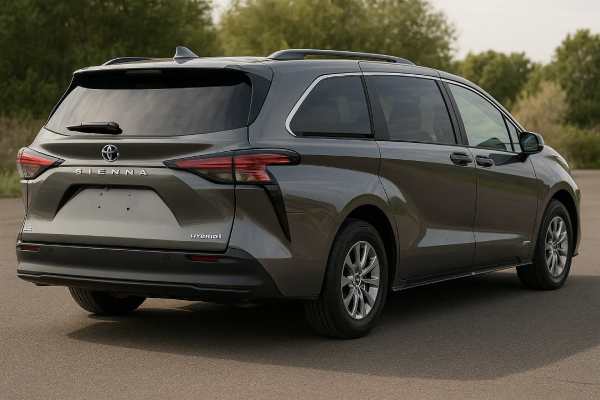
The fourth-generation Toyota Sienna moved this family icon into a very different place: hybrid power only, a more van-like crossover style, and an available Electronic On-Demand all-wheel-drive system that uses an extra electric motor on the rear axle instead of a conventional driveshaft. For households that need three rows, winter confidence, and better fuel economy than an older V6 minivan, the Sienna XL40 e-AWD is one of the most efficient and refined options on sale today.
This guide focuses on the hybrid Sienna with Electronic On-Demand AWD, powered by the A25A-FXS 2.5-litre Atkinson-cycle four-cylinder and Toyota’s latest hybrid system. We will walk through key specs, dimensions, real-world performance, reliability patterns, maintenance planning, and how it stacks up against rivals like the Honda Odyssey, Kia Carnival, and Chrysler Pacifica (including the Pacifica Hybrid). The aim is to help you decide whether this version of the Sienna matches your use case, running-cost expectations, and long-term ownership plans.
Owner Snapshot
- Hybrid Sienna e-AWD combines three-row practicality with real 35–36 mpg (≈ 6.7 L/100 km) efficiency in mixed driving.
- Separate rear electric motor gives confident traction in snow and wet conditions without the weight of a traditional AWD driveline.
- Cabin is quiet, with sliding second-row “Super Long Slide” seats and a flat floor that work well for families and ride-sharing.
- Hybrid system adds complexity: brake service, cooling, and high-voltage components need hybrid-literate technicians.
- Typical engine oil change interval is 10,000 miles / 16,000 km or 12 months under normal conditions, with 5,000 miles / 8,000 km advisable for heavy city or towing use.
Explore the sections
- Toyota Sienna e-AWD background
- Hybrid e-AWD specs and data
- Trims equipment and safety tech
- Reliability trends and service fixes
- Maintenance schedule and buying tips
- Driving experience and real economy
- Sienna e-AWD versus rivals
Toyota Sienna e-AWD background
The XL40 Toyota Sienna, launched for the 2021 model year (2020 in some markets), is built on Toyota’s TNGA-K architecture and replaces the previous V6-powered XL30 generation. Instead of offering both gasoline and hybrid powertrains, Toyota chose to make the Sienna hybrid-only. Every model pairs a 2.5-litre A25A-FXS four-cylinder with electric motors and a nickel-metal hydride (NiMH) battery.
Electronic On-Demand AWD is Toyota’s branding for the hybrid AWD system on this Sienna. In front, the engine and a main electric motor drive the front wheels through an eCVT (a planetary gear-based continuously variable transmission). At the rear, a separate electric motor sits on the rear axle, with no mechanical driveshaft running down the centre of the vehicle. The system can leave the rear motor idle for efficiency, then spin it up instantly when front-wheel slip is predicted or detected, or when you ask for strong acceleration.
Compared with earlier Siennas:
- The V6 is gone; system output is about 245 hp, but torque delivery is boosted at low speed by the electric motors.
- Fuel economy is dramatically better; high-20s to mid-30s mpg (≈ 6.7–8.7 L/100 km) is realistic for many owners where older vans returned high teens.
- Cabin packaging changes: the hybrid battery is mounted low and centrally, so floor height remains reasonable and seating remains three-row with up to eight seats depending on trim.
For buyers in snowy climates, the Electronic On-Demand AWD variant is the sweet spot. It offers more traction and security without the added fuel penalty and complexity of a traditional mechanical AWD system with a centre differential and driveshaft. Ground clearance remains minivan-like rather than SUV-tall, but tyre choice and the quick-reacting rear motor can make a large difference in winter confidence.
This background matters because it shifts how you think about the Sienna: it is less of a conventional minivan and more of a hybrid people mover that leans toward SUV-lite duty, with a strong focus on total cost of ownership and long-term reliability.
Hybrid e-AWD specs and data
This section focuses on the XL40 Sienna with the A25A-FXS hybrid powertrain and Electronic On-Demand AWD, as commonly sold in North America.
Engine and hybrid system
| Item | Value |
|---|---|
| Engine code | A25A-FXS (Dynamic Force) inline-4 |
| Displacement | 2.5 L (2,487 cc) |
| Induction | Naturally aspirated, Atkinson-cycle |
| Valvetrain | DOHC, 16 valves, Dual VVT-iE |
| Compression ratio | ~14.0 : 1 (market-dependent) |
| Fuel system | Port and direct injection (D-4S system) |
| Max engine power | ~189 hp (141 kW) around 6,000 rpm (approximate) |
| Max engine torque | ~176 lb-ft (239 Nm) around 4,300–4,400 rpm (approximate) |
| Front traction motor | Permanent-magnet synchronous motor, ~134 kW (rating varies by documentation) |
| Rear traction motor (e-AWD) | Permanent-magnet motor, approx. 40–54 hp (30–40 kW) equivalent |
| Hybrid system output | 245 hp (system net, as per Toyota) |
| Hybrid battery | Nickel-metal hydride (NiMH), ~1.9 kWh, ~288 V nominal |
| Emissions standard | ULEV/SULEV equivalent depending on market |
The key point is how the system behaves rather than the individual component outputs: the engine runs in its efficient zone as much as possible, while the electric motors handle low-speed torque and assist during acceleration. In normal driving, the rear motor is mostly off; in slippery conditions, it can send extra torque to the rear axle quickly.
Transmission and driveline
| Item | Value |
|---|---|
| Transmission type | Electronically controlled eCVT (planetary gearset) |
| Drive type | Electronic On-Demand AWD (front engine/motor, independent rear motor) |
| Centre coupling | None (no mechanical driveshaft) |
| Differential types | Open differentials front and rear; traction control uses brake-based torque vectoring |
| AWD logic | Rear motor engages based on slip, steering angle, throttle, and drive mode inputs; can assist from a standstill and in corners |
While you cannot lock the AWD system like a dedicated 4×4, the e-AWD logic is tuned for low-traction surfaces, slopes, and light off-pavement use such as gravel or dirt roads. For winter climates, fitting quality winter tyres can transform this system into a very competent all-weather setup.
Chassis and dimensions
Typical values for an AWD hybrid Sienna (figures may vary slightly by trim and market):
| Item | Value (approximate) |
|---|---|
| Platform | TNGA-K (unibody) |
| Front suspension | MacPherson strut with stabilizer bar |
| Rear suspension | Multi-link rear with stabilizer bar |
| Steering | Electric power steering; ~14–15:1 ratio |
| Brake type | Four-wheel disc, ventilated front/solid rear, ABS with EBD and brake assist |
| Wheelbase | ~3,060 mm (120.1 in) |
| Length | ~5,175 mm (203.7 in) |
| Width (without mirrors) | ~1,995 mm (78.5 in) |
| Height | ~1,775 mm (69.9 in) |
| Ground clearance | ≈ 165–170 mm (about 6.5–6.7 in) |
| Turning circle (kerb-to-kerb) | ~11.4 m (37.4 ft) |
| Curb weight (AWD) | ~2,100–2,200 kg (4,630–4,850 lb), depending on trim |
| Fuel tank | ~68 L (18 US gal) |
| Cargo volume | Around 949 L (≈ 33.5 ft³) behind 3rd row; ~2,129 L (≈ 75 ft³) behind 2nd; ~2,860+ L (≈ 101+ ft³) behind 1st row (SAE methods; varies by seat position) |
| Seating configurations | 7- or 8-passenger depending on trim |
Performance and capability
| Item | Value (typical) |
|---|---|
| 0–100 km/h (0–62 mph) | Roughly 7.5–8.0 seconds in independent testing, depending on load |
| Top speed | Around 175 km/h (≈ 109 mph), electronically governed |
| Towing capacity | Up to 1,585 kg (3,500 lb) with proper equipment |
| Payload | Typically ~1,300–1,500 lb (≈ 590–680 kg), depending on trim |
| Roof load | Consult owner’s manual; often 75–75+ kg (165+ lb) including rack (varies by market and accessories) |
The Sienna is not a performance vehicle, but the electric assistance makes it feel stronger than raw horsepower suggests, particularly at lower speeds or when pulling away with a full load.
Efficiency
EPA figures for the 2021 Sienna Hybrid AWD are:
- 35 mpg combined, 35 mpg city, 36 mpg highway (≈ 6.7 L/100 km combined).
Real-world owner reports typically fall between 32–38 mpg (7.4–6.2 L/100 km) depending on climate, tyre choice, and driving mix.
Fluids and key capacities (typical)
Always verify with the specific service manual for your region and model year:
| System | Specification (typical) | Approx. capacity |
|---|---|---|
| Engine oil | 0W-16 API SN+ / ILSAC equivalent Toyota Genuine or similar | ~4.5 L (4.8 US qt) with filter |
| Engine / hybrid coolant | Toyota Super Long Life Coolant (pink); pre-mixed 50/50 | ~9–11 L (9.5–11.6 US qt) combined loops, depending on procedure |
| eCVT / transaxle fluid | Toyota WS (World Standard) ATF | Capacity varies; drain and fill typically 3–4 L |
| AWD rear motor / reduction gear oil | Toyota gear oil (consult manual; many markets treat as “lifetime fill” unless severe use) | Few litres at most, service access dependent |
| A/C refrigerant | R-1234yf on most newer models; charge amount varies by label | See under-hood label |
| 12V auxiliary battery | AGM or flooded, trunk-mounted, ~45–60 Ah depending on trim | — |
Key torque examples (always confirm):
- Wheel lug nuts: typically around 103 Nm (76 lb-ft).
- Engine oil drain plug: often around 39–40 Nm (29–30 lb-ft).
Electrical and safety systems
The hybrid Sienna integrates extensive driver assistance:
- Toyota Safety Sense (TSS) suite with pre-collision braking, adaptive cruise control, lane-keeping, and automatic high beams is standard across the range in many markets.
- Full complement of front, side, curtain, and driver’s knee airbags.
- Later years add enhanced lane-tracing, improved pedestrian and cyclist detection, and sometimes intersection assist, depending on market and update.
Trims equipment and safety tech
Trims vary by market, but across North America the AWD hybrid Sienna has been offered in grades such as LE, XLE, XSE, Limited, and Platinum, often with both FWD and AWD available. Some markets add specific packages like Woodland Edition with a slight suspension lift and more outdoors-oriented styling.
Trim and options overview (AWD focus)
While details change by year and region, you can think of the range roughly as:
- LE AWD
- Cloth seats, manual sliding doors (or power doors depending on market), smaller infotainment screen, basic audio.
- 17-inch wheels.
- Still includes hybrid powertrain, TSS active safety, and tri-zone climate control.
- XLE AWD
- Adds power sliding doors and sometimes power tailgate.
- SofTex or leatherette upholstery, heated front seats, more USB ports.
- Available 8-passenger bench or 7-passenger super-long-slide captain’s chairs.
- XSE AWD
- Sport-styled variant with 20-inch wheels on some versions, firmer suspension tuning, and more aggressive front/rear fascias.
- Often includes sportier interior trim and an available premium audio system.
- Limited / Platinum AWD
- Top trims with leather seating, ventilated front seats, memory driver’s seat, premium JBL audio.
- Larger screens for infotainment and available rear-seat entertainment in some years.
- Digital rear-view mirror, panoramic sunroof, 360° camera systems, and larger alloy wheels.
Mechanical hardware (engine and hybrid system) is largely the same across trims. Differences arise in wheel and tyre packages, suspension tuning (especially for XSE and Woodland), and tow package availability (cooling and wiring).
Seating, cargo, and usability
The XL40 Sienna moves away from removable second-row seats. Instead, the second-row chairs are mounted on long floor rails and are not easily removable by owners, especially on models with integrated ottomans. This has pros and cons:
Advantages
- Huge fore-aft adjustment: you can slide the second row far back for limousine-like legroom or forward to expand cargo space.
- Integrated ottomans (on some trims) improve long-distance comfort.
Trade-offs
- Seats do not fold flat into the floor like Chrysler’s Stow ’n Go; this can limit maximum height for cargo when all seats are installed.
- Removing seats for occasional big moves is more involved and not recommended for everyone due to weight and airbag/occupancy sensor wiring.
For families, the usability win is strong: large door openings, low step-in, wide-sliding doors, and multiple USB and power outlets. For commercial or camper conversions, the fixed nature of second-row seats is something to consider.
Safety ratings snapshot
Safety performance is a strong point of the XL40 Sienna:
- Independent testing agencies have given the 2021+ Sienna top-tier scores, including top ratings in most crashworthiness assessments and recognition such as “Top Safety Pick+” in multiple years, when equipped with specific headlights.
- NHTSA testing for early XL40 model years reports a five-star overall safety rating for many configurations, with four stars in rollover.
The summary is straightforward: structurally, the Sienna tests very well, and its active safety suite is among the more complete offerings in the minivan class during these years.
ADAS and calibration considerations
As ADAS content has grown, so have service implications:
- Front radar and camera recalibration may be required after windshield replacement, front-end collision repairs, or even some suspension and alignment work.
- Blind-spot monitoring and rear cross-traffic alert rely on radar modules in the rear corners; body repairs or bumper replacement in that area should include proper calibration.
- Parking and surround-view cameras on top trims can require specialized calibration tools if mounts are disturbed.
When buying used, it is wise to ask for repair documentation after any collision and verify that calibration procedures were completed with the appropriate equipment.
Reliability trends and service fixes
The XL40 Sienna is still relatively new compared with older generations, but Toyota’s experience with hybrid components and the A25A family of engines results in encouraging early reliability data. That said, no vehicle is problem-free, and paying attention to emerging patterns is important.
Overall reliability picture
Key points so far:
- Hybrid components (motors, inverters, NiMH battery) have a good track record, particularly when cooling systems are maintained and filters remain clean.
- The A25A-FXS engine shares much of its hardware with other Toyota four-cylinders; issues like severe oil consumption or timing chain failures are rare when maintenance is kept up.
- Interior electronics and sliding door mechanisms are more common sources of minor annoyance than the core powertrain itself.
Toyota’s hybrid warranty coverage in many markets extends hybrid system and battery coverage well beyond the basic warranty, often to around 8 years / 100,000 miles (160,000 km) or more, and sometimes longer on the battery. This reduces financial risk for early hybrid component failures.
Common or notable issues (early reports)
Because these vehicles are newer, most issues are low-to-moderate severity:
- Sliding door and tailgate alignment / sensors
- Symptoms: Doors stopping midway, warning messages, or needing extra force to close.
- Likely cause: Misaligned latches, weak actuators, or dirty/obstructed tracks and seals.
- Remedy: Clean and lubricate tracks; adjust alignment; replace failing latch motors or sensors.
- Infotainment glitches and connectivity problems
- Symptoms: Freezing, random reboots, or flaky Bluetooth/Apple CarPlay / Android Auto connections.
- Likely cause: Software bugs or, less commonly, failing head unit.
- Remedy: Software updates at dealer; in some cases, replacement under warranty.
- Interior trim squeaks and rattles
- Symptoms: Noises over rough roads, often from sliding door areas or seat tracks.
- Likely cause: Plastic trim interfaces and long seat rails; large cabin amplifies sounds.
- Remedy: Insulation, felt tape, and careful refitting of trim can reduce issues; some dealers perform such fixes under warranty if customers complain early.
- Brake feel and hybrid regen blending
- Symptoms: Slight grabby or inconsistent brake feel at low speeds, particularly when cold or on uneven surfaces.
- Likely cause: Interaction between regenerative braking and friction brakes.
- Remedy: Firmware updates, proper brake servicing, and using quality pads/rotors. This is usually a characteristic rather than a fault, but poor maintenance can worsen it.
Potential high-voltage and hybrid-specific concerns
While not widespread, owners and technicians should be aware of:
- Hybrid battery cooling
- Clogged intake vents, pet hair, or debris can reduce cooling airflow and shorten NiMH battery life. Keeping vents clean and cabin air filters fresh, especially if carrying pets frequently, is important.
- Inverter and DC-DC converter
- These units are robust but sensitive to overheating and voltage irregularities. Maintaining correct coolant levels and not ignoring warning lights is critical.
- Rear motor / e-AWD components
- Failures are rare so far. However, unusual noises from the rear under acceleration or warning messages about AWD system performance should be checked promptly. Early attention can prevent more expensive damage.
Recalls, TSBs, and extended coverage
The XL40 Sienna has had a handful of recalls and technical service bulletins (TSBs) since launch. Examples include:
- Seat and seat-rail-related recalls in certain model years, where front seat structures could move under impact in rare conditions; the fix involves inspections and hardware replacement.
- Software-related updates for hybrid control modules or ADAS systems to address driveability quirks, false warnings, or improved system robustness.
If you own or are considering a Sienna e-AWD:
- Run the VIN through your regional Toyota or government recall site.
- Ask a dealer for a printout of completed and outstanding campaigns.
- Where possible, keep that paperwork with the vehicle history.
Pre-purchase checks
For a used Electronic On-Demand AWD Sienna, pay particular attention to:
- Full service history, ideally with hybrid-savvy workshops or dealerships.
- Evidence of regular coolant and brake fluid changes.
- Any hybrid system warnings in the instrument cluster (have a shop scan for hybrid-specific codes).
- Smooth operation of sliding doors and tailgate.
- Tyre wear patterns suggesting alignment issues or heavy curb impacts.
The early-age reliability story is strong, but long-term data is still forming; rigorous maintenance and careful inspection still matter.
Maintenance schedule and buying tips
Although the Sienna XL40 hybrid is complex, routine maintenance is straightforward when broken into clear intervals. Always cross-check with the specific maintenance schedule for your market; use the following as a practical starting point.
Practical maintenance intervals (typical, under normal use)
Distances are approximate; alternative in years given where appropriate.
- Engine oil and filter
- Every 10,000 miles / 16,000 km or 12 months (whichever comes first).
- For heavy city driving, extreme temperatures, or frequent towing, shortening to 5,000–8,000 miles (8,000–13,000 km) is wise.
- Engine air filter
- Inspect annually; replace every 30,000–40,000 miles (48,000–64,000 km) or sooner in dusty conditions.
- Cabin air filter
- Replace every 15,000–20,000 miles (24,000–32,000 km) or 1–2 years. Important for hybrid battery cooling if the battery intake draws from the cabin area.
- Spark plugs
- Iridium plugs typically rated for ~120,000 miles (190,000 km). Inspect at ~90,000 miles (145,000 km).
- Coolant (engine and hybrid cooling loops)
- First change around 100,000 miles (160,000 km) or 10 years, then every 50,000 miles (80,000 km) or 5 years, unless your local schedule differs.
- eCVT / transaxle fluid
- Toyota may label this “lifetime” under normal use, but many independent technicians recommend drain-and-fill every 60,000–100,000 miles (96,000–160,000 km), especially if towing or operating in hot climates.
- Brake fluid
- Every 2–3 years regardless of mileage. Moisture contamination affects both corrosion and ABS/ESP system performance.
- Brake pads and rotors
- Inspect at least every 15,000 miles / 24,000 km. Regenerative braking reduces wear but can encourage corrosion on rotors if the van is used mostly for short trips—occasional firm braking helps keep rotors clean.
- Differential / rear motor gear oil
- Follow official guidance; if unspecified, consider inspection or replacement around 100,000 miles, especially if towing or driving frequently on steep grades.
- Tyre rotation and alignment
- Rotate every 5,000–7,500 miles (8,000–12,000 km).
- Check alignment after major pothole impacts, curb strikes, or uneven wear.
- 12V battery
- Test annually from year 4 onward. Replacement often needed around 5–7 years depending on climate and usage.
- Hybrid components
- Follow any scheduled inspections in the maintenance booklet; ensure software updates are applied during dealer visits.
Fluids, capacities, and torque for decision-making
When choosing a workshop or planning DIY work:
- Insist on the correct 0W-16 engine oil (or as specified in your market).
- Use Toyota Super Long Life (pink) coolant; mixing types can reduce protection and service life.
- For eCVT and differential fluids, using the exact Toyota-spec fluids is safer than relying on universal substitutes.
- Make sure wheel lug nuts are torqued properly (typical spec around 103 Nm / 76 lb-ft) to avoid warped rotors or loose wheels.
Buyer’s guide: what to look for
When shopping for a used Sienna Electronic On-Demand AWD:
- Model year and trim
- Earlier model years (launch years) may have more TSBs and small software updates, but they also may have had more of those issues already fixed under warranty.
- Higher trims bring comfort and tech, but also more complexity (panoramic roof, power seats, extra electronics).
- Maintenance history
- Look for documented oil changes at appropriate intervals.
- Confirm coolant and brake fluid have been changed on schedule.
- Ask specifically whether any hybrid system or software campaigns have been carried out.
- Usage profile
- Vans used mostly for long highway trips often show lower wear than those used for short city trips and school runs.
- Examine tyre wear for signs of carrying heavy loads constantly or poor alignment.
- Corrosion and body condition
- Check underbody and subframes, especially in snow-belt regions where road salt is common.
- Inspect sliding door tracks and bottom edges for early rust.
- Hybrid system health
- During a pre-purchase inspection, ask for a scan of hybrid system codes and freeze-frame data.
- Observe the state of charge behaviour: large swings or frequent full/depleted cycles under light driving may warrant deeper evaluation.
Long-term durability outlook
Given Toyota’s hybrid track record in models like the Prius, Camry Hybrid, and RAV4 Hybrid, the Sienna e-AWD is very likely to age well if maintained properly. High-voltage batteries and hybrid components are engineered to last well beyond 150,000–200,000 miles (240,000–320,000 km) in typical use. The bigger unknown is long-term wear on the rear motor and e-AWD components specifically in heavy winter salt environments, but so far there is little evidence of systemic failures.
For most owners, the real differentiator in longevity will be:
- Careful, regular maintenance with correct fluids.
- Avoiding neglect of brake fluid and coolant.
- Addressing warning lights early rather than driving with active hybrid or ABS/traction system faults.
Driving experience and real economy
The driving experience of the Sienna Electronic On-Demand AWD is defined less by raw power and more by smoothness, refinement, and low running costs.
Ride, handling, and NVH
On the road, the Sienna feels closer to a comfortable crossover than a traditional boxy van:
- Ride quality is generally supple, especially on trims with 17- or 18-inch wheels. XSE and other sport-oriented variants with 20-inch tyres can feel slightly firmer, occasionally sharp over broken pavement.
- Body control is respectable given the size and height. The low-mounted hybrid components help keep the centre of gravity down, reducing excessive roll in corners.
- Steering is light but accurate. Feedback is modest, but the tuning is well-suited for suburban use and highway cruising.
- Noise levels are low: the hybrid system often shuts the engine off at low speeds, and the cabin is well-insulated. Wind and road noise are present at higher speeds, especially on coarse surfaces, but not intrusive for this class.
Passengers benefit from the long wheelbase and low floor: the Sienna remains one of the easier three-row vehicles for older relatives or young children to climb into, especially compared with taller SUVs.
Powertrain character
The A25A-FXS hybrid system has a distinct personality:
- In gentle driving, the Sienna pulls away mostly on electric power, then brings in the engine smoothly as speed builds.
- At moderate throttle, the eCVT allows the engine to sit at a steady rpm while the electric motors handle small changes in load.
- Under full throttle (for example, highway merging or steep grades with a full load), the engine revs rise and stay elevated until the manoeuvre is done. This is normal behaviour for Toyota eCVT hybrids, though some drivers may find the noise level higher than a stepped automatic transmission.
Compared with the previous V6 Sienna, acceleration feels a bit less urgent at the top end, but real-world drivability is helped by the instant torque of the electric motors. For everyday use—overtaking at moderate speeds, climbing short hills, city manoeuvres—the hybrid system feels strong enough and more relaxed than the numbers suggest.
Electronic On-Demand AWD in real use
The e-AWD system shines in:
- Snow and ice: The rear motor can help the Sienna pull away with less wheelspin, and torque can shift rearward as needed when the front tyres start to slip.
- Rain and standing water: Additional rear-axle support improves stability under acceleration and when exiting corners.
- Gravel and dirt roads: It provides extra traction when climbing or descending uneven surfaces, though ground clearance remains minivan-like.
There is no dedicated low-range gearing or mechanical locking differential. For heavy off-road use, an SUV with a more traditional 4×4 system is still better. Within the intended envelope—paved and unpaved roads, steep driveways, winter use—the system works very well, especially when paired with appropriate tyres.
Real-world fuel economy and range
In practice, owners commonly report:
- City: Around 33–40 mpg (7.1–5.9 L/100 km) depending on traffic, temperature, and driving style. Hybrids benefit from slower, smoother urban driving.
- Highway: Around 32–36 mpg (7.4–6.5 L/100 km) at 65–75 mph (100–120 km/h).
- Combined: Often near the EPA 35 mpg figure for AWD versions, slightly higher in mild climates with gentle driving.
Cold weather, short trips, heavy loads, and roof boxes can all reduce economy significantly. However, even in harsher conditions, the Sienna hybrid AWD usually outperforms non-hybrid minivans and many three-row SUVs by a substantial margin.
The fuel tank of roughly 68 litres means realistic highway ranges of 600–800 km (375–500 miles) between fill-ups for many drivers, with longer stretches possible if you drive gently.
Towing and load behaviour
With a rated towing capacity of up to 3,500 lb (1,585 kg), the Sienna e-AWD can comfortably pull small campers, utility trailers, or boats when equipped with the proper hitch and wiring, and ideally a tow package that includes additional cooling for some markets.
Expect:
- Increased engine rpm and noise when towing up grades.
- Targeted coolant and transmission fluid temperatures are managed by the hybrid system, but keeping up with maintenance is vital.
- Fuel consumption increasing by 25–50% under sustained towing, depending on trailer shape, speed, and terrain.
With a full passenger load and luggage but no trailer, the Sienna’s hybrid system continues to perform well; performance feels modest but adequate, and stability remains good thanks to the long wheelbase and low-mounted battery.
Sienna e-AWD versus rivals
The Electronic On-Demand AWD Sienna competes with other modern minivans and large three-row crossovers. The key alternatives are the Honda Odyssey, Kia Carnival, Chrysler Pacifica (gas and hybrid), and three-row SUVs like the Toyota Highlander, Honda Pilot, and Kia Telluride.
Versus other minivans
Honda Odyssey
- Pros vs Sienna: Strong V6 performance, conventional driving feel, flexible interior, often lower purchase prices used.
- Cons vs Sienna: No hybrid option, no AWD in most markets; fuel economy significantly lower, especially in city use. For winter climates, snow tyres help but do not fully replace the confidence of AWD plus hybrid traction control.
Kia Carnival
- Pros vs Sienna: Upscale interior design, strong V6 power, competitive pricing, high feature content.
- Cons vs Sienna: No hybrid or AWD at the time of writing in most markets; fuel economy and winter traction lag Sienna AWD. Long-term hybrid system durability for Kia’s future offerings is not yet comparable to Toyota’s track record.
Chrysler Pacifica and Pacifica Hybrid
- Pacifica gas offers available AWD and a smooth V6; however, fuel consumption is higher than Sienna hybrid AWD.
- Pacifica Hybrid provides plug-in capability and meaningful all-electric range, which is excellent for short commutes and school runs but is FWD-only and more complex from a battery packaging and charging perspective.
In summary, among minivans, the Sienna hybrid AWD is the only combination of standard hybrid power with a genuine AWD system. If your top priorities are winter traction and fuel efficiency, it leads the class, while rivals may appeal more with outright power, removable seats, or plug-in capability.
Versus three-row SUVs
Compared with popular three-row SUVs:
- Efficiency: Sienna hybrid AWD usually beats gasoline SUVs by 20–40% in fuel economy, particularly in city driving.
- Space: Sliding doors, a low floor, and a more square cabin make the Sienna more practical for frequent third-row use and loading bulky items.
- Image and off-road capability: SUVs maintain a perceived image and often provide more ground clearance and off-road modes. If you often drive on badly rutted roads or need higher approach and departure angles, a proper SUV may be more suitable.
Toyota’s own Highlander Hybrid provides a similar powertrain in an SUV body but offers less cargo volume and more limited third-row comfort than the Sienna, with the trade-off of higher ground clearance and a different visual appeal.
Who the Sienna e-AWD suits best
The Electronic On-Demand AWD Sienna is a strong fit if you:
- Live in a region with snow or heavy rain and want the confidence of AWD without sacrificing fuel economy.
- Regularly carry families, friends, or clients and need easy third-row access, large doors, and sliding seat flexibility.
- Prefer low running costs, long hybrid warranties, and Toyota’s conservative engineering over cutting-edge but unproven systems.
It may be less ideal if you:
- Need very high tow ratings beyond 3,500 lb on a regular basis.
- Want second-row seats that can be easily removed or fold fully into the floor.
- Strongly prefer the feel and sound of a large naturally aspirated V6 or turbocharged engine.
For many households, especially in North America and similar markets, the Sienna Electronic On-Demand AWD is one of the most rational and refined ways to move people and cargo in all weather while keeping fuel bills under control.
References
- 2025 Sienna Product Information 2024 (Owner’s Manual / Product Data) ([NHTSA][1])
- 2021 Toyota Sienna Hits Dealerships This November 2020 (Press Release) ([NHTSA][2])
- 2021 Toyota Sienna 2021 (Fuel Economy Data) ([Fuel Economy][3])
- Toyota Launches New “Dynamic Force Engine” Series 2017 (Engineering Overview) ([Wikipedia][4])
Disclaimer
This article is for informational purposes only and does not replace professional diagnosis, repair procedures, or official service information. Specifications, torque values, maintenance intervals, and features can vary by model year, market, trim level, and individual vehicle configuration. Always confirm technical data and procedures with the official owner’s manual, workshop manual, and bulletins for your specific VIN before performing any work or making purchase decisions.
If you found this guide useful, you are welcome to share it on social platforms such as Facebook or X/Twitter to help other owners and support xcar’s work.