
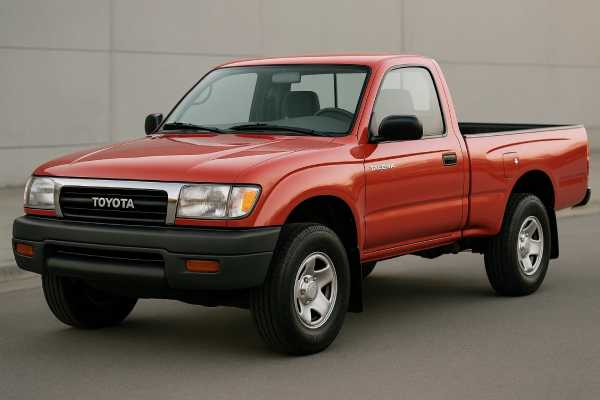
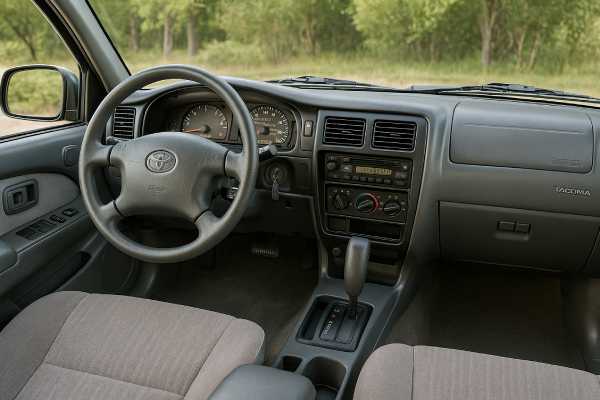
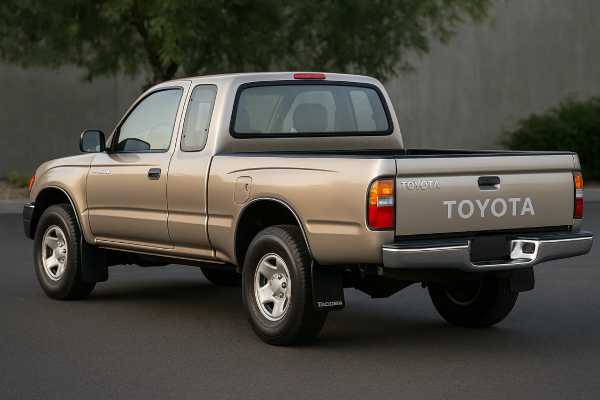
The first-generation Toyota Tacoma 4×4 with the 3RZ-FE 2.7-litre engine sits in a sweet spot between basic work truck and dependable off-road partner. Built from 1995 to 2000 on the N140 platform, this configuration combines a simple ladder frame, a stout part-time four-wheel-drive system, and a naturally aspirated four-cylinder that is easier – and cheaper – to keep alive than the V6 in many real-world fleets. Owners value these trucks for their mechanical honesty: manual 4WD engagement, straightforward suspension, and very little in the way of electronics. At the same time, payload and towing capability are still strong enough for light trailers, overland builds, or daily utility use.
In this guide we will walk through key specifications, real dimensions and capacities, known reliability patterns, and what to look for when buying or maintaining a Tacoma 4×4 2.7. The goal is to help you decide whether this specific drivetrain and chassis combination fits your use case and budget for the long term.
Top Highlights
- Proven 3RZ-FE 2.7L chain-driven four-cylinder with about 150 hp and strong low-end torque for light towing and off-road work.
- Robust part-time 4×4 system with low range, solid ground clearance around 275 mm, and simple manual hubs or ADD front axle depending on year.
- Frame and suspension handle payloads in the 700–800 kg range and typical tow ratings up to 1,600 kg (3,500 lb) when properly equipped.
- Watch for frame rust, lower ball joint recalls, and ageing rubber components on trucks now well past 20 years old.
- Oil and filter changes every 10,000 km or 6 months with 5W-30 and roughly 5.4 L capacity are a good baseline for long engine life.
Section overview
- Tacoma 2.7 4×4 background
- 4×4 3RZ-FE specs overview
- Equipment levels and 4×4 safety
- Reliability of Tacoma 4×4 3RZ
- Service schedule and buying advice
- Off-road driving and performance
- Tacoma 3RZ 4×4 versus rivals
Tacoma 2.7 4×4 background
The first-generation Tacoma replaced the older Hilux-based pickup in the U.S. for the 1995 model year. Compared with the earlier truck, it focused more on ride comfort and safety while keeping the durable frame-on-body construction that off-road drivers wanted. The N140-series 4×4 trucks with the 3RZ-FE 2.7-litre engine quickly became a favourite for owners who needed real four-wheel drive but did not want the extra complexity or fuel consumption of the 3.4-litre V6.
The 3RZ-FE itself is a square-bore, 16-valve inline-four with dual overhead cams and a timing chain instead of a belt. It was designed to deliver flat, usable torque rather than high horsepower. In Tacoma trim it is rated around 150 hp at 4,800 rpm and 177 lb-ft at 4,000 rpm, which is enough for moderate towing and highway speeds when geared correctly. Paired with a 5-speed manual or 4-speed automatic and a part-time 4WD transfer case, it gives the truck a simple and coherent mechanical package.
Toyota offered several body and drivetrain combinations over 1995–2000:
- Regular Cab 4×4
- Xtracab (extended cab) 4×4
- Different bed lengths and axle ratios
Most 2.7 4×4 models use a 6-lug hub pattern (shared with the 4×4 V6 and PreRunner) and a live rear axle with leaf springs. Compared with 2WD trucks, the 4x4s sit higher, have a different front suspension layout (independent with torsion bars or coils, depending on year and trim), and include a separate transfer case with 2H/4H/4L modes controlled by a floor lever or dash selector.
For many owners, the appeal of this configuration is balance:
- Enough clearance and traction for genuine trail use
- Manageable running costs and simpler repairs than the V6
- A chassis that can still be daily-driven without feeling like a full-size truck
If you are considering a first-generation Tacoma as an all-rounder – commuting during the week, trails and light towing on weekends – the 2.7 4×4 belongs on the short list.
4×4 3RZ-FE specs overview
In this section we focus on the 3RZ-FE 2.7-litre 4×4 Tacoma, using representative figures from the late-1990s Regular Cab and Xtracab models. Exact numbers can vary slightly by year, body style, transmission, and market, so always confirm against the VIN-specific manual.
Engine and performance
| Item | Specification (3RZ-FE 2.7 4×4) |
|---|---|
| Engine code | 3RZ-FE inline-4 |
| Displacement | 2.693 L (2,693 cc) |
| Bore × stroke | 95.0 × 95.0 mm |
| Valvetrain | DOHC, 4 valves per cylinder, shim-over-bucket tappets |
| Induction | Naturally aspirated |
| Fuel system | Multi-point fuel injection |
| Compression ratio | ~9.5:1 |
| Max power | ~150 hp (112 kW) @ 4,800 rpm |
| Max torque | ~240 Nm (177 lb-ft) @ 4,000 rpm |
| Timing drive | Duplex chain with hydraulic tensioner |
| Firing order | 1-3-4-2 |
| Recommended oil | SAE 5W-30, API SJ or better |
| Oil capacity | ~5.4 L (5.7 qt) including filter |
Transmission and 4×4 driveline
| Item | Manual 4×4 | Automatic 4×4 |
|---|---|---|
| Transmission | 5-speed manual (R150F family, typical) | 4-speed automatic (A340F family, typical) |
| Drive type | Part-time 4×4, 2H / 4H / 4L | Part-time 4×4, 2H / 4H / 4L |
| Transfer case | Gear-driven, low-range reduction | Same basic layout |
| Final drive ratios | Commonly 4.10 or 4.56 | Often 4.10 |
| Front differential | Independent front suspension, open diff | |
| Rear axle | Solid axle with leaf springs, open diff (locker available on some trims in later years) | |
| Front engagement | Automatic disconnecting differential (ADD) or manual locking hubs, by year/market |
Gear ratios vary slightly by transmission code, but in practice the truck feels short-geared enough for off-road work while still tolerable at highway speeds.
Chassis and dimensions
Representative figures for a late-1990s Xtracab 2.7 4×4:
| Item | Value |
|---|---|
| Length | ~5,055 mm (199.0 in) |
| Width | ~1,689 mm (66.5 in) |
| Height | ~1,560 mm (61.4 in) |
| Wheelbase | ~3,096 mm (121.9 in) |
| Ground clearance | ~275 mm (10.8 in) |
| Curb weight | ~1,500–1,550 kg (3,300–3,420 lb) depending on cab and transmission |
| Gross vehicle weight rating (GVWR) | Around 2,250–2,300 kg (4,960–5,070 lb) |
| Fuel tank capacity | ~57 L (15.0 US gal) |
| Steering | Power-assisted rack-and-pinion or recirculating ball (variant-dependent) |
| Brakes | Front ventilated discs, rear drums; ABS optional on many trims |
Off-road geometry is configuration-dependent, but expect approximately:
- Approach angle: low 30-degree range with stock bumper
- Departure angle: mid-20-degree range
- Breakover angle: mid-20s for Regular Cab, slightly lower for Xtracab
Performance and capability
| Metric | Typical value (2.7 4×4) |
|---|---|
| 0–100 km/h (0–62 mph) | ~12–13 s (manual), a little slower with automatic |
| Top speed | ~165 km/h (102 mph), gear and tyre limited |
| Rated towing capacity | Commonly 1,588 kg (3,500 lb) with 2.7 engine and tow package |
| Typical payload | ~750–860 kg (1,650–1,900 lb), configuration dependent |
Tow ratings vary across documents; many references quote 3,500 lb for the 2.7-litre trucks and higher ratings only for the V6. Always check the door-jamb sticker and owner’s manual for the exact number for your VIN.
Fluids, service capacities and basic torque values
(Values are typical for the 3RZ-FE Tacoma; always verify for your exact model year.)
| System | Spec / capacity | Notes |
|---|---|---|
| Engine oil | 5W-30, ~5.4 L with filter | Change every 10,000 km or 6 months for mixed use |
| Engine coolant | Toyota long-life (red), 50/50 mix, ~7–8 L | Replace about every 80–100,000 km or 5 years |
| Manual gearbox | GL-4/GL-5 75W-90, ~2.0–2.2 L | Shorter intervals if towing often |
| Automatic transmission | Toyota Type T-IV or equivalent, ~7–8 L total fill | Drain-and-fill uses less |
| Front diff | 75W-90 GL-5, ~1.1 L | Inspect after deep water crossings |
| Rear diff | 75W-90 GL-5, ~2.0–2.3 L | LSD units may need friction modifier |
| Transfer case | 75W-90 GL-4/5, ~1.0–1.2 L | Check level after heavy off-road use |
Indicative torque values:
- Wheel nuts: ~100–110 Nm (74–81 lb-ft)
- Engine oil drain plug: ~35–40 Nm (26–30 lb-ft)
- Spark plugs: ~18–22 Nm (13–16 lb-ft)
Electrical and safety basics
The Tacoma 2.7 4×4 of this era uses a conventional 12 V system with:
- Alternator output typically around 70–80 A
- 12 V lead-acid battery in the 40–60 Ah range
- Standard spark plugs rather than factory iridium
Safety equipment is simple by modern standards: dual front airbags on later years, optional ABS, three-point belts, and a rigid cab structure that performed acceptably but not perfectly in crash tests for the period.
Equipment levels and 4×4 safety
The Tacoma 3RZ-FE 4×4 was offered in a small set of trims that varied by cab, equipment, and cosmetic packages rather than major mechanical differences.
Trims and options (North American focus)
Exact names vary slightly over 1995–2000, but typical 2.7 4×4 offerings included:
- Base / DX Regular Cab 4×4
- Vinyl or basic cloth interior
- Manual windows and locks
- Steel wheels, smaller tyre sizes
- Often manual transmission only
- SR5 Regular Cab / Xtracab 4×4
- Upgraded cloth, better sound insulation
- Optional power windows and locks
- Alloy wheels on higher packages
- More exterior chrome, colour-keyed trim
- Special packages / regional editions
- Off-road packages with different tyre sizes and skid plates
- Cosmetic appearance packages such as decals, unique seat fabrics, or grille designs
Key mechanical distinctions by trim:
- Some SR5 and off-road packages include larger tyres and wheels, slightly changing gearing feel and approach/departure angles.
- Limited-slip differentials were available on some models; proper identification normally requires checking the axle code on the VIN plate.
- ABS was optional in many years and not always fitted to base trims.
Quick visual identifiers:
- 2.7 4×4 vs 2WD – six-lug wheels, taller ride height, front differential and half-shafts visible.
- 3RZ vs 5VZ-FE (V6) – inline-four layout versus “V” layout; 3RZ has the intake and exhaust on opposite sides of a straight block.
- ABS-equipped trucks – ABS warning lamp at key-on and ABS hydraulic unit visible in the engine bay.
Safety ratings
Crash-test coverage for compact pickups from the 1990s is more limited than for modern vehicles, but broad themes are:
- Moderate-overlap frontal tests from independent bodies generally rated the Tacoma cab structure as acceptable, with some elevated risk of lower leg injury in severe impacts.
- Federal frontal crash ratings for certain model years often fall in the mid-range compared with later vehicles, and many configurations were not tested in side or rollover protocols that became common later.
In modern terms, these are modest ratings reflecting the vehicle’s age and class. There is no engineered crumple zone comparable to current pickups, and there are no side curtain airbags.
Safety systems and driver assistance
The 1995–2000 Tacoma 2.7 4×4 predates modern ADAS technology. You can expect:
- Airbags:
- Driver airbag from launch
- Passenger airbag added and improved over the production run
- Braking and stability:
- Power-assisted ventilated front discs and rear drums
- Load-sensing proportioning valve in the rear circuit
- Optional four-wheel ABS on many 4×4 trims
- No electronic stability control or traction control
- Child seat provisions:
- No ISOFIX/LATCH; child seats are secured with belts and recommended routing
- Regular Cab use with rear-facing seats is limited by airbag and space considerations – the owner’s manual should be followed closely
- Visibility and lighting:
- Simple halogen headlamps that meet period standards but feel dim compared with modern projector or LED units
After any front-end collision or major chassis repair, pay attention to:
- Airbag lamp operation (on at key-on, off after self-test)
- Alignment, steering-wheel centring, and pull under braking
- ABS warning indicators and stored fault codes
Reliability of Tacoma 4×4 3RZ
The 3RZ-FE Tacoma 4×4 has a strong reputation for durability, provided corrosion is controlled and basic maintenance is respected. The engine itself is overbuilt, with a timing chain designed for long life, generous oil capacity, and a simple fuel and ignition system. Many engines exceed 400,000 km without internal work when serviced regularly.
To make this practical, it helps to group issues by system.
Engine and fuel system
Common to occasional issues:
- Valve-clearance drift (high mileage)
- Symptoms: Ticking noise on cold start, slightly rough idle, or gradually declining performance.
- Cause: Shim-over-bucket valvetrain needs periodic adjustment; valves can tighten over time.
- Remedy: Measure and adjust clearances, replacing shims as needed. Usually medium labour cost; parts are inexpensive.
- Timing chain wear (very high mileage)
- Symptoms: Rattling at start-up, noise from timing cover, possible timing correlation errors on OBD II trucks.
- Cause: Chain, guides and tensioner wear after long service, especially with poor oil change history.
- Remedy: Replace chain, guides and tensioner; follow service manual procedure and replace related seals.
- Oil leaks
- Front and rear crankshaft seals, cam cover gasket, and oil pan can leak with age. Typically a medium-cost repair but not usually catastrophic if monitored.
- Fuel-system wear
- Ageing injectors and pumps can cause hard starting, misfires, or noise. Many owners treat pump and filter replacement as a once-per-ownership refresh item if history is unknown.
Serious engine failures are rare compared with many contemporaries, particularly if the cooling system is maintained and the engine is not repeatedly overheated.
Cooling, driveline and suspension
- Radiator and hoses:
- Plastic end tanks on original radiators may crack after decades. Proactive replacement along with upper and lower hoses is cheap insurance.
- Manual gearbox and clutch:
- Gearboxes are generally robust. Expect normal clutch wear on high-mileage or heavily towed trucks. Crunching into second or third often points to synchro wear or old oil.
- Front differential and CV joints:
- Off-road use, especially with lifted suspension, accelerates CV boot stress. Torn boots lead to joint wear and noise.
- Suspension wear:
- Front ball joints and control-arm bushings eventually loosen. There was a well-known lower ball joint recall on many Tacomas, so confirm recall completion.
- Rear leaf-spring bushings and shackles may corrode; leaf springs themselves can crack or sag when heavily loaded or rusted.
Frame and corrosion
The single biggest long-term risk on a first-generation Tacoma – including the 2.7 4×4 – is frame corrosion in certain climates. Toyota ran large frame-inspection and buy-back campaigns for severe rust on specific VIN ranges, especially in salt-belt regions.
Key points:
- Inspect the frame rails near the rear leaf-spring hangers, crossmembers, and steering rack mounts.
- Surface rust is manageable; deep flaking, bubbles, and perforation are serious warning signs.
- Ask for documentation if the truck had a frame inspection, replacement, or rustproofing under any Toyota campaign or dealer program.
Recalls, TSBs and service actions
Across the 1998–2000 Tacoma range, official sources list several recalls, often covering:
- Lower ball joint or steering components
- Leaf spring or rear suspension hardware
- Airbag or seat-belt components
- Frame corrosion inspection or treatment
For any candidate truck:
- Obtain the full VIN.
- Run it through the official recall database for your region.
- Ask the seller for printed service records showing recall completion and major repairs.
Pre-purchase checks for reliability
When evaluating a used Tacoma 2.7 4×4 today, prioritise:
- Frame condition and any signs of structural rust
- Evidence of regular oil and coolant changes
- Driveline noise or vibration, especially in 4H and 4L
- Steering play, clunks, and uneven tyre wear
- ABS and airbag warning lamp operation
A structurally sound truck with a clean frame and normal wear items is usually a safer bet than a low-mileage example with heavy rust or missing service history.
Service schedule and buying advice
Because these trucks are now older, a practical maintenance plan has two layers: catching up on age-related service and then following a steady ongoing schedule.
Practical maintenance schedule (typical use)
Intervals below are approximate and should be adjusted for heavy towing, extreme climates, or dusty conditions.
- Engine oil and filter – every 8–10,000 km or 6 months with quality 5W-30. Shorten to 5–7,000 km for frequent short trips or heavy loads.
- Engine air filter – inspect every 15,000 km; replace every 30,000 km or sooner in dusty use.
- Cabin filter – many early Tacomas did not have a cabin filter from the factory; if a retrofit kit is fitted, follow its guidance.
- Fuel filter – for models with a serviceable inline filter, consider replacement every 80–100,000 km or as needed.
- Spark plugs – standard copper plugs are often specified around 30,000–40,000 km intervals; long-life plugs can go longer but should still be inspected.
- Valve clearance check – around 100–120,000 km and then every 80,000 km or when symptoms (noise or performance changes) appear.
- Coolant – replace every 80–100,000 km or 5 years with the correct long-life coolant.
- Drive belts and hoses – inspect at every service; typically replace belts around 80–100,000 km or when cracking appears, and hoses when they feel soft, swollen or cracked.
- Manual gearbox, transfer case, and differentials – refresh fluids roughly every 60–80,000 km; halve the interval for frequent towing or heavy off-road use.
- Automatic transmission – drain-and-fill or pan-service every 60–80,000 km is a sensible target, especially if towing or driving in hot climates.
- Brake fluid – flush every 2–3 years regardless of mileage.
- Brake pads, rotors and shoes – inspect at each tyre rotation; replacement ranges of 40–80,000 km are common depending on driving style.
- Tyre rotation and alignment – rotate every 10–12,000 km; align whenever pull, uneven wear, or suspension work occurs.
- 12 V battery – test annually from the 4-year mark onwards; expect 4–6 years of life in typical conditions.
Because the 3RZ-FE uses a timing chain, there is no fixed belt-replacement interval, but chain condition should be assessed around 250–300,000 km or if noises or timing errors appear.
Fluid choices and capacities in context
When planning work or parts orders, it helps to note:
- Engine oil – 5.4 L including filter usually means one 5-L jug plus a top-up bottle.
- Gear oils – most driveline components can be serviced with 4–5 L of 75W-90, assuming standard diffs and transfer case.
- Coolant – two 4-L bottles of concentrate will usually cover a full refill when mixed 50/50 with distilled water.
Always consult service literature for torque specs on aluminium components to avoid stripped threads.
Buyer’s checklist for the Tacoma 3RZ 4×4
When inspecting a potential purchase, work through the following:
- Frame and underbody
- Examine frame rails, crossmembers, rear shackle mounts, and steering-rack area for rust.
- Probe questionable spots; perforation and heavy flaking are serious concerns.
- Driveline and 4×4 system
- Engage 4H and 4L on a loose surface; check for grinding, binding, or flashing indicators.
- Verify smooth engagement and disengagement of the ADD or manual hubs.
- Engine condition
- Cold start should be clean, with minimal smoke and stable idle.
- Check for oil leaks around the timing cover, rear of engine, and valve cover.
- Suspension and steering
- Listen for clunks, knocks, or rattles over bumps.
- Check for play in wheel bearings, tie rods, ball joints, and control-arm bushings.
- Service and recall history
- Look for recent fluid services, brake work, and suspension repairs.
- Confirm recall status (frame, ball joints, springs, airbags) with a VIN check.
Which years or trims to favour?
- Trucks with documented frame inspection or replacement are especially attractive in rust-prone areas.
- The 2.7 4×4 is often a better long-term prospect than a similar-vintage V6 if you prioritise simplicity and fuel cost over towing heavy loads.
- Avoid heavily lifted or extensively modified trucks unless you plan to inspect and refresh the entire driveline and suspension.
A 3RZ-FE Tacoma that has had regular oil changes, periodic valve checks, clean coolant, and timely suspension work can be a very long-lived, low-drama truck even by modern standards.
Off-road driving and performance
From behind the wheel, the Tacoma 2.7 4×4 feels compact by modern pickup standards, with a relatively narrow body and light steering. Ride quality is firm when unladen but settles with some weight in the bed. Compared with many body-on-frame trucks of the 1990s, it offers decent straight-line stability and predictable behaviour at highway speeds, though crosswinds and ruts will remind you of its age.
Powertrain character
The 3RZ-FE is not a fast engine, but it is tractable and cooperative:
- It is strongest in the mid-range, pulling willingly from about 2,000–4,000 rpm.
- Throttle response is linear, with minimal delay thanks to cable-actuated throttle and simple fuel injection.
- The 5-speed manual makes the most of the available torque; the 4-speed automatic is smooth but can feel a little busy on hills.
For everyday driving, you can expect:
- City: Easy to keep up with traffic if you use the torque band; frequent short trips favour shorter oil intervals.
- Highway (100–120 km/h): Engine revs higher than in modern multi-gear automatics, but noise remains acceptable; wind and tyre noise can exceed engine noise.
Real-world fuel economy for 2.7 4WD models typically falls around 13–14 L/100 km in mixed driving, with city use somewhat worse and careful highway cruising slightly better. Official ratings in period reflect combined consumption in the high teens in mpg (US).
Off-road behaviour
The Tacoma 3RZ 4×4 is very comfortable on trails within its size and clearance limits:
- Low-range gearing allows controlled descents and slow-speed rock work.
- Ground clearance of around 275 mm and modest overhangs suit rutted tracks and ledges.
- Approach and departure angles are good for a stock pickup; the rear bumper or tow hitch is often the limiting factor.
Traction depends heavily on tyres and whether the truck has an LSD or locker. With open diffs and road-biased tyres, careful line choice and momentum are important; with a rear locker and more aggressive tyres, the truck feels far more capable than the power figure suggests.
Points to watch:
- Front CV joint angles – large lifts without driveline corrections accelerate CV wear.
- Skid-plate coverage – factory armour is light; many owners add transfer-case, engine, and tank protection.
- Water crossings – breather extensions and frequent diff-fluid checks are wise if you regularly drive through deep water.
Towing and load performance
Within its rated 3,500-lb tow capacity for many configurations, the Tacoma 2.7 4×4 behaves predictably:
- It is not fast up long grades, but temperatures remain stable if cooling is healthy.
- Braking distances increase; trailer brakes are strongly recommended near the upper limit.
- Fuel consumption can climb to 16–18 L/100 km or more under sustained towing at highway speeds.
Payloads around 500–600 kg feel well within the chassis’ comfort zone, especially with fresh rear springs and shocks. At maximum payload, expect more rear-end movement over bumps and a slightly nose-high stance if springs are tired.
Tacoma 3RZ 4×4 versus rivals
When these trucks were new, their main competitors were the Nissan Frontier (D22), Ford Ranger, Mazda B-Series, Chevrolet S-10/GMC Sonoma, and compact offerings from Isuzu and others. On today’s used market, several differences still stand out.
Strengths versus rivals
- Powertrain robustness – the 3RZ-FE is widely regarded as one of the most durable four-cylinder truck engines of its era, with relatively few systemic weaknesses and a long record in other Toyota platforms.
- Aftermarket support – excellent availability of OEM and aftermarket parts, from factory-style components to suspension kits and off-road accessories.
- Resale and community knowledge – strong resale values and active owner communities make it easier to diagnose issues, find how-to information, and source used parts.
Where competitors can be better
- Ride comfort and cabin space – some later Rangers and Frontiers offer more modern seats, sound insulation, and interior design.
- Safety – newer or later-generation competitors may include side airbags, improved crash structures, and, eventually, stability control.
- On-road performance – V6-powered compact trucks of the same period often accelerate and tow more confidently, though with higher fuel consumption and complexity.
Who the Tacoma 2.7 4×4 suits best
This configuration is especially attractive if:
- You value longevity and simplicity over outright power.
- You want a compact truck that can genuinely go off-road without the footprint of a full-size pickup.
- You are comfortable doing some maintenance yourself or using independent specialists.
It is less ideal if:
- You regularly tow at or near the top of the rating over long distances.
- You require modern crash protection and driver assistance systems for family duty.
- You prioritise a quiet, car-like cabin and soft ride over utility and durability.
For many enthusiasts, a sound-frame Tacoma 3RZ 4×4 remains one of the best long-term, modest-budget platforms for camping, light overlanding, and daily use, provided that rust and deferred maintenance are addressed early in ownership.
References
- Gas Mileage of 1998 Toyota Tacoma 2024 (Fuel Economy Data)
- 1998 Toyota Tacoma 2024 (Safety Rating)
- Vehicle Detail Search – 1998 TOYOTA TACOMA 2024 (Recall Database)
- Toyota 3RZ-FE 2.7L Engine Specs, Problems & Reliability 2024 (Engine Technical Data)
- Used 1997 Toyota Tacoma Regular Cab – Specs & Features 2024 (Specification Summary)
Disclaimer
This article is intended for informational purposes only and is not a substitute for professional diagnosis, repair, or safety assessment. Specifications, capacities, torque values, service intervals, and procedures can vary by VIN, model year, market, equipment level, and any modifications made over the vehicle’s life.
Always confirm critical data against the official owner’s manual, factory service literature, and current technical bulletins for your specific vehicle, and follow all relevant safety and legal requirements.
If you found this guide useful, consider sharing it with other owners or enthusiasts on your preferred platforms (such as Facebook or X/Twitter). Your support helps xcar continue to produce detailed, model-specific technical content.