
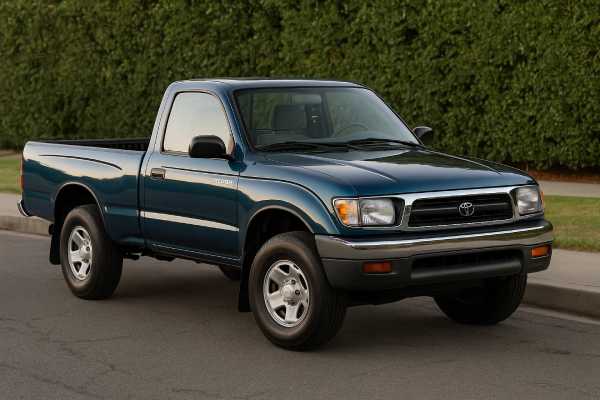
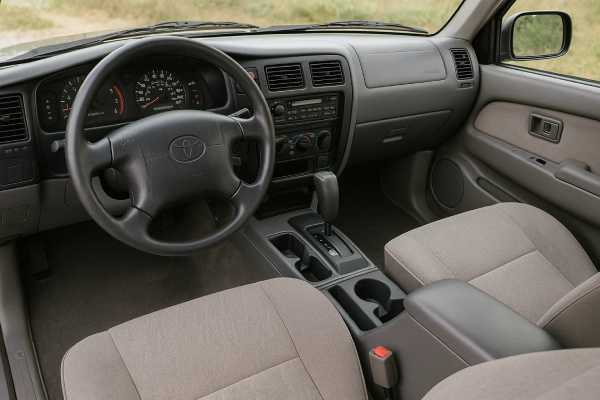
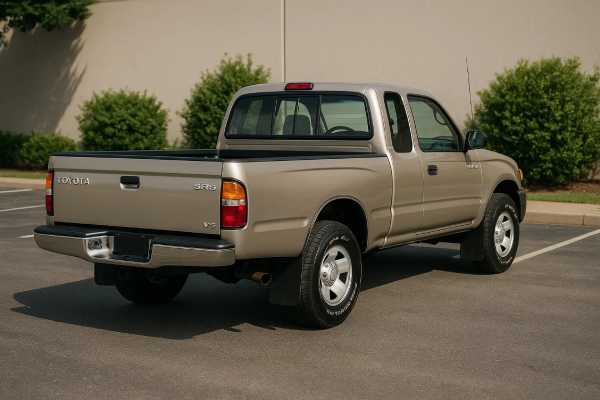
The first-generation Toyota Tacoma 4×4 with the 5VZ-FE 3.4-litre V6 has become one of the most sought-after compact trucks of the late 1990s. Built on the N140 platform between 1995 and 2000, it blends a strong ladder frame, part-time four-wheel drive, and a smooth naturally aspirated V6 that feels at home both on the highway and on rough access roads.
Compared with four-cylinder Tacomas, the 3.4 V6 4×4 offers noticeably stronger acceleration, easier towing, and more relaxed cruising at modern speeds. At the same time, it keeps a compact footprint and relatively simple mechanical layout, so a competent owner or independent shop can still handle most jobs without exotic tools.
This guide looks beyond brochure numbers. You will find key specifications, real-world driving impressions, reliability patterns, corrosion concerns, and a practical maintenance and buyer’s checklist. The aim is to help you decide whether a 1995–2000 Tacoma 4×4 V6 suits your needs today, and what it takes to keep one dependable for the long term.
Top Highlights
- 3.4-litre 5VZ-FE V6 delivers around 190 hp and strong mid-range torque for towing and mountain driving.
- Part-time 4×4 with low range gives real off-road ability and confidence in snow, gravel, and mud.
- Simple, proven drivetrain with broad parts availability and a large aftermarket support network.
- Main ownership caveats are frame and underbody rust plus age-related suspension and brake wear.
- Sensible oil and filter changes every 8–10,000 km or 6 months help these engines run past 300,000 km.
Guide contents
- Tacoma 3.4 4×4 background
- Tacoma 5VZ-FE 4×4 specs
- Tacoma 4×4 trims and safety
- Reliability of V6 4×4 Tacoma
- Ownership maintenance and buyer tips
- Road manners and 4×4 performance
- How Tacoma 4×4 compares
Tacoma 3.4 4×4 background
The first-generation Tacoma arrived for 1995 as Toyota’s replacement for the older Hilux-based pickup in North America. The goal was to keep the rugged ladder-frame construction while improving comfort, safety, and refinement. The N140 platform underpins a range of configurations: four-cylinder and V6 engines, rear-wheel drive and four-wheel drive, regular and extended cabs, and multiple bed lengths.
The 5VZ-FE 3.4-litre V6 was the range-topping petrol engine in this generation. It uses an iron block with aluminium cylinder heads, dual overhead cams, and four valves per cylinder. The emphasis is on a broad, usable torque band rather than peaky power. In typical Tacoma tune it produces about 190 hp and 220 lb-ft, which is plenty for a compact pickup from this era.
The 4×4 system is a simple part-time setup: the truck runs in rear-wheel drive on dry pavement and the front axle is engaged via a transfer case for 4H and 4L. This simplicity is a big part of its long-term appeal. There is no full-time centre differential or complex electronics to manage normal driving; instead, the driver chooses when to engage four-wheel drive.
In period, the Tacoma 3.4 4×4 was aimed at outdoors-oriented buyers who wanted something smaller and easier to park than a full-size truck, but still capable of towing small boats, utility trailers, or campers. Today, that positioning still makes sense. The truck feels more compact and “analogue” than modern mid-size pickups, which is exactly what many enthusiasts and overland travellers are looking for.
Tacoma 5VZ-FE 4×4 specs
Below are typical specifications for a 1995–2000 Toyota Tacoma 4×4 with the 5VZ-FE V6. Exact figures can vary slightly by year, cab style, axle ratio, and market. Always confirm against your VIN and official manual.
Engine and performance data
| Item | Specification |
|---|---|
| Engine code | 5VZ-FE |
| Configuration | 60° V6, iron block, aluminium heads |
| Valvetrain | DOHC, 4 valves per cylinder |
| Displacement | 3.4 l (3,378 cc) |
| Bore × stroke | Approx. 93.5 × 82.0 mm |
| Induction | Naturally aspirated |
| Fuel system | Multi-point fuel injection |
| Compression ratio | Around 9.6 : 1 |
| Maximum power | About 190 hp (142 kW) @ ~4,800 rpm |
| Maximum torque | About 220 lb-ft (298 Nm) @ ~3,600 rpm |
| Recommended fuel | Unleaded regular (typically 87 AKI in North America) |
The 5VZ-FE’s character is more about strong mid-range pull than high-rev excitement. It feels relaxed at highway speeds and can hold gears on hills without constant downshifting, especially with the manual gearbox.
Transmission and 4×4 driveline
| Item | Manual version | Automatic version |
|---|---|---|
| Gearbox | 5-speed manual | 4-speed automatic |
| Drive type | Part-time 4×4 (2H / 4H / 4L) | Part-time 4×4 (2H / 4H / 4L) |
| Transfer case | Lever-operated, chain-driven | Lever-operated, chain-driven |
| Front differential | Open | Open |
| Rear differential | Open; locking rear differential on some TRD Off-Road trucks | Same |
Typical axle ratios are in the 4.10–4.30 range, depending on transmission and towing package. Trucks with factory rear lockers are particularly sought after for off-road work.
Dimensions and weights (typical 3.4 4×4 Xtracab)
| Item | Approximate value |
|---|---|
| Overall length | 4,700–4,830 mm (185–190 in) depending on bed length |
| Overall width | Around 1,690 mm (66.5 in) |
| Overall height | Around 1,650–1,715 mm (65–67.5 in) |
| Wheelbase | About 2,620–3,095 mm (103–122 in) |
| Ground clearance | Roughly 200–235 mm (7.9–9.3 in) under the differential |
| Curb weight | Approximately 1,600–1,750 kg (3,530–3,860 lb) |
| GVWR | Around 2,450–2,600 kg (5,400–5,730 lb), configuration dependent |
| Fuel tank | About 57–70 l (15–18.5 US gal), depending on model year and cab |
Suspension, steering, and brakes
| System | Layout |
|---|---|
| Front suspension | Independent double wishbone or double A-arm with torsion bars or coils (varies by year) |
| Rear suspension | Solid axle with semi-elliptic leaf springs |
| Steering | Power-assisted steering (rack-and-pinion or recirculating ball) |
| Brakes | Front ventilated discs, rear drums; ABS optional/standard on many V6 trims |
| Typical tyres | 235/75R15 or 265/70R16 all-terrain or highway tyres |
Bushings, shocks, and ball joints are straightforward to replace and benefit greatly from modern aftermarket components when refreshing an older truck.
Performance and capability
| Metric | Typical value (stockish truck) |
|---|---|
| 0–60 mph (0–97 km/h) | Roughly mid-8 to low-9 seconds with manual, slightly slower with automatic |
| Top speed | Limited by gearing and tyres; typically around 170–180 km/h (105–112 mph) |
| Towing capacity | Up to about 2,270 kg (5,000 lb) with tow package; lower on base models |
| Payload | Typically 680–820 kg (1,500–1,800 lb) depending on cab and options |
Key fluids and capacities (for planning)
Exact numbers vary; always check your factory manual:
- Engine oil: 5W-30, roughly 4.5–5.5 l including filter
- Engine coolant: long-life coolant, about 7–9 l total system capacity
- Manual gearbox: approx. 2–3 l of 75W-90 gear oil
- Automatic transmission: Toyota ATF (e.g., Type T-IV on many units), capacity depends on drain vs full overhaul
- Transfer case: around 1–1.5 l of 75W-90 gear oil
- Front differential: roughly 1–1.3 l of gear oil
- Rear differential: roughly 2.5–3 l of gear oil
These numbers help you estimate fluid quantities before a full service, but always verify for your exact axle and gearbox codes.
Tacoma 4×4 trims and safety
Trim levels and option packages play a big role in how a Tacoma 4×4 behaves and what it can do. While naming varies slightly by year and market, the main patterns are consistent.
Common 4×4 V6 trim levels
Base / standard 4×4 V6
- Regular or Xtracab
- Cloth or vinyl seats
- Steel wheels
- Basic audio and interior trim
- Manual windows and locks on many examples
SR5 4×4 V6
- More comfortable seats and interior fabrics
- Optional power windows, locks, and mirrors
- Better audio, more instrumentation, tilt steering
- Alloy wheels and extra chrome or colour-keyed trim
TRD Off-Road package (usually on SR5)
- Rear differential locker
- Off-road-tuned suspension with upgraded shocks
- Skid plates for vulnerable components
- Distinctive wheels and decals
- Sometimes different axle ratios for better off-road or towing performance
These packages can change spring rates, shocks, and gear ratios, which affects ride and towing behaviour. The rear locker, where fitted, is a major advantage off-road and in deep snow.
How to identify equipment quickly
- Look for a rear diff-lock switch on the dash for TRD Off-Road trucks.
- Check the axle code on the build sticker or VIN plate to confirm ratio and whether a locker is present.
- Count leaf springs and inspect spring packs; heavier-duty packs often indicate higher payload or tow rating.
Safety equipment
For a 1990s truck, the Tacoma 4×4 offers decent but basic safety features:
- Dual front airbags (driver and passenger)
- Three-point seat belts for front occupants
- Load-sensing proportioning valve in the rear brake circuit
- Anti-lock brakes (ABS) on many V6 trucks, though not all
There are no side airbags, curtain airbags, or modern driver-assistance systems. No stability control, no traction control, and no automatic emergency braking. Driver alertness and careful loading remain critical for safety.
Child seat fitment uses the seat belts; ISOFIX/LATCH mounting points were not provided in this era. Extended cab jump seats are not ideal for child seats and should be used with extreme care or avoided for that purpose.
Crashworthiness and real-world safety
Crash-test coverage for compact pickups from the late 1990s is less comprehensive than for modern vehicles. Where tests exist, first-generation Tacomas typically perform reasonably for their age, but they cannot match the protection of newer mid-size trucks with improved crumple zones and side-impact structures.
When evaluating safety, keep in mind:
- This is a narrow, relatively light body-on-frame truck. In multi-vehicle collisions with modern SUVs and full-size pickups, the Tacoma is at a disadvantage simply due to physics.
- Many examples now have 25–30 years of wear. Condition of brakes, tyres, suspension, and steering components has a large effect on emergency handling.
Buyers who prioritise maximum passive and active safety may be better served by a newer model, but a well-maintained first-gen Tacoma driven with realistic expectations can still be a safe daily driver for many uses.
Reliability of V6 4×4 Tacoma
The 5VZ-FE V6 and associated 4×4 driveline are widely respected for durability. Many failures on older trucks trace back to neglected maintenance, harsh environments, or corrosion rather than inherent design flaws.
Engine reliability patterns
Strengths
- Robust bottom end that tolerates high mileage with regular oil changes
- Aluminium heads that, when not overheated, rarely crack or warp
- Timing components that are predictable and easy to service on a schedule
Common age-related issues
- Timing belt and accessories
- The V6 uses a timing belt rather than a chain.
- Neglect can lead to belt failure or tensioner issues; even if the engine survives, you risk breakdown and collateral damage.
- The best practice is to replace the belt, tensioner, idlers, and water pump together at the recommended interval or when history is unknown.
- Valve cover and cam seals
- Gaskets harden and shrink over decades, leading to weeping or small leaks.
- Oil smells on hot shutdown and damp areas around the head covers are typical signs.
- Combine gasket replacement with timing-belt service when possible to save labour.
- Cooling system
- Radiators, heater cores, and hoses age from the inside as well as the outside.
- Overheating is one of the few things that can seriously shorten 5VZ-FE life; even a single severe overheat can damage head gaskets.
- Proactive radiator and hose replacement on very old trucks is cheap insurance.
- Sensors and emissions equipment
- Oxygen sensors, mass-airflow sensors, and EGR components can cause rough running or poor fuel economy as they age.
- Most issues are solved by targeted diagnostics and replacing the specific faulty parts.
Driveline and 4×4 system
The part-time 4×4 hardware is relatively simple:
- Manual transmissions are strong; worn synchros result from high mileage or rough shifting.
- Automatic transmissions can last a long time if fluid is kept clean and temperatures controlled, especially when towing.
- Transfer cases and diffs rarely fail outright if fluid levels are maintained and off-road abuse is reasonable.
Common issues:
- Front CV joints and boots: These see heavy articulation in lifted or off-road trucks; cracks in the boots quickly lead to joint wear.
- Driveshaft U-joints: Vibration under acceleration or deceleration can indicate worn joints or an out-of-balance shaft.
- Rear differential noise: Whine on steady throttle may indicate wear from low fluid or high mileage.
Suspension, steering, and brakes
These trucks are now old enough that many will have:
- Worn ball joints and tie-rod ends
- Cracked or collapsed rubber bushings
- Tired leaf springs and shocks
The good news is that all of these parts are straightforward to replace, and the aftermarket offers stock-equivalent or upgraded components. A full suspension refresh can make a high-mileage Tacoma feel remarkably tight again.
Brake systems also age:
- Front calipers can seize or stick if not serviced.
- Rear drum mechanisms need correct adjustment and clean internals to perform properly.
- Old rubber hoses can swell internally, leading to spongy pedal feel.
Frame and corrosion concerns
For the 1995–2000 Tacomas, frame rust is the headline reliability risk in many regions:
- Moisture and road salt can accumulate inside boxed frame sections and around weld seams.
- Rust often starts where you cannot easily see it, such as the inner surfaces of rails and crossmembers.
- Severe corrosion can cause frame perforation, cracked spring hangers, and compromised crash performance.
Toyota introduced inspection and, in some cases, frame replacement programmes for certain trucks in high-salt markets. Today, those programmes are generally expired, so the responsibility falls on the buyer and current owner to inspect and protect the frame.
On a practical level, a spotless frame is more valuable than any amount of engine or interior work. A truck with a seriously compromised frame is often only suitable as a parts donor.
Ownership maintenance and buyer tips
A good maintenance plan and a careful purchase decision make the difference between a dependable truck and a constant project. This section combines a practical service schedule with a buyer’s checklist.
Practical maintenance schedule
Use your official manual for exact intervals; the following is a sensible pattern for mixed use:
Every 8,000–10,000 km or 6 months
- Engine oil and filter (quality 5W-30)
- Visual inspection of fluids, belts, hoses, and underbody
- Check for leaks around engine, gearbox, and diffs
- Tyre rotation and pressure adjustments
Every 24,000–30,000 km
- Engine air filter replacement or cleaning
- Inspect spark plugs and ignition components
- Check and adjust rear drum brakes, inspect front pads and rotors
- Inspect steering and suspension joints for play
Every 40,000–50,000 km
- Brake fluid flush
- Inspect and, if necessary, replace power-steering fluid
- Alignment check, especially if you use the truck off-road or after hitting potholes
Every 80,000–100,000 km or according to manual
- Timing belt, tensioner, idlers, and water pump
- Coolant flush and refill
- Manual gearbox, transfer case, and differential oils (earlier if towing heavily or water ingress is suspected)
- Spark plugs (and ignition leads if fitted and aged)
Age-based items
Regardless of mileage, consider:
- Radiator and hoses after 10–15 years
- Rubber fuel lines and brake hoses on very old trucks
- Suspension bushings, shocks, and leaf springs once ride quality and control deteriorate
When in doubt, replace fluids and rubber components pre-emptively; they are cheaper than dealing with breakdowns or secondary damage.
Fluid specifications for decision-making
As a planning guide:
- Engine oil: 5W-30 meeting current international specifications
- Gear oils: 75W-90 GL-4/GL-5 for gearbox, transfer case, and diffs (use exactly what your manual specifies)
- Coolant: phosphate and silicate-free long-life coolant compatible with aluminium engines
- Brake fluid: DOT 3 or DOT 4, from sealed containers only
Keep a written record of service dates, mileages, and parts used. This not only keeps you organised but also boosts resale value.
Buyer’s checklist for a used Tacoma 3.4 4×4
- Frame and underside
- Inspect rails, crossmembers, and spring hangers with a bright light.
- Probe flaky rust; surface rust is manageable, deep scaling or perforation is a serious warning sign.
- Look at fuel and brake lines along the frame for corrosion.
- Driveline and 4×4 operation
- Test 2H, 4H, and 4L on loose ground. Engagement should be clean and silent.
- Listen for grinding, clunks, or reluctance to shift in or out of 4×4.
- Check for vibrations under load that may point to driveshaft or U-joint issues.
- Engine and cooling system
- Cold start should be easy with no knocking or rattling.
- Look for smoke on startup or after idling.
- Check coolant colour and level; oil and coolant should never mix.
- Ask for proof of timing-belt replacement or plan to do it immediately if unknown.
- Suspension, steering, and brakes
- Drive over bumps and listen for clunks or knocking.
- Check steering for play on-centre or wandering on the highway.
- Inspect tyres for uneven wear that may indicate alignment or suspension issues.
- Documentation and history
- Seek service records showing regular oil changes and major services.
- Ask whether any recalls or corrosion inspections were completed in the past.
- Prefer trucks that are closer to stock rather than heavily modified, unless you know and trust the modifications.
Long-term durability outlook
A Tacoma 4×4 V6 with a solid frame and a documented maintenance history can reasonably be expected to serve for many more years. The most expensive surprises tend to revolve around rust and neglected timing-belt or cooling-system issues. Address those proactively, and the rest of the truck is usually straightforward to keep in shape.
Road manners and 4×4 performance
The driving experience is a big part of why the Tacoma 3.4 4×4 retains such a following. It feels mechanical and honest compared with many modern trucks, yet still civilised enough for daily use.
On-road behaviour
Ride and comfort
Unladen, the rear leaf springs can be firm and a bit choppy over broken pavement. Adding a moderate load in the bed often improves ride quality by settling the rear suspension. Aftermarket shocks and fresh bushings can also tame harshness and improve control.
Steering and handling
Steering is light with reasonable feedback for a truck. Straight-line stability on the highway is good when alignment and suspension components are healthy. Body roll is noticeable compared with a car, but the truck remains predictable and easy to place.
Noise levels
Wind noise and tyre roar are more pronounced than in modern vehicles. The V6 itself is smooth and relatively quiet at cruise; the cabin character is dominated more by aerodynamics and tyre choice than by engine noise.
Powertrain character
The 5VZ-FE V6 pulls strongly from low and mid rpm:
- In normal driving, you rarely need to rev it out; short-shifting still yields adequate performance.
- With the manual gearbox, you can keep it in the sweet spot for climbs and overtakes.
- The automatic prefers to upshift early for efficiency but will kick down cleanly when more power is needed.
When towing or on long steep grades, it is wise to drop a gear manually, both to keep the V6 in its ideal rev range and to reduce strain on the transmission.
Off-road behaviour and traction
The Tacoma 4×4 performs very well in typical off-road conditions:
- 4H is ideal for snow, gravel roads, and faster dirt sections.
- 4L offers fine control for steep climbs, rocky sections, and technical obstacles.
Strengths:
- Compact width and relatively short wheelbase (on many models) help on tight trails.
- Low-range gearing provides good crawl capability for a stock truck.
- TRD models with a rear locker have significantly improved traction when one rear wheel lifts or loses grip.
Limitations:
- Standard ground clearance and approach/departure angles are good but not exceptional. Very rough terrain may require skid plates or small lifts.
- Large lifts and oversized tyres can hurt on-road handling and drivetrain angles if not set up carefully.
Efficiency and range
Real-world fuel use depends heavily on tyre size, gearing, and driving style, but many owners report:
- Around 12–14 l/100 km (17–20 mpg US) in mixed driving on near-stock tyres.
- Better economy on long, steady highway runs at moderate speeds.
- Significantly higher consumption off-road or when towing near capacity.
With the typical fuel-tank size, realistic mixed-use range for a stock truck is often in the 400–550 km window between fill-ups.
How Tacoma 4×4 compares
When new, the 3.4-litre Tacoma 4×4 competed against trucks like the Nissan Frontier, Ford Ranger/Mazda B-Series, and Chevrolet S-10. On the used market today, it still stands out in several ways.
Key advantages
- Proven V6 driveline
The 5VZ-FE engine and associated gearboxes have a long record of surviving high mileage with relatively few internal failures when maintained correctly. - Compact yet capable
The Tacoma is smaller than most modern mid-size pickups, making it easier to manoeuvre in cities and on narrow tracks, yet it can still tow and haul enough for many recreational uses. - Aftermarket and community support
There is a huge ecosystem of parts, from OEM-level replacements to heavy-duty off-road components. Online communities and documentation make troubleshooting and modification easier. - Resale value
Even high-mileage 3.4 4×4 Tacomas command strong prices, reflecting demand and reputation.
Typical drawbacks
- Rust risk
Frame and underbody corrosion can be more severe on some Tacomas than on certain rivals. A truck from a harsh climate may be structurally compromised even if the engine runs well. - Age and safety equipment
These trucks lack many modern safety and driver-assistance systems. Buyers coming from newer vehicles may notice the difference immediately. - Cab space
Regular cabs are tight, and even extended cabs are modest by modern standards. If you routinely carry adult passengers in the rear, a later double-cab Tacoma or different truck may fit better.
Who should consider a 1995–2000 Tacoma 4×4 V6
This truck is a strong candidate if you:
- Want a durable, simple 4×4 for camping, light towing, or remote travel
- Prefer a compact body and a naturally aspirated engine over larger, more complex modern trucks
- Are willing to invest time in a thorough inspection and ongoing maintenance, especially for rust prevention
It may not be ideal if you put top priority on the latest crash ratings, very low fuel consumption, or maximum interior space. For many owners, however, those trade-offs are worth it to gain a tough, characterful truck that can still work hard decades after it left the factory.
References
- 2000 Toyota Tacoma Owner’s Manual 2000 (Owner’s Manual)
- TOYOTA Service Information 2024 (Service Manual and Technical Data)
- Fuel Economy of 1998 Toyota Tacoma 2024 (Fuel Economy Data)
- 1998 Toyota Tacoma crash test ratings 1998 (Safety Rating)
- 1998 TOYOTA TACOMA – Vehicle Details and Recalls 2024 (Recall Database)
Disclaimer
This article is provided for informational purposes only and does not replace professional diagnosis, inspection, or repair. Specifications, torque values, service intervals, and procedures can vary by VIN, production date, market, and installed equipment. Always verify all data against the official owner’s manual, factory service literature, and current technical bulletins for your specific vehicle before performing any work or making purchase decisions.
If you found this guide useful, please consider sharing it with other owners or enthusiasts on platforms such as Facebook or X/Twitter. Your support helps xcar continue to produce detailed, model-specific technical content.