
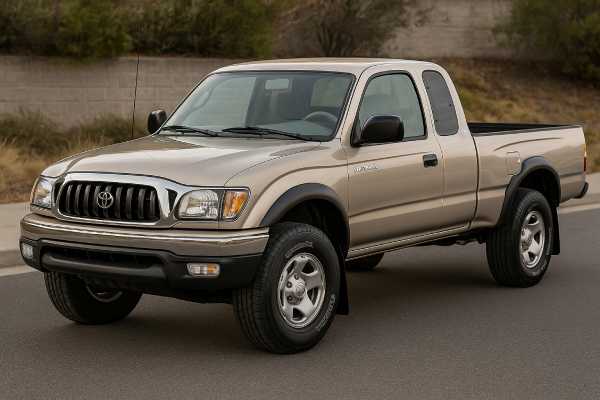
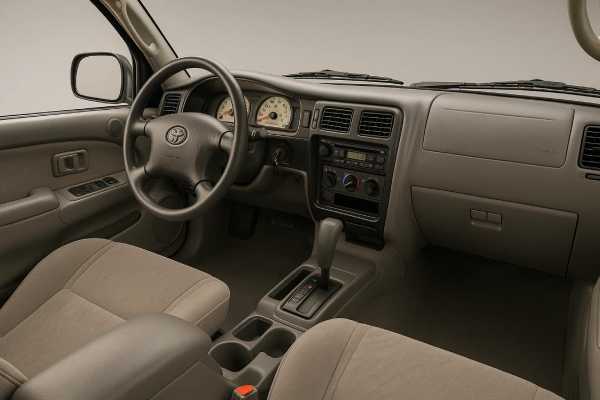
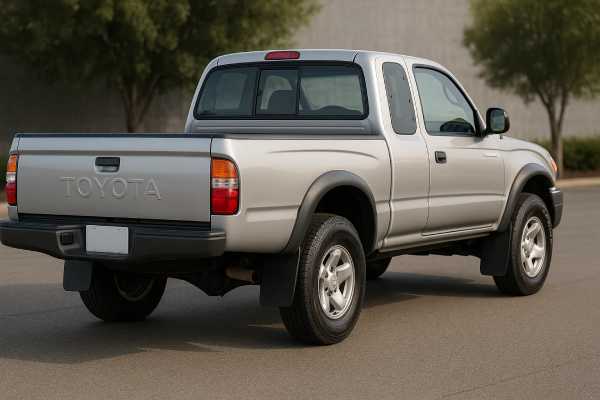
The facelifted 2001–2004 Toyota Tacoma RWD with the 3RZ-FE 2.7 litre four cylinder sits in a sweet spot between old-school simplicity and everyday usability. It kept the robust N140 chassis introduced in the mid-1990s but gained refreshed front styling, more modern interior trims, and the option of the Double Cab body, which made it far more practical as a daily driver. Under the hood, the 3RZ-FE remains a square, naturally aspirated workhorse with a long track record in commercial and off-road applications, valued for its durability and straightforward serviceability.
For buyers today, this generation offers a compact footprint, honest towing and payload capability, and a reputation for running well past 300,000 km with basic maintenance. At the same time, age-related corrosion, recall history, and higher used prices mean you need to shop with a clear checklist. This guide focuses specifically on the facelift 2001–2004 2WD Tacoma with the 3RZ-FE engine to help you understand its specs, running costs, strengths, and weak points.
Owner Snapshot
- Strong 3RZ-FE engine with timing chain and a reputation for 300,000+ km longevity when serviced on time.
- Compact, light RWD chassis with good payload for its size and simple suspension that is easy to repair.
- Cabin is basic but durable; facelift interior and Double Cab option make it more livable as a daily driver.
- Frame and suspension rust plus lower ball joint history demand careful inspection and recall verification.
- Plan on engine oil and filter changes every 8,000–10,000 km or 6 months, whichever comes first.
Section overview
- Tacoma 3RZ-FE facelift summary
- Engine specs and chassis data
- Facelift trims equipment and safety
- Reliability patterns and issues
- Maintenance schedule and buying advice
- Driving feel and real-world economy
- Tacoma facelift rivals comparison
Tacoma 3RZ-FE facelift summary
The 2001–2004 facelift brought the first-generation Tacoma into the new decade without changing its basic architecture. Toyota updated the front end (grille, bumper, and headlights), tweaked interior materials, and broadened the body and trim range, but the underlying N140 frame and running gear remained the same proven setup. The RWD 3RZ-FE models are built on a traditional body-on-frame platform with a live rear axle and leaf springs, favouring durability over refinement.
The 3RZ-FE 2.7 litre inline-four is the heart of this configuration. It is a square engine (95 mm bore and 95 mm stroke), with an iron block, aluminium 16-valve DOHC head, timing chain, and multi-point fuel injection. Output is roughly 150 hp and 240 Nm (about 177 lb-ft) of torque, giving enough pull for light towing and everyday hauling without the thirst of the larger 3.4 V6.
In facelift form, the 3RZ Tacoma RWD could be had as a Regular Cab, Xtracab (extended cab), and in many markets as a Double Cab, all with rear-wheel drive and a choice of 5-speed manual or 4-speed automatic. This gives buyers a lot of flexibility: a simple short-bed work truck, or a family-friendly crew cab that still feels compact in traffic.
What distinguishes the 2001–2004 facelift trucks from the earlier 1995–2000 models is mostly detail work and corrosion-protection improvements, but they still fall within the group of Tacomas covered by major frame-rust campaigns and lower ball joint recalls. That means a well-maintained facelift truck can be an excellent long-term bet, while a neglected one can be an expensive metalwork project.
From an ownership perspective, this Tacoma is appealing if you want:
- A simple, analogue truck with minimal electronics.
- Strong aftermarket support for parts, suspension upgrades, and rust repair.
- Better fuel economy than a V6 4×4, but more torque than a small car-derived pickup.
It is less ideal if you expect modern crash safety ratings, advanced driver assistance, or SUV-like noise levels. The cabin is robust rather than plush, and the ride is tuned for payload, not luxury.
Engine specs and chassis data
This section focuses on the 3RZ-FE RWD facelift Tacoma for 2001–2004. Exact figures vary slightly by year, cab, gearbox, and market, so treat the numbers below as typical values and always confirm against your VIN and local documentation.
Engine and performance
| Item | Specification |
|---|---|
| Engine code | 3RZ-FE |
| Displacement | 2.7 l (2,693–2,693 cc) |
| Layout | Inline-4, cast-iron block, aluminium DOHC head |
| Valvetrain | DOHC, 4 valves per cylinder (16-valve) |
| Bore × stroke | 95.0 mm × 95.0 mm |
| Compression ratio | ~9.5:1 |
| Induction | Naturally aspirated |
| Fuel system | Multi-point fuel injection (MPI) |
| Max power | ~150 hp (112 kW) @ ~4,800–5,000 rpm |
| Max torque | ~240 Nm (177 lb-ft) @ ~4,000 rpm |
| Emissions standard (US) | Tier 1 / LEV depending on state and year |
| Timing drive | Chain, no belt |
The 3RZ-FE is designed for durability rather than high-revving power. The long stroke and conservative tune favour mid-range torque, which is what you feel when pulling away with a load in the bed. The timing chain avoids scheduled belt replacements, but the chain, guides, and tensioner still need clean oil and can rattle if maintenance is neglected.
Factory fuel economy ratings for a 2WD 2.7 litre Tacoma of this era typically sit around the high teens to low 20s in mpg (US) for city driving and low to mid-20s on the highway, depending on body style and transmission. Official figures for a similar 2001 Tacoma 2WD four-cylinder fall in this band, and real-world owner reports are usually close when the truck is stock and well maintained.
Transmission and driveline
| Item | Specification (typical) |
|---|---|
| Drive type | Rear-wheel drive (RWD) |
| Manual transmission | 5-speed manual, floor-shift |
| Automatic transmission | 4-speed automatic with overdrive |
| Final drive ratios | Around 3.58–4.10 depending on axle and package |
| Rear differential | Open; some markets offered limited-slip or locking diff as option |
| Front | No driven front axle on RWD models |
Gear ratios and final drive vary between base trucks and those equipped with towing or off-road packages. Shorter gearing improves low-speed pull but raises engine rpm at highway speeds, slightly hurting fuel economy. If you plan on long-distance commuting, favour configurations with taller (numerically lower) axle ratios.
Chassis and dimensions
Again, dimensions vary by cab and bed length; typical figures for a facelift Tacoma 2WD with a long bed are as follows:
| Item | Approximate value |
|---|---|
| Overall length | ~5,150–5,200 mm (around 203 in) |
| Overall width | ~1,690–1,700 mm (around 66–67 in) |
| Overall height | ~1,650 mm (around 65 in) |
| Wheelbase | ~3,100 mm (around 122 in) long-bed; shorter for Regular Cab short-bed |
| Ground clearance | ~190–205 mm (7.5–8.0 in), RWD |
| Turning circle | Roughly 11.0–12.0 m (36–39 ft), configuration-dependent |
| Curb weight | ~1,350–1,500 kg (2,975–3,300 lb) depending on cab/bed and gearbox |
| GVWR | Typically 2,270–2,540 kg (5,000–5,600 lb) |
Suspension and brakes:
- Front: Double-wishbone with coil springs and an anti-roll bar.
- Rear: Solid live axle with leaf springs.
- Brakes: Front ventilated discs, rear drums on most RWD trims.
- Steering: Rack-and-pinion with hydraulic assist.
This simple suspension layout is part of why the Tacoma is so popular in rough environments. Parts are easy to source, and most jobs are familiar to any independent shop.
Performance and payload
Exact published performance is sparse, but owners and period tests generally report:
- 0–100 km/h (0–62 mph): roughly 10–12 seconds for a lightly loaded RWD 3RZ-FE with manual gearbox.
- Top speed: around 170 km/h (105 mph), gearing and load dependent.
Towing and payload:
- Maximum towing: typically up to about 1,600 kg (3,500 lb) with proper equipment on 2.7 litre RWD models.
- Payload: often in the 600–725 kg (1,300–1,600 lb) range, depending on cab, bed, and GVWR plate.
Always check the sticker on the driver’s door jamb and the owner’s manual for the exact rating of your truck.
Fluids and service capacities (typical)
Values below are approximate for a 3RZ-FE RWD Tacoma; verify for your specific year:
- Engine oil: about 5.4–5.7 litres (5.7–6.0 US qt) with filter; 5W-30 API-approved petrol engine oil is commonly specified.
- Cooling system: roughly 7–8 litres (7.4–8.5 US qt) of ethylene glycol-based coolant at the correct mix (often 50:50).
- Manual transmission oil: approximately 2–2.5 litres (2–2.6 US qt) of appropriate gear oil.
- Automatic transmission fluid: total capacity around 7–8.5 litres (7.4–9.0 US qt), with drain-and-fill using less.
- Rear differential: roughly 1.5–2.0 litres (1.6–2.1 US qt) of gear oil.
Key torque examples (confirm in service data):
- Wheel lug nuts: typically around 100–115 Nm (74–85 lb-ft).
- Spark plugs: usually around 18–25 Nm (13–18 lb-ft).
Facelift trims equipment and safety
The facelift Tacoma broadened the range considerably. Exact trim names and equipment differ by market, but you can think in terms of three main dimensions: cab style, equipment level, and drivetrain.
Trims, cabs, and options
For 3RZ-FE RWD facelift trucks, you will typically encounter:
- Regular Cab – Two-door, two- or three-seat work truck. Usually the lightest and most basic: manual windows and locks, vinyl or basic cloth seats, minimal sound insulation.
- Xtracab (extended cab) – Small rear jump seats or storage behind the front seats. Often adds nicer trim, more options, and slightly higher curb weight.
- Double Cab – Four-door crew cab with a shorter bed. This is the most family-friendly configuration and became popular after its introduction around the 2001 model year.
Common trim levels include a base “DX” or work grade and higher “SR5” style packages with more comfort equipment. Typical upgrades as you move up the range:
- Power windows and locks.
- Better cloth upholstery and improved interior trim.
- Tilt steering, tachometer, and more complete gauge cluster.
- Alloy wheels and tyre size changes.
- Air conditioning (optional on some base trims, standard on most higher grades).
Option packages may include:
- Appearance packs (body-colour bumpers, chrome details).
- Convenience packs (cruise control, remote locking, upgraded audio).
- Towing packages (receiver hitch, wiring, and sometimes axle-ratio changes).
Mechanical differences by trim
Compared with V6 or 4×4 models, the 3RZ-FE RWD trucks share the same basic frame but usually carry:
- Slightly lighter front suspension components.
- Different rear springs tuned for their GVWR and intended payload.
- Gear ratio variations depending on whether the truck was ordered for towing or general use.
Some higher-spec or region-specific RWD trucks may have a limited-slip rear differential, which is worth having for traction on wet or loose surfaces. Most base trucks left the factory with an open diff.
Safety ratings
The first-generation Tacoma predates modern crash-test protocols. In North America, the Tacoma of this era was evaluated by safety agencies in selected configurations; ratings are generally mixed to average by modern standards, reflecting its compact pickup design and age.
Key points:
- Front airbags: Dual front airbags are standard by this time.
- ABS: Available and often standard on higher trims, but not always present on basic fleet-spec trucks.
- Side and curtain airbags: Not offered on this generation.
- Electronic stability control and modern ADAS: Not available; you have basic traction limitations and must rely on careful driving.
Safety equipment and child-seat provisions
- Three-point seat belts for outboard front positions; the centre seat (if fitted) may have a lap belt.
- Rear seats in Double Cab models offer better child-seat anchorage options, though ISOFIX/LATCH is not as modern or abundant as in later generations.
- Rear drums and relatively narrow tyres mean stopping distances are longer than on a current mid-size pickup. Regular brake inspection and quality tyres are crucial.
Overall, think of the facelift Tacoma as solid by early-2000s standards but outclassed by modern trucks in crash performance and active safety equipment. If safety is a top priority, make sure you pair good tyres with fresh brakes and drive with conservative margins.
Reliability patterns and issues
The 3RZ-FE facelift Tacoma has a strong reputation for reliability, but by now every example is two decades old. Age, rust, and deferred maintenance matter more than odometer readings alone.
Engine and fuel system
Typical engine-related issues and patterns:
- Oil leaks – Common from valve cover gaskets and timing-chain tensioner seals. Symptoms include oil smell on hot shutdown and wetness around the back or side of the head. Remedies are straightforward gasket and seal replacements.
- Accessory drive noise – Worn belts or idler bearings can cause squeaks or chirps. Replacing belts and tensioner assemblies is routine.
- Exhaust manifold cracks – Some 3RZ manifolds develop hairline cracks, leading to a ticking noise on cold start and possible exhaust smells. Replacement manifolds and aftermarket headers are widely available.
Fuel system issues are typically limited to:
- Age-related fuel pump wear (hard starting, loss of power under load).
- Dirty injectors causing rough idle or misfire codes.
Both are manageable with standard diagnostic and repair work.
Cooling, timing chain, and sensors
The cooling system is robust but ageing:
- Radiators can corrode, plastic end tanks can crack, and hoses harden with time. Any sign of coolant staining around the radiator or water pump is a prompt for proactive replacement.
- Thermostats can stick open (long warm-up) or closed (overheating). Given the age of these trucks, it is common to refresh the thermostat and cap as preventative maintenance.
The timing chain itself is long-lived if oil changes are done regularly. Chain rattle on cold start, especially when hot oil pressure is low, can point to guide or tensioner wear. In severe cases, the chain can jump, but this is far less common than belt failures in engines that use timing belts.
On the sensor side, typical age-related issues include:
- Oxygen sensor failure (increased fuel consumption, check-engine light).
- Mass air-flow sensor contamination.
- Evaporative emissions system leaks or solenoid faults, especially in rust-prone areas.
Driveline and suspension
Well-known problem areas include:
- Front lower ball joints – Certain Tacoma model years were subject to recalls due to risk of lower ball joint separation. Any facelift truck should be checked by VIN to confirm recall completion, and current ball joints should be inspected for play at every service.
- Steering racks and tie-rod ends – Wear can lead to vague steering and clunks over bumps. Rebuilders and aftermarket replacements are common.
- Leaf springs and shackles – In rust-belt regions, leaf springs and shackles can rust heavily, sometimes to the point of cracking. Factory campaigns for frame rust often included inspecting and sometimes replacing leaf springs.
Manual gearboxes are generally durable; clutch wear is proportional to use (towing, city driving, and off-road work shorten clutch life). The 4-speed automatic is simple but benefits from regular fluid changes. Harsh shifts or slipping often respond to fluid and filter service if addressed early.
Frame, body, and corrosion
Frame rust is the single most serious long-term concern:
- The 1995–2004 Tacoma frame was covered by extended rust-corrosion inspections and, in some regions, buyback or frame-replacement programmes. Many trucks had frames replaced, others received rust treatment, and some were scrapped.
- Inspect the frame rails, rear sections near the leaf-spring mounts, crossmembers, and the area around the steering rack and front lower control arms.
- Look for flaking rust, swelling around welds, and any signs of previous frame replacement (fresh-looking frame with older body mounts).
Cab corners, bed seams, and inner wheel arches can also rust, especially where winter salt is used. Surface rust is manageable; structural rust near suspension mounts is a red flag.
Recalls, TSBs, and extended coverage
Because of the frame and suspension issues, it is essential to:
- Run the VIN through official recall databases and, if possible, your local Toyota dealer’s system.
- Verify whether frame inspections, rust-proofing, or replacements were performed and documented.
- Confirm completion of lower ball joint recalls and any campaigns affecting fuel-tank straps or leaf springs.
When buying, ask explicitly for paperwork on:
- Frame inspections or replacement.
- Suspension recall completion.
- Any warranty extensions or customer satisfaction campaigns that might still have been active earlier in the truck’s life.
A Tacoma that has had its frame replaced by Toyota and has a full record of recall work is often a better bet than a truck with unknown history and visible rust.
Maintenance schedule and buying advice
A facelift 3RZ-FE Tacoma is easy to maintain if you follow a structured schedule and use correct fluids. Below is a practical, conservative maintenance outline. Always cross-check with the owner’s manual and regional service documentation.
Core service intervals (typical)
Assuming mixed use and normal conditions:
- Engine oil and filter – Every 8,000–10,000 km (5,000–6,000 miles) or 6 months, whichever comes first. Use quality 5W-30 oil that meets or exceeds the original specification.
- Engine air filter – Inspect every 15,000 km (10,000 miles); replace every 30,000 km (20,000 miles) or sooner in dusty conditions.
- Cabin filter – If fitted, replace roughly every 20,000–30,000 km (12,000–18,000 miles) or every 2 years. Some early Tacomas may not have a factory cabin filter; retrofits exist.
- Spark plugs – Copper plugs typically every 30,000–40,000 km (20,000–25,000 miles). If upgraded to long-life plugs matching factory spec, follow their recommended interval.
- Coolant – Replace every 5 years or 100,000 km (60,000 miles), whichever comes first.
- Brake fluid – Flush every 2–3 years regardless of mileage.
- Manual transmission oil – Replace every 60,000–80,000 km (37,000–50,000 miles).
- Automatic transmission fluid – Drain and refill (with filter inspection) every 60,000–80,000 km unless the manufacturer specifies otherwise; more often for heavy towing.
- Differential oil – Replace roughly every 80,000–100,000 km (50,000–60,000 miles), or sooner if towing.
Timing components: the 3RZ-FE uses a chain, so there is no fixed belt interval. Instead:
- Listen for chain rattle on start-up.
- Address oil leaks promptly, especially near the tensioner.
- Investigate any cam/crank correlation codes or mis-timing symptoms.
Chassis and safety inspections
At least once a year (or every 15,000 km) have a shop:
- Inspect frame rails, crossmembers, and spring hangers for rust and cracks.
- Check front ball joints, tie-rod ends, control-arm bushings, and steering rack mounts.
- Inspect leaf springs, shackles, and U-bolts.
- Measure brake pad and shoe thickness; inspect rotors and drums for scoring and rust.
- Check steering and suspension alignment; uneven tyre wear is often the first clue.
In rust-belt regions, rust prevention (undercoating with proper prep and drainage) can significantly extend frame life, but should never be used to hide structural corrosion.
Buyer’s checklist
If you are considering a facelift 3RZ-FE Tacoma RWD, go through the following:
- Paperwork and history
- Seek evidence of regular oil changes and cooling-system service.
- Look for receipts showing clutch, suspension, and brake work when appropriate.
- Confirm recall work (frame, lower ball joints, leaf springs, fuel-tank straps) via VIN and documentation.
- Frame and body
- Inspect frame rails from front to back; use a hammer or screwdriver to check for thin sections (with seller’s consent).
- Look at the inside of the frame near the rear axle and spring hangers.
- Check cab corners, floor pans, inner bedsides, and rear wheel arches for rust bubbles or repair patches.
- Engine and driveline
- Cold start: listen for chain rattle, lifter noise, or knock.
- Hot idle: should be smooth, with no misfire or hunting.
- Drive test: confirm smooth shifting, no clutch slip, and no driveline vibration at highway speeds.
- Suspension and steering
- Drive over small bumps and turn full-lock both ways; note clunks or excessive play.
- Check that the truck tracks straight on a flat road with no steering pull.
- Electrical and interior
- Ensure all gauges, warning lights, and basic electrics (lights, wipers, blower, windows) work.
- Test air conditioning and heater performance.
Long-term durability outlook
A facelift 3RZ-FE Tacoma RWD that has:
- A solid, rust-free or professionally replaced frame,
- Up-to-date fluids,
- Completed recalls and documented maintenance,
can realistically serve as a dependable daily and light-duty work truck for many more years. Repair parts are widely available, and the mechanical layout is straightforward. The main threat to longevity is severe corrosion, not the engine or transmission themselves.
Driving feel and real-world economy
The 3RZ-FE RWD facelift Tacoma drives very differently from modern mid-size pickups. It is smaller, lighter, and more mechanical in feel, which many owners appreciate.
Engine character and transmission behaviour
The 2.7 litre four-cylinder is not quick off the line compared with later V6 models, but it feels eager and honest:
- Low-rpm torque is adequate for unloaded driving; you will often rev higher when merging or climbing hills, especially with a full bed.
- The engine is smooth for a truck four-cylinder and lacks the coarse vibration of some contemporary rivals.
- With the 5-speed manual, the truck feels more responsive; you can keep the engine around its torque peak when pulling a trailer or climbing grades.
- The 4-speed automatic is relaxed and simple. It tends to shift early into higher gears for economy and may kick down when you request more throttle on inclines.
Because the 3RZ-FE is naturally aspirated and uses a conventional throttle, response is linear rather than jumpy, making it predictable in slippery or gravel conditions.
Ride, handling, and NVH
Ride and handling are defined by the leaf-spring rear and light body:
- Unloaded, the rear can feel bouncy or skittish over rough roads, particularly with stiff or aftermarket springs.
- With 150–300 kg in the bed, ride quality improves noticeably; the truck settles and feels more planted.
- Steering is light, with modest feedback; small-truck dimensions make it easy to place in tight spaces and car parks.
- Body roll is moderate but well-controlled for a body-on-frame pick-up of its era.
Noise levels are higher than a modern SUV:
- Tyre roar and wind noise become more evident above 100 km/h (62 mph).
- Engine noise under heavy throttle is present but not harsh; cruising at steady speeds is relatively quiet once in top gear.
Cabin refinement depends heavily on trim level. Basic work trucks with thin door cards and vinyl floors are noisier than SR5-style trims with more insulation and better seats.
Real-world fuel economy
Actual economy depends on cab style, gearing, load, and driving style. Based on official figures for similar 2001 2WD 2.7 litre Tacomas and owner reports, you can expect:
- City driving – Roughly 11–13 l/100 km (18–21 mpg US).
- Highway – Roughly 9–11 l/100 km (21–26 mpg US) at 100–110 km/h (62–70 mph), with higher consumption at 120 km/h.
- Mixed use – Typically around 10–12 l/100 km (19–23 mpg US).
Factors that hurt economy:
- Oversized off-road tyres or heavy wheels.
- Lift kits or roof racks that increase aerodynamic drag.
- Persistent high-speed driving or heavy towing.
Good maintenance (clean air filter, healthy oxygen sensors, correct tyre pressures) makes a noticeable difference for this engine.
Load and towing behaviour
For light towing and hauling within its rated capacity, the 3RZ-FE RWD Tacoma behaves predictably:
- With moderate trailers (up to around 1,300–1,400 kg), the engine can maintain highway speeds, but expect downshifts on hills and higher fuel use.
- Braking distances increase under load; a trailer with its own brakes is strongly recommended near the upper end of the rating.
- With several hundred kilograms in the bed, the rear suspension compresses appropriately and ride improves, but very heavy constant loads may accelerate leaf-spring wear.
Stability is generally good as long as weight is distributed correctly and tyres are in good condition. This is still a relatively narrow, light truck, so crosswinds and abrupt steering inputs should be handled with care.
Tacoma facelift rivals comparison
When new, the facelift 3RZ-FE Tacoma RWD competed with compact pickups such as the Nissan Frontier/Hardbody, Mazda B-Series/Ford Ranger of the era, and later early-2000s Chevrolet S-10/Sonoma. On the used market today, you might also compare it with early second-generation Tacomas or even mid-size body-on-frame SUVs based on similar platforms.
Strengths versus period rivals
Compared with its early-2000s peers, the 3RZ-FE Tacoma RWD stands out for:
- Powertrain durability – The 3RZ-FE has a strong reputation for long life with basic care, often outlasting some rival four-cylinder engines that suffered from head-gasket or timing-belt issues.
- Resale value – Tacomas typically command higher prices on the used market, reflecting demand and perceived reliability.
- Aftermarket and community – The Tacoma enjoys extensive aftermarket support for suspension, rust repair, accessories, and engine parts.
The trade-off is that you often pay more up front than for an equivalent-age Ranger or S-10, sometimes with similar or higher mileage.
Weaknesses and limitations
Areas where rivals can match or beat the Tacoma:
- Rust susceptibility – While many compact pickups of the era rusted, Tacomas are especially known for frame issues that led to large corrosion campaigns and, in some regions, buybacks. A non-rusty Ranger or Frontier can be a better bet than a heavily corroded Tacoma.
- Interior features – Some rivals offered plusher cabins or more modern dashboards earlier; the Tacoma feels more utilitarian.
- Safety – None of the compact pickups of that era are impressive by modern crash-test standards, but depending on configuration and test cycle, some competing models show similar or slightly better results in specific categories.
How it compares to later Tacomas
If you are cross-shopping this facelift truck with second-generation (2005+) Tacomas:
- The later trucks offer better crash safety, more refined interiors, and more powerful engines.
- They also bring more electronics, higher curb weight, and sometimes more expensive components.
- A well-kept 2001–2004 3RZ-FE RWD truck will feel simpler, smaller, and in some cases easier to work on.
Overall, if you value mechanical simplicity, relatively low running costs, and a proven engine over modern features and maximum power, the facelift 3RZ-FE RWD Tacoma still compares very well. If you prioritise crash safety, electronic aids, and refinement, you may be better served by a newer generation or by a modern mid-size pickup from another brand.
References
- Gas Mileage of 2001 Toyota Tacoma 2024 (Fuel Economy Data)
- Vehicle Detail Search – 2001 TOYOTA TACOMA 4 DR | NHTSA 2024 (Recall Database)
- Toyota Tacoma 1st generation (N140) Specifications 2020 (Technical Overview)
- Engine Toyota 3RZ-FE 2023 (Engine Technical Data)
Disclaimer
This article is intended for informational purposes only and is not a substitute for professional diagnosis, repair, or safety inspection. Specifications, torque values, maintenance intervals, and procedures can vary by VIN, market, production date, and installed equipment. Always confirm critical data against your vehicle’s official owner’s manual, factory workshop information, and local regulations, and consult a qualified technician before performing repairs or modifications.
If you found this guide useful, consider sharing it with other owners and enthusiasts on social platforms such as Facebook or X/Twitter to support xcar’s work and help more people keep their Tacomas running safely and reliably.