
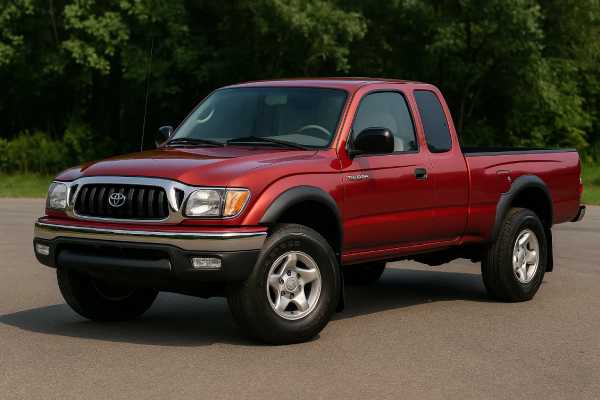
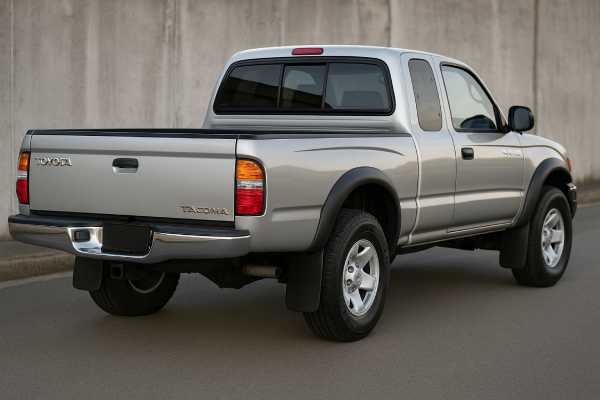
The facelifted first-generation Toyota Tacoma (2001–2004) in rear-wheel drive form is a straightforward, durable work truck with enough refinement to double as a dependable daily driver. With the 5VZ-FE 3.4 litre V6, you get 190 hp and strong mid-range torque plus a traditional body-on-frame chassis that feels familiar to anyone used to older compact pickups.
In RWD N140 form (including PreRunner and street-focused variants), these Tacomas are mechanically simple, relatively light, and capable of respectable towing when properly equipped. They lack modern driver-assistance tech but offer basic crash protection, ABS on many trims, and a cabin that withstands abuse well. The main ownership concerns today are age-related: frame and underbody corrosion in harsh climates, suspension wear, and staying ahead of the timing-belt schedule on the 5VZ-FE. If you want a compact, reliable V6 RWD pickup with minimal electronics and strong parts support, a well-kept 2001–2004 Tacoma remains a compelling choice.
At a Glance
- Robust 5VZ-FE 3.4L V6 with a track record of very high mileages when serviced on time.
- Compact, manoeuvrable RWD chassis with useful payload and towing capacity for light trailers and work use.
- Watch for frame and underbody corrosion, plus completion of key recalls on suspension and spare-tire hardware.
- Typical timing-belt replacement interval is around 90,000 miles (145,000 km) or roughly every 6–9 years.
- Oil and filter changes every 5,000–6,000 miles (8,000–10,000 km) are a sensible baseline, especially with towing or city use.
Navigate this guide
- Toyota Tacoma 3.4 RWD overview
- Toyota Tacoma 5VZ-FE specifications
- Tacoma trims safety and driver aids
- Tacoma 5VZ-FE reliability issues
- Maintenance and Tacoma buyer guide
- Driving performance Tacoma 3.4 RWD
- Toyota Tacoma rivals comparison
Toyota Tacoma 3.4 RWD overview
The 2001–2004 Tacoma represents the facelifted phase of the first generation, still a genuinely compact pickup by modern standards. Toyota updated the front fascia, interior trim, and option mix, but underneath you still have a ladder frame, leaf-sprung rear axle, and a straightforward mechanical layout.
For RWD N140 chassis trucks with the 5VZ-FE 3.4 litre V6, you are usually looking at PreRunner and S-Runner variants, plus some RWD V6 extended cab and double cab models. The PreRunner mimics the stance of a 4×4 with higher ride height and 6-lug wheels while remaining 2WD; the S-Runner sits lower with street-biased suspension and tyres. All share the same basic 190 hp V6 with strong low- and mid-range torque, which suits towing and everyday driving.
Compared with the base four-cylinder Tacoma, the V6 RWD models are noticeably stronger when pulling grades or hauling. V6 PreRunner RWD trucks with the factory towing package can tow around 5,000 lb (about 2,270 kg), while non-tow-package trucks and many four-cylinder trims are limited to roughly 3,500 lb (1,590 kg). Payload on V6 RWD double cabs typically lands in the 1,400–1,700 lb (635–770 kg) range, with some regular and extended cabs exceeding that slightly.
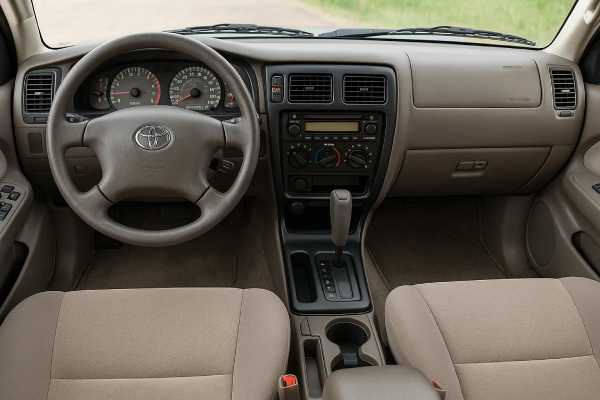
Inside, the cabin is simple: hard-wearing plastics, clear analogue gauges, and just enough adjustment to be comfortable on long days. Later facelift years gained more standard features such as CD audio and available keyless entry, but these trucks still feel “old-school” compared with mid-2000s and newer pickups.
The main appeal today is the combination of compact size, genuinely usable capability, and an engine that tolerates moderate neglect better than many modern powertrains. However, most examples are now more than 20 years old, so condition, rust history, and maintenance records matter far more than odometer readings alone.
Toyota Tacoma 5VZ-FE specifications
Engine and performance data
Typical data for a 2003 Tacoma PreRunner V6 RWD (US market):
| Item | Specification |
|---|---|
| Engine code | 5VZ-FE V6, petrol |
| Layout | 60° V6, cast-iron block, aluminium heads, DOHC, 4 valves/cyl |
| Displacement | 3.4 L (3,378 cc) |
| Bore × stroke | 93.5 × 82.0 mm (3.68 × 3.23 in) |
| Induction | Naturally aspirated |
| Fuel system | Multi-point fuel injection (MPFI) |
| Compression ratio | Around 9.6:1 (typical 5VZ-FE spec) |
| Max power | 190 hp (142 kW) @ 4,800 rpm |
| Max torque | 220 lb-ft (298 Nm) @ 3,600 rpm |
| Timing drive | Belt-driven camshafts |
| Timing-belt interval | Approx. 90,000 miles (145,000 km) or 6–9 years |
| Fuel type | Unleaded petrol (check local octane recommendations) |
| Fuel economy (EPA, typical V6 RWD) | About 16 mpg city / 19–20 mpg hwy (US) |
| Real-world mixed | Often 15–18 mpg US (13–16 L/100 km) depending on load and tyres |
Aerodynamic data such as drag coefficient (Cd) and frontal area are rarely published for this generation, but the tall cab and open bed mean efficiency resembles other compact body-on-frame trucks: expect higher consumption at freeway speeds and a noticeable penalty when towing, running roof racks, or using aggressive off-road tyres.
Transmission and driveline
Most RWD V6 Tacomas of this era use either a 4-speed automatic or a 5-speed manual:
| Item | Specification |
|---|---|
| Transmission options | 4-speed automatic (A340E family); 5-speed manual (R150 family) |
| Typical auto gear ratios | 1st 2.804, 2nd 1.531, 3rd 1.000, 4th 0.705; reverse 2.393 |
| Typical manual gear ratios (R150) | 1st 3.83, 2nd 2.062, 3rd 1.436, 4th 1.000, 5th 0.838; reverse 4.22 |
| Drive type | Rear-wheel drive (RWD) |
| Rear differential | Open diff on most RWD models; some TRD packages offer limited-slip or locker (verify by axle code) |
| Common final drive ratios | Typically around 3.91–4.10:1 depending on transmission, tyre size and tow package |
Because axle codes and ratios vary by build, always decode the axle tag or build sheet if gearing is important for towing, large tyres, or highway rpm.
Chassis, weights and dimensions
Representative figures for a 2003 Tacoma PreRunner V6 Double Cab RWD:
| Item | Specification |
|---|---|
| Frame | Ladder frame, body-on-frame construction |
| Front suspension | Double wishbone with coil springs |
| Rear suspension | Leaf-sprung solid axle |
| Steering | Power rack-and-pinion |
| Brakes | Front ventilated discs / rear drums, power-assisted |
| Wheelbase | Around 3,095 mm (121.8 in) |
| Overall length | Around 5,135 mm (202.1 in) for many V6 double-cab/short-bed RWD models |
| Width | About 1,690 mm (66.5 in) |
| Height | Around 1,700–1,730 mm (67–68 in), varies by suspension and tyres |
| Turning circle | Roughly 12.5–12.8 m (41–42 ft) curb-to-curb |
| Curb weight | Roughly 1,520–1,575 kg (3,350–3,475 lb) for V6 RWD double cabs |
| GVWR | Typically around 2,310–2,320 kg (about 5,100 lb) on V6 RWD PreRunner models |
| Fuel tank | About 68–70 L (18–18.5 US gal) on most V6 RWD models |
| Ground clearance | Around 250 mm (about 10 in) for PreRunner RWD; lower on S-Runner |
| Bed length | Roughly 1,890 mm (about 74.5 in) on many double cabs |
Performance and capability
For a typical 5VZ-FE V6 RWD Tacoma:
| Item | Typical value |
|---|---|
| 0–60 mph (0–97 km/h) | Roughly 8.5–9.5 s for V6 RWD, depending on cab, gearing and tyres |
| Top speed | Typically governed near 105–110 mph (169–177 km/h) |
| Braking 60–0 mph | Commonly around 140–160 ft on stock tyres and healthy brakes |
| Max towing capacity | Up to 5,000 lb (2,270 kg) with V6, tow package and proper equipment |
| Typical payload | About 1,400–1,700 lb (635–770 kg) depending on cab and trim |
Fluids and service capacities (typical)
Always verify by VIN and official service data, but for a 5VZ-FE Tacoma RWD these values are a useful starting point:
| System | Spec (typical) | Approx. capacity | Notes |
|---|---|---|---|
| Engine oil | API SL or better; 5W-30 preferred | ~5.2–5.7 L (around 5.5 qt) with filter | Drain-plug torque commonly around 37 N·m (27 ft-lb) |
| Coolant | Toyota long-life ethylene glycol | ~7–8 L total | Use correct premix ratio, often 50/50 |
| Automatic transmission | ATF Type T-IV or equivalent | Around 10 L total fill (less on drain-and-fill) | Check level hot, in neutral, on level ground |
| Manual transmission (R150 family) | API GL-4/GL-5 75W-90 | ~2 L | Fill to level plug |
| Differential (RWD) | API GL-5 75W-90 | ~1.6–2.0 L depending on axle | Confirm axle code and capacity |
| Power steering | ATF (Type T-IV or Dexron III style) | ~1 L | Bleed after service |
| Brake fluid | DOT 3 or DOT 4 | As required | Replace every 2–3 years |
Basic torque values owners often reference:
- Wheel lug nuts: commonly around 113 N·m (83 ft-lb).
- Spark plugs: follow plug manufacturer spec, usually around 18–25 N·m (13–18 ft-lb).
Electrical and safety basics
These trucks use a traditional 12 V system with a belt-driven alternator (often in the 80–90 A range) and a conventional lead–acid starting battery in roughly the 50–70 Ah range depending on trim. Spark plugs are usually long-life copper or nickel types with a 1.1 mm gap (e.g., NGK BKR5EKB-11 or equivalent).
Safety equipment is basic by modern standards: dual front airbags are standard, ABS is available or standard on many V6 trims, but there is usually no electronic stability control or side/curtain airbags in this generation.
Tacoma trims safety and driver aids
Trims and options for V6 RWD Tacomas
In 2001–2004, the RWD N140 Tacoma V6 line-up typically includes:
- PreRunner V6: High-riding 2WD with 6-lug wheels and a stance similar to 4×4 models. Available as Xtracab or Double Cab. Often paired with SR5 and TRD packages.
- S-Runner (in markets where offered): Lowered, street-oriented extended cab with V6, sport suspension, 5-lug wheels, and unique body and interior trim.
- Standard 4×2 V6 (market dependent): A lower RWD V6 with simpler equipment and more basic appearance.
Key functional differences by trim and package:
- TRD Off-Road / TRD packages (availability varies): Can add upgraded shocks, larger wheels and tyres, and in some cases a selectable rear locker (more common on 4×4 models, so verify individual trucks).
- Tow package: Often includes a frame-mounted hitch, higher-capacity cooling (e.g., transmission cooler, different fan clutch), and trailer wiring. Tow rating on properly equipped V6 trucks climbs to around 5,000 lb.
- S-Runner: Shorter springs and performance shocks, 16-inch wheels with performance tyres, and specific interior touches. Payload and tow ratings are usually lower than on PreRunner work-focused trucks.
Visual identifiers:
- 6-lug wheels and higher ride height generally indicate a PreRunner or 4×4.
- Lower stance with 5-lug wheels and colour-coded trim is typically an S-Runner.
- Fender flares, TRD decals, and specific wheel designs point to TRD-equipped trucks.
Across 2001–2004, mechanical differences are minor; most changes are in equipment levels, options, and special editions.
Safety ratings
Crash-test coverage for this generation is limited compared with newer trucks. The Tacoma of this era achieved mid-range ratings in available front-impact tests, with decent overall structure but elevated loads in some areas such as lower legs. Side, roof, and small-overlap crash performance were not typically tested to modern protocols.
Because many of these trucks were sold before current safety-assessment standards, it is wise not to assume modern crash performance. For buyers, the most important safety checks are:
- Confirming that all open recalls are completed using official VIN lookups.
- Verifying airbag operation and checking for any warning lights.
- Inspecting seat belts, buckles, and anchor points for damage or poor retraction.
Safety systems and ADAS
These Tacomas predate modern driver-assistance suites, so expectations need to be realistic:
- Passive safety
- Dual front airbags (driver and passenger) as standard.
- Three-point belts at all outboard seating positions; centre positions may have lap belts only depending on seat configuration.
- Child seat provisions vary; later years may offer tether anchors, but ISOFIX/LATCH is not universal.
- Active safety
- ABS: Optional or standard on many V6 RWD trims; its presence should be confirmed by inspection or build sheet.
- Traction and stability control: Generally not fitted on this generation.
- Brake system: Front ventilated discs and rear drums, without the sophisticated brake assist or electronic brakeforce distribution that later models offer.
Because there is no lane-keeping assist, adaptive cruise control, or automatic emergency braking, the primary “safety system” remains the driver. Good tyres, well-maintained brakes, and conservative driving habits are more important here than on newer vehicles with extensive electronic aids.
Tacoma 5VZ-FE reliability issues
Overall reliability picture
The 5VZ-FE Tacoma is widely regarded as one of Toyota’s more durable truck powertrains. Engines that receive timely oil changes, cooling-system service, and regular timing-belt replacement frequently reach 250,000–300,000 miles without major internal work. Age, environment, and prior neglect, however, can offset that built-in robustness.
It helps to separate issues by major systems.
Engine and cooling
Timing belt overdue or undocumented
- Symptoms: Unknown service history, age beyond 6–9 years, or mileage well past 90,000 miles since the last belt.
- Risk: The 5VZ-FE is generally considered a non-interference engine, so belt failure usually does not bend valves, but it will leave you stranded and can damage ancillary components.
- Remedy: Replace timing belt, water pump, idlers, and tensioner; inspect cam and crank seals and accessory belts at the same time.
Valve cover gasket and cam plug leaks
- Symptoms: Oil seepage down the back of the engine, burning smell on exhaust, oily bellhousing area.
- Cause: Hardened gaskets and ageing rubber seals.
- Remedy: Replace valve cover gaskets and half-moon plugs, clean the PCV system, and verify that crankcase ventilation is working correctly.
Cooling system neglect
- Symptoms: Rusty or discoloured coolant, overheating in heavy load or hot weather, leaking radiators or heater cores.
- Cause: Old coolant, mixed coolant types, or corroded cores and fittings.
- Remedy: Flush the system, refill with the correct Toyota long-life coolant, replace ageing hoses, and consider a new radiator if fins are corroded or plastic tanks are brittle.
Fuel, ignition and intake
Aging ignition components
- Coils, leads (where fitted), and spark plugs can all contribute to misfires or rough running as they age.
- Following the recommended plug replacement interval and using parts of the correct heat range and gap is important.
Idle air control (IAC) and throttle body deposits
- Symptoms: Unstable idle, stalling on cold start, or high idle.
- Cause: Carbon build-up in the throttle body and idle passages.
- Remedy: Clean throttle body and IAC passages, check for vacuum leaks, and verify proper PCV operation.
Driveline and transmission
The A340E 4-speed auto and R150 manual are generally robust with regular fluid changes.
Automatic transmission
- Issue: Heat stress when towing or in very hot climates.
- Symptoms: Dark or burnt-smelling ATF, delayed shifts, or slipping under load.
- Remedy: Install or verify an auxiliary transmission cooler if towing frequently, and shorten ATF change intervals.
Manual gearbox
- Issue: Worn synchros and bearings on high-mileage trucks, especially when gear oil changes are neglected.
- Symptoms: Gear crunching on shifts, whining in certain gears, or excessive play in the shifter.
- Remedy: Fresh gear oil may help minor issues; deeper problems require inspection and possible rebuild.
Chassis, suspension and corrosion
This is where first-gen Tacomas, including RWD trucks, demand especially careful attention.
Front lower ball joints
- Toyota has addressed safety concerns around lower ball joints on certain years and configurations through recalls and service campaigns.
- Even beyond campaign coverage, these joints are a known wear item: excessive play can lead to alignment issues and, in severe cases, joint separation.
- Replacement with high-quality components at sensible intervals is cheap insurance on any older Tacoma.
Spare tyre carrier corrosion
- In salt-belt regions, corrosion can attack the spare tyre carrier and its lift plate.
- If the plate fails, the spare tyre can drop from under the truck.
- Inspect the carrier carefully; on affected trucks, ensure any recall or remedial action has been completed.
Frame and underbody rust
- Certain model years of Tacoma are known for frame corrosion concerns, and manufacturers have run inspection or reinforcement programmes in some markets.
- On any older Tacoma, thoroughly examine frame rails (particularly near rear leaf-spring mounts, crossmembers, and steering-rack mounts), plus the spare tyre well and brake lines.
- Severe scaling, flaking, or perforation can be a reason to walk away from a purchase, even if the powertrain seems healthy.
Leaf springs and bushings
- Sagging rear leaf packs and worn shackle/bushing hardware are common on trucks that have regularly carried heavy loads or towed trailers.
- Worn components can lead to poor ride, axle steer, and clunks over bumps. Replacement with OEM or quality aftermarket packs can significantly improve comfort and stability.
Electrical and ancillaries
Common age-related items include:
- Alternator wear: Charging issues, dim lights at idle, or battery warning lights.
- Starter solenoid contacts: Intermittent no-crank situations, often worse when hot.
- Grounds and connectors: Corroded grounds can cause sporadic electrical issues, from sensor faults to dim lighting.
Recalls, service campaigns and verification
At minimum, for any prospective Tacoma purchase:
- Run the VIN through official recall databases to confirm that campaigns relating to suspension components, spare-tyre carriers, and frame corrosion have been completed.
- Ask the seller for dealer printouts or receipts showing recall and service campaign completion.
- If records are missing, assume critical inspections and maintenance are overdue and budget accordingly for ball joints, frame inspection, and possibly corrosion repairs.
Maintenance and Tacoma buyer guide
Practical maintenance schedule (typical)
Exact schedules vary by market and model year, but for a 5VZ-FE Tacoma RWD used as a mixed-duty truck, the following is a sensible baseline.
| Interval (miles / km) | Interval (time) | Key items |
|---|---|---|
| Every 5,000–6,000 mi (8,000–10,000 km) | 6 months | Engine oil + filter (5W-30), tyre rotation, visual check of leaks, brakes, steering and suspension |
| 15,000 mi (24,000 km) | 12–18 months | Engine air filter, cabin filter (if fitted), more detailed brake inspection and lubrication |
| 30,000 mi (48,000 km) | 2–3 years | Fuel filter (if external), inspect driveline fluids, clean throttle body/IAC, check alignment and steering play |
| 45,000–60,000 mi (72,000–96,000 km) | 3–4 years | Replace brake fluid, inspect coolant, belts and hoses, inspect suspension joints and bushings |
| 90,000 mi (145,000 km) | 6–9 years | Timing-belt kit (belt, water pump, idlers, tensioner), accessory belts, spark plugs, full coolant service |
| 120,000 mi (190,000 km) | 8–10 years | Refresh transmission and differential oils, inspect wheel bearings and driveshaft U-joints |
| 150,000–180,000 mi (240,000–290,000 km) | 10–12+ years | Comprehensive rust inspection of frame and brake lines, check steering rack mounts, consider suspension refresh |
Additional points:
- ATF: If towing or in hot climates, consider drain-and-fill every 30,000–40,000 miles rather than waiting for long “lifetime” intervals.
- Manual gearbox and differential: Replace oil every 60,000–90,000 miles, or after deep water crossings.
- Coolant: Renew roughly every 5 years or whenever contamination is present, always using a compatible long-life coolant.
- Brake fluid: Replace at least every 2–3 years to keep the system dry and protect ABS components.
- 12 V battery: Test annually after five years and replace proactively if cranking performance declines.
Fluid and torque references (quick buyer notes)
When budgeting for a “baseline” service on a newly purchased Tacoma, expect to use approximately:
- Around 5.5 qt of 5W-30 engine oil plus a quality filter.
- 2–3 US gallons of concentrated coolant mixed appropriately with distilled water.
- Several litres of gear oil or ATF for transmission and differential drain-and-fill procedures.
- Wheel lug nut torque around 83 ft-lb (113 N·m); avoid heavy impact-gun use on original studs.
Buyer’s checklist: what to inspect
For a used 2001–2004 Tacoma RWD V6:
- Frame and underbody
- Inspect frame rails, rear leaf-spring mounts, and crossmembers for rust perforation or heavy scaling.
- Pay attention to the spare-tyre carrier and its mounting plate.
- Check brake and fuel lines for corrosion, especially in salt-belt trucks.
- Suspension and steering
- Check lower ball joints, tie-rod ends, and control-arm bushings for play or torn boots.
- Look for uneven tyre wear or wandering on test drives, which may indicate alignment issues or worn steering components.
- Powertrain
- Cold start should be quick, with smooth idle and minimal tapping noises.
- Confirm timing-belt age with receipts; if there is any doubt, treat it as due.
- Check for coolant or oil leaks around the timing cover, valve covers, and rear main area.
- Towing and load history
- Trucks that frequently towed close to 5,000 lb will often show more transmission and rear-suspension wear.
- Aftermarket transmission coolers, brake controllers, and heavy-duty hitches can indicate regular towing use.
- Brakes and wheels
- Inspect pads, rotors, and drums for thickness and condition; listen for grinding or pulsation.
- Confirm wheels and tyres are correctly sized and that lug nuts have not been over-torqued.
- Interior and electrics
- Test all gauges, warning lights, lights, wipers, and HVAC modes.
- Check power windows and locks where fitted, and ensure there are no water leaks into the cab.
Recommended trims and years
Rather than a single “best” year, focus on condition and documentation. That said:
- Best all-rounder: V6 PreRunner Double Cab RWD with tow package and ABS – combines practicality, towing ability, and common parts.
- Enthusiast / street use: S-Runner (where available), thanks to its manual gearbox, specific suspension tuning, and lower stance.
In all cases, prioritise:
- Structurally sound frames with minimal rust.
- Clear maintenance history, especially for the timing belt and major fluid services.
- Clean titles and evidence of careful ownership.
Driving performance Tacoma 3.4 RWD
Powertrain character
The 5VZ-FE’s standout traits are smoothness and a strong mid-range. Peak torque arrives around 3,600 rpm, but the engine pulls cleanly from low revs and feels relaxed in typical driving. It is not a high-revving sports engine; it is tuned for dependable thrust in the 2,000–4,500 rpm band where a work truck spends most of its life.
With the 4-speed automatic, shifts are usually smooth but deliberate rather than quick. In stock calibration the transmission favours early upshifts for efficiency, which can make it feel sleepy at times. Locking out overdrive on hills or when towing prevents gear hunting and keeps the engine closer to its torque peak. Trucks with the 5-speed manual feel more eager and allow better control of revs, though the clutch and shifter will feel more truck-like than car-like in traffic.
Throttle response is linear, with no turbo lag to manage. The engine is forgiving of imperfect gear choices and pulls steadily even when slightly lugged in higher gears.
Ride, handling and NVH
As a compact body-on-frame pickup with leaf springs and a relatively short wheelbase on some trims, the Tacoma rides firmly when unladen:
- Ride comfort: With no load in the bed, the rear end can hop over sharp bumps and expansion joints. A few hundred pounds of cargo often improves ride quality dramatically.
- Straight-line stability: Generally solid at highway speeds, though crosswinds and aggressive all-terrain tyres can add some wander.
- Cornering: Predictable, with moderate body roll. The truck will understeer progressively at the limit, and grip is more limited by tyres than by suspension design.
- Steering: Light to medium weighting, with reasonable feedback for a truck of this era.
Cabin noise at 60–70 mph is mainly tyre and wind noise. The truck is noisier than modern mid-size pickups, but with good door seals and stock exhaust it is still comfortable for long highway drives if expectations are set correctly.
Real-world economy and range
Owners commonly report:
- City driving: Around 14–16 mpg US (17–20 L/100 km).
- Highway (around 65–70 mph / 105–115 km/h): Around 17–20 mpg US (12–14 L/100 km) on stock tyres and gearing.
- Mixed use: Often 16–18 mpg US (13–15 L/100 km) for typical mixed driving.
Large tyres, lift kits, roof racks, and heavy bumpers will reduce economy, as will constant short trips where the engine never fully warms up. With an 18–18.5 gallon tank, practical mixed-range is often in the 250–320 mile (400–515 km) band between fuel stops.
Load and towing behaviour
Within rated limits and with a healthy cooling system, the Tacoma tows small travel trailers, boats, and equipment trailers competently:
- Stability: Shorter wheelbase trims can feel more sensitive to trailer sway; proper tongue weight, good trailer tyres, and functioning trailer brakes are essential as trailer mass approaches 3,000 lb and above.
- Braking: Stock brakes are adequate but benefit from high-quality pads and well-maintained hydraulics, especially for repeated downhill braking.
- Heat management: Additional transmission cooling and a clean radiator make a significant difference when towing near the 5,000 lb limit, particularly in hot climates or mountainous terrain.
Expect a pronounced drop in fuel economy under load. It is common to see towing consumption fall into the 10–13 mpg US (18–24 L/100 km) range depending on speed, trailer shape, and terrain.
Traction and control
RWD Tacomas can spin an unloaded rear tyre on wet or loose surfaces, especially with an open differential and an empty bed. Practical tips for owners include:
- Carrying some bed weight (for example, tools or gear) to increase rear-axle traction.
- Choosing tyres that match the primary use: good highway all-seasons for paved use, quality all-terrains for mixed surface driving.
- In snowy climates, dedicated winter tyres and some ballast in the bed dramatically improve traction and braking.
While RWD PreRunners lack the low-range capability of true 4×4 Tacomas, they still handle light trails, gravel roads, and worksites well thanks to ground clearance and robust suspension, assuming the driver respects their traction limits.
Toyota Tacoma rivals comparison
During 2001–2004, the Tacoma’s main rivals in North America included the Nissan Frontier (D22), Ford Ranger, and Chevrolet S-10/GMC Sonoma. In other regions, the Hilux, Mazda B-Series, and Isuzu pickups filled similar roles. Each alternative has its own strengths and compromises.
Versus Nissan Frontier (D22)
Tacoma strengths
- Strong durability reputation for the 5VZ-FE engine and basic driveline, supported by large owner communities and parts availability.
- Resale values typically higher, reflecting demand among buyers who prioritise reliability.
Frontier advantages
- Some trims offer more power, including supercharged V6 options in certain markets.
- Purchase prices can be lower for similar age and mileage, making the Frontier attractive for budget buyers.
For drivers planning long-term ownership and valuing a deep knowledge base, the Tacoma tends to be the safer choice. The Frontier can appeal to those chasing more power or lower upfront costs.
Versus Ford Ranger (compact, 1998–2004)
Tacoma strengths
- Perceived as more consistent in build quality and long-term reliability, especially in powertrain and electronics.
- Strong aftermarket support for off-road modifications, suspension upgrades, and bolt-on accessories.
Ranger advantages
- Often cheaper on the used market, especially in work-truck specifications.
- Widely available parts and service support in North America, with many independent shops familiar with the platform.
The Ranger’s optional 4.0 V6 competes well in torque, but the Tacoma’s reputation for reliability and corrosion management (when recalls and inspections are up to date) often justifies the higher purchase price for long-term owners.
Versus GM S-10 / GMC Sonoma
The S-10 and Sonoma are simple and can be inexpensive to purchase and maintain, but:
- Interiors tend to wear more quickly, with more squeaks, rattles, and ageing plastics.
- Corrosion can be an issue in salt-belt regions, sometimes worse than on comparable Tacomas.
- V6 engines provide decent torque but do not carry the same near-legendary longevity reputation as the 5VZ-FE.
For someone planning to keep a truck for another decade, a well-preserved Tacoma often makes more sense even if it costs more initially, particularly when factoring in resale value.
Who should choose a Tacoma 3.4 RWD (N140)?
This generation suits:
- Drivers needing a compact truck that still fits urban parking but can tow and haul respectably.
- Owners who prioritise mechanical simplicity, ease of DIY maintenance, and minimal electronics.
- Enthusiasts who want a proven non-interference V6, body-on-frame construction, and a huge knowledge base for modifications and repairs.
It is less suitable for buyers who demand the highest crash-test scores, modern driver-assistance suites, or luxury-truck levels of quietness and comfort. Those needs are better served by later-generation Tacomas (from 2005 onward) or other newer mid-size trucks.
References
- Used 2003 Toyota Tacoma Double Cab Specs & Features 2024 (Specifications)
- 2003 Toyota Tacoma Specs 2024 (Specifications)
- 2001 Toyota Tacoma regular cab pickup 2024 (Safety Rating)
- Special Service Campaign 50J – Front Suspension Lower Ball Joint 2001 through mid-2004 Tacoma 4WD and PreRunner Safety Recall Notice 2005 (Recall Notice)
- Toyota Safety Recall C0V – Remedy Notice – 2001 through 2004 Model Year Toyota Tacoma Vehicles Phase 1 [2WD (excluding PreRunner)] 2013 (Recall Bulletin)
Disclaimer
This article is for informational purposes only and is not a substitute for professional diagnosis, repair, or factory service information. Specifications, torque values, fluid types, and maintenance intervals can vary by VIN, market, model year, and installed equipment. Always verify procedures and specifications against the official owner’s manual, service literature, and technical bulletins for your specific vehicle, and consult a qualified technician whenever you are unsure.
If you found this guide useful, consider sharing it with other owners and enthusiasts on Facebook, X/Twitter, or your preferred forums to support xcar’s work.