
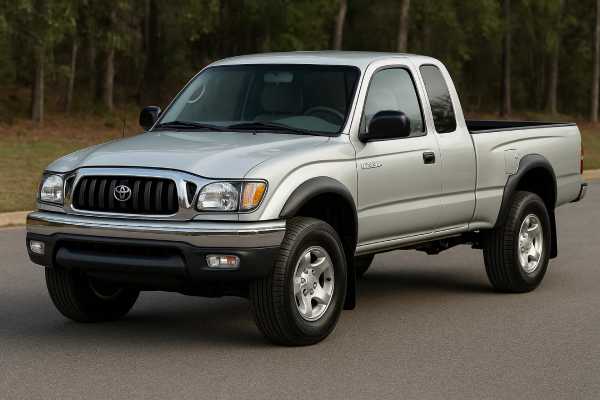
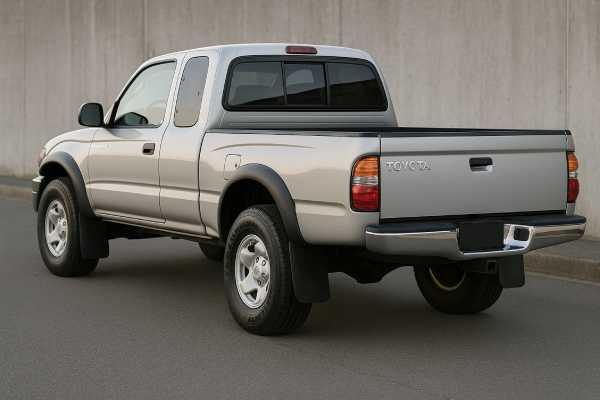
The facelifted first-generation Toyota Tacoma 4×4 (N140) with the 5VZ-FE 3.4-liter V6 is the template many later midsize pickups tried to copy. Built from 2001 to 2004, it combines a stout ladder frame, a proven part-time 4×4 system with low range, and one of Toyota’s most respected V6 truck engines.
For today’s buyer, this truck sits at the intersection of old-school durability and modern usability. It is compact enough for tight trails and city streets, but still capable of towing a small camper or hauling tools every day. Owners prize its mechanical simplicity and parts availability, yet factors like frame corrosion, recalls, and age-related wear now matter more than original brochure claims.
This guide walks through the key specs, capability, reliability patterns, and maintenance priorities so you can understand what the 3.4 V6 Tacoma 4×4 can really do—and what it realistically needs—more than 20 years after it left the factory.
Owner Snapshot
- Strong 3.4-liter 5VZ-FE V6, reliable torque and proven long-life bottom end when serviced on time.
- Part-time 4×4 with low range and solid ground clearance makes it genuinely capable off road and in snow.
- Known corrosion risks on frame and spare-tire carrier in salted regions require very careful inspection.
- Timing belt replacement is typically due every 90,000 miles (about 145,000 km) or 6–9 years, whichever comes first.
- Front suspension, steering components and prop-shaft U-joints often need refresh by 150,000–200,000 miles on used examples.
Guide contents
- First-gen Tacoma 3.4 4×4 summary
- Engine and technical data for Tacoma 4×4
- Tacoma 4×4 trims, safety and off-road aids
- Tacoma 4×4 V6 reliability
- Maintenance plan and buyer guide
- Driving feel on and off road
- Tacoma 4×4 versus rivals
First-gen Tacoma 3.4 4×4 summary
The 2001–2004 Tacoma 4×4 with the 5VZ-FE 3.4-liter V6 sits at the top of the first-generation Tacoma range. Compared with 2WD models, these trucks add a reinforced front suspension, a front differential, a transfer case with low range, and usually slightly taller ride height and more aggressive tires. In everyday use, the result is a compact pickup that feels at home on muddy jobsites, forest roads and winter highways, not just on pavement.
This engine is a naturally aspirated 60-degree V6 with double overhead cams and four valves per cylinder. Output is about 190 hp and 220 lb-ft of torque, tuned for mid-range pulling rather than high-rpm power. In the 4×4 Tacoma, it offers confident acceleration up to highway speeds and enough torque for towing small trailers or boats, although the extra driveline losses and weight compared with RWD models are noticeable in fuel economy.
Body styles for 4×4 models include regular cab (in some markets), Xtracab (extended cab with jump seats) and Double Cab (four conventional doors and a shorter bed). Cab choice affects wheelbase, turning circle and payload, so buyers should match configuration to how they actually use the truck: long commutes and tight city parking favor shorter cabs and beds; family and daily duty often favor the Double Cab.
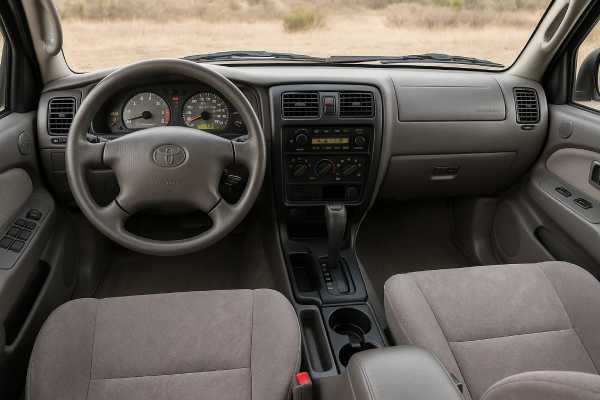
Inside, the Tacoma reflects early-2000s Toyota design: simple, somewhat plain plastics but excellent control layout and generally robust switchgear. Noise insulation is modest by modern standards, yet the V6 is smooth and the manual and automatic gearboxes are usually trouble-free when serviced. The key strengths of this generation are its mechanical honesty, parts availability and the large knowledge base in both dealer and independent shops. Its weaknesses—chiefly frame and underbody rust in salted climates, along with known suspension recalls—are manageable if you know where to look and how to inspect a candidate truck.
Engine and technical data for Tacoma 4×4
Engine and performance
First-gen Tacoma 4×4 V6 models use the 5VZ-FE engine family.
| Item | Value |
|---|---|
| Engine code | 5VZ-FE |
| Displacement | 3.4 L (3,378 cc) |
| Layout and cylinders | 60° V6, DOHC, 4 valves per cylinder |
| Bore × stroke | 93.5 mm × 82.0 mm (3.68 × 3.23 in) |
| Induction | Naturally aspirated |
| Fuel system | Sequential multi-port fuel injection |
| Compression ratio | 9.6:1 (typical) |
| Max power | ~190 hp (142 kW) @ 4,800 rpm |
| Max torque | ~298 Nm (219 lb-ft) @ 3,600 rpm |
| Timing drive | Belt-driven cams, non-interference design |
| Firing order | 1-2-3-4-5-6 |
| Recommended fuel | Regular unleaded (often 87 AKI in North America) |
Economy figures vary by cab, gearbox and tires, but for a 3.4 V6 4×4 Double Cab:
| Fuel use | Typical value (factory / real-world) |
|---|---|
| Urban | ~13.8 L/100 km (17 mpg US) |
| Extra-urban | ~12.4 L/100 km (19 mpg US) |
| Mixed real-world | About 13–14 L/100 km (17–18 mpg US) with 4×4 and larger tires |
Aerodynamic data are limited; drag coefficient is roughly in the mid-0.4 range for these body-on-frame pickups.
Transmission and 4×4 driveline
Most 5VZ-FE 4×4 Tacomas were available with both manual and automatic gearboxes, depending on trim and market.
| Item | Value |
|---|---|
| Transmission options | 5-speed manual; 4-speed automatic |
| Typical manual code | R150F (varies by market) |
| Typical automatic code | A340 series (4-speed electronically controlled) |
| Drive type | Part-time 4×4, rear-drive in 2H, selectable 4H/4L |
| Transfer case | 2-speed, chain-driven, manual lever or electronic shift depending on trim |
| Front differential | Independent front diff with CV half-shafts |
| Rear differential | Solid axle; open or with factory limited-slip or locker on some TRD Off-Road models |
| Final drive ratios | Commonly in the 3.91–4.10 range for V6 4×4 (varies by axle and package) |
Gear ratio details vary slightly by year and market; however, low range is deep enough to give confident crawl control on steep, loose surfaces with stock tires.
Chassis and dimensions
Figures below are typical for a Double Cab 3.4 V6 4×4; regular and extended cabs differ slightly.
| Item | Value |
|---|---|
| Body type | Double Cab pickup, 4 doors, 5 seats |
| Length | ~5,138 mm (202.3 in) |
| Width | ~1,781 mm (70.1 in) |
| Height | ~1,715 mm (67.5 in) |
| Wheelbase | ~3,096 mm (121.9 in) |
| Ground clearance | ~215 mm (8.5 in) |
| Turning circle | Approx. 12.0 m (39–40 ft) depending on cab/tyres |
| Curb weight | Around 1,680–1,750 kg (3,700–3,850 lb) for V6 4×4 Double Cab |
| GVWR | Around 1,930–2,040 kg (4,250–4,500 lb) depending on spec |
| Fuel tank | ~70 L (18.5 US gal, 15.4 UK gal) |
Suspension, steering and brakes:
| System | Design |
|---|---|
| Front suspension | Independent double wishbone with coil-over shocks (4×4/PreRunner style) |
| Rear suspension | Solid axle with leaf springs |
| Steering | Rack-and-pinion with hydraulic assist |
| Front brakes | Ventilated discs |
| Rear brakes | Drums with load-sensing proportioning valve on many models |
| Wheels/tyres | 15–16 in rims; common OEM sizes include 205/75R15 and 265/70R16 on off-road packages |
Performance and capability
Actual numbers depend on cab, gearbox and axle, but typical ranges are:
| Metric | Approximate value for 3.4 V6 4×4 |
|---|---|
| 0–100 km/h (0–62 mph) | Roughly 10–11 s (manual; stock tyres) |
| Top speed | Around 170 km/h (105 mph), electronically limited in some markets |
| Braked towing capacity | Up to about 2,270 kg (5,000 lb) for V6 4×4 with proper equipment |
| Payload | Roughly 590–700 kg (1,300–1,540 lb), depending on cab and options |
| Roof load | Commonly 70–100 kg (155–220 lb) with appropriate rack, check manual |
Angles vary by bumper and suspension, but stock trucks usually have respectable approach and departure angles for light off-roading.
Fluids, capacities and key torque data (typical)
Exact specs depend on market and manual; always confirm for your VIN.
| System | Specification (example) | Capacity (approx.) |
|---|---|---|
| Engine oil | API SJ/SL 5W-30 (common recommendation) | ~5.4–5.7 L (5.7–6.0 US qt) with filter |
| Engine coolant | Ethylene glycol long-life coolant, ~50/50 mix | ~8–9 L (8.5–9.5 US qt) |
| Manual transmission | GL-4/GL-5 gear oil (often 75W-90) | ~1.6–2.0 L (1.7–2.1 US qt) |
| Automatic transmission | Toyota Type T-IV ATF or equivalent | ~8–9 L (partial change smaller) |
| Front diff (4×4) | GL-5 75W-90 | ~1.1 L (1.2 US qt) |
| Rear diff | GL-5 75W-90 | ~2.7–3.0 L (2.9–3.2 US qt) |
| Transfer case | GL-4/GL-5 75W-90 | ~1.3–1.5 L (1.4–1.6 US qt) |
| A/C refrigerant | R134a | ~500–700 g (varies) |
Typical critical torque values taken from engine data and service literature:
- Crankshaft pulley bolt: around 250 Nm (184 lb-ft).
- Cylinder head bolts: multi-step torque-plus-angle sequence; follow manual exactly.
- Wheel lug nuts: usually ~113 Nm (83 lb-ft), but verify for your wheel type.
Electrical and basic safety equipment
| Item | Value |
|---|---|
| Alternator output | Typically 80–90 A (varies by trim) |
| 12 V battery | Around 48–70 Ah, group size varies by market |
| Spark plugs | Commonly NGK BKR5EKB-11 or Denso K16TR11 (copper or platinum) |
| Plug gap | ~1.1 mm (0.043 in) |
Safety equipment is simple by modern standards: front airbags, three-point belts, and in some markets ABS. Advanced driver-assistance systems (AEB, lane keep, radar cruise) were not available on this generation.
Tacoma 4×4 trims, safety and off-road aids
Trim levels and key options
For 2001–2004, Tacoma 4×4 V6 models were typically sold in a small number of trims with option packages layered on top:
- Base 4×4 – Often cloth seats, manual windows/locks in some markets, steel wheels, manual 4×4 lever, and minimal cosmetic extras.
- SR5 – The volume trim, adding power windows and locks, nicer interior fabrics, better audio, and cosmetic upgrades. Many SR5 trucks also carried tow packages with a receiver hitch and wiring.
- TRD Off-Road (where offered) – The enthusiast choice, usually combining Bilstein shocks, specific spring rates, different wheel/tyre packages, and in many cases a rear locking differential or limited-slip differential. This package can materially improve loose-surface traction and suspension control over rough trails.
Mechanical differences to watch for by trim and package:
- Differentials: Some TRD Off-Road trucks have a factory rear e-locker; others rely on a limited-slip or open differential. The presence of locker controls in the cabin (and the correct axle code on the VIN plate) is a strong clue.
- Gearing: Tow packages or off-road packages may pair the 3.4 V6 with slightly shorter axle ratios. This helps with towing and hill climbing but raises highway rpm.
- Suspension: TRD shocks and springs give a firmer, more controlled ride over big bumps and reduce bottoming off-road, but can feel stiffer when unladen compared with basic 4×4 models.
Xtracab and Double Cab layouts change the cabin experience more than the trim badge: Xtracab offers more bed space and slightly lighter weight; Double Cab is more practical for passengers and daily family use.
Safety ratings
Crash-test coverage for first-gen Tacomas is limited compared with modern vehicles, but there are some key points:
- Moderate-overlap frontal crash tests on regular-cab models of this generation achieved an overall rating in the acceptable range, with good performance in most upper-body measures but higher loads in the lower legs and footwell area.
- Side-impact, small-overlap, rollover resistance and head-restraint evaluations were not conducted to current protocols for most 2001–2004 Tacoma 4×4 V6 variants.
- These trucks pre-date widespread availability of side airbags, electronic stability control and advanced restraint systems; their occupant protection reflects late-1990s engineering, not modern pickup standards.
In practice, the Tacoma’s sturdy frame and relatively low curb weight provide reasonable protection in moderate-speed impacts but cannot match the crash performance of newer midsize trucks with side-curtain airbags and more sophisticated crash structures. Good tires, up-to-date brakes and a careful alignment do as much for safety on these trucks as any factory electronics.
Safety systems and driver assistance
Standard safety and support technology typically includes:
- Dual front airbags.
- Three-point belts at all outboard seating positions.
- Load-sensing proportioning valve for rear brakes on many pickup configurations.
- Anti-lock brakes (ABS) on many, but not all, 4×4 Tacomas.
Advanced driver-assistance systems such as automatic emergency braking, lane-keeping, blind-spot monitoring and adaptive cruise control were not offered from the factory. Aftermarket solutions (e.g., reverse cameras, parking sensors, better lighting) are common upgrades to bring some modern safety convenience to these trucks.
Child-seat installation relies on seat belts rather than ISOFIX/LATCH anchorages in many markets. Parents should confirm the specific rear seating arrangement and consult the owner’s manual for approved child-seat positions, especially in Double Cab models.
Off-road aids beyond the mechanical systems are straightforward: there are no terrain management computers, hill-descent modes or adjustable traction maps. Instead, capability comes from the part-time 4×4 system, low-range gearing, and—in some trims—a locking rear differential. The simplicity is a feature: fewer electronics to fail in harsh environments, and clear, predictable behavior for experienced drivers.
Tacoma 4×4 V6 reliability
Engine and ancillaries
The 5VZ-FE is widely regarded as one of Toyota’s more durable truck engines:
- Common issues (generally low to medium severity):
- Valve cover gasket leaks, often appearing as oil seepage down the back of the heads.
- Aging coolant hoses and radiator tanks, especially on trucks still running original parts.
- Accessory belt noise and worn idlers/tensioners after many years.
- Less common but important:
- Neglected timing belt service can lead to breakdowns. Fortunately, this engine is generally non-interference, so a snapped belt usually stops the engine rather than destroying it, but it will still leave you stranded.
- Throttle-body and idle-air control (IAC) valve deposits causing unstable idle or stalling; usually resolved with cleaning and, if necessary, replacement.
With proper oil changes (5,000–7,500 miles / 8,000–12,000 km, depending on usage) and cooling system maintenance, it is not unusual to see these engines run well beyond 300,000 miles (480,000 km).
Driveline and suspension
The 4×4 hardware introduces additional wear points that buyers should understand:
- Front suspension lower ball joints:
A well-documented weak point on 1995–2004 Tacomas, addressed by a special service campaign and recall that replaced the lower ball joints with improved parts. Unrepaired or heavily worn joints can lead to noisy steering, vague self-centering and, in extreme neglect, joint separation. Confirm recall completion and inspect for play. - CV axles and boots:
Torn outer boots from off-road use or age allow dirt and moisture into the joints, leading to clicking noises on turns and eventual failure. Boots can be replaced proactively; heavily worn joints require axle replacement. - Driveshaft U-joints and slip yokes:
High-mileage trucks may develop driveline vibration or clunks on take-off due to worn universal joints or dry slip yokes. Regular greasing (where grease fittings are present) and timely replacement of worn parts keeps the driveline smooth. - Leaf springs and bushings:
Rust, overloading, and constant towing can fatigue the rear leaf springs. Sagging ride height, squeaks or axle steer under load signal the need for fresh springs and bushings.
Corrosion and frame issues
Frame and underbody corrosion is the biggest long-term threat to many Tacoma 4x4s:
- Trucks from regions with heavy road-salt use are prone to significant rust on the boxed frame rails, crossmembers and suspension mounts. In extreme cases, perforation can lead to cracks near leaf-spring hangers or steering components.
- Separate recalls and customer support programs have addressed frame corrosion and spare-tire carrier corrosion for early-2000s Tacomas in specified cold-climate areas. Some vehicles received frame replacements; others had inspections and corrosion-resistant coatings applied.
Any prospective buyer should treat a thorough frame inspection as non-negotiable. That means visual checks with the truck on a lift, tapping with a hammer in known weak areas, and looking for welds or reinforcement plates that might indicate previous repairs.
Recalls, technical bulletins and software
The first-gen Tacoma is mostly mechanical; software updates are relatively rare compared with modern vehicles. However:
- Recalls have covered front lower ball joints, corrosion of the spare-tire carrier lift plate in cold-climate states, and various smaller items on some model years.
- Technical service bulletins (TSBs) have addressed issues such as driveline vibrations, alignment specs and minor drivability complaints.
When evaluating a truck, obtain the VIN and ask a Toyota dealer to print the recall/SSC history. Combine that with owner records when possible; a stack of receipts for ball joints, tie rods, shocks, brake hardware and frame inspections is a good sign that a previous owner kept on top of known issues.
Maintenance plan and buyer guide
Practical maintenance schedule (typical guidance)
Always align with the official schedule for your market, but the following intervals are a useful starting point for a 3.4 V6 4×4 Tacoma used in mixed conditions:
- Every 5,000 miles / 8,000 km or 6 months
- Engine oil and filter (more often for heavy towing, dusty use, or mostly short trips).
- Visual inspection of brake pads/shoes, lines and hoses.
- Tyre rotation (front–rear cross pattern if appropriate), tyre pressure check.
- Lubricate propeller shaft U-joints and slip yokes (if fitted with grease nipples).
- Every 15,000–20,000 miles / 24,000–32,000 km
- Replace engine air filter (more often for dusty off-road use).
- Inspect cabin air filter (if fitted) and replace as needed.
- Inspect front and rear suspension bushings, ball joints, steering rack and tie rods.
- Check front CV boots and rear leaf spring condition.
- Every 30,000 miles / 48,000 km or 3 years
- Replace brake fluid.
- Inspect front and rear differential oil and transfer case oil; change in severe service (frequent 4×4 use, water crossings, towing).
- Inspect fuel filter (if serviceable in your market) and fuel lines.
- Every 60,000 miles / 96,000 km
- Coolant change if using conventional long-life coolant; extended-life formulas may go longer but age also matters.
- Thorough inspection of wheel bearings, hub seals and steering rack boots.
- Timing belt and related components
- Typical recommendation: every 90,000 miles (about 145,000 km) or around 6–9 years, whichever comes first.
- Replace the belt, tensioner, idlers and usually the water pump at the same time. Inspect cam and crank seals and replace if leaking.
- Long-term items (100,000–150,000 miles / 160,000–240,000 km)
- Spark plugs (copper plugs may need replacement sooner; platinum/iridium last longer).
- Transmission fluid service (manual and automatic) with filter change on automatics.
- Comprehensive inspection of frame, crossmembers and suspension mounts for corrosion.
- Check 12 V battery capacity and cables; many owners proactively replace batteries around the 5-year mark.
Fluids and torque values for decision-making
For DIY and planning purposes, owners should note:
- Engine oil: 5W-30 meeting Toyota’s recommendations is a common choice; capacity is just under 6 US quarts with filter.
- Differentials and transfer case: high-quality GL-5 75W-90 synthetic gear oil suits most climates; check for limited-slip additives if your axle requires them.
- When fitting wheels, torque lugs to the specified value rather than relying on “feel”; this protects studs and helps avoid warped brake rotors.
Always confirm final values in a trusted manual before applying torque.
Buyer’s inspection checklist
For a used Tacoma 4×4 with the 3.4 V6, prioritize:
- Frame and underbody:
- Look for perforation, deep scaling and flaking, especially near rear leaf-spring hangers, fuel-tank straps, steering box mounts and crossmembers.
- Check spare-tire carrier structure for heavy rust and proper operation.
- Front suspension and steering:
- Inspect lower ball joints for play or torn boots; confirm recall history.
- Check tie-rod ends, upper ball joints and control-arm bushings for wear and noise in a test drive.
- Driveline:
- Engage 4H and 4L on a test drive; confirm smooth engagement and no grinding or popping noises.
- Listen for clunks on take-off (U-joint or slip-yoke wear) and whine at steady speed (potential differential or bearing issues).
- Engine and cooling system:
- Look for oil leaks around valve covers, front crank seal and rear main area.
- Check coolant color and level; inspect radiator tanks for cracks.
- Ask for documentation of timing belt and water pump replacement; if unknown, budget to do it immediately.
- Brakes and wheels:
- Inspect rotor and drum wear, brake line corrosion and handbrake operation.
- Check wheel bearings for play when rocking each wheel at 12 and 6 o’clock.
- Electrical and interior:
- Confirm all gauges, 4×4 indicator lights, ABS light and airbag light cycle correctly at start-up.
- Inspect wiring under the dash and around the engine bay for poorly done modifications, alarms or stereo installs.
Recommended and avoidable configurations
- Often recommended:
- V6 4×4 trucks with documented timing belt service, frame inspection or replacement paperwork, and recent suspension/steering work.
- TRD Off-Road models for enthusiastic off-roading, provided they have not been heavily abused.
- Use caution with:
- Trucks from heavy road-salt regions with no frame inspection records.
- Vehicles used extensively for heavy towing beyond their rated capacity, especially with lifted suspensions and oversized tires.
Overall, a well-maintained Tacoma 4×4 V6 can still offer many years of service. The limiting factors are almost always rust and neglect, not inherent engine or driveline flaws.
Driving feel on and off road
Ride, handling and refinement
On pavement, the 2001–2004 Tacoma 4×4 feels unmistakably like an older, compact pickup. The steering is light but not particularly quick, with modest feedback and some body roll in corners. The solid rear axle and leaf springs can feel bouncy on broken pavement when the truck is unladen, and you will feel expansion joints more than in a modern midsize pickup with multi-link rear suspension.
However, the ride settles noticeably once there is some weight in the bed—anything from tools and gear to camping equipment. At highway speeds, straight-line stability is generally good, provided the alignment is correct, tyres are in good condition and suspension components are not excessively worn. Wind and tyre noise are higher than on a modern double-cab, but the V6 itself is smooth and low-key at cruise.
Braking performance is adequate if the system is in good health. Front discs and rear drums were typical for the era; fresh pads, shoes and properly adjusted rear brakes are essential to maintain stopping distances. Trucks with older, glazed drums or non-OEM components can feel under-braked, especially when carrying loads or towing.
Powertrain character
The 3.4-liter 5VZ-FE is tuned for usable torque rather than headline power. Peak torque arrives in the mid-range, which gives a strong, predictable pull from low speeds, especially in the lower gears. There is no turbo lag to manage, and throttle response is linear by cable standards.
- Manual transmission:
- Offers good control off-road and in hilly terrain, with well-spaced ratios and a robust clutch when properly maintained.
- The gearing is short enough that the engine spends much of its time in the meat of the torque curve, but highway revs can be higher than some drivers expect.
- Automatic transmission:
- The 4-speed automatic shifts smoothly when serviced and is generally durable.
- Kickdown response is acceptable, though not as quick or adaptive as a modern multi-speed unit. In hilly areas, drivers often select lower gears manually to maintain speed and engine braking.
Real-world fuel economy and range
Owners typically see:
- City driving: around 14–16 L/100 km (15–17 mpg US) depending on traffic, load and tyre size.
- Highway at 100–110 km/h (60–70 mph): roughly 12–13 L/100 km (18–20 mpg US) on stock tyres and a healthy engine.
- Mixed use: many drivers report averages in the 13–14 L/100 km (17–18 mpg US) range.
Larger off-road tyres, lift kits, roof racks and loaded bed racks can all push consumption higher, so a well-kept stock or lightly modified truck will usually be more economical than an aggressively built overlanding rig.
Off-road traction and control
Off-road is where the Tacoma 4×4 feels most at home:
- The part-time system allows 2H for normal dry pavement driving, with 4H engaged on loose surfaces such as gravel, dirt, mud or snow.
- 4L offers a substantial gearing reduction for steep climbs, descents, technical obstacles or slow rock crawling.
- On TRD Off-Road models, a factory rear locker (where fitted) dramatically increases traction on cross-axle obstacles.
Without electronic terrain modes, the driver controls throttle, braking and line choice directly. This simplicity and predictability appeal to many enthusiasts and makes it easier to understand what the truck is doing under you. Good tyres and a careful approach are more important than any software trickery.
Towing and hauling behavior
Towing up to around 2,270 kg (5,000 lb) with the V6 4×4 is realistic if:
- The trailer has its own brakes and is properly set up.
- The truck’s cooling system and brakes are in excellent condition.
- You respect the payload limit, especially regarding tongue weight and bed cargo.
Under load, expect longer stopping distances and higher transmission and coolant temperatures on long grades. Manual trucks allow more precise control of engine braking on downhill stretches, while automatic models benefit from manual gear selection and a transmission cooler. Fuel consumption can rise significantly under sustained towing—20 L/100 km (12 mpg US) or worse is not unusual with a tall trailer.
Tacoma 4×4 versus rivals
When new, the 2001–2004 Tacoma 4×4 V6 competed with trucks like the Ford Ranger 4×4, Nissan Frontier/Xterra 4×4, Chevrolet S-10/ZR2 and various compact SUVs with body-on-frame layouts. On today’s used market, buyers often compare it both with those older rivals and with more recent midsize trucks.
Against period competitors
- Versus Ford Ranger 4×4 (late 1990s–mid-2000s):
- The Tacoma generally offers smoother engine refinement and better long-term reliability perception.
- Rangers can be cheaper to buy, with simpler parts availability in some regions, but frame and rust concerns exist on both.
- Versus Nissan Frontier (first generation) and Xterra 4×4:
- Nissan’s V6 engines are strong performers, and some models offer rear disc brakes and different gearing options.
- The Tacoma tends to command a price premium driven by reputation and a large aftermarket, especially in North America.
- Versus GM S-10 / Sonoma / small Blazer:
- The Tacoma usually ages more gracefully in terms of interior wear, driveline robustness and body hardware.
- GM trucks can be inexpensive to buy and repair but often require more frequent attention to electrical and suspension components.
Compared with newer midsize pickups
Modern midsize trucks (later Tacoma generations, Colorado/Canyon, Ranger T6, Navara, Hilux and others) offer:
- Far better crash protection and optional advanced driver-assistance systems.
- More powerful and efficient engines, including turbodiesels in many markets.
- More refined interiors, quieter cabins and greater comfort on long highway trips.
However, the first-gen Tacoma 4×4 still appeals because:
- It has fewer complex electronics and emissions systems, making long-term ownership more predictable and repairs more DIY-friendly.
- The compact exterior size is easier to maneuver on narrow trails and in tight city streets than some bulkier modern trucks.
- Its depreciation curve has largely flattened; a clean, rust-free truck tends to hold value remarkably well.
Who the Tacoma 4×4 suits best
This generation of Tacoma 4×4 fits buyers who:
- Value durability and mechanical simplicity over the latest infotainment and safety technology.
- Need a truck primarily for light-to-moderate off-roading, rural use, or occasional towing, rather than heavy commercial hauling every day.
- Are willing to invest time and attention into inspecting for corrosion, maintaining the 4×4 system and keeping up with scheduled services.
For owners who understand its age-related needs, the 2001–2004 Tacoma 4×4 with the 3.4-liter V6 can still serve as a dependable work partner, camping vehicle or daily driver, with character and capability that many newer pickups struggle to replicate at the same price point.
References
- Toyota Tacoma I Double Cab (facelift 2000) 3.4 V6 (190 Hp) 4WD | Technical specs, data, fuel consumption, Dimensions 2025 (Technical data)
- Toyota 5VZ-FE – Engine Specs 2025 (Engine specifications and torque data)
- Used 2003 Toyota Tacoma V6 Specs & Features | Edmunds 2025 (US market configuration and capacities)
- 2001 Toyota Tacoma Regular cab pickup 2025 (Safety rating)
- 2003 Toyota Tacoma Owner’s Manual 2016 (Owner’s manual, maintenance guidance)
Disclaimer
This article is for informational purposes only and is not a substitute for professional diagnosis, repair advice, or official service documentation. Specifications, torque values, maintenance intervals and procedures can vary by VIN, production date, market and installed equipment. Always confirm critical data and procedures using the official service manual, owner’s literature and current technical bulletins for your specific vehicle, and consult a qualified technician when in doubt.
If you found this guide useful, consider sharing it with other enthusiasts and owners on social media platforms such as Facebook or X (Twitter). Your support helps xcar continue to produce detailed, independent technical content for drivers and DIY owners.