
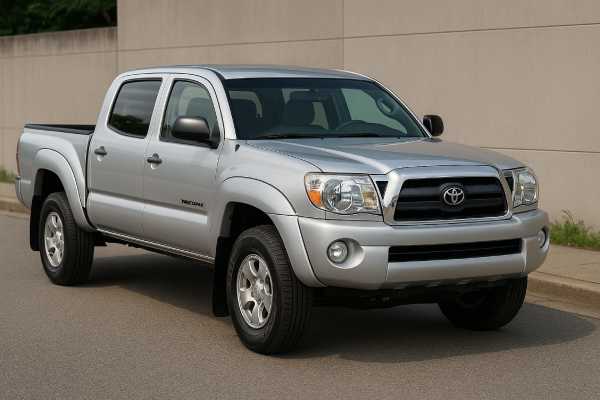
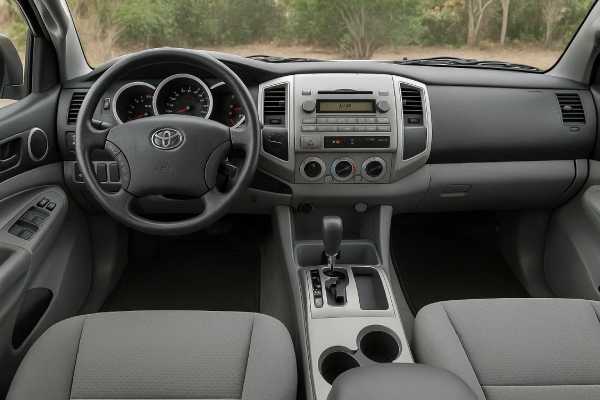
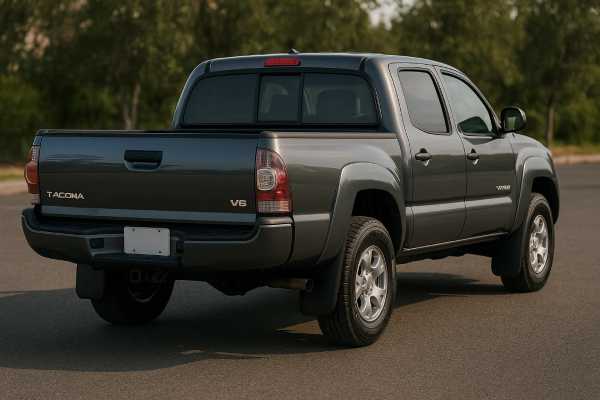
The second-generation Toyota Tacoma with the 1GR-FE 4.0 litre V6 in rear wheel drive (RWD) form is a very specific tool: a midsize truck built for everyday use, long highway stretches, and light to medium towing without the weight and complexity of four wheel drive. Produced from 2005 to 2011 on the N220 platform, it combines a stout ladder frame, a chain driven V6, and simple leaf spring rear suspension.
Many owners choose this configuration because they want the strongest available engine and towing package while keeping purchase price, running costs, and weight down compared with a 4×4. It also appeals to drivers in warmer or drier climates who rarely need off road traction but still value payload and durability. In this guide, we will dig into the engine and technical specs, real world performance, reliability patterns, maintenance planning, and how the V6 RWD Tacoma compares to rival midsize trucks of the same era.
Key Takeaways
- Strong 4.0 litre 1GR-FE V6 delivers around 236 hp and 360 Nm, giving relaxed highway cruising and solid towing for a midsize pickup.
- RWD layout keeps weight, complexity, and servicing costs lower than 4×4 Tacomas while preserving payload and bed practicality.
- Frame corrosion checks, cooling system condition, and driveline vibrations are important inspection points on higher mileage trucks.
- Typical service rhythm: engine oil and filter every 5,000–7,500 miles (8,000–12,000 km) or 6–12 months depending on use.
- For long life, budget additional fluid changes (ATF, differentials) roughly every 60,000 miles (100,000 km) and cooling system service around 100,000 miles (160,000 km).
Guide contents
- Tacoma 4.0 RWD use case
- 1GR-FE engine and key specs
- RWD V6 Tacoma trims and safety
- Reliability trends for 1GR-FE Tacomas
- Maintenance roadmap and buyer guidance
- Driving performance of 4.0 RWD
- Tacoma V6 versus rival trucks
Tacoma 4.0 RWD use case
The second generation Tacoma launched for 2005 and ran largely unchanged through 2011. The 1GR-FE 4.0 litre V6 was the top petrol engine, sitting above the 2.7 litre four cylinder. In RWD form, it is most commonly found in PreRunner and standard 4×2 V6 trims, often with the tow package and automatic transmission.
This configuration suits owners who spend most of their time on paved roads or gravel, but still want a genuine working truck. Compared with 4×4 Tacomas, the RWD V6 usually offers:
- Slightly better fuel economy and less drivetrain drag.
- Lower curb weight and a modest advantage in payload.
- Fewer components to maintain (no front differential or transfer case).
The chassis is classic Toyota truck: boxed front frame sections with open C section rails further back, double wishbone front suspension, and leaf springs on a solid rear axle. This layout is simple, proven, and tolerant of abuse, though it rides more firmly when unladen than a crossover or SUV.
Within the N220 range, the V6 RWD sits between base four cylinder work trucks and off road focused TRD 4×4 models. It is a good choice if you:
- Tow small to medium trailers (boats, pop up campers, small equipment).
- Haul tools or materials but mostly stay on road.
- Prefer the smoother power delivery of a V6 over the 2.7 four cylinder.
Cab choices (Regular, Access, Double Cab) and bed lengths (short and long) let you prioritise people space or cargo length. In Double Cab form with the 4.0, the Tacoma can double as a family vehicle while still being a capable light commercial truck.
From an ownership perspective, the 1GR-FE V6 RWD Tacoma is attractive because the engine is timing chain driven, the drivetrain is mechanically straightforward, and parts availability in North America is excellent. The trade off is that fuel consumption is higher than smaller four cylinder trucks or later model midsize diesels and that ride and cabin refinement reflect early 2000s design rather than modern pickups.
1GR-FE engine and key specs
The heart of this Tacoma is the 1GR-FE, a 4.0 litre V6 from Toyota’s GR engine family. It is designed for longitudinal mounting in trucks and SUVs and is known for its strong midrange and long service life when maintained.
Engine and performance
| Item | Specification |
|---|---|
| Engine code | 1GR-FE (Gen 1, VVT-i / later dual VVT-i on some markets) |
| Layout and cylinders | 60° V6, DOHC, 4 valves per cylinder, aluminium block and heads |
| Displacement | 4.0 L (approx. 3,956 cc) |
| Bore x stroke | 94.0 mm x 95.0 mm |
| Induction | Naturally aspirated |
| Fuel system | Multi port fuel injection (MPFI) |
| Compression ratio | Around 10.0:1 |
| Max power | About 236 hp (176 kW) @ ~5,200 rpm (North American tuning) |
| Max torque | About 360 Nm (266 lb ft) @ ~4,000 rpm |
| Timing drive | Single primary timing chain (no scheduled replacement) |
| Recommended fuel | Regular unleaded, minimum 87 AKI (check local spec) |
Fuel economy and efficiency (typical U.S. EPA ratings, 2WD V6)
| Configuration | City (mpg US) | Highway (mpg US) | Combined (mpg US) | Combined (L/100 km, approx.) |
|---|---|---|---|---|
| 4.0 V6 2WD automatic | 17 | 21 | 18 | ~13.1 |
| 4.0 V6 2WD manual | 15 | 18 | 16 | ~14.7 |
Real world use often sits a little below the official ratings, especially with larger tyres, lift kits, or frequent towing. Mixed driving in a stock truck commonly returns 16–18 mpg US (13–15 L/100 km).
Transmission and driveline
Most RWD V6 Tacomas are equipped with a 5 speed automatic, though a 6 speed manual was offered in some markets and configurations.
| Item | Specification |
|---|---|
| Transmission options | 5 speed automatic; 6 speed manual (availability by trim/year) |
| Drive type | Rear wheel drive (4×2) |
| Final drive ratio | Typically around 3.73–3.91 (varies with cab/bed/tow package) |
| Differential | Open rear differential; some models with limited slip or electronic aid via stability control |
Chassis and dimensions (typical Double Cab, short bed RWD V6)
Values vary with cab and bed length but the following are representative:
| Item | Approximate value |
|---|---|
| Overall length | ~5,285 mm (208 in) |
| Width | ~1,895 mm (75 in) |
| Height | ~1,780 mm (70 in) |
| Wheelbase | ~3,245 mm (128 in) |
| Ground clearance | ~230–240 mm (9.0–9.5 in) depending on trim |
| Curb weight | ~1,750–1,900 kg (3,850–4,200 lb) |
| GVWR | ~2,420–2,630 kg (5,335–5,800 lb) |
| Fuel tank | ~80 L (about 21 US gal) |
Performance and capability
| Item | Approximate value |
|---|---|
| 0–100 km/h (0–62 mph) | Roughly 7.8–8.5 s depending on cab/bed and gearbox |
| Top speed | Limited mainly by gearing and tyres; typically ~175 km/h (~109 mph) |
| Max towing (properly equipped, V6 tow package) | Up to about 2,950–3,000 kg (6,500 lb) |
| Standard towing (without full tow package) | Around 1,585 kg (3,500 lb) |
| Typical payload | 550–800 kg (1,200–1,750 lb) depending on spec |
Fluids, capacities and basic torque references (typical)
Always verify by VIN and market:
- Engine oil: SAE 5W-30 (many markets); capacity roughly 5.5–5.8 L (5.8–6.1 US qt) with filter.
- Coolant: Toyota Super Long Life (pink); total system roughly 9–10 L.
- Automatic transmission fluid: Toyota WS, capacity ~9 L total, 3–4 L on a drain and fill.
- Rear differential: SAE 75W-90 gear oil, about 2 L.
- Wheel lug nuts: typically around 113–131 Nm (83–97 lb ft).
Electrical
- Alternator output: usually in the 100–130 A range depending on equipment.
- 12 V battery: commonly group size 24F, around 550–650 CCA in original fitment.
- Spark plugs: long life plugs (iridium), gap typically around 1.0–1.1 mm.
RWD V6 Tacoma trims and safety
Across 2005–2011, Toyota offered the V6 RWD Tacoma in several cab and trim combinations. Naming and equipment vary slightly by market and year, but you will typically see:
- Base / Work truck: simpler interior, steel wheels, fewer comfort features.
- SR5 or mid level trims: power accessories, upgraded audio, nicer upholstery.
- PreRunner (where offered): RWD truck with 4×4 style raised suspension and visual cues, but without front driven hardware.
Mechanically, V6 RWD trucks may differ by:
- Rear axle ratio (tow package vs standard).
- Brake package (larger front rotors and sometimes transmission cooler on tow package models).
- Wheel and tyre sizes (15, 16, or 17 inch wheels depending on trim and option packages).
From a safety standpoint, the second generation Tacoma improved over the first in body structure and crash performance. By the late 2000s:
- Dual front airbags were standard across the range.
- Front seat side torso airbags and side curtain airbags became standard or widely available (by 2009 in North America).
- Anti lock brakes (ABS) were standard.
- Electronic stability control and traction control became standard on later years, often combined with brake assist and electronic brakeforce distribution.
The Insurance Institute for Highway Safety tested 2WD Tacomas of this generation in moderate overlap frontal and other key crash modes. The truck earned high scores for frontal crashworthiness and head restraints, with some limitations in newer or more demanding tests that were introduced after this platform was designed. As a small body on frame pickup, its structure is robust, but its mass and height can be a disadvantage in certain multi vehicle collisions.
Child seat installation is generally straightforward in Double Cab models thanks to LATCH/ISOFIX style anchors and adequate rear seat space. In Access Cab models, rear seat packaging is tighter and child restraint fitment requires more care.
RWD V6 Tacoma models do not usually include advanced driver assistance systems such as autonomous emergency braking, adaptive cruise control, or lane keeping support; these technologies arrived on later generations. The key electronic safety systems on 2005–2011 trucks are:
- ABS with electronic brakeforce distribution.
- Traction and stability control (on later years and higher trims).
- Tyre pressure monitoring, depending on market and year.
When shopping used, check that:
- All airbag warning lights cycle correctly at start up.
- Stability control and ABS indicator behaviour matches the owner’s manual.
- There are no unresolved airbag or safety related recalls by running the VIN through an official recall lookup.
Reliability trends for 1GR-FE Tacomas
The 1GR-FE V6 Tacoma has a strong reputation for durability, often reaching high mileages if serviced properly. However, like any platform, certain issues appear more frequently.
Engine and cooling
Common to occasional issues:
- Water pump seepage or failure (medium cost): may show as coolant crust around the pump housing or light overheating at speed. The remedy is pump replacement and a fresh coolant fill.
- Accessory drive noise (low to medium cost): ageing idler pulleys, tensioners, or belts can squeal, especially on cold starts. Replacing the belt and noisy pulleys usually resolves it.
- Intake and throttle body deposits (low cost): can cause slightly unstable idle or sluggish response. A careful throttle body cleaning and fresh air filter normally restores smoothness.
Rare but important:
- Head gasket issues: less frequent than on some other Toyota engines, but any persistent coolant loss, unexplained overheating, or white exhaust smoke on a 1GR-FE deserves proper diagnosis.
- Secondary air injection pump and valves (later years, medium to high cost): failure can trigger check engine lights and limp mode. Some owners fit bypass kits in regions without emissions testing, but the proper repair is pump and valve replacement or an updated kit.
Because the engine uses a timing chain rather than a belt, there is no fixed replacement interval. Chain stretch or guide wear is relatively rare when oil changes are kept on schedule. Signs of trouble include rattling on cold start, timing correlation fault codes, or significant metal in the oil.
Transmission and driveline
The 5 speed automatic used with the V6 is generally robust but sensitive to fluid condition and heat when towing:
- Harsh or delayed shifts (medium cost): often respond well to a careful fluid exchange using the correct Toyota WS specification fluid.
- Torque converter shudder or slip (higher cost): more likely on trucks that towed near their limits without added cooling. Repair may require converter replacement or a rebuild.
On the driveline side:
- Prop shaft and U joint wear (medium cost): can cause vibrations or clunks on take off. Replacement of worn joints or rebalancing the shaft is the cure.
- Rear differential noise: worn bearings may show as a whine at constant speed; addressing it early can limit damage.
Suspension, steering and brakes
- Front lower ball joints and control arm bushings: wear over time, especially on trucks with heavy loads or rough roads, leading to looseness or alignment issues.
- Leaf spring bushings: can squeak or allow axle steer; replacement or greasing where appropriate helps.
- Brake rotors: may warp if heavily loaded or overheated; quality replacements and correct torque on wheel nuts reduce recurrence.
Frame and body corrosion
While the worst rust campaigns focused on earlier Tacoma generations, second generation trucks can still suffer:
- Rust at frame rails, crossmembers, and leaf spring mounts.
- Corrosion behind plastic fender liners and at bed seams.
In rust prone regions, a thorough underbody inspection is essential. Some trucks received frame inspections, coatings, or replacements under service campaigns; documentation is valuable when buying.
Recalls and service actions
Over the 2005–2011 run, Tacoma trucks were subject to various recalls and technical service bulletins, including:
- Floor mat and accelerator pedal interference.
- Airbag wiring and occupant classification sensor issues.
- Leaf spring corrosion and fracture concerns on certain VIN ranges.
Always:
- Check the VIN against official recall databases for your region.
- Ask for printed service history showing recall completion and major repairs.
Overall, when maintained, the 1GR-FE Tacoma is considered a low risk, long lived truck. The most significant owner controlled factors are fluid quality, avoiding chronic overheating, and addressing rust before it becomes structural.
Maintenance roadmap and buyer guidance
A clear maintenance plan is the easiest way to extend the life of a 4.0 RWD Tacoma and avoid expensive repairs. The intervals below are typical for normal use; always confirm with the official maintenance guide for your model year and market.
Core service intervals (typical)
- Engine oil and filter: every 5,000–7,500 miles (8,000–12,000 km) or 6–12 months, using quality 5W-30 and an appropriate filter. Shorter intervals are wise for heavy towing, hot climates, or lots of short trips.
- Engine air filter: inspect every 15,000 miles (24,000 km); replace around 30,000 miles (48,000 km) or sooner in dusty conditions.
- Cabin air filter (if fitted): replace every 15,000–25,000 miles (24,000–40,000 km) or when airflow drops.
- Spark plugs: iridium plugs often specified at 60,000–100,000 miles (96,000–160,000 km). Replacement is more involved on the V6 than the four cylinder but still straightforward for a trained technician.
- Coolant: Toyota Super Long Life coolant is often specified for up to 100,000 miles (160,000 km) or 10 years on the first fill, then shorter intervals thereafter. Many owners proactively service around 5–7 years or 100,000 miles.
- Automatic transmission fluid: for longevity, a drain and fill around every 60,000 miles (100,000 km) is a sensible compromise, especially if towing.
- Rear differential oil: change around 60,000–90,000 miles (100,000–145,000 km).
- Brake fluid: flush about every 2–3 years regardless of mileage.
- Drive belts and hoses: inspect annually; replace belts around 90,000–120,000 miles (145,000–190,000 km) or at the first signs of cracking.
- Wheel alignment and tyre rotation: rotate every 5,000–7,500 miles (8,000–12,000 km); check alignment when tyre wear looks uneven or after impacts.
- 12 V battery: test annually after the third year; many last 4–5 years in typical climates.
Because the 1GR-FE uses a timing chain, there is no routine timing belt replacement. Instead, listen for chain noise and watch for oil quality and level.
Fluid specs and decision pointers
- Use oils and fluids meeting Toyota’s specifications (or equivalent) to ensure compatibility with seals and clutches.
- When in doubt between minimum and “severe service” intervals, choose the shorter one if you tow, sit in heavy traffic, or operate in very hot or cold climates.
Buyer’s checklist for a used V6 RWD Tacoma
When inspecting a candidate truck:
- Frame and underbody: look closely at frame rails, crossmembers, and leaf spring mounts for scaling, deep rust, or repairs. Light surface rust is normal; heavy flaking or holes are red flags.
- Cooling system: check coolant colour, look for dried residue around the water pump, radiator, and hoses, and verify steady temperature during a long test drive.
- Transmission behaviour: shifts should be smooth and consistent, with no harsh engagements, flares, or shudder under light throttle.
- Driveline: listen for clunks on take off, vibrations at highway speeds, or whines from the rear axle.
- Suspension and steering: drive over bumps and through turns; note any knocking, wandering, or uneven tyre wear.
- Electrics: confirm that all warning lights, including ABS and stability control, behave correctly, and check windows, locks, A/C, and lighting.
- Service history: a folder or digital record showing regular oil changes, fluid services, and recall work is a major positive.
Which years and trims to prefer
- Later years in this generation (2009–2011) often benefit from incremental improvements in safety features and equipment.
- Trucks with documented tow package installation, auxiliary transmission coolers, and regular fluid changes are safer bets if you plan to tow.
- Fleet or work trucks can be fine if maintained, but inspect them more carefully for wear, rust, and rough use.
With a sensible maintenance plan and a careful purchase inspection, a 1GR-FE RWD Tacoma can reasonably be expected to deliver well over a decade of continued service, even at higher mileages.
Driving performance of 4.0 RWD
On the road, the 4.0 litre V6 is the main reason many owners choose this specific Tacoma. Compared with the 2.7 four cylinder, the V6 offers more effortless acceleration, especially once loaded or towing.
Powertrain character
The 1GR-FE pulls strongly from low to mid rpm, with its best surge between about 2,500 and 4,500 rpm. Throttle response is clean and predictable, especially on trucks kept stock or near stock. The 5 speed automatic usually prefers to upshift early for economy, but kicks down promptly when you ask for more power.
With a light right foot, the engine hums quietly at highway speeds, turning moderate rpm thanks to its displacement and gearing. When you floor it to merge or pass, the V6 grows louder but not harsh, and acceleration is brisk for a midsize pickup of this era. Manual transmission trucks feel more mechanical and engaging but are rarer and can be more tiring in heavy traffic.
Ride, handling, and NVH
The RWD Tacoma rides slightly lower and lighter than its 4×4 siblings. That gives:
- A bit less body roll and a more responsive feel when changing lanes.
- Slightly better braking performance thanks to reduced mass.
- A firmer, sometimes choppy ride when unladen because of rear leaf springs tuned for payload.
Noise levels are typical of early 2000s trucks: wind and tyre noise are noticeable at motorway speeds, but engine noise is well managed in steady cruising. Double Cab models usually feel quieter than Access Cab or Regular Cab versions.
Steering is light to moderate in weight with reasonable accuracy for a truck. It is not sports car precise, but tracks straight and feels predictable once the suspension is in good condition and alignment is correct.
Real world efficiency and range
In mixed driving, many owners see around:
- 15–18 mpg US (13–16 L/100 km) in city heavy use.
- 18–21 mpg US (11–13 L/100 km) on steady highway runs at moderate speeds.
- Slightly worse figures if towing, running larger tyres, or using lift kits.
With an 80 litre fuel tank, that yields a practical highway range of roughly 450–600 km (280–375 miles) depending on conditions.
Under moderate towing at or near 5,000–6,000 lb, expect fuel consumption to worsen significantly, sometimes by 30–40 percent. On long grades, it is important to use tow/haul modes where available and to monitor transmission temperatures if you have an auxiliary gauge.
Traction and control
Being RWD, the truck relies on weight over the rear axle and tyre choice for traction on loose surfaces. Important points:
- Unladen, the rear can step out on wet or loose surfaces if you are abrupt with throttle. Stability and traction control (where fitted) help manage this, but physics still applies.
- With a moderate load in the bed, traction and ride improve noticeably.
- In light snow or mud, all terrain tyres and some bed weight can make the truck manageable, but this is not a substitute for a true 4×4.
Braking performance is adequate but, as with many trucks, can feel less confidence inspiring when fully loaded. Upgrading pads and fresh brake fluid can improve pedal feel, but overall behaviour is governed by tyre grip and weight transfer.
Tacoma V6 versus rival trucks
In the 2005–2011 period, the Tacoma V6 RWD competed directly with the Nissan Frontier, Chevrolet Colorado / GMC Canyon, Ford Ranger (older generation), and some regional rivals. Each has strengths, but the Tacoma carved out a clear niche.
Where the Tacoma 4.0 RWD stands out
- Long term durability: the 1GR-FE engine and Toyota’s body on frame design have a strong record for high mileage reliability when serviced.
- Resale value: used prices for Tacomas tend to be higher than rivals, sometimes significantly so, reflecting market confidence in the platform.
- Aftermarket support: parts availability (OEM and aftermarket) for suspension, protection, towing, and cosmetic upgrades is excellent.
- Cab and bed flexibility: a wide mix of cab and bed combinations means many owners can find a configuration that suits their use.
Areas where rivals can be stronger
- Ride and refinement: some later model rivals (especially newer generations introduced near the end of this Tacoma’s life) offer smoother rides and quieter cabins.
- Fuel efficiency: four cylinder or diesel competitors often beat the 4.0 V6 on fuel consumption, especially in city driving.
- Modern safety and driver assistance: newer platforms introduced in the 2010s offer features like autonomous emergency braking and advanced lane support that are absent on this generation Tacoma.
Tacoma versus specific competitors
- Nissan Frontier (mid-2000s to early 2010s): Frontier V6 models offer similar power and capability, but many buyers view Tacoma as having stronger long term reliability and corrosion protection. Frontier purchase prices are often lower.
- Chevrolet Colorado / GMC Canyon (first generation): these can be cheaper to buy, but engines and gearboxes do not have the same reputation for very high mileage reliability. Interiors can feel less robust.
- Ford Ranger (older North American generation): simpler and often cheaper but smaller and less refined. The Tacoma feels more modern and generally offers stronger crash performance.
Who should choose the Tacoma 4.0 RWD
This truck is a good match if you:
- Want a midsize pickup that you can keep for a decade or more with predictable maintenance.
- Live mainly in dry or temperate climates where 4×4 is rarely needed.
- Tow or haul regularly but not at heavy commercial levels.
- Value residual value and parts support over the latest in cabin tech or safety features.
If you often drive in snow, off road, or very slippery conditions, a 4×4 Tacoma or a rival with advanced traction systems may suit better. If low running costs and fuel efficiency dominate your priorities, a four cylinder Tacoma or a more modern diesel or hybrid truck might be the better balance.
For many owners, though, the 1GR-FE RWD Tacoma combines a robust mechanical package, strong V6 performance, and manageable ownership costs in a way that still makes sense years after production ended.
References
- Gas Mileage of 2010 Toyota Tacoma 2010 (Fuel Economy Data)
- 2011 Toyota Tacoma 2011 (Safety Rating)
- 2010 Tacoma – Warranty and Maintenance Guide 2010 (Owner’s Manual / Maintenance Guide)
- Toyota Tacoma II Double Cab 4.0 V6 (236 Hp) Automatic | Technical specs, data, fuel consumption, Dimensions 2010 (Technical Specs)
- General 2005–2015 Toyota Tacoma Maintenance 2023 (Maintenance Reference)
Disclaimer
This article is for informational purposes only and is not a substitute for professional diagnosis, repair, or safety advice. Specifications, torque values, service intervals, and procedures can vary by VIN, model year, market, and equipment level. Always confirm details against the official owner’s manual, workshop manual, and technical service information for your specific vehicle, and consult a qualified technician when planning or performing maintenance and repairs.
If you found this guide useful, consider sharing it with other enthusiasts and owners on Facebook, X/Twitter, and your favourite forums to help support xcar’s work and keep reliable information circulating in the community.