
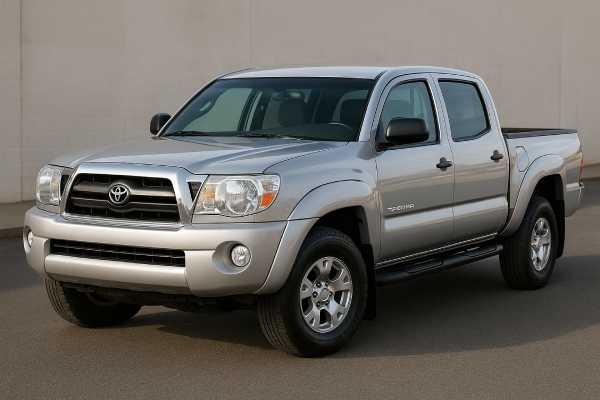
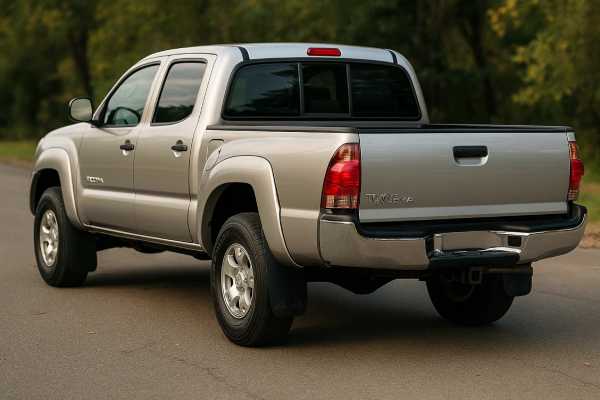
The second-generation Toyota Tacoma 4×4 with the 1GR-FE 4.0-litre V6 is one of the most respected compact pickups of the mid-2000s. It combines a stout ladder frame, simple part-time four-wheel drive, and a strong naturally aspirated V6 that tolerates hard use and high mileage. For many buyers it was a “do-everything” truck: daily driver, light overland build, weekend tow rig, and work partner.
Between 2005 and 2011, Toyota refined this N220 chassis with incremental safety upgrades, better rust protection, and a broader mix of Access Cab and Double Cab configurations. At the same time, owners learned the real-world story: where the 1GR-FE shines, which suspension and frame areas need inspection, and how to maintain the truck so it feels tight well past 200,000 miles (320,000 km). This guide walks through specs, capability, reliability patterns, maintenance planning, and how the Tacoma 4×4 V6 stacks up against competing trucks of the era.
Top Highlights
- Strong 4.0-litre V6 (1GR-FE) with 236 hp and generous mid-range torque for towing and off-road use.
- Simple, durable part-time 4×4 with low range and robust double-wishbone / leaf-spring suspension.
- Excellent long-term durability when serviced on time; many examples exceed 300,000 km with original powertrain.
- Watch for frame and underbody corrosion, front suspension wear, and oil leaks around timing cover and cam towers.
- Change engine oil every 8,000–10,000 km or 6 months on mixed use; shorten to 5,000 km for heavy off-road or towing.
Start here
- 4×4 Tacoma V6 profile
- Drivetrain specs and technical data
- 4×4 trims, equipment and safety
- Reliability issues and service actions
- Maintenance schedule and buying tips
- On road and off road performance
- How Tacoma 4×4 compares
4×4 Tacoma V6 profile
The 2005–2011 Tacoma 4×4 with the 1GR-FE 4.0-litre V6 sits at the top of the N220 lineup in performance and capability. It is built on a fully boxed ladder frame up front with a strong C-channel rear section, using a double-wishbone front suspension and leaf-spring solid rear axle. This combination gives the truck both good on-road manners and the robustness that off-road owners expect.
The 1GR-FE is an aluminium-block, DOHC V6 with variable valve timing (VVT-i) on the intake side in these years. It is naturally aspirated, chain-driven, and tuned for torque rather than peak power. In North American Tacoma applications it produces 236 hp and about 266 lb-ft (360 Nm) of torque, with a broad plateau in the mid-range. Mated to either a 6-speed manual or 5-speed automatic, it can comfortably move a loaded Double Cab and tow medium trailers.
Tacoma 4×4 models use a part-time transfer case: rear-wheel drive in normal driving, with 4-High and 4-Low engaged via a dash switch or small selector, depending on model year. There is no centre differential, so four-wheel drive is intended for loose or slippery surfaces. Many V6 4×4 trucks are also equipped with a limited-slip differential or electronic aids that simulate one via the stability system, and certain TRD Off-Road trims add a locking rear differential.
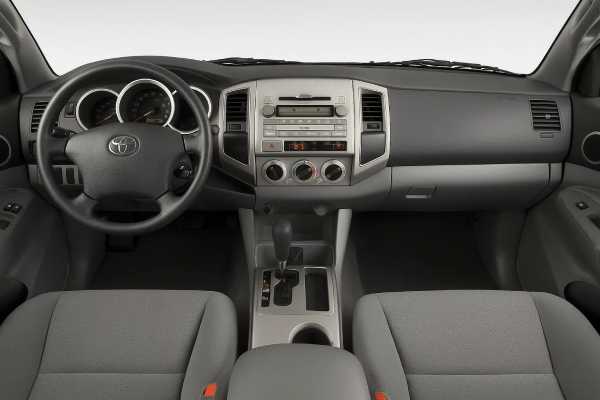
Inside, the Tacoma is functional rather than luxurious. Early years have harder plastics and simpler audio, while later years gain updated audio head units, available Bluetooth, and small trim changes. Seating is generally upright and supportive, with Access Cab models offering compact rear seats and Double Cab models delivering genuine family-friendly space. The cabin noise level is acceptable for a truck of this era, though not as quiet as later generations.
For owners, the essence of this truck is versatility: it is small enough to live with in town, powerful enough for highway towing, and rugged enough for trails and winter use.
Drivetrain specs and technical data
This section focuses on the 4.0-litre V6 4×4 Tacoma (N220), typical for 2005–2011 North American models. Minor variations exist by year, cab style, and region.
Engine and performance (1GR-FE V6)
| Item | Specification |
|---|---|
| Engine code | 1GR-FE |
| Layout | V6, 60°, aluminium block and heads |
| Valvetrain | DOHC, 4 valves per cylinder, VVT-i on intake |
| Displacement | 4.0 l (3,956 cc) |
| Bore × stroke | 94.0 mm × 95.0 mm (approx.) |
| Induction | Naturally aspirated |
| Fuel system | Sequential multi-port fuel injection (MPFI) |
| Compression ratio | ~10.0:1 (varies slightly by year/market) |
| Max power | 236 hp @ ~5,200 rpm |
| Max torque | ~266 lb-ft (≈360 Nm) @ ~4,000 rpm |
| Timing drive | Chain (no scheduled replacement) |
| Recommended fuel | Regular unleaded (87 AKI) |
Real-world fuel consumption for a 4×4 Double Cab automatic typically falls around 14–15 l/100 km (15–17 mpg US) city and 10–11 l/100 km (20–22 mpg US) highway when stock on all-terrain tyres and driven sensibly.
Transmission and 4×4 system
| Item | Specification |
|---|---|
| Transmissions | 6-speed manual or 5-speed automatic (A750 series) |
| Drive type | Part-time 4×4 with 2H / 4H / 4L |
| Transfer case | Two-speed, chain-driven, electronically actuated |
| Front differential | Open differential |
| Rear differential | Open or limited-slip; selectable rear locker on TRD Off-Road trims |
| Typical final drive ratios | ~3.73–3.91 (varies by year/trim) |
Chassis, dimensions, and capacities
Figures vary slightly by cab and bed length; the numbers below are representative of a Double Cab Short Bed 4×4 V6.
| Item | Approximate value |
|---|---|
| Overall length | ~5,270 mm (207 in) |
| Width (without mirrors) | ~1,830 mm (72 in) |
| Height | ~1,790 mm (70 in) |
| Wheelbase | ~3,245 mm (128 in) Double Cab; shorter on Access Cab |
| Ground clearance | ~230–240 mm (9–9.5 in) |
| Approach / departure angle | Around mid-30° / low-20° (varies by trim and tyres) |
| Curb weight | ≈1,850–1,980 kg (4,080–4,360 lb) |
| GVWR | ≈2,540–2,680 kg (5,600–5,900 lb) |
| Fuel tank | ~79 l (21 US gal) |
Payload and towing:
| Item | Typical range |
|---|---|
| Payload | ~500–650 kg (1,100–1,430 lb) depending on configuration |
| Towing capacity (V6 4×4) | Up to 2,268 kg (5,000 lb) with proper equipment |
Fluids and service-relevant data
Values below are typical ranges; always confirm by VIN and manual.
| System | Specification / capacity (approx.) |
|---|---|
| Engine oil | 5W-30 or 0W-30 (region-dependent); ~5.5–6.0 l including filter |
| Coolant | Toyota Super Long Life pink; total capacity ~9–10 l |
| Manual transmission oil | API GL-4/GL-5 75W-90; ~1.8–2.0 l |
| Automatic ATF | Toyota WS; pan drain typically 3–4 l, full exchange more |
| Front diff / transfer / rear diff | 75W-90 GL-5 gear oil; 1–2 l each (varies) |
| A/C refrigerant | R-134a; charge in the 500–600 g range (model-specific) |
Electrical basics:
- Alternator output typically around 100–130 A.
- 12 V battery in group 24F/27F size depending on equipment.
- Spark plugs are long-life iridium; service interval often around 160,000 km (100,000 miles) in normal use.
4×4 trims, equipment and safety
Across 2005–2011, Tacoma 4×4 V6 trucks were sold in a range of trims and cab styles. Names vary slightly by market, but common North American groupings include SR5, TRD Off-Road, TRD Sport, and various appearance or convenience packages.
SR5-type trucks usually pair the 4.0-litre V6 with cloth seats, manual or automatic transmission, and basic but functional interior trim. You may see steel or simple alloy wheels, conventional suspension tuning, and a focus on payload and towing rather than aggressive off-road equipment. These are a good choice for mixed use and work duty.
TRD Off-Road models add more serious trail hardware. Expect off-road tuned Bilstein-type shocks, an electronically locking rear differential, hill-start assist and downhill assist (on later years with automatic), skid plates, and all-terrain tyres. Some models also receive upgraded cooling and alternator specs. These trucks ride slightly firmer on pavement but offer more composure on rough trails.
TRD Sport trims lean toward on-road handling. They usually include colour-keyed exterior trim, sport-tuned suspension, 17-inch or similar wheels, and street-biased tyres. The rear differential is typically open or limited-slip rather than lockable, and the focus is on sharper steering response and reduced body roll.
Cab and bed configurations:
- Access Cab: smaller rear-hinged rear doors and compact back seat; often paired with a longer bed.
- Double Cab: full-size rear doors and rear bench; available with short or long bed, popular for family and daily use.
Safety equipment improved over the run. Early trucks delivered dual front airbags and available side and curtain airbags, with anti-lock brakes standard. Electronic stability control, traction control, and more advanced brake assist functions were phased in and became standard across the range as regulations tightened toward the end of the decade.
Crash-test performance is generally solid for the class and era, but you should note that ratings standards have become tougher since then. Later model years score better thanks to stability control and side-curtain airbags being more widely fitted. Head restraints and seat design also saw incremental improvements.
Child-seat installation uses LATCH/ISOFIX anchors in Double Cab rear seats. Access Cab rear seats are more constrained; many owners prefer Double Cab for regular child-seat use. Airbag and sensor calibration should be checked if the truck has been involved in a crash or had seat or dashboard work done.
Advanced driver-assistance systems (ADAS) in the modern sense were not yet common. You will not find adaptive cruise control, lane-keep assist, or automatic emergency braking in factory 2005–2011 Tacomas. This simplifies ownership—fewer sensors and cameras to fail—but also means drivers rely more on their own awareness and driving skill.
Reliability issues and service actions
The Tacoma 4×4 V6 has an excellent durability record overall, but no used truck is perfect. Understanding typical issues by mileage and usage makes it easier to screen a candidate and plan preventative work.
Engine and ancillaries (1GR-FE)
- Timing cover and cam tower oil seepage (common, usually low–medium cost).
Small oil leaks at the front timing cover or around the cam/valve cover areas are common as the engine ages. Symptoms are oil smell on hot shutdown and light misting on the front of the block. Left alone, leaks can slowly worsen. Remedies range from resealing the timing cover (labour-intensive) to replacing valve cover gaskets and half-moon plugs. - Water pump wear (common at higher mileage).
The water pump can begin to seep coolant around 160,000–220,000 km. Look for pink crust around the pump weep hole or front of the engine. Replacing the pump and serpentine belt together is a standard repair. - Accessory belt and idler pulleys (age-related).
Chirping or squealing on cold start often traces to a glazed belt or worn idler/tensioner bearings. These are straightforward replacement items and worth refreshing pre-emptively on a new-to-you truck. - Secondary air injection issues (occasional, market-dependent).
On some later 1GR-FE applications, secondary air injection pumps and valves can fail, causing check-engine lights and limp-home modes. Not all Tacoma years/markets are affected; where present, failure usually calls for pump/valve replacement or bypass solutions.
Driveline and chassis
- Front suspension wear (control arm bushings, ball joints, shocks).
Heavy off-road use or rough roads accelerate wear in upper and lower control arm bushings and ball joints. Symptoms include wandering, clunks on bumps, uneven tyre wear, and loose steering feel. Proper inspection on a lift is essential. Replacement with quality components restores tightness and improves tyre life. - Wheel bearings and CV joints (occasional on lifted/abused trucks).
Trucks running large tyres or frequent mud use can see front wheel bearings and CV joints wear earlier. Listen for humming that changes with speed or clicking in tight turns. - Driveshaft and U-joints.
Grease-able joints last well if serviced regularly, but neglected joints may develop vibration or clunk when shifting from drive to reverse. Replacement parts are not expensive; labour is moderate. - Frame and underbody corrosion (climate-dependent, potentially high cost).
While the worst frame rust issues are often associated with earlier Tacoma generations, any N220 truck from salty regions deserves careful frame inspection, especially around rear leaf spring mounts, crossmembers, and weld seams. Severe scaling, perforation, or flaking metal can be safety-critical and costly to repair.
Brakes and hydraulics
Calipers, especially rear, can stick in regions with road salt, leading to uneven pad wear, hot wheels, and reduced fuel economy. Flexible brake hoses can also crack with age. During pre-purchase checks, confirm even pad thickness, smooth braking, and a firm pedal.
Electrical and interior
Most electrical faults are minor: window switches, blower resistors, and aging audio head units. Airbag warning lights may appear after seat or steering-wheel work; resolving them correctly can require proper diagnostic equipment and sometimes replacement of spiral cables or seat sensors.
Recalls and TSBs
Over its life, the second-generation Tacoma has been subject to multiple recalls and technical service bulletins, including campaigns on leaf springs, rust, and specific safety concerns. For any candidate truck:
- Run an official VIN recall check in the relevant market.
- Ask for documentation that major recall campaigns and service actions were completed.
- On modified trucks (lifts, bumpers, winches), confirm that recall repairs and frame inspections were done after modifications, not before.
Well-maintained examples with documented repairs to these known issues tend to be very reliable workhorses.
Maintenance schedule and buying tips
A Tacoma 4×4 V6 will generally treat you as well as you treat it. Below is a practical, owner-friendly maintenance roadmap. Always cross-check with the official maintenance guide for your year and market.
Core maintenance (time or distance, whichever comes first)
- Engine oil and filter:
Every 8,000–10,000 km or 6 months in mixed driving. Reduce to ~5,000 km for heavy towing, desert heat, or short-trip usage. Use quality oil meeting Toyota’s specifications. - Engine air filter:
Inspect every 15,000 km; replace around 30,000 km, sooner in dusty off-road conditions. - Cabin air filter:
Replace every 20,000–25,000 km or annually, especially if you use the truck in dusty or pollen-heavy regions. - Coolant:
The factory Super Long Life coolant has an extended first interval (often around 160,000 km or 10 years) and shorter subsequent intervals. For a used truck, many owners choose to flush around 8–10 years or 160,000 km, then every 80,000–100,000 km. - Spark plugs (iridium):
Typically around 160,000 km in normal use. On hard-worked trucks, consider inspection earlier. - Brake fluid:
Flush every 2–3 years regardless of mileage. - Manual transmission, transfer case, and differentials:
60,000–80,000 km is a sensible interval if you use 4×4 regularly, tow, or ford water. For light use, 100,000 km is often acceptable, but do not ignore age. - Automatic transmission (Toyota WS):
Despite “lifetime” claims, many experienced owners service the fluid every 60,000–80,000 km using drain-and-fill or gentle exchange methods. - Steering and suspension:
Inspect annually: ball joints, bushings, tie-rod ends, shocks, and strut mounts. Re-torque critical suspension hardware after off-road trips or lifting the truck. - Tyre rotation and alignment:
Rotate every 10,000 km; check alignment annually or after suspension work. - 12 V battery:
Test yearly after year four; replace proactively between 5–7 years depending on climate.
Buying checklist
When inspecting a used Tacoma 4×4 V6:
- Frame and underbody: look for serious rust, especially at rear spring mounts, crossmembers, and weld seams. Tap suspect areas and look for flaking metal.
- Front suspension and steering: check for play in ball joints and tie-rods, torn boots, and uneven tyre wear.
- Engine bay: inspect for oil seepage at timing cover and valve covers, coolant crust at water pump, and condition of belts and hoses.
- Driveline: drive in 2H, 4H, and 4L; listen for clunks or grinding, and confirm smooth engagement.
- Brakes: ensure even braking with no pull, soft pedal, or grinding noises.
- Electronics: test 4×4 switch, locker (if equipped), power windows, locks, and all cluster warning lights.
- Service history: prioritise trucks with records for fluid changes and recall work.
What to look for
- Favour trucks that are mechanically stock or lightly modified with quality parts.
- A modest suspension lift with correct alignment and driveshaft geometry can be fine; extreme lifts and very large tyres increase wear.
- TRD Off-Road trims with rear locker are attractive for mixed trail use, but SR5-type trucks can be better values if you do mostly road driving.
With a realistic maintenance budget and careful inspection, a Tacoma 4×4 V6 can provide many more years of dependable use.
On road and off road performance
The 4.0-litre Tacoma 4×4 feels more relaxed and capable than four-cylinder models, especially once you add passengers, gear, or a trailer. The 1GR-FE’s torque arrives low enough in the rev range that you can maintain highway speeds on grades without constantly downshifting. Acceleration to 100 km/h (62 mph) is not sports-car fast but confident for a mid-2000s pickup—roughly in the 7.5–8.5 second range depending on configuration and conditions.
On pavement, the ride quality is firm but controlled. The double-wishbone front suspension resists dive and squat better than older torsion-bar designs, and the leaf-spring rear is well tuned for light loads while still handling payload. TRD Sport trucks feel a little sharper in turns; TRD Off-Road trucks feel more composed on broken surfaces but may be slightly more truck-like over small bumps.
Steering is relatively light with decent feedback. It is not as quick as a modern crossover, but it inspires confidence once you adapt to the turning circle and higher centre of gravity. Cabin noise is moderate: you will hear tyre and wind noise at motorway speeds, but the V6 settles into a quiet hum in top gear.
Off-road, the Tacoma 4×4 is limited more by tyres and driver than by hardware. With 4-High engaged, the truck copes easily with gravel, snow, and light trails. 4-Low and the available rear locker give real crawling capability for rocky sections or deep mud, especially when combined with appropriate tyres and careful throttle use. Approach and departure angles are good for the segment; long-bed trucks have slightly worse breakover angles and require more care over crests.
When towing, the V6 and 4×4 driveline handle moderate loads well, especially within the common 2,000–2,500 kg trailer range. Stability is generally good if the trailer is loaded correctly, and transmission temperatures remain reasonable if you use tow/haul mode where available and keep speeds within safe limits. You should expect a noticeable increase in fuel consumption—often 30–50% more—when towing at highway speeds.
Real-world fuel economy depends heavily on tyre choice, lift height, and driving style. A stock Double Cab on highway-oriented tyres can manage low-11 l/100 km (around 21–22 mpg US) on steady highway runs. With a modest lift, heavy bumpers, roof rack, and all-terrain tyres, consumption can climb toward the mid-teens l/100 km (mid-teens mpg US), particularly at higher speeds or in headwinds.
Overall, the Tacoma 4×4 V6 strikes a balance: it is not the quickest or most refined mid-size truck of its era, but it offers predictable, confidence-inspiring performance both on and off the road.
How Tacoma 4×4 compares
In the 2005–2011 period, the Tacoma 4×4 V6 competed with trucks such as the Nissan Frontier/Navara, Chevrolet Colorado/GMC Canyon, Ford Ranger (where sold), and some regional models like the Mitsubishi Triton/L200. Each rival has strengths, but the Tacoma built a reputation that still shapes used values today.
Versus Nissan Frontier/Navara
The Frontier/Navara V6 (or diesel in some markets) often offers slightly stronger straight-line performance and, in certain trims, rear-disc brakes and more car-like road manners. However, many owners find the Tacoma’s interior layout simpler and appreciate Toyota’s dealer network and parts availability. Frontier frames and suspensions are also robust, but long-term perception of reliability often leans towards the Toyota, which is reflected in resale prices.
Versus Chevrolet Colorado / GMC Canyon (first generation)
Early Colorado/Canyon models feel lighter and sometimes more agile, especially with inline-five engines, but they typically trail the Tacoma in perceived interior quality, long-term durability, and off-road aftermarket support. The Tacoma’s 1GR-FE V6 is widely regarded as more durable under hard use than many competing gasoline engines of the era.
Versus older Ford Ranger
The compact Ranger of this era is simpler, narrower, and can be cheaper to buy used. It is a good work platform but usually offers less interior space, fewer comfort features, and a less refined ride compared with a Double Cab Tacoma. Off-road, a well-equipped Ranger can be very capable, but Tacoma aftermarket support and community knowledge are broader.
Strengths of the Tacoma 4×4 V6
- Proven 1GR-FE engine that tolerates high mileage, long trips, and off-road heat cycles when maintained.
- Strong resale value and abundant aftermarket parts for suspension, armour, and overland setups.
- Well-balanced size: easier to park than full-size trucks but still offers meaningful payload and towing capability.
- Simple, mechanical four-wheel drive system without complicated full-time or on-demand electronics to fail.
Trade-offs
- Fuel economy trails some modern rivals and four-cylinder diesel competitors, especially once modified.
- Cabin materials, while durable, feel dated compared with later generations.
- Limited ADAS and safety tech by current standards.
- Used-market prices are often high because of strong demand and reputation.
For buyers prioritising long-term dependability, easy parts access, and proven off-road capability, the 2005–2011 Tacoma 4×4 V6 remains one of the most compelling choices in the mid-size truck world—even many years after production.
References
- Gas Mileage of 2011 Toyota Tacoma 2011 (Fuel Economy Data)
- 2011 Toyota Tacoma 4-door pickup 2011 (Safety Rating)
- The 2011 Toyota Tacoma compact pick-up: Rugged performance, power and versatility 2010 (Product Information)
- Vehicle Detail Search – 2011 TOYOTA TACOMA 2011 (Recall Database)
Disclaimer
This article is for informational purposes only and is not a substitute for professional diagnosis, repair, or inspection. Specifications, torque values, maintenance intervals, and procedures can vary by VIN, market, equipment level, and prior modifications. Always confirm critical data and repair steps against the official service documentation and parts information for your specific vehicle, and consult a qualified technician when in doubt.
If you found this guide useful, please consider sharing it on social platforms such as Facebook or X/Twitter to help other owners and support xcar’s work.