
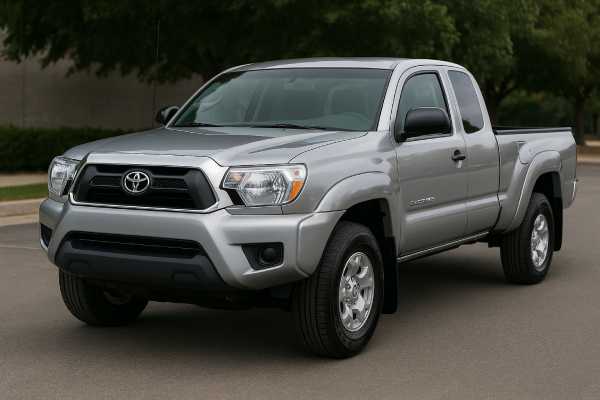
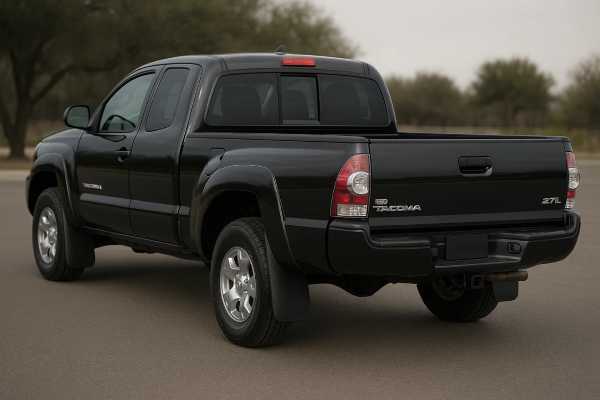
The facelifted 2012–2015 Toyota Tacoma RWD with the 2TR-FE 2.7-litre engine sits in a sweet spot between affordability, durability, and everyday usability. It keeps the same basic N220 chassis that earned the Tacoma its reputation for longevity, but benefits from refreshed styling, improved cabins, and incremental safety and equipment updates. Under the hood, the naturally aspirated four-cylinder is simple, chain-driven, and known for long life when serviced on time, even if it is not the most powerful option in the range.
In rear-wheel-drive form, this Tacoma is lighter and more efficient than its 4×4 siblings while still offering a stout frame, real payload capacity, and respectable towing for a four-cylinder truck. For buyers who split their time between commuting, light hauling, and weekend projects rather than heavy off-roading, this configuration can be a very rational choice. This guide walks through specs, performance, reliability, safety, maintenance, and how it compares to rival mid-size pickups.
Quick Specs and Notes
- Simple 2.7 l 2TR-FE four-cylinder with timing chain and conservative tune for long-term durability
- RWD layout offers lower curb weight, better fuel economy, and easier running costs than 4×4 versions
- Known for strong frame and body integrity, but still requires careful inspection for rust and recall completion
- Engine oil and filter changes are best done every 8,000–10,000 km or 6 months in mixed real-world use
Explore the sections
- Facelift Tacoma 2.7 RWD profile
- Tacoma 2.7 RWD specs and data
- Tacoma facelift trims and safety
- Long-term reliability and fixes
- Maintenance planning and buyer guide
- Real-world driving and performance
- Tacoma 2.7 RWD versus rivals
Facelift Tacoma 2.7 RWD profile
The 2012–2015 facelift brought a sharper front fascia, updated interior trim, and revised infotainment to the second-generation Tacoma without changing its basic architecture. In RWD 2.7-litre form, it targets buyers who want a real body-on-frame pickup but do not need constant four-wheel drive or the fuel consumption of the 4.0-litre V6.
The 2TR-FE engine is a 2.7 l inline-four with aluminium head, cast-iron block, dual overhead cams, and a timing chain. It is tuned here for around 159 hp at 5,200 rpm and roughly 244 Nm (180 lb-ft) of torque at 3,800 rpm. Power delivery is linear rather than punchy, and the truck feels at its best in low-to-mid rpm, especially when unladen or carrying moderate loads.
Facelift trucks retain the N220 ladder frame with a boxed front section and open C-channel rear sections. Front suspension is independent with coil springs and double wishbones, while the rear uses a solid axle on leaf springs. This is old-school hardware chosen for strength and ease of service rather than ultimate ride sophistication.
Within the range, the RWD 2.7 Tacoma is often the least expensive way into a mid-size Toyota pickup. It is available in Regular, Access Cab, and Double Cab configurations, with short and long beds depending on market. Typical payloads land around 600–680 kg (1,300–1,500 lb), and braked towing capacity for the four-cylinder RWD models is usually in the 1,600 kg (3,500 lb) region when equipped with the proper towing kit.
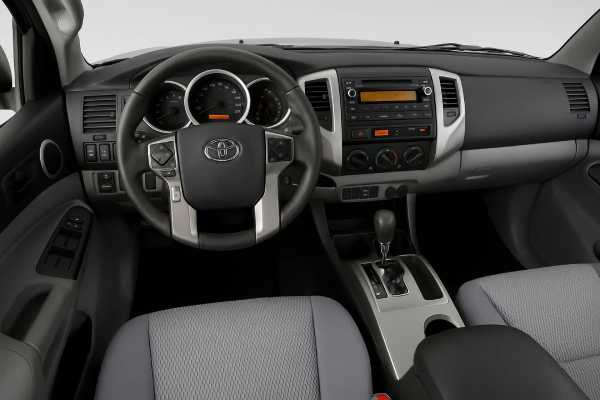
The facelift also improved interior ergonomics: better seat fabrics, revised instrument cluster graphics, and more modern audio units with Bluetooth and, on later trucks, touchscreen interfaces. Cabin materials are still utilitarian and focused on durability, but overall usability and perceived quality are noticeably higher than early second-generation models.
Tacoma 2.7 RWD specs and data
This section focuses on typical specifications for a 2012–2015 Tacoma 2.7-litre RWD Double Cab or Access Cab with common North American equipment. Exact figures vary slightly by body style, transmission, and market.
Engine and performance (2TR-FE 2.7 l)
| Item | Specification |
|---|---|
| Engine code | 2TR-FE |
| Configuration | Inline-4, DOHC, 16 valves |
| Bore × stroke | ~95.0 mm × 95.0 mm (3.74 in × 3.74 in) |
| Displacement | 2.7 l (2,693 cc) |
| Induction | Naturally aspirated |
| Fuel system | Multi-point fuel injection |
| Compression ratio | Approx. 9.6 : 1 |
| Max power | 159 hp (≈118 kW) @ 5,200 rpm |
| Max torque | ~244 Nm (180 lb-ft) @ 3,800 rpm |
| Timing drive | Chain, no routine replacement interval |
| Emissions standard (US) | Tier 2 / LEV II era, varies by state |
| Rated economy (typical 2WD) | Around 10–10.5 l/100 km combined (21–23 mpg US) depending on transmission |
| Real-world highway (120 km/h) | Often 10–11 l/100 km (19–23 mpg US) when lightly loaded |
Power is modest for the truck’s weight, but the broad torque plateau and relatively short gearing make it usable for city work and moderate highway towing.
Transmission and driveline
| Item | Specification |
|---|---|
| Transmission options | 5-speed manual (R155 series) or 4-speed automatic (A340/750 series, market-dependent) |
| Drive type | Rear-wheel drive (4×2) |
| Rear differential | Open, with brake-based traction control and “auto LSD” function on many trims |
| Final drive ratio | Typically around 3.73–4.10 : 1 depending on transmission and axle option |
Manual trucks feel livelier but run higher revs on the highway; automatics are smoother in traffic and common in urban fleets.
Chassis and dimensions
| Item | Specification (typical Double Cab Short Bed 4×2) |
|---|---|
| Front suspension | Double wishbone, coil springs, gas shocks, stabilizer bar |
| Rear suspension | Solid axle, leaf springs, gas shocks |
| Steering | Rack-and-pinion with hydraulic assist |
| Front brakes | Ventilated discs |
| Rear brakes | Drums (varies by market) |
| Wheelbase | ~3,236 mm (127.4 in) |
| Length | ~5,283 mm (208 in) |
| Width (without mirrors) | ~1,895 mm (74–75 in) |
| Height | ~1,730 mm (68–69 in), trim-dependent |
| Ground clearance | Roughly 200–210 mm (7.9–8.3 in) for 4×2 models |
| Turning circle | Around 12.6 m (≈41 ft) kerb-to-kerb |
Weights, capacities and capability
| Item | Value (typical) |
|---|---|
| Curb weight | ~1,650–1,750 kg (3,640–3,860 lb) depending on cab/bed and options |
| GVWR | ~2,450–2,500 kg (5,400–5,500 lb) |
| Payload | Approx. 600–680 kg (1,300–1,500 lb) |
| Braked towing capacity | Up to ~1,600 kg (3,500 lb) for most 2.7 RWD configurations |
| Unbraked trailer | Typically limited to ~680 kg (1,500 lb) |
| Fuel tank | About 79 l (21.0 US gal) |
| Bed lengths | Short (~5 ft) or long (~6 ft), depending on cab |
Fluids and key service capacities (typical)
Values vary slightly by year and axle/transmission type; always confirm for the exact VIN.
| System | Specification and capacity (approx.) |
|---|---|
| Engine oil | 0W-20 full-synthetic, API SN or later; ~5.7 l (6.0 US qt) with filter |
| Engine coolant | Toyota Super Long Life pink coolant, premixed 50:50; ~7–8 l (7.4–8.5 US qt) |
| Manual transmission | GL-4/GL-5 gear oil (75W-90), ~1.7–2.0 l |
| Automatic transmission | Toyota WS ATF, ~8–9 l total fill; drain/refill significantly less |
| Rear differential | 75W-90 GL-5 gear oil, ~1.5–1.7 l |
| A/C refrigerant | R-134a, charge mass varies slightly by cab/market |
| Spark plugs | Iridium, long-life; gap ~1.0 mm (0.039 in) |
Electrical system (typical)
| Item | Specification |
|---|---|
| Alternator output | ~100–130 A depending on equipment |
| 12 V battery | 12 V lead-acid, ~65–70 Ah, typical group size 24F/27F (market-dependent) |
Tacoma facelift trims and safety
Facelift 2012–2015 Tacoma RWD 2.7 trucks were offered in a range of trims depending on market. In North America, familiar names include base, SR, SR5, and some appearance-oriented packages such as PreRunner-style 4×2 variants that share the raised “4×4 look” without the transfer case.
Base and work-oriented trims usually feature simple cloth seats, manual air conditioning, steel wheels, and basic audio. SR5 and similar grades add alloy wheels, upgraded upholstery, more speakers, keyless entry, and often a leather-wrapped steering wheel. Special Edition or appearance packages may bring unique wheels, contrast trim, and additional infotainment features. Mechanically, most 2.7 RWD variants share the same engine and axle hardware, with differences mainly in wheel and tyre packages and available towing preparation.
Quick identifiers for a facelift truck include the redesigned front fascia with a more angular grille, updated headlamp internals, and refreshed bumper design. Inside, the centre stack gets a more integrated audio or touchscreen unit, and the instrument cluster scale graphics differ from pre-facelift models. VIN decoders or build sheets can be used to confirm engine code (2TR-FE), drive type (4×2), and axle ratio.
On the safety side, all facelift Tacomas receive dual front airbags, front-seat side airbags, and full-length side curtain airbags in most major markets. Electronic stability control, traction control, and anti-lock braking with electronic brake-force distribution are standard. Brake-based “auto limited-slip” functionality in the traction control system helps a RWD truck maintain traction on loose or wet surfaces by pulsing the spinning rear wheel.
Child-seat provisions include lower anchors and top tether points for rear outboard seating positions on Double Cab models. Access Cab trucks may require careful review of local regulations when using rear jump seats with child restraints.
Crash-test ratings for this generation are solid rather than spectacular by modern standards. The robust frame and straightforward structure perform well in many tests, but the design predates the very latest small-overlap and advanced crash-avoidance requirements. However, for its era, the Tacoma generally scored competitive ratings against other mid-size pickups and offers a reasonable level of passive and active safety for daily use.
Advanced driver-assistance systems such as autonomous emergency braking, lane departure warning, or adaptive cruise control were not widely available on 2012–2015 Tacoma RWD 2.7 models. Buyers prioritising these systems may need to look at later generations.
Long-term reliability and fixes
The 2TR-FE four-cylinder is one of Toyota’s simpler truck engines and has a strong reputation for running high mileages with relatively low drama, provided fluids are kept fresh and the cooling system is healthy. The timing chain design means there is no scheduled belt replacement; chain stretch or guide wear is rare under normal maintenance.
Common or noteworthy issues on 2012–2015 Tacoma 2.7 RWD include:
- Exhaust manifold and emissions-related recalls
Certain 2TR-FE Tacomas from this era were subject to service campaigns related to exhaust components, where cracks or leaks could trigger check-engine lights or emissions faults. In many cases the official remedy involved replacement of exhaust parts and updated calibration. Ensuring recall or service campaign completion is important, especially in emissions-regulated regions. - Frame and underbody corrosion
Toyota improved rust protection over early 2000s trucks, but any body-on-frame pickup used in salted climates can suffer. Key areas to inspect are the frame rails near the rear leaf spring mounts, crossmembers, spare-wheel carrier, and front subframe. Surface rust is expected; heavy scaling, perforation, or weld repairs demand a careful structural assessment. - Rear leaf springs and ride height
Leaf springs can sag over time, especially on trucks that haul near maximum payload regularly. Excessive rear sag, a nose-high stance, or uneven ride height from side to side can all indicate spring fatigue. Replacement leaf packs or quality aftermarket solutions generally restore ride and handling. - Driveline vibration and U-joints
Age and mileage can bring minor driveline vibrations at certain speeds, often related to worn universal joints, centre bearings (on longer shafts), or imbalanced wheels. Catching these early prevents secondary wear in the differential or transmission output bearings. - Interior electronics and head units
Touchscreen audio units on later facelift trucks occasionally show glitches, frozen screens, or Bluetooth connectivity issues. Many problems can be resolved with software updates or head-unit replacement, but it is worth checking all functions during a test drive.
Severity for most of these issues is moderate rather than catastrophic. The engine and basic driveline are robust, and catastrophic bottom-end failures are rare under normal use. The main risk factors are neglected oil changes, chronic overheating due to a blocked radiator or failed water pump, and severe structural corrosion.
From a service-action perspective, a smart buyer or owner will:
- Run an official VIN check for open recalls and campaigns.
- Confirm documentation for any exhaust or frame-related work.
- Ask for invoices relating to coolant flushes, transmission or differential fluid services, and brake maintenance.
Properly maintained, a Tacoma 2.7 RWD is very capable of running well past 250,000 km (155,000+ miles) without major engine or transmission overhauls.
Maintenance planning and buyer guide
A clear maintenance plan is essential to keep the 2TR-FE and N220 chassis healthy. Intervals below are typical and conservative; always compare with the official schedule for the specific market and usage pattern.
Suggested maintenance schedule (typical)
- Engine oil and filter – Every 8,000–10,000 km (5,000–6,000 miles) or 6 months, whichever comes first; more often for heavy towing, short-trip use, or dusty conditions.
- Engine air filter – Inspect annually; replace every 30,000–40,000 km or sooner in dusty environments.
- Cabin air filter – Replace every 20,000–25,000 km or once a year.
- Coolant – Toyota Super Long Life coolant usually first replacement around 160,000 km (100,000 miles) or 8–10 years, then at shorter intervals; many owners choose a 5-year/100,000 km cycle for peace of mind.
- Spark plugs (iridium) – Around 160,000 km (100,000 miles) under normal use.
- Fuel filter – Often integrated with the pump in the tank; typically “lifetime” but worth considering replacement at high mileage or if fuel-delivery issues arise.
- Transmission fluid – For automatics, a drain-and-fill every 60,000–80,000 km is a sensible preventive measure, especially for towing or urban stop-and-go driving. For manuals, change gear oil every 80,000–100,000 km.
- Differential oil – Replace every 60,000–80,000 km or after deep-water crossings.
- Brake fluid – Flush every 2–3 years.
- Brake pads and rotors – Inspect at least annually; sooner if towing or driving in hilly areas.
- Serpentine/aux belts and hoses – Inspect at every service; replace belts every 90,000–120,000 km or when cracked/noisy, and hoses if swelling, soft spots, or leaks appear.
- Alignment and tyre rotation – Rotate tyres every 10,000–12,000 km and check alignment whenever uneven wear appears or after hitting potholes.
- 12 V battery – Test annually after 4 years of age; many last 5–7 years depending on climate.
Key torque values to keep in mind (always verify for the exact truck) include wheel lug nuts (around 105–115 Nm / 77–85 lb-ft) and drain plugs in the 35–45 Nm range. Over-tightening can damage threads or crush gaskets.
Buyer’s checklist
When shopping for a 2012–2015 Tacoma RWD 2.7, pay attention to:
- Frame and underbody – Look for heavy rust, patches, or weld repairs. Tap suspect areas with a hammer or screwdriver handle to check for thin metal.
- Service history – Favour trucks with documented oil changes, coolant replacement, and at least one transmission/differential service.
- Recalls and campaigns – Ask for proof of completed recall work (exhaust, frame-related actions, airbag campaigns where applicable).
- Driveline and steering feel – Test at various speeds for vibrations, clunks on acceleration/deceleration, or excessive play in the steering wheel.
- Cooling system – Check for dried coolant traces, low reservoir level, or evidence of overheating (burnt smell, discoloured coolant, warped plastic tanks).
- Electrics and accessories – Verify all power windows, locks, audio, and air conditioning; a weak blower or intermittent A/C may hint at electrical or refrigerant issues.
In general, the best candidates are lightly modified or stock trucks with sensible tyre sizes, factory-style suspension, and no significant aftermarket lift kits. For long-term ownership, a lower-mileage example with solid documentation and minimal corrosion is preferable to a higher-mileage truck, even if the latter appears cheaper at first glance.
Real-world driving and performance
On the road, the facelift Tacoma 2.7 RWD feels honest and predictable. Steering is moderately weighted with a slight on-centre dead band typical of trucks, but straight-line stability at highway speeds is good when suspension and tyres are in decent condition. The ride is firm when unladen, especially on trucks with stiffer rear leaf packs or higher-load-rating tyres, yet it settles nicely with a few hundred kilograms in the bed.
Cornering behaviour is safe and mildly understeery. The high-profile tyres and leaf-spring rear end mean the truck will lean more than a car, but grip levels are adequate for normal driving. Stability and traction control help manage wheelspin on wet surfaces; in RWD configuration, deliberate throttle in low-traction conditions should be applied with a bit of restraint, particularly on empty roads or worn tyres.
The 2.7-litre engine offers adequate acceleration for everyday use. 0–100 km/h (0–62 mph) is not sports-car quick, but for solo driving it is sufficient, especially with the manual gearbox where you can keep the engine in its torque band. Passing manoeuvres on two-lane highways require planning, particularly when the truck is loaded or towing.
Fuel economy in mixed driving typically falls in the 10–12 l/100 km (19–24 mpg US) range depending on driving style, tyre choice, and transmission. Manual trucks can edge slightly better consumption if driven gently, while automatics tend to be more consistent in urban environments. At a steady 110–120 km/h (70–75 mph), many owners report consumption in the low-10 l/100 km range with stock tyres.
Noise levels are acceptable for a mid-size body-on-frame pickup of this era. The four-cylinder engine becomes audible at higher revs, and you may hear some wind noise from the mirrors and A-pillars on the highway, but the cabin is generally comfortable enough for long trips. Aftermarket tyres with aggressive tread patterns can significantly increase road noise.
When towing up to about 1,600 kg (3,500 lb) with a properly set-up trailer and electric brakes, the Tacoma 2.7 RWD remains stable provided speeds are sensible and loads are balanced. Expect a noticeable drop in fuel economy (often 30–40% higher consumption) and more frequent downshifts on grades. For regular heavy towing, however, many buyers still prefer the V6 or a 4×4 model.
Tacoma 2.7 RWD versus rivals
In the 2012–2015 mid-size pickup segment, key rivals to the Tacoma RWD 2.7 include the Nissan Frontier (Navara in some markets), Chevrolet Colorado/GMC Canyon of that era, and in some regions the Ford Ranger or Mazda BT-50. Each has its strengths, but the Tacoma carved out a loyal following for several reasons.
Compared with many competitors, the Tacoma’s four-cylinder engine is less powerful on paper than some V6 or diesel options, yet it is simple, widely supported, and known for high-mileage survivability. Parts availability and aftermarket support are excellent, especially in North America. The chassis and suspension are well understood by independent shops, and modifications for light off-road use, towing, or overlanding are easy to source.
Against the Nissan Frontier of the same period, the Tacoma often wins on resale value and perceived long-term durability, while the Frontier can offer sharper pricing and, in some trims, a slightly more powerful six-cylinder engine. Compared with the Colorado/Canyon of that era, many buyers view the Tacoma as more conservative and less refined inside, but also less complex mechanically and more robust in severe use.
Where the Tacoma can lag rivals is in cabin space (especially rear legroom in some Double Cab configurations), lack of advanced driver-assistance systems, and its relatively thirsty petrol four-cylinder compared with modern small-displacement turbos or diesels. It is also usually more expensive on the used market, reflecting strong demand and residual values.
For buyers who want a mid-size truck primarily for commuting, light hauling, DIY projects, and occasional adventure travel, the 2012–2015 Tacoma RWD 2.7 offers a compelling balance of durability, cost of ownership, and practicality. Those who routinely tow at the upper end of the rating, drive in deep snow, or cover long highway distances with heavy loads might be better served by a V6 4×4 Tacoma or a more modern rival with advanced safety tech and a stronger engine.
References
<a href="https://www.toyota.com/owners/resources/owners-manuals/tacoma/2013">Original Owner's Manual - 2013 Toyota Tacoma</a> 2013 (Owner’s Manual)([support.toyota.com][1])<a href="https://www.fueleconomy.gov/feg/bymodel/2014_Toyota_Tacoma.shtml">Gas Mileage of 2014 Toyota Tacoma</a> 2014 (Fuel Economy Data)([fueleconomy.gov][2])<a href="https://www.nhtsa.gov/vehicle/2012/TOYOTA/TACOMA">Vehicle Detail Search - 2012 TOYOTA TACOMA</a> 2012 (Safety Ratings and Recalls)</a>([NHTSA][3])<a href="https://www.nhtsa.gov/vehicle/2014/TOYOTA/TACOMA/ACCESS-CAB-4WD">Recalls: Toyota Tacoma 2014 Access Cab 4WD (4 dr)</a> 2014 (Recall Database)([NHTSA][4])<a href="https://static.nhtsa.gov/odi/rcl/2014/RCONL-14V604-9051.pdf">Safety Recall E0D – Remedy Notice – 2012-2014 Model Year Tacoma</a> 2014 (Safety Recall Notice)([IIHS HLDI][5])
Disclaimer
This article is intended for informational purposes only and is not a substitute for professional diagnosis, repair, or official service literature. Specifications, torque values, service intervals, and procedures can vary by VIN, model year, market, trim level, and installed equipment. Always verify all technical data and repair steps against the official service manual, technical bulletins, and parts information for your specific vehicle.
If you found this guide useful, consider sharing it with fellow owners or enthusiasts on social platforms such as Facebook or X/Twitter to support xcar’s work and help other Tacoma drivers make better decisions.