
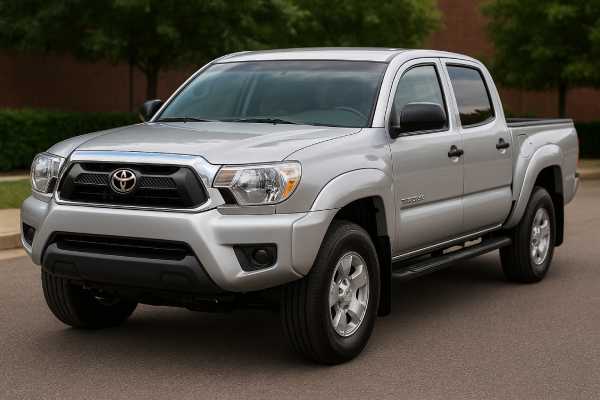
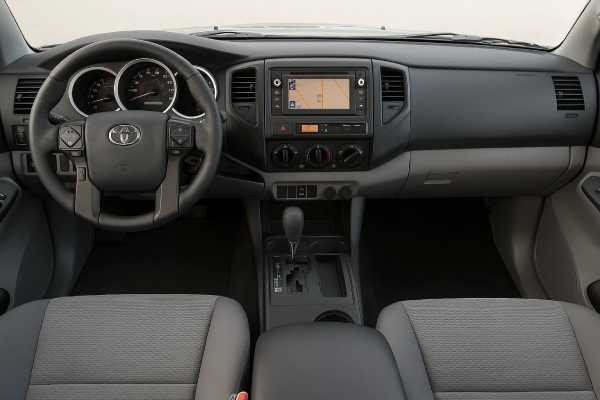
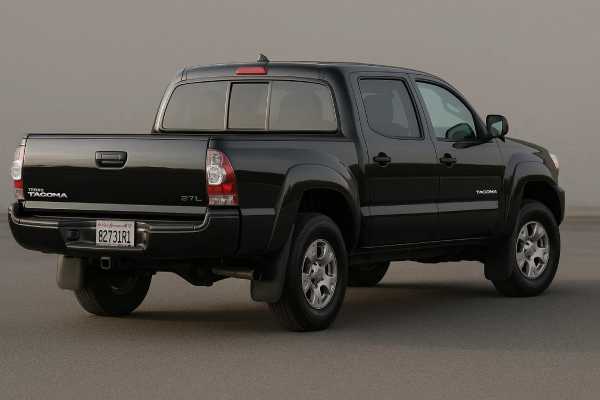
The 2012–2015 facelift Toyota Tacoma 4×4 with the 2TR-FE 2.7-litre four-cylinder is the “light-duty” end of the 4×4 Tacoma range, but it is far from a lightweight. It combines the simple, durable 2.7 engine with a part-time four-wheel-drive system, a robust frame and Toyota’s typical focus on longevity. Compared with early 2005–2011 trucks, the facelift brought a more modern cabin, updated infotainment and small but useful safety and comfort tweaks, while keeping the proven mechanical package mostly unchanged.
For buyers, this specific configuration suits those who need 4×4 traction for snow, trails, forest roads or job sites, but do not tow at the upper limits all the time. It is easier to live with day to day than the 4.0-litre V6 in terms of fuel cost and complexity, yet still capable enough for light to moderate off-road and work use. This guide walks through the key specifications, reliability patterns, maintenance needs and how it stacks up against rivals so you can judge if this facelift Tacoma 2.7 4×4 fits your use case.
Top Highlights
- Strong 2TR-FE 2.7 l chain-driven engine with a long track record for high-mileage reliability.
- Simple part-time 4×4 system (2H, 4H, 4L) that is robust and easy to service, ideal for snow and light off-road.
- Payload and bed usability remain excellent for a midsize truck, even with the four-cylinder engine and 4×4 hardware.
- Watch for frame and underbody corrosion in rust-belt regions; undercoating and regular washing are important.
- Typical engine oil change interval is 5,000–7,500 miles (8,000–12,000 km) or 6–12 months, depending on use and oil type.
Navigate this guide
- Facelift 2.7 4×4 Tacoma profile
- Engine, driveline and specs
- Grades, equipment and safety tech
- Real world reliability record
- Service schedule and buying advice
- On road and off road driving
- Tacoma 2.7 4×4 rivals comparison
Facelift 2.7 4×4 Tacoma profile
The facelifted 2012–2015 Tacoma 4×4 with the 2.7-litre 2TR-FE engine sits at an interesting point in the lineup. It gives you the full ladder-frame chassis, low-range transfer case and ground clearance expected from a proper pickup, but paired with a simpler and more economical four-cylinder rather than the 4.0-litre V6. For many owners who mostly commute, run errands and occasionally head to the mountains, that’s a very sensible balance.
Visually, the facelift brought a more squared-off front fascia, new grille and headlamp designs, and small tweaks to bumpers and wheels. Inside, the dashboard was redesigned, with a more integrated centre stack, updated HVAC controls, improved seat fabrics and, importantly, modern audio systems with Bluetooth and available touchscreen. The cabin still feels utilitarian and easy to clean, but less “early-2000s” than pre-facelift trucks.
The 2.7 4×4 configuration was typically available in Access Cab and Double Cab body styles, often with the shorter bed on Double Cabs and longer beds on Access Cabs. Payload and cargo usability remained strong: straight bed walls, a wide tailgate opening, and tie-down systems made it easy to secure loads. Compared with RWD versions, the 4×4 trucks sit slightly higher, with better approach and departure angles and a more purposeful stance.
Mechanically, the 2TR-FE carried over largely unchanged, which is good news for durability. It is a naturally aspirated, port-injected inline-four with a timing chain and relatively low specific output, which generally translates to low stress and fewer catastrophic failures. The part-time 4×4 system uses a separate transfer case with a selectable 4H and 4L mode, feeding an independent front suspension with CV shafts and a solid rear axle with leaf springs.
Safety and driver-assistance expectations also moved on by this era. Stability control, ABS, traction control and multiple airbags became standard, and later facelift years added incremental improvements in seat design and head restraint geometry. Although advanced driver-assist systems (AEB, lane keep assist) were not yet fitted, the truck meets modern basics for passive and active safety.
In short, the facelift Tacoma 2.7 4×4 appeals to owners who value mechanical simplicity, manageable running costs and genuine off-pavement capability, and who are comfortable trading some straight-line performance for that mix.
Engine, driveline and specs
This section focuses on the typical North American 2012–2015 Tacoma 4×4 equipped with the 2TR-FE 2.7-litre engine. Exact numbers may vary slightly with cab, bed length and options, but the tables below give a solid working reference.
Engine and performance (2TR-FE 2.7 l)
| Item | Specification |
|---|---|
| Engine code | 2TR-FE |
| Layout and cylinders | Inline-4, DOHC, 16-valve |
| Valvetrain | DOHC with VVT-i on intake (market-dependent) |
| Bore × stroke | ~95.0 mm × 95.0 mm (3.74 in × 3.74 in) |
| Displacement | 2.7 l (2,693 cc) |
| Induction | Naturally aspirated |
| Fuel system | Multi-port fuel injection (MPFI) |
| Compression ratio | ~9.6 : 1 (typical) |
| Max power | 159 hp (≈118 kW) @ ~5,200 rpm |
| Max torque | 244 Nm (180 lb-ft) @ ~3,800 rpm |
| Firing order | 1-3-4-2 |
| Timing drive | Chain (no scheduled replacement interval) |
| Emissions standard | ULEV/LEV II (North America, market-dependent) |
Fuel economy and efficiency (typical real-world)
| Condition | Approx. consumption |
|---|---|
| City driving | 12–14 l/100 km (17–20 mpg US / 20–24 mpg UK) |
| Highway 100–110 km/h (60–70 mph) | 9–11 l/100 km (21–26 mpg US / 25–31 mpg UK) |
| Mixed driving | 10–12 l/100 km (19–23 mpg US / 23–28 mpg UK) |
| Towing moderate loads | Expect 20–30% higher fuel use vs. unloaded highway |
These figures assume stock tyres, no heavy aftermarket bumpers, and moderate driving. Lift kits, aggressive all-terrain tyres and roof racks can add significantly to fuel consumption.
Transmission and driveline
| Item | Specification |
|---|---|
| Transmission options | 5-speed manual or 4-speed automatic (regional availability) |
| Drive type | Part-time 4×4 (2H / 4H / 4L) |
| Transfer case | 2-speed, electrically or mechanically actuated (model-year dependent) |
| Front differential | Open, with ADD (Automatic Disconnecting Differential) on many models |
| Rear differential | Open; electronic locking diff on some TRD Off-Road trims |
| Typical final drive ratio | Around 3.73–4.10 (varies with transmission and trim) |
| Low-range ratio | Roughly 2.5–2.6 : 1 (transfer case) |
Note that the 2.7 4×4 trucks often share gearing with V6 models, but the final drive ratio may differ between manual and automatic gearboxes.
Chassis and dimensions (typical)
| Item | Specification (approximate range) |
|---|---|
| Frame | Ladder frame with boxed front sections |
| Front suspension | Independent double wishbone with coilover shocks |
| Rear suspension | Solid axle with leaf springs |
| Steering | Rack-and-pinion with power assist |
| Brakes | Front ventilated discs, rear drums |
| Wheels and tyres | Commonly 16 in rims, 245/75 R16 or similar all-season/all-terrain tyres |
| Ground clearance | ~215–225 mm (8.5–8.9 in), depending on trim |
| Approach / departure angles | Roughly 29–35° / 23–26° (tyre and bumper-dependent) |
| Overall length | Approx. 5,285–5,645 mm (208–222 in) depending on cab/bed |
| Width (without mirrors) | Around 1,895 mm (≈74.5 in) |
| Height | Around 1,780–1,800 mm (70–71 in) |
| Wheelbase | About 3,236–3,246 mm (127.4–127.8 in) for Access/Double Cab 4×4 |
| Turning circle | ~12.0–12.8 m (39–42 ft) |
| Curb weight | ~1,750–1,870 kg (3,860–4,120 lb) |
| GVWR | Often around 2,500–2,670 kg (5,500–5,900 lb), trim-dependent |
| Fuel tank | Around 79 l (≈21 US gal / 17.5 UK gal) |
Performance and capability
| Item | Specification (typical for 2.7 4×4) |
|---|---|
| 0–100 km/h (0–62 mph) | Roughly 11–13 seconds, depending on cab, bed and gearbox |
| Top speed | Around 170–180 km/h (105–112 mph), electronically limited in many markets |
| Braking 100–0 km/h | Typically in the 40–45 m range (132–148 ft) on good tyres |
| Max towing capacity | Commonly around 1,600–1,800 kg (3,500–4,000 lb) with 2.7 4×4 configuration |
| Payload | Often 500–700 kg (1,100–1,550 lb), depending on cab/bed and GVWR rating |
| Roof load | Typically 68–75 kg (150–165 lb) on factory rails; verify for your specific truck |
The 2.7 4×4 is not a high-performance tow vehicle; if you routinely haul near max trailer weight, the 4.0 V6 is generally the better choice.
Fluids and service capacities (approximate)
Always verify with your exact owner’s/service manual, as specs can differ by market, climate package and year.
| System | Fluid type (typical) | Capacity (approx.) |
|---|---|---|
| Engine oil | 5W-30 or 0W-20 API SN or better | ~5.5–6.0 l (5.8–6.3 US qt) with filter |
| Engine coolant | Toyota Super Long Life Coolant (pink), 50/50 mix | ~8–9 l (8.5–9.5 US qt) total system |
| Manual transmission | GL-4/GL-5 75W-90 gear oil | ~1.5–2.5 l (1.6–2.6 US qt) |
| Automatic transmission | Toyota WS ATF | 7–9 l (full), 3–4 l typical drain-and-fill |
| Front differential | GL-5 75W-90 gear oil | ~1.1–1.3 l (1.2–1.4 US qt) |
| Rear differential | GL-5 75W-90 gear oil | ~2.0–2.5 l (2.1–2.6 US qt) |
| Transfer case | GL-4/GL-5 75W-90 or specified fluid | ~1.1–1.4 l (1.2–1.5 US qt) |
| Brake fluid | DOT 3 or DOT 4 | As required for system flush |
| A/C refrigerant | R-134a | Charge mass varies by option (typically 500–650 g) |
Electrical and ignition (typical)
| Item | Specification |
|---|---|
| Alternator output | Commonly 80–100 A (trim-dependent) |
| 12 V battery | Group size around 24F or similar; 550–650 CCA typical |
| Spark plugs | Long-life iridium; service interval often ~96,000–160,000 km (60,000–100,000 miles) |
| Plug gap | ~1.0–1.1 mm (0.039–0.043 in) – verify for your year |
Grades, equipment and safety tech
The 2012–2015 Tacoma range offered several trims, and availability of the 2.7 4×4 varied by body style and region. In North America, the four-cylinder 4×4 was more common in work-oriented and mid-grade trims than in fully loaded TRD packages, but there were exceptions.
Typical trim walk (names and content vary by country):
- Work/entry trims (e.g., base, SR)
- Vinyl or basic cloth seats
- Simpler audio head units (though facelift added Bluetooth and USB on many)
- Steel wheels, minimal chrome
- Manual air conditioning, manual windows and locks on some early trucks
- 4×4 system present but without locking rear differential in many cases
- Mid-grade trims (e.g., SR5)
- Upgraded cloth upholstery and interior trim
- Alloy wheels and body-colour exterior accents
- Better audio with touchscreen on many facelift models
- Cruise control, keyless entry, sliding rear window, more storage features
- Off-road-oriented trims (regional TRD-style packages)
- More common with the V6, but in some markets you could pair off-road suspension and tyres with the 2.7 4×4
- Skid plates, upgraded shocks, and sometimes an electronic locking rear differential
- All-terrain tyres from factory, tow package and auxiliary power points
From a mechanical perspective, the biggest trim-dependent differences you should look for are:
- Rear differential type – open vs. locking
- Suspension tune – firmer shocks, different rear leaf packs in off-road and tow-focused packages
- Wheel and tyre packages – off-road tyres improve dirt and snow performance but increase fuel consumption and noise
Visually, badges on tailgate and fenders, different wheel designs, fog lights and interior colour schemes help identify trims. VIN build sheets from a dealer can confirm original equipment, diff type and tow package presence.
On the safety side, the facelift Tacoma standardised many core systems:
- Front airbags, side airbags and side-curtain airbags
- ABS with Electronic Brake-force Distribution
- Vehicle Stability Control (VSC) and traction control
- Brake Assist and tyre pressure monitoring in many markets
Child-seat provisions are straightforward: rear seats in Double Cabs typically have LATCH/ISOFIX points and top tether anchors, while Access Cab rear seating is more limited and best suited to occasional passengers or compact seats. Always verify anchor locations and weight limits in the manual.
Advanced driver-assistance systems (ADAS) as we know them today—automatic emergency braking, adaptive cruise control, lane-keeping assist—were not fitted to these trucks from the factory. This keeps the electronics simpler and maintenance cheaper, but also means no “safety net” for inattentive moments. Headlight performance is acceptable but not outstanding in stock halogen form; many owners upgrade bulbs or add auxiliary lighting (where legal and properly aimed) for rural night driving.
Crash-test results for comparable 2012–2015 Tacoma models generally show solid occupant protection for a body-on-frame pickup, with rollover ratings typical for tall, narrow vehicles. When shopping, it is worth confirming that airbags have not been disabled and that any recall work related to safety systems has been fully completed.
Real world reliability record
The facelift Tacoma 2.7 4×4 inherits much of its reliability reputation from both earlier 2.7-powered Tacomas and contemporary Hilux models that use similar hardware. The combination of a non-turbocharged four-cylinder, conservative output and proven 4×4 system means that most problems are age- and environment-related rather than design flaws.
You can think of the risks in three broad groups: powertrain, driveline/chassis and body/electrical.
Engine and powertrain
On the 2TR-FE itself, serious internal failures are rare when oil changes and cooling system maintenance are respected. Common age-related items include:
- Oil leaks from valve cover gaskets and front crank seals
- Symptoms: burning oil smell, oily residue on engine front, drip marks
- Remedy: replace affected gaskets/seals, clean engine and monitor
- Water pump seepage or bearing wear
- Symptoms: coolant traces around pump, occasional noise, or overheating if ignored
- Remedy: replace water pump, fresh coolant; usually a moderate-cost job
- Ignition coil or plug issues
- Symptoms: misfire codes, rough idle, poor fuel economy
- Remedy: replace ignition coil(s) and spark plugs, check for moisture intrusion
Timing chains on these engines normally last the life of the vehicle, but chain stretch can occur at very high mileages if oil changes are neglected. Rattling on cold start or correlation fault codes are the cues to investigate.
Automatic transmissions paired with the 2.7 are generally robust. Problems tend to centre on:
- Old ATF causing harsh shifts or delayed engagement
- Cooler line corrosion in harsh climates
- Occasional solenoid faults on very high mileage trucks
Manual gearboxes can develop worn synchros, especially on second and third gear, if driven hard without rev-matching. Fresh gear oil and gentle operation can prolong life; rebuilds are rarely needed on lightly used trucks.
4×4 system and chassis
The additional 4×4 hardware introduces some extra wear points:
- Front CV joints and boots – more stressed on lifted trucks and those used heavily off-road. Split boots lead to joint wear and clicking in turns; budget for replacement if you see torn boots.
- Front differential and transfer case seals – can seep with age; watch for damp housings and drops on the driveway. Early leaks can often be addressed with seal replacement before bearings are affected.
- 4×4 actuator issues – on trucks with electronic actuators, lack of use can lead to sticking. Cycling between 2H and 4H on dry, straight roads a few times a month keeps things moving and lubricated.
The earlier 2005–2011 Tacomas were affected by a widely known rear leaf spring and frame corrosion recall. By the facelift years, Toyota had improved frame coatings and leaf designs, but corrosion can still be an issue in salt-belt regions. Focus your inspection on:
- Inside of boxed frame sections near rear axle
- Rear leaf spring hangers and shackles
- Crossmembers, especially around fuel tank and spare tyre
- Brake lines and fuel lines clipped to the frame
Treat any active rust seriously. Surface rust can be cleaned and coated; deep flaking or perforation requires professional assessment and possibly frame repair or replacement.
Suspension wear follows normal patterns for a work truck: front lower control arm bushings and ball joints, rear leaf spring bushings, and shock absorbers will all age, especially on trucks that tow or carry heavy tools.
Recalls, service campaigns and software
While the facelift years avoided some of the largest frame-related campaigns that affected earlier trucks, it is essential to check recall status by VIN through official channels. Recalls can cover:
- Airbag inflator replacements
- Seatbelt anchor or pretensioner issues
- Brake or fuel line routing and protection updates
Software updates (ECU/TCU reflashes) are less common on this relatively simple powertrain but may address driveability quirks or emissions diagnostics. A dealer can confirm if any calibration updates are outstanding.
How to assess reliability risk
When evaluating a used Tacoma 2.7 4×4 facelift, reliability risk is heavily influenced by:
- Rust exposure – trucks from dry regions usually age extremely well; heavily salted roads accelerate frame and brake line corrosion.
- Usage pattern – mixed commuting and light weekend use is kinder than constant heavy towing or payload.
- Maintenance culture – complete service records, regular fluid changes and prompt repair of minor leaks are strong positive signs.
Well-maintained examples commonly exceed 200,000–300,000 km (125,000–185,000 miles) with only routine wear items and the occasional accessory replacement.
Service schedule and buying advice
A sensible maintenance plan is the easiest way to extend the life of a Tacoma 2.7 4×4 and avoid unpleasant surprises. The table below outlines a practical, conservative schedule that works well for mixed daily driving, light towing and occasional off-road use. Always cross-check with the official maintenance guide for your specific year and market.
Practical maintenance schedule (typical guidance)
| Item | Interval (distance/time) | Notes |
|---|---|---|
| Engine oil and filter | 5,000–7,500 miles (8,000–12,000 km) or 6–12 months | Shorter intervals for heavy towing, dusty use or many short trips |
| Engine air filter | Inspect every 10,000 miles (16,000 km); replace 20,000–30,000 miles (32,000–48,000 km) | Replace sooner in dusty/off-road environments |
| Cabin air filter | 15,000–20,000 miles (24,000–32,000 km) or 1–2 years | Keeps HVAC performance and odours in check |
| Spark plugs | 60,000–100,000 miles (96,000–160,000 km) depending on plug type | Use OEM-equivalent iridium plugs |
| Engine coolant | Around 100,000 miles (160,000 km) or 8–10 years initially, then 50,000 miles (80,000 km) / 5 years | Follow Super Long Life Coolant guidance |
| Manual trans oil | 30,000–60,000 miles (48,000–96,000 km) | Shorter intervals if towing or off-roading frequently |
| Automatic ATF | 30,000–60,000 miles (48,000–96,000 km) drain-and-fill | “Lifetime” fluid is optimistic; regular refreshes extend life |
| Front and rear diff oil | 30,000–50,000 miles (48,000–80,000 km) | More frequent service for deep-water crossings or hard use |
| Transfer case oil | 30,000–50,000 miles (48,000–80,000 km) | Service alongside diff oils |
| Brake fluid | Every 2–3 years regardless of mileage | Prevents internal corrosion and maintains pedal feel |
| Brake pads/rotors | Inspect at least annually | More often if towing or driving in mountains |
| Serpentine/drive belts | Inspect every 20,000 miles (32,000 km); replace around 90,000–120,000 miles (145,000–190,000 km) or at first cracking/noise | |
| Hoses and coolant lines | Inspect at every oil change from 8–10 years onward | Replace any that are soft, swollen or cracked |
| Wheel alignment and tyre rotation | Rotate every 5,000–7,500 miles (8,000–12,000 km); align as needed or every 1–2 years | 4×4 trucks benefit from regular rotation to even wear |
| 12 V battery | Test annually after 4–5 years; replace at first sign of weakness | Avoid being stranded, especially in cold climates |
Because the 2TR-FE uses a timing chain, there is no scheduled belt replacement. Instead, your focus should be on frequent oil changes and listening for chain noise on cold start.
Key torque values (approximate, for planning)
These are not instructions—only typical magnitudes so you can judge whether DIY is realistic and understand shop quotes. Always use official service data for actual work.
- Wheel lug nuts: often around 110–120 Nm (81–89 lb-ft)
- Engine oil drain plug: roughly 35–45 Nm (26–33 lb-ft)
- Spark plugs: typically 18–25 Nm (13–18 lb-ft) on aluminium heads
- Differential drain/fill plugs: often 40–60 Nm (30–44 lb-ft)
Buyer’s checklist for a used Tacoma 2.7 4×4 facelift
When inspecting a truck, work through the following:
- Corrosion check
- Inspect frame rails inside and out, crossmembers, spring mounts, and spare-tyre area. Tap questionable spots gently with a hammer and look for flaking or perforation.
- Check brake and fuel lines along the frame for rust and damp spots.
- 4×4 system operation
- On a straight, dry road at moderate speed, shift from 2H to 4H and back; engagement should be smooth and reasonably quick (follow manual instructions).
- In a safe low-traction area, briefly test 4L for proper low-range reduction and engagement.
- Driveline and suspension
- Listen for clunks or bangs when shifting from reverse to drive, which may suggest driveline slack.
- Check for CV boot tears, damp differential housings and play in front and rear wheel bearings.
- Engine and transmission health
- Cold start: engine should fire quickly without loud rattles.
- Drive: watch for misfires, flat spots, hunting shifts or slipping. The 2.7 is not fast, but it should feel smooth and consistent.
- Interior and electrical condition
- Confirm operation of all windows, locks, HVAC modes, 4×4 indicator lights and instrument cluster warning lights.
- Check for water leaks behind the seats and in footwells; blocked sunroof drains (if fitted) or window seals can cause issues.
- Documentation
- Seek trucks with a clear record of oil changes, diff and transfer case services, brake fluid flushes and cooling system maintenance.
- Request recall completion printouts and, if possible, dealer service history.
A well-maintained facelift Tacoma 2.7 4×4 is often a safer bet than a poorly maintained V6, even if on paper the V6 seems more desirable. Condition and rust state matter more than trim name.
On road and off road driving
From behind the wheel, the facelift Tacoma 2.7 4×4 feels like a traditional body-on-frame pickup: sturdy, a bit busy over broken pavement, but predictable and confidence-inspiring once you understand its character.
Ride, handling and NVH
The front independent suspension and rear leaf springs are tuned primarily for durability and load-carrying rather than plush comfort. Unladen, the rear can feel slightly bouncy over sharp bumps, especially with higher-rate leaf packs. Adding some cargo in the bed—tools, sandbags, camping gear—often smooths things out.
Steering effort is moderate, with reasonable on-centre feel at highway speeds. It is not sports-car precise, but it tracks straight if alignment and tyres are in good condition. Body roll in corners is noticeable but well-controlled, and the truck communicates grip levels clearly. Wind and road noise are present at freeway speeds, but generally acceptable for a midsize pickup of this generation.
Cabin noise from the 2.7 engine is most noticeable under heavy throttle or steep climbs. At a steady cruise, the engine settles into a relaxed hum, especially with the automatic transmission keeping revs modest.
Powertrain character
The 2TR-FE’s strengths are linearity and predictability rather than brute force. Off the line, the 2.7 moves the truck adequately, and in light traffic its response is more than sufficient. With the automatic, downshifts are required for brisk acceleration or highway merging, and the truck can feel busy on long climbs with heavy loads.
The manual gearbox gives you more direct control and can make the most of the engine’s modest torque, but not all markets received the manual in 4×4 2.7 form. For towing or mountainous regions, the V6 does deliver a more relaxed experience; with the four-cylinder, careful gear selection and realistic expectations are key.
Real-world efficiency
In everyday use, owners typically see:
- Around 10–12 l/100 km (19–23 mpg US) in mixed driving with stock tyres
- Higher consumption in city-only use or with larger tyres, roof racks or lift kits
- On long, steady highway runs at legal speeds, mid-20s mpg US is achievable with a light foot
The 4×4 system does impose a slight penalty versus RWD models due to extra weight and rotating mass. Engaging 4H on loose surfaces does not dramatically change fuel economy in the short term but will over long distances.
Off-road and winter behaviour
Where the 2.7 4×4 Tacoma shines is in traction-limited conditions:
- The part-time system, low range and strong chassis make it well-suited for snow-covered roads, forest tracks, muddy job sites and mild to moderate trails.
- Ground clearance and approach angles are sufficient for most overlanding routes without heavy rock-crawling.
- An optional locking rear differential, if fitted, significantly helps in cross-axle situations, steep loose climbs and deep ruts.
Tyre choice transforms the truck’s behaviour. Factory all-season tyres are fine for general road and light dirt use; quality all-terrain tyres dramatically improve grip on dirt, gravel and snow, at the cost of some noise and fuel use. For winter, dedicated snow tyres on separate wheels provide the best control.
For more serious off-pavement use, common upgrades include:
- Skid plates to protect engine, transmission and transfer case
- Slightly taller all-terrain tyres within stock wheel wells
- Moderately upgraded shocks for better control on washboard or loaded trips
Care should be taken not to over-lift the truck without proper geometry correction, as this can accelerate wear on CV joints, ball joints and steering components.
Towing and hauling
The 2.7 4×4 facelift Tacoma is happiest towing small to medium trailers—small campers, utility trailers, light boats—rather than max-capacity loads. With loads near the rated limit, expect:
- Longer acceleration times and more frequent downshifts
- Higher coolant and transmission temperatures on long grades (tow-package cooling helps)
- Noticeable increase in fuel consumption, often by 30–50% compared to empty cruising
Payload capacity remains a strong point. Carrying tools, building materials, motorcycles or camping gear in the bed is exactly what this truck is designed for. As always, load the bed evenly, keep heavy items low and forward of the rear axle, and respect the GVWR and axle limits.
Tacoma 2.7 4×4 rivals comparison
In the facelift years, the Tacoma 2.7 4×4 competed primarily with the Nissan Frontier, the then-new Chevrolet Colorado / GMC Canyon, and in some markets the Ford Ranger and other global midsize pickups. Each has its strengths; the Tacoma’s appeal comes from simplicity, residual value and long-term durability more than cutting-edge specs.
Versus Nissan Frontier (Navara in some markets)
- Powertrains: The Frontier typically offered 4-cyl and V6 options as well. Some markets had diesel engines, which can out-torque the Tacoma 2.7 but bring their own complexity.
- Ride and handling: Frontier ride quality is similar—firm and truck-like—but some drivers find steering feel in the Frontier a bit heavier.
- Reliability: Both trucks can be durable, but certain Frontier years had specific concerns (e.g., radiator–transmission cross-contamination on some automatic models). The Tacoma 2.7 4×4 generally has a slightly stronger long-term reputation if maintained.
Overall, the Frontier may offer more power or options in some trims, but the Tacoma tends to hold value better and has a broader aftermarket.
Versus Chevrolet Colorado / GMC Canyon (early new-gen models)
With the re-introduction of Colorado/Canyon in the mid-2010s, GM brought more modern interiors, available diesel engines and a range of comfort features.
- Comfort and tech: GM trucks often feel more car-like inside, with softer materials and more advanced infotainment.
- Engines: Four-cylinder petrol and V6 options can feel stronger than the Tacoma 2.7, and later diesels provide excellent torque and efficiency.
- Complexity: More sophisticated powertrains and electronics can mean higher long-term repair bills, especially outside warranty.
If you value a quieter cabin and stronger acceleration, a Colorado/Canyon may be appealing; if you value simple, proven hardware and robust resale, the Tacoma still has an edge.
Versus global Ford Ranger and others
In markets where the Ranger, Mitsubishi Triton, Isuzu D-Max and similar trucks compete directly, you’ll encounter more diesel-focused line-ups:
- Diesel torque: Rivals with modern turbo-diesels often deliver more low-rpm torque and better towing performance than the 2.7 petrol, with strong fuel economy.
- Emissions systems: However, DPF, SCR and high-pressure fuel systems add complexity and can generate expensive repairs if misused (short trips, poor fuel quality).
- Chassis and off-road capability: Rangers and others can match or exceed the Tacoma off-road when properly configured, but long-term rust and electronics reliability vary widely by brand and build location.
For buyers who prefer petrol engines, the Tacoma remains a conservative, low-risk choice. For those comfortable with modern diesel ownership and good service support, a rival diesel truck can be more efficient for heavy towing and long highway hauls.
Where the Tacoma 2.7 4×4 facelift stands out
- Strengths
- Proven 2TR-FE engine with huge parts support and global experience
- Strong resale value and large owner community
- Simple, durable 4×4 system and straightforward maintenance tasks
- Good balance between everyday drivability and true truck capability
- Limitations
- Modest power and towing capability versus V6 or diesel rivals
- Fewer luxury and advanced safety features than newer designs
- Potential frame and underbody corrosion in harsh climates if not protected
If you prioritise long-term durability, ease of ownership and a “tool first, toy second” philosophy, the 2012–2015 Tacoma 2.7 4×4 facelift remains a highly attractive choice. For buyers seeking maximum performance, luxury features or advanced ADAS, stepping up to a newer generation or a higher-spec rival might make more sense.
References
- Fuel Economy of the 2014 Toyota Tacoma 2014 (Fuel Economy Data)
- Vehicle Detail Search – 2014 TOYOTA TACOMA 2014 (Safety Ratings and Recalls Database)
- Safety Recall E02 – Certain 2005–2011 Model Year Tacoma Pre-Runner and 4×4 Vehicles Rear Leaf Spring 2015 (Recall Bulletin)
Disclaimer
This article is for informational purposes only and is not a substitute for professional diagnosis, repair advice or an official maintenance plan. Specifications, torque values, capacities, intervals and procedures can vary by VIN, model year, market, equipment level and previous repair history.
Always confirm information against your official Toyota service manual, owner’s manual and technical bulletins, and follow local regulations and safety practices when working on a vehicle. If you are unsure about any inspection, repair or modification, consult a qualified technician or authorised Toyota dealer.
If you found this guide useful, please consider sharing it with other owners or shoppers via Facebook, X/Twitter or your favourite forums. It helps support xcar’s work in producing detailed, independent technical content.