
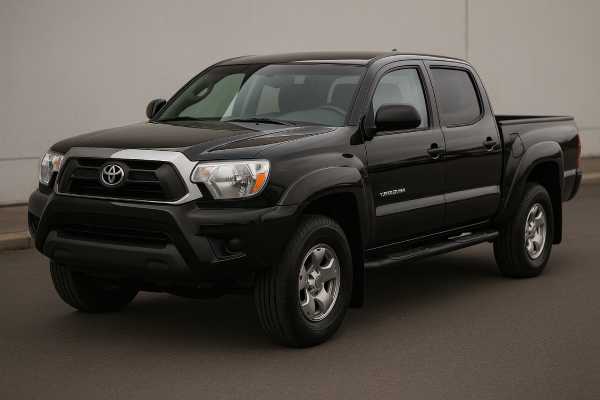
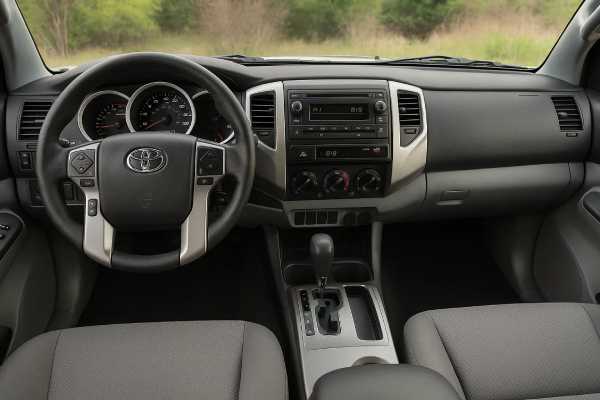
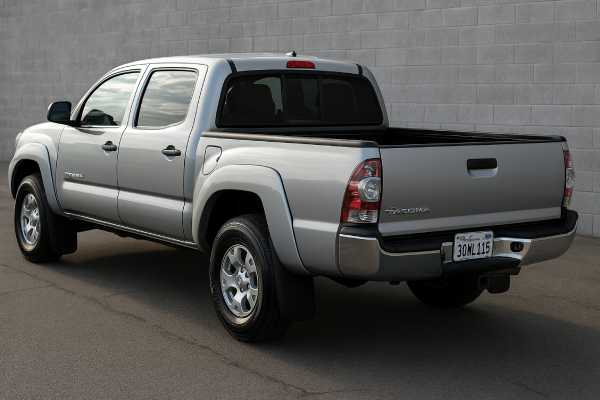
The 2012–2015 Toyota Tacoma RWD with the 1GR-FE 4.0 litre V6 sits in a sweet spot for many owners: old enough to be affordable, but new enough to have solid crash protection, stability control, and a modern-feeling drivetrain. This generation (N220) is the late-facelift second-generation Tacoma, built on a proven body-on-frame chassis and powered by a chain-driven DOHC V6 rated at 236 hp and 266 lb-ft.
If you want a mid-size pickup that can tow, haul, and commute without the size of a full-size truck, this specific RWD V6 configuration is a serious contender. It was sold mainly as a PreRunner-style 4×2 with raised ride height and available rear differential lock, plus a few street-oriented variants. Compared with newer Tacomas, you give up advanced driver-assist tech, but you gain simpler mechanicals and a very strong aftermarket. The trade-offs are straightforward: higher fuel use than a four-cylinder, potential frame rust in road-salt regions, and the need to stay on top of fluids and underbody protection if you want it to last 15+ years.
Fast Facts
- Strong 1GR-FE 4.0 V6 (236 hp, 266 lb-ft) with timing chain and proven hardware; well suited to towing and long highway trips.
- Practical size: mid-size footprint, composite bed, and RWD layout make it easy to park yet capable of real work.
- Watch for frame corrosion on trucks from heavy road-salt areas; Toyota has issued frame-corrosion campaigns for this generation.
- Typical oil change interval: 8,000–10,000 km or 6 months with quality 5W-30 and OEM-grade filter; shorten to ~5,000 km for heavy towing or lots of short trips.
- With the 4.0 V6 and 5-speed automatic, expect about 12–13 L/100 km (18–20 mpg US) in mixed real-world driving if kept stock.
Navigate this guide
- Toyota Tacoma RWD 4.0 Overview
- Tacoma 4.0 V6 Specifications
- Tacoma RWD Trims and Safety
- Reliability and Common Issues
- Maintenance and Buying Guide
- Driving Experience and Efficiency
- Tacoma Versus Mid-Size Rivals
Toyota Tacoma RWD 4.0 Overview
The 2012–2015 Tacoma RWD (N220) with the 1GR-FE 4.0 litre V6 is the tail end of the second-generation truck, just before Toyota launched the N300 in 2016. The N220-coded second generation ran from model years 2005–2015, with these facelift years bringing updated front styling, revised interior trim, and expanded standard safety equipment such as stability control and side airbags.
In this period, the 4.0 V6 RWD models were sold mainly as “PreRunner” style trucks: rear-wheel drive but riding at roughly the same height as the 4×4 versions, usually with six-lug wheels, larger tyres, and available electronic locking rear differential. You could buy them as Access Cab or Double Cab, with short (5-ft) or long (6-ft) composite beds. The composite bed is a key ownership advantage: it resists dents and rust, and many trucks came with integrated bed rails and tie-downs.
Under the hood, the 1GR-FE is a 4.0 L DOHC V6 with variable valve timing and a timing chain, rated at 236 hp and 266 lb-ft in Tacoma applications. Most RWD V6 trucks use a 5-speed automatic; a 6-speed manual exists in some markets and trims but is relatively rare, especially in later years.
This configuration targets owners who:
- Need more towing and payload than a compact crossover, but don’t want full-size truck size or fuel use.
- Prefer RWD simplicity over the weight and complexity of 4×4, especially in warm or dry climates.
- Value longevity and resale: second-gen Tacomas are known for strong resale values when well maintained.
On the road, these trucks feel old-school in ways many owners like. The hydraulic steering, body-on-frame construction, and relatively simple electronics give them a more mechanical character than newer mid-size pickups. The trade-offs are a firm ride when unladen, noticeable wind and tyre noise by modern standards, and limited driver-assistance tech. For many buyers, the equation still works: a trustworthy, easy-to-live-with work and adventure truck that can double as a daily driver.
Tacoma 4.0 V6 Specifications
This section focuses on the 2012–2015 Tacoma RWD (2WD/PreRunner) with the 4.0 L 1GR-FE V6, using typical Double Cab PreRunner V6 automatic specs as a reference. Exact numbers vary slightly by cab, bed length, trim, and market.
Engine and Performance
| Item | Specification* |
|---|---|
| Engine code | 1GR-FE V6, aluminium block and heads |
| Layout | 60° V6, DOHC, 4 valves per cylinder, dual VVT-i |
| Displacement | 4.0 L (3,956 cc) |
| Bore × stroke | 94 mm × 95 mm (3.70 in × 3.74 in) |
| Compression ratio | 10.0:1 (single VVT-i version used in Tacoma) |
| Induction | Naturally aspirated |
| Fuel system | Sequential multi-point port fuel injection |
| Max power | 236 hp (176 kW) @ 5,200 rpm |
| Max torque | 266 lb-ft (360 Nm) @ 4,000 rpm |
| Recommended fuel | Regular unleaded (87 AKI) |
| Timing drive | Chain (no scheduled replacement) |
| Emissions standard (US) | ULEV-II / Tier 2 Bin 5 (typical for this era) |
| EPA fuel economy (V6 2WD auto) | 19 mpg combined / 17 city / 21 highway (≈ 12.4 / 13.8 / 11.2 L/100 km) |
| Real-world mixed (typical) | ~18–20 mpg US (11.8–13 L/100 km) when stock |
*Figures are typical U.S. Tacoma PreRunner V6 values; always confirm to your VIN.
Transmission and Driveline
| Item | Specification |
|---|---|
| Transmission options | 5-speed automatic; 6-speed manual (limited availability) |
| Drive type | Rear-wheel drive (4×2), “PreRunner” ride height on most V6 trucks |
| Rear differential | 8-inch solid axle; open or optional electronic locking diff on some TRD models |
| Typical final drive ratios | Around 3.73:1 on many V6 4×2 PreRunner trucks; some 2WD manuals around 3.31:1 |
| Traction aids | Brake-actuated limited-slip (via stability control), optional rear diff lock, hill-start assist on many automatics |
Chassis and Dimensions (typical Double Cab PreRunner V6)
| Item | Specification |
|---|---|
| Wheelbase | 127.4 in (3,237 mm) |
| Overall length | 208.1 in (5,286 mm) (Double Cab short bed) |
| Width (max, without mirrors) | 74.6 in (1,895 mm) |
| Height | ~70.1 in (1,781 mm) |
| Ground clearance | ~9.3 in (236 mm) at the lowest point on many PreRunner V6 trucks |
| Turning circle | ~40.7 ft (12.4 m) |
| Curb weight | Roughly 3,800–4,200 lb (1,724–1,905 kg) depending on cab/bed/options |
| GVWR | Typically around 5,500–5,600 lb (≈ 2,495–2,540 kg), trim-dependent |
| Bed lengths | 60.3 in (short) or 73.5 in (long) composite inner bed |
| Fuel tank | ~21.1 US gal (80 L) |
Performance and Capability
| Item | Typical figure (V6 RWD with tow package) |
|---|---|
| 0–60 mph | ~7.5–8.0 s (independent tests, unladen) |
| Top speed | ~110 mph (177 km/h), limited by gearing and aerodynamics |
| Max towing | Up to 6,500 lb (2,948 kg) when properly equipped with V6 and tow package |
| Payload | Roughly 1,200–1,400 lb (545–635 kg) depending on configuration |
| Roof load | Typically ~100 kg (220 lb) with appropriate rack system |
Fluids, Service Capacities and Key Torque Values (approximate, typical 1GR-FE Tacoma)
| System | Spec / Capacity (approx.) |
|---|---|
| Engine oil | 5W-30 meeting API/ILSAC spec; ~5.2–5.5 L (5.5–5.8 US qt) with filter |
| Engine coolant | Toyota Super Long Life Coolant (pink); ~10–11 L total system volume |
| Automatic transmission | Toyota WS ATF; ~3.5–4.0 L for drain/refill, ~9–10 L total (dry) |
| Rear differential | 75W-85 or 75W-90 GL-5 gear oil; ~2.5–2.8 L |
| Power steering | ATF-type fluid (where hydraulic) |
| Brake fluid | DOT 3 or DOT 4 |
Key torque values (always verify for your VIN):
- Wheel lug nuts: ~113 Nm (83 lb-ft)
- Engine oil drain plug: ~39 Nm (29 lb-ft)
- Spark plugs: ~18 Nm (13 lb-ft)
Electrical
- Alternator: typically ~100–130 A depending on trim and equipment
- 12 V battery: group 24F or similar, usually around 65 Ah, often with 550–600 CCA
- Spark plugs: long-life iridium, gapped around 1.0–1.1 mm (0.039–0.043 in)
Safety and Driver Assistance
Crash-test data is mostly for Double Cab models but is broadly representative of this generation:
- Insurance and government tests generally show solid occupant protection for the era, especially in side and frontal impacts.
- Overall ratings typically sit around 4 out of 5 stars in government testing, with rollover risk a little higher due to the tall, narrow truck layout.
Driver-assistance suite is basic for this era:
- Standard: ABS, electronic brake-force distribution, brake assist, stability and traction control, tyre pressure monitoring.
- Typically available: rearview camera (more common later in the run).
- Not available: automatic emergency braking, adaptive cruise control, lane-keeping assist, blind-spot monitoring.
Tacoma RWD Trims and Safety
In the facelift 2012–2015 years, the RWD 4.0 V6 trucks were offered mainly in PreRunner-style trims in North America, plus some region-specific grades.
Trims and Equipment (RWD V6 focus)
Exact trim names vary slightly by market and year, but for U.S. and Canada you’ll generally see:
- Base / SR / SR5
- Cloth interior, manual seats, basic radio or touchscreen (later years).
- 16-inch steel wheels on lower grades; alloys on SR5.
- Available V6 and PreRunner configuration, sometimes with an open rear differential.
- TRD Sport (often RWD PreRunner)
- Street-biased setup with firmer suspension, colour-keyed bumpers, and a hood scoop on some years.
- 17-inch alloys with all-season tyres.
- Optional electronic locking rear differential, tow package, and upgraded audio.
- TRD Off-Road (some RWD, many 4×4)
- Off-road tuned shocks, skid plates, and traction-control logic tailored for loose surfaces.
- More likely to include an electronic rear locker from the factory.
- Limited / Premium packages
- Leather or leather-trimmed seats, upgraded head unit, possible navigation and premium audio.
- Chrome accents, unique wheels, and extra convenience features.
By 2015, Toyota also added a TRD Pro variant, but that is mainly a 4×4 off-road package; the core RWD V6 concept remains similar across standard TRD trims.
Quick identifiers:
- PreRunner styling: raised ride height, six-lug wheels, often “PreRunner” badging.
- TRD models: TRD stickers, unique wheels, and often an axle code on the door jamb label indicating an electronic locker.
Safety Ratings by Body Style
Crash ratings depend on cab style and test organisation:
- Double Cab (crew cab)
- Strong side-impact performance with side airbags and curtain airbags.
- Moderate overlap frontal tests typically show good protection, with some frame flex normal for body-on-frame designs.
- Access Cab (extended cab)
- Shares much of the structure with the Double Cab; safety performance is similar in major crashes, though rear seating is less substantial.
Government rollover ratings tend to highlight the higher rollover risk of pickups compared with sedans or crossovers, simply due to geometry, not a specific flaw of the Tacoma.
Safety and ADAS Feature Evolution
Across 2012–2015, key safety content includes:
- Airbags: dual front, front seat-mounted side, and full-length curtain airbags standard on all Tacomas by this period.
- Child-seat provisions: LATCH anchors on rear outboard seats in Double Cab; top tether points in Access Cab jump seats.
- Braking and stability systems: 4-wheel ABS, EBD, brake assist, stability control (VSC), traction control, and electronic limited-slip via brake intervention.
- Hill-start assist: added on many automatic models to reduce roll-back when launching uphill.
What you do not get compared with newer trucks:
- No forward collision warning or automatic emergency braking.
- No adaptive cruise control.
- No lane-keeping assist or blind-spot monitoring.
This simplifies ownership (no radar calibrations after minor bumps, fewer sensor-related warnings), but if you prioritise advanced driver aids, you may find the Tacoma behind the curve.
For repairs: any work on airbags, steering angle sensors, or stability-control components may require scan-tool calibration. After collision repairs, a proper four-wheel alignment and verification of ABS/ESC fault codes should be part of the hand-over checklist.
Reliability and Common Issues
Overall, the 2012–2015 Tacoma RWD V6 has a strong durability reputation, especially for the drivetrain, but some age-related issues and known campaigns are worth noting.
To make this practical, think in terms of likelihood (common / occasional / rare) and impact (low / medium / high cost).
Engine and Cooling (1GR-FE)
Generally robust, but not flawless.
Common to occasional issues:
- Head gasket concerns (mostly older, overheated engines)
- Symptoms: misfire on one cylinder, coolant loss, sweet exhaust smell, white smoke at cold start.
- Root cause: the 1GR-FE uses thin cast-in cylinder liners; severe overheating can distort the block and head gasket sealing surface.
- Impact: medium to high – proper repair means head gasket replacement, machining checks, and sometimes a replacement short block.
- Water pump seepage
- Typical mileage band: ~100,000–160,000 km (60,000–100,000 mi).
- Symptoms: pinkish crust around pump weep hole, slight coolant smell, slow coolant loss.
- Fix: replace pump, gasket, and often the serpentine belt at the same time; medium cost.
- Timing chain tensioner noise (high mileage)
- Symptoms: rattle on cold start that disappears quickly.
- Usually appears beyond ~240,000 km (150,000 mi).
- Remedy: replace tensioner and related guides if noise persists; many engines never need this if oil is changed on time.
Overall, a well-maintained 1GR-FE that avoids overheating is capable of very high mileage; many owners report 300,000 km or more with only routine service.
Driveline and Chassis
Common/expected wear:
- Rear leaf springs
- Issues: sagging under load, squeaks, or cracked leaves on high-mileage or heavily loaded trucks.
- Some model years had leaf spring campaigns or recalls for cracking that could contact the fuel tank; the remedy is spring replacement.
- Driveshaft and U-joint vibration
- Symptoms: rumble or vibration on light throttle between 50–80 km/h.
- Causes: worn U-joints, imbalance, or pinion angle changes after lifts.
- Fix: replace U-joints, re-balance shaft, or correct suspension geometry.
- Front suspension bushings and ball joints
- Mileage band: usually beyond 160,000 km.
- Symptoms: clunks over bumps, vague steering, inner tyre wear.
- Remedy: replacement of lower control arm bushings/ball joints and an alignment.
Frame Corrosion Campaigns
The major “big ticket” issue for this generation is frame rust in road-salt regions:
- Toyota has run frame corrosion inspection and treatment campaigns for various Tacoma years, including this generation, in certain cold-climate markets.
- Remedies range from inspection and application of a corrosion-resistant compound to full frame replacement if rust perforation meets defined criteria.
This is not always a conventional recall but can save an affected owner a very large repair bill. For a used truck:
- Always inspect the frame rails, crossmembers, and rear leaf-spring mounts with a hammer and pick.
- Ask for proof of any frame inspection, corrosion-resistant compound application, or frame replacement under Toyota’s programs.
- Run the VIN on Toyota’s and NHTSA’s official recall and service campaign lookup tools to see open campaigns and completion status.
Electronics and Miscellaneous
Overall electronics are simple and reliable, but you may see:
- Blower motor resistor failures (fan only works on certain speeds).
- Age-related issues with door lock actuators.
- Occasional ABS or stability-control warnings from dirty wheel-speed sensors, especially if used off-road.
These are usually low-to-medium cost fixes compared with the value of the truck.
Maintenance and Buying Guide
A sensible maintenance plan is the best way to keep a Tacoma RWD 4.0 running well beyond 250,000 km. The intervals below blend typical manufacturer guidance with real-world experience; always adjust for severe use and confirm against the official manual for your build.
Core Maintenance Schedule (typical guidance)
Approximate intervals (whichever comes first):
- Engine oil and filter
- Every 8,000–10,000 km or 6 months in mixed use.
- Shorten to ~5,000 km if you tow frequently, idle a lot, or do mostly short trips.
- Engine air filter
- Inspect every 20,000 km; replace about every 30,000–40,000 km, sooner in dusty conditions.
- Cabin air filter
- Every 20,000–25,000 km or annually; more often if you drive on dirt roads.
- Coolant (Toyota Super Long Life)
- First change around 160,000 km or 10 years, then every 80,000 km or 5 years thereafter in many markets.
- Spark plugs (iridium)
- Around 160,000 km (100,000 mi) under normal use. Inspect earlier if misfire or hard starting appears.
- Automatic transmission fluid (Toyota WS)
- Although often labelled “lifetime,” a practical interval is every 60,000–80,000 km (heavy use) or 100,000–120,000 km (lighter use), with drain-and-fill or exchange using the correct fluid.
- Manual transmission and differential oils
- Around every 60,000–80,000 km, more often if you tow or off-road regularly.
- Brake fluid
- Every 2–3 years regardless of mileage.
- Brake pads and rotors
- Inspect at each tyre rotation (10,000–12,000 km). Replace when thickness or wear limits are reached; rear drums need adjustment and shoe inspection.
- Serpentine/aux belt
- Inspect every service; typically replace by ~100,000–120,000 km or at first signs of cracking or noise.
- Steering and suspension
- Check bushings, ball joints, tie-rod ends, and shocks annually or every 20,000 km.
- Tyre rotation and alignment
- Rotate every 10,000–12,000 km; check alignment annually or after any major pothole or off-road hit.
- 12 V battery
- Load-test yearly after 4–5 years; many OEM batteries last around 5–7 years depending on climate.
Timing is via chain on the 1GR-FE, so there is no scheduled timing belt replacement, but you should act on any chain or tensioner noise promptly to avoid secondary damage.
Practical Fluid Choices
- Engine oil: quality synthetic 5W-30 (or 0W-30/0W-40 in colder climates), meeting current API/ILSAC standards.
- Coolant: Toyota SLLC (pink) or an equivalent phosphate-based, silicate-free long-life coolant compatible with Toyota systems.
- Transmission/diff: Toyota WS for the automatic; 75W-85 or 75W-90 GL-5 for differentials as specified by the manual.
Always confirm capacities and specs by VIN, model year, and transmission type, as not all RWD V6 Tacomas are identical.
Buyer’s Checklist
When evaluating a used 2012–2015 Tacoma RWD 4.0:
- Frame and underbody
- Inspect frame rails inside and out, crossmembers, rear leaf-spring mounts, and steering rack mounts.
- Walk away from extensive flaking, perforation, or previous repairs of questionable quality, especially if there is no record of frame inspection or treatment.
- Service history
- Look for regular oil changes, documented coolant and ATF services, and receipts for water pump, belt, spark plugs, and diff fluid around the appropriate mileage.
- Drivetrain check
- From a cold start, listen for excessive rattles (chain tensioner), ticking, or knocks.
- On a test drive, feel for transmission flare or harsh shifts, and for driveline vibrations under light throttle.
- Suspension and tyres
- Uneven tyre wear may point to worn front-end components or poor alignment.
- Inspect shocks and leaf springs, especially on trucks that have towed or hauled heavily.
- Electronics and interior
- Test ABS and stability-control operation (warning lights should come on briefly at start-up and then go out).
- Check all window and lock switches, rear camera where fitted, and infotainment functions.
Recommended Years and Trims
- Safer bets
- Late-run trucks (2013–2015) with documented maintenance and minimal rust.
- PreRunner or TRD PreRunner V6 with tow package if you need towing, thanks to well-matched gearing and cooling.
- Caution zones
- Trucks from heavy road-salt regions without proof of frame inspection or treatment.
- Heavily lifted or modified trucks with poor driveline angles or cut frames.
If you buy carefully and stick to a sensible maintenance plan, this generation Tacoma can be a long-term ownership play rather than a short-term flip.
Driving Experience and Efficiency
The RWD 4.0 Tacoma feels distinctly “truckish” in a way many buyers enjoy, but it is worth knowing what to expect if you are coming from a car or crossover.
Ride, Handling and NVH
- Ride quality
- Unladen, the rear leaf-spring suspension can feel firm and occasionally choppy over broken pavement.
- Add a bit of load in the bed and the ride settles noticeably.
- Steering and handling
- Hydraulic power steering gives a natural, linear feel.
- Body roll is present but well controlled for a mid-size pickup, especially on TRD Sport models with firmer suspension.
- High-speed stability is good; the truck tracks straight on the highway, though crosswinds and ruts remind you it is tall and relatively narrow compared with a car.
- Noise levels
- Expect more wind and tyre noise than in a modern crossover, plus some engine growl under load.
- The composite bed can drum slightly when empty over sharp bumps.
Powertrain Character
The 1GR-FE V6 is the star of the show:
- Strong low-to-midrange torque; it pulls comfortably from below 2,000 rpm and feels relaxed at highway speeds.
- The 5-speed automatic favours early upshifts for economy but kicks down readily when you ask for more throttle.
- With the tow package and proper gearing, it handles moderate trailers (up to roughly 2,500–3,000 kg) with confidence, provided you keep speeds reasonable and use the correct gear on grades.
Manual-transmission trucks are relatively rare, but when you find one, you get closer control and a more engaging drive at the cost of some convenience in traffic.
Real-World Efficiency
Official fuel economy figures for a V6 2WD automatic Tacoma from this era sit around 17 mpg city / 21 mpg highway / 19 mpg combined (about 13.8 / 11.2 / 12.4 L/100 km).
In practice:
- City driving: 14–16 L/100 km (15–17 mpg US) is common if you do a lot of short trips or stop-and-go traffic.
- Highway at 100–120 km/h (60–75 mph): 11–12.5 L/100 km (19–22 mpg US) when unloaded and stock.
- Towing a mid-size trailer (~1,800–2,200 kg): expect roughly a 30–40% fuel-consumption penalty at highway speeds.
Tyre choice, lift kits, and roof racks all affect consumption; aggressive all-terrain tyres and taller lifts can easily add 1–2 L/100 km to your usual figures.
Traction and Control (RWD)
Even though this article focuses on RWD, the Tacoma still provides useful traction tools:
- Brake-based traction control can mimic a limited-slip differential when one rear tyre spins.
- On trucks with the optional electronic locking rear differential, you can mechanically lock both rear wheels together at low speeds off-road or on slippery surfaces.
- Stability control intervenes gently but effectively if you push too hard on a wet road or enter a corner too quickly.
In snow and mud, RWD obviously requires more care than a 4×4. Good winter tyres transform the truck; many owners keep a dedicated winter wheel and tyre set for cold climates.
Tacoma Versus Mid-Size Rivals
When new, the 2012–2015 Tacoma RWD 4.0 competed directly with the Nissan Frontier, Chevrolet Colorado/GMC Canyon (earlier generation), and, in some markets, the Honda Ridgeline. On the used market, buyers often cross-shop it with newer V6 mid-size trucks too.
Strengths versus Rivals
- Proven platform and parts availability
- The second-gen Tacoma was produced for many years, so parts, aftermarket support, and community knowledge are excellent.
- Resale value
- Used Tacomas commonly sell for more than comparable Frontiers or older Colorado/Canyons with similar mileage, a sign of continued demand.
- Drivetrain robustness
- The 1GR-FE, when not abused or overheated, has a strong reputation in Tacomas and related models, with many examples exceeding 300,000 km.
- Aftermarket ecosystem
- Suspension kits, armour, racks, bed accessories, and gearing upgrades are widely available and well-documented.
Trade-Offs and Weak Spots
- Fuel economy
- Compared with newer V6s or turbo-fours in more recent mid-size trucks, the 4.0 V6 uses more fuel, especially in city conditions.
- The older 5-speed automatic also has fewer ratios than the 6–8-speed transmissions in newer rivals, which reduces efficiency and flexibility.
- Safety and tech
- The Tacoma’s crash performance is solid for its era, but it lacks modern active safety features like automatic emergency braking, lane-keeping assist, and advanced blind-spot systems that newer trucks offer.
- Frame corrosion risk in cold climates
- While Toyota has supported owners with frame inspection and corrosion programs, the fact that such campaigns exist is a reminder to inspect carefully.
- Ride and refinement
- Rivals such as the first-generation Honda Ridgeline or newer unibody trucks feel more car-like and refined on pavement, with quieter cabins and smoother rides when unladen.
Who the Tacoma RWD 4.0 Suits Best
- Owners who want a simple, durable work and adventure truck and care more about longevity than about the latest tech.
- Drivers in mild or dry climates, where frame corrosion is less of a concern and RWD traction is sufficient.
- Enthusiasts planning light to moderate off-road use who prefer RWD/PreRunner setups and enjoy modifying suspensions and tyres.
If you are willing to trade a bit of fuel economy and modern driver-assist tech for mechanical robustness, deep parts support, and strong resale value, the 2012–2015 Tacoma RWD 4.0 remains one of the most compelling mid-size pickups on the used market.
References
<a href="https://www.fueleconomy.gov/feg/bymodel/2015_Toyota_Tacoma.shtml">Gas Mileage of 2015 Toyota Tacoma</a> 2015 (Fuel Economy Data)<a href="https://www.iihs.org/ratings/vehicle/toyota/tacoma-crew-cab-pickup/2015">2015 Toyota Tacoma Crew cab pickup</a> 2015 (Safety Rating)<a href="https://www.nhtsa.gov/vehicle/2015/TOYOTA/TACOMA">2015 TOYOTA TACOMA Vehicle Details</a> 2015 (Recall Database)<a href="https://pressroom.toyota.com/2015-toyota-tacoma-product-news-release/">2015 Toyota Tacoma Shows What It Takes to Remain a Top Pick-Up Truck</a> 2014 (Manufacturer Product Release)<a href="https://www.manuals.ca/toyota/tacoma-2015/manual">Toyota Tacoma (2015) user manual (English - 590 pages)</a> 2015 (Owner’s Manual)
Disclaimer
This article is for informational purposes only and is not a substitute for professional diagnosis, repair, or official service information. Specifications, torque values, capacities, and maintenance intervals can vary by VIN, model year, market, engine calibration, and installed equipment. Always confirm critical data and procedures against the official owner’s manual, workshop manual, and bulletins that apply to your specific vehicle.
If you found this guide useful, you are welcome to share it with other enthusiasts or owners on social platforms such as Facebook or X/Twitter to support xcar’s work and help more people make informed decisions.