
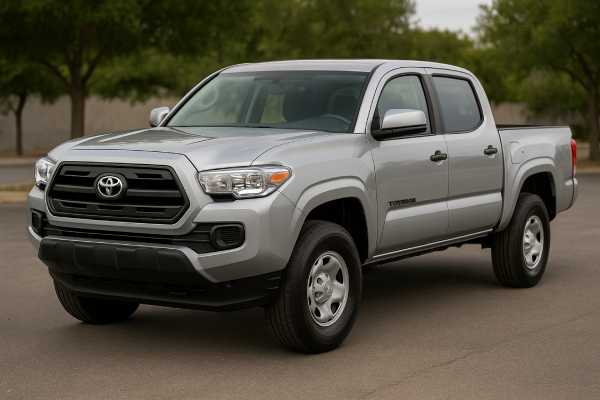
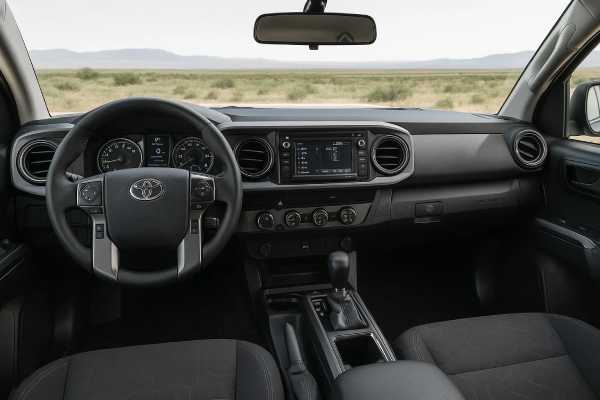
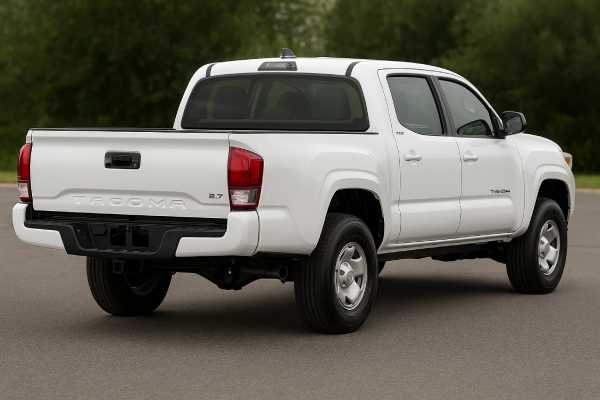
The 2016–2019 Toyota Tacoma 4×4 with the 2TR-FE 2.7 litre engine sits at the practical, long-lasting end of the third-generation Tacoma range. It combines a simple, proven four-cylinder petrol engine with a part-time four-wheel drive system, low-range transfer case, and the stronger N300 chassis. The result is a truck that is not especially quick but is tough, predictable, and relatively easy to maintain over high mileage.
Compared with the V6 4×4 models, the 2.7 4×4 Tacoma costs less to buy, is mechanically simpler, and uses a little less fuel in day-to-day driving. It still offers proper 4×4 hardware for snow, muddy tracks, and rough back roads, especially when equipped with suitable tyres. From 2018 onwards, standard Toyota Safety Sense P added modern driver-assistance features on top of the existing passive safety structure.
This guide covers the key specifications, real-world performance, reliability patterns, and maintenance considerations so you can judge whether a 2.7 4×4 Tacoma matches your use case and budget.
Fast Facts
- Robust 2TR-FE 2.7 litre four-cylinder with timing chain, port injection, and a reputation for high-mileage durability.
- Part-time 4×4 system with low range gives real winter and off-road capability when paired with good tyres.
- Tow rating and acceleration trail the V6 models; best suited to light and moderate trailers.
- Watch for vacuum pump knocking TSB completion and inspect frame and suspension components for rust in salt-belt trucks.
- Plan engine oil and filter changes every 5,000 miles (8,000 km) or 6 months with quality 0W-20 synthetic oil.
Contents and shortcuts
- Toyota Tacoma 2.7 4×4 Context
- Tacoma 2.7 4×4 Key Specs
- 4×4 Tacoma Trims and Protection
- Reliability Patterns for 2.7 4×4
- Ownership Maintenance and Buying Guide
- Driving Impressions and 4×4 Performance
- How Tacoma 2.7 4×4 Competes
Toyota Tacoma 2.7 4×4 Context
Within the third-generation Tacoma (N300, introduced for 2016), the 2.7 4×4 occupies a specific niche. Most marketing attention goes to the 3.5 litre V6 and the TRD off-road variants, but the 2.7 4×4 is aimed at buyers who want genuine four-wheel drive hardware without the higher cost and complexity of the V6.
The engine is the familiar 2TR-FE: an inline-four with an iron block, aluminium head, dual overhead cams, and 16 valves. In this generation it typically delivers 159 hp at around 5,200 rpm and 180 lb-ft of torque near 3,800 rpm. It uses port fuel injection and a timing chain, which removes the need for scheduled belt changes and has proven capable of long service life when fed clean oil.
Compared to the older N220 Tacoma, the N300 brings a stiffer frame, improved crash performance, and a more refined interior. Noise insulation is better, the seats are more supportive, and the dashboard layout suits daily driving in traffic as much as back-road work. Four-wheel drive models get independent front suspension with coil springs, a leaf-spring solid rear axle, and six-lug hubs, giving them a familiar mid-size truck stance and footprint.
The 2.7 4×4 powertrain is honest rather than exciting. On steep grades or with a loaded bed, the engine needs revs and the six-speed automatic must downshift to maintain speed, but the package is straightforward to understand and service. For drivers who value a “keep it forever” truck for mixed commuting, winter, and off-pavement use, this combination is often more appealing than spec-sheet numbers might suggest.
Tacoma 2.7 4×4 Key Specs
This section focuses on Technical Data relevant to the 2TR-FE 2.7 litre 4×4 Tacoma in the 2016–2019 range. Exact figures can vary slightly by cab style, bed length, and region, so treat them as representative.
Engine and Performance (2TR-FE 2.7)
| Item | Value (typical N300 2.7 4×4) |
|---|---|
| Engine code | 2TR-FE |
| Configuration | Inline-4, DOHC, 16 valves |
| Valvetrain | Variable valve timing on intake and exhaust in most markets |
| Displacement | 2.7 L (approx. 2,693 cc) |
| Bore × stroke | 95.0 × 95.0 mm (3.74 × 3.74 in) |
| Compression ratio | Around 9.6–10.2:1 |
| Max power | 159 hp (118 kW) @ ~5,200 rpm |
| Max torque | 180 lb-ft (244–245 Nm) @ ~3,800 rpm |
| Induction | Naturally aspirated |
| Fuel system | Sequential multi-point fuel injection |
| Timing drive | Chain |
Typical fuel economy for a Double Cab 2.7 4×4 automatic is around 19 mpg city, 22–23 mpg highway, and about 20 mpg combined, depending on tyre choice, accessories, and driving style.
Transmission and 4×4 Driveline
| Item | Specification |
|---|---|
| Transmission | 6-speed automatic, electronically controlled |
| 1st / 2nd / 3rd | Approx. 3.60 / 2.09 / 1.49 |
| 4th / 5th / 6th | 1.00 / 0.69 / 0.58 |
| Reverse | Approx. 3.73 |
| Drive type | Part-time four-wheel drive |
| Transfer case | Two-speed, electric shift |
| Low-range ratio | Around 2.57:1 |
| Front differential | Open, assisted by brake-based traction control |
| Rear differential | Open on most 2.7 4x4s; mechanical locker usually reserved for specific V6 TRD grades |
The system is intended for 2H use on dry pavement, with 4H engaged for slippery surfaces and 4L for low-speed control off-road, in deep snow, or when manoeuvring a trailer on steep grades.
Chassis and Dimensions (typical Double Cab 2.7 4×4)
| Item | Value (approximate) |
|---|---|
| Overall length | ~5,390 mm (212.3 in) |
| Width (without mirrors) | ~1,890 mm (74–75 in) |
| Height | ~1,790 mm (70.5 in) |
| Wheelbase | ~3,234 mm (127.3 in) |
| Ground clearance | About 239 mm (9.4 in) |
| Approach / departure angles | Typically mid-30° / mid-20° on off-road-focused trims |
| Turning circle | Around 12.2 m (40 ft) |
| Curb weight | Roughly 1,950–2,000 kg (4,300–4,410 lb) |
| GVWR | Around 2,630–2,720 kg (5,800–6,000 lb) |
| Fuel tank capacity | Approximately 79–80 L (21.1 US gal) |
Performance and Capability
| Metric | Value (typical) |
|---|---|
| 0–100 km/h (0–62 mph) | Around 11–12 s (unladen) |
| Top speed | In the 175–185 km/h (108–115 mph) band |
| Max tow rating | Up to about 1,587 kg (3,500 lb) properly equipped |
| Payload | Often 550–700 kg (1,200–1,550 lb), trim-dependent |
| Roof load | Typically 75–100 kg (165–220 lb) with suitable rack system |
This makes the 2.7 4×4 ideal for light to medium trailers such as small campers, utility trailers, or boats, rather than heavy enclosed or long travel trailers.
Fluids and Service Capacities (guideline values)
Always confirm for your VIN and market:
| System | Spec / Grade | Approx. Capacity |
|---|---|---|
| Engine oil | 0W-20 API SN+ or newer full synthetic | ~5.5–6.0 L (5.8–6.3 US qt) |
| Engine coolant | Toyota Super Long Life (pink) 50:50 | ~8–9 L (8.5–9.5 US qt) |
| Automatic transmission | Toyota ATF WS | ~8–10 L (total fill) |
| Transfer case | GL-4/GL-5 75W-90 | ~1.0 L |
| Front differential | GL-5 75W-85/75W-90 | ~1.3–1.6 L |
| Rear differential | GL-5 75W-85/75W-90 | ~2.0–2.5 L |
| A/C refrigerant | R-134a or R-1234yf (depending on year) | Typically 500–600 g |
Example torque values:
- Wheel nuts: about 113 Nm (83 lb-ft).
- Engine oil drain plug: around 39–40 Nm (29–30 lb-ft).
Electrical
- Alternator output is generally around 130 A, enough for moderate winch and lighting loads if planned carefully.
- 12 V starting battery capacity typically falls in the 48–65 Ah range.
- Iridium spark plugs support extended service intervals, usually in the 60,000–120,000 mile window depending on official guidance.
Safety and Driver Assistance Snapshot
- Multi-airbag system with front, side, and curtain coverage.
- Stability control, traction control, ABS, brake assist, and electronic brake-force distribution are standard.
- Rear-view camera provided across the range.
- From model year 2018, all Tacomas gain Toyota Safety Sense P (TSS-P) with pre-collision braking, lane departure alert, automatic high beams, and dynamic radar cruise control.
- Independent crash testing typically shows strong side-impact and roof strength results, with some variation in small-overlap and headlight ratings by year and trim.
4×4 Tacoma Trims and Protection
Availability of the 2.7 4×4 combination depends on market, but the general trim structure in North America looks like this.
Trims and Options (2.7 4×4 Focus)
- SR 4×4
- The workhorse spec in many fleets.
- Steel wheels, durable cloth upholstery, and often vinyl or easy-clean flooring.
- Basic infotainment system but full core safety suite once TSS-P arrives.
- Excellent base for upfitting with racks, toolboxes, and work equipment.
- SR5 4×4
- Adds alloy wheels, more sound insulation, upgraded infotainment, and extra convenience features.
- Better suited to mixed private and work use, with a more car-like cabin feel.
- TRD-based 2.7 4×4 (market-specific)
- In many regions, TRD Off-Road and TRD Pro are restricted to the V6; in others, TRD styling or suspension packages can be paired with the 2.7.
- Where offered, these bring better shocks, specific tyres, and off-road cosmetics without changing the core engine output.
Mechanical differences between SR and SR5 2.7 4×4 models are relatively minor: wheel and tyre sizes, minor suspension tuning, and options like tow hitches and bed features. In both cases you get the same core frame, engine, and 4×4 system.
Quick ways to identify a 2.7 4×4 Tacoma:
- Six-lug hubs and front differential confirm 4×4 hardware.
- Engine bay label shows 2.7L 2TR-FE specifications.
- Interior usually has a 4×4 selector knob or switch panel for 2H/4H/4L rather than a simple 2WD layout.
Safety Ratings and Trim Nuances
Crash performance is mainly driven by body structure rather than engine choice, so 2.7 4×4 models largely share ratings with V6 equivalents of the same body style and model year. Where trims diverge is in:
- Headlights: base halogen reflector units on SR and some SR5 trucks often score lower in formal testing than projector or LED units on higher trims.
- Active safety: from 2018 onwards, even an SR 2.7 4×4 benefits from TSS-P, but early 2016–2017 trucks may not have all of these functions, depending on regional packaging.
Safety Systems and ADAS Considerations
Key safety and driver-assistance features include:
- Dual front airbags, front-seat side airbags, and curtain airbags for both rows in Double Cab models.
- LATCH-type lower anchors and top tethers on rear seats for child restraints.
- Electronic stability and traction control, plus ABS with brake assist.
- Hill-start assist control on many automatic models, useful on steep or slippery slopes.
- Toyota Safety Sense P (on later model years) adding automatic emergency braking, lane-departure alert, radar cruise, and auto high beams.
After windshield replacement, front bumper repair, or suspension height changes, the radar sensor and camera may need calibration. Buyers should ask for documentation of calibration work where the truck has had collision repairs or glass replacement.
Reliability Patterns for 2.7 4×4
The 2TR-FE engine and associated drivetrain are generally known for reliability. Many trucks reach high mileage with few major issues when basic maintenance is respected. Still, several patterns appear across owner reports and workshop experience.
Engine and Ancillary Components
- Vacuum pump knocking noise
- Symptoms: Distinct tapping or knocking from the front of the engine at idle, sometimes more noticeable when the engine is warm.
- Cause: Internal wear or design-related noise in the engine-driven vacuum pump used for the brake booster.
- Remedy: Toyota has released a technical service bulletin covering affected years. The usual fix is replacing the vacuum pump with a revised part. When buying used, ask whether the truck had this repair and, if not, budget for diagnosis.
- Oil-change neglect
- Symptoms: Dirty oil on the dipstick, noisy timing chain, variable valve timing faults, or general rough running.
- Cause: Extended oil-change intervals or low-quality oil in a chain-driven DOHC engine.
- Remedy: Return to 0W-20 synthetic oil changes every 5,000 miles / 8,000 km or 6 months. In more severe cases, internal inspection and cleaning may be needed.
- Minor leaks and seepage
- Valve cover gaskets, timing cover edges, and front crank seals can develop weeping with age.
- In early stages, these are more of a housekeeping issue but should be addressed before they contaminate rubber components or belts.
- Ignition and fuel system age-related issues
- Misfires under load can point to ageing coils, fouled plugs, or contaminated injectors.
- Fresh plugs, targeted coil replacement, and fuel-system cleaning usually restore normal operation.
4×4 System and Driveline
- Transfer case actuator and front axle engagement problems
- Symptoms: Flashing 4WD indicator, reluctance to engage or disengage 4H or 4L, or being “stuck” in a mode.
- Causes: Corrosion, moisture ingress, or infrequent use of the shift actuators and automatic disconnecting differential.
- Remedy: Regularly exercising 4H and 4L on loose surfaces keeps components moving. Persistent faults need electrical and mechanical diagnosis; repairs range from connector cleaning to actuator replacement.
- Driveline clunk or bump
- Symptoms: A noticeable “clunk” when stopping or taking off, often felt from the rear of the truck.
- Cause: Normal movement of the slip yoke and driveshaft when lubrication is old or missing.
- Remedy: Removing the driveshaft, cleaning the splines, and applying the correct grease usually reduce the effect. In more stubborn cases, revised parts may be used.
- Suspension and wheel-bearings wear
- Heavy off-road use, big tyres, and frequent towing can accelerate wear in front wheel bearings, lower ball joints, and bushings.
- Regular inspections and timely replacements keep the truck safe and stable.
Frame, Corrosion, and Body
Although the N300 generation improved on earlier frames, corrosion remains a concern in regions that use road salt:
- Frame rails and crossmembers can develop surface rust that, if ignored, progresses to scaling and potential perforation over many winters.
- Leaf-spring mounts and shackles should be inspected carefully for rust, cracks, and deformation, particularly on high-mileage work trucks.
- Regular underbody washing, especially in winter, and periodic rust treatment help preserve the frame.
Electrical and Electronic Issues
- Infotainment quirks: Some owners report Bluetooth issues, random reboots, or camera glitches. Many are resolved with software updates or, in some cases, head-unit replacement.
- Warning lights and sensor faults: Wheel-speed sensors, oxygen sensors, and EVAP components can fail with age, causing warning lamps and stored codes. A proper scan tool and systematic diagnosis are important before replacing parts.
- ADAS sensitivity: On TSS-P equipped trucks, misaligned sensors or obstructed camera views can disable features. After repairs or windshield replacement, ensure calibration procedures were followed.
Recalls, TSBs, and Extended Coverage
For any 2016–2019 Tacoma 2.7 4×4 you are considering:
- Run the VIN through your region’s official recall checker.
- Ask a dealer for a printout of completed campaigns, especially for brake-system, airbag, and vacuum-pump-related bulletins.
- Keep proof of TSB and recall completion; it helps future resale and confirms that important updates have been performed.
Ownership Maintenance and Buying Guide
A sensible maintenance plan protects the Tacoma’s strengths and reduces the chance of expensive surprises.
Practical Maintenance Schedule (general guidance)
- Engine oil and filter
- 5,000 miles (8,000 km) or 6 months, whichever comes first.
- Shorter intervals if you tow, idle extensively, or drive many short trips.
- Engine air filter
- Inspect at 15,000 miles (24,000 km).
- Replace around 30,000–40,000 miles (48,000–64,000 km), more often if you drive off-road or in dusty conditions.
- Cabin air filter
- Replace every 15,000–20,000 miles (24,000–32,000 km) or once a year.
- Coolant
- First change usually around 100,000 miles (160,000 km) or 10 years, then at shorter intervals.
- Earlier replacement is wise if the coolant condition is unknown on a used truck.
- Spark plugs (iridium)
- Replace between 60,000 and 120,000 miles (96,000–192,000 km), depending on local maintenance schedules and engine condition.
- Automatic transmission fluid (WS)
- Consider a drain-and-fill every 60,000–80,000 miles (96,000–128,000 km), particularly if you tow or drive in hot, hilly environments.
- Transfer case and differentials
- Replace gear oil around every 50,000–60,000 miles (80,000–96,000 km), sooner after deep-water crossings or heavy off-road use.
- Brake fluid
- Replace every 2–3 years, regardless of mileage.
- Drive belts and hoses
- Inspect at every service after 60,000 miles (96,000 km); replace at the first sign of cracking, glazing, or swelling.
- Timing chain
- No scheduled replacement. Monitor for rattles, timing errors, and unusual metal in the oil. Address issues promptly if symptoms appear.
- Tyres and alignment
- Rotate tyres every 5,000–7,500 miles (8,000–12,000 km).
- Check alignment annually or after significant off-road use or pothole impacts.
- 12 V battery
- Test annually from year three onward; replacement is common between years five and seven depending on climate and use.
Buyer’s Inspection Checklist
When evaluating a used 2016–2019 Tacoma 2.7 4×4:
- Underbody and frame
- Inspect frame rails, crossmembers, suspension mounts, and the rear frame around leaf-spring hangers for corrosion and repairs.
- Look for fresh undercoating that may be hiding rust.
- Engine bay
- Check for oil or coolant leaks, damaged wiring, and non-factory modifications.
- Listen for vacuum pump knocking, timing chain noise, or rough idle when warm.
- 4×4 system
- On a test drive (on loose ground), verify smooth engagement of 4H and 4L, and confirm that warning lights behave normally.
- Suspension and steering
- Listen for clunks over bumps and check for uneven tyre wear that might indicate worn ball joints or poor alignment.
- Brakes and tyres
- Inspect pad and rotor thickness and condition.
- Confirm tyres are of appropriate load rating and not excessively old (check date codes).
- Interior and electronics
- Test all windows, locks, lights, and infotainment features.
- Where fitted, confirm that TSS-P features such as adaptive cruise and pre-collision alerts operate normally.
Recommended Years and Configurations
- Best balance of age and features: 2018–2019 2.7 4×4, which include TSS-P as standard and benefit from incremental refinements.
- Value choice: 2016–2017 2.7 4×4 with clean frame, good maintenance history, and completed TSBs and recalls can offer excellent value if priced appropriately.
With sensible maintenance and rust control, a 2.7 4×4 Tacoma can realistically serve as a primary or work vehicle for well over a decade.
Driving Impressions and 4×4 Performance
The 2.7 4×4 Tacoma feels like a traditional mid-size truck rather than a crossover with a bed, and its behaviour reflects this.
Ride, Handling, and NVH
- Ride quality: With an empty bed, the rear suspension can feel firm and occasionally bouncy over sharp bumps because it is tuned to carry payload. Adding some constant weight in the bed often smooths things out.
- Handling: Steering is reasonably accurate for a ladder-frame pickup, with good on-centre stability. Body roll is noticeable in corners but well controlled, and the truck feels secure in lane changes when tyres and suspension are in good condition.
- Noise: At highway speeds, wind and road noise are present but not overwhelming. The engine is quiet at light throttle but becomes more audible under heavy load, particularly on hills.
Powertrain Character
The 2TR-FE engine is tuned more for reliability and tractability than quick acceleration:
- Around town, it provides enough low-end torque for normal driving and moderate loads.
- On on-ramps and hills, the six-speed automatic downshifts and lets the engine rev near its power band; you will hear it working but it remains smooth.
- With a trailer or heavy cargo, progress is steady rather than brisk. Using the manual “S” mode to hold gears can reduce hunting and improve control.
Drivers who accept that this is not a performance truck often find the powertrain satisfying for its consistency and predictability.
Real-World Efficiency and Range
In typical use for a Double Cab 2.7 4×4 automatic:
- City: roughly 18–19 mpg US (12.4–13.1 L/100 km).
- Highway (100–120 km/h / 60–75 mph): around 20–22 mpg US (10.7–11.8 L/100 km) with stock tyres and moderate speeds.
- Mixed: about 19–21 mpg US (11–12.4 L/100 km) for many owners.
The approximate 21-gallon tank provides real-world ranges of 380–430 miles (610–690 km) between fills in mixed driving if you avoid excessive idling and high-speed cruising.
Accessories such as roof racks, light bars, larger off-road tyres, and heavy bumpers will increase fuel consumption and should be considered when planning modifications.
4×4 System, Traction, and Control
With proper tyres and sensible driving:
- 4H offers improved traction and stability on snow, loose gravel, and muddy roads.
- 4L provides precise control for steep climbs, descents, and technical sections, as well as for manoeuvring trailers in tight or steep situations.
- Brake-based traction control helps manage wheelspin when one wheel lifts or loses grip, though it is not as aggressive as a true locking differential.
For demanding off-road use, owners often upgrade to all-terrain or mud-terrain tyres, add underbody protection, and consider mild suspension lifts. Even in mostly stock form, however, the 2.7 4×4 can handle snow, fire roads, and moderate trails confidently.
Towing and Load Behaviour
When towing within its rated limit (roughly 3,500 lb) and staying well within payload:
- The chassis feels stable, especially with correct tongue weight and functioning trailer brakes.
- Braking distances increase, but the pedal remains consistent if the system is well maintained.
- Engine and transmission will work harder on grades; use lower gears and avoid extended full-throttle pulls to keep temperatures under control.
Fuel consumption under tow can climb substantially, often by 30–50%. Planning your speed and route with that in mind keeps towing more relaxed and economical.
How Tacoma 2.7 4×4 Competes
The 2016–2019 Tacoma 2.7 4×4 competes in a field that includes the Chevrolet Colorado and GMC Canyon, Nissan Frontier, and, in some markets, Ford Ranger and other mid-size pickups.
Key Advantages
- Mechanical simplicity and durability
- The iron-block 2TR-FE with a timing chain and port injection is simpler than many turbocharged or high-pressure direct-injection rivals.
- When serviced regularly, it has a strong record of long service life with relatively few major engine failures.
- Proven frame and 4×4 hardware
- A traditional ladder frame, solid rear axle, and part-time 4×4 system make the Tacoma easy to understand, modify, and repair.
- Even non-TRD 2.7 4×4 trucks can be serious off-road tools with tyre and suspension upgrades.
- Resale value and parts support
- Tacomas often retain higher resale value than many competitors.
- A deep aftermarket catalogue covers everything from basic service parts to expedition-level modifications, reducing long-term ownership risk.
- Standard active safety (on later years)
- From 2018, every Tacoma gets TSS-P, helping narrow the gap to newer rivals in active safety and driver assistance.
Trade-Offs and Limitations
- Power and tow capacity
- Rivals with larger V6 or modern turbo engines often accelerate faster and tow heavier trailers more comfortably.
- If you regularly pull heavy, high-drag trailers in hilly terrain, the 2.7 4×4 will feel strained.
- Fuel economy versus some competitors
- Some diesel or newer turbocharged mid-size trucks can match or exceed Tacoma’s fuel economy while providing more torque.
- Interior and tech feel
- While the N300 is a step up from older Tacomas, some rivals offer larger screens, more storage, or a more SUV-like cabin.
- However, the Tacoma’s straightforward layout is an advantage to owners who prefer simple, durable controls over the latest features.
Ideal Buyer Profile
The 2016–2019 Tacoma 2.7 4×4 suits:
- Drivers who prioritise durability, predictable running costs, and long-term reliability over peak performance.
- Owners in regions with real winter or unpaved roads who need 4×4 but do not haul heavy trailers.
- Small-business or fleet operators who want a straightforward, proven platform with strong resale value.
- Enthusiasts who plan to build a capable but modestly powered off-road truck based on a solid chassis and simple engine.
Buyers who need strong towing performance, rapid highway acceleration, or cutting-edge interior tech may be better served by a V6 Tacoma or one of the newer high-output mid-size pickups. For everyone else who values an honest, “keep it for years” truck, the Tacoma 2.7 4×4 is a very sensible choice.
References
- TACOMA 2016 (Quick Reference Guide)
- Toyota Manuals and Warranties | Toyota Owners 2024 (Owner’s Manual Portal)
- Gas Mileage of 2017 Toyota Tacoma 2017 (Fuel Economy Data)
- 2019 Toyota Tacoma crew cab pickup 2019 (Safety Rating)
- Knocking Noise From Vacuum Pump 2019 (TSB)
Disclaimer
This article is for informational purposes only and does not replace professional diagnosis, repair, or official service documentation. Specifications, torque values, fluid types, and maintenance intervals can vary by VIN, model year, market, trim level, and optional equipment. Always confirm critical data and procedures using your vehicle’s owner’s manual, warranty and maintenance guide, and the official service manual for your specific Tacoma.
If you found this guide useful, please consider sharing it with other owners or shoppers on platforms such as Facebook or X/Twitter. Your support helps xcar continue to produce detailed, independent technical content for enthusiasts and professionals.