
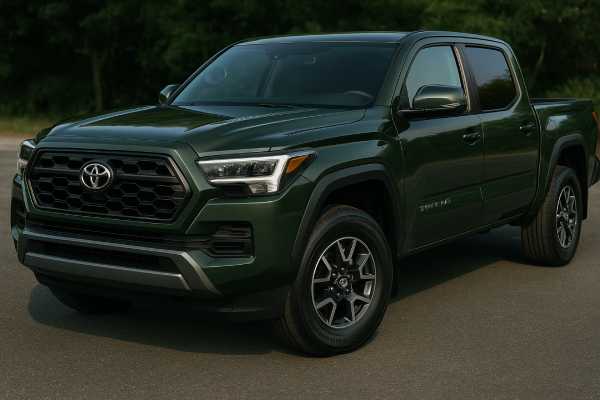
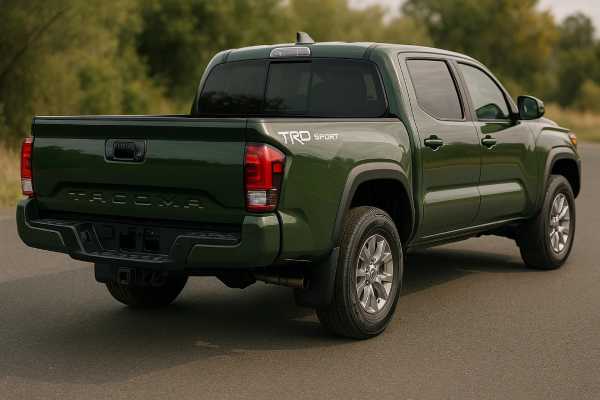
The fourth-generation Toyota Tacoma RWD (N400) with the T24A-FTS 2.4 litre turbo engine is very different from the old V6 truck many owners remember. Instead of a large naturally aspirated engine and leaf springs on every trim, you now get a downsized but torquey turbo four, a stiffer frame, far more safety tech, and a cabin that feels closer to a modern SUV than a work tool.
For buyers who do not need four wheel drive, the rear wheel drive SR and other 4×2 variants offer a lighter, more efficient chassis with the same new platform and most of the same technology. The base ii-FORCE tune delivers 228 hp and 243 lb-ft through an eight speed automatic, with fuel economy in the low-20s mpg combined and a modest 3,500 lb tow rating when properly equipped.
This guide walks through the key specs, strengths, maintenance realities, and how the Tacoma RWD compares to rivals if you are deciding whether this is the right mid-size truck for you.
Fast Facts
- Strong low and mid-range torque from the 2.4 litre turbo keeps the Tacoma RWD relaxed around town and on the highway.
- Rear wheel drive trims are simpler, lighter, and more efficient than 4×4 versions, with up to about 20 mpg city and 26 mpg highway.
- Standard Toyota Safety Sense 3.0 brings automatic emergency braking, adaptive cruise control, and lane support to every 2024+ Tacoma.
- Turbocharged, direct-injection engines are sensitive to oil quality and interval discipline; short-trip use benefits from 5,000 mile (8,000 km) oil changes.
- Plan on engine oil and filter every 5,000–10,000 miles (8,000–16,000 km), brake fluid about every 3 years, and spark plugs roughly every 40,000–60,000 miles (65,000–100,000 km) depending on usage.
What’s inside
- Tacoma 2.4 RWD overview
- Tacoma RWD specs and data
- Tacoma RWD trims and safety
- Tacoma RWD reliability notes
- Maintenance and buyer guidance
- Driving performance and efficiency
- Tacoma RWD versus rivals
Tacoma 2.4 RWD overview
The 2024-present Tacoma RWD sits on Toyota’s TNGA-F truck platform, shared with the latest Tundra, Sequoia, and Land Cruiser. For the first time, every Tacoma engine is a 2.4 litre turbocharged inline-four; in the entry SR 4×2 tune it produces about 228 hp at 6,000 rpm and 243 lb-ft around 1,600–1,700 rpm. That lower output tune is matched to an eight speed automatic and rear wheel drive as standard.
In practical terms, the RWD Tacoma targets buyers who mostly drive on pavement or light gravel but still need a useful bed and occasional towing. Curb weights for 4×2 Double Cab models run in the mid-4,200 lb range, depending on bed length and options, which is lighter than many 4×4 versions and helps fuel economy. Typical EPA figures for a 2024 Tacoma SR 4×2 automatic are about 20 mpg city, 26 mpg highway, and 23 mpg combined.
Rear suspension depends on configuration. XtraCab long-bed work trucks retain a traditional leaf spring rear axle for simplicity and payload. Many Double Cab trucks use a new multi-link coil spring rear suspension, which improves ride comfort and axle control while still allowing solid towing figures. Every Tacoma uses a fully boxed frame with increased stiffness compared with the outgoing generation.
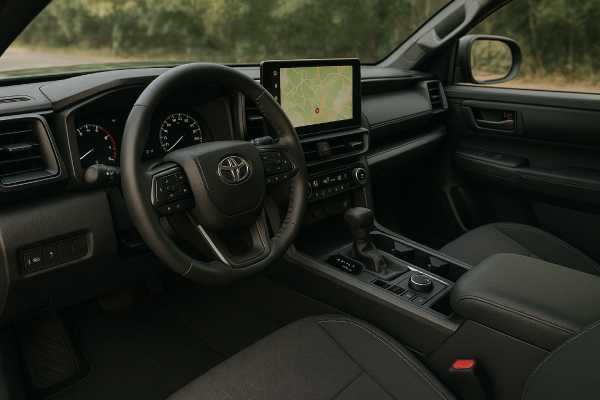
Inside, the Tacoma RWD feels much more like a modern crossover. Even the SR gets an 8 inch central touchscreen with wireless Apple CarPlay and Android Auto, a digital driver display, and a far more adjustable driving position than earlier Tacomas. At the same time, Toyota has kept physical knobs and robust switchgear, so the truck remains easy to use with gloves or on rough roads.
If you come from the older 3.5 litre V6 Tacoma, the main differences are:
- A turbo four with more low-rpm torque but a different, slightly more refined sound.
- Far more driver assistance tech as standard.
- Improved seat comfort and cabin space, especially for taller drivers.
- A somewhat lower tow rating in base RWD form, but better fuel economy and everyday drivability.
Tacoma RWD specs and data
Engine and performance (T24A-FTS ii-FORCE, 4×2 automatic)
| Item | Specification (approximate where noted) |
|---|---|
| Engine code | T24A-FTS |
| Layout and cylinders | Inline-4, DOHC, 16 valves, dual VVT-i |
| Valves per cylinder | 4 |
| Bore × stroke | 87.5 × 99.5 mm (3.44 × 3.92 in) |
| Displacement | 2.4 l (2,393 cc) |
| Induction | Turbocharged, intercooled, twin-scroll |
| Fuel system | D-4ST combined direct and port injection |
| Compression ratio | About 11.0:1 |
| Max power | 228 hp @ 6,000 rpm (SR 4×2 tune) |
| Max torque | 243 lb-ft @ ~1,600–1,700 rpm |
| Timing drive | Chain |
| Emissions standard | U.S. LEV III / Tier 3 equivalent |
| Rated economy (SR 4×2) | ~20 mpg city / 26 mpg highway / 23 mpg combined |
| Real-world highway (120 km/h) | Typically 22–24 mpg (9.8–10.7 l/100 km) when unladen |
| Aerodynamics (typical) | Cd around 0.36–0.38, frontal area about 2.8 m² (30 ft²) |
Because the Tacoma is sold with multiple outputs of the same engine, always confirm that your truck is the 228 hp ii-FORCE tune (SR 4×2 automatic) rather than one of the higher-output i-FORCE or i-FORCE MAX variants.
Transmission and driveline (RWD models)
| Item | Specification |
|---|---|
| Transmission | 8 speed automatic, electronically controlled |
| Drive type | Rear wheel drive (4×2) |
| Final drive ratio | Around 3.91:1 (varies slightly by axle and package) |
| Differential | Open rear differential |
| Traction aids | Brake-based electronic traction control, stability control |
| Tow/Haul mode | Yes, with adjusted shift mapping |
Manual transmissions and part-time four wheel drive are available on some trims, but the typical Tacoma RWD covered here is the SR or SR5 with the 8 speed automatic and open rear axle.
Chassis and dimensions (typical Double Cab 4×2, 5 ft bed)
Values can vary modestly with cab, bed, and market:
| Item | Specification (approximate) |
|---|---|
| Front suspension | Double-wishbone with coil springs and stabiliser bar |
| Rear suspension | Multi-link coil or leaf springs, solid axle (configuration-dependent) |
| Steering | Electric power assist rack-and-pinion |
| Front brakes | Ventilated discs, ~13.4 in diameter |
| Rear brakes | Ventilated discs, ~12.2 in diameter |
| Wheels and tyres | 17 in wheels, all-season tyres (e.g. 245–265/65 R17) |
| Ground clearance | Around 9.0–9.5 in (230–241 mm) |
| Length | ~213.0 in (5,410 mm) |
| Width (mirrors folded) | ~76–78 in (1,930–1,980 mm) |
| Height | ~74 in (1,880 mm) |
| Wheelbase | 131.9 in (3,350 mm) |
| Turning circle (kerb-to-kerb) | Around 44 ft (13.4 m) |
| Curb weight (SR 4×2) | Roughly 4,200–4,300 lb (1,905–1,950 kg) |
| GVWR | Typically around 6,000 lb (2,720 kg) |
| Fuel tank | About 18 gal (68 l) |
| Bed length (short bed) | ~60.3 in (1,532 mm) |
Performance and capability (SR 4×2 automatic, typical values)
| Item | Specification (approximate) |
|---|---|
| 0–60 mph (0–97 km/h) | About 7.5–8.0 s (unladen) |
| Top speed (limited) | Around 106 mph (171 km/h) |
| Braking 60–0 mph | Roughly 170–180 ft (52–55 m), tyre-dependent |
| Towing capacity | 3,500 lb (1,588 kg) when properly equipped |
| Payload | Commonly ~1,400–1,600 lb (635–725 kg) depending on spec |
| Roof load | Typically 165–220 lb (75–100 kg) with appropriate rack |
Fluids and service capacities (typical, confirm by VIN)
| System | Specification |
|---|---|
| Engine oil | 0W-20 API SP / ILSAC GF-6; about 5.6–5.9 qt (5.3–5.6 l) with filter |
| Coolant | Toyota Super Long Life Coolant; roughly 10–11 l total system |
| Automatic transmission | Toyota WS or equivalent ATF; service fill typically 3–5 l |
| Differential (rear) | Hypoid gear oil 75W-85 or 75W-90; capacity ~1.5–2.0 l |
| A/C refrigerant | R-1234yf; charge mass varies by option, typically ~500–700 g |
| A/C compressor oil | ND-oil specified by Toyota; small charge in tens of millilitres |
| Example torque – wheel nuts | Around 130–135 Nm (95–100 lb-ft) |
| Example torque – oil drain plug | Around 40 Nm (30 lb-ft) |
Always verify capacities and torque values against the official service manual for your exact VIN before performing work.
Electrical
| Item | Specification |
|---|---|
| Alternator output | Typically 130–150 A, depending on equipment |
| 12 V battery | Around 65–70 Ah, group size similar to H5/Group 24 |
| Spark plugs | Long-life iridium, gap around 0.7–0.8 mm |
Safety and driver assistance
For 2024–2025, the new Tacoma has received strong crashworthiness scores from major test bodies, and every trim includes Toyota Safety Sense 3.0:
- Forward collision warning with pedestrian and cyclist detection.
- Automatic emergency braking.
- Lane departure alert with steering assist and lane tracing assist.
- Full speed adaptive cruise control.
- Road sign assist.
Blind spot monitoring and rear cross-traffic alert are widely available or standard on higher trims. Headlights are LED projectors with an Acceptable rating in IIHS headlight testing on 2024 extended cab models. At the time of writing, NHTSA crash ratings may still be partial or pending for some cab and drivetrain combinations, so it is worth checking the official database for the latest scores.
Tacoma RWD trims and safety
For rear wheel drive buyers, the key trims are SR, SR5, TRD PreRunner, TRD Sport, and Limited, though exact line-ups vary by market and model year. The base SR 4×2 is usually the only Tacoma that uses the 228 hp ii-FORCE tune; most other trims step up to the 278 hp i-FORCE or the hybrid i-FORCE MAX.
Trims and options for 4×2 models
- SR 4×2
- 228 hp 2.4 litre turbo, 8 speed automatic, rear wheel drive.
- 17 in steel wheels, basic cloth interior, 8 in touchscreen.
- Simple suspension tune, often leaf-spring rear on XtraCab work trucks.
- Tow rating typically 3,500 lb.
- SR5 4×2
- 278 hp version of the 2.4 litre turbo, 8 speed automatic.
- Alloy wheels, upgraded interior materials, available coil-spring rear on Double Cab.
- Higher tow rating when properly equipped, often up to the mid-6,000 lb range.
- TRD PreRunner (4×2)
- A raised, off-road-look 4×2 with locking rear differential and more aggressive tyres.
- Larger wheels and tyres, off-road suspension tuning, skid plates and styling upgrades.
- TRD Sport and Limited 4×2
- Street-biased or premium trims with the 278 hp i-FORCE engine tune in most markets.
- Larger touchscreens, more advanced audio options, and comfort features like dual-zone climate.
Option packages add items such as:
- Upgraded infotainment (14 in screen), JBL audio with portable speaker.
- Panoramic view and multi-terrain view monitors.
- Trailer brake controller and towing technology package.
- Digital key, wireless charging, and more advanced driver assistance such as parking assist.
Quick identifiers for a base SR 4×2:
- Black or simple body-colour grille without aggressive TRD elements.
- 17 in steel wheels rather than alloys.
- Smaller 8 in center screen and cloth seats.
- VIN and door jamb build labels will list engine code and drivetrain; the window sticker will show ii-FORCE and 4×2.
Safety ratings summary
- IIHS: 2024 and 2025 Tacoma crew cab and extended cab models have earned strong crashworthiness scores, including Good ratings in most crash tests and an Acceptable rating for headlights on many trims. Some tests, such as the updated moderate overlap with a rear passenger, may carry slightly lower scores, so it is worth checking the specific combination of cab and year you are considering.
- NHTSA: Full star ratings may not yet be available for all 2024+ Tacoma configurations; buyers should verify the latest information.
Safety systems and ADAS evolution
Compared with the outgoing Tacoma, the new N400 makes advanced driver assistance standard across the board:
- Multiple airbags including front, side, curtain, and often driver knee airbags.
- Electronic stability control, traction control, anti-lock brakes, and a standard rear view camera.
- Toyota Safety Sense 3.0 with improved object detection, better lane tracing, and more natural adaptive cruise behaviour than earlier generations.
ADAS systems rely on cameras and radar units mounted in the grille and behind the windshield. After windscreen replacement, front-end collision repairs, or alignment of radar and camera units, calibration using factory procedures is required to restore correct operation. This is especially important for dynamic radar cruise control and lane tracing assist.
For child seats, most Double Cab trucks provide LATCH / ISOFIX anchors on the outboard rear seats and top tether anchors across the rear bench. The extended cab’s jump seats are more limited for child seat use and are better suited for occasional passengers.
Tacoma RWD reliability notes
Because the N400 Tacoma is new, long-term data is still developing. However, the T24A-FTS turbo engine and related hardware are already used in several Toyota and Lexus models, giving some early insight into potential issues.
Engine and fuel system
So far, there are no widespread catastrophic failures reported for the 2.4 litre turbo in truck duty. Key things to watch:
- Oil quality and change discipline: Turbochargers and combined direct/port injection place more stress on the oil. Owners who tow, idle for long periods, or drive mostly short trips are better served by 5,000 mile (8,000 km) oil changes rather than stretching to the maximum interval.
- Carbon build-up: The D-4ST system includes port injectors, which helps wash intake valves and reduce classic direct-injection deposits. Even so, prolonged low-load operation and poor fuel quality can still lead to some intake and combustion deposits over time.
- Boost and sensor issues: As with any turbo engine, boost control solenoids, wastegate actuators, and MAP/MAP sensors can cause drivability issues if they fail. Typical symptoms include reduced power, boost-related fault codes, and limp-home modes.
Driveline and chassis
For rear wheel drive Tacomas:
- The 8 speed automatic is much improved over some earlier Toyota units, but early trucks may receive software updates to smooth low-speed shifts and reduce hunting. If you feel harsh or indecisive shifting, ask a dealer to check for transmission calibration updates.
- Leaf-spring rear trucks (often XtraCab work models) can develop squeaks, clunks, or axle wrap under heavy load. Periodic bushing inspection and correct torque on U-bolts and shackles help.
- Multi-link coil rear suspensions behave well on the road but bring more bushings and links; long-term, these may wear and produce play or noise.
Corrosion is historically a talking point for older Tacomas. The N400 frame is fully boxed and uses more protection than older generations, but it is still wise to inspect:
- Frame rails around suspension mounts.
- Bed mounts and rear frame crossmembers.
- Seams and welds in road-salt regions.
Regular underbody washing and periodic inspections maintain resale value and safety.
Recalls, TSBs, and extended coverage
As of the first model years:
- Some Tacomas have seen software-related campaigns for instrument panel display behaviour, multimedia glitches, or advanced driver assistance warning messages.
- Various Toyota service bulletins exist for minor driveline refinement and noise.
When shopping used or servicing your own truck:
- Run the VIN through the official recall lookup to confirm all recalls and service campaigns are complete.
- Ask for printouts of dealer history, including any calibration updates applied to the engine control module, transmission, or safety systems.
- If the truck has aftermarket wheels, suspension lifts, or tuning, be more cautious and inspect for driveline vibrations, axle seal leaks, or altered alignment.
Because this is not an electrified powertrain, there is no high-voltage traction battery to worry about, but there is still a 12 V system that should be tested periodically, particularly before winter.
Maintenance and buyer guidance
The Tacoma RWD with the 2.4 litre turbo engine is fairly straightforward to maintain, but the combination of turbocharging and modern emissions hardware means you should stick to a structured schedule rather than treating it like an older naturally aspirated truck.
Practical maintenance schedule (typical, always confirm by VIN)
Every 5,000–6,000 miles (8,000–10,000 km) or 6 months
- Engine oil and filter (especially if towing, off-roading, or driving short trips).
- General inspection of belts, hoses, boots, and visible leaks.
- Tyre rotation and pressure check; inspect for uneven wear and adjust alignment if needed.
Every 10,000–12,000 miles (16,000–20,000 km) or yearly
- Engine air filter check and replace as needed.
- Cabin air filter replacement.
- Brake system visual inspection: pads, rotors, lines, and parking brake function.
Every 30,000–40,000 miles (50,000–65,000 km)
- Automatic transmission fluid drain and fill if the truck tows, sees heavy use, or is kept long term, even if marketed as “lifetime”.
- Rear differential fluid change.
- Comprehensive cooling system inspection (hoses, clamps, and for any seepage at water pump or thermostat housings).
Every 40,000–60,000 miles (65,000–100,000 km)
- Spark plugs (turbo engines generally benefit from shorter plug intervals).
- More detailed brake inspection, including slide pins and parking brake mechanisms.
Every 100,000–120,000 miles (160,000–190,000 km)
- Coolant replacement using Toyota Super Long Life Coolant.
- Thorough inspection of suspension bushings, ball joints, and steering links; replace worn parts.
Timing is via chain, so there is no scheduled belt replacement. Instead, listen for chain rattle on cold start, watch for timing correlation codes, and monitor oil quality; if symptoms appear, chain and tensioner service becomes a corrective job.
The 12 V battery often lasts 4–6 years in normal climates. Test it annually after year three, especially if your truck uses features like digital key, telematics, and frequent accessory use with the engine off.
Fluids and key specs for decision-making
- Engine oil: 0W-20 synthetic, API SP / ILSAC GF-6; about six quarts with filter.
- Transmission: Toyota WS ATF; plan on regular drain-and-fill services for long-term reliability.
- Differential: 75W-85 or 75W-90 gear oil; heavier tow use may benefit from more frequent changes.
- Brake fluid: DOT 3 or DOT 4 (per manual); change roughly every 3 years.
For DIY owners, knowing typical torque figures such as around 30 lb-ft for the drain plug and around 95–100 lb-ft for wheel lugs helps, but these must always be confirmed in the factory data before use.
Buyer’s guide: what to look for
When evaluating a Tacoma RWD:
- Service history
- Look for documented oil changes at realistic intervals.
- Ask specifically about transmission and differential fluid services if the truck has towed.
- Corrosion and structure
- Inspect frame rails, crossmembers, and suspension mounts for rust or poorly repaired damage.
- Check bed seams, tailgate hinge areas, and door bottoms.
- Driveline and steering
- On the test drive, feel for shudder during light throttle, hunting between gears, or clunks during on-off acceleration.
- Check steering for straight-ahead stability and absence of vibration.
- Electronics and ADAS
- Confirm that all warning lights clear after start-up.
- Test adaptive cruise, lane tracing, and road sign assist on a suitable road.
- Preferred trims
- For a simple, efficient work truck: SR 4×2 with minimal options is fine, but confirm it has the features you need, such as cruise control and the correct bed length.
- For mixed work and family duty: SR5 or Limited 4×2 bring better seats, more comfort features, and higher tow ratings while still avoiding the weight and complexity of 4×4.
Long term, the Tacoma’s reputation, Toyota’s parts support, and the new engine’s broad use across the range make it a safe bet for 10+ years of ownership, provided maintenance is done correctly.
Driving performance and efficiency
On the road, the Tacoma RWD with the 228 hp ii-FORCE engine feels different from many older mid-size trucks. Rather than needing revs to make power, it delivers a strong swell of torque just above idle, then pulls steadily through the mid-range.
Powertrain character
- Throttle response: There is a small amount of turbo lag if you floor it from very low rpm, but for normal driving the engine responds quickly, especially in the default Normal or Sport modes.
- Transmission behaviour: The 8 speed prefers to upshift early in Eco mode, targeting fuel economy. In Sport or when you select Tow/Haul, it holds gears longer and is more willing to downshift on grades.
- Noise and refinement: At idle, the engine is relatively quiet, with more of a subdued four-cylinder hum than the old V6 growl. Under load, you hear some turbo whoosh and induction noise, but overall refinement is good for the segment.
The 228 hp tune is not as quick as the 278 hp i-FORCE or hybrid versions, which matter if you tow near capacity or often drive in mountainous terrain. For everyday commuting, light hauling, and urban duties, the base engine’s strong low-rpm torque and the shorter gearing of the automatic keep the truck from feeling underpowered.
Ride, handling, and NVH
The TNGA-F chassis and, on many 4×2 Double Cabs, the coil-spring rear suspension transform the Tacoma’s ride:
- Ride quality: Unladen, the RWD Tacoma is firmer than a crossover but much less choppy than many older body-on-frame trucks. Speed bumps and expansion joints are handled cleanly.
- Handling: Steering is reasonably direct with good straight-line stability. Turn-in is predictable and body roll is controlled; you always feel the height and mass, but it is secure rather than floaty.
- Cabin noise: At highway speeds, wind and tyre noise are acceptable, though off-road tyres and roof racks can raise noise noticeably. The new cab structure and acoustic glass options help the truck feel calmer on long trips.
Real-world economy and range
For a typical SR 4×2:
- City: Many owners report mid-teens to low-20s mpg depending on traffic and load.
- Highway: Around 22–26 mpg at 65–75 mph (about 9–11 l/100 km), with the best numbers coming from steady speeds and light loads.
- Mixed: Low-20s mpg (about 10–11.5 l/100 km) are realistic for normal use.
Cold weather, roof loads, big tyres, and frequent short trips will drag these numbers down. Towing a 3,000–3,500 lb trailer can cut fuel economy by one-third or more, dropping highway consumption into the mid-teens mpg.
Load and towing behaviour
Within its 3,500 lb tow rating, the RWD Tacoma behaves predictably when properly set up:
- Stability: With a correctly loaded trailer and a weight-distributing hitch where appropriate, straight-line stability is good.
- Braking: Truck and trailer brakes together are important; the Tacoma’s own brakes are sized for the class but should not be relied on to handle an unbraked trailer near the limit.
- Temperatures: The 2.4 turbo’s cooling package is designed for moderate towing but is still compact. Long grades in hot conditions are a good reason to use Tow/Haul mode, watch temperatures, and downshift early rather than riding the brakes.
For heavier towing, or if you will spend much of your time near capacity, the higher-output i-FORCE or hybrid four wheel drive variants, with their higher tow ratings, deserve a close look. For most light-duty users, the RWD SR and SR5 provide a nice balance of efficiency and capability.
Tacoma RWD versus rivals
The mid-size truck field is crowded, with strong competition from the Chevrolet Colorado, GMC Canyon, Ford Ranger, Nissan Frontier, and Honda Ridgeline. The Tacoma RWD’s role is to combine Toyota’s durability reputation with a modern engine and technology while staying manageable in size.
Versus Chevrolet Colorado and GMC Canyon (2.7 turbo)
- The Colorado and Canyon offer very strong torque and towing in their higher-output 2.7 litre turbo tunes.
- Their cabins feel wide, with excellent infotainment, but the driver assistance suite and ride quality can vary by trim.
- The Tacoma counters with Toyota Safety Sense standard on every truck, robust aftermarket support, and a long track record of resale value.
If you tow often near the limit, the GM twins may hold an edge. If you want long-term ownership with simpler parts availability and strong off-road aftermarket support, the Tacoma is still a safe choice.
Versus Ford Ranger
- The Ranger’s turbo four offers similar power and efficiency, and the new generation brings a well-appointed interior.
- Ford’s option structure makes it easy to get powerful drivetrains, but some of the advanced safety and technology features are packaged high in the range.
The Tacoma’s advantages are its broad dealer network familiar with trucks and off-road use, and the perception of long-term reliability. The Ranger can feel more powerful in some trims, while the Tacoma prioritises a slightly more conservative, comfort-oriented tune.
Versus Nissan Frontier
- The Frontier focuses on a naturally aspirated V6 with a traditional feel and straightforward driving experience.
- It offers strong towing, but its safety tech and fuel economy lag behind the latest competitors.
If you prefer a simpler, naturally aspirated engine and can live without the most advanced ADAS, the Frontier is a solid alternative. For owners wanting modern driver assistance and better fuel efficiency in city use, the turbo Tacoma RWD stands out.
Versus Honda Ridgeline
- The Ridgeline is more of a crossover-based pickup, with a unibody chassis, all wheel drive, and excellent on-road manners.
- It rides and handles better than almost any body-on-frame rival but offers less ultimate off-road capability and a different aesthetic.
The Tacoma RWD is better suited to users who value frame strength, bed customization, long-term modification potential, and truck-style durability. The Ridgeline is ideal for those who prioritise ride and cabin comfort over traditional truck character.
Overall, the 2.4 litre turbo Tacoma RWD carves out a niche as the efficient, modern, and still rugged entry point into Toyota’s truck family. It is particularly attractive if you mostly drive on paved roads, want strong safety tech, and will use the bed often but only tow moderately heavy loads occasionally.
References
- 2024 Tacoma Gas 2024 (Product Summary Brochure)
- 2024 Toyota Tacoma 2024 (Safety Rating)
- Vehicle Detail Search – 2024 Toyota Tacoma 2024 (Recall Database and Ratings)
- 2024 Toyota Tacoma MPG and Fuel Economy 2024 (Fuel Economy Data)
- Engine specifications for Toyota T24A-FTS, characteristics, oil and fuel consumption 2022 (Engine Technical Data)
Disclaimer
This article is for informational purposes only and is not a substitute for professional diagnosis, repair, or safety inspection. Specifications, torque values, service intervals, and procedures can vary by VIN, market, model year, and installed equipment. Always verify all technical data and instructions against your official Toyota service documentation, owner’s manual, and current technical service bulletins before performing any work or making purchase decisions.
If you found this guide helpful, consider sharing it with other enthusiasts and owners on platforms such as Facebook or X/Twitter to support xcar’s work and help more people understand their Tacoma.