
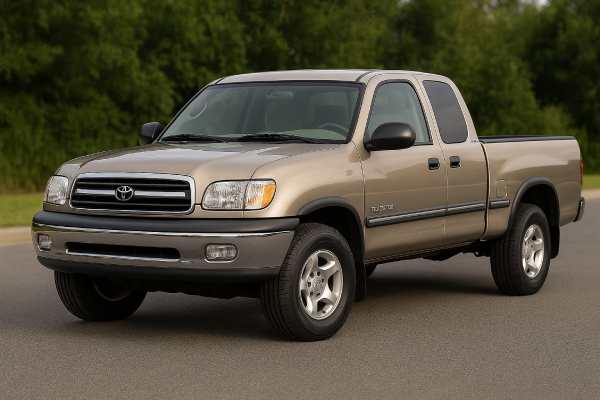
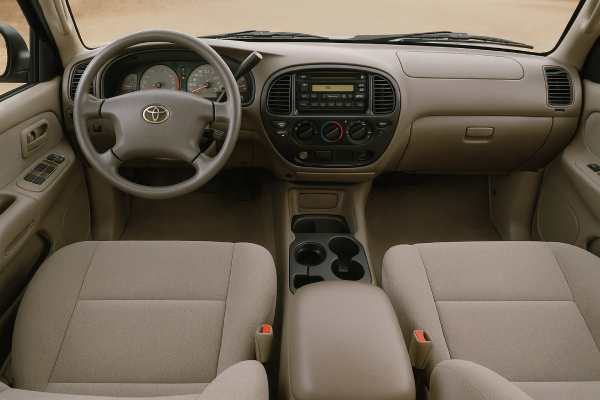
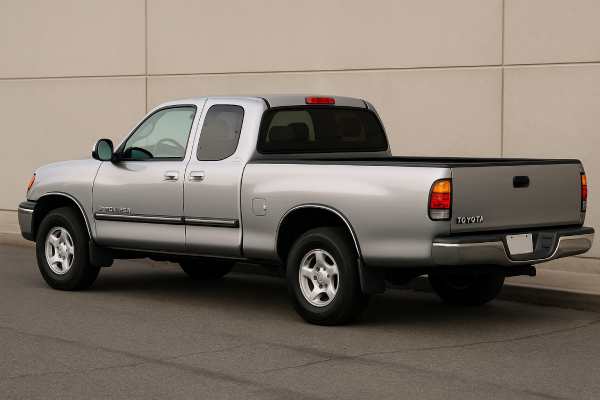
The first-generation Toyota Tundra RWD (XK30) with the 5VZ-FE 3.4 litre V6 is a bit of an outlier in the full-size truck world. It combines a mid-size style V6 powertrain with a full-size footprint, aimed at owners who needed a work-capable pickup without the thirst or complexity of a V8. Built in the U.S. for the North American market, this 1999–2002 configuration offered 190 hp, rear-wheel drive, and a relatively compact Access Cab body that fits more easily in typical garages than later Tundras.
Today, many of these trucks are past 200,000 miles, so questions shift from showroom specs to reliability, existing recalls, and what it actually costs to keep one running. This guide focuses on the RWD XK30 with the 5VZ-FE, covering technical data, real-world performance, known issues (including frame corrosion campaigns), safety ratings, maintenance planning, and how it compares to rival V6 and V8 half-ton pickups of the era.
At a Glance
- Stout 5VZ-FE 3.4 l V6 with timing belt, 190 hp and 220 lb-ft, proven in 4Runner and Tacoma applications.
- Comfortable, car-like ride and compact dimensions compared with domestic full-size trucks, yet still rated to tow around 2,300–2,400 kg (5,000–5,300 lb) when properly equipped.
- Major ownership caveat: frame and rear crossmember corrosion recall on many 2000–2003 trucks in salt-belt states — any survivor should be checked for completed campaigns and remaining rust.
- Typical oil change interval is 5,000–7,500 miles (8,000–12,000 km) or 6–12 months depending on use; timing belt service is usually due around 90,000 miles (145,000 km).
- Expect 14–16 mpg US (17–19 mpg UK, about 15–17 L/100 km) in mixed driving from the V6 RWD, with heavier towing driving it into the low teens (high teens L/100 km).
Guide contents
- Toyota Tundra XK30 V6 profile
- Toyota Tundra 3.4 V6 specs
- Tundra XK30 trims and safety tech
- Reliability and known 5VZ-FE issues
- Ownership maintenance and buying advice
- On-road performance and towing feel
- How this Tundra stacks against rivals
Toyota Tundra XK30 V6 profile
The XK30-generation Toyota Tundra RWD with the 3.4 litre 5VZ-FE V6 sits at the bottom of the first-gen Tundra range, below the 4.7 V8 models. Mechanically, it blends a mid-size truck drivetrain (shared with 4Runner and Tacoma) with a larger, more comfortable body and cabin. The result is a truck that feels lighter and more rev-happy than V8 domestic competitors, but still robust enough for moderate towing and daily work.
In North America, this configuration was most commonly sold as a 2WD Access Cab V6 SR5 with a 4-speed automatic transmission and a short bed. The wheelbase of roughly 128 in (3,260 mm) and overall length around 217 in (5,525 mm) make it more maneuverable than later full-size trucks, yet interior space in the front row is generous, with a simple, low-dash layout and big, easy-to-use controls.
The 5VZ-FE engine is a 60° cast-iron block V6 with aluminium DOHC heads and four valves per cylinder, designed for torque and long-term durability rather than peak power. Rated at 190 hp and about 220 lb-ft (298 Nm), it produces its torque low in the rev range, which suits relaxed, low-rpm cruising. A timing belt drives the camshafts, so belt replacement is a key scheduled service item.
For owners, the main attraction of this Tundra is its reputation for reliability and relatively low running costs versus V8 half-tons. The chassis and suspension are conservative: double wishbones up front, a solid rear axle with leaf springs, and hydraulic steering. That keeps parts prices modest and makes most wear items straightforward for a competent shop to service.
However, there are two realities any buyer or current owner must factor in. First, early first-gen Tundras are subject to a well-known frame and rear crossmember corrosion recall in salted-road regions; surviving trucks should be inspected thoroughly underneath, regardless of recall status. Second, while the 5VZ-FE engine itself is robust, age-related issues such as cooling system degradation, rubber component cracking, and suspension bushing wear are now standard considerations for 20+ year-old vehicles.
Toyota Tundra 3.4 V6 specs
This section focuses on the rear-wheel-drive XK30 Tundra with the 3.4 V6 5VZ-FE and 4-speed automatic, produced roughly 1999–2002.
Engine and performance
| Item | Value |
|---|---|
| Engine code | 5VZ-FE V6 petrol |
| Layout and valvetrain | 60° V6, DOHC, 4 valves per cylinder |
| Displacement | 3.4 l (3,378 cc) |
| Bore × stroke | 93.5 mm × 82.0 mm |
| Induction | Naturally aspirated |
| Fuel system | Sequential multiport fuel injection (SFI) |
| Compression ratio | 9.6 : 1 |
| Max power | 190 hp (142 kW) @ 4,800 rpm |
| Max torque | ~220 lb-ft (298 Nm) @ 3,600 rpm |
| Firing order | 1–2–3–4–5–6 |
| Emissions/efficiency | Petrol, LEV-compliant for its era (US) |
| Rated economy (combined) | ~15.6 l/100 km (15.1 mpg US / 18.1 mpg UK) for 2WD 3.4 V6 auto |
Real-world users often report 14–16 mpg US in mixed driving with the RWD Access Cab, depending on load, tyre choice, and gearing. Highway-only figures at 65–70 mph can approach the official extra-urban number if the truck is stock and lightly loaded.
Transmission and driveline
| Item | Value |
|---|---|
| Transmission | 4-speed automatic with lock-up torque converter (A340E family) |
| Gear ratios (typical A340E) | 1st 2.804, 2nd 1.531, 3rd 1.000, 4th 0.705, Rev 2.393 |
| Drive type | Rear-wheel drive (RWD) |
| Differential | Open rear differential, axle ratio commonly around 3.90:1 (varies by axle code) |
| Tow/haul hardware | Available receiver hitch and wiring; no factory integrated brake controller on this generation |
Chassis and dimensions
| Item | Value |
|---|---|
| Front suspension | Independent double wishbone with coil springs |
| Rear suspension | Solid axle with leaf springs |
| Steering | Rack-and-pinion, hydraulic assist |
| Brakes | Front ventilated discs, rear drums (ABS available) |
| Typical tyre size | 245/70 R16 (varies by trim and region) |
| Length | ~5,525 mm (217.5 in) |
| Width | ~1,910 mm (75.2 in) |
| Height | ~1,795 mm (≈70–71 in, depending on tyre/suspension) |
| Wheelbase | ~3,260 mm (128.3 in) |
| Ground clearance | ~270 mm (10.6 in) on stock tyres (unladen) |
| Curb weight | ~1,870–1,900 kg (4,120–4,200 lb) for 2WD 3.4 V6 automatic |
| GVWR | ~2,585–2,590 kg (≈5,700 lb) |
Performance and capability
| Item | Value |
|---|---|
| 0–100 km/h (0–62 mph) | Roughly mid-10s seconds (V6, RWD, automatic) |
| Top speed | Around 170 km/h (105 mph), limited by gearing/aero |
| Max trailer weight (braked) | Approx. 2,300–2,400 kg (5,000–5,300 lb) with correct hitch and equipment |
| Payload | Typically 700–800 kg (1,500–1,750 lb) depending on configuration |
| Fuel tank | Around 100 l (26.4 US gal, ~22 UK gal) |
Fluids and electrical (high-level)
Because values vary slightly by market, trim, and cooling package, always confirm with the service manual for your exact VIN — especially for torque specs.
- Engine oil: approx. 5.3 l (5.6 US qt) with filter; typical viscosity 5W-30 meeting API SL or newer (follow latest Toyota guidance).
- Engine coolant: Toyota long-life coolant (usually red or pink); capacity varies by heater and tow package — typically in the 7–9 l (7.4–9.5 qt) range.
- Automatic transmission fluid: Toyota ATF Type T-IV (or approved equivalent) for the A340E; total capacity ~8 l, but drain-and-fill exchanges a smaller portion at a time.
- Differential oil: Hypoid gear oil (e.g., 75W-90 GL-5), capacity depending on axle.
- Alternator: rating sufficient for factory loads; many trucks now have upgraded units when accessories are added.
- 12 V battery: group size varies; a 550–700 CCA battery is typical for reliable cold-weather starting.
For wheel, suspension, engine-mount, and steering-related torque values, rely on an official repair manual; incorrect torque on these fasteners can compromise safety.
Tundra XK30 trims and safety tech
Within the 1999–2002 run, the 2WD V6 XK30 Tundra was generally sold in base and SR5 trim levels, with regional and year-to-year differences.
Trims, options, and identifiers
- Base V6 2WD
- Vinyl or basic cloth bench, manual windows and locks in many markets.
- Steel wheels, simpler interior trim.
- Often lacks cruise control and keyless entry.
- SR5 V6 2WD
- Popular configuration: Access Cab, cloth interior, power windows/locks, cruise control.
- Alloy wheels, chrome exterior trim, and additional storage.
- Optional split bench or buckets with center console, upgraded audio.
Functional differences between trims on V6 RWD trucks are modest: most share the same engine, gearbox, and rear axle architecture. Options that do matter to buyers include:
- Towing equipment – factory or dealer-installed receiver hitch and 7-pin wiring.
- Limited-slip differential (where available) – sometimes coded in the axle label; more common on V8 trucks but worth checking on a used V6.
- Wheel/tyre packages – SR5 models often got alloys with slightly wider tyres, which subtly affects ride and steering feel.
Quick ways to identify a 3.4 V6 RWD XK30 truck:
- VIN decoders and parts sites will show engine code 5VZ-FE and drivetrain as 4×2.
- Many build stickers list an axle code (e.g., A03A/B type) that indicates ratio and differential type.
- Visual: no front differential, no front driveshaft, and a relatively low front ride height compared with the 4×4 XK31.
Safety ratings
Formal crash testing and safety ratings for the early Tundra focus on the extended/Access Cab configurations:
- IIHS (Insurance Institute for Highway Safety)
- 2000 Tundra extended cab (similar body to XK30) scored “Good” overall in the frontal offset crash test, making it one of the best-performing full-size pickups in that era in that specific test.
- NHTSA (U.S. government 5-star ratings)
- Period data for early Tundras show around 4 stars for frontal driver and 3–4 for passenger in certain body styles; ratings vary by cab and equipment.
Standard passive safety equipment includes:
- Dual front airbags.
- Three-point belts for outboard front positions; lap belt for some center seating positions.
- Structural design that performed notably well in the IIHS frontal offset test for its time.
Active safety systems:
- ABS (anti-lock braking system) was widely available and standard on most higher trims.
- Stability control, traction control, and advanced airbag systems common in later trucks were not yet standard on these early models.
Advanced driver assistance systems (ADAS) such as automatic emergency braking, lane keeping, or radar cruise did not exist on this generation, so safety relies on basic hardware condition, tyre quality, and the driver’s situational awareness.
Child-seat provisions and service implications
The XK30 predates modern ISOFIX/LATCH anchors in many markets. Child seats often rely on seat belt routing; owners should:
- Inspect belts, buckles, and seat structures carefully for wear and corrosion.
- Consider professional installation checks for rear-facing seats, given the age of materials.
After any major structural repair (frame reinforcement, crossmember replacement) or airbag deployment, alignment of steering, ABS, and brake bias must be verified. While this truck lacks modern radar sensors, the condition of the frame and brake lines — especially in rust-belt examples — is a critical safety factor and should be examined whenever the truck is on a lift.
Reliability and known 5VZ-FE issues
The 5VZ-FE V6 and first-gen Tundra platform have strong reputations for durability, but the trucks are now old enough that age and rust matter as much as mileage.
Engine and powertrain
Common to occasional issues:
- Cooling system wear (common, medium severity)
- Symptoms: rising temperature under load, coolant smell, or crusting around radiator tanks and water pump weep hole.
- Likely cause: ageing radiator plastics, original water pump, or clogged core.
- Remedy: replace radiator, hoses, thermostat, and water pump (usually done with timing belt service), flush coolant.
- Timing belt neglect (occasional, high potential severity)
- Symptoms: unknown service history, belt age > 10 years or 90,000 miles, cracking or oil contamination.
- Risk: although 5VZ-FE is generally non-interference, belt failure still strands the vehicle and can cause collateral damage.
- Remedy: full timing belt kit including idlers, tensioner, and water pump at recommended interval.
- Head gasket failure (rare to occasional, high severity)
- More likely on heavily overheated engines or severe towing in hot climates.
- Symptoms: unexplained coolant loss, white exhaust smoke, misfire on startup, or cross-contamination in oil/coolant.
- Remedy: machine-shop level repair; replacement long block sometimes more economical on high-mileage trucks.
Automatic transmissions (A340E) are generally robust if fluid is clean and not overheated. Typical age-related issues include:
- Shift flare or harsh shifts (occasional, medium severity)
- Often due to worn valve body, old ATF, or sticky solenoids.
- Remedy: fluid service and filter (where serviceable), then diagnostic pressure checks; rebuild only if necessary.
Frame, suspension, and corrosion
The headline reliability concern for early Tundras is frame and rear crossmember corrosion, particularly in “cold climate states” with heavy road salt use:
- Toyota and NHTSA addressed this with a series of campaigns (e.g., recall 09V444000 and subsequent corrosion-resistant compound campaigns).
- Severe rust around the rear crossmember, spare tyre carrier, and brake proportioning valve can lead to:
- Spare tyre detaching and becoming a road hazard.
- Corroded brake lines and loss of rear brake circuit.
Other corrosion hotspots:
- Rear leaf spring mounts and shackles.
- Fuel tank straps.
- Bed supports and cab mounts.
- Front lower control arms and steering rack mounts in heavily salted regions.
Suspension and steering wear items:
- Lower ball joints, inner and outer tie rods, and control arm bushings wear with age.
- Symptoms include clunks over bumps, wandering steering, and uneven tyre wear.
- Remedy: quality replacement components, followed by professional alignment.
Recalls, TSBs, and extended coverage
Key recall themes affecting 2000–2002 Tundras include:
- Frame rear crossmember and frame corrosion – inspection, corrosion-resistant coating, crossmember replacement, or complete frame replacement in severe cases, mainly in salt-belt states.
- Various service campaigns for brake lines and fuel tank strap corrosion tied into the same frame-corrosion concern.
- Other smaller campaigns over the life of the first-gen Tundra (e.g., drivetrain or electronics on some variants) are less central to the V6 RWD trucks but should still be checked via a VIN search.
Owners and buyers should:
- Use the official VIN recall lookup (NHTSA or Toyota owner site) to verify completion of all corrosion-related campaigns.
- Request documented dealer invoices or photos for any frame replacement or crossmember repairs.
- Inspect the frame in person or via lift photos, not just relying on paperwork.
Pre-purchase checks specific to this Tundra
When assessing a used XK30 3.4 V6:
- Confirm timing belt and water pump history; if unknown, treat replacement as immediate.
- Inspect frame rails, crossmembers, and fuel tank straps with a hammer and pick for flaking or perforation.
- Look for coolant stains and signs of overheating around the radiator, hoses, and head gaskets.
- Listen for differential whine at steady cruise, which can indicate wear from heavy towing.
- Check for transmission slip or harsh shifts, especially 2–3 and 3–4.
- Verify that ABS light cycles correctly and no airbag lights are on; older modules and sensors can be expensive to diagnose.
Properly maintained and not crippled by rust, the 5VZ-FE Tundra can realistically exceed 250,000 miles (400,000 km) of service, with many examples going further.
Ownership maintenance and buying advice
Given the age of these trucks, a proactive maintenance mindset is essential. Below is a practical schedule for a lightly modified 3.4 V6 RWD Tundra used for mixed street and light towing. Always cross-check against the official maintenance guide for your year.
Core service intervals (typical guidance)
- Engine oil and filter – every 5,000–7,500 miles (8,000–12,000 km) or 6–12 months, shorter interval for frequent towing, short trips, or dusty conditions.
- Engine air filter – inspect every 15,000 miles (24,000 km), replace as needed.
- Cabin filter – if fitted, replace every 15,000–20,000 miles (24,000–32,000 km).
- Coolant – replace every 5 years or ~60,000 miles (100,000 km), then inspect annually.
- Spark plugs – typical interval around 60,000–90,000 miles (100,000–145,000 km) depending on plug type.
- Fuel filter – if serviceable external filter is fitted, replace ~60,000 miles or according to manual.
- Timing belt and water pump – around 90,000 miles (145,000 km) or 9 years; many owners treat time as equally important as mileage.
- Serpentine/aux belts and hoses – inspect at every oil change, replace around 90,000 miles or at first signs of cracking or noise.
Driveline and chassis:
- Automatic transmission fluid – drain and fill every 30,000–60,000 miles (50,000–100,000 km), more often for heavy towing.
- Differential oil – every 60,000 miles (100,000 km) or 5 years.
- Brake fluid – flush every 2–3 years regardless of mileage.
- Brake pads/rotors – inspect at least annually; these trucks often see long pad life if not heavily towed.
- Steering and suspension – inspect ball joints, tie rods, and bushings annually; address any looseness immediately.
- Tyre rotation and alignment – rotate every 5,000–7,500 miles (8,000–12,000 km), alignment check annually or after any suspension work.
- 12 V battery – test yearly once older than 4–5 years.
Because this is an ICE-only truck, there is no high-voltage battery or inverter service to worry about.
Fluid specification notes
- Use engine oil and ATF that clearly meet Toyota and API specifications for the year — modern synthetic oils that meet or exceed those standards can improve cold-start protection.
- For coolant, stick to Toyota long-life or a compatible phosphate-based coolant approved for aluminium engines; avoid mixing unknown coolant types.
- For the differential, GL-5 hypoid gear oil is required; many owners like 75W-90 synthetic for cold-climate service.
Buyer’s guide: what to seek and avoid
Preferable examples:
- Trucks with:
- Documented timing belt and water pump replacement within the last 6–8 years.
- Evidence of regular fluid changes (engine, transmission, differential, coolant).
- Frame inspection or recall paperwork, especially from salt-belt regions.
- Minimal modifications (stock tyres or mild upsizing, no extreme lifts or hitches welded to rusty frames).
- RWD V6 trucks from dry climates (Southwest, interior West) often have much cleaner frames and underbodies.
Caution/avoid if:
- Frame shows deep scaling, swelling around crossmembers, or perforation — especially near the spare tyre carrier and leaf spring mounts.
- There are multiple warning lights (ABS, airbag, check engine) with no diagnostic paperwork.
- Transmission flares noticeably between gears, especially under light throttle.
- Cooling system is an unknown mix of coolant types or shows heavy internal rust.
Long-term durability outlook is positive when rust is controlled and maintenance kept up: the 5VZ-FE engine design is conservative and tolerant of high mileage, and the rest of the chassis uses proven Toyota truck components.
On-road performance and towing feel
On the road, the RWD Tundra 3.4 V6 feels more like a large mid-size truck than a heavy-duty half-ton. The V6 is smooth and reasonably quiet, with a broad, flat torque curve that suits relaxed driving.
Ride, handling, and NVH
- Ride quality: Unladen, the rear leaf springs can feel a bit firm over sharp bumps, but the overall ride is more compliant and controlled than many same-era domestic pickups.
- Steering: Hydraulic rack-and-pinion steering gives a light, consistent feel with good straight-line stability. There is limited road feedback compared with modern electric racks, but few bad habits.
- Noise levels: At highway speed, wind and tyre noise are moderate, and the V6 spins at modest rpm thanks to the overdrive 4th gear. Well-maintained door seals and fresh tyres help keep the cabin pleasantly quiet for its age.
The relatively compact width and wheelbase make parking and tight turns easier than in later, bulkier Tundras. Body roll is present but well-controlled; the truck feels predictable rather than sporty.
Powertrain character
- Throttle response: Naturally aspirated V6 response is linear; there is no turbo lag, and response is predictable, if not urgent.
- Low-rpm torque: Peak torque arrives around 3,600 rpm, but usable torque starts much lower, making it easy to pull away smoothly in traffic.
- Transmission behaviour: The 4-speed automatic tends to upshift early for economy and will kick down decisively with moderate throttle. On grades, it may hunt a bit between 3rd and 4th when heavily loaded — a common trait of 4-speeds of this era.
There are no drive modes or adaptive dampers; behaviour is consistent and simple. With proper maintenance, shifts stay smooth and predictable.
Efficiency and range
Owners should expect:
- Mixed driving: about 14–16 mpg US (17–19 mpg UK, 15–17 l/100 km) depending on tyres, load, and speed.
- Highway at 65–70 mph (105–115 km/h): 16–18 mpg US is realistic for a stock RWD V6 truck in good mechanical condition.
- City use: 12–14 mpg US is common if there is heavy stop-and-go.
With a ~26.4 gallon (100+ litre) tank, practical range is often 350–400 miles (560–640 km) per fill on mixed driving.
Towing and load behaviour
The V6 RWD Tundra is best thought of as a light-duty tow vehicle:
- Suitable for small to medium trailers — utility trailers, light campers, boats in the 2,000–4,000 lb (900–1,800 kg) range.
- With loads near its rated limit (~5,000–5,300 lb), you will feel:
- Longer stopping distances.
- More frequent downshifts on hills.
- Increased coolant and transmission temperatures if airflow is restricted.
Chassis stability is generally good; the truck tracks straight and feels composed if the tongue weight and trailer brakes are set up correctly. Tyres and brakes are the limiting factors more than frame strength, assuming the frame is sound.
Under load, fuel consumption can easily climb into the low teens mpg (high teens to low 20s l/100 km), so trip planning should allow for more frequent fuel stops.
Traction-wise, empty RWD trucks can spin the rear wheels on wet or snowy surfaces; a limited-slip diff, good all-terrain tyres, and some weight in the bed make a noticeable difference. There is no electronic stability control, so conservative driving in poor weather is important.
How this Tundra stacks against rivals
In its era, the RWD Tundra 3.4 V6 competed with V6 versions of the Ford F-150, Chevrolet Silverado 1500, GMC Sierra 1500, and Dodge Ram 1500, as well as some V8 half-tons.
Against domestic V6 half-tons
Pros for the Tundra V6:
- Refinement and reliability – the 5VZ-FE is widely regarded as more durable than many domestic V6 truck engines of the time, with fewer major internal failures when maintained.
- Ride and cabin quality – interior materials and assembly quality often age better, with fewer rattles and squeaks.
- Fuel economy – in comparable configurations, the Tundra V6’s consumption is broadly similar to rival V6s, but real-world owners often report slightly better reliability, reducing total cost of ownership.
Trade-offs:
- The Tundra V6 does not have the outright towing grunt of some domestic V8s of the same era.
- Aftermarket performance support is more limited compared with small-block domestic V8 platforms.
Against V8 half-tons (including V8 Tundras)
Compared with the 4.7 V8 Tundra and other V8 trucks:
- Performance: The V8 trucks pull harder, especially when towing near their rated capacity or running at highway speeds with a heavy load.
- Economy: Real-world fuel usage between the 3.4 V6 and many V8s is often closer than owners expect — especially when the V6 works hard under load. In some cases, a lightly loaded V8 will deliver similar mpg to a V6 that is constantly at higher throttle openings.
- Complexity and maintenance: V8s have more cylinders and, in many cases, slightly more complex exhaust and accessory systems, with a modest increase in parts cost.
The niche of the V6 RWD Tundra is owners who want:
- A full-size cab and bed.
- Toyota reliability and build quality.
- Moderate towing and hauling capability.
- A simpler, easier-to-service engine with lower parts costs than many overhead-cam V8s.
Market context and long-term value
Today, the RWD 3.4 V6 Tundra tends to be cheaper to buy than comparable V8 models, partly because many buyers chase maximum towing capacity and horsepower. For value-focused shoppers who don’t need to pull heavy loads regularly, the XK30 V6 can be a smart choice:
- Purchase prices are often attractive.
- Insurance is typically reasonable.
- Parts availability is good thanks to shared components with 4Runner, Tacoma, and other Toyota trucks.
The biggest single factor that affects long-term value is frame condition. A 3.4 V6 Tundra with a clean or replaced frame and strong maintenance history can be a long-lived work partner. One with unrepaired or advanced frame rust may be unsafe regardless of engine health.
References
- Toyota Tundra I 3.4 V6 (190 Hp) Automatic – Full specifications 2024 (Technical Specs)
- Toyota 5VZ-FE 3.4L Engine Specs, Problems, Reliability, Info 2023 (Engine Specs)
- 2000 Toyota Tundra Specifications 2024 (Model Specifications)
- 2000 Toyota Tundra 2005 (Safety Rating)
- Vehicle Detail Search – 2000 TOYOTA TUNDRA 2010 (Recall and Safety Database)
Disclaimer
This article is for informational purposes only and is not a substitute for professional diagnosis, repair, or official service documentation. Specifications, torque values, maintenance intervals, and procedures can vary by VIN, market, production date, and installed equipment. Always confirm details against your vehicle’s owner’s manual and factory service information, and consult a qualified technician before performing safety-critical work.
If you found this guide useful, consider sharing it with other owners or enthusiasts on Facebook, X/Twitter, or your favourite forum to support xcar’s work.