
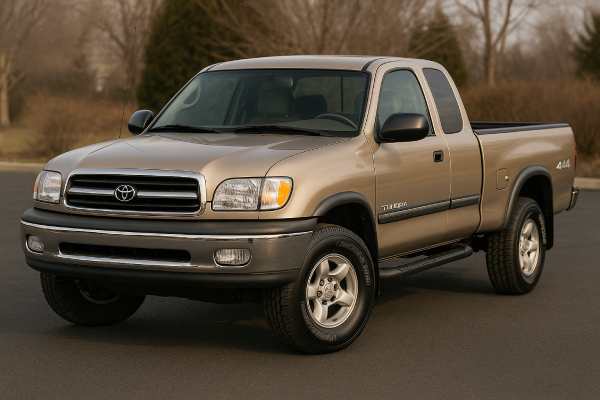
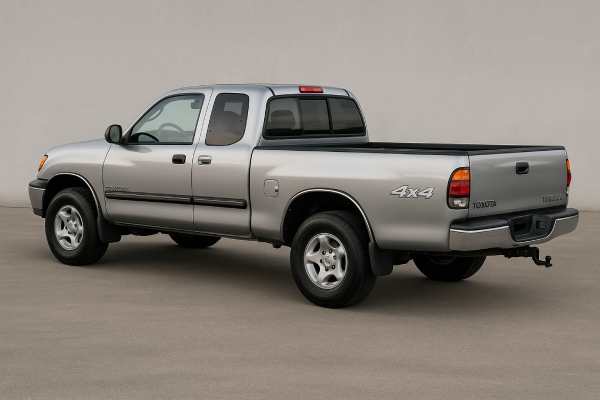
The first-generation Toyota Tundra 4×4 (XK40) with the 2UZ-FE 4.7 litre V8 is the version many owners consider the “complete” early Tundra. It combines a smooth, understressed V8 with a part-time four-wheel drive system, double-wishbone front suspension, and a frame that was engineered for real truck work. With around 245 hp and roughly 315 lb-ft of torque, it tows confidently, cruises quietly, and has enough ground clearance and low-range gearing to tackle snow, trails, and work sites.
Because these trucks are now 20+ years old, the key questions are no longer only about power and tow ratings. Instead, shoppers want to know how the 4.7 V8 holds up in high-mileage use, what frame and rust issues to watch for, how the 4×4 system ages, and what kind of maintenance budget to plan for. This guide focuses on the XK40 4×4 V8 from 1999–2002, covering specs and dimensions, real-world performance, reliability patterns, safety, and the ownership habits that keep these trucks viable today.
Top Highlights
- Refined 2UZ-FE 4.7 l V8 with about 245 hp and strong low-end torque gives relaxed highway cruising and confident towing in a compact full-size package.
- Part-time 4×4 with low range, independent front suspension, and available off-road hardware delivers genuine winter and trail capability without ruining on-road comfort.
- Main ownership caveat is frame and rear crossmember corrosion on trucks from heavy-road-salt regions, including past recall campaigns; a rust-free chassis is more important than low mileage.
- Typical oil change interval is 5,000–7,500 miles (8,000–12,000 km) or 6–12 months, with timing belt and water pump service commonly due around every 90,000 miles (145,000 km) or 9 years.
- Real-world mixed fuel economy for 4.7 4×4 owners often lands around 14–17 mpg US (14–17 l/100 km), with highway trips at the upper end and towing/off-road use at the lower end.
Section overview
- XK40 4.7 V8 Tundra overview
- 2UZ-FE 4×4 technical breakdown
- Tundra 4×4 trims and protection
- Long-term reliability and fixes
- Maintenance planning and buying guide
- Driving performance in real use
- 4.7 V8 4×4 versus rivals
XK40 4.7 V8 Tundra overview
The XK40 4×4 Toyota Tundra with the 2UZ-FE V8 is the four-wheel drive counterpart to the rear-drive XK30 V8 trucks. Mechanically it adds a two-speed transfer case, a driven front axle, and slightly taller ride height. In day-to-day use, the result is a truck that feels secure in bad weather, capable on mild to moderate trails, and still pleasant to live with on long highway trips.
The 2UZ-FE is a 90° V8 with an iron block and aluminium DOHC cylinder heads, four valves per cylinder, and a timing belt. It is part of Toyota’s UZ engine family, used in Land Cruiser and Lexus models, and is tuned in the Tundra for torque and longevity rather than peak power. The broad torque curve means the truck pulls strongly from low revs and rarely feels strained, even with a trailer or full bed.
Most XK40 trucks in this configuration are Access Cab or similar, with rear-hinged back doors and short or standard-length beds. Compared with today’s full-size pickups, the first-generation Tundra is modestly sized. That makes it easier to manoeuvre in city traffic, park in standard spaces, and thread along narrow rural roads or forest tracks.
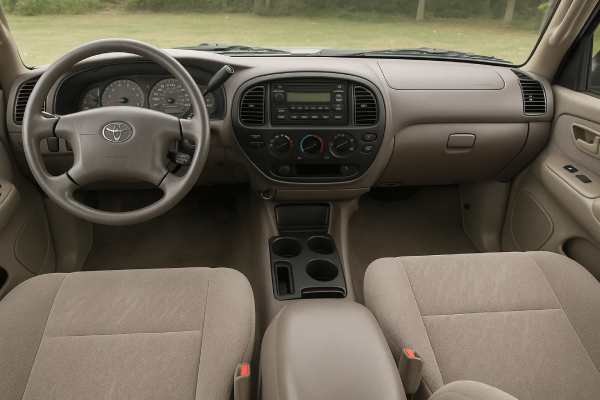
The interior is practical and straightforward: clear analogue gauges, large HVAC and audio controls, and materials that tend to age well if cleaned periodically. Higher trims add leather, power seats, and premium audio, but even work-oriented versions feel more refined than many same-era rivals.
The 4×4 system is part-time: the truck runs in rear-wheel drive on dry pavement and uses 4H or 4L when needed. Engagement is typically via a lever or an electronic selector, with the front differential connecting through a vacuum or electric actuator rather than manual locking hubs. This layout is simple, durable, and familiar to anyone who has owned a Toyota 4×4 from the late 1990s or early 2000s.
For many current owners, the main attractions of the XK40 4.7 are its mechanical honesty, parts interchange with other Toyota models, and the feeling that the truck was engineered conservatively. The trade-offs are typical for the era: basic safety electronics, relatively thirsty fuel consumption, and the need to pay close attention to frame condition in rust-prone regions.
2UZ-FE 4×4 technical breakdown
This section focuses on the 1999–2002 Tundra XK40 with 2UZ-FE 4.7 l V8, part-time 4×4, and 4-speed automatic. Exact figures vary by year, cab/bed combination, axle ratio, and market, so always confirm against the documentation for a specific VIN.
Engine and performance (Engine and Performance)
| Item | Value |
|---|---|
| Engine code | 2UZ-FE V8 petrol |
| Layout and valvetrain | 90° V8, iron block, aluminium DOHC heads, 4 valves/cyl |
| Displacement | 4.7 l (4,663 cc) |
| Bore × stroke | 94.0 mm × 84.0 mm |
| Induction | Naturally aspirated |
| Fuel system | Sequential multiport fuel injection |
| Compression ratio | Around 9.6 : 1 |
| Max power | Approx. 245 hp (183 kW) @ ~4,800 rpm |
| Max torque | Roughly 315 lb-ft (≈426 Nm) @ ~3,400 rpm |
| Firing order | 1–8–4–3–6–5–7–2 |
| Emissions standard (period) | Low-emission petrol, US and Japanese regulations |
| Typical combined consumption (4×4) | About 14–17 l/100 km (14–17 mpg US) in mixed use |
The engine’s focus is smooth, low-end and midrange torque rather than peak power. In a 4×4 Tundra, that translates to relaxed cruising and confident towing within the truck’s rated limits.
Transmission and driveline (Transmission and Driveline)
| Item | Value |
|---|---|
| Transmission | 4-speed automatic with lock-up torque converter (A340-series family) |
| Gear ratios (typical) | 1st 2.804, 2nd 1.531, 3rd 1.000, 4th 0.705, Rev 2.393 |
| Transfer case | Part-time, 2H / 4H / 4L, manual or electronic selection |
| Drive type | 4×4 (rear-drive on pavement, selectable front axle) |
| Front differential | Independent front differential with CV shafts |
| Rear differential | Solid axle, usually open; limited-slip available on some builds |
| Common axle ratios | Around 3.91:1 or similar, depending on tow package and market |
| Towing hardware | Optional tow package with hitch receiver, wiring, and auxiliary coolers (config-dependent) |
Chassis and dimensions (Chassis and Dimensions)
| Item | Value |
|---|---|
| Frame | Ladder-type steel frame |
| Front suspension | Independent double wishbone with coil springs and anti-roll bar |
| Rear suspension | Solid axle with leaf springs and anti-roll bar on some trims |
| Steering | Rack-and-pinion, hydraulic power assist |
| Brakes | Front ventilated discs, rear drums; ABS widely available/standard |
| Typical wheel/tyre | About 245/70 R16; off-road packages may use more aggressive tyres |
| Overall length | Roughly 5,525–5,600 mm (217–220 in) by cab/bed |
| Width | Around 1,910 mm (75 in) excluding mirrors |
| Height | Approx. 1,800–1,830 mm (71–72 in) for 4×4 ride height |
| Wheelbase | About 3,260 mm (128.3 in) in common configurations |
| Ground clearance | Typically 270–290 mm (10.5–11.4 in) unladen for 4×4 |
| Curb weight | Around 2,050–2,150 kg (4,500–4,740 lb) depending on trim |
| GVWR | Roughly 2,720–2,860 kg (6,000–6,300 lb) |
Performance and capability (Performance and Capability)
| Item | Value |
|---|---|
| 0–100 km/h (0–62 mph) | Approximately mid/high 8s to low 9s seconds, unloaded |
| Top speed | Around 170 km/h (105 mph), limited more by gearing and drag than power |
| Max trailer weight (braked) | Often 3,000–3,400 kg (6,500–7,500 lb) with tow package and correct equipment |
| Typical payload | About 700–900 kg (1,500–2,000 lb), trim-dependent |
| Off-road geometry | Respectable stock approach and departure angles; limited primarily by tow hitch and side steps |
Fluids, service capacities, and electrics (Fluids and Electrical)
Exact values depend on year and variant; always verify with a manual.
- Engine oil: roughly 6.2–6.6 l (6.5–7.0 US qt) with filter; typical viscosity 5W-30 or 0W-30 meeting Toyota and API specs.
- Engine coolant: Toyota long-life coolant (red/pink); around 10–12 l total capacity.
- Automatic transmission fluid: Toyota ATF Type T-IV (or later-approved equivalent), roughly 10 l total (much less per drain-and-fill).
- Front differential oil: 75W-90 GL-5, volume per housing spec.
- Rear differential oil: 75W-90 GL-5 (or as specified), volume per axle code.
- Transfer case fluid: ATF or gear oil depending on transfer case model.
- Power steering: ATF-type fluid per reservoir label.
- A/C refrigerant: R134a with charge quantity marked on underhood label.
- Alternator output: typically around 100–130 A, variant-dependent.
- Spark plugs: long-life platinum/iridium with gaps set per manual; service interval usually 60,000–100,000 miles.
Tundra 4×4 trims and protection
The 4×4 2UZ-FE Tundra generally mirrors the 2WD lineup in trim hierarchy, but equipment mixes lean more toward capability and comfort in bad-weather and off-road use. Nomenclature varies slightly by market, but the typical North American pattern is base, SR5, and Limited, with optional off-road packages such as TRD on some trucks.
Trim and equipment overview
Base 4×4 V8
- Cloth bench or split-bench seating.
- Steel wheels, simpler exterior trims, and basic audio.
- Manual air conditioning and limited power features.
- Mechanically shares engine, transmission, and 4×4 hardware with higher trims, making it attractive for owners who prioritise simplicity.
SR5 4×4 V8
- The volume trim level for many markets.
- Power windows and locks, keyless entry on most examples.
- Alloy wheels, chrome bumpers and grille, and extra storage.
- Upgraded cloth seats, often with split-fold rear seating and more interior conveniences.
Packages commonly available on SR5 trucks include:
- Tow package (receiver hitch, wiring harness, and cooling upgrades).
- Appearance or “sport” packages with specific wheels and body trims.
- In some cases, TRD Off-Road–type packages with tuned shocks and skid plates.
Limited 4×4 V8
- Leather seating on many trucks, with power-adjustable front seats.
- Automatic climate control and premium audio systems.
- More sound insulation and cosmetic upgrades such as body-colour bumpers, fog lamps, and larger alloy wheels.
- Often includes tow hardware and convenience features as standard, making it an appealing all-rounder for mixed work and family use.
Off-road and tow-focused options
Trim level alone does not always reveal how a truck is equipped for off-road or towing:
- Some SR5 and Limited trucks have factory skid plates, Bilstein or similar shocks, and specific wheel/tyre packages that significantly improve rough-road control.
- Axle ratio and tow package content can change the official tow rating; reading the door jamb label, axle code, and tow package documentation is important.
- Aftermarket additions such as winches, lift kits, and larger tyres can improve off-road capability but may add stress to steering, suspension, and drivetrain components.
Safety ratings and protection
In period crash testing, the first-generation Tundra performed well in key categories:
- IIHS frontal offset testing for early Tundras reported a “Good” overall rating and noted that the truck compared favourably with competing full-size pickups, some of which scored “Marginal” or “Poor” at the time.
- NHTSA frontal crash tests gave strong results for driver and passenger protection on many configurations.
Standard and typical safety equipment:
- Dual front airbags.
- Three-point seatbelts for outboard seats; lap belts for some centre positions.
- Anti-lock braking system (ABS), commonly standard on V8 4×4 trims.
What the truck does not have:
- No factory electronic stability control or traction control on early model years.
- No factory lane keeping, automatic emergency braking, blind-spot monitoring, or radar cruise systems.
Child-seat arrangements rely heavily on correct seat belt use and, where present, top tether anchors; ISOFIX/LATCH anchors were not universally fitted in all markets at this time.
Safety-related service and calibration points
Because the XK40 predates complex ADAS, safety maintenance focuses on core systems:
- Braking: pad and rotor condition, brake fluid freshness, and line integrity, especially in rust-prone regions.
- Tyres and suspension: good tread, correct pressures, and tight steering/suspension joints to preserve stability and stopping distances.
- Frame and crossmembers: absence of severe corrosion at critical mounting points for springs, shocks, and steering components.
After significant structural work—such as frame repairs or crossmember replacement—alignment, steering pull, and brake behaviour should be checked thoroughly on road tests.
Long-term reliability and fixes
The XK40 2UZ-FE Tundra 4×4 enjoys a strong reputation for durability, especially in the engine and transmission. Age, rust, and neglected maintenance are now bigger threats than many original design choices. Understanding typical failure points by system helps prioritise repairs.
Engine and ancillaries
Timing belt and front-end service
- The 2UZ-FE uses a timing belt, not a chain, and Toyota’s recommended replacement interval is typically around 90,000 miles or 9 years.
- A comprehensive service often replaces the belt, idlers, tensioner, water pump, thermostat, and sometimes cam and crankshaft seals.
- Neglecting this service can risk loss of drive to camshafts; while 2UZ-FE damage behaviour varies by case, nobody wants a belt failure on the highway or while towing.
Cooling system
- Original radiators may develop cracks at the plastic end tanks or leaks at seams.
- Mineral-heavy or mixed coolant can promote internal corrosion and hot spots.
- Trucks used for towing or in hot climates benefit from proactive radiator, hose, and thermostat replacement once the original components age.
Oil leaks and gaskets
Common age-related leaks include:
- Valve cover gaskets, causing oil smell and minor seepage onto the exhaust.
- Front crankshaft and camshaft seals, particularly if oil change intervals were long.
- Oil cooler and oil filter housing seals on some variants.
Addressing these leaks during timing belt or other front-end services can significantly reduce labour duplication.
Starter motor and valley components
The starter on many 2UZ-FE installations sits in the engine “valley” beneath the intake manifold:
- As contacts wear, owners may experience intermittent no-crank or click-only symptoms.
- Replacement requires intake removal, which is labour-intensive.
- Many owners combine starter replacement with knock sensor or wiring inspections, intake gasket renewal, and deep cleaning of valley areas.
4×4 hardware, transmission, and driveline
Automatic transmission
The A340-family 4-speed automatic is generally robust when not overheated:
- Old, burnt, or contaminated ATF can lead to shift flare, harsh engagement, or delayed reverse.
- A sensible strategy is periodic drain-and-fill services, watching the fluid colour and smell.
- Trucks used for heavy towing or in mountainous terrain benefit from tow-package cooling and conservative driving.
Transfer case and differentials
Typical age- or usage-related issues include:
- Leaks at transfer case and differential seals, especially at the front axle where CV shafts exit.
- Worn or dried-out output shaft seals leading to drips at driveshaft flanges.
- Rare but possible gear or bearing wear if fluid was never changed or ran low.
Regular 4H/4L engagement keeps actuators, chain, and sliding components from sticking. Fluid changes at sensible intervals help the transfer case and differentials reach high mileages.
CV joints, driveshafts, and wheel bearings
- Torn CV boots admit dirt and lose grease, eventually causing clicking on turns under power.
- U-joints can develop play or vibration; neglected grease points accelerate wear.
- Wheel bearings may grow noisy or loose, especially after years on rough roads or with oversized tyres.
Frame corrosion and recalls
The most serious reliability concern on many early Tundras, including XK40 4x4s, is frame corrosion:
- Cold-climate trucks exposed to road salt can exhibit severe frame rust, especially at the rear crossmember, spare tyre carrier, and spring hangers.
- Toyota and NHTSA campaigns addressed frame corrosion and rear crossmember failures in certain 2000–2003 Tundra vehicles, including inspections, coatings, and in some cases frame replacement.
Even if a truck has paperwork for recall or service campaigns, the current condition of the frame must be checked. Poor prior repairs or new rust can undermine the value of any earlier work.
Typical pre-purchase reliability checks
When evaluating a used 4.7 4×4 Tundra:
- Confirm timing belt and water pump history with dates and mileages.
- Inspect for coolant leaks, overheating history, and condition of the coolant.
- Check for oil leaks around valve covers, front crank seal, and oil pan.
- Engage 4H and 4L; listen for grinding or clunks, and verify that 4×4 warning lights behave as expected.
- Look for CV boot tears, diff leaks, and transfer case drips.
- Perform a full underside and frame inspection, including rear crossmember, cab mounts, and fuel tank strap areas.
A truck with a healthy frame and strong maintenance records is often a better purchase than a lower-mileage example with questionable rust or incomplete service.
Maintenance planning and buying guide
Given age and typical use patterns, it is best to treat official maintenance intervals as minimums. A proactive, structured plan is key to making an XK40 Tundra 4×4 a long-term, dependable tool.
Practical maintenance schedule
Engine and cooling
- Engine oil and filter: every 5,000–7,500 miles (8,000–12,000 km) or 6–12 months, shorter intervals for frequent towing, dusty conditions, or many short trips.
- Engine air filter: inspect every 15,000 miles (24,000 km); replace at least every 30,000 miles (48,000 km), more often if off-road or dusty.
- Cabin filter (if fitted): 15,000–20,000 miles (24,000–32,000 km).
- Coolant: replace every 5 years or 60,000 miles (100,000 km), then inspect annually and top up with correct coolant.
- Spark plugs: 60,000–100,000 miles (100,000–160,000 km) depending on plug type and use.
- Fuel filter: if serviceable and external, replace around 60,000 miles or as specified.
Timing, belts, and hoses
- Timing belt, tensioner, idlers, and water pump: around 90,000 miles (145,000 km) or 9 years; sooner if history is unknown.
- Serpentine/aux belts: inspect at each oil change; replace about every 90,000 miles or at first sign of cracking or noise.
- Hoses (coolant, heater, and vacuum): inspect yearly; replace proactively after 10–12 years if original, or immediately if soft, cracked, or swollen.
Driveline, brakes, and 4×4 system
- Automatic transmission fluid: drain and fill every 30,000–60,000 miles (50,000–100,000 km).
- Front and rear differential oils: replace about every 60,000 miles or 5 years; sooner for heavy off-road or towing use.
- Transfer case fluid: on a similar interval to differential oils.
- Brake fluid: flush every 2–3 years regardless of mileage.
- Brake pads and rotors: inspect at least yearly; sooner if towing or driving in mountains.
- 4×4 system exercise: run through 2H–4H–4L on a suitable loose surface several times a year to keep actuators free.
Suspension, tyres, and electrics
- Steering/suspension: annual checks for ball joints, tie rods, control arm bushings, shocks, and strut mounts.
- Tyre rotation: every 5,000–7,500 miles (8,000–12,000 km); align annually or after suspension work.
- Wheel bearings: inspect for play and noise during brake and suspension inspections.
- 12 V battery: load-test yearly once over 4–5 years old; inspect terminals and cables for corrosion.
Fluid specifications and torque notes
- Use engine oil that meets Toyota’s recommendations and suits the climate; quality 5W-30 or 0W-30 is common.
- Use Toyota-approved long-life coolant; avoid mixing incompatible coolants.
- Use GL-5 gear oil of the specified viscosity in front and rear differentials.
- Torque critical fasteners—wheels, suspension arms, steering components, and brake calipers—to factory specs using a calibrated torque wrench.
Buyer’s checklist and recommended targets
When shopping for an XK40 4.7 4×4:
- Chassis and frame
- Check frame rails, rear crossmember, spring hangers, and cab mounts for severe rust, holes, or past repairs.
- Avoid trucks where metal flakes away easily or where patch plates are poorly welded.
- Powertrain and fluids
- Inspect oil and transmission fluid condition; very dark, burnt fluid suggests neglect.
- Watch for coolant stains around the radiator, water pump, and heater core pipes.
- Start the engine cold and warm; listen for knocking, ticking, or exhaust leaks.
- 4×4 system and driveline
- Test 4H and 4L engagement on appropriate surfaces.
- Listen for differential whine, transfer case growls, or driveshaft vibration at highway speeds.
- Check CV boots and driveshaft U-joints for damage and play.
- Interior and electrical
- Confirm that all electrical accessories, gauges, and HVAC functions work in all modes.
- Check for water leaks, damp carpets, or mould smells.
In general, a rust-free, mechanically sound Tundra with clear evidence of timing belt service and regular fluid changes is worth paying more for than a cheaper truck with an unknown history and a rusty frame. Planning for an initial “baseline” service—fluids, filters, belts, and a thorough inspection—is wise when taking ownership.
Driving performance in real use
On the road and trail, the XK40 4.7 4×4 Tundra focuses on smooth, predictable behaviour rather than headline-grabbing acceleration. That fits its role as a work and adventure truck rather than a performance machine.
Ride, handling, and refinement
The independent front suspension and leaf-sprung rear are tuned for a middle ground between comfort and load-carrying:
- Unladen, the rear can feel firm over sharp bumps or expansion joints, but the truck avoids the choppy ride some competitors show when empty.
- With tools, cargo, or camping gear in the bed, the ride typically settles and becomes more composed.
- Straight-line stability is good at highway speeds, even in crosswinds, when alignment and tyres are in good condition.
Steering effort is light at low speeds, helpful for parking and tight manoeuvres, and gains weight on the highway. Body roll in corners is noticeable but predictable; the truck encourages smooth, measured inputs rather than aggressive driving.
Cab noise is moderate to low for the era:
- The 2UZ-FE V8 is quiet at cruise and produces a muted growl under acceleration.
- Wind noise is reasonable, although roof racks and off-road accessories can add noticeable sound.
- Tyre roar becomes more pronounced with aggressive all-terrain or mud-terrain tyres.
Powertrain character and performance metrics
The 4.7 V8’s strong low-end torque defines how the truck drives:
- It pulls smoothly from low revs, making it easy to merge into traffic or climb grades without frequent downshifts.
- Kickdown for passing is prompt; the engine revs willingly but rarely feels strained within normal use.
- In everyday conditions, 0–100 km/h (0–62 mph) acceleration in the high 8s to low 9s second range feels more than adequate.
The 4-speed automatic’s simple logic is an advantage for long-term reliability:
- It upshifts early for economy in gentle driving.
- It locks the torque converter effectively at cruising speeds, reducing revs and noise.
- There are no drive-mode profiles to manage; drivers learn how the gearbox responds and can anticipate shifts easily.
Real-world fuel use and towing behaviour
Fuel consumption in real use is shaped by speed, load, and terrain:
- City driving: often 12–14 mpg US (17–20 l/100 km) depending on traffic and driving style.
- Highway cruising: 15–18 mpg US (13–16 l/100 km) is realistic at moderate speeds with stock tyres and no large roof load.
- Mixed driving: many owners report around 14–17 mpg US (14–17 l/100 km).
Towing within the rated range is a key strength:
- The V8’s torque and the 4×4 driveline give stable, confident behaviour with medium-sized travel trailers, boats, and equipment trailers.
- On long grades, the transmission will downshift, but the engine remains composed and temperatures are manageable if the cooling system is healthy and the truck is not overloaded.
- Fuel consumption can drop into the low teens mpg or worse when towing near maximum capacity, which is expected for a naturally aspirated V8 of this era.
Off-road traction and control
In low-traction conditions, the Tundra 4.7 4×4 offers:
- 4H for snow, rain, and gravel, improving stability and traction when tyre grip is limited.
- 4L for slow-speed crawling, steep climbs/descents, and technical manoeuvres.
- Enough ground clearance for most forestry roads and moderate trails, especially with all-terrain tyres and careful line choice.
Traction control and advanced terrain modes are absent; instead, progress relies on throttle modulation, tyre selection, and driver judgement. That simplicity appeals to owners who prefer mechanical solutions and who understand traditional 4×4 techniques.
Overall, the driving experience blends relaxed V8 torque, honest truck dynamics, and sufficient off-road ability to handle work, weekends, and winter without feeling exhausting or complicated.
4.7 V8 4×4 versus rivals
When new, the 4.7 V8 4×4 Tundra competed with V8-equipped 4×4 half-ton pickups like the Ford F-150 (4.6 and 5.4 V8), Chevrolet Silverado and GMC Sierra 1500 (4.8 and 5.3 V8), Dodge Ram 1500 (4.7 and 5.2/5.9 V8), and Nissan’s full-size offerings in some markets. Today, the comparison is as much about age, condition, and ownership costs as it is about original specs.
Strengths versus other full-size 4x4s
- Refinement and comfort
Contemporary reviews and owner feedback often noted the Tundra’s smooth powertrain, quiet cabin, and car-like ride as clear advantages over some rivals, particularly in base and mid trims. - Powertrain durability
The 2UZ-FE V8 and 4-speed automatic, when serviced, are known for covering high mileages with few internal failures. This reputation is bolstered by their use in heavy-duty Land Cruiser and Lexus applications. - Cabin and control layout
Interior materials and ergonomics tend to age gracefully. Switchgear, seat mechanisms, and basic electronics are generally robust, and most components are still serviceable with readily available parts.
Trade-offs and compromises
- Payload and size
The first-gen Tundra is closer to “mid-size plus” than today’s oversized half-tons. This can be a plus for manoeuvrability, but buyers needing maximum interior volume and the largest bed options might find it limiting. - Aftermarket ecosystem
While there is strong support for maintenance and mild modification, domestic truck platforms typically enjoy deeper aftermarket options for extreme lifts, engine tuning, and heavy-duty drivetrain swaps. - Safety and tech
Compared with newer trucks or even some later first-gen rivals, the XK40 lacks advanced safety electronics and driver assistance features. Buyers focused on state-of-the-art crash avoidance and connectivity may prefer younger vehicles.
Versus other Tundra powertrains
Within the first-generation Tundra lineup:
- Compared with the 3.4 V6 4×4, the 4.7 V8 offers stronger towing performance, more relaxed highway driving, and similar real-world fuel economy in many use cases.
- Compared with 2WD Tundra V8 models, the 4×4 adds capability on snow and trails but carries a slight fuel economy and maintenance penalty due to extra driveline components.
Who the XK40 4.7 4×4 suits today
The 2UZ-FE Tundra 4×4 is a strong fit if you:
- Want a reliable, straightforward V8 4×4 truck for towing, hauling, and real off-road use.
- Value mechanical simplicity and proven components over the latest electronics.
- Are willing to invest time in finding a rust-free example and maintaining it carefully.
It is less ideal if you need maximum fifth-wheel towing capability, the very latest safety tech, or a luxury-grade interior. For those needs, a newer full-size truck may be more appropriate. But for many owners, a clean XK40 4.7 4×4 Tundra offers a very appealing combination of durability, capability, and everyday usability that is hard to replace.
References
- 2000 Tundra – Owners’s Manual 2000 (Owner’s Manual)
- Toyota Manuals and Warranties | Toyota Owners 2023 (Owner’s Manual Library)
- Vehicle Detail Search – 2000 TOYOTA TUNDRA 2010 (Recall Database)
- 2000 Toyota Tundra 2005 (Safety Rating)
- Fuel Economy of 2000 Toyota Tundra 2020 (Fuel Consumption Data)
Disclaimer
This article is for informational purposes only and is not a substitute for professional diagnosis, repair, or official service documentation. Specifications, torque values, maintenance intervals, and procedures can vary by VIN, market, production date, and installed equipment. Always confirm details against your vehicle’s owner’s manual and factory service information, and consult a qualified technician before carrying out safety-critical work.
If you found this guide useful, please consider sharing it with other owners or enthusiasts on Facebook, X/Twitter, or your preferred forums to support xcar’s work and help more people keep their trucks safely on the road.