
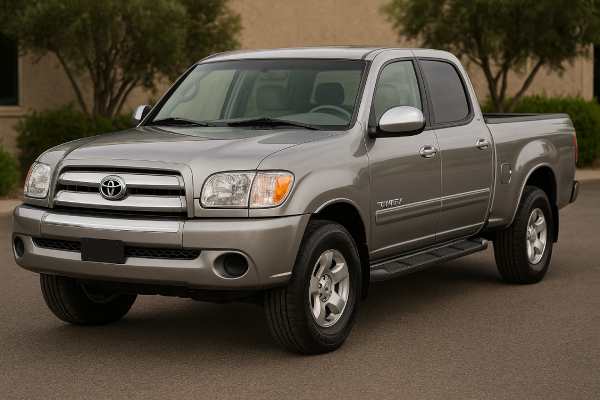
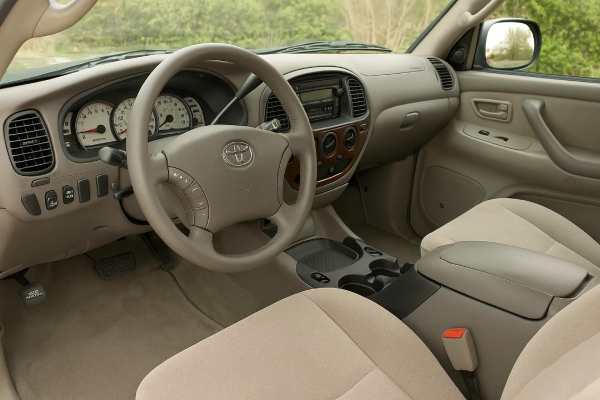
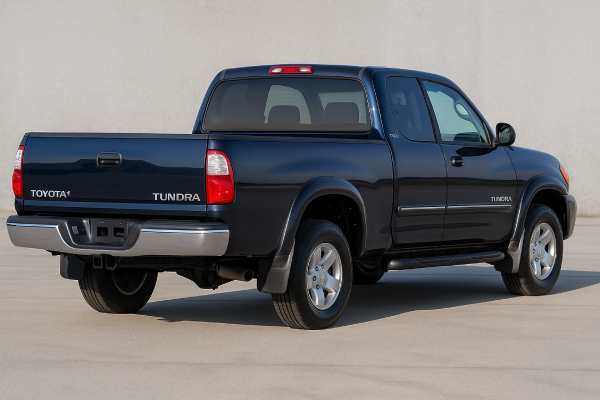
The 2004–2005 Toyota Tundra RWD (XK30) with the 2UZ-FE 4.7 litre V8 sits in a sweet spot for many buyers: old enough to be affordable, new enough to feel modern, and powered by one of Toyota’s most durable engines. The facelift years brought the stronger VVT-i version of the 4.7, rated at 282 hp and 325 lb-ft in U.S. spec, giving noticeably better mid-range pull without hurting day-to-day drivability.
As a rear-wheel-drive half-ton on a relatively compact frame, the XK30 Tundra is easy to place in traffic yet still offers serious towing and payload capability in regular-cab V8 form. What really defines this truck, though, is its mix of bulletproof mechanicals and very real age-related issues like frame corrosion and suspension recalls. If you understand those trade-offs, a carefully inspected 2UZ-powered Tundra can deliver hundreds of thousands of miles of service with straightforward maintenance.
Fast Facts
- Strong 2UZ-FE 4.7 V8 with VVT-i, rated around 282 hp and 325 lb-ft, widely known for 300,000+ mile lifespans with proper care.
- Regular Cab 2WD 4.7 can tow roughly 7,000 lb and carry around 2,000 lb payload when properly equipped.
- Major age-related concerns: frame rust in salt regions and lower ball joint recall; both must be verified by VIN.
- Typical fuel economy for 4.7 RWD is around 15 mpg combined (about 15.7 L/100 km), with 14/17 city/highway.
- Timing belt service interval is roughly 90,000 miles / 145,000 km or about 6–9 years; combine with water pump and drive belts.
Navigate this guide
- Toyota Tundra XK30 RWD overview
- Toyota Tundra XK30 specs and data
- Trims, equipment and safety tech
- Reliability, issues and service notes
- Maintenance schedule and buying tips
- Driving impressions and performance
- How this Tundra compares rivals
Toyota Tundra XK30 RWD overview
The first-generation Toyota Tundra (1999–2006) was Toyota’s first serious entry into the U.S. full-size pickup market. XK30 designates rear-wheel-drive models on this platform; XK40 covers the 4×4 versions. For 2004–2005, Toyota updated styling, added the Double Cab, and, crucially for 2005, upgraded the 4.7 V8 to the VVT-i 2UZ-FE with the 282 hp rating highlighted in this article.
When people talk about the “bulletproof” Tundra, this engine and chassis combination is usually what they mean. The 2UZ-FE uses a cast-iron block, aluminum DOHC heads and conservative tuning, prioritising longevity over peak output. Owners routinely report 250–350k miles from the drivetrain if oil changes, timing belt and cooling system service are kept up.
The RWD XK30 layout keeps things simple: no transfer case, fewer u-joints, and a straightforward rear differential. That means less weight, slightly better fuel economy and easier servicing than the 4×4 versions. In regular-cab long-bed 4.7 V8 form, you typically get:
- Seating for three
- A long 8-foot bed
- Around 4,300 lb curb weight
- Roughly 2,000 lb payload and up to about 7,000+ lb towing when properly equipped
The 2004 facelift modernised the exterior and interior, and by 2005 the VVT-i engine, five-speed automatic and available stability control brought it closer to later trucks in refinement. However, you do not get modern driver aids like automatic emergency braking, lane keeping or blind-spot monitoring. Safety is solid for its era but basic by today’s standards.
In short, the 2004–2005 Tundra XK30 RWD is best thought of as a “classic modern” truck: big enough for real work, small and simple enough to live with comfortably, and built around an over-engineered V8 that rewards consistent maintenance.
Toyota Tundra XK30 specs and data
Below specs focus on a typical 2005 Toyota Tundra Regular Cab 2WD (XK30) with the 2UZ-FE 4.7 V8 and 5-speed automatic. Figures can vary slightly by market, trim and equipment; always verify against the VIN and local documentation.
Engine and performance (2UZ-FE VVT-i)
| Item | Detail |
|---|---|
| Engine code | 2UZ-FE VVT-i “i-Force” |
| Layout & cylinders | 90° V8, DOHC, 32 valves, 4 valves/cyl |
| Block / head | Cast-iron block, aluminum heads |
| Displacement | 4.7 L (4,663 cc) |
| Bore × stroke | 94.0 × 84.0 mm (3.70 × 3.31 in) |
| Induction | Naturally aspirated |
| Fuel system | Sequential multi-port injection (SFI) |
| Compression ratio | About 10.0:1 (VVT-i versions) |
| Max power | 282 hp (210 kW) @ 5,400 rpm |
| Max torque | 325 lb-ft (441 Nm) @ 3,400 rpm |
| Firing order | 1-8-4-3-6-5-7-2 |
| Timing drive | Belt to intake cams, gears to exhaust cams |
| Recommended fuel | Regular unleaded (87 AKI) in most markets |
| EPA economy (typical 4.7 RWD) | Roughly 15 mpg US combined; ~14 city / 17 highway |
| Approx. metric economy | ~15.7 L/100 km combined; ~16.8 city / 13.8 highway (derived) |
| Real-world highway @ 120 km/h | Often 13–15 L/100 km (15–18 mpg US) depending on load and tyres |
Transmission and driveline
| Item | Detail |
|---|---|
| Transmission | 5-speed automatic, A750E overdrive |
| Gear ratios | 1st 3.52; 2nd 2.04; 3rd 1.40; 4th 1.00; 5th 0.72; Rev 3.22 |
| Drive type | Rear-wheel drive (XK30) |
| Rear differential | Open, ratios around the mid-3.9:1 range on many 2WDs |
Chassis and dimensions (Regular Cab 2WD, long bed)
| Item | Detail |
|---|---|
| Front suspension | Double wishbone, coil-spring/strut with anti-roll bar |
| Rear suspension | Leaf springs with solid axle |
| Steering | Rack-and-pinion power steering |
| Brakes | Front ventilated discs; rear drums on many trims |
| Wheel / tyre examples | 16 in alloys or steel, e.g. 245/70 R16 |
| Length | About 218 in (≈5,540 mm) |
| Width | About 75 in (≈1,910 mm) |
| Height | About 70–71 in (≈1,790 mm) |
| Wheelbase | About 128 in (≈3,250–3,260 mm) |
| Ground clearance | Around 10 in (≈250–265 mm) for many 4.7 2WDs |
| Curb weight | ≈4,250–4,350 lb (≈1,930–1,975 kg) |
| GVWR | ≈6,300–6,600 lb depending on spec |
| Fuel tank | Around 26 US gal (≈100 L) |
| Payload | Up to about 2,000–2,050 lb (≈900–930 kg) in Regular Cab 4.7 2WD |
Performance and capability
| Item | Detail |
|---|---|
| 0–60 mph (0–96 km/h) | Roughly 7.5–8.0 s for 4.7 VVT-i 2WD |
| Top speed | Electronically limited; typically around 110–115 mph (177–185 km/h) |
| Towing capacity | Up to about 7,000–7,100 lb (≈3,200 kg) for Regular Cab 4.7 2WD properly equipped |
| Braked vs unbraked | Many markets rate about 5,000 lb without weight-distributing hitch; check local data |
| Roof load | Commonly around 100–150 lb rated for OEM racks (varies by accessory) |
Fluids and service capacities (typical values)
| System | Spec and capacity (approximate) |
|---|---|
| Engine oil | API SJ/SL 5W-30; ~6.4–6.8 L (about 6.8–7.2 qt) with filter |
| Coolant | Toyota Long Life / Super Long Life coolant; roughly 10–11 L total system (varies; check manual) |
| ATF | Toyota Type T-IV or WS depending on production; pan drain ≈3–4 L, full refill higher |
| Rear differential | ~2.0–2.5 L of 75W-90 GL-5 (verify label) |
| A/C refrigerant | R-134a; charge amount specified on under-hood label |
| Oil pan drain plug torque | Around 39 Nm (29 ft-lb) |
| Typical wheel lug nut torque | Around 112 Nm (83 ft-lb); confirm for your truck |
Electrical
| Item | Detail |
|---|---|
| Alternator | Roughly 100–130 A depending on trim |
| 12 V battery | Group 24/27 style, typically 550–700 CCA |
| Spark plugs | Iridium, with gap around 1.1 mm (0.043 in) |
Safety and driver assistance
| Item | Detail |
|---|---|
| Frontal crash ratings | Good frontal performance in major offset tests for airbag-equipped models |
| NHTSA ratings | Many cab/airbag combinations scored four to five stars in frontal and side tests; rollover ratings lower due to height |
| Airbags | Dual front airbags; available front-seat side airbags and curtain airbags on some trims |
| ABS | Standard 4-wheel ABS on most 2004–2005 Tundras |
| Stability / traction control | TRAC and VSC available/standard on many 2005 V8 trims; not fitted to all trucks |
| ADAS | No AEB, lane-keeping or blind-spot monitoring; parking sensors rare and usually aftermarket or dealer-installed |
Trims, equipment and safety tech
For the facelift era, the rear-drive V8 Tundra was offered mainly in three trim levels in North America: base, SR5 and Limited. Within those, you had Regular Cab, Access Cab and Double Cab body styles; our focus is the RWD Regular Cab and its close relatives, but the mechanical picture is similar across XK30 V8 trucks.
Trim and options overview
- Base / Work Truck – Vinyl or basic cloth, minimal power equipment, steel wheels, air conditioning, basic audio. Often Regular Cab with long bed; ideal as a simple workhorse.
- SR5 – The volume trim. Adds better cloth seats, more sound insulation, power windows/locks, alloy wheel options, upgraded audio and more interior storage.
- Limited – More upscale finishes, leather on many trucks, JBL audio, power driver’s seat, larger wheels and additional appearance trim.
Mechanical differences by trim are modest but matter:
- Most V8 Tundra XK30s use similar suspension, brakes and driveline hardware.
- Tow-package trucks may have:
- Shorter (numerically higher) rear axle ratio in the 3.9x range
- Transmission cooler
- Heavier-duty alternator
- Slightly higher tow rating
Wheel and tyre packages vary: base 16 in steel wheels with tall sidewalls versus 16–17 in alloys on SR5/Limited, which slightly firm up the ride and can reduce snow-tyre sidewall height.
Safety equipment by trim and year
- Dual front airbags are standard across the line.
- Side torso and curtain airbags were optional on many 2005 trucks; these significantly improve side-impact performance when fitted.
- ABS is present on nearly all facelift Tundras, but Vehicle Stability Control (VSC) and traction control appear only on certain V8 trims – often as part of packages on higher trims or with specific option bundles.
There are no advanced camera or radar systems on 2004–2005 trucks; reversing cameras and parking sensors were still rare dealer or aftermarket accessories.
Safety ratings and what they mean for buyers
The first-generation Tundra achieved strong frontal crash performance in major independent tests, making it a standout among early-2000s full-size pickups. However, side-impact protection is strongly dependent on airbag fitment. Rollover ratings reflect the tall stance and truck architecture rather than any unusual stability problem.
From a buyer’s perspective:
- Prefer trucks with side and curtain airbags where possible.
- For families or frequent passengers, Double Cab models with full-size rear doors and side airbags are safer and more convenient.
- For fleet or work use, a Regular Cab with basic trim still provides a solid safety baseline, but you rely more on the inherent crash structure and less on extra restraint technology.
Because these are 20-year-old vehicles, the condition of seatbelts, airbag systems and any structural repairs after crashes matters as much as the original rating. A pre-purchase inspection should always include an airbag system scan and careful under-body inspection.
Reliability, issues and service notes
Mechanically, the 2UZ-FE / A750E combination is one of Toyota’s most durable powertrains. Many engines run well past 300,000 miles with only routine service. The main reliability story with a 2004–2005 Tundra XK30 RWD is age-related wear and corrosion-related campaigns, not catastrophic engine design faults.
Common / important issues
- Frame corrosion (common in rust-belt trucks; high severity)
- Symptoms: heavy scale rust on frame rails and crossmembers, flaking metal, perforation near leaf spring hangers or rear crossmember.
- Cause: road-salt exposure; first-gen Tundra frames were prone to rust in harsh climates.
- Actions: Toyota has run service campaigns and frame inspection programs in certain regions, including CRC coating or full frame replacement where perforation exceeded set limits.
- Buyer takeaway: treat frame condition as make-or-break. If a frame replacement was performed, documentation is valuable; if not, inspect with a pick and lift.
- Front lower ball joint recall (common, high severity if neglected)
- Symptoms: clunking, wander, uneven tyre wear; in worst cases, separation leading to wheel collapse.
- Cause: premature wear of lower ball joints in 2004–2006 Tundra/Sequoia.
- Official remedy: safety recall replacing front lower ball joints with revised parts.
- Buyer takeaway: verify recall completion via the official VIN recall tool or dealer records.
- Rusty brake and fuel lines (occasional, medium severity)
- Symptoms: soft pedal, fluid leaks, or fuel smell under body.
- Cause: the same salt exposure that attacks frames will also corrode hard lines.
- Remedy: replace affected lines; sometimes done during frame campaigns.
- Exhaust manifold cracks / leaks (occasional, medium cost)
- Symptoms: ticking noise at cold start, exhaust smell, emissions fault codes in some cases.
- Cause: heat cycling of cast manifolds with age.
- Remedy: manifold replacement or upgraded headers where emissions rules permit.
- Age-related suspension wear (common, low–medium cost)
- Bushings, shocks, steering rack bushings and wheel bearings can be tired on high-mileage trucks; symptoms include vague steering, clunks and uneven tyre wear.
- Refreshing suspension can dramatically improve ride, tracking and braking feel.
Powertrain reliability
The 2UZ-FE VVT-i itself has an excellent record:
- Timing belt – belt-driven cams with a recommended interval around 90,000 miles / 145,000 km. If the belt fails, you risk severe engine damage, so staying on schedule is critical.
- Oil leaks – rocker cover gaskets and front crank seals can seep with age, but usually slowly and predictably.
- Cooling system – original radiators, hoses and water pumps are now at or beyond their design life; these are age-limited items and should be treated as preventative maintenance after 15–20 years or at timing belt service.
The A750E 5-speed automatic is generally robust if fluid is clean. Neglect (very long drain intervals, overheating from heavy towing with old fluid) can lead to shudder or harsh shifts. A measured approach is to perform periodic drain-and-fills rather than aggressive flushes on high-mileage units.
Software and campaigns
These trucks pre-date most complex over-the-air software updates, but a few items matter:
- Some VSC/traction control warning-light issues are resolved by sensor replacement or ECU calibration after repairs.
- Recall and service-campaign bulletins cover ball joints, frame inspections and corrosion treatments, and various label or compliance items.
Pre-purchase checks to request
- Full service history with proof of timing-belt and water-pump replacement.
- Documentation of frame inspection or replacement, especially in salt states or coastal regions.
- Confirmation that all recalls and service campaigns are closed for that VIN.
- Evidence of recent fluid services (engine oil, ATF, diff, coolant, brake fluid).
- Professional inspection of ball joints, tie-rods, control-arm bushings and rear leaf shackles, plus a road test checking for driveline noises and vibration.
Maintenance schedule and buying tips
Because these trucks are now two decades old, condition and maintenance history matter more than mileage alone. The table below gives a practical baseline for a 2UZ-FE Tundra; always compare with the official schedule for your market.
Practical maintenance intervals (approximate)
| Item | Interval (distance / time) | Notes |
|---|---|---|
| Engine oil & filter | 5,000–7,500 mi (8,000–12,000 km) or 6–12 months | Use quality 5W-30 oil, 6.4–6.8 L with filter. Shorter intervals for towing or short-trip use. |
| Engine air filter | Inspect yearly; replace 30,000–40,000 mi (50–65k km) | More often in dusty conditions. |
| Cabin filter | 15,000–20,000 mi (24–32k km) or every 2 years | If equipped; some early trucks lack an easy cabin filter retrofit. |
| Spark plugs | 90,000–120,000 mi (145–190k km) | Iridium plugs; replace sooner if misfires appear. |
| Fuel filter | In-tank on many models; inspect/replace as needed | Often serviced with fuel pump; check local documentation. |
| Timing belt & water pump | 90,000 mi (145k km) or 6–9 years | Replace belt, tensioner, idlers, water pump, drive belts and cam/crank seals as needed. |
| Coolant | 100,000 mi (160k km) initial, then every 50–60k mi (80–100k km) or 5 years | Use Toyota Long Life / Super Long Life coolant. |
| ATF (A750E) | 60,000–90,000 mi (95–145k km) | Drain-and-fill; more frequent with towing or heavy use. |
| Rear differential oil | 30,000–60,000 mi (50–95k km) | Use GL-5 75W-90; shorter interval for heavy towing. |
| Brake fluid | Every 2–3 years | Full flush to reduce internal corrosion. |
| Brake pads/rotors | Inspect every 10,000–15,000 mi (16–24k km) | Rust on backing plates and hardware is common with age. |
| Power-steering fluid | Inspect annually; refresh 60,000–90,000 mi | Gradual exchange is usually sufficient. |
| Tyre rotation & alignment | Rotate every 5,000–7,500 mi; align regularly | Helps keep steering tight and wear even. |
| 12 V battery | Test annually after 4–5 years; replace around 6–7 years | Weak batteries can trigger ABS/VSC warning lights and no-starts. |
Fluid specs to know
- Engine oil – API SJ/SL 5W-30, around 6.4–6.8 L with filter.
- Coolant – Toyota red or pink Long Life / Super Long Life mix; follow label for water ratio.
- Brake fluid – DOT 3 or DOT 4 as specified.
- Differential – GL-5 75W-90; capacity varies by axle.
Use torque specs like roughly 39 Nm for the engine drain plug and around 112 Nm for wheel lug nuts as ballpark values, but always confirm in the correct manual for your model year.
Buyer’s checklist
When inspecting a 2004–2005 Tundra XK30:
- Frame and underside – Lift the truck and probe frame rails, crossmembers and leaf spring mounts for perforation. Surface rust is acceptable; scaling, flaking and holes are not.
- Front suspension – Check for play in lower ball joints (even if recall done), upper ball joints, tie rods and control-arm bushings.
- Driveline slack – Light clunk when shifting from R to D can be normal, but loud bangs or harsh engagement merit further inspection.
- Cooling system – Look for crusty residue around radiator seams, water pump weep hole and hoses.
- Electronics – Confirm that ABS, TRAC and VSC lights cycle correctly at start-up and stay off while driving.
Best configurations to target
- For pure work: Regular Cab 2WD 4.7 with tow package, clean frame and documented belt service.
- For mixed family and work: Access Cab or Double Cab 4.7 with side/curtain airbags and, ideally, stability control.
Avoid trucks with:
- Significant frame perforation or poorly executed repairs.
- Unknown timing-belt status over 120,000 mi / 190,000 km.
- Persistent ABS/VSC/airbag warning lights and no diagnostic report.
Long-term, a well-maintained 2UZ-powered Tundra is one of the more durable full-size trucks available from this era, with parts support still strong and plenty of enthusiast knowledge around.
Driving impressions and performance
The 2UZ-FE VVT-i transforms the first-gen Tundra from “adequate” to “effortless” in everyday driving. Compared to earlier non-VVT-i 4.7s, the 282 hp facelift engine pulls more strongly from mid-range revs while remaining smooth and quiet.
Powertrain character
- Low-rpm response – Off-idle torque is modest, but by 1,500–2,000 rpm the V8 feels strong and linear. This suits towing or hauling better than a peaky engine.
- Mid-range – From about 2,500–4,500 rpm the Tundra accelerates confidently, merging onto highways and passing at 50–70 mph without drama. Real-world 0–60 mph times in the high-7 to low-8 second range are typical for a stock 2WD VVT-i truck.
- Transmission behaviour – The 5-speed A750E shifts smoothly, with sensible spacing; fifth gear drops revs significantly on the highway compared with earlier 4-speeds. Under load it will hold gears rather than constantly hunting, especially with tow/haul-style shift logic and correct axle ratio.
Ride, handling and NVH
The XK30 Tundra is lighter and narrower than later full-size trucks, which helps in town. Steering is light but accurate, and the front double-wishbone suspension keeps the front end composed over bumps. With an empty bed, the rear leaf springs can feel bouncy on broken pavement – typical for a body-on-frame pickup – but with a few hundred pounds in the bed the ride settles nicely.
Cabin noise is well controlled for an early-2000s truck:
- The V8 is quiet at cruise, with a muted growl under throttle.
- Wind noise is modest; tyre noise depends heavily on tyre choice (aggressive all-terrains will be louder).
Braking and control
Front discs and rear drums provide adequate braking for stock use. Well-maintained brakes stop straight and predictably, but rotor corrosion and cheap pads can hurt performance. ABS intervention is conservative; you will feel some pedal pulsation on loose surfaces.
On trucks equipped with TRAC and VSC, stability control will cut power and pulse brakes if it senses a slide, improving stability on wet or snowy roads. However, these systems are not as refined as modern ESC setups, and some owners find them intrusive during spirited driving or when towing on steep grades.
Real-world economy and towing behaviour
In mixed commuting, many owners report:
- City – 13–15 mpg US (18–21.5 L/100 km)
- Highway (100–120 km/h) – 15–18 mpg US (13–16 L/100 km) if driven gently
- Mixed – around 15–16 mpg US (14.5–15.7 L/100 km)
When towing close to the 7,000 lb limit, you can expect fuel consumption to worsen significantly, often into the 9–11 mpg US range (21–26 L/100 km), especially on grades or into a headwind.
Stability while towing is generally good:
- Long wheelbase Regular Cabs are stable with correctly set up hitches.
- Integrated trailer brake controllers were not factory-fitted; you’ll rely on an aftermarket controller and proper brake adjustment on the trailer.
In snow or off-pavement use, the RWD XK30 will obviously not match a 4×4, but good winter tyres, a locking rear differential (if fitted) and some bed weight make it surprisingly capable for light duty. If you regularly drive on unploughed roads or tow in winter, a 4×4 XK40 may be a better fit.
How this Tundra compares rivals
When new, the 2004–2005 Tundra RWD 4.7 competed with trucks like the Ford F-150 4.6/5.4, Chevrolet Silverado 1500 4.8/5.3, Dodge Ram 1500 4.7/5.7 and Nissan Titan 5.6. Today, shoppers cross-shop the same era of those trucks on the used market.
Strengths versus rivals
- Powertrain durability – The 2UZ-FE V8 has one of the best reputations for longevity in the class, with relatively few systemic issues compared with some domestic V8s of the period.
- Refinement – Even by modern standards, the VVT-i 4.7 is smooth and quiet. The A750E 5-speed is well-behaved and generally less failure-prone than some contemporary 4-speed and early 5-speed automatics in competitors.
- Manageable size – First-gen Tundras are slightly smaller than most Big Three half-tons of the same era, making them easier to park and thread through tight spaces.
Areas where rivals may win
- Maximum capacity – Domestics and the Titan often offer higher maximum payload and towing capacities in specific heavy-duty or high-axle-ratio configurations. If you constantly haul near GVWR, a ¾-ton or later half-ton may be better.
- Cab configurations – While the Tundra Double Cab is roomy, some rivals offer even larger crew cabs and more rear-seat legroom.
- Aftermarket depth – There is decent aftermarket support for the Tundra, but the F-150 and Silverado enjoy a broader ecosystem of performance and work-truck parts.
Rust and recalls comparison
- Frame corrosion is a known issue for Tundra, Tacoma and some domestic trucks alike, but the Tundra’s frame campaigns mean buyers must be extra careful about inspection and documentation.
- Rivals of the same era often have their own issues – from spark-plug thread problems and transmission failures to electrical gremlins – so reliability comparisons depend heavily on brand, engine and service history.
Who the XK30 4.7 RWD suits best
Choose a 2004–2005 Tundra RWD 2UZ-FE if you:
- Want a durable, straightforward V8 truck mainly for on-road use and light off-pavement work.
- Value long-term reliability and ease of service over cutting-edge features or maximum towing numbers.
- Are willing to invest time in finding a clean, low-rust frame with documented suspension recall and timing-belt service.
If you need latest-generation safety tech, 8-speed transmissions, or 10,000+ lb towing, a much newer truck (including later Tundras) will be a better match. But for a solid, honest work and recreation truck, a sorted 2UZ-powered XK30 remains a very compelling used choice.
References
- 2005 Toyota Tundra 2005 (Safety Rating)
- Look up Safety Recalls & Service Campaigns by VIN 2024 (Recall Database)
- TOYOTA CUSTOMER SERVICES 2007 (Safety Recall – Front Suspension Lower Ball Joint)
- TOYOTA 2014 (Service Bulletin – Frame Corrosion Inspection and Treatment)
- Used 2005 Toyota Tundra Regular Cab Base – Specs & Features 2005 (Specifications Overview)
Disclaimer
This article is for informational purposes only and is not a substitute for professional diagnosis, repair or official service information. Specifications, torque values, maintenance intervals and procedures can vary by VIN, model year, market and installed equipment. Always confirm critical data against your vehicle’s official owner’s manual, service manual and current technical bulletins, and follow local regulations and safety procedures when working on your vehicle.
If you found this guide useful, consider sharing it with other owners or enthusiasts on platforms like Facebook or X/Twitter to help support xcar’s work and keep more of these trucks on the road.