
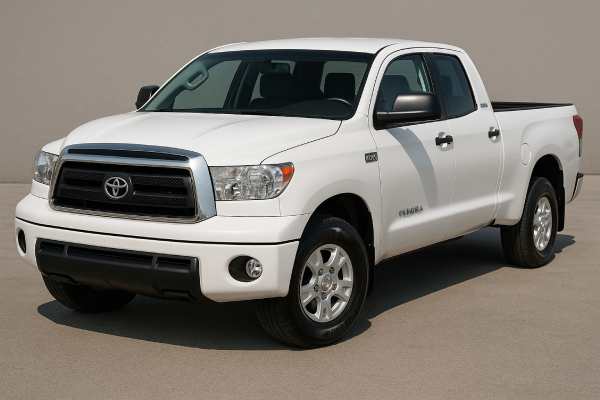
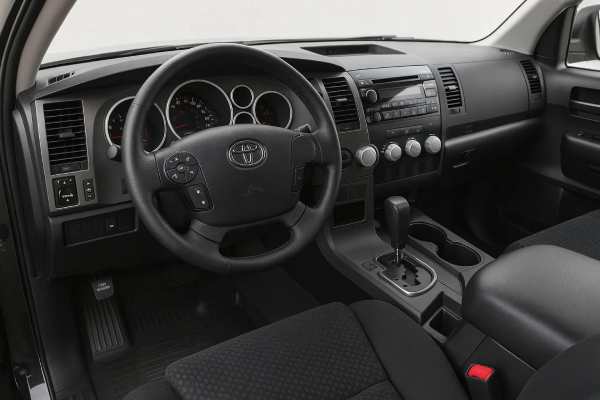
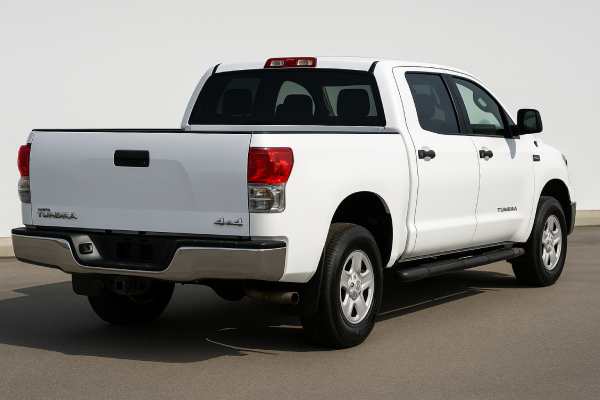
The 2007–2013 Toyota Tundra RWD (XK50) with the 5.7-liter 3UR-FE V8 is one of the most straightforward full-size pickups to own: big frame, big engine, and big capability. Toyota developed this generation specifically to compete head-on with domestic half-ton trucks, pairing a strong 381 hp V8 and 6-speed automatic with a heavy-duty chassis, integrated tow equipment, and generous cab and bed choices.
For today’s used buyers, the rear-wheel-drive 5.7 Tundra is attractive because it combines simple, proven hardware with excellent long-term durability and strong resale value. The trade-offs are predictable: high fuel use, a large footprint in tight cities, and safety tech that predates modern driver-assistance suites. If you want a truck that tows, hauls, and racks up high mileage with relatively few surprises—provided you keep up with basic maintenance—this Tundra generation deserves serious consideration.
Fast Facts
- 5.7-liter 3UR-FE V8 produces 381 hp and 401 lb-ft, giving roughly 6-second 0–60 mph performance in many tests.
- RWD 5.7 Tundras are typically rated to tow around 9,000–10,400 lb (about 4,100–4,700 kg) when properly equipped, with payloads over 1,500 lb (700+ kg).
- Known trouble spots include the secondary air-injection system, occasional water-pump leaks, and frame corrosion in heavy-salt regions.
- Real-world mixed fuel use for a 2WD 5.7 truck is usually around 15 L/100 km (about 15–16 mpg US), higher in city use or when towing.
- A practical service rhythm is engine oil and filter every 5,000 miles / 8,000 km or 6 months, even with quality synthetic oil.
Navigate this guide
- Toyota Tundra 5.7 RWD basics
- Toyota Tundra 5.7 key specs
- Tundra RWD trims safety tech
- Reliability issues and service actions
- Maintenance schedule and buying tips
- Driving character and real world mpg
- Toyota Tundra RWD vs rivals
Toyota Tundra 5.7 RWD basics
The second-generation Toyota Tundra (internal code XK50) arrived for 2007 as a clean-sheet full-size pickup. Compared with the earlier Tundra, it grew in every direction: a stronger frame, larger engines, bigger cabs, and higher payload and towing numbers. The 5.7-liter 3UR-FE V8 with rear-wheel drive is the configuration many shoppers focus on because it blends strong performance with simple, robust mechanicals and wide availability.
All 5.7-liter Tundras use an iron-block, aluminum-head DOHC V8 with dual variable valve timing and a 6-speed automatic transmission. In RWD form, the transmission is the AB60E, paired with a 4.30:1 rear axle ratio on most tow-package trucks. The 5.7 is the only engine in this generation that always includes a factory heavy-duty tow package, with upgraded cooling and an integrated hitch.
RWD models are especially common in warmer, flatter regions where buyers prioritize payload, towing on paved roads, and lower purchase cost over deep-snow traction. Compared with 4×4 versions, a 2WD Tundra offers slightly better fuel economy, less weight, and fewer driveline parts to service. With good tires and some weight over the rear axle, a RWD truck can still cover light winter duty, but on steep or icy roads it will not match a 4×4.
Model-year updates are relatively modest across 2007–2013. The early trucks established the core package; later years added safety refinements, minor styling changes, and some equipment reshuffling. There are no truly “bad” years in this span. Condition, rust, and maintenance history matter far more than the exact model year, so a clean 2008 can be a better buy than a neglected 2013.
Toyota Tundra 5.7 key specs
The tables below summarize typical specs for a 2007–2013 Toyota Tundra Double Cab 4×2 with the 5.7-liter V8. Exact figures can vary slightly by year, cab, bed length, and market, so always verify details against the truck’s VIN and official documentation.
Engine and performance
| Item | Spec |
|---|---|
| Engine code | 3UR-FE 5.7-liter V8 |
| Layout and valvetrain | 90° V8, DOHC, 32 valves, dual variable valve timing |
| Displacement | 5.7 L (5,663 cc) |
| Bore × stroke | 94.0 × 102.0 mm (3.70 × 4.02 in) |
| Compression ratio | About 10.2:1 (varies slightly by market/year) |
| Induction | Naturally aspirated |
| Fuel system | Sequential multi-port fuel injection |
| Max power | 381 hp (283 kW) @ 5,600 rpm |
| Max torque | 544 Nm (401 lb-ft) @ 3,600 rpm |
| Timing drive | Chain-driven camshafts |
| Emissions standard | Typically ULEV II / LEV II in North America |
| Rated economy (2WD 5.7) | Around 14 mpg US combined (about 16.8 / 13.1 / 14.9 L/100 km city / hwy / combined) |
| Real-world highway @ 120 km/h | Commonly 14–15 L/100 km (about 15–17 mpg US) unloaded |
Transmission and driveline
| Item | Spec |
|---|---|
| Transmission | 6-speed automatic, AB60E |
| Gear ratios (1st→6th, R) | 3.333 / 1.960 / 1.353 / 1.000 / 0.728 / 0.588, reverse 3.061 |
| Final drive ratio | 4.30:1 on most 5.7-liter tow-package trucks |
| Drive type | Rear-wheel drive (4×2) |
| Differential | Open differential with Auto LSD (brake-based electronic limited-slip function) |
Chassis and dimensions (typical Double Cab 4×2)
| Item | Spec |
|---|---|
| Front suspension | Double wishbone, coil springs, gas-charged shocks |
| Rear suspension | Solid rear axle, leaf springs, gas-charged shocks |
| Steering | Rack-and-pinion, power assisted |
| Brakes | Front and rear ventilated discs, large diameter |
| Wheels / tires (common) | 17–20 in wheels; typical sizes 255/70 R18 or 275/65 R18 |
| Ground clearance | Around 264 mm (10.4 in) |
| Overall length | About 228.7 in (≈5,809 mm) for Double Cab with standard bed |
| Overall width | About 79.9 in (≈2,029 mm) |
| Overall height | Around 75–76 in (≈1,900–1,930 mm) for 2WD Double Cab |
| Wheelbase | 145.7 in (3,700 mm) on most Double Cab and CrewMax trucks |
| Curb weight | Roughly 5,300–5,500 lb (about 2,400–2,500 kg) depending on trim |
| GVWR | Around 7,100–7,500 lb (≈3,220–3,400 kg), configuration-dependent |
| Fuel tank | Around 26.4 US gal (100 L) |
| Bed lengths | 5.5, 6.5, or 8.1 ft depending on cab and wheelbase |
| Turning circle | Around 44 ft (≈13.4 m) curb-to-curb on typical wheelbases |
Performance and capability
| Item | Spec |
|---|---|
| 0–60 mph | Approximately 6.0–6.5 s in many independent tests |
| Top speed (limited) | Around 109 mph (≈175 km/h), region-dependent |
| Towing capacity (5.7 RWD) | Roughly 9,000–10,400 lb (≈4,100–4,700 kg) when properly equipped |
| Payload | Up to about 2,000 lb (≈900 kg) in certain configurations |
Fluids and service (typical reference values)
| System | Fluid / spec | Approx. capacity |
|---|---|---|
| Engine oil | 0W-20 or 5W-20 meeting Toyota spec | About 7.5–7.9 US qt with filter |
| Coolant | Toyota Super Long Life Coolant (pink), 50/50 mix | Around 12–14 L total system |
| Transmission | Toyota ATF WS | Around 10–11 L total (drain-and-fill is less) |
| Rear differential | 75W-85 or 75W-90 gear oil (Toyota spec) | Around 3 L |
| A/C refrigerant | R-134a | Charge varies by cab; see under-hood label |
Electrical (typical)
- Alternator: usually in the 130–150 A range depending on equipment and tow package.
- 12 V battery: Group 27F or similar, often around 700–750 CCA.
- Spark plugs: long-life iridium (for example, SK20HR11 type), with a preset gap around 1.1 mm (0.044 in).
Safety and driver assistance hardware
- Airbags: dual front airbags, front side airbags, and full-length side curtain airbags; driver and front passenger knee airbags added from 2010 onward.
- Stability and braking: ABS, electronic brake-force distribution, Brake Assist, Vehicle Stability Control, traction control, and Auto LSD are standard.
- ADAS: no factory autonomous emergency braking, adaptive cruise control, lane-keeping assist, or blind-spot monitoring in this generation; higher trims may have parking sensors and a backup camera.
Tundra RWD trims safety tech
Across 2007–2013, the 5.7-liter RWD Tundra was offered in most trims and body styles, ranging from basic work trucks to fully equipped luxury models.
Trims and configurations
- Cab styles: Regular Cab, Double Cab (extended cab with full doors), and CrewMax (full crew cab with extra rear legroom).
- Bed lengths: 6.5-ft “standard” and 8.1-ft “long” beds on Regular and Double Cab; 5.5-ft short bed on CrewMax.
- Main trims by era:
- Early years: base models, SR5, and Limited.
- Later years: addition of Rock Warrior (off-road oriented) and Platinum (luxury) packages or trims.
RWD 5.7 trucks are common among Regular Cab and Double Cab configurations, and many SR5 and some Limited or Platinum models in warmer regions also use 4×2 drivetrains. Rock Warrior variants are more commonly 4×4.
Quick trim identifiers
- Base / Tundra Grade: vinyl or basic cloth seats, simpler stereos, often steel wheels, minimal chrome, and straightforward controls.
- SR5: alloy wheels, upgraded cloth, additional storage, fog lights on many models, and improved audio and convenience features.
- Limited: leather seats, dual-zone climate control, more robust sound systems (often JBL), and more chrome and appearance upgrades.
- Platinum: largely associated with CrewMax, with 20-inch wheels, heated and ventilated seats, more advanced infotainment, and distinctive exterior and interior trim.
Dealers can usually print a build sheet from the VIN showing original equipment, axle ratio, GVWR, and tire size. This is very useful when you are checking whether a truck has the heavy-duty tow package or other key options.
Safety ratings and structure
Extended-cab (Double Cab) Tundras of this generation achieved strong crash-test scores, with high marks in moderate-overlap frontal and side impacts and a robust cab structure. Later trucks benefit from refinements to the airbag systems and knee airbags in front, improving injury metrics in frontal crashes.
Frontal and side ratings differ slightly by model year and test program, but overall this Tundra generation compares well with its contemporary full-size rivals on passive safety. The heavy frame, strong cabin, and comprehensive airbag coverage all contribute to that result.
Safety systems and ADAS evolution
- 2007–2009 trucks provide the core safety suite: multi-stage front airbags, side and curtain airbags, stability control, ABS, and traction control with Auto LSD.
- Around 2010, knee airbags for driver and front passenger were added, and stability-control tuning was refined.
- Rear-view cameras and parking sensors become more common in higher trims and with navigation packages as the years progress.
If you are used to modern vehicles, you will notice the absence of many driver-assistance features. For some buyers this is a drawback; for others, it is a benefit because there are fewer sensors and modules to maintain or recalibrate after repairs.
Reliability issues and service actions
The 3UR-FE V8 and XK50 chassis have a strong reputation for durability. Many owners report mileages in the 300,000–400,000-mile range with relatively few major issues when maintenance is kept up. Still, there are patterns and known weak points that a buyer or owner should understand.
Engine and under-hood
Key items to watch include:
- Secondary air-injection system (common):
- Symptoms: Check-engine light, limp mode, and trouble codes related to air pumps or switching valves.
- Cause: Moisture and corrosion in the pumps and valves, which are mounted relatively low in the engine bay on early designs.
- Remedy: Replace the affected pump(s) and valves with updated parts; some owners choose relocation kits that mount components higher and better protected.
- Water pump seepage (common):
- Symptoms: Sweet coolant smell, pink or white crust on or near the pump, slow coolant loss.
- Remedy: Replace the water pump and gasket; often combined with a coolant change and inspection of hoses and the serpentine belt.
- Cam-tower and valve-cover leaks (occasional):
- Symptoms: Oily residue on the back of the engine, burning smell from oil on hot exhaust components.
- Remedy: Reseal the leaking cam towers or valve covers. The repair can be labor-intensive, so many owners combine it with spark-plug replacement and other major services.
- Oil consumption (occasional on high mileage or poorly serviced engines):
Some engines develop increased oil consumption as they age. Regular oil changes with the correct viscosity and quality filters greatly reduce risk. Monitor oil level between changes and investigate any sudden increase in usage.
Timing chains are typically long-lived; true chain stretch or guide failures are rare when oil stays clean and at the correct level. Chain rattle on cold start, persistent timing-related fault codes, or metal in the oil are warning signs that need prompt professional attention.
Driveline and chassis
- Driveshaft clunk or slip-yoke feel:
A light clunk when taking up drive after stops is often related to slip-yoke lubrication. In many cases, cleaning and properly greasing the slip yoke reduces or eliminates the sensation. - Rear differential seepage:
Small leaks around the pinion seal or cover can develop over time. If ignored, slow leaks can lower fluid level and accelerate gear wear. Periodic inspection and timely resealing or pinion-seal replacement prevent bigger problems. - Front suspension wear:
On higher-mileage trucks, front control-arm bushings, ball joints, and sway-bar links gradually wear and can cause clunks, wandering, or uneven tire wear. Replacement parts are widely available and not unusual for a truck that may have carried heavy loads or used rough roads. - Frame and underbody corrosion:
In regions that use road salt, frame rails, crossmembers, and spring mounts can corrode significantly. Problem areas include the rear frame near spring hangers, the spare-tire crossmember, and front subframe sections. In severe cases, corrosion can compromise structural integrity, and repair becomes difficult and expensive. Good rustproofing and regular rinsing underneath help, but inspection is essential on any truck from a harsh climate.
Recalls, service bulletins, and extended coverage
Several notable campaigns and bulletins have affected this Tundra generation. Highlights include:
- Recalls for certain rear propeller shafts with improper hardness, which could crack under load. Remedy involved inspection and replacement of affected shafts.
- Pedal and floor-mat related campaigns as part of Toyota’s wider unintended-acceleration recalls, which required pedal modifications, floor-mat corrections, or both on some Tundras.
- Various campaigns for airbag systems and related modules in specific years and configurations.
Because recall status is VIN-specific, the only safe approach is to run the truck’s VIN through official recall tools and to ask a Toyota dealer to print a campaign and service history report.
Pre-purchase reliability checklist
When evaluating a used Tundra 5.7 RWD, prioritize:
- Complete service history: look for consistent oil changes, coolant service, and transmission and differential fluid changes, not just occasional quick-lube visits.
- Recall and campaign proof: confirm all open recalls are addressed using official VIN tools and dealer records.
- Frame condition: inspect frame rails, crossmembers, suspension mounts, and brake/fuel lines for heavy corrosion, swelling, or perforation.
- Engine bay inspection: check for coolant residue near the water pump, oil leaks around the back of the engine, and evidence of improperly modified emissions or air-injection systems.
- Road test: evaluate cold starts, hot starts, shift quality, straight-line stability, steering feel, and noise levels. Listen for whine or rumble from the differential and for clunks on throttle tip-in or over bumps.
A truck that passes these checks and has a clean service record is usually a strong candidate for long-term, low-drama ownership.
Maintenance schedule and buying tips
Toyota’s official maintenance schedule depends on model year, market, and sometimes usage profile. For a used 2007–2013 Tundra 5.7, it is wise to follow a conservative, use-based plan rather than stretching intervals to the maximum.
Practical maintenance schedule (typical use)
Distances are shown in miles and kilometers; adjust to your habits and conditions.
- Engine oil and filter: every 5,000 miles (8,000 km) or 6 months, whichever comes first. Shorter intervals are recommended for heavy towing, hot climates, or frequent short trips.
- Engine air filter: inspect at 15,000 miles (24,000 km), replace around 30,000 miles (48,000 km), sooner in dusty environments.
- Cabin air filter: every 15,000–20,000 miles (24,000–32,000 km) or 1–2 years, depending on local air quality.
- Spark plugs (iridium): around 120,000 miles (190,000 km) or 10 years. Replace sooner if misfires or rough running develop.
- Coolant (Toyota Super Long Life): first change around 100,000 miles (160,000 km) or 10 years, then every 50,000 miles (80,000 km) or 5 years if following typical Toyota guidance.
- Automatic transmission fluid (ATF WS): many owners and independent shops favor a drain-and-fill or partial exchange every 60,000–90,000 miles (100,000–150,000 km), especially for towing.
- Rear differential oil: every 60,000 miles (100,000 km), or 30,000 miles (50,000 km) if you tow or haul heavy loads often.
- Brake fluid: every 3 years regardless of mileage.
- Power steering and other fluids: inspect at least annually; replace if discolored or contaminated.
- Serpentine belt and hoses: inspect yearly; replacement is common around 90,000–120,000 miles (145,000–190,000 km) or sooner if cracking, glazing, or noise appears.
- Tire rotation and alignment: rotate tires every 5,000–7,500 miles (8,000–12,000 km); align whenever you install new tires or observe irregular wear or pull.
- 12 V battery: load-test annually from year four onward; many batteries last around 5–7 years.
Timing chains are not scheduled maintenance items; instead, monitor for noise or timing-related fault codes, especially on high-mileage trucks, and address issues as they appear.
Fluid and torque decision points
Because details vary by VIN and market, always confirm:
- The correct oil grade and specification for your climate and year.
- The specified ATF type (WS) and any temperature requirements for level checks.
- Exact coolant specifications and capacities.
- Torque values for wheel nuts, drain plugs, and suspension or steering fasteners you service.
Over-tightening lug nuts or drain plugs can cause damage that is costly to remedy, so a quality torque wrench and the correct specifications are important.
Buyer’s guide: practical inspection tips
When shopping for a Tundra 5.7 RWD:
- Start underneath. Look at the frame, crossmembers, brake and fuel lines, and suspension mounts. Heavy scaling, flaking, repairs near spring hangers, or perforation are strong reasons to walk away.
- Check for signs of off-road abuse or overloading. Bent or dented frame sections, deformed spring mounts, crushed exhaust components, or mismatched tires can hint at hard use.
- Look for leaks. A dry engine and transmission are ideal. Light “mist” on older trucks can be acceptable, but active drips or oily residues near the rear main seal, transmission, or differential should be investigated.
- Drive in varied conditions. Include cold start, warm restart, city speeds, highway speeds, and at least one firm brake application. Feel for shudder, pull, vibrations, clunks, and steering wander.
- Match interior wear to mileage. Excessive wear on the driver’s seat, steering wheel, and pedals on a low-indicated mileage truck may suggest rolled-back mileage or hard usage.
- Prefer documented care over flashy spec. A basic trim with detailed service records is usually a better bet than a fully loaded truck with gaps in maintenance.
Recommended years and configurations
- For many buyers, 2010–2013 SR5 or Limited 5.7 RWD trucks in Double Cab or CrewMax form offer a good mix of safety updates, features, and availability.
- Earlier trucks can be excellent values if rust-free and well maintained. Focus your search on condition, history, and how closely the configuration matches your towing and payload needs.
Overall, the Tundra 5.7 RWD rewards conservative maintenance with long service life and relatively predictable running costs.
Driving character and real world mpg
On the road, the Tundra 5.7 RWD feels like what it is: a large, traditional body-on-frame truck. The difference is that this one accelerates with surprising urgency. The 3UR-FE’s 381 hp and strong mid-range torque, combined with the 6-speed automatic’s gearing, make the truck feel eager even with a load in the bed.
Ride, handling, and refinement
Unladen, the rear leaf springs can feel firm over patched or broken pavement. This is typical for a half-ton set up for towing and payload. Adding modest weight in the bed calms the ride noticeably. Steering is on the lighter side but reasonably precise around the straight-ahead, so highway stability is good once you get used to the size.
Body roll in corners is present but well controlled, and the truck generally feels predictable. The high seating position and large mirrors give a commanding view of the road, though those mirrors can add wind noise at highway speeds. Engine sound is present under acceleration but settles into a quiet background hum at cruising speeds.
Powertrain character
The 5.7 V8 likes to rev compared with some lower-speed pushrod V8s, but it also offers plenty of low-rpm pull. Throttle response is smooth and progressive rather than overly sharp, which is ideal when towing or driving in slippery conditions. The 6-speed automatic usually shifts decisively and makes good use of the engine’s power band. Manual shift mode allows you to hold gears on grades or when descending with a trailer.
Harsh shifts, flare between gears, or shudder at steady speed are signs that the truck needs diagnostics and potentially transmission service or repair. On a healthy truck with fresh fluids, the powertrain should feel strong and consistent.
Real-world fuel consumption
Actual numbers depend heavily on driving style, speed, load, tire choice, and climate, but typical owner-reported figures for a 2WD 5.7 Tundra on stock tires are:
- City driving: around 17–19 L/100 km (about 12–14 mpg US) in mixed urban traffic.
- Highway at 100–110 km/h (60–70 mph): about 13–15 L/100 km (roughly 16–18 mpg US) when lightly loaded.
- Mixed driving: often around 15 L/100 km (15–16 mpg US) for a daily-driven truck.
Short trips, cold weather, aggressive driving, large lift kits, and heavy off-road tires can push consumption higher. Gentle driving, moderate speeds, and aerodynamic aids such as a tonneau cover can trim fuel use a little, but this will never be a fuel-sipping vehicle.
Towing and load behavior
The Tundra 5.7 RWD is well suited for moderate to heavy trailers within its rated capacity. The integrated tow package, strong brakes, and 4.30 axle ratio contribute to confident acceleration and controlled braking. On long grades, the 6-speed will downshift and allow the engine to provide engine braking, which helps manage temperatures and brake wear.
When towing at highway speeds, expect a fuel-consumption increase of 20–40% or more, depending on trailer weight and aerodynamics. Stability is generally good with properly set up weight distribution, quality tires, and correct tongue weight. In wet or snowy conditions, a 2WD truck requires more care than a 4×4; traction-control and Auto LSD help, but they cannot fully overcome low-traction surfaces.
Toyota Tundra RWD vs rivals
When new, the 2007–2013 Toyota Tundra 5.7 RWD competed directly against:
- Ford F-150 with the 5.4 V8 initially, later the 5.0 V8 and EcoBoost V6 options.
- Chevrolet Silverado and GMC Sierra 1500 with 5.3 and 6.0 V8 engines.
- Ram 1500 with the 5.7 Hemi V8.
On the used market today, these same trucks are typical alternatives. Each has strengths and weaknesses.
Where the Tundra 5.7 RWD is strong
- Long-term powertrain reliability: The combination of the 3UR-FE V8 and 6-speed automatic is widely regarded as one of the more durable setups in the half-ton segment for this era, especially if fluids are changed regularly.
- Mechanical simplicity: There is no turbocharging, no cylinder deactivation lifters, and no very high gear-count automatic. Owners who prefer simpler, proven hardware often gravitate toward this truck.
- Towing performance: In 5.7 form, the Tundra was among the segment leaders for tow rating and real-world acceleration with heavy trailers.
- Resale and reputation: The model’s reliability reputation and relatively limited supply compared with domestic trucks help keep resale values relatively strong.
Where rivals may appeal more
- Fuel economy: Later F-150 EcoBoost engines and some GM 5.3 trucks can deliver better fuel economy, especially in highway use and when lightly loaded.
- Ride comfort: Some Ram and GM trucks with coil-spring or more comfort-focused rear suspensions ride a bit more smoothly when unladen.
- Feature content: High-trim domestic trucks of the time often offered more advanced infotainment, integrated trailer-brake controllers, and a wider variety of luxury and convenience options.
Safety and technology comparison
In passive safety, the Tundra compares well with its peers, particularly in structural strength and airbag coverage. In active driver assistance, none of the trucks from this era match modern standards, but some rivals offered earlier adoption of certain convenience features. If you prioritize advanced driver-assist systems, you may want to consider newer trucks from any brand.
Who the Tundra 5.7 RWD best suits
This truck is an excellent choice if you:
- Value durability and straightforward engineering over the latest gadgets.
- Plan to tow regularly within the truck’s rated capacity and want a proven powertrain.
- Live in or can source a truck from a low-rust region, and you plan to keep the vehicle for many years.
If you want maximum fuel efficiency, the most compliant unladen ride, or the newest technology, a carefully chosen rival may fit better. But for buyers who prioritize a stout, honest truck with strong reliability, the 2007–2013 Toyota Tundra 5.7 RWD remains a very compelling option.
References
- Toyota Tundra – Wikipedia 2024 (Model Overview)
- WHAT’S NEW: 2010 TOYOTA TUNDRA 2009 (Press Release)
- 2011 Toyota Tundra Gets More Powerful Base Engine – Toyota USA Newsroom 2010 (Press Release)
- Vehicle Detail Search – 2007 TOYOTA TUNDRA 4 DR RWD/AWD | NHTSA 2007 (Safety & Recall Database)
- 2010 Toyota Tundra 2010 (Safety Rating)
Disclaimer
This article is for general informational purposes only and is not a substitute for professional diagnosis, repair advice, or official service documentation. Specifications, torque values, fluid types, and maintenance intervals can vary by VIN, model year, market, equipment level, and technical updates. Always verify critical information against the official Toyota owner’s manual, factory service manual, and applicable technical bulletins, or consult a qualified technician before performing any work.
If you found this guide helpful, you are welcome to share it with other owners and shoppers on platforms such as Facebook or X/Twitter to support xcar’s work and help more readers benefit from the information.