
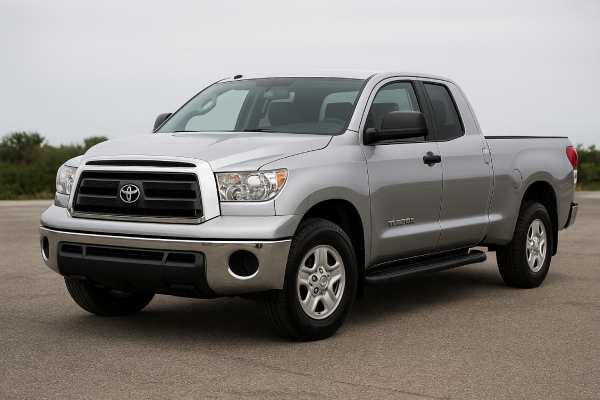
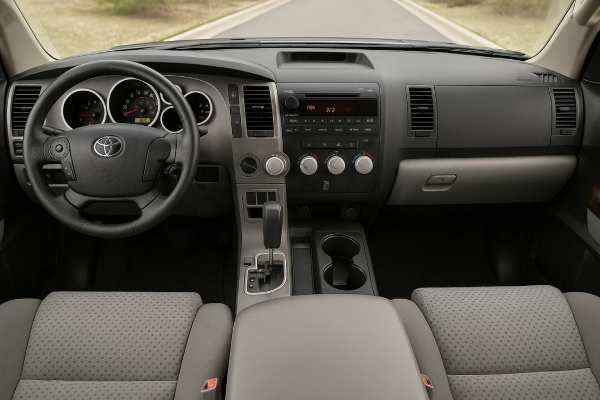
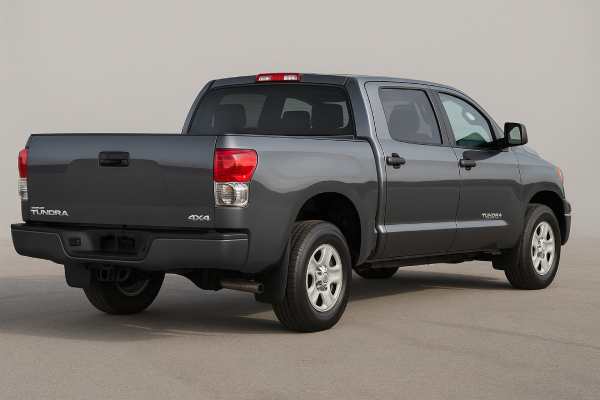
For 2009, Toyota added a flex-fuel twist to its full-size pickup: the Tundra RWD (XK50) powered by the 3UR-FBE 5.7-liter V8. Mechanically, it is very close to the regular 3UR-FE engine, but it is calibrated and equipped to run on E85 as well as regular gasoline. That makes this truck appealing in regions where E85 is widely available or where fleet policies favor flex-fuel vehicles.
From an ownership perspective, the 3UR-FBE Tundra keeps the core strengths of the platform: a stout ladder frame, heavy-duty running gear, and a strong 6-speed automatic transmission. The trade-off is predictable: running E85 increases fuel consumption, and RWD versions rely on good tires and traction control rather than front-axle drive in winter. For buyers who want a simple, durable half-ton and like the idea of flex-fuel capability for cost or emissions reasons, the 2009–2013 Tundra RWD 3UR-FBE is a smart niche to consider.
Top Highlights
- Flex-fuel 3UR-FBE V8 runs on gasoline or E85 without driver intervention, keeping power close to the standard 5.7 V8.
- RWD configuration combines strong towing capacity with slightly lower weight and simpler driveline hardware than 4×4 models.
- Fuel use rises noticeably on E85, so cost advantage depends on local pump pricing and how you drive.
- Pay attention to frame corrosion, secondary air-injection components, and fuel-system condition on high-mileage flex-fuel trucks.
- A conservative baseline is oil and filter every 5,000 miles / 8,000 km or 6 months, with fuel-filter and injector checks if E85 use is heavy.
What’s inside
- Flex-fuel Tundra RWD summary
- 3UR-FBE engine specs and data
- Tundra 3UR-FBE trims and safety
- Flex-fuel Tundra reliability insights
- Service schedule and buyer advice
- On-road performance and economy
- Flex-fuel Tundra vs competitors
Flex-fuel Tundra RWD summary
The 3UR-FBE is the flex-fuel version of Toyota’s 5.7-liter V8, introduced in the Tundra around the 2009 model year. It is designed to operate on any blend of gasoline and ethanol up to E85, with engine management automatically adjusting fueling and spark to suit the ethanol content. Under most conditions, output on pure gasoline matches the standard 3UR-FE at 381 hp and 401 lb-ft, while power on E85 is similar or only slightly reduced, depending on conditions and calibration.
From the driver’s seat, the flex-fuel Tundra RWD feels nearly identical to the regular gasoline 5.7 truck. The frame, cab options, bed lengths, 6-speed automatic transmission, and rear axle hardware are shared. The differences sit mostly in the fuel system: corrosion-resistant lines and tank coatings, higher-flow injectors, and ethanol-tolerant seals and components. Owners can fill up with gasoline, E85, or any blend in between without flipping switches or changing modes.
RWD (4×2) Tundras equipped with the 3UR-FBE target a specific set of users. Fleets that run where E85 is inexpensive may see fuel-cost benefits or regulatory advantages. Private owners might value the ability to choose whichever fuel is cheaper or more available. The trade-off is that E85 carries less energy per liter than gasoline, so fuel consumption rises when you use it, sometimes by 20–30 percent.
In everyday use, RWD flex-fuel Tundras feel lighter on their feet than 4×4 versions and are easier to service thanks to a simpler driveline. They are at their best in moderate climates and in roles where towing and hauling are common but serious off-road work is not. In snowy or icy conditions, quality tires, some ballast in the bed, and sensible driving are essential, because the truck relies entirely on the rear axle for traction.
3UR-FBE engine specs and data
The 3UR-FBE shares its basic architecture with the 3UR-FE: a large-displacement, naturally aspirated V8 tuned for torque and durability. The tables below describe typical specifications for a 2009–2013 RWD Tundra with the 3UR-FBE.
Engine and performance
| Item | Spec |
|---|---|
| Engine code | 3UR-FBE 5.7-liter flex-fuel V8 |
| Layout and valvetrain | 90° V8, DOHC, 32 valves, dual variable valve timing |
| Displacement | 5.7 L (5,663 cc) |
| Bore × stroke | 94.0 × 102.0 mm (3.70 × 4.02 in) |
| Compression ratio | Around 10.2:1 |
| Induction | Naturally aspirated |
| Fuel system | Sequential multi-port injection with flex-fuel sensing and calibration |
| Fuel type | Unleaded gasoline, E85, or any blend up to 85% ethanol |
| Max power (gasoline) | 381 hp (283 kW) @ 5,600 rpm (typical rating) |
| Max torque (gasoline) | 401 lb-ft (544 Nm) @ 3,600 rpm |
| Timing drive | Chain-driven camshafts |
| Emissions standard | Meets contemporary LEV II / ULEV II standards in key markets |
Efficiency (approximate)
| Driving condition | Gasoline | E85 (approximate) |
|---|---|---|
| City | Around 14–15 mpg US (16–17 L/100 km) | Often 10–11 mpg US (21–24 L/100 km) |
| Highway | Around 18–19 mpg US (12–13 L/100 km) | Often 13–14 mpg US (17–18 L/100 km) |
| Combined | Around 16 mpg US (15 L/100 km) | Typically 11–13 mpg US (18–21 L/100 km) |
These figures will vary with driving style, climate, load, and gearing, but they illustrate the main flex-fuel trade-off: you burn more volume of E85 to travel the same distance.
Transmission and driveline (RWD)
| Item | Spec |
|---|---|
| Transmission | 6-speed automatic, AB60E (typical for RWD 5.7) |
| Gear ratios (1st→6th) | Approx. 3.333 / 1.960 / 1.353 / 1.000 / 0.728 / 0.588 |
| Reverse | Around 3.061 |
| Final drive ratio | Often 4.30:1 on 5.7 trucks with tow package |
| Drive type | Rear-wheel drive (4×2) |
| Differential | Open differential with brake-based Auto LSD function |
Chassis and dimensions (typical 3UR-FBE RWD Double Cab)
| Item | Spec |
|---|---|
| Frame | Fully boxed truck frame, body-on-frame construction |
| Front suspension | Double wishbone, coil springs, gas shocks |
| Rear suspension | Solid axle, leaf springs, gas shocks |
| Brakes | Ventilated discs front and rear |
| Wheels / tires | 17–20 in wheels; common tire sizes 255/70 R18 or 275/65 R18 |
| Ground clearance | Around 260 mm (≈10.2 in) |
| Overall length | About 228–229 in (≈5,790–5,810 mm) for Double Cab standard bed |
| Width | Around 80 in (≈2,030 mm) |
| Height | Around 75–76 in (≈1,900–1,930 mm) |
| Wheelbase | 145.7 in (3,700 mm) for most Double Cab / CrewMax RWD trucks |
| Curb weight | Typically 5,300–5,500 lb (≈2,400–2,500 kg) |
| GVWR | Roughly 7,000–7,400 lb (≈3,175–3,355 kg), configuration-dependent |
| Fuel tank | Around 26.4 US gal (100 L) |
Performance and capability
| Item | Spec |
|---|---|
| 0–60 mph (gasoline) | Low to mid-6 seconds in many configurations |
| Top speed (limited) | Around 109 mph (≈175 km/h) |
| Towing capacity | Commonly 9,000–10,400 lb (≈4,100–4,700 kg) when properly equipped |
| Payload | Often 1,500–2,000 lb (≈680–900 kg), configuration-dependent |
Fluids and service capacities (typical)
| System | Fluid | Approx. capacity |
|---|---|---|
| Engine oil | 0W-20 or 5W-20 meeting Toyota spec | About 7.5–7.9 qt (7.1–7.5 L) with filter |
| Coolant | Toyota Super Long Life Coolant | Around 12–14 L total |
| Automatic transmission | Toyota ATF WS | About 10–11 L total (service fills smaller) |
| Rear differential | 75W-85 or 75W-90 gear oil | Around 3 L |
| A/C refrigerant | R-134a | Varies by cab and system |
Electrical
- Alternator output typically around 130–150 A.
- 12 V battery usually around 700–750 CCA in a Group 27-type case.
- Long-life iridium spark plugs, gapped around 1.1 mm (0.044 in), are standard.
Tundra 3UR-FBE trims and safety
Flex-fuel capability on the Tundra was primarily aimed at the North American market and often targeted fleet or certain regional emissions requirements. In practice, the 3UR-FBE engine appeared across several trims rather than on a single fleet-only variant, though availability varied by state or dealer ordering patterns.
Trims and configurations
Typical trim and configuration patterns for RWD 3UR-FBE Tundras from 2009–2013 include:
- Cab styles: Regular Cab, Double Cab, and CrewMax. Flex-fuel engines were common on Double Cab and Regular Cab trucks in regions where E85 was more common, while CrewMax flex-fuel trucks tend to be less frequent but still present.
- Trims:
- Base / Tundra Grade: Vinyl or basic cloth interiors, steel or simple alloy wheels, straightforward equipment. Popular with fleets and value-focused buyers.
- SR5: Cloth interiors with more comfort features, alloy wheels, better audio, and more storage. Many flex-fuel RWD trucks were ordered in SR5 spec.
- Limited: Leather seats, dual-zone climate, larger wheels, and more chrome. Limited with 3UR-FBE is less common than SR5 but available in some markets.
Flex-fuel identification is important. Telltales often include:
- “Flex Fuel” or “FFV” badging on the tailgate or body in some markets.
- A yellow fuel cap or labeling around the filler door stating E85 compatibility.
- VIN and build-sheet codes indicating the 3UR-FBE rather than 3UR-FE.
Safety equipment
All 2009–2013 Tundras, including 3UR-FBE RWD models, share a common safety hardware set:
- Multi-stage front airbags for driver and passenger.
- Front-seat side airbags and full-length curtain airbags.
- Anti-lock brakes with electronic brake-force distribution and Brake Assist.
- Vehicle stability control and traction control, including Auto LSD for improved launching traction on low-grip surfaces.
From around 2010 onward, knee airbags for driver and front passenger were added, and stability-control tuning was refined. Rear-view camera systems, parking sensors, and more advanced audio/navigation screens became more widely available, especially on higher trims.
Crash-test performance
In independent crash testing, the second-generation Tundra generally performed strongly for a full-size pickup. Extended-cab and crew-cab versions showed good results in moderate-overlap frontal and side-impact tests, with robust roof strength. While ratings can vary with model year and body style, the Tundra’s structure and airbag coverage give it an edge over some contemporaries, particularly in side impacts.
RWD vs 4×4 does not dramatically change crash ratings, but it does affect traction in low-grip conditions. Safety on slippery roads depends heavily on tire choice, driver behavior, and use of traction and stability aids.
ADAS and driver aids
This generation predates widespread deployment of modern driver-assistance systems. There is no factory adaptive cruise control, lane-keeping assist, or automatic emergency braking on 2009–2013 Tundras. The main driver aids are stability control, traction control, and optional reversing cameras and parking sensors. For some buyers, that simplicity is a plus; for others, it is a reminder that this is an older platform by current ADAS standards.
Flex-fuel Tundra reliability insights
In general, the 3UR-FBE shares the solid reputation of the 3UR-FE. Owners and fleet operators often report very high mileages with relatively few major engine problems when maintenance is consistent. Still, the flex-fuel hardware and age of these trucks introduce a few specific points to watch.
Engine and fuel-system considerations
Flex-fuel hardware means the 3UR-FBE uses fuel lines, seals, and injectors designed to handle ethanol’s higher solvency and moisture absorption. When E85 is used regularly, it can keep some deposits down but may also expose weaknesses in components that are marginal. On an older flex-fuel truck, look out for:
- Hard cold starts, rough running on cold mornings, or strong fuel smells after startup. These can point to injector, fuel-pressure, or sensor issues.
- Deteriorated fuel hoses or seepage at connections if low-quality replacement parts were fitted in the past.
- Corrosion or contamination in the fuel tank or lines, especially if the truck sat for long periods with a high-ethanol mix.
Aside from flex-fuel specifics, the 3UR-FBE shares the usual 5.7 Tundra patterns:
- Secondary air-injection pumps and valves that are vulnerable to moisture and can trigger check-engine lights and limp mode.
- Water-pump seepage at moderate to high mileages, often showing up as dried coolant near the pump and slow coolant loss.
- Occasional cam-tower or valve-cover oil leaks, which are more nuisance than catastrophe but labor-intensive to correct.
- Gradual oil consumption on some high-mileage or poorly serviced engines.
Oil quality and change intervals play a large role in long-term reliability. Trucks that have had frequent oil changes with the correct viscosity tend to show fewer timing-chain, lifter, and sludge-related issues.
Driveline and chassis
Because this article focuses on RWD models, there is no transfer case or front differential to worry about, which simplifies long-term ownership. The main driveline and chassis themes are:
- Driveshaft u-joint wear or slip-yoke clunk, especially on high-mileage or heavily loaded trucks.
- Rear differential seepage or pinion-seal leaks; these become serious only if fluid level drops and is not corrected.
- Front suspension wear (ball joints, control-arm bushings, and sway-bar links) and rear leaf-spring bush and shackle wear. These are normal wear items for a heavy truck.
- Frame and underbody corrosion in regions with heavy road-salt use. Rust can affect frame rails, crossmembers, spring mounts, and brake/fuel lines.
Flex-fuel use does not directly change frame or suspension wear, but many flex-fuel trucks were bought by fleets that may have used them intensively. That means more tow miles, more idling, more exposure to salt, and sometimes less cosmetic care. Service records and a thorough underside inspection are crucial.
Recalls and service campaigns
Flex-fuel Tundras from this period share the broad recall landscape of other Tundras:
- Campaigns for accelerator-pedal and floor-mat interactions.
- Specific driveshaft-related recalls on some early trucks.
- Airbag and occupant-classification system updates over time.
While the 3UR-FBE itself has not been associated with major engine design recalls, software updates for engine and transmission control modules may exist. These can improve drivability, shift quality, and diagnostic behavior. Confirming that software is current via a dealer scan is a worthwhile step when buying or recommissioning one of these trucks.
Service schedule and buyer advice
Because flex-fuel operation can be more demanding on the fuel system and, in some cases, on oil, a conservative maintenance approach is wise for the 3UR-FBE Tundra RWD. The guidelines below are general; always tailor them to the official schedule for your model year and your actual usage.
Practical maintenance schedule (3UR-FBE RWD)
- Engine oil and filter: every 5,000 miles (8,000 km) or 6 months. If you use E85 extensively, tow, or idle a lot, shorter intervals (3,000–4,000 miles) can be worthwhile.
- Engine air filter: inspect at 15,000 miles (24,000 km), replace around 30,000 miles (48,000 km) or more often in dusty conditions.
- Cabin air filter: 15,000–20,000 miles (24,000–32,000 km) or every 1–2 years.
- Spark plugs: long-life iridium plugs typically last around 120,000 miles (190,000 km), but on a flex-fuel engine used heavily on E85, inspecting earlier in the 90,000–100,000-mile range is sensible.
- Coolant: first change around 100,000 miles (160,000 km) or 10 years, then every 50,000 miles (80,000 km) or 5 years.
- Automatic transmission fluid: for the AB60E, many owners favor drain-and-fill services every 60,000–90,000 miles (100,000–150,000 km), especially with towing.
- Rear differential oil: around every 60,000 miles (100,000 km), or 30,000 miles (50,000 km) for heavy towing or hot climates.
- Brake fluid: every 3 years.
- Fuel system:
- Add a high-quality fuel-system cleaner at intervals if E85 use is heavy.
- Replace the fuel filter according to the service manual (intervals vary), and sooner if there are performance or starting issues.
- Serpentine belt and hoses: annual inspection, with replacement typically around 90,000–120,000 miles (145,000–190,000 km).
- Tire rotation and alignment: rotate every 5,000–7,500 miles (8,000–12,000 km); align when installing new tires or if you notice uneven wear or pulling.
- 12 V battery: load-test annually after the fourth year.
Timing chains need no scheduled replacement, but listen for noise, watch for timing-related codes, and address any issues early.
Fluid specs and torque values
Because exact capacities and torque specifications vary by configuration and year, always verify:
- Oil grade and specification from the owner’s manual.
- ATF type (WS) and correct procedure for level checking.
- Differential and power-steering fluid specs for your climate.
- Torque values for wheel nuts, drain plugs, and critical suspension fasteners.
Using correct fluids and torque values prevents both premature wear and damage such as stripped threads or warped brake rotors.
Buyer’s guide tips for 3UR-FBE Tundras
When shopping for a 2009–2013 RWD Tundra with the flex-fuel engine:
- Confirm it is truly a 3UR-FBE. Look for flex-fuel labels, yellow fuel caps, and VIN build data; do not rely on seller claims alone.
- Check frame and underside first. Rust on rails, crossmembers, spring mounts, and brake/fuel lines can be a deal-breaker.
- Inspect for fuel-system issues. Ask how often E85 was used. Look for fuel leaks or smells, hard starts, or uneven idle, all of which warrant deeper diagnosis.
- Review service records. Frequent oil changes and periodic driveline fluid changes matter more than cosmetic upgrades.
- Test drive thoroughly. Include cold start, highway cruising, and stop-and-go. Listen for driveline noises, steering wander, or brake pulsation.
- Verify recall completion. Use official VIN tools and, where possible, a dealer printout to confirm that key campaigns have been done.
A truck with good records, clean underside, and smooth driveline behavior is usually a solid candidate for long-term use.
On-road performance and economy
On gasoline, the Tundra RWD 3UR-FBE feels very similar to its 3UR-FE sibling. Acceleration is strong, especially from low and mid-range rpm, and the 6-speed automatic keeps the engine in its sweet spot. The combination delivers confident merging, brisk passing, and relaxed highway cruising, even with a moderate load in the bed.
Driving character
Ride quality is typical of a full-size pickup tuned for real work. Unladen, the rear leaf springs can feel a bit firm over broken pavement, especially on E-load tires and rough city streets. Adding weight in the bed, such as tools or equipment, smooths the ride. On the highway, the truck tracks straight, with reasonably light steering and predictable responses.
Noise levels are acceptable for a truck from this era. You will hear some wind noise from the mirrors and some tire roar on coarse surfaces, but the V8 settles into a muted background hum at steady speeds. Under hard acceleration, the engine note is prominent but not harsh.
RWD traction and stability
In dry conditions, RWD is more than adequate, and the Tundra’s long wheelbase and stability control help it feel secure. On wet or icy roads, traction depends heavily on tire choice and loading. The truck includes traction control and Auto LSD, which use the rear brakes to control wheelspin, but these are aids rather than magic solutions. In snowy climates, dedicated winter tires and some ballast near the tailgate transform the truck’s manners.
Fuel economy in the real world
The flex-fuel capability primarily affects fuel consumption when you actually use E85:
- On gasoline, many owners see around 14–15 mpg US (16–17 L/100 km) in city driving, 18–19 mpg US (12–13 L/100 km) on the highway, and around 16 mpg US (15 L/100 km) mixed.
- On E85, consumption typically rises to around 10–11 mpg US (21–24 L/100 km) in city use and 13–14 mpg US (17–18 L/100 km) on the highway, depending on conditions.
Whether E85 makes financial sense depends on local pricing. As a rough rule, E85 usually needs to be at least 20–30 percent cheaper per gallon than gasoline to offset the increased consumption. Some buyers, however, value the potentially lower carbon intensity or the ability to support local ethanol production rather than pure cost.
Towing and load behavior
The 3UR-FBE Tundra RWD shares the core towing characteristics of other 5.7 Tundras. When equipped with the tow package, it offers:
- Strong acceleration with trailers in the 5,000–8,000-lb (2,270–3,630-kg) range.
- Good temperature control when cooling systems are healthy.
- Useful tow/haul mode that adjusts shift points and provides better engine braking on grades.
Using E85 while towing further increases fuel consumption, so range between fill-ups can drop noticeably. Many owners choose to tow primarily on gasoline for range and convenience, using E85 when running empty or locally. Stability with a properly set up trailer is generally good, though RWD always asks for more attention to traction on wet or loose surfaces than a 4×4.
Flex-fuel Tundra vs competitors
When the 3UR-FBE Tundra arrived, flex-fuel half-tons from domestic makers were already common. Ford, GM, and Ram all offered E85-capable V8s in their full-size trucks. Comparing the Tundra flex-fuel RWD to those rivals helps clarify who it suits best.
Strengths of the Tundra 3UR-FBE RWD
- Powertrain durability: The 3UR-series V8 and 6-speed automatic have a strong reputation for long-term reliability, with many examples reaching very high mileage when serviced properly.
- Mechanical simplicity: There are no turbos, no complex cylinder-deactivation systems, and no ultra-high gear-count transmissions. This simplifies maintenance and reduces the pool of potential failure points.
- Consistent driving feel: Whether you run gasoline or E85, the truck feels broadly similar. You may notice differences in range and slight changes in cold behavior, but the basic performance character remains stable.
- Resale and reputation: Toyota’s reputation for durable trucks generally supports higher resale values and strong owner loyalty, even when the truck is a niche flex-fuel variant.
Areas where rivals may lead
- Fuel economy innovations: Some rivals introduced more aggressive cylinder deactivation, downsized turbo engines, or more advanced automatics that can improve fuel efficiency when running on gasoline.
- Cab refinement and features: In higher trims, rivals often offered more luxury features, more modern infotainment, and earlier introduction of some driver-assistance technologies.
- Flex-fuel adoption scale: Because domestic manufacturers supplied a larger share of fleet and government markets, their flex-fuel trucks may be easier to find in large numbers, which can influence pricing and configuration selection.
Which buyer fits the Tundra flex-fuel best
The 3UR-FBE Tundra RWD is most attractive if you:
- Want a simple, robust half-ton with Toyota’s reliability reputation and are comfortable with V8-sized fuel bills.
- Live where E85 is widely available and often priced significantly below gasoline, giving you flexibility in how you fuel the truck.
- Value long-term ownership and are likely to keep the truck past typical fleet or lease cycles, making durability more important than the latest cabin gadgets.
- Do not need 4×4 capability or are willing to rely on good tires, ballast, and careful driving in winter instead of a front-driven axle.
If you prioritize the newest driver-assistance tech, the most advanced infotainment, or squeezing every last mile from a gallon of fuel, certain rival trucks may fit better. But if your priorities center on straightforward engineering, flex-fuel flexibility, and proven mechanicals, the 2009–2013 Toyota Tundra RWD 3UR-FBE is a compelling choice in the used-truck market.
References
- Toyota Announces 2009 Tundra Pricing 2008 (Press Release)
- 2011 Toyota Tundra Flex-Fuel Engine Availability 2010 (Press Release)
- 2012 Tundra Owner’s Manual 2012 (Owner’s Manual)
- 2010 TOYOTA TUNDRA 4 DR RWD 2010 (Safety Rating and Recall Database)
- 2012 Toyota Tundra 2012 (Safety Rating)
Disclaimer
This article is intended for general informational purposes only and does not replace professional diagnosis, repair advice, or official service documentation. Specifications, torque values, fluid types, and maintenance intervals can vary by VIN, model year, market, and equipment level, and they may change with technical updates or recalls. Always verify critical information using the official Toyota owner’s manual, factory service manual, and applicable technical bulletins, or consult a qualified technician before performing any work on your vehicle.
If you found this guide helpful, you are welcome to share it with other owners and shoppers on platforms such as Facebook or X/Twitter to support xcar’s work and help more people make informed decisions about the Toyota Tundra.