
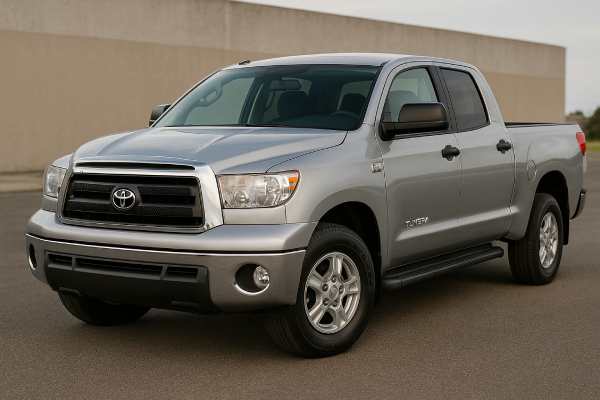
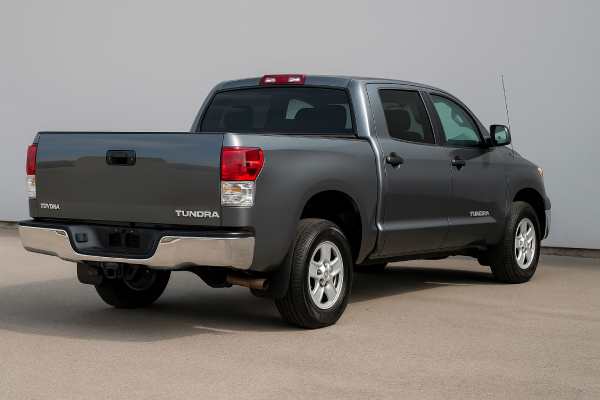
The 2011–2013 Toyota Tundra RWD with the 1GR-FE 4.0 litre V6 is the “quiet worker” of the XK50 range. It lacks the big-numbers towing of the 5.7 V8, but it delivers something many owners value more over a decade of use: predictable running costs, simpler hardware, and typically excellent reliability. The Dual VVT-i V6 is chain-driven, naturally aspirated, and happy to run high mileage if you keep up with fluids.
In rear-wheel-drive form, the truck is lighter and slightly more efficient than comparable 4x4s, yet still offers a payload in the 1,400–1,600 lb range and towing around 4,500–4,900 lb when properly equipped. Safety equipment is strong for the era, and the chassis is robust enough for regular hauling and worksite use. This guide walks through specs, real-world performance, known issues, and maintenance and buying advice so you can judge whether a 4.0 V6 RWD Tundra fits your needs today.
Quick Specs and Notes
- 1GR-FE 4.0 litre V6 with Dual VVT-i, timing chain, and naturally aspirated power tuned for longevity rather than peak output.
- RWD layout keeps weight down and improves steering feel and manoeuvrability compared with heavier 4×4 versions.
- Typical payload around 650–730 kg (1,430–1,610 lb) and tow ratings up to roughly 2,000–2,220 kg (4,400–4,900 lb) depending on cab, bed, and axle ratio.
- Watch for frame and underbody corrosion in road-salt regions, ageing coolant hoses, and secondary air injection faults on high-mileage trucks.
- Sensible oil change interval is 8,000–10,000 km (5,000–6,000 miles) or 6 months with the correct 0W-20 or 5W-30 oil, especially if towing or working the truck hard.
What’s inside
- Toyota Tundra 4.0 RWD essentials
- Key specs for 4.0 V6 RWD
- Grades equipment and safety systems
- Reliability on 4.0 RWD Tundra
- Service planning and buyer advice
- Driving character and performance
- Tundra 4.0 versus competitors
Toyota Tundra 4.0 RWD essentials
For 2011, Toyota revised the Tundra’s base 4.0 litre V6 with Dual VVT-i, raising output to about 270 hp and 278 lb-ft and making this engine more competitive while keeping its durable architecture. In RWD form, it serves as a work-oriented configuration aimed at owners who need a full-size pickup bed and a stout frame, but do not tow at the limit every day.
The 1GR-FE is a 60-degree aluminium V6 with cast-iron liners, chain-driven cams, and port fuel injection. That means no turbochargers, no direct-injection carbon build-up, and no timing belt replacement interval. For long-term owners who plan to keep a truck past 200,000 km (125,000 miles), this relatively simple layout is a major advantage.
Most 4.0 RWD Tundras in this era were sold as Regular Cab or Double Cab trucks in lower or mid-level grades. They share the same basic frame, suspension design, and cab structure as the V8 models, so you are not giving up robustness—only outright straight-line performance and maximum tow ratings. In fact, the lighter front end and slightly lower nose weight can make the V6 RWD feel more agile in urban driving and easier on front suspension components.
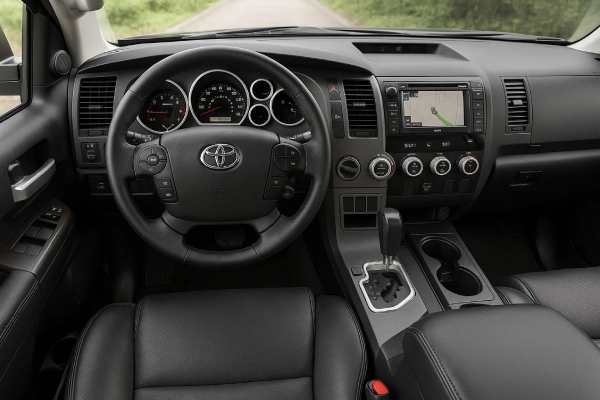
Safety is better than many older full-size trucks: multiple airbags, stability control, traction control, and strong crash-test performance for the time. Inside, the cabin is functional rather than luxurious, but controls are large and glove-friendly, and the driving position suits a wide range of body types.
Where the 4.0 RWD Tundra shines is predictable ownership. Fuel economy is still that of a body-on-frame pickup, but real-world consumption is a little better than the 4.6 and 5.7 V8s, and routine maintenance costs are kept down by long-life plugs, a chain-driven valve train, and widely available parts. If your use case is mixed commuting, DIY hauling, and occasional light-to-medium towing, the V6 RWD configuration can make more sense than a heavily equipped 4×4 V8.
Key specs for 4.0 V6 RWD
This section focuses on a typical 2011–2013 Tundra 2WD (RWD) Regular or Double Cab with the 4.0 litre V6 and standard-length bed. Exact numbers vary slightly by body style and equipment, but the ranges below are representative.
Engine and performance (1GR-FE 4.0 V6)
| Item | Specification |
|---|---|
| Engine code | 1GR-FE (Dual VVT-i) |
| Layout and cylinders | 60° V6, DOHC, 24 valves (4 valves/cyl) |
| Bore × stroke | 94.0 × 95.0 mm (3.70 × 3.74 in) |
| Displacement | 4.0 l (3,956 cc) |
| Induction | Naturally aspirated |
| Fuel system | Sequential multi-port fuel injection |
| Compression ratio | ~10.4 : 1 |
| Max power | ≈ 270 hp (201 kW) @ 5,600 rpm |
| Max torque | ≈ 377 Nm (278 lb-ft) @ 4,400 rpm |
| Timing drive | Chain (no routine replacement interval) |
| Emissions standard | US ULEV-II / Tier 2 Bin 5 |
| Rated consumption | ~13.1 l/100 km combined (18 mpg US / 22 mpg UK) |
| City / highway | ~14.7 / 11.8 l/100 km (16 / 20 mpg US) |
| Real-world highway @ 120 km/h | Around 13–13.5 l/100 km (17–18 mpg US) with light load |
| Aerodynamics | Approx. Cd 0.38; frontal area ≈ 3.1 m² (33 ft²) |
Transmission and driveline
| Item | Specification |
|---|---|
| Transmission | 5-speed automatic, electronically controlled (A750E-type) |
| 1st / 2nd / 3rd gears | 3.52 / 2.04 / 1.40 |
| 4th / 5th / Reverse | 1.00 / 0.72 / 3.22 |
| Drive type | Rear-wheel drive (2WD) |
| Final drive ratio | ≈ 3.91 : 1 (with optional 4.10 : 1 on some tow-oriented trucks) |
| Differential | Open rear differential; traction aided by electronic stability and traction control |
Chassis and dimensions
| Item | Specification (typical V6 RWD Double or Regular Cab) |
|---|---|
| Front suspension | Independent double wishbone with coil springs and gas shocks |
| Rear suspension | Live axle with trapezoidal multi-leaf springs and gas shocks |
| Steering | Hydraulic rack-and-pinion, approx. 3.7 turns lock-to-lock |
| Front / rear brakes | Ventilated discs front and rear (diameter varies by wheel package) |
| Typical wheels/tyres | 17–18 in steel or alloy; e.g., 245/70R17 or 255/70R18 all-season |
| Ground clearance | ≈ 260 mm (10.2 in) |
| Length | Around 5,330 mm (210 in) with standard bed |
| Width (without mirrors) | ≈ 2,030 mm (80 in) |
| Height | ≈ 1,920–1,950 mm (75–77 in), depending on trim |
| Wheelbase | 3,700 mm (145.7 in) for most Regular and Double Cab trucks |
| Turning circle | About 13.4 m (44 ft) kerb-to-kerb |
| Curb (kerb) weight | Roughly 2,050–2,100 kg (4,520–4,630 lb) |
| GVWR | Around 2,800–2,900 kg (6,150–6,400 lb) |
| Fuel tank | ~100 l (26.4 US gal / 22.0 UK gal) |
| Bed length (standard) | ≈ 2,000 mm (78.7 in) inside length |
Performance and capability
| Item | Typical value (4.0 V6 RWD) |
|---|---|
| 0–100 km/h (0–62 mph) | Approx. 9–10 s depending on cab/bed and load |
| Top speed | Electronically limited; around 175–180 km/h (109–112 mph) |
| Braking 100–0 km/h | Mid-60 m range on quality tyres (varies by load) |
| Towing capacity | Approx. 2,000–2,220 kg (4,400–4,900 lb) when properly equipped |
| Payload | Approx. 650–730 kg (1,430–1,610 lb) depending on configuration |
| Roof load | Typically around 75–100 kg (165–220 lb) with appropriate rack system |
Fluids and service capacities (approximate)
Always confirm exact values and specifications from official service data for your VIN and market.
| System | Specification | Capacity (approx.) |
|---|---|---|
| Engine oil | 0W-20 (later guidance) or 5W-30 API SM/SN; ILSAC approved | ~6.0–6.2 l (≈ 6.3–6.6 US qt) with filter |
| Engine coolant | Toyota Super Long Life pink coolant, 50/50 mix | ~9.5–10.0 l (10–10.5 US qt) |
| Automatic transmission | Toyota WS ATF | ≈ 10–11 l (10.5–11.6 US qt) total; drain/refill uses less |
| Rear differential | Hypoid gear oil, typically 75W-85 or 75W-90 GL-5 | ~3.0 l (3.2 US qt) |
| Power steering | ATF-type fluid (check manual) | ~1.0 l (1.1 US qt) |
| A/C refrigerant | R-134a, exact charge varies | ~650–750 g (23–26 oz) typical |
| A/C compressor oil | ND-OIL 8 or equivalent | ~120–150 ml (4–5 fl oz) typical |
| Selected torque examples | Wheel nuts ≈ 131 Nm (97 lb-ft); engine oil drain plug ≈ 39 Nm (29 lb-ft); spark plugs ≈ 18 Nm (13 lb-ft) |
Electrical
| Item | Specification |
|---|---|
| Alternator | Typically 130–150 A output depending on trim |
| 12 V battery | Around 70–80 Ah, 600–700 CCA, Group 27/27F-type case in many markets |
| Spark plugs | Long-life iridium (e.g., SK20HR11-type), gap around 1.0–1.1 mm (0.039–0.043 in) |
Safety and driver assistance hardware
For 2011–2013, the Tundra’s safety suite is primarily passive and stability-oriented rather than advanced ADAS:
- Front, side, and full-length curtain airbags plus driver’s knee airbag.
- Four-wheel ABS with Electronic Brake-force Distribution and Brake Assist.
- Vehicle Stability Control (VSC) and traction control, including trailer sway control from 2011 onward.
- Available rear-view camera on many SR5 and higher-grade trucks, often bundled with convenience or navigation packages.
Crash-test data from major bodies for these model years shows strong scores in frontal and side impacts and generally favourable rollover ratings for a full-size pickup.
Grades equipment and safety systems
The 4.0 V6 RWD Tundra was positioned as the practical, value-focused choice in the 2011–2013 XK50 line-up. Understanding which trims and options were available with this engine helps you filter used-market trucks.
Trims and configurations for the 4.0 RWD
Exact naming varies slightly by year and market, but broadly the 4.0 RWD was offered as:
- Regular Cab, standard bed – work-oriented model with a three-seat bench, vinyl or basic cloth upholstery, manual or simple powered accessories, and minimal cosmetic extras.
- Double Cab, standard bed – adds a second row with conventional rear doors, more interior storage, and higher standard equipment.
Most V6 RWD trucks were sold in the base “Tundra” or “Grade” trim and the mid-level SR5:
- Base/Grade
- Steel wheels, plain bumpers, and a simple audio system.
- Manual air conditioning, tilt steering, basic instrumentation.
- Vinyl floors and a split bench on many Regular Cab trucks.
- SR5 (where combined with V6)
- Alloy wheels and additional chrome or colour-keyed trim.
- Upgraded audio with steering-wheel controls on later models.
- Power driver seat on some Double Cab configurations, better cloth upholstery, and more storage features.
The 4.0 RWD rarely appears in high-luxury trims like Limited or Platinum; those were usually paired with V8 engines. If you see a V6 with a lot of luxury equipment, verify that it has not had major aftermarket modifications.
Mechanical and functional differences by grade
For this engine and drive configuration, mechanical differences between trims are limited:
- Same basic suspension and brakes across base and SR5 V6 RWD variants, though wheel and tyre sizes can differ. Larger wheels typically bring slightly larger brake rotors.
- Axle ratio varies more by tow package than by grade: some V6 trucks carry a taller 3.91 rear axle, while those ordered for towing may have a shorter ratio or an added tow package with upgraded cooling and hitch hardware.
- Tow package on V6 trucks is less extreme than on 5.7 V8 models but can still include an upgraded receiver hitch, wiring, and sometimes extra cooling capacity.
Quick identifiers:
- Badging – “i-FORCE” badges are associated with V8s; V6 trucks often lack these, showing only “Tundra” and grade badges.
- Interior tells – base trucks use more hard plastics and simple gauges; SR5 models often add a multi-information display and higher-contrast trim.
- VIN / build codes – the 5th–8th characters and engine code in the VIN plate will confirm 1GR-FE and 2WD configuration; dealers can decode this for you.
Safety ratings and equipment evolution
Across 2011–2013, the Tundra maintained strong structural performance:
- Good scores in moderate-overlap frontal and side-impact tests from major crash-test organisations for most cab styles.
- Strong roof-crush performance for the era, contributing to rollover protection.
- Many configurations recognised as high-performing within their safety programmes at the time.
Standard safety features on the 4.0 RWD largely mirror those on V8 models:
- Front, side, and curtain airbags plus driver’s knee airbag.
- ABS, stability control, traction control, and electronic brake-force distribution.
- Trailer sway control from 2011, integrated into the stability-control logic.
Advanced driver-assistance systems such as autonomous emergency braking, adaptive cruise control, and lane-keeping assistance were not fitted in this generation. When the truck has features like a reversing camera or parking sensors, they are usually part of audio/navigation or convenience packages and may vary year-to-year.
Reliability on 4.0 RWD Tundra
The 1GR-FE-powered RWD Tundra has a very strong reliability reputation, especially compared with some contemporaries. That said, these trucks are now a decade or more old, so age-related issues, corrosion, and deferred maintenance matter as much as factory design.
Below is an overview of common issues by system, with rough prevalence and impact.
Engine and ancillaries
- Secondary air injection system
- Prevalence: occasional to common on high-mileage, older trucks.
- Symptoms: check-engine light, limp-home mode, codes relating to air injection pumps or switching valves, especially on cold starts.
- Cause: moisture and corrosion in the air injection pumps and valves.
- Remedy: replace pumps and valves with updated components; in some markets there have been goodwill policies or extended coverage, but assume you’ll be paying on an out-of-warranty truck.
- Water pump seepage
- Symptoms: pink or whitish crust around the pump, gradual coolant loss, occasional squeak from the bearing.
- Typical mileage: often 120,000–200,000 km (75,000–125,000 miles).
- Remedy: replace pump, associated seals, and drive belt; refresh coolant.
- Valve cover and cam housing oil leaks
- Symptoms: oil smell, minor wetness around valve covers, occasionally a drip onto the exhaust shield.
- Severity: usually low, but should be corrected before it contaminates rubber parts or the alternator.
Overall, bottom-end failures and major internal engine issues are rare if oil change intervals and coolant quality are respected. The timing chain system is generally durable; excessive noise or correlation faults on this engine are unusual and suggest severe neglect.
Fuel, ignition, and emissions
- Coil-on-plug failures
- Symptoms: misfire under load, flashing check-engine light, rough idle.
- Pattern: more common on very high-mileage trucks or those exposed to water and mud.
- Remedy: replace the affected coil(s) and spark plug; consider replacing a full bank if several are original.
- Evap system and filler-neck corrosion (rust-belt trucks)
- Evaporative emissions leaks can trigger codes; inspect lines, canister, and tank/filler regions for corrosion before replacing parts blindly.
Transmission and driveline
The 5-speed automatic paired with the 4.0 V6 is generally robust.
- Fluid degradation and shudder
- Symptoms: harsh shifts, slight shudder under light acceleration, delayed engagement after cold starts.
- Remedy: staged ATF drain and refill with the correct WS fluid; consider adding a transmission cooler if regularly towing near the V6 tow limit.
- Universal joint wear
- Symptoms: driveline vibration or clunks on take-off or when shifting from drive to reverse.
- Remedy: inspect U-joints and centre support bearing; replace worn parts and ensure propshaft alignment.
Some trucks are affected by steering rack or gear leaks; in some cases there have been recalls or service campaigns addressing defective steering gear assemblies. Always check recall status by VIN.
Suspension, brakes, and body
- Front suspension wear
- Common items: lower ball joints, control-arm bushings, and front shock absorbers, especially on trucks that carry front-mounted equipment or see rough roads.
- Symptoms: clunks over bumps, wandering steering, uneven tyre wear.
- Rear leaf spring bushings and shackles
- Heavy loads and corrosion can wear bushings and hardware. Listen for rear clunks and inspect the shackles and hangers closely.
- Frame and underbody corrosion
- Risk band: trucks in regions with heavy road salt, especially those infrequently washed underneath.
- Hotspots: rear frame rails, spare tyre carrier area, leaf spring mounts, brake and fuel line clips.
- Remedy: surface rust can be cleaned and treated; extensive flaking or perforation is a serious safety concern and may be uneconomical to repair.
Recalls, TSBs, and extended coverage
Across the 2007–2013 production span, Tundras have been subject to multiple recalls and technical service bulletins, including:
- Steering gear assembly and power-steering leaks.
- Airbag inflator and occupant-classification issues on some trucks.
- Various ECU reflash campaigns for driveability or emissions.
Because coverage and applicability vary by year, plant, and VIN, owners should:
- Run a VIN search on the official safety-recall database for their region.
- Ask a Toyota dealer to print the campaign/TSB history for the truck.
- Verify that recall stickers and campaign labels in the doorjamb match completed work.
Doing this before purchase dramatically reduces surprises.
Service planning and buyer advice
A clear maintenance plan and a structured inspection checklist are key to getting the best from a 2011–2013 Tundra 4.0 RWD. The schedule below blends Toyota’s guidance with common best practices for long-term truck ownership.
Practical maintenance schedule (typical guidance)
Always adapt to your market, driving pattern, and official documentation.
- Engine oil and filter – Every 8,000–10,000 km (5,000–6,000 miles) or 6 months, whichever comes first. Use quality 0W-20 or 5W-30 oil meeting the specified Toyota/ILSAC/ACEA standards.
- Engine air filter – Inspect every 15,000 km (10,000 miles); replace around 30,000–40,000 km (20,000–25,000 miles), or sooner in dusty conditions.
- Cabin (pollen) filter – Replace every 20,000–25,000 km (12,000–15,000 miles) or annually.
- Coolant – For Toyota Super Long Life coolant, first change typically at 160,000 km (100,000 miles) or 10 years, then every 80,000 km (50,000 miles) or 5 years. On an older truck with unknown history, a complete coolant service is wise.
- Spark plugs – Long-life iridium plugs are often scheduled for 160,000–192,000 km (100,000–120,000 miles). If the truck has reached this range, budgeting for new plugs is sensible.
- Automatic transmission fluid (WS) – Many manuals describe ATF as “lifetime,” but for longevity, especially if towing, a drain-and-fill every 60,000–90,000 km (40,000–60,000 miles) is advisable.
- Rear differential oil – Replace every 60,000–80,000 km (40,000–50,000 miles); sooner after heavy towing or frequent water crossings.
- Brake fluid – Flush every 3 years regardless of mileage.
- Brake pads and rotors – Inspect at least every 15,000 km (10,000 miles) or annually; more often if towing or driving in mountains.
- Serpentine/auxiliary belt – Inspect from 60,000 km (40,000 miles) onwards; replace by ~150,000 km (90,000 miles) or when cracked or noisy.
- Hoses – Inspect at every service; proactively replacing old coolant and vacuum hoses on a 10+-year-old truck is good insurance.
- Timing chain system – No scheduled replacement. Listen for abnormal chain noise, check for timing-correlation codes, and investigate oil-pressure issues promptly.
- Alignment and tyre rotation – Rotate tyres every 10,000–12,000 km (6,000–8,000 miles) and align the truck whenever tyres are replaced or you notice uneven wear or pulling.
- 12 V battery – Test annually after 4–5 years; replacement every 5–7 years is typical in moderate climates.
Fluid capacities and torque values listed in the specs section can help you discuss work intelligently with a workshop or, if you are experienced, plan DIY jobs. However, always verify against the official repair manual for your exact model code.
Buyer’s guide: what to inspect
When evaluating a used 2011–2013 Tundra 4.0 RWD:
- Service history
- Look for regular oil changes, documented coolant and brake-fluid services, and any transmission or differential fluid changes.
- Confirm spark-plug replacement around the 100,000–120,000 mile mark if the truck is in that range.
- Corrosion and frame condition
- Inspect the frame rails from front to rear, especially around the rear axle, spare tyre carrier, and leaf spring mounts.
- Check brake and fuel lines for rust at clip points. Heavy scaling or perforation is a red flag.
- Engine bay and cooling system
- Look for coolant residue around the water pump and thermostat housing.
- Check for oil leaks at valve covers and the front of the engine.
- Air injection and emissions
- Scan for stored or pending codes, particularly for secondary air injection and evaporative systems.
- Driveline and suspension
- Test drive at urban and highway speeds. Listen for clunks on take-off (U-joints), wander (alignment or steering wear), and rumbling or growling (wheel bearings).
- Interior and electronics
- Verify operation of air conditioning, blower speeds, radio, steering-wheel controls, and any navigation or camera systems.
Which years and specs to prefer
For this particular configuration, 2011–2013 trucks share broadly similar hardware, as the key engine update came for 2011. Focus less on model year and more on:
- Condition and maintenance history. A well-maintained 2011 can be a better bet than a neglected 2013.
- Body style fit. Regular Cab for maximum bed with minimal cabin, Double Cab for mixed family and work use.
- Rust exposure. Southern or dry-climate trucks tend to have far cleaner frames and fasteners.
Long-term, a well-cared-for 4.0 RWD Tundra can realistically see 300,000 km (185,000 miles) or more on the original engine and transmission, making it appealing to buyers who value durability over the latest tech.
Driving character and performance
Jumping into a 2011–2013 Tundra 4.0 RWD after driving modern turbocharged trucks is a reminder of how a naturally aspirated V6 feels. Power builds smoothly rather than in a big mid-range surge, and the truck rewards drivers who are comfortable letting the engine rev a little.
Powertrain character
The 1GR-FE V6 is smooth and reasonably quiet, particularly at cruise. Low-rpm torque is adequate but not abundant, so the 5-speed automatic will downshift on hills or when merging. For daily driving and moderate loads, performance is more than acceptable:
- Acceleration:
- Regular Cab trucks can reach 100 km/h (62 mph) in roughly 9 seconds when unladen.
- Heavier Double Cab versions are closer to the high-9 or low-10-second range.
The gearbox’s logic is tuned more for durability and response than for maximum fuel saving. In Tow/Haul mode it holds gears longer, raises shift points, and improves engine braking on descents, which helps protect the transmission when towing within the V6’s more modest limits.
Ride, handling, and NVH
With RWD and no front differential, the nose feels a little lighter than on 4×4 Tundras. Steering is traditional hydraulic, with decent weight and predictable effort, making the truck easy to place in traffic and on rural roads. Body roll is present, as you would expect in a high-riding pickup, but roll builds progressively and the truck remains stable in sweeping bends.
Ride quality:
- Unladen: the rear leaf springs can feel firm or even a little choppy on broken pavement, especially with higher tyre pressures.
- Lightly loaded: adding 100–200 kg (220–440 lb) to the bed often improves ride comfort significantly.
Noise levels are acceptable for a full-size truck of this era. There is some wind noise from the large mirrors and body, and tyre roar varies with the chosen tyre package. The V6 itself is refined, with a subdued growl under load and a quiet hum at highway cruise.
Real-world fuel economy and range
In mixed driving, owners commonly report:
- City: roughly 15–17 l/100 km (14–16 mpg US).
- Highway at 100–110 km/h (60–70 mph): around 11.5–13.0 l/100 km (18–21 mpg US) in calm conditions.
- Mixed use: often close to the official combined figure of about 13 l/100 km (18 mpg US).
At a 100-litre tank size, that yields a real-world range of roughly 550–750 km (340–460 miles), depending on speed, load, and terrain.
Towing or carrying heavy loads increases consumption significantly. Expect roughly a 25–40% penalty in fuel economy when towing near the V6’s rated capacity, especially with a tall frontal-area trailer.
Traction and control
Being RWD, traction on wet grass, gravel, or snow requires more care than in a 4×4. However:
- The stability and traction control systems are well tuned for this era. They intervene early enough to prevent most spins but not so aggressively that the truck becomes frustrating to drive.
- A set of good all-terrain or winter tyres transforms wet- or snow-road behaviour, especially when combined with some ballast near the rear axle.
For owners who rarely leave paved roads and who appreciate lower purchase and maintenance costs, RWD is a reasonable trade-off. Those regularly on construction sites, farms, or unploughed roads should consider whether a 4×4 Tundra or another 4×4 model would better suit their use.
Tundra 4.0 versus competitors
When new, the 2011–2013 Tundra 4.0 RWD competed directly with other base V6 (and some V8) full-size pickups: Ford F-150 with its 3.7 V6, Chevrolet Silverado/GMC Sierra 1500 with their 4.3 V6 and 4.8/5.3 V8s, and the Ram 1500 with the 3.7 V6 or 4.7/5.7 V8s. On today’s used market, buyers often compare Tundra V6 trucks against these rivals plus newer V6 or turbo-four full-size models.
Strengths of the Tundra 4.0 RWD
- Reliability and longevity
The 1GR-FE engine and associated drivetrain have an excellent track record when serviced properly. There is no turbocharger, no timing belt, and no complex cylinder-deactivation system to worry about. Many trucks reach high mileages with only routine wear-and-tear items. - Simple, robust hardware
Compared with some rivals, there is less complexity in the engine, and the 5-speed automatic is well proven. This simplicity can reduce both the likelihood and the cost of rare major repairs. - Strong safety fundamentals
Good crash-test performance for the era, a full array of airbags, and standard stability control put it ahead of many older or lower-spec pickups, especially those designed before electronic stability control became common. - Chassis strength
The frame and suspension are designed with serious towing in mind (especially for the V8 models), so using a V6 RWD for moderate hauling and towing keeps the hardware well within its comfort zone.
Where rivals may be stronger
- Fuel economy and gearing
Later six-speed (or more) transmissions and smaller-displacement turbos in competitors can deliver better highway fuel economy. If you spend most of your time lightly loaded at motorway speeds, some newer rivals may run a little cheaper at the pump. - Interior and tech
Ford, Ram, and GM gradually improved cabin materials and infotainment through this era. A 2011–2013 Tundra feels solid but somewhat utilitarian compared with some rival trims that offered more sophisticated dashboards and features. - Maximum tow ratings
The Tundra line as a whole tows strongly, but in 4.0 RWD form its tow rating is modest. If you regularly haul near or above 3,000 kg (6,600 lb), a V8 Tundra or rival with a higher tow package is more appropriate.
Who the Tundra 4.0 RWD suits best
This configuration makes the most sense if:
- You value long-term durability and straightforward maintenance more than the latest in-cab tech.
- Your towing needs are light to moderate, such as a small caravan, utility trailer, or pair of motorcycles, rather than a large enclosed car hauler or heavy boat.
- You frequently carry tools or building materials but do not need 4×4 capability.
- You are shopping used and want a truck that holds value reasonably well but still offers a fair entry price compared with V8 4×4 variants.
In short, the 2011–2013 Toyota Tundra RWD 4.0 V6 is a sensible, conservative choice: not the flashiest or quickest truck in the class, but one that prioritises robust engineering, predictable ownership costs, and real-world usability.
References
- 2011 Toyota Tundra Gets More Powerful Base Engine 2010 (Press Release)
- Gas Mileage of 2012 Toyota Tundra 2012 (Fuel Economy Data)
- Vehicle Detail Search – 2012 Toyota Tundra 2012 (Recall Database)
- 2011 Toyota Tundra Extended cab pickup 2011 (Safety Rating)
- Toyota 2013 Tundra Owners Manual (OM34491U) 2013 (Owner’s Manual)
Disclaimer
This article is for general informational purposes only and is not a substitute for professional diagnosis, repair, or safety inspection. Specifications, torque values, fluid capacities, maintenance intervals, and procedures can vary by VIN, market, model year, calibration level, and optional equipment. Always verify all technical data and service steps against the official Toyota service documentation, owner’s manual, and current technical bulletins for your specific vehicle, and consult a qualified technician where appropriate.
If you found this guide useful, consider sharing it with other owners and shoppers on social platforms such as Facebook or X/Twitter. It helps support the work that goes into creating detailed, independent xcar resources.