
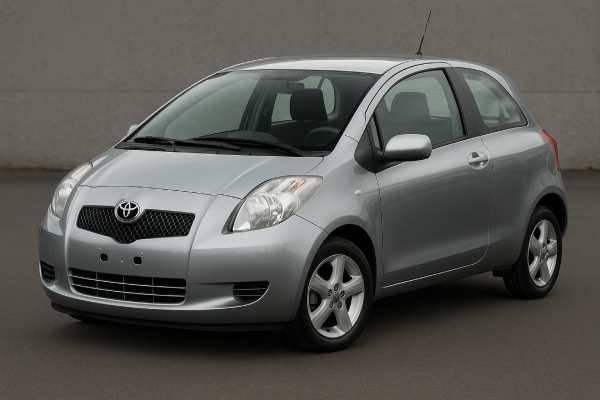
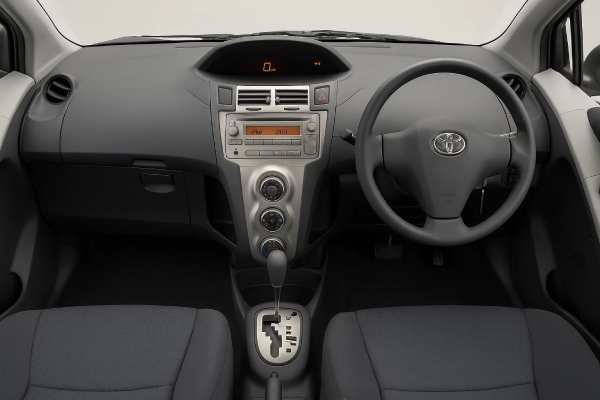
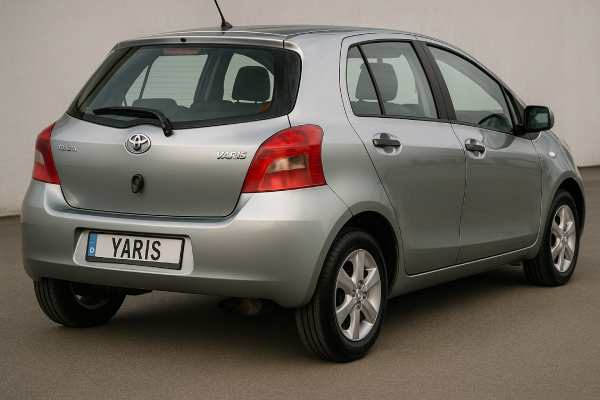
The second-generation Toyota Yaris KSP90 with the 1.0-litre 1KR-FE engine is one of those small hatchbacks that quietly does its job for years with little drama. Built primarily for European city use, it combines a compact footprint with a surprisingly spacious cabin, low fuel consumption, and Toyota’s reputation for durability. The three-cylinder petrol engine is modest on paper at 68 hp, but in real traffic it feels eager enough if you keep it in its power band.
For buyers today, the 2005–2008 Yaris 1.0 is interesting because it sits at the intersection of older, simpler tech and modern safety expectations. It brings a strong Euro NCAP crash score for adult occupants, plus thoughtful details like sliding rear seats and smart interior packaging. The flip side is that age, recalls (including wide-ranging airbag campaigns), and the optional MultiMode automated gearbox mean you should shop carefully and plan maintenance with intent rather than treating it as a “fill with fuel and forget” car.
Fast Facts
- Strong crash performance for its era with robust occupant protection in independent tests.
- Very low running costs: real-world use often around 5.5–6.5 L/100 km in mixed driving when maintained and driven gently.
- Simple, chain-driven 1KR-FE engine is robust but sensitive to skipped oil changes and low oil level.
- MultiMode (MMT) automated manual can be jerky and costly to sort; many buyers prefer the 5-speed manual.
- Basic but solid service rhythm: engine oil and filter about every 10,000–15,000 km or 12 months, whichever comes first.
Navigate this guide
- Toyota Yaris KSP90 1.0 in Detail
- Engine Specs and Dimensions for Yaris KSP90
- Yaris KSP90 Trims, Safety and Equipment
- Reliability and Known Issues KSP90 1.0
- Maintenance Schedule and Buying Advice
- Driving Impressions and Real-World Economy
- Toyota Yaris 1.0 Versus City Car Rivals
Toyota Yaris KSP90 1.0 in Detail
The KSP90-code Toyota Yaris is the second-generation Yaris (XP90 platform), sold in Europe and many other markets from late 2005. It was offered as three- and five-door hatchbacks and built primarily at Toyota’s Valenciennes plant in France. The 1.0-litre 1KR-FE petrol engine is the entry powertrain, aimed squarely at city drivers, first-time buyers, and people who prioritise low ownership costs over outright performance.
Despite the small displacement, the Yaris feels like a “grown-up” car inside. The wheelbase of around 2,460 mm and tall body give good headroom and a rear bench that can genuinely carry adults on shorter trips. The sliding, split rear seat and flat floor make the car more flexible than many rivals of the time, particularly for families juggling child seats and pushchairs. Boot space ranges from roughly 272 litres seats-up to over 1,000 litres with the backrests folded, depending on rear-seat position and measurement method.
The 1KR-FE itself is an all-aluminium inline-three with dual overhead camshafts, 12 valves and variable valve timing on the intake side (VVT-i). It was shared with the Aygo and several Daihatsu-related models, so parts and know-how are widely available. Toyota chose a timing chain instead of a belt, helping keep scheduled maintenance simple as long as oil changes are not neglected and the engine is not allowed to run low on oil.
On the road, the 1.0 Yaris is not fast, and you will notice this on motorways and steep hills. Official 0–100 km/h times sit in the mid-teens of seconds with a top speed around the mid-150 km/h range. However, in town the light body (often around 950–980 kg depending on trim and equipment) and short gearing make it feel agile enough and easy to place in traffic.
For a buyer today, the appeal lies in a mix of:
- Simple, robust mechanicals with a long track record.
- Strong passive safety for a small car from this era.
- Cabin versatility that still stands up well for child seats, shopping and commuting.
- A huge knowledge base of independent garages and owners, which helps keep repair costs predictable.
The main cautions are age-related issues, corrosion in harsher climates, and making sure any airbag and steering-related recalls have been completed. A careful pre-purchase inspection and a check of the vehicle’s recall status are essential.
Engine Specs and Dimensions for Yaris KSP90
This section gathers the key technical data for the 2005–2008 Toyota Yaris KSP90 1.0 with the 1KR-FE engine and front-wheel drive. Figures can vary slightly by market and year; always verify against the VIN and local documentation.
Engine and Performance
| Parameter | Value |
|---|---|
| Engine code | 1KR-FE inline-3 petrol |
| Displacement | 998 cc (1.0 l) |
| Configuration | Inline-3, DOHC, 4 valves per cylinder (12-valve) |
| Bore × stroke | Approximately 71.0 × 84.0 mm |
| Compression ratio | Around 10.5:1 |
| Induction | Naturally aspirated |
| Fuel system | Multi-point manifold injection (MPFI) |
| Max power | 68–69 hp (about 50 kW) @ 6,000 rpm |
| Max torque | About 93 Nm @ 3,600–3,800 rpm |
| Emissions class | Typically Euro 4 for European models |
| Official combined consumption (NEDC) | About 5.4–5.7 l/100 km (≈41–44 mpg US; 49–50 mpg UK) |
| Real-world mixed driving | Often 5.5–6.5 l/100 km for most owners when serviced correctly |
| CO₂ emissions | Roughly 119–128 g/km depending on tyre size and test year |
Transmission and Driveline
| Parameter | Value |
|---|---|
| Drive type | Front-wheel drive |
| Manual gearbox | 5-speed C5x-series manual (e.g. C50/C551 family) |
| Optional gearbox | 5-speed MultiMode automated manual (MMT) |
| Final drive (typical manual) | Around 4.3:1 on 1.0-litre applications |
| Turning circle | Approximately 9.4 m kerb-to-kerb |
| Clutch | Single dry plate, hydraulically actuated (manual), electro-hydraulically controlled in MMT |
Chassis and Dimensions
| Parameter | Value |
|---|---|
| Platform | Toyota B platform (XP90 generation) |
| Suspension (front) | MacPherson strut with coil springs |
| Suspension (rear) | Torsion beam axle with coil springs |
| Steering | Rack-and-pinion with electric power assist |
| Front brakes | Ventilated discs, about 255–260 mm diameter |
| Rear brakes | Drums, around 200 mm diameter |
| Typical wheel/tyre | 175/65 R14 or 185/60 R15, steel or alloy depending on trim |
| Length × width × height | ≈3,750 × 1,695 × 1,530 mm |
| Wheelbase | ≈2,460 mm |
| Kerb weight | Roughly 950–980 kg depending on trim and equipment |
| Gross vehicle weight (GVW) | Around 1,440 kg |
| Fuel tank | About 42 l petrol (usually RON 95 recommended) |
| Luggage volume | 272–363 l seats up (seat position dependent), up to roughly 1,000 l with seats folded |
Performance
| Metric | Value (approx.) |
|---|---|
| 0–100 km/h (0–62 mph) | Typically 13.5–15.5 s depending on body style and gearing |
| Top speed | Around 155–160 km/h (96–99 mph) |
| Braking 100–0 km/h | Commonly around 38–40 m in independent tests (tyre-dependent) |
| Towing (braked) | Often 700–900 kg depending on market approval; verify locally |
Fluids and Service Capacities (1KR-FE, KSP90)
| System | Capacity (approx.) | Specification |
|---|---|---|
| Engine oil (with filter) | ≈3.1 l | API SL–SM, ILSAC petrol engine oil, often 5W-30 in Europe |
| Engine coolant | ≈4.5 l | Toyota Super Long Life Coolant (pink, OAT) or equivalent |
| Manual gearbox (C5x) | ≈1.7 l | GL-4/GL-5 75W gear oil |
| MMT gearbox | ≈1.7 l | Same base spec; follow MMT-specific guidance |
| A/C refrigerant | Roughly 400–450 g R134a (varies by equipment) |
Electrical
| Item | Typical value |
|---|---|
| Alternator | Around 80–90 A output depending on equipment level |
| 12 V battery | Around 45–50 Ah, small-case lead-acid (varies by region) |
| Spark plugs | Long-life iridium plugs (for example, IFR6A11); gap about 1.0 mm |
Safety and Driver Assistance
- Euro-market models of this generation Yaris achieved strong adult-occupant scores in crash testing, with a solid passenger cell and effective airbags.
- Electronic stability control (often labelled VSC) was not standard on all 1.0 models; it became more common after the mid-life years and depended on market and trim.
- Modern driver assistance systems such as autonomous emergency braking, adaptive cruise control or lane-keeping are not fitted to 2005–2008 Yaris 1.0 models; safety relies on structure, airbags, braking and the driver.
Yaris KSP90 Trims, Safety and Equipment
Exact trim names vary by country, but 2005–2008 Yaris 1.0 models typically follow a simple grade ladder, for example basic, mid and high trims (often badged with names like Terra, Luna, Sol, T2, T3, T Spirit in different markets). At the bottom you usually get steel wheels, basic fabric seats, manual mirrors and a simple radio, sometimes even without air conditioning on the earliest or cheapest specifications.
Higher trims bring:
- Manual or automatic air conditioning.
- Better audio systems and extra speakers.
- Split-fold sliding rear seats as standard rather than optional.
- Front fog lamps, alloy wheels and extra interior storage solutions.
Mechanically, most 1.0 trims share the same engine and 5-speed manual gearbox. Differences relate mainly to wheel and tyre sizes, overall weight, and the availability of the MultiMode automated manual transmission. Some markets offered specific “eco” or “comfort” packs that altered equipment without changing powertrain or suspension.
Identifying trims quickly
- Wheel size and style: alloys usually signal mid or high trims.
- Tailgate badges: many cars carry a small trim label on the rear.
- Interior details: leather steering wheel, steering-wheel audio controls, split sliding rear bench and extra cubbies often mark a higher grade.
Safety equipment by trim and year
Early in the production run, most European Yaris 1.0s came with:
- Driver and front passenger airbags.
- Seatbelt pretensioners and force limiters.
- ABS with electronic brake-force distribution.
Depending on market and trim, you may also find:
- Front side airbags.
- Curtain airbags for both seating rows.
- Driver’s knee airbag on some higher-spec versions.
- Electronic stability control (VSC) and traction control, particularly from around 2007 onwards.
Child-seat provisions are generally good for a car this size, with ISOFIX-type anchor points on the outer rear seats in most markets, clearly detailed in the owner’s manual. Rear doors on five-door models open quite wide, making it easier to load bulky child seats.
Driver assistance systems
This generation predates the now-common advanced driver assistance features. You will not see factory adaptive cruise, lane-keep assistance or automatic emergency braking. Instead, the meaningful safety “assists” are:
- ABS with EBD and brake assist.
- Traction and stability control where fitted.
- Clear instrumentation and good all-round visibility to support the driver.
When shopping, prioritise a car with:
- As many airbags as possible (ideally front, side and curtain).
- Stability control where available in your market.
- Documented completion of all recall campaigns, especially those connected to airbags and steering components.
Reliability and Known Issues KSP90 1.0
Overall, the KSP90 Yaris 1.0 enjoys an excellent reputation for reliability, particularly when fitted with the 5-speed manual and given regular oil changes. However, age and mileage mean some patterns have emerged that buyers and owners should understand.
Engine and ancillaries
- Oil consumption (occasional, medium severity): Some high-mileage engines show increased oil use after roughly 150,000–200,000 km. Symptoms include low oil on the dipstick between services, warning lights and blue smoke on start-up. Regular level checks and timely top-ups are vital; in severe cases, a rebuild or replacement engine may be required.
- Timing chain noise (occasional, medium severity): The 1KR-FE uses a chain, but wear in the chain, guides or tensioner can cause rattling on cold start or trigger timing-related fault codes. Well-maintained engines often never need chain work; neglected oil changes raise the risk.
- Water pump seepage and accessory belt wear (common, low severity): Age-related coolant stains around the pump and squeaky belts are routine maintenance items. They are relatively inexpensive to fix and should not put you off a good car.
Fuel and emissions
- Lambda/O₂ sensor faults (occasional, low/medium severity): The pre-catalyst oxygen sensor can fail with age, leading to check-engine lights and higher fuel consumption. Replacement with a quality sensor usually resolves the issue.
- Evaporation system leaks (rare, low severity): Age or damage can lead to small leaks in hoses or valves, again flagging emissions fault codes.
Transmission and driveline
- MMT automated gearbox behaviour (common on MMT cars, medium/high severity): The MultiMode transmission is a manual gearbox with an automated clutch and shift actuators. Owners report jerky shifts, clutch judder, hesitation and occasional failure to select gears. Software resets and clutch replacement can help, but when components wear out, repairs can be costly compared with a conventional manual. Many used-car buyers simply avoid the MMT and seek a true manual.
- Manual gearbox durability (generally robust): The C5x manual transmissions are known to be strong; most issues relate to clutch wear, worn linkage bushings or, occasionally, bearings at very high mileage.
Chassis and body
- Rear axle beam and underbody corrosion (climate-dependent, medium severity): In countries that use heavy amounts of road salt, surface rust on the rear torsion beam, brake pipes and exhaust can progress over time. The Yaris fares better than some rivals, but after nearly two decades, a thorough underside inspection is essential.
- Suspension bushes and drop links (common, low severity): Clunks over bumps often trace back to anti-roll bar links or front control arm bushes. These are consumable items and relatively inexpensive to replace.
Electrical and interior
- Steering wheel spiral cable (clock spring) faults (occasional, high safety impact): The spiral cable in the steering wheel, which connects the airbag and controls, can crack or fail. Typical signs are an airbag warning light, loss of horn function or inoperative steering-wheel buttons. Many cars were covered by recalls or service campaigns; replacements restore proper safety function.
- Airbag inflator recalls (safety-critical): Like many vehicles of its era, the Yaris was affected by campaigns to replace certain front airbag inflators. These should be completed free of charge by dealers, but not every car has been updated yet, especially if it has changed owners often.
- Minor electrical issues (occasional, low severity): Blower fan resistors, window regulators and door-lock actuators can fail, especially in high-use, high-mileage cars. These problems are usually straightforward for an experienced workshop.
Software updates, TSBs and recalls
Common themes in technical service bulletins and recalls for this generation include:
- Airbag inflator replacements and revised modules.
- Steering spiral cable improvements.
- In some markets, electric power steering ECU updates or replacement to address inconsistent assistance or warning lights.
For any car you are considering, it is wise to:
- Run the VIN through Toyota’s regional recall/ campaign lookup.
- Check with your national safety authority’s database for outstanding actions.
- Ask the seller for printed proof that recall work has been completed.
A Yaris with full service history and recall documentation is generally one of the most dependable small cars of its time, with predictable running costs and few nasty surprises.
Maintenance Schedule and Buying Advice
Service intervals differ slightly by market, fuel quality and usage pattern, so treat this as a practical baseline and verify against the owner’s manual or local dealer guidance. The aim is to balance cost with long-term durability rather than just stretching intervals to the maximum.
Practical maintenance schedule (1KR-FE Yaris 1.0)
| Item | Typical interval (whichever comes first) | Notes |
|---|---|---|
| Engine oil and filter | 10,000–15,000 km or 12 months | Shorten to 10,000 km for mainly city, short-trip driving. |
| Engine air filter | 30,000 km or 2 years | Inspect earlier in dusty conditions. |
| Cabin (pollen) filter | 15,000–20,000 km or 1–2 years | Helps airflow and demisting. |
| Spark plugs (iridium) | 90,000–100,000 km or 6 years | Use quality iridium plugs and ensure correct gap. |
| Coolant | First change at around 160,000 km/10 years, then every 80,000 km/5 years | Many owners choose shorter intervals on older cars. |
| Manual/MMT gearbox oil | 80,000–100,000 km | Fresh oil improves shift quality and longevity. |
| Brake fluid | Every 2 years | Important for braking performance and corrosion prevention. |
| Brake pads and discs | Inspect every service | Replace when thickness or condition is out of spec. |
| Steering and suspension | Inspect annually | Look for play, leaks and torn bushes. |
| Tyre rotation and alignment | 10,000–15,000 km | Keeps wear even; correct alignment saves fuel. |
| 12 V battery | Test yearly after about 5 years | Replace before it fails completely. |
Key fluid specifications (summary)
- Engine oil: typically 5W-30 meeting Toyota’s recommended API/ILSAC standards for petrol engines in this era; in some regions, 0W-20 is permitted for later years.
- Coolant: long-life, silicate-free OAT coolant compatible with Toyota Super Long Life Coolant.
- Gearbox: GL-4/GL-5 75W gear oil for C5x manual and MMT units, following local technical data.
For detailed torque values such as wheel nuts, oil drain plug and spark plugs, consult official service data. As a rough guide, wheel nuts are usually around 100 Nm, but rely on the exact numbers for your model and market.
Buyer’s checklist
When assessing a used Yaris 1.0:
- Service history: Look for regular oil changes (ideally every year), documented coolant and brake fluid changes, and any gearbox oil service. A stamped book or invoices are more convincing than verbal claims.
- Recalls: Ask for proof of airbag and steering-related recall completion, and run the VIN through Toyota’s and your national authority’s systems. This is especially important for cars imported from other regions.
- Engine health: Listen for rattles on cold start, watch for warning lights, and check for visible exhaust smoke. Inspect for oil leaks and confirm there is no heavy sludge visible under the oil filler cap.
- Gearbox behaviour: On MMT cars, confirm that it shifts smoothly in all modes with no hesitation or warning lamps. On manuals, check the clutch for slipping and the gearshift for notchiness or crunching when engaging gears quickly.
- Corrosion: Inspect the rear axle beam, sills, floorpan, around the fuel filler area and under the boot floor. Surface rust is common; deep scaling or previous welding repairs need closer evaluation.
- Interior and electrics: Test all windows, locks, mirrors and HVAC functions. Check that the airbag light goes out normally after start-up and that the steering-wheel controls (if fitted) work correctly.
Recommended years and trims
- Any 2007–2008 manual Yaris 1.0 with full history and completed recalls is a strong all-round choice.
- Aim for mid-grade trims that include at least side airbags and preferably curtain airbags if available in your market.
- Be cautious with very low-priced cars that show poor servicing, noisy chains, heavy corrosion or incomplete recall history. There are enough cars on the market that you can afford to walk away and wait for a better example.
Long-term, a well-maintained 1KR-FE Yaris can realistically exceed 200,000–250,000 km with only routine wear items and occasional age-related repairs. Many owners keep them far longer, especially when rust is kept under control and minor faults are dealt with promptly.
Driving Impressions and Real-World Economy
The Yaris 1.0 is engineered first and foremost as a city and suburban car, and it is in this environment that it feels most at home. The light steering, tight turning circle and generous glass area make parking very easy, even in dense urban areas and tight parking garages.
Ride, handling and noise
The suspension tune sits on the comfortable side of the small-car spectrum. Over rough tarmac and speed bumps, the car filters smaller imperfections well, though larger potholes can still send a thump through the cabin because of the short wheelbase. Body roll is noticeable when you push through roundabouts or twisty roads, but the car remains predictable and easy to place.
Noise levels are acceptable for a light hatchback of this age. The three-cylinder engine has a distinct thrum, becoming more vocal as revs rise. At urban speeds this is generally fine; at motorway speeds the engine, tyre and wind noise combine to make the car feel busier than larger, heavier rivals. If you spend many hours at 120–130 km/h, it is worth considering whether a larger-engined car might be more relaxing.
Powertrain character
With around 68 hp and 93 Nm, the 1KR-FE is modest but willing if you make use of the rev range. The key points are:
- Around town up to 50–60 km/h, performance feels adequate, particularly if you do not lug the engine at very low rpm.
- On motorways and steep hills, you will need to shift down to 4th or even 3rd for brisk acceleration and overtakes.
The 5-speed manual gearbox is light and reasonably precise, with a friendly clutch that makes the car suitable for new drivers. The MultiMode (MMT) version removes the clutch pedal but can feel jerky and indecisive, especially in stop–start traffic and on hills. Many drivers find the manual more natural and more durable in the long run.
Efficiency in the real world
Against official combined fuel figures in the mid-5-litre-per-100-km range, real-world experience tends to look like this:
- City-heavy use: 6.5–7.5 l/100 km (about 31–36 mpg US) if most journeys are short and the engine rarely fully warms up.
- Mixed driving: 5.5–6.5 l/100 km (36–43 mpg US) with a blend of town and open-road use.
- Steady motorway (100–120 km/h): roughly 6.0–7.0 l/100 km (34–39 mpg US), depending on load, wind and road gradients.
Tyre choice has a clear impact. Narrow 14-inch eco tyres tend to roll more easily and generate less noise, while wider or low-profile aftermarket wheels may improve grip but usually increase fuel consumption and harshness.
Load and light towing
The Yaris 1.0 can carry four adults and luggage, but when fully loaded it feels noticeably slower and requires more planning for overtakes and motorway merges. Where towing is officially permitted, limits are modest, and the combination of small engine and light chassis means it is best treated as an occasional, light-duty tower rather than a regular caravan hauler.
In everyday use, the combination of small external size, good visibility, predictable handling and low running costs makes the Yaris a very easy car to live with. If you value relaxed high-speed performance above all, you may prefer a larger-engined variant; if your driving is dominated by city and suburban routes, the 1.0 is usually sufficient.
Toyota Yaris 1.0 Versus City Car Rivals
When new, the 2005–2008 Yaris 1.0 competed with cars like the Ford Fiesta Mk6, Opel/Vauxhall Corsa C and early D, Renault Clio III, Fiat Punto, Peugeot 207, Honda Jazz/Fit and various VW Polo, Seat Ibiza and Skoda Fabia models. Each of these has its appeal, but the Yaris occupies a distinctive position in the class.
Where the Yaris 1.0 stands out
- Reliability and longevity: Few rivals from this era match the Yaris’ overall reliability record. Honda’s Jazz/Fit comes close, but many French and Italian superminis suffer more frequent electrical or trim issues, and some small turbo engines in later rivals do not age as gracefully as Toyota’s simple naturally aspirated three-cylinder.
- Safety for its time: The Yaris achieved strong crash-test results for adult occupants when new, at a time when not every B-segment hatchback reached that level. Combined with multiple airbags on better-equipped trims, it offered a reassuring package for families.
- Cabin packaging: The sliding rear bench, tall roofline and clever storage solutions make the Yaris more flexible than many same-size cars. Compared to older Fiestas and Corsas with fixed rear seats and simpler interiors, it often swallows more awkward loads and is kinder to child-seat installation.
Where rivals may be preferable
- Performance and refinement: A Fiesta or Polo with a larger 1.25–1.4-litre engine generally feels stronger on motorways and hills, with lower revs at cruising speed and less engine noise.
- Driving enjoyment: The Fiesta in particular has more engaging steering and body control, making it the driver’s choice in this class. The Yaris is safe and tidy but not especially sporty.
- Interior feel: While the Yaris’ materials are durable, some rivals in higher trims offer softer plastics and more premium-looking dashboards, which may matter to drivers who spend hours commuting.
Total cost of ownership
On the used market, Yaris prices can be slightly higher than comparable Corsas or Clios because of their reputation for reliability. However:
- Parts availability is excellent through both Toyota dealers and aftermarket suppliers.
- Fuel and insurance costs are typically low.
- Major mechanical failures are relatively rare on well-maintained examples.
For a buyer who values trouble-free ownership, predictable running costs and good safety more than sharp handling or motorway power, a sound Yaris 1.0 is often a better long-term companion than many more exciting alternatives. For those who regularly carry five people or cover long motorway distances, a larger-engined Yaris (1.3/1.33) or a roomier compact may be a more suitable choice.
References
- Toyota-Club.Net – Fluids & capacities – Yaris (2005-2011) 2018 (Service data summary)
- 2005 Yaris DPL 2005 (Press information)
- Vehicle Information | Owners 2022 (Owner’s Manual portal)
- Vehicle Detail Search – 2007 TOYOTA YARIS 2024 (Recall and Safety Database)
- Recalls & Campaigns Lookup 2023 (Recall Database)
Disclaimer
This article is for informational purposes only and is not a substitute for professional diagnosis, repair or official service information. Specifications, torque values, fluids and maintenance intervals can vary by VIN, model year, market and equipment level. Always confirm critical data and procedures against your vehicle’s official owner’s manual, workshop manual and current technical service bulletins, and follow all local regulations. If you are unsure about any inspection or repair, consult a qualified technician or authorised Toyota service centre.
If you found this guide useful, you are welcome to share it on social platforms such as Facebook or X/Twitter to help other Toyota Yaris owners and support our work.
Toyota Yaris (KSP90) 1.0 l / 68 hp / 2005 / 2006 / 2007 / 2008 : Specs, reliability, running costs, and maintenance tips
Toyota Yaris (KSP90) 1.0 l / 68 hp / 2005 / 2006 / 2007 / 2008 : Specs, fuel economy, common problems, and service schedule
Toyota Yaris (KSP90) 1.0 l / 68 hp / 2005 / 2006 / 2007 / 2008 : Specs, dimensions, safety ratings, and owner insights
Toyota Yaris (KSP90) 1.0 l / 68 hp / 2005 / 2006 / 2007 / 2008 : Specs, performance figures, city driving review, and long-term reliability
Toyota Yaris (KSP90) 1.0 l / 68 hp / 2005 / 2006 / 2007 / 2008 : Specs, trim levels, standard equipment, and buying advice
Toyota Yaris (KSP90) 1.0 l / 68 hp / 2005 / 2006 / 2007 / 2008 : Specs, scheduled maintenance, service intervals, and DIY notes
Toyota Yaris (KSP90) 1.0 l / 68 hp / 2005 / 2006 / 2007 / 2008 : Specs, recall information, safety features, and inspection checklist
Toyota Yaris (KSP90) 1.0 l / 68 hp / 2005 / 2006 / 2007 / 2008 : Specs, pros and cons, ownership experience, and value
The second-generation Toyota Yaris KSP90 with the 1.0-litre 1KR-FE engine is one of those small hatchbacks that quietly does its job for years with little drama. Built primarily for European city use, it combines a compact footprint with a surprisingly spacious cabin, low fuel consumption, and Toyota’s reputation for durability. The three-cylinder petrol engine is modest on paper at 68 hp, but in real traffic it feels eager enough if you keep it in its power band.
For buyers today, the 2005–2008 Yaris 1.0 is interesting because it sits at the intersection of older, simpler tech and modern safety expectations. It brings a strong Euro NCAP crash score for adult occupants, plus thoughtful details like sliding rear seats and smart interior packaging. The flip side is that age, recalls (including wide-ranging airbag campaigns), and the optional MultiMode automated gearbox mean you should shop carefully and plan maintenance with intent rather than treating it as a “fill with fuel and forget” car.
Fast Facts
- Strong crash performance for its era with robust occupant protection in independent tests.
- Very low running costs: real-world use often around 5.5–6.5 L/100 km in mixed driving when maintained and driven gently.
- Simple, chain-driven 1KR-FE engine is robust but sensitive to skipped oil changes and low oil level.
- MultiMode (MMT) automated manual can be jerky and costly to sort; many buyers prefer the 5-speed manual.
- Basic but solid service rhythm: engine oil and filter about every 10,000–15,000 km or 12 months, whichever comes first.
Navigate this guide
- Toyota Yaris KSP90 1.0 in Detail
- Engine Specs and Dimensions for Yaris KSP90
- Yaris KSP90 Trims, Safety and Equipment
- Reliability and Known Issues KSP90 1.0
- Maintenance Schedule and Buying Advice
- Driving Impressions and Real-World Economy
- Toyota Yaris 1.0 Versus City Car Rivals
Toyota Yaris KSP90 1.0 in Detail
The KSP90-code Toyota Yaris is the second-generation Yaris (XP90 platform), sold in Europe and many other markets from late 2005. It was offered as three- and five-door hatchbacks and built primarily at Toyota’s Valenciennes plant in France. The 1.0-litre 1KR-FE petrol engine is the entry powertrain, aimed squarely at city drivers, first-time buyers, and people who prioritise low ownership costs over outright performance.
Despite the small displacement, the Yaris feels like a “grown-up” car inside. The wheelbase of around 2,460 mm and tall body give good headroom and a rear bench that can genuinely carry adults on shorter trips. The sliding, split rear seat and flat floor make the car more flexible than many rivals of the time, particularly for families juggling child seats and pushchairs. Boot space ranges from roughly 272 litres seats-up to over 1,000 litres with the backrests folded, depending on rear-seat position and measurement method.
The 1KR-FE itself is an all-aluminium inline-three with dual overhead camshafts, 12 valves and variable valve timing on the intake side (VVT-i). It was shared with the Aygo and several Daihatsu-related models, so parts and know-how are widely available. Toyota chose a timing chain instead of a belt, helping keep scheduled maintenance simple as long as oil changes are not neglected and the engine is not allowed to run low on oil.
On the road, the 1.0 Yaris is not fast, and you will notice this on motorways and steep hills. Official 0–100 km/h times sit in the mid-teens of seconds with a top speed around the mid-150 km/h range. However, in town the light body (often around 950–980 kg depending on trim and equipment) and short gearing make it feel agile enough and easy to place in traffic.
For a buyer today, the appeal lies in a mix of:
- Simple, robust mechanicals with a long track record.
- Strong passive safety for a small car from this era.
- Cabin versatility that still stands up well for child seats, shopping and commuting.
- A huge knowledge base of independent garages and owners, which helps keep repair costs predictable.
The main cautions are age-related issues, corrosion in harsher climates, and making sure any airbag and steering-related recalls have been completed. A careful pre-purchase inspection and a check of the vehicle’s recall status are essential.
Engine Specs and Dimensions for Yaris KSP90
This section gathers the key technical data for the 2005–2008 Toyota Yaris KSP90 1.0 with the 1KR-FE engine and front-wheel drive. Figures can vary slightly by market and year; always verify against the VIN and local documentation.
Engine and Performance
| Parameter | Value |
|---|---|
| Engine code | 1KR-FE inline-3 petrol |
| Displacement | 998 cc (1.0 l) |
| Configuration | Inline-3, DOHC, 4 valves per cylinder (12-valve) |
| Bore × stroke | Approximately 71.0 × 84.0 mm |
| Compression ratio | Around 10.5:1 |
| Induction | Naturally aspirated |
| Fuel system | Multi-point manifold injection (MPFI) |
| Max power | 68–69 hp (about 50 kW) @ 6,000 rpm |
| Max torque | About 93 Nm @ 3,600–3,800 rpm |
| Emissions class | Typically Euro 4 for European models |
| Official combined consumption (NEDC) | About 5.4–5.7 l/100 km (≈41–44 mpg US; 49–50 mpg UK) |
| Real-world mixed driving | Often 5.5–6.5 l/100 km for most owners when serviced correctly |
| CO₂ emissions | Roughly 119–128 g/km depending on tyre size and test year |
Transmission and Driveline
| Parameter | Value |
|---|---|
| Drive type | Front-wheel drive |
| Manual gearbox | 5-speed C5x-series manual (e.g. C50/C551 family) |
| Optional gearbox | 5-speed MultiMode automated manual (MMT) |
| Final drive (typical manual) | Around 4.3:1 on 1.0-litre applications |
| Turning circle | Approximately 9.4 m kerb-to-kerb |
| Clutch | Single dry plate, hydraulically actuated (manual), electro-hydraulically controlled in MMT |
Chassis and Dimensions
| Parameter | Value |
|---|---|
| Platform | Toyota B platform (XP90 generation) |
| Suspension (front) | MacPherson strut with coil springs |
| Suspension (rear) | Torsion beam axle with coil springs |
| Steering | Rack-and-pinion with electric power assist |
| Front brakes | Ventilated discs, about 255–260 mm diameter |
| Rear brakes | Drums, around 200 mm diameter |
| Typical wheel/tyre | 175/65 R14 or 185/60 R15, steel or alloy depending on trim |
| Length × width × height | ≈3,750 × 1,695 × 1,530 mm |
| Wheelbase | ≈2,460 mm |
| Kerb weight | Roughly 950–980 kg depending on trim and equipment |
| Gross vehicle weight (GVW) | Around 1,440 kg |
| Fuel tank | About 42 l petrol (usually RON 95 recommended) |
| Luggage volume | 272–363 l seats up (seat position dependent), up to roughly 1,000 l with seats folded |
Performance
| Metric | Value (approx.) |
|---|---|
| 0–100 km/h (0–62 mph) | Typically 13.5–15.5 s depending on body style and gearing |
| Top speed | Around 155–160 km/h (96–99 mph) |
| Braking 100–0 km/h | Commonly around 38–40 m in independent tests (tyre-dependent) |
| Towing (braked) | Often 700–900 kg depending on market approval; verify locally |
Fluids and Service Capacities (1KR-FE, KSP90)
| System | Capacity (approx.) | Specification |
|---|---|---|
| Engine oil (with filter) | ≈3.1 l | API SL–SM, ILSAC petrol engine oil, often 5W-30 in Europe |
| Engine coolant | ≈4.5 l | Toyota Super Long Life Coolant (pink, OAT) or equivalent |
| Manual gearbox (C5x) | ≈1.7 l | GL-4/GL-5 75W gear oil |
| MMT gearbox | ≈1.7 l | Same base spec; follow MMT-specific guidance |
| A/C refrigerant | Roughly 400–450 g R134a (varies by equipment) |
Electrical
| Item | Typical value |
|---|---|
| Alternator | Around 80–90 A output depending on equipment level |
| 12 V battery | Around 45–50 Ah, small-case lead-acid (varies by region) |
| Spark plugs | Long-life iridium plugs (for example, IFR6A11); gap about 1.0 mm |
Safety and Driver Assistance
- Euro-market models of this generation Yaris achieved strong adult-occupant scores in crash testing, with a solid passenger cell and effective airbags.
- Electronic stability control (often labelled VSC) was not standard on all 1.0 models; it became more common after the mid-life years and depended on market and trim.
- Modern driver assistance systems such as autonomous emergency braking, adaptive cruise control or lane-keeping are not fitted to 2005–2008 Yaris 1.0 models; safety relies on structure, airbags, braking and the driver.
Yaris KSP90 Trims, Safety and Equipment
Exact trim names vary by country, but 2005–2008 Yaris 1.0 models typically follow a simple grade ladder, for example basic, mid and high trims (often badged with names like Terra, Luna, Sol, T2, T3, T Spirit in different markets). At the bottom you usually get steel wheels, basic fabric seats, manual mirrors and a simple radio, sometimes even without air conditioning on the earliest or cheapest specifications.
Higher trims bring:
- Manual or automatic air conditioning.
- Better audio systems and extra speakers.
- Split-fold sliding rear seats as standard rather than optional.
- Front fog lamps, alloy wheels and extra interior storage solutions.
Mechanically, most 1.0 trims share the same engine and 5-speed manual gearbox. Differences relate mainly to wheel and tyre sizes, overall weight, and the availability of the MultiMode automated manual transmission. Some markets offered specific “eco” or “comfort” packs that altered equipment without changing powertrain or suspension.
Identifying trims quickly
- Wheel size and style: alloys usually signal mid or high trims.
- Tailgate badges: many cars carry a small trim label on the rear.
- Interior details: leather steering wheel, steering-wheel audio controls, split sliding rear bench and extra cubbies often mark a higher grade.
Safety equipment by trim and year
Early in the production run, most European Yaris 1.0s came with:
- Driver and front passenger airbags.
- Seatbelt pretensioners and force limiters.
- ABS with electronic brake-force distribution.
Depending on market and trim, you may also find:
- Front side airbags.
- Curtain airbags for both seating rows.
- Driver’s knee airbag on some higher-spec versions.
- Electronic stability control (VSC) and traction control, particularly from around 2007 onwards.
Child-seat provisions are generally good for a car this size, with ISOFIX-type anchor points on the outer rear seats in most markets, clearly detailed in the owner’s manual. Rear doors on five-door models open quite wide, making it easier to load bulky child seats.
Driver assistance systems
This generation predates the now-common advanced driver assistance features. You will not see factory adaptive cruise, lane-keep assistance or automatic emergency braking. Instead, the meaningful safety “assists” are:
- ABS with EBD and brake assist.
- Traction and stability control where fitted.
- Clear instrumentation and good all-round visibility to support the driver.
When shopping, prioritise a car with:
- As many airbags as possible (ideally front, side and curtain).
- Stability control where available in your market.
- Documented completion of all recall campaigns, especially those connected to airbags and steering components.
Reliability and Known Issues KSP90 1.0
Overall, the KSP90 Yaris 1.0 enjoys an excellent reputation for reliability, particularly when fitted with the 5-speed manual and given regular oil changes. However, age and mileage mean some patterns have emerged that buyers and owners should understand.
Engine and ancillaries
- Oil consumption (occasional, medium severity): Some high-mileage engines show increased oil use after roughly 150,000–200,000 km. Symptoms include low oil on the dipstick between services, warning lights and blue smoke on start-up. Regular level checks and timely top-ups are vital; in severe cases, a rebuild or replacement engine may be required.
- Timing chain noise (occasional, medium severity): The 1KR-FE uses a chain, but wear in the chain, guides or tensioner can cause rattling on cold start or trigger timing-related fault codes. Well-maintained engines often never need chain work; neglected oil changes raise the risk.
- Water pump seepage and accessory belt wear (common, low severity): Age-related coolant stains around the pump and squeaky belts are routine maintenance items. They are relatively inexpensive to fix and should not put you off a good car.
Fuel and emissions
- Lambda/O₂ sensor faults (occasional, low/medium severity): The pre-catalyst oxygen sensor can fail with age, leading to check-engine lights and higher fuel consumption. Replacement with a quality sensor usually resolves the issue.
- Evaporation system leaks (rare, low severity): Age or damage can lead to small leaks in hoses or valves, again flagging emissions fault codes.
Transmission and driveline
- MMT automated gearbox behaviour (common on MMT cars, medium/high severity): The MultiMode transmission is a manual gearbox with an automated clutch and shift actuators. Owners report jerky shifts, clutch judder, hesitation and occasional failure to select gears. Software resets and clutch replacement can help, but when components wear out, repairs can be costly compared with a conventional manual. Many used-car buyers simply avoid the MMT and seek a true manual.
- Manual gearbox durability (generally robust): The C5x manual transmissions are known to be strong; most issues relate to clutch wear, worn linkage bushings or, occasionally, bearings at very high mileage.
Chassis and body
- Rear axle beam and underbody corrosion (climate-dependent, medium severity): In countries that use heavy amounts of road salt, surface rust on the rear torsion beam, brake pipes and exhaust can progress over time. The Yaris fares better than some rivals, but after nearly two decades, a thorough underside inspection is essential.
- Suspension bushes and drop links (common, low severity): Clunks over bumps often trace back to anti-roll bar links or front control arm bushes. These are consumable items and relatively inexpensive to replace.
Electrical and interior
- Steering wheel spiral cable (clock spring) faults (occasional, high safety impact): The spiral cable in the steering wheel, which connects the airbag and controls, can crack or fail. Typical signs are an airbag warning light, loss of horn function or inoperative steering-wheel buttons. Many cars were covered by recalls or service campaigns; replacements restore proper safety function.
- Airbag inflator recalls (safety-critical): Like many vehicles of its era, the Yaris was affected by campaigns to replace certain front airbag inflators. These should be completed free of charge by dealers, but not every car has been updated yet, especially if it has changed owners often.
- Minor electrical issues (occasional, low severity): Blower fan resistors, window regulators and door-lock actuators can fail, especially in high-use, high-mileage cars. These problems are usually straightforward for an experienced workshop.
Software updates, TSBs and recalls
Common themes in technical service bulletins and recalls for this generation include:
- Airbag inflator replacements and revised modules.
- Steering spiral cable improvements.
- In some markets, electric power steering ECU updates or replacement to address inconsistent assistance or warning lights.
For any car you are considering, it is wise to:
- Run the VIN through Toyota’s regional recall/ campaign lookup.
- Check with your national safety authority’s database for outstanding actions.
- Ask the seller for printed proof that recall work has been completed.
A Yaris with full service history and recall documentation is generally one of the most dependable small cars of its time, with predictable running costs and few nasty surprises.
Maintenance Schedule and Buying Advice
Service intervals differ slightly by market, fuel quality and usage pattern, so treat this as a practical baseline and verify against the owner’s manual or local dealer guidance. The aim is to balance cost with long-term durability rather than just stretching intervals to the maximum.
Practical maintenance schedule (1KR-FE Yaris 1.0)
| Item | Typical interval (whichever comes first) | Notes |
|---|---|---|
| Engine oil and filter | 10,000–15,000 km or 12 months | Shorten to 10,000 km for mainly city, short-trip driving. |
| Engine air filter | 30,000 km or 2 years | Inspect earlier in dusty conditions. |
| Cabin (pollen) filter | 15,000–20,000 km or 1–2 years | Helps airflow and demisting. |
| Spark plugs (iridium) | 90,000–100,000 km or 6 years | Use quality iridium plugs and ensure correct gap. |
| Coolant | First change at around 160,000 km/10 years, then every 80,000 km/5 years | Many owners choose shorter intervals on older cars. |
| Manual/MMT gearbox oil | 80,000–100,000 km | Fresh oil improves shift quality and longevity. |
| Brake fluid | Every 2 years | Important for braking performance and corrosion prevention. |
| Brake pads and discs | Inspect every service | Replace when thickness or condition is out of spec. |
| Steering and suspension | Inspect annually | Look for play, leaks and torn bushes. |
| Tyre rotation and alignment | 10,000–15,000 km | Keeps wear even; correct alignment saves fuel. |
| 12 V battery | Test yearly after about 5 years | Replace before it fails completely. |
Key fluid specifications (summary)
- Engine oil: typically 5W-30 meeting Toyota’s recommended API/ILSAC standards for petrol engines in this era; in some regions, 0W-20 is permitted for later years.
- Coolant: long-life, silicate-free OAT coolant compatible with Toyota Super Long Life Coolant.
- Gearbox: GL-4/GL-5 75W gear oil for C5x manual and MMT units, following local technical data.
For detailed torque values such as wheel nuts, oil drain plug and spark plugs, consult official service data. As a rough guide, wheel nuts are usually around 100 Nm, but rely on the exact numbers for your model and market.
Buyer’s checklist
When assessing a used Yaris 1.0:
- Service history: Look for regular oil changes (ideally every year), documented coolant and brake fluid changes, and any gearbox oil service. A stamped book or invoices are more convincing than verbal claims.
- Recalls: Ask for proof of airbag and steering-related recall completion, and run the VIN through Toyota’s and your national authority’s systems. This is especially important for cars imported from other regions.
- Engine health: Listen for rattles on cold start, watch for warning lights, and check for visible exhaust smoke. Inspect for oil leaks and confirm there is no heavy sludge visible under the oil filler cap.
- Gearbox behaviour: On MMT cars, confirm that it shifts smoothly in all modes with no hesitation or warning lamps. On manuals, check the clutch for slipping and the gearshift for notchiness or crunching when engaging gears quickly.
- Corrosion: Inspect the rear axle beam, sills, floorpan, around the fuel filler area and under the boot floor. Surface rust is common; deep scaling or previous welding repairs need closer evaluation.
- Interior and electrics: Test all windows, locks, mirrors and HVAC functions. Check that the airbag light goes out normally after start-up and that the steering-wheel controls (if fitted) work correctly.
Recommended years and trims
- Any 2007–2008 manual Yaris 1.0 with full history and completed recalls is a strong all-round choice.
- Aim for mid-grade trims that include at least side airbags and preferably curtain airbags if available in your market.
- Be cautious with very low-priced cars that show poor servicing, noisy chains, heavy corrosion or incomplete recall history. There are enough cars on the market that you can afford to walk away and wait for a better example.
Long-term, a well-maintained 1KR-FE Yaris can realistically exceed 200,000–250,000 km with only routine wear items and occasional age-related repairs. Many owners keep them far longer, especially when rust is kept under control and minor faults are dealt with promptly.
Driving Impressions and Real-World Economy
The Yaris 1.0 is engineered first and foremost as a city and suburban car, and it is in this environment that it feels most at home. The light steering, tight turning circle and generous glass area make parking very easy, even in dense urban areas and tight parking garages.
Ride, handling and noise
The suspension tune sits on the comfortable side of the small-car spectrum. Over rough tarmac and speed bumps, the car filters smaller imperfections well, though larger potholes can still send a thump through the cabin because of the short wheelbase. Body roll is noticeable when you push through roundabouts or twisty roads, but the car remains predictable and easy to place.
Noise levels are acceptable for a light hatchback of this age. The three-cylinder engine has a distinct thrum, becoming more vocal as revs rise. At urban speeds this is generally fine; at motorway speeds the engine, tyre and wind noise combine to make the car feel busier than larger, heavier rivals. If you spend many hours at 120–130 km/h, it is worth considering whether a larger-engined car might be more relaxing.
Powertrain character
With around 68 hp and 93 Nm, the 1KR-FE is modest but willing if you make use of the rev range. The key points are:
- Around town up to 50–60 km/h, performance feels adequate, particularly if you do not lug the engine at very low rpm.
- On motorways and steep hills, you will need to shift down to 4th or even 3rd for brisk acceleration and overtakes.
The 5-speed manual gearbox is light and reasonably precise, with a friendly clutch that makes the car suitable for new drivers. The MultiMode (MMT) version removes the clutch pedal but can feel jerky and indecisive, especially in stop–start traffic and on hills. Many drivers find the manual more natural and more durable in the long run.
Efficiency in the real world
Against official combined fuel figures in the mid-5-litre-per-100-km range, real-world experience tends to look like this:
- City-heavy use: 6.5–7.5 l/100 km (about 31–36 mpg US) if most journeys are short and the engine rarely fully warms up.
- Mixed driving: 5.5–6.5 l/100 km (36–43 mpg US) with a blend of town and open-road use.
- Steady motorway (100–120 km/h): roughly 6.0–7.0 l/100 km (34–39 mpg US), depending on load, wind and road gradients.
Tyre choice has a clear impact. Narrow 14-inch eco tyres tend to roll more easily and generate less noise, while wider or low-profile aftermarket wheels may improve grip but usually increase fuel consumption and harshness.
Load and light towing
The Yaris 1.0 can carry four adults and luggage, but when fully loaded it feels noticeably slower and requires more planning for overtakes and motorway merges. Where towing is officially permitted, limits are modest, and the combination of small engine and light chassis means it is best treated as an occasional, light-duty tower rather than a regular caravan hauler.
In everyday use, the combination of small external size, good visibility, predictable handling and low running costs makes the Yaris a very easy car to live with. If you value relaxed high-speed performance above all, you may prefer a larger-engined variant; if your driving is dominated by city and suburban routes, the 1.0 is usually sufficient.
Toyota Yaris 1.0 Versus City Car Rivals
When new, the 2005–2008 Yaris 1.0 competed with cars like the Ford Fiesta Mk6, Opel/Vauxhall Corsa C and early D, Renault Clio III, Fiat Punto, Peugeot 207, Honda Jazz/Fit and various VW Polo, Seat Ibiza and Skoda Fabia models. Each of these has its appeal, but the Yaris occupies a distinctive position in the class.
Where the Yaris 1.0 stands out
- Reliability and longevity: Few rivals from this era match the Yaris’ overall reliability record. Honda’s Jazz/Fit comes close, but many French and Italian superminis suffer more frequent electrical or trim issues, and some small turbo engines in later rivals do not age as gracefully as Toyota’s simple naturally aspirated three-cylinder.
- Safety for its time: The Yaris achieved strong crash-test results for adult occupants when new, at a time when not every B-segment hatchback reached that level. Combined with multiple airbags on better-equipped trims, it offered a reassuring package for families.
- Cabin packaging: The sliding rear bench, tall roofline and clever storage solutions make the Yaris more flexible than many same-size cars. Compared to older Fiestas and Corsas with fixed rear seats and simpler interiors, it often swallows more awkward loads and is kinder to child-seat installation.
Where rivals may be preferable
- Performance and refinement: A Fiesta or Polo with a larger 1.25–1.4-litre engine generally feels stronger on motorways and hills, with lower revs at cruising speed and less engine noise.
- Driving enjoyment: The Fiesta in particular has more engaging steering and body control, making it the driver’s choice in this class. The Yaris is safe and tidy but not especially sporty.
- Interior feel: While the Yaris’ materials are durable, some rivals in higher trims offer softer plastics and more premium-looking dashboards, which may matter to drivers who spend hours commuting.
Total cost of ownership
On the used market, Yaris prices can be slightly higher than comparable Corsas or Clios because of their reputation for reliability. However:
- Parts availability is excellent through both Toyota dealers and aftermarket suppliers.
- Fuel and insurance costs are typically low.
- Major mechanical failures are relatively rare on well-maintained examples.
For a buyer who values trouble-free ownership, predictable running costs and good safety more than sharp handling or motorway power, a sound Yaris 1.0 is often a better long-term companion than many more exciting alternatives. For those who regularly carry five people or cover long motorway distances, a larger-engined Yaris (1.3/1.33) or a roomier compact may be a more suitable choice.
References
- Toyota-Club.Net – Fluids & capacities – Yaris (2005-2011) 2018 (Service data summary)
- 2005 Yaris DPL 2005 (Press information)
- Vehicle Information | Owners 2022 (Owner’s Manual portal)
- Vehicle Detail Search – 2007 TOYOTA YARIS 2024 (Recall and Safety Database)
- Recalls & Campaigns Lookup 2023 (Recall Database)
Disclaimer
This article is for informational purposes only and is not a substitute for professional diagnosis, repair or official service information. Specifications, torque values, fluids and maintenance intervals can vary by VIN, model year, market and equipment level. Always confirm critical data and procedures against your vehicle’s official owner’s manual, workshop manual and current technical service bulletins, and follow all local regulations. If you are unsure about any inspection or repair, consult a qualified technician or authorised Toyota service centre.
If you found this guide useful, you are welcome to share it on social platforms such as Facebook or X/Twitter to help other Toyota Yaris owners and support our work.
11. Toyota Yaris (KSP90) — 1KR-FE / 1.0 l — 68 hp — 2005–2008: Specs, Dimensions, Performance, Reliability, Safety ratings, Maintenance, and Advantages.
The second-generation Toyota Yaris KSP90 with the 1.0-litre 1KR-FE engine is one of those small hatchbacks that quietly does its job for years with little drama. Built primarily for European city use, it combines a compact footprint with a surprisingly spacious cabin, low fuel consumption, and Toyota’s reputation for durability. The three-cylinder petrol engine is modest on paper at 68 hp, but in real traffic it feels eager enough if you keep it in its power band.
For buyers today, the 2005–2008 Yaris 1.0 is interesting because it sits at the intersection of older, simpler tech and modern safety expectations. It brings a strong Euro NCAP crash score for adult occupants, plus thoughtful details like sliding rear seats and smart interior packaging. The flip side is that age, recalls (including wide-ranging airbag campaigns), and the optional MultiMode automated gearbox mean you should shop carefully and plan maintenance with intent rather than treating it as a “fill with fuel and forget” car.
Fast Facts
- Strong crash performance for its era with robust occupant protection in independent tests.
- Very low running costs: real-world use often around 5.5–6.5 L/100 km in mixed driving when maintained and driven gently.
- Simple, chain-driven 1KR-FE engine is robust but sensitive to skipped oil changes and low oil level.
- MultiMode (MMT) automated manual can be jerky and costly to sort; many buyers prefer the 5-speed manual.
- Basic but solid service rhythm: engine oil and filter about every 10,000–15,000 km or 12 months, whichever comes first.
Navigate this guide
- Toyota Yaris KSP90 1.0 in Detail
- Engine Specs and Dimensions for Yaris KSP90
- Yaris KSP90 Trims, Safety and Equipment
- Reliability and Known Issues KSP90 1.0
- Maintenance Schedule and Buying Advice
- Driving Impressions and Real-World Economy
- Toyota Yaris 1.0 Versus City Car Rivals
Toyota Yaris KSP90 1.0 in Detail
The KSP90-code Toyota Yaris is the second-generation Yaris (XP90 platform), sold in Europe and many other markets from late 2005. It was offered as three- and five-door hatchbacks and built primarily at Toyota’s Valenciennes plant in France. The 1.0-litre 1KR-FE petrol engine is the entry powertrain, aimed squarely at city drivers, first-time buyers, and people who prioritise low ownership costs over outright performance.
Despite the small displacement, the Yaris feels like a “grown-up” car inside. The wheelbase of around 2,460 mm and tall body give good headroom and a rear bench that can genuinely carry adults on shorter trips. The sliding, split rear seat and flat floor make the car more flexible than many rivals of the time, particularly for families juggling child seats and pushchairs. Boot space ranges from roughly 272 litres seats-up to over 1,000 litres with the backrests folded, depending on rear-seat position and measurement method.
The 1KR-FE itself is an all-aluminium inline-three with dual overhead camshafts, 12 valves and variable valve timing on the intake side (VVT-i). It was shared with the Aygo and several Daihatsu-related models, so parts and know-how are widely available. Toyota chose a timing chain instead of a belt, helping keep scheduled maintenance simple as long as oil changes are not neglected and the engine is not allowed to run low on oil.
On the road, the 1.0 Yaris is not fast, and you will notice this on motorways and steep hills. Official 0–100 km/h times sit in the mid-teens of seconds with a top speed around the mid-150 km/h range. However, in town the light body (often around 950–980 kg depending on trim and equipment) and short gearing make it feel agile enough and easy to place in traffic.
For a buyer today, the appeal lies in a mix of:
- Simple, robust mechanicals with a long track record.
- Strong passive safety for a small car from this era.
- Cabin versatility that still stands up well for child seats, shopping and commuting.
- A huge knowledge base of independent garages and owners, which helps keep repair costs predictable.
The main cautions are age-related issues, corrosion in harsher climates, and making sure any airbag and steering-related recalls have been completed. A careful pre-purchase inspection and a check of the vehicle’s recall status are essential.
Engine Specs and Dimensions for Yaris KSP90
This section gathers the key technical data for the 2005–2008 Toyota Yaris KSP90 1.0 with the 1KR-FE engine and front-wheel drive. Figures can vary slightly by market and year; always verify against the VIN and local documentation.
Engine and Performance
| Parameter | Value |
|---|---|
| Engine code | 1KR-FE inline-3 petrol |
| Displacement | 998 cc (1.0 l) |
| Configuration | Inline-3, DOHC, 4 valves per cylinder (12-valve) |
| Bore × stroke | Approximately 71.0 × 84.0 mm |
| Compression ratio | Around 10.5:1 |
| Induction | Naturally aspirated |
| Fuel system | Multi-point manifold injection (MPFI) |
| Max power | 68–69 hp (about 50 kW) @ 6,000 rpm |
| Max torque | About 93 Nm @ 3,600–3,800 rpm |
| Emissions class | Typically Euro 4 for European models |
| Official combined consumption (NEDC) | About 5.4–5.7 l/100 km (≈41–44 mpg US; 49–50 mpg UK) |
| Real-world mixed driving | Often 5.5–6.5 l/100 km for most owners when serviced correctly |
| CO₂ emissions | Roughly 119–128 g/km depending on tyre size and test year |
Transmission and Driveline
| Parameter | Value |
|---|---|
| Drive type | Front-wheel drive |
| Manual gearbox | 5-speed C5x-series manual (e.g. C50/C551 family) |
| Optional gearbox | 5-speed MultiMode automated manual (MMT) |
| Final drive (typical manual) | Around 4.3:1 on 1.0-litre applications |
| Turning circle | Approximately 9.4 m kerb-to-kerb |
| Clutch | Single dry plate, hydraulically actuated (manual), electro-hydraulically controlled in MMT |
Chassis and Dimensions
| Parameter | Value |
|---|---|
| Platform | Toyota B platform (XP90 generation) |
| Suspension (front) | MacPherson strut with coil springs |
| Suspension (rear) | Torsion beam axle with coil springs |
| Steering | Rack-and-pinion with electric power assist |
| Front brakes | Ventilated discs, about 255–260 mm diameter |
| Rear brakes | Drums, around 200 mm diameter |
| Typical wheel/tyre | 175/65 R14 or 185/60 R15, steel or alloy depending on trim |
| Length × width × height | ≈3,750 × 1,695 × 1,530 mm |
| Wheelbase | ≈2,460 mm |
| Kerb weight | Roughly 950–980 kg depending on trim and equipment |
| Gross vehicle weight (GVW) | Around 1,440 kg |
| Fuel tank | About 42 l petrol (usually RON 95 recommended) |
| Luggage volume | 272–363 l seats up (seat position dependent), up to roughly 1,000 l with seats folded |
Performance
| Metric | Value (approx.) |
|---|---|
| 0–100 km/h (0–62 mph) | Typically 13.5–15.5 s depending on body style and gearing |
| Top speed | Around 155–160 km/h (96–99 mph) |
| Braking 100–0 km/h | Commonly around 38–40 m in independent tests (tyre-dependent) |
| Towing (braked) | Often 700–900 kg depending on market approval; verify locally |
Fluids and Service Capacities (1KR-FE, KSP90)
| System | Capacity (approx.) | Specification |
|---|---|---|
| Engine oil (with filter) | ≈3.1 l | API SL–SM, ILSAC petrol engine oil, often 5W-30 in Europe |
| Engine coolant | ≈4.5 l | Toyota Super Long Life Coolant (pink, OAT) or equivalent |
| Manual gearbox (C5x) | ≈1.7 l | GL-4/GL-5 75W gear oil |
| MMT gearbox | ≈1.7 l | Same base spec; follow MMT-specific guidance |
| A/C refrigerant | Roughly 400–450 g R134a (varies by equipment) |
Electrical
| Item | Typical value |
|---|---|
| Alternator | Around 80–90 A output depending on equipment level |
| 12 V battery | Around 45–50 Ah, small-case lead-acid (varies by region) |
| Spark plugs | Long-life iridium plugs (for example, IFR6A11); gap about 1.0 mm |
Safety and Driver Assistance
- Euro-market models of this generation Yaris achieved strong adult-occupant scores in crash testing, with a solid passenger cell and effective airbags.
- Electronic stability control (often labelled VSC) was not standard on all 1.0 models; it became more common after the mid-life years and depended on market and trim.
- Modern driver assistance systems such as autonomous emergency braking, adaptive cruise control or lane-keeping are not fitted to 2005–2008 Yaris 1.0 models; safety relies on structure, airbags, braking and the driver.
Yaris KSP90 Trims, Safety and Equipment
Exact trim names vary by country, but 2005–2008 Yaris 1.0 models typically follow a simple grade ladder, for example basic, mid and high trims (often badged with names like Terra, Luna, Sol, T2, T3, T Spirit in different markets). At the bottom you usually get steel wheels, basic fabric seats, manual mirrors and a simple radio, sometimes even without air conditioning on the earliest or cheapest specifications.
Higher trims bring:
- Manual or automatic air conditioning.
- Better audio systems and extra speakers.
- Split-fold sliding rear seats as standard rather than optional.
- Front fog lamps, alloy wheels and extra interior storage solutions.
Mechanically, most 1.0 trims share the same engine and 5-speed manual gearbox. Differences relate mainly to wheel and tyre sizes, overall weight, and the availability of the MultiMode automated manual transmission. Some markets offered specific “eco” or “comfort” packs that altered equipment without changing powertrain or suspension.
Identifying trims quickly
- Wheel size and style: alloys usually signal mid or high trims.
- Tailgate badges: many cars carry a small trim label on the rear.
- Interior details: leather steering wheel, steering-wheel audio controls, split sliding rear bench and extra cubbies often mark a higher grade.
Safety equipment by trim and year
Early in the production run, most European Yaris 1.0s came with:
- Driver and front passenger airbags.
- Seatbelt pretensioners and force limiters.
- ABS with electronic brake-force distribution.
Depending on market and trim, you may also find:
- Front side airbags.
- Curtain airbags for both seating rows.
- Driver’s knee airbag on some higher-spec versions.
- Electronic stability control (VSC) and traction control, particularly from around 2007 onwards.
Child-seat provisions are generally good for a car this size, with ISOFIX-type anchor points on the outer rear seats in most markets, clearly detailed in the owner’s manual. Rear doors on five-door models open quite wide, making it easier to load bulky child seats.
Driver assistance systems
This generation predates the now-common advanced driver assistance features. You will not see factory adaptive cruise, lane-keep assistance or automatic emergency braking. Instead, the meaningful safety “assists” are:
- ABS with EBD and brake assist.
- Traction and stability control where fitted.
- Clear instrumentation and good all-round visibility to support the driver.
When shopping, prioritise a car with:
- As many airbags as possible (ideally front, side and curtain).
- Stability control where available in your market.
- Documented completion of all recall campaigns, especially those connected to airbags and steering components.
Reliability and Known Issues KSP90 1.0
Overall, the KSP90 Yaris 1.0 enjoys an excellent reputation for reliability, particularly when fitted with the 5-speed manual and given regular oil changes. However, age and mileage mean some patterns have emerged that buyers and owners should understand.
Engine and ancillaries
- Oil consumption (occasional, medium severity): Some high-mileage engines show increased oil use after roughly 150,000–200,000 km. Symptoms include low oil on the dipstick between services, warning lights and blue smoke on start-up. Regular level checks and timely top-ups are vital; in severe cases, a rebuild or replacement engine may be required.
- Timing chain noise (occasional, medium severity): The 1KR-FE uses a chain, but wear in the chain, guides or tensioner can cause rattling on cold start or trigger timing-related fault codes. Well-maintained engines often never need chain work; neglected oil changes raise the risk.
- Water pump seepage and accessory belt wear (common, low severity): Age-related coolant stains around the pump and squeaky belts are routine maintenance items. They are relatively inexpensive to fix and should not put you off a good car.
Fuel and emissions
- Lambda/O₂ sensor faults (occasional, low/medium severity): The pre-catalyst oxygen sensor can fail with age, leading to check-engine lights and higher fuel consumption. Replacement with a quality sensor usually resolves the issue.
- Evaporation system leaks (rare, low severity): Age or damage can lead to small leaks in hoses or valves, again flagging emissions fault codes.
Transmission and driveline
- MMT automated gearbox behaviour (common on MMT cars, medium/high severity): The MultiMode transmission is a manual gearbox with an automated clutch and shift actuators. Owners report jerky shifts, clutch judder, hesitation and occasional failure to select gears. Software resets and clutch replacement can help, but when components wear out, repairs can be costly compared with a conventional manual. Many used-car buyers simply avoid the MMT and seek a true manual.
- Manual gearbox durability (generally robust): The C5x manual transmissions are known to be strong; most issues relate to clutch wear, worn linkage bushings or, occasionally, bearings at very high mileage.
Chassis and body
- Rear axle beam and underbody corrosion (climate-dependent, medium severity): In countries that use heavy amounts of road salt, surface rust on the rear torsion beam, brake pipes and exhaust can progress over time. The Yaris fares better than some rivals, but after nearly two decades, a thorough underside inspection is essential.
- Suspension bushes and drop links (common, low severity): Clunks over bumps often trace back to anti-roll bar links or front control arm bushes. These are consumable items and relatively inexpensive to replace.
Electrical and interior
- Steering wheel spiral cable (clock spring) faults (occasional, high safety impact): The spiral cable in the steering wheel, which connects the airbag and controls, can crack or fail. Typical signs are an airbag warning light, loss of horn function or inoperative steering-wheel buttons. Many cars were covered by recalls or service campaigns; replacements restore proper safety function.
- Airbag inflator recalls (safety-critical): Like many vehicles of its era, the Yaris was affected by campaigns to replace certain front airbag inflators. These should be completed free of charge by dealers, but not every car has been updated yet, especially if it has changed owners often.
- Minor electrical issues (occasional, low severity): Blower fan resistors, window regulators and door-lock actuators can fail, especially in high-use, high-mileage cars. These problems are usually straightforward for an experienced workshop.
Software updates, TSBs and recalls
Common themes in technical service bulletins and recalls for this generation include:
- Airbag inflator replacements and revised modules.
- Steering spiral cable improvements.
- In some markets, electric power steering ECU updates or replacement to address inconsistent assistance or warning lights.
For any car you are considering, it is wise to:
- Run the VIN through Toyota’s regional recall/ campaign lookup.
- Check with your national safety authority’s database for outstanding actions.
- Ask the seller for printed proof that recall work has been completed.
A Yaris with full service history and recall documentation is generally one of the most dependable small cars of its time, with predictable running costs and few nasty surprises.
Maintenance Schedule and Buying Advice
Service intervals differ slightly by market, fuel quality and usage pattern, so treat this as a practical baseline and verify against the owner’s manual or local dealer guidance. The aim is to balance cost with long-term durability rather than just stretching intervals to the maximum.
Practical maintenance schedule (1KR-FE Yaris 1.0)
| Item | Typical interval (whichever comes first) | Notes |
|---|---|---|
| Engine oil and filter | 10,000–15,000 km or 12 months | Shorten to 10,000 km for mainly city, short-trip driving. |
| Engine air filter | 30,000 km or 2 years | Inspect earlier in dusty conditions. |
| Cabin (pollen) filter | 15,000–20,000 km or 1–2 years | Helps airflow and demisting. |
| Spark plugs (iridium) | 90,000–100,000 km or 6 years | Use quality iridium plugs and ensure correct gap. |
| Coolant | First change at around 160,000 km/10 years, then every 80,000 km/5 years | Many owners choose shorter intervals on older cars. |
| Manual/MMT gearbox oil | 80,000–100,000 km | Fresh oil improves shift quality and longevity. |
| Brake fluid | Every 2 years | Important for braking performance and corrosion prevention. |
| Brake pads and discs | Inspect every service | Replace when thickness or condition is out of spec. |
| Steering and suspension | Inspect annually | Look for play, leaks and torn bushes. |
| Tyre rotation and alignment | 10,000–15,000 km | Keeps wear even; correct alignment saves fuel. |
| 12 V battery | Test yearly after about 5 years | Replace before it fails completely. |
Key fluid specifications (summary)
- Engine oil: typically 5W-30 meeting Toyota’s recommended API/ILSAC standards for petrol engines in this era; in some regions, 0W-20 is permitted for later years.
- Coolant: long-life, silicate-free OAT coolant compatible with Toyota Super Long Life Coolant.
- Gearbox: GL-4/GL-5 75W gear oil for C5x manual and MMT units, following local technical data.
For detailed torque values such as wheel nuts, oil drain plug and spark plugs, consult official service data. As a rough guide, wheel nuts are usually around 100 Nm, but rely on the exact numbers for your model and market.
Buyer’s checklist
When assessing a used Yaris 1.0:
- Service history: Look for regular oil changes (ideally every year), documented coolant and brake fluid changes, and any gearbox oil service. A stamped book or invoices are more convincing than verbal claims.
- Recalls: Ask for proof of airbag and steering-related recall completion, and run the VIN through Toyota’s and your national authority’s systems. This is especially important for cars imported from other regions.
- Engine health: Listen for rattles on cold start, watch for warning lights, and check for visible exhaust smoke. Inspect for oil leaks and confirm there is no heavy sludge visible under the oil filler cap.
- Gearbox behaviour: On MMT cars, confirm that it shifts smoothly in all modes with no hesitation or warning lamps. On manuals, check the clutch for slipping and the gearshift for notchiness or crunching when engaging gears quickly.
- Corrosion: Inspect the rear axle beam, sills, floorpan, around the fuel filler area and under the boot floor. Surface rust is common; deep scaling or previous welding repairs need closer evaluation.
- Interior and electrics: Test all windows, locks, mirrors and HVAC functions. Check that the airbag light goes out normally after start-up and that the steering-wheel controls (if fitted) work correctly.
Recommended years and trims
- Any 2007–2008 manual Yaris 1.0 with full history and completed recalls is a strong all-round choice.
- Aim for mid-grade trims that include at least side airbags and preferably curtain airbags if available in your market.
- Be cautious with very low-priced cars that show poor servicing, noisy chains, heavy corrosion or incomplete recall history. There are enough cars on the market that you can afford to walk away and wait for a better example.
Long-term, a well-maintained 1KR-FE Yaris can realistically exceed 200,000–250,000 km with only routine wear items and occasional age-related repairs. Many owners keep them far longer, especially when rust is kept under control and minor faults are dealt with promptly.
Driving Impressions and Real-World Economy
The Yaris 1.0 is engineered first and foremost as a city and suburban car, and it is in this environment that it feels most at home. The light steering, tight turning circle and generous glass area make parking very easy, even in dense urban areas and tight parking garages.
Ride, handling and noise
The suspension tune sits on the comfortable side of the small-car spectrum. Over rough tarmac and speed bumps, the car filters smaller imperfections well, though larger potholes can still send a thump through the cabin because of the short wheelbase. Body roll is noticeable when you push through roundabouts or twisty roads, but the car remains predictable and easy to place.
Noise levels are acceptable for a light hatchback of this age. The three-cylinder engine has a distinct thrum, becoming more vocal as revs rise. At urban speeds this is generally fine; at motorway speeds the engine, tyre and wind noise combine to make the car feel busier than larger, heavier rivals. If you spend many hours at 120–130 km/h, it is worth considering whether a larger-engined car might be more relaxing.
Powertrain character
With around 68 hp and 93 Nm, the 1KR-FE is modest but willing if you make use of the rev range. The key points are:
- Around town up to 50–60 km/h, performance feels adequate, particularly if you do not lug the engine at very low rpm.
- On motorways and steep hills, you will need to shift down to 4th or even 3rd for brisk acceleration and overtakes.
The 5-speed manual gearbox is light and reasonably precise, with a friendly clutch that makes the car suitable for new drivers. The MultiMode (MMT) version removes the clutch pedal but can feel jerky and indecisive, especially in stop–start traffic and on hills. Many drivers find the manual more natural and more durable in the long run.
Efficiency in the real world
Against official combined fuel figures in the mid-5-litre-per-100-km range, real-world experience tends to look like this:
- City-heavy use: 6.5–7.5 l/100 km (about 31–36 mpg US) if most journeys are short and the engine rarely fully warms up.
- Mixed driving: 5.5–6.5 l/100 km (36–43 mpg US) with a blend of town and open-road use.
- Steady motorway (100–120 km/h): roughly 6.0–7.0 l/100 km (34–39 mpg US), depending on load, wind and road gradients.
Tyre choice has a clear impact. Narrow 14-inch eco tyres tend to roll more easily and generate less noise, while wider or low-profile aftermarket wheels may improve grip but usually increase fuel consumption and harshness.
Load and light towing
The Yaris 1.0 can carry four adults and luggage, but when fully loaded it feels noticeably slower and requires more planning for overtakes and motorway merges. Where towing is officially permitted, limits are modest, and the combination of small engine and light chassis means it is best treated as an occasional, light-duty tower rather than a regular caravan hauler.
In everyday use, the combination of small external size, good visibility, predictable handling and low running costs makes the Yaris a very easy car to live with. If you value relaxed high-speed performance above all, you may prefer a larger-engined variant; if your driving is dominated by city and suburban routes, the 1.0 is usually sufficient.
Toyota Yaris 1.0 Versus City Car Rivals
When new, the 2005–2008 Yaris 1.0 competed with cars like the Ford Fiesta Mk6, Opel/Vauxhall Corsa C and early D, Renault Clio III, Fiat Punto, Peugeot 207, Honda Jazz/Fit and various VW Polo, Seat Ibiza and Skoda Fabia models. Each of these has its appeal, but the Yaris occupies a distinctive position in the class.
Where the Yaris 1.0 stands out
- Reliability and longevity: Few rivals from this era match the Yaris’ overall reliability record. Honda’s Jazz/Fit comes close, but many French and Italian superminis suffer more frequent electrical or trim issues, and some small turbo engines in later rivals do not age as gracefully as Toyota’s simple naturally aspirated three-cylinder.
- Safety for its time: The Yaris achieved strong crash-test results for adult occupants when new, at a time when not every B-segment hatchback reached that level. Combined with multiple airbags on better-equipped trims, it offered a reassuring package for families.
- Cabin packaging: The sliding rear bench, tall roofline and clever storage solutions make the Yaris more flexible than many same-size cars. Compared to older Fiestas and Corsas with fixed rear seats and simpler interiors, it often swallows more awkward loads and is kinder to child-seat installation.
Where rivals may be preferable
- Performance and refinement: A Fiesta or Polo with a larger 1.25–1.4-litre engine generally feels stronger on motorways and hills, with lower revs at cruising speed and less engine noise.
- Driving enjoyment: The Fiesta in particular has more engaging steering and body control, making it the driver’s choice in this class. The Yaris is safe and tidy but not especially sporty.
- Interior feel: While the Yaris’ materials are durable, some rivals in higher trims offer softer plastics and more premium-looking dashboards, which may matter to drivers who spend hours commuting.
Total cost of ownership
On the used market, Yaris prices can be slightly higher than comparable Corsas or Clios because of their reputation for reliability. However:
- Parts availability is excellent through both Toyota dealers and aftermarket suppliers.
- Fuel and insurance costs are typically low.
- Major mechanical failures are relatively rare on well-maintained examples.
For a buyer who values trouble-free ownership, predictable running costs and good safety more than sharp handling or motorway power, a sound Yaris 1.0 is often a better long-term companion than many more exciting alternatives. For those who regularly carry five people or cover long motorway distances, a larger-engined Yaris (1.3/1.33) or a roomier compact may be a more suitable choice.
References
- Toyota-Club.Net – Fluids & capacities – Yaris (2005-2011) 2018 (Service data summary)
- 2005 Yaris DPL 2005 (Press information)
- Vehicle Information | Owners 2022 (Owner’s Manual portal)
- Vehicle Detail Search – 2007 TOYOTA YARIS 2024 (Recall and Safety Database)
- Recalls & Campaigns Lookup 2023 (Recall Database)
Disclaimer
This article is for informational purposes only and is not a substitute for professional diagnosis, repair or official service information. Specifications, torque values, fluids and maintenance intervals can vary by VIN, model year, market and equipment level. Always confirm critical data and procedures against your vehicle’s official owner’s manual, workshop manual and current technical service bulletins, and follow all local regulations. If you are unsure about any inspection or repair, consult a qualified technician or authorised Toyota service centre.
If you found this guide useful, you are welcome to share it on social platforms such as Facebook or X/Twitter to help other Toyota Yaris owners and support our work.