
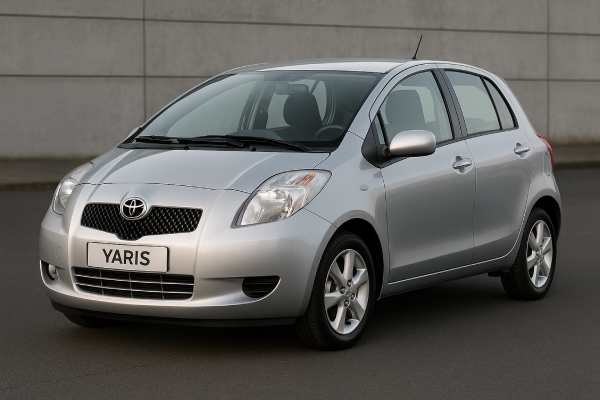
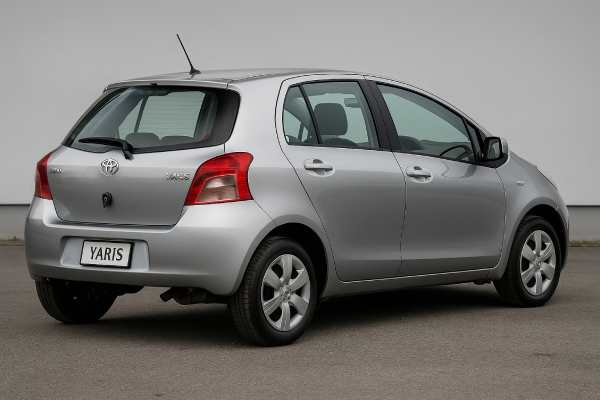
The second-generation Toyota Yaris (SCP90) with the 2SZ-FE 1.3 litre engine sits in a sweet spot between the entry-level 1.0 and the later 1.33 units. It offers enough performance for fast roads and light motorway use, while keeping running costs close to the smallest engines in the class. The 2SZ-FE is a compact, chain-driven four-cylinder with variable valve timing, designed for low friction, good emissions and high reliability.
Inside, the Yaris makes smart use of its short footprint. A sliding and split-folding rear bench, deep boot floor and plenty of oddment storage mean this small hatchback can genuinely replace a larger family car for many owners. Safety is strong for its era, with multiple airbags and a five-star Euro NCAP rating on well-equipped models. If you respect its service schedule and watch a few known age-related issues, the SCP90 1.3 can be a very low-drama daily driver for many years.
Top Highlights
- 1.3 litre 2SZ-FE delivers noticeably stronger acceleration than the 1.0 with similar fuel use.
- Clever sliding rear bench and tall body make the Yaris feel bigger inside than outside.
- Follow 15,000 km or 12 month service intervals to keep the timing chain and VVT system healthy.
- Automated MMT gearboxes can feel jerky and need careful test drives; manual units are generally robust.
- Check for completed airbag and safety recalls plus corrosion on rear axle and underbody seams.
What’s inside
- Toyota Yaris SCP90 1.3 in Focus
- Technical Specs Yaris SCP90 1.3
- SCP90 1.3 Grades, Safety and Tech
- Reliability, Issues and Service Actions
- Maintenance Plan and Used-Buy Guide
- On-Road Performance and Driving Feel
- Yaris 1.3 SCP90 Versus Rivals
Toyota Yaris SCP90 1.3 in Focus
The SCP90-generation Yaris launched in 2005 as Toyota’s B-segment hatchback for Europe and many other markets. The 1.3 litre 2SZ-FE version sits above the 1.0 three-cylinder, aimed at drivers who spend more time on faster roads or carry passengers and luggage more often. It retains the same compact footprint but adds useful reserve power and higher equipment potential.
The 2SZ-FE is a naturally aspirated inline-four with 16 valves and VVT-i on the intake side. In European trim it develops roughly 86 hp (87 PS) at 6,000 rpm and about 120–122 Nm of torque near 4,200 rpm. In practice, that means you can keep up with motorway traffic without constantly revving the engine to the limiter. The power delivery is smooth and linear, which suits the Yaris’s role as a calm city and commuter car.
Toyota positioned this engine for buyers who wanted:
- Lower fuel consumption than many rival 1.4–1.6 units.
- Stronger performance than basic 1.0–1.1 city cars.
- Simple, proven technology rather than complex turbocharging.
The platform itself shares much with the KSP90 1.0 variant, including suspension layout, cabin design and clever packaging. Key differences come from trim levels, brakes and wheel sizes that tend to be slightly more generous on 1.3 cars.
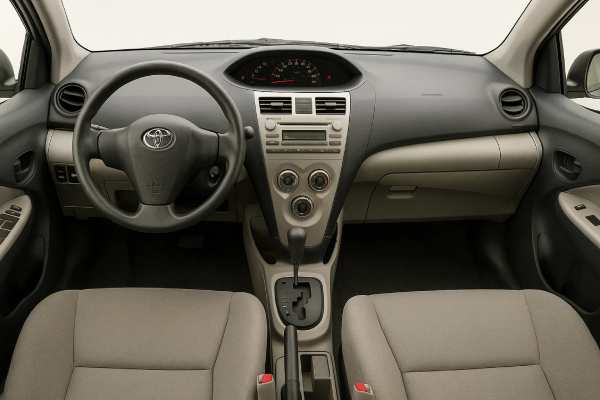
In the cabin, the central instrument pod, high seating position and large glass area give a light, airy feel. The sliding rear bench allows you to prioritise either rear legroom or boot volume. With the bench fully forward, the boot becomes competitive with larger hatchbacks.
For many owners the SCP90 Yaris 1.3 represents a “do everything” small car: easy to park, cheap to own, but still comfortable enough for long trips. The rest of this guide focuses on understanding the technical details, known weak points and how to select and look after a good example.
Technical Specs Yaris SCP90 1.3
Below are key specifications for a typical European-market Toyota Yaris II (XP90/SCP90) 1.3 i VVT-i with the 2SZ-FE engine and 5-speed manual gearbox (2005–2008).
Engine and Performance
| Item | Data |
|---|---|
| Engine code | 2SZ-FE |
| Type | Inline-4, DOHC, 16-valve, VVT-i (intake) |
| Displacement | 1.3 l (1,296 cm³) |
| Bore × stroke | 72.0 × 79.6 mm |
| Compression ratio | ~11.0 : 1 (export spec around 10.0–11.0 depending on market) |
| Induction | Naturally aspirated |
| Fuel system | Multi-point port fuel injection (MPI) |
| Max power | ~86 hp (64 kW) @ 6,000 rpm |
| Max torque | ~121–122 Nm (89 lb-ft) @ 4,200 rpm |
| Redline | Around 6,500 rpm |
| Timing drive | Single-row timing chain, hydraulic tensioner |
| Emissions standard | Euro 4 in most European markets |
| Official combined consumption | ~6.0 l/100 km (39 mpg US / 47 mpg UK) |
| Real-world mixed use | Typically 6.0–7.0 l/100 km depending on driving style |
Transmission and Driveline
| Item | Data |
|---|---|
| Transmission | 5-speed manual; some markets also MMT automated manual |
| Gearbox family | C5x-series manual (varies by market) |
| Drive type | Front-wheel drive (FWD) |
| Final drive ratio | Around 4.2–4.3:1 (varies slightly by box) |
| Differential | Open front differential |
Chassis and Dimensions
| Item | Data |
|---|---|
| Platform code | XP90 (SCP90 for 1.3 petrol) |
| Front suspension | MacPherson strut, coil springs, anti-roll bar |
| Rear suspension | Torsion beam axle, coil springs |
| Steering | Rack and pinion, electric power assist |
| Front brakes | Ventilated discs (approx. 258 mm) |
| Rear brakes | Drums |
| Wheelbase | 2,460 mm (96.9 in) |
| Length | 3,750 mm (147.6 in) |
| Width | 1,695 mm (66.7 in) |
| Height | ~1,530 mm (60.2 in) |
| Turning circle | ~9.4 m kerb-to-kerb |
| Curb weight | ~1,010 kg (2,227 lb) |
| Gross vehicle weight | ~1,480 kg (3,263 lb) |
| Fuel tank | 42 l (11.1 US gal, 9.2 UK gal) |
| Boot volume | 272–1,086 l (seats up/seat folded, VDA) |
Performance
| Item | Data |
|---|---|
| 0–100 km/h (0–62 mph) | ~11.5 s (manual) |
| Top speed | ~170 km/h (106 mph) |
| Typical braking 100–0 km/h | Around mid- to high-30 m on good tyres (varies by test) |
Fluids and Service Capacities
(Always confirm with the service manual for your exact VIN and market.)
| System | Specification | Approx. Capacity |
|---|---|---|
| Engine oil | ACEA A1/B1 or A5/B5; API SL/SM; typical 5W-30 | ~3.2 l with filter |
| Engine coolant | Toyota Super Long Life Coolant (pink HOAT) | ~5.1 l |
| Manual gearbox oil | GL-4 75W-90 | ~1.7–2.0 l |
| Brake fluid | DOT 3 or DOT 4 | Fill to MAX mark |
| Power steering | Electric (no fluid service) | — |
| A/C refrigerant | R134a | ~400–500 g (varies by market) |
Electrical and Ignition
| Item | Data |
|---|---|
| Alternator | ~80–90 A output depending on trim and market |
| 12V battery | Typically 35–45 Ah, small DIN/JIS form factor |
| Spark plugs | Long-life iridium or platinum, 4 pieces |
| Plug gap | Around 1.0 mm (0.039 in); check label and manual |
Safety and Driver Assistance Hardware
For 2005–2008 European Yaris models, typical features include:
- Front airbags plus front side airbags.
- Full-length curtain airbags on many trims.
- Driver’s knee airbag on cars aligned with Euro NCAP test spec.
- ABS with Electronic Brake-force Distribution (EBD) and Brake Assist as standard.
- Vehicle Stability Control (VSC) offered on many higher trims and option packs.
- ISOFIX child seat anchorages on outer rear seats.
Exact equipment varies strongly by year, trim level and market, which we cover in more detail next.
SCP90 1.3 Grades, Safety and Tech
Trim and grade naming for the Yaris SCP90 1.3 varies by region, but the pattern is similar: there is usually a basic grade with smaller wheels and simpler interior trim, a mid-level with more comfort features, and a higher grade with safety and convenience options bundled in.
Common European-style line-ups include combinations like Terra, Luna, Sol, T2, T3, T Spirit or SR. In general:
- Entry trims usually have steel wheels, manual air conditioning (or just ventilation in the very base), and fewer cosmetics.
- Mid trims add better upholstery, split-fold/sliding rear bench, steering-wheel audio controls and additional storage features.
- High trims bring alloy wheels, fog lamps, upgraded audio, leather steering wheel and often more airbags or safety packs.
Mechanically, the 2SZ-FE engine itself is the same across trims. Differences that matter to an enthusiast or buyer include:
- Brake disc size and rear drum dimensions on sportier models.
- Wheel and tyre packages (185/60 R15 common on 1.3 cars, with some markets offering 16 or even 17 inch options on sporty editions).
- Availability of VSC and side/curtain airbags bundled in “Safety” or “Protection” packs.
From a safety perspective, the second-generation Yaris achieved a five-star Euro NCAP occupant protection rating in period tests for suitably equipped models, scoring in the mid-30s for points. This was notable in the class at the time, thanks in part to:
- Standard driver and passenger airbags with carefully tuned restraint systems.
- Availability of a driver’s knee airbag to reduce leg injury risk.
- A strong cabin structure with controlled deformation and good pedal-area protection.
Child safety performance depends on the use of correct ISOFIX seats and rear bench configuration. Most cars are fitted with ISOFIX anchorages on the outer rear positions, plus top tether points depending on market.
Advanced driver assistance systems in the modern sense (adaptive cruise control, lane keeping) did not yet exist in this generation. However, for its era, the Yaris offered:
- ABS with EBD and Brake Assist as standard on most markets.
- VSC stability control as standard or optional depending on engine and trim.
- Tyre pressure monitoring arriving only on later cars in some regions or via aftermarket additions.
When shopping used, it is worth decoding the VIN and inspecting the build sheet (or at least visually checking interior features) to confirm whether a particular car has side/curtain airbags and VSC. These features significantly improve passive and active safety, especially for family use.
Reliability, Issues and Service Actions
The SCP90 Yaris with the 2SZ-FE engine has a strong reputation for durability when serviced on time. Many cars comfortably exceed 200,000 km with mostly routine maintenance. That said, age and mileage now mean patterns of wear are well known.
Engine and ancillaries
- Oil quality and change intervals: The 2SZ-FE is tolerant but not immune to neglect. Extended oil change gaps can accelerate timing-chain wear, sludge formation and VVT-i actuator noise. Sticking to 15,000 km / 12-month intervals (or less for severe use) is important.
- Chain noise on cold start: A brief rattle at start-up can be normal, but persistent noise or timing-correlation fault codes suggest chain stretch or tensioner wear. Remedy is timing chain, guides and tensioner replacement, which is labour-intensive but not catastrophic if caught early.
- Coil pack failures: Individual ignition coils can fail, causing misfires under load, rough idle and a flashing MIL. Replacing a single faulty coil is fine, but on higher-mileage cars many owners opt to replace the full set pre-emptively.
- Throttle body contamination: Short-trip urban use can lead to carbon build-up in the throttle body and idle control passages. Symptoms include unstable idle and stalling when coming to a stop. Cleaning the throttle and performing an idle relearn usually resolves it.
Cooling system
- Water pump seepage: Like many Toyota small engines, slight weeping from the water pump weep hole is not unusual with age. Replacement is straightforward; ignore major leaks and you risk overheating and head gasket damage.
- Radiator and heater core: Cars run long-term without proper coolant can suffer internal corrosion and clogging. When inspecting, feel for uniform heat from the heater and look for any rusty deposits in the expansion tank.
Driveline and transmission
- Manual gearboxes are generally robust. Issues mostly involve worn clutch friction plates after heavy city use, and occasionally release bearings that become noisy. Smooth shifts without crunching into second and third are a good sign.
- MMT automated manuals can be more troublesome: jerky low-speed behaviour, slow clutch engagement and warning lights due to actuator or clutch wear. Some owners adapt to the shift pattern and live happily with it; others prefer to avoid MMT altogether on used cars.
Chassis and body
- Suspension wear: Expect tired front dampers, worn anti-roll bar bushes and top mounts on high-mile Yaris examples. Clunks over speed bumps are typical symptoms. Parts are widely available and not expensive.
- Wheel bearings: Rear wheel bearings can become noisy with age, particularly if the car has spent time on rough roads. Constant humming that rises with road speed is a common sign.
- Corrosion hotspots: While the Yaris generally resists rust well, check the rear axle beam, lower edges of the doors, sills behind the plastic covers and floorpan seams. Cars from salt-heavy climates can show flaking underbody protection and surface rust on suspension arms.
Safety-related recalls and service actions
Over its life, the Yaris SCP90 has been included in airbag-related recalls and smaller campaigns on specific components (such as wiring or steering column issues) in some markets. For any candidate car, you should:
- Run an official VIN check on Toyota’s regional website or through a dealer.
- Ask for printed proof of recall completion.
- Inspect invoices for any steering, airbag or brake-related campaign work.
Overall, the SCP90 1.3 is usually a low-risk used buy, provided you confirm a solid service history, listen for timing-chain noise, assess the condition of MMT gearboxes carefully, and check the underbody for corrosion and accident repair.
Maintenance Plan and Used-Buy Guide
A clear maintenance plan helps you budget and keep the 2SZ-FE Yaris in its comfort zone. The table below summarises practical intervals for a typical European usage pattern; always confirm against official schedules for your VIN and market.
Core service schedule (typical guidance)
| Item | Interval (distance/time) | Notes |
|---|---|---|
| Engine oil and filter | Every 15,000 km or 12 months (whichever comes first) | Shorten to 10,000 km / 12 months for mainly city or harsh use |
| Engine air filter | Inspect every 15,000 km; replace every 45,000 km | Sooner in dusty conditions |
| Cabin (pollen) filter | Every 15,000–30,000 km or 1–2 years | More often if you suffer from allergies or drive in urban pollution |
| Spark plugs (iridium) | Every 90,000 km or 6 years | Use correct heat range and torque |
| Coolant | First replacement around 150,000 km or 8–10 years, then every ~90,000 km | Only use Toyota Super Long Life or equivalent HOAT coolant |
| Brake fluid | Every 2 years | Flush through all callipers and cylinders |
| Manual gearbox oil | Around every 90,000–120,000 km | Many cars never get this; changing improves shift feel |
| Auxiliary / serpentine belt | Inspect every 30,000 km; replace ~90,000–120,000 km or at first signs of cracking | |
| Timing chain system | No fixed interval; check by noise, codes and cam/crank correlation | Replace chain set if out of spec |
| Wheel alignment and tyre rotation | Check annually; rotate tyres every 10,000–15,000 km | Reduces feathering and noise |
| 12V battery | Test annually after 5–6 years; typical life 6–8 years | Look for slow cranking or warning lights |
Because the 2SZ-FE uses a timing chain rather than a belt, there is no regular belt change cost, but this does not mean it is maintenance-free. Neglected oil changes are the main chain-killer, so regular, quality oil is effectively your “timing chain insurance”.
Fluids and torque values (for planning)
- Wheel nuts: typically around 100–110 Nm.
- Spark plugs: roughly 18–22 Nm with anti-seize used carefully (check manual).
- Engine oil drain plug: about 30–40 Nm, with a fresh crush washer.
Always confirm exact values from the workshop manual or torque chart for your specific car.
Buyer’s checklist
When viewing a used Yaris SCP90 1.3, work through the following:
- Service history: Look for consistent oil changes at or before 15,000 km intervals, documented coolant changes and any gearbox oil service.
- Cold start behaviour: Listen for rattling from the timing chain area and ensure idle settles smoothly.
- Test drive: Check clutch bite and gearbox smoothness; on MMT cars, feel for excessive judder or delays. Confirm the car tracks straight and does not wander.
- Brakes and suspension: Note any vibration under braking, knocking over bumps or excessive body roll.
- Electrics: Test all windows, central locking, A/C, heaters and instrument backlighting.
- Body and underbody: Inspect for mismatched paint, overspray, rust on the rear axle beam and repaired accident damage.
Recommended years and trims
Early cars (2005–2006) and later facelift versions drive very similarly. For family use, prioritise cars with:
- Side and curtain airbags.
- VSC stability control where available.
- Mid or high trims with A/C, sliding rear bench and better seats.
Avoid cars with heavily neglected service histories, tired MMT transmissions with warning lights present, or significant rust in structural areas. A well-kept SCP90 1.3 can still deliver many years of reliable service with modest maintenance costs.
On-Road Performance and Driving Feel
In daily driving, the 1.3 litre Yaris feels more relaxed than its 1.0 sibling without ever turning into a hot hatch. The 2SZ-FE needs revs to give its best, but there is enough mid-range torque to avoid constant downshifts in normal traffic.
Ride and handling
The XP90 platform focuses on stability and comfort rather than razor-sharp handling. The ride is generally compliant, soaking up typical urban potholes and speed bumps well. On larger wheels or low-profile tyres, impacts are felt more sharply but body control improves slightly.
Straight-line stability on motorways is good for a car of this size, especially on 185/60 R15 tyres. Crosswinds can still nudge the light body, but steering corrections are small. The electric power steering is light at low speeds for easy parking and weights up in a predictable way as speed increases, though it does not deliver a huge amount of road feel.
In corners, the Yaris tends to mild understeer when pushed, with body roll that is noticeable but well contained. The chassis remains predictable and forgiving, which suits new drivers and urban use. VSC, where fitted, intervenes early and smoothly to keep the car in check.
Braking and NVH
Ventilated front discs and rear drums provide reliable braking for a car this light. Pedal feel is usually firm with progressive response, especially once discs and pads are in good condition. Brake Assist helps deliver additional force in emergency stops.
Noise, vibration and harshness levels are well controlled for the class. At city speeds the cabin is quiet, with most noise coming from tyres and the engine only when revved hard. At 120 km/h, wind and tyre noise become more noticeable but still acceptable for longer journeys, particularly if door seals and suspension bushes remain in good condition.
Performance and efficiency in the real world
- In typical mixed driving, expect around 6.0–6.5 l/100 km if you shift sensibly.
- Pure city use often lands in the 7.0–8.0 l/100 km range, depending on congestion.
- Gentle extra-urban trips at 80–100 km/h can return figures in the mid-5 l/100 km.
Driving style makes a big difference. Keeping revs between 2,000 and 3,500 rpm, using the torque band rather than constantly chasing the redline, helps economy without making the car feel sluggish.
Overtakes at motorway speeds require planning but are realistic with a downshift or two. The engine stays smooth even near the redline, so brief bursts to 5,500–6,000 rpm for joining fast traffic are well within its comfort zone.
For light towing (where permitted) or full-load holiday trips, the 1.3 will cope, but you will notice slower hill climbs and higher fuel use. The cooling system is generally up to the task provided it is maintained, but watch temperature and avoid lugging the engine in high gears at very low rpm on long climbs.
Overall, the Yaris SCP90 1.3 delivers a calm, predictable driving experience: not exciting, but confidence-inspiring, frugal and easy to live with.
Yaris 1.3 SCP90 Versus Rivals
When new, the 2005–2008 Yaris 1.3 competed with cars like the Honda Jazz/Fit 1.4, Ford Fiesta 1.25 and 1.4, Renault Clio 1.2 16V and Peugeot 207 1.4. As a used buy today, the same comparison set still makes sense.
Space and practicality
- Against the Jazz, the Yaris loses a little rear legroom and ultimate seat-fold flexibility, but the sliding rear bench and tall roofline still make it one of the most practical small hatchbacks.
- Compared with Fiesta and Clio rivals, the Yaris usually offers a more upright driving position and easier rear access, especially for child seats.
Reliability and ownership costs
- The 2SZ-FE Yaris is often cheaper to maintain than French rivals of the same era and generally at least as reliable as the Honda Jazz. The main advantage is the simplicity of the engine and the widespread availability of parts.
- Insurance and tax classes are usually favourable thanks to modest power and low CO₂ output.
- Fuel economy is similar to or slightly better than many naturally aspirated competitors of the time.
Driving character
- A Fiesta of the same age usually feels sharper and more engaging to drive, with better steering feedback and cornering balance. If you value fun above all, the Ford may appeal more.
- The Jazz offers a more rev-happy engine and firmer ride, which some drivers enjoy but others find tiring.
- The Yaris places comfort, predictability and ease of use first. Steering is lighter, the clutch is forgiving, and the car is simple to manoeuvre in tight spaces.
Safety and equipment
The Yaris’s strong Euro NCAP performance and availability of multiple airbags and stability control make it competitive or better than many period rivals. Some competitors caught up later with more advanced ESP systems, but few combined safety, reliability and low running costs as well as the Yaris did at launch.
Who should choose the SCP90 1.3?
- Drivers who want a long-lived, low-stress commuter car.
- Families needing a small second car with good safety and flexible interior space.
- New drivers looking for an easy-to-drive, forgiving first car.
Enthusiasts seeking sportier dynamics might prefer a Fiesta or a hotter Yaris derivative, but for most people the SCP90 1.3 strikes an excellent balance of practicality, reliability and efficiency.
References
<a href="https://newsroom.toyota.eu/2005-yaris-dpl/">2005 Yaris DPL</a> 2005 (Press information)<a href="https://toyota-club.net/files/techdata/ttx/yaris_90.htm">Fluids & capacities - Yaris (2005-2011)</a> 2023 (Service data)<a href="https://toyota-club.net/files/faq/21-07-01_faq_sz-engine_en.htm">Toyota SZ series engines</a> 2021 (Technical overview)<a href="https://www.gerritspeek.nl/auto/diversen/yaris_maintenance_schedule.pdf">Yaris 2005-08</a> 2008 (Maintenance schedule)<a href="https://www.auto-data.net/en/toyota-yaris-ii-1.3-i-vvt-i-87hp-4053">Toyota Yaris II 1.3 i VVT-i (87 Hp) | Technical specs, data, fuel consumption, Dimensions</a> 2025 (Technical specifications)
Disclaimer
This article is for general informational purposes only and is not a substitute for professional diagnosis, repair advice or safety guidance. Specifications, torque values, service intervals and procedures can vary by VIN, production date, market and equipment level. Always verify critical data against your vehicle’s official owner’s manual, workshop manual and current manufacturer service information before carrying out any work.
If you found this guide useful, consider sharing it with other owners or enthusiasts on social platforms such as Facebook or X/Twitter. It helps support the effort that goes into creating detailed, owner-focused technical content.