
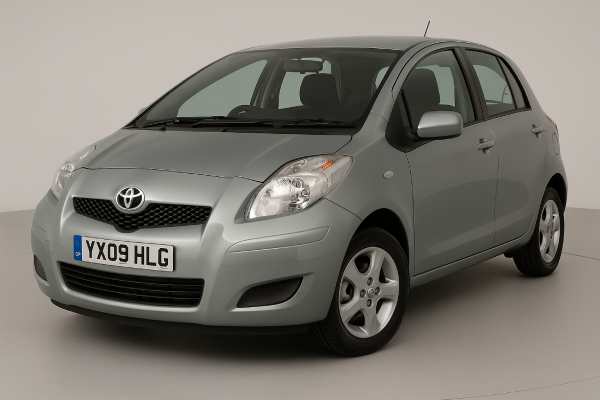
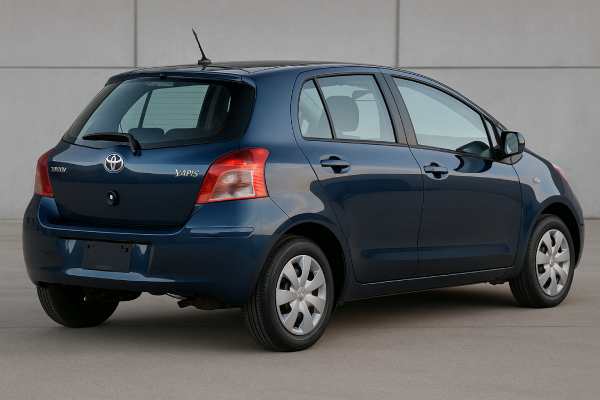
The 2009–2011 Toyota Yaris 1.3 (NSP90, 1NR-FE) sits in a sweet spot for drivers who want dependable, low-cost motoring without giving up basic comfort and safety. This facelifted second-generation Yaris received Toyota’s more modern 1.33-litre Dual VVT-i engine, a six-speed manual gearbox and, in some markets, stop-start. Together these changes improved fuel economy and drivability compared with the earlier 1.3 engine.
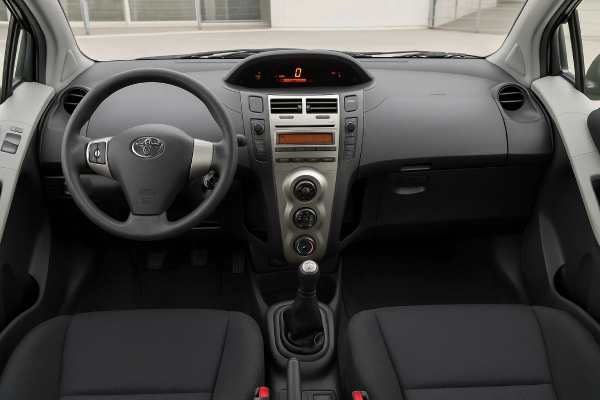
Inside, the Yaris feels simple but cleverly packaged. The centrally mounted instruments free up dashboard space, and the tall body gives good headroom for adults in both rows. Sliding and reclining rear seats on many trims make the small boot surprisingly flexible. Safety is strong for its era thanks to a reinforced passenger cell, multiple airbags and available stability control.
The main shadow over this otherwise robust little car is the 1NR-FE engine’s tendency toward oil consumption on some examples, especially those with long service intervals. With proper maintenance and careful pre-purchase checks, however, the Yaris 1.3 can still deliver many years of reliable daily use and very low running costs.
Fast Facts
- Strong economy for its class, with real-world mixed consumption often around 5.5–6.0 L/100 km (about low-40s mpg US).
- Compact exterior size but a tall body and flexible rear bench give genuinely useful cabin and cargo space.
- High passive safety for its age, with multiple airbags, ABS and often stability control.
- Ownership caveat: some 1NR-FE engines develop high oil consumption and may need major internal work.
- Typical service rhythm: engine oil and filter every 15,000 km or 12 months, with shorter intervals preferred for long life.
Navigate this guide
- Toyota Yaris NSP90 buyers guide
- Toyota Yaris 1NR FE specs
- Yaris trims safety and options
- Reliability and known issues
- Maintenance schedule and buying tips
- Driving performance and economy
- Yaris versus small car rivals
Toyota Yaris NSP90 buyers guide
The 2009–2011 Toyota Yaris 1.3 belongs to the late phase of the second-generation Yaris, often referred to by the chassis family XP90/NSP90. The facelift brought Toyota’s “Optimal Drive” changes: the newer 1.33-litre Dual VVT-i petrol engine (code 1NR-FE), a six-speed manual gearbox and detail tweaks to styling and trim. In everyday use the car is very much a city-biased supermini, but with enough stability for regular motorway driving.
Compared with earlier 1.3-litre Yaris models, this version is cleaner, slightly quicker and more relaxed at higher speeds thanks to the extra gearbox ratio. The cabin retains the central instrument cluster and simple plastic finishes, but everything is laid out clearly and tends to wear well. Five-door versions suit small families, and the sliding rear bench found on many trims allows you to trade rear legroom for extra boot space or vice versa.
The Yaris 1.3 works well as:
- a first car for new drivers,
- a low-stress commuter, or
- a second family car for school runs and errands.
Insurance, road tax and consumables like tyres and brakes are modestly priced for most markets. Routine servicing is straightforward, with good access to common components and widely available parts.
Safety is a strong point for such a small vehicle. This generation achieved high scores in contemporary crash tests and could be ordered with up to seven airbags, including a driver’s knee airbag, along with ABS and brake assist as standard. Many 1.33 models also have stability control and traction control, which were less common in B-segment cars of the time.
On the downside, refinement is average at motorway speeds, the sound insulation is not up to more modern rivals, and the car’s light weight means it can be affected by strong crosswinds. The key technical concern is the 1NR-FE engine’s history of oil consumption on some examples. As a buyer you should therefore prioritise service history and a careful mechanical inspection, but if those check out, the Yaris remains one of the safest small-car bets for inexpensive, dependable motoring.
Toyota Yaris 1NR FE specs
Engine and performance
The 1NR-FE is a 1.33-litre, all-aluminium inline-four designed around efficiency and low emissions. It uses Dual VVT-i (variable valve timing on both intake and exhaust cams), a relatively high compression ratio and low internal friction to extract good power from a small displacement.
| Item | Value |
|---|---|
| Engine code | 1NR-FE (Dual VVT-i) |
| Layout and cylinders | Inline-4, transverse, DOHC, 16 valves |
| Displacement | 1.33 L (1,329 cc) |
| Bore × stroke | 72.5 × 80.5 mm |
| Induction | Naturally aspirated |
| Fuel system | Multi-point fuel injection |
| Compression ratio | Around 11.5 : 1 (market-dependent) |
| Max power | About 98 hp (73 kW) at 6,000 rpm |
| Max torque | About 132 Nm (97 lb-ft) at 3,800 rpm |
| Timing drive | Chain with hydraulic tensioner |
| Emissions class (Europe) | Typically Euro 4 or Euro 5 |
| Official combined consumption | Around 5.1 L/100 km (≈46 mpg US / 55 mpg UK) for a manual |
| CO₂ rating | Around 120 g/km for a manual |
| Typical real highway use | Roughly 6.0–6.5 L/100 km at 120 km/h, depending on load and tyres |
These figures vary slightly by market and test cycle, but they give a good picture of the engine’s character: modest output, strong efficiency and a preference for revs when you ask for performance.
Transmission and driveline
| Item | Value |
|---|---|
| Transmission options | 6-speed manual; 6-speed MultiMode automated manual (MMT) |
| Drive type | Front-wheel drive (FWD) |
| Differential | Open differential at the front axle |
| Clutch | Single-plate dry clutch (conventional pedal on manual, electro-hydraulic actuation on MMT) |
The six-speed manual is the better choice for long-term ownership, with simpler hardware and a more natural feel. MultiMode provides clutchless operation but can feel jerky at low speeds and is more sensitive to driving style and correct calibration.
Chassis and dimensions
| Item | Value |
|---|---|
| Front suspension | MacPherson strut, coil springs, anti-roll bar |
| Rear suspension | Torsion-beam axle, coil springs |
| Steering | Electric power steering |
| Front brakes | Ventilated discs |
| Rear brakes | Drums |
| Typical tyres | 185/60 R15 |
| Length | ≈3,750 mm (147.6 in) |
| Width | ≈1,695 mm (66.7 in) |
| Height | ≈1,530 mm (60.2 in) |
| Wheelbase | ≈2,460 mm (96.9 in) |
| Kerb (curb) weight | Around 1,000–1,080 kg (approx. 2,200–2,380 lb) |
| GVWR | Around 1,440–1,500 kg (approx. 3,175–3,300 lb) |
| Fuel tank | ≈42 L (about 11.1 US gal / 9.2 UK gal) |
| Cargo volume | Around 270–300 L seats up; up to about 1,100–1,180 L seats folded (VDA) |
Performance and capability
| Metric | Value (approximate) |
|---|---|
| 0–100 km/h (0–62 mph) | Around 11.5–12.0 s (manual) |
| Top speed | Around 170–175 km/h (105–109 mph) |
| Braked towing capacity | Up to roughly 900 kg (1,980 lb), depending on market approval |
| Unbraked towing | Typically around 400–450 kg (880–990 lb) |
These numbers put the Yaris 1.3 in the middle of the small-car pack. It is not fast, but brisk enough to merge and overtake safely when driven with some mechanical sympathy.
Fluids and service capacities (typical)
Values vary slightly by region and gearbox code; always confirm for your VIN, but these figures are useful planning references.
| System | Specification (example) | Approximate capacity |
|---|---|---|
| Engine oil | 0W-20 or 5W-30 meeting Toyota or ACEA A5/B5/API SN requirements | About 3.4–3.7 L (3.6–3.9 US qt) with filter |
| Engine coolant | Toyota Super Long Life Coolant (premixed ethylene glycol) | Roughly 4.5–4.7 L |
| Manual gearbox oil | API GL-4 75W or equivalent Toyota gear oil | Around 2.1–2.5 L |
| Brake fluid | DOT 3 or DOT 4 | Fill to reservoir, change interval-based |
| A/C refrigerant | R134a | Charge amount varies; check under-bonnet label |
Key torque values are broadly in line with other small Toyotas: wheel nuts around 100–110 Nm, oil drain plug roughly 35–40 Nm, spark plugs around 18–22 Nm. Use the official service data for final figures.
Electrical and safety hardware
| Item | Value |
|---|---|
| Alternator | Around 80–100 A output, segment-conductor type |
| 12 V battery | Typically 45–55 Ah in a compact JIS case |
| Ignition | Coil-on-plug with fine-iridium spark plugs |
Safety equipment (varies with trim) includes:
- Up to seven airbags (front, side, curtain and driver’s knee).
- ABS with Electronic Brakeforce Distribution and Brake Assist.
- Stability control (VSC) and traction control (TRC) on many 1.33 models.
- ISOFIX child-seat anchor points on the outer rear seats.
Yaris trims safety and options
Trim structure and equipment differences
Trim names vary by country, but a typical UK or European lineup for the 1.33 includes entry, mid-range and higher-spec grades such as T2, TR, SR and T Spirit, with broadly similar patterns elsewhere.
- Entry-level (T2 or equivalent)
- Often paired with smaller engines, but sometimes available with the 1.33.
- Steel wheels, simpler seat fabrics and basic audio.
- Manual air conditioning may be optional depending on market.
- Still includes ABS and at least front and side airbags.
- Mid-range (TR or similar)
- Common specification for the 1.33.
- Manual A/C as standard, 15-inch alloys, body-coloured mirrors and handles.
- Sliding and reclining rear seats on many cars.
- Extended airbag coverage (curtain and knee airbags) and, in many markets, standard stability control.
- Sport-flavoured (SR or equivalent)
- Cosmetic upgrades such as sportier front bumper, grille, spoiler and privacy glass.
- 15-inch or different-design alloy wheels.
- Sometimes slightly stiffer suspension tuning, though still comfort-oriented.
- High grade (T Spirit or similar)
- Added convenience features, such as climate control, keyless entry or upgraded audio on some markets.
- More chrome and gloss interior detailing.
Mechanically, all 1.33 trims share the same basic engine and driveline. Differences that affect ownership are mainly:
- Wheel and tyre sizes (which influence ride comfort and tyre cost).
- Whether stability control and the full airbag set are fitted.
- Availability of MultiMode versus manual gearboxes.
During the 2009–2011 run, changes were mostly related to options and equipment bundles rather than major technical revisions. Some countries saw overlap between this generation and the all-new 2011 Yaris, so late cars may have better-standard safety kit.
Crash safety and child protection
The second-generation Yaris achieved strong scores in contemporary European crash tests, with top ratings for adult occupant protection under the test protocol of the time. Child occupant and pedestrian scores were more modest but acceptable for a small hatchback of its size and era.
Key structural and safety features include:
- A rigid passenger cell with defined crumple zones.
- Energy-absorbing steering column and pedal box design to limit leg injuries.
- Standard three-point belts for all seats and pretensioners with load limiters at the front.
- ISOFIX mounts and top-tether points for compatible child seats.
Note that later Euro NCAP and other programmes updated their procedures, so a modern small car may achieve a different star rating even if the underlying safety is similar. Always compare ratings within the same time period.
Active safety and driver assistance
For the NSP90 Yaris, active safety is largely limited to conventional systems:
- Anti-lock braking system with electronic brake-force distribution and brake assist.
- Vehicle stability control and traction control where fitted.
- Tyre pressure monitoring in some markets.
- No factory autonomous emergency braking, lane-keeping, adaptive cruise or blind-spot monitoring.
While that sounds basic by modern standards, the fundamentals—chassis balance, braking performance and clear visibility—are solid. The lack of complex ADAS systems also means there is no need for camera or radar calibration after glass replacement or minor collisions, which simplifies repairs on older cars.
When buying, check that:
- All relevant warning lights (ABS, stability control, airbag, tyre pressure where fitted) illuminate at key-on and go out after start.
- ABS engages correctly in a controlled emergency stop on a safe surface.
- The steering tracks straight with no pull or vibration, which might indicate accident damage or poor alignment.
Reliability and known issues
The Yaris has a strong reputation for reliability, and the NSP90 platform is generally robust. However, the 1NR-FE petrol engine and the optional MultiMode gearbox introduce specific risk areas that buyers should understand.
Engine and fueling
1. Oil consumption
The most notable issue with the 1NR-FE is high oil consumption on some engines. The typical pattern is:
- Noticeable drop in oil level between services, sometimes as much as one litre per 1,000–2,000 km.
- Occasional blue smoke on cold starts or after idling.
- Fouled spark plugs and carbon deposits in the combustion chambers.
The root cause is usually piston rings that have worn or stuck in their grooves, sometimes linked to long oil-change intervals or low-quality oil. The proper cure is an engine rebuild with updated pistons and rings, or a replacement engine. This is a major job, so careful pre-purchase checks for oil usage are crucial.
2. Hard starting and rough idle
A smaller number of engines suffer from extended cranking, occasional stalling at idle or rough running when cold. Contributing factors can include:
- Carbon build-up on intake valves and in combustion chambers.
- Weak battery or starter motor.
- Outdated engine control software.
Cleaning, new plugs and coils, and control-unit software updates often improve these symptoms. In severe cases, carbon removal or partial engine overhaul may be needed.
3. Timing chain wear
The 1NR-FE uses a chain instead of a belt, but poor lubrication can still lead to stretch and guide wear. Warning signs include:
- Rattling noise on cold start that lasts more than a moment or two.
- Fault codes for cam/crank correlation.
- Consistently retarded or unstable timing readings.
Replacing the chain, tensioner and guides restores reliability, but labour costs mean it is worth catching early before secondary damage occurs.
Cooling and emissions systems
- Water pump leaks are reasonably common with age. Look for pink or white marks from dried coolant below the pump or at the bottom of the timing cover. Replacement is straightforward and not terribly costly.
- Thermostat and radiator issues are less common but can appear after many years or in harsh climates. Watch for slow warm-up, fluctuating temperature gauge or overheating under load.
- EGR valve and intake fouling may cause rough idle or low-speed stumble on engines that spend their lives in heavy city traffic. Cleaning usually restores proper operation.
Transmission and driveline
The conventional six-speed manual gearbox is generally durable. Common wear items are the clutch friction plate and release bearing, particularly on cars used mainly in town, but these are routine maintenance jobs.
The optional MultiMode gearbox combines a manual transmission with electro-hydraulic clutch and shift actuation. Issues here include:
- Jerky or hesitant take-off.
- Inconsistent shifts, especially between first and second.
- Warning lights or limp-home behaviour if the clutch or gear actuators, sensors or control unit develop faults.
Sometimes a recalibration and software update restore smoothness. Worn clutches and malfunctioning actuators are more expensive to fix. When buying a MultiMode car, a prolonged test drive that includes hill starts and stop–start traffic is essential.
The rest of the driveline is simple: driveshafts, wheel bearings and CV joints wear with use, but there are no endemic weaknesses if the car has not been heavily abused or lowered.
Suspension, brakes and body
With age and mileage, expect:
- Play in front lower control arm bushes and anti-roll-bar links, causing knocking over bumps or vague steering.
- Rear torsion-beam bushes and shock absorbers gradually losing control, leading to a bouncy ride.
- Corrosion on rear brake drums and backing plates in salt-heavy climates.
- Surface rust on the rear axle, subframes and brake lines, especially if underbody protection has worn away.
The body shell itself holds up well, but inspect:
- Rear wheel arches and inner lips for bubbling paint.
- Door bottoms and bootlid edges.
- The area around the tailgate latch and under the boot floor covering for moisture or rust.
Electrical faults are relatively rare and usually minor: sticky window switches, central locking actuators and ageing radios are the most typical complaints.
Recalls and service campaigns
Depending on region and VIN, this generation Yaris may be covered by:
- Airbag inflator recalls (including Takata campaigns).
- Power window switch recalls.
- Various service bulletins related to engine oil consumption, starting behaviour and MultiMode gearbox calibration.
Always check the VIN with a Toyota dealer or relevant government recall database, and ask for documentation confirming that all recall and campaign work has been completed.
Maintenance schedule and buying tips
Core maintenance schedule
Exact intervals differ by market, but the following schedule gives a sensible baseline for a Yaris 1.3 used in normal conditions:
- Engine oil and filter – every 15,000 km or 12 months at most; 10,000 km / 12 months is safer if you want to minimise ring and chain wear.
- Engine air filter – inspect every 15,000 km, replace about every 30,000 km or more often in dusty environments.
- Cabin filter – replace every 15,000–20,000 km or 1–2 years.
- Spark plugs (iridium) – approximately every 90,000–100,000 km or 6 years.
- Coolant (Toyota Super Long Life) – first change roughly 10 years / 160,000 km, then every 5 years / 80,000 km.
- Brake fluid – change every 2 years regardless of mileage.
- Manual gearbox oil – inspect regularly; change around 60,000–90,000 km if you plan long-term ownership.
- Timing chain – no fixed interval; monitor for noise and timing codes, and renew when symptoms appear.
- Auxiliary belt and hoses – inspect at each service; expect replacement around 90,000–120,000 km or when cracking/noise occurs.
- Brakes – inspect at least annually; front pads and discs often last 60,000–90,000 km depending on driving style.
- Tyres – rotate every 10,000–15,000 km and check alignment if there is uneven wear.
- 12 V battery – test from year 4–5 onwards; many last 6–8 years.
Keeping to or slightly exceeding these intervals, and using fluids that meet Toyota’s listed specifications, greatly reduces the risk of expensive engine and gearbox problems.
Fluid choices and DIY notes
- Use quality, name-brand oils that match Toyota’s viscosity and performance requirements. Low-ash, detergent-rich oils help keep piston rings and EGR passages cleaner.
- Stick to the correct pink Toyota Super Long Life coolant or its official equivalent to avoid galvanic corrosion and water pump wear.
- When working on brakes or suspension, use a torque wrench and follow official values for wheel nuts, caliper bolts and suspension fasteners.
DIY servicing is very feasible on these cars; access to the oil filter, air filter, spark plugs and front brakes is straightforward, making them popular with home mechanics.
Pre-purchase inspection checklist
When assessing a used NSP90 Yaris 1.3, focus on:
- Oil level and consumption
- Check oil level before and after a long test drive.
- Ask how often the owner tops up, and whether there are any oil stains on the driveway.
- Service history
- Look for consistent annual servicing with invoices, not just stamps.
- Confirm that the correct grade of oil has been used and that intervals were not stretched excessively.
- Cold start and idle
- Listen for timing-chain rattle that lasts more than a second or two.
- Watch for extended cranking, misfires or unstable idle.
- Cooling system
- Check coolant colour (should be clean, not rusty or oily).
- Look for dried coolant traces around the water pump, radiator and hoses.
- Gearbox behaviour
- For manual cars, feel for clutch slip or very high biting point.
- For MultiMode, test low-speed manoeuvres, hill starts and reverse. Any severe shudder, delay or warning lights are red flags.
- Chassis and brakes
- Listen for knocks over bumps, wandering steering or vibrations at speed.
- During braking, feel for pulsing or steering pull which could indicate warped discs or uneven pad wear.
- Body, corrosion and leaks
- Inspect wheel arches, sills, subframes and brake pipes.
- Lift the boot floor trim and check for moisture or rust.
- Recalls and campaigns
- Ask for proof that airbag and other recalls have been completed.
- If in doubt, call a dealer with the VIN for confirmation.
Which Yaris 1.3 is best to buy?
For most buyers, the sweet spot is:
- A 2009–2011 1.33 with a six-speed manual gearbox.
- Mid-level or higher trim including side, curtain and knee airbags along with stability control.
- Full, verifiable service history with annual oil changes and evidence of recall work.
Cars with documented engine rebuilds addressing oil consumption can also be attractive if the work was done properly and is supported by invoices. MultiMode gearbox cars should be considered only if they drive smoothly and show no signs of actuator or clutch trouble.
Driving performance and economy
Powertrain character
On the road, the 1NR-FE feels willing rather than powerful. At low revs it is smooth and quiet, making it pleasant in town. To get the best acceleration you need to rev it beyond about 3,000 rpm, where it pulls more strongly and feels lighter on its feet.
The six-speed manual gearbox complements the engine well:
- Lower gears are short enough for good response in city traffic.
- The tall sixth gear drops revs on the motorway, improving refinement and fuel economy.
- The shift action is light and reasonably precise, with a clutch that most drivers find easy to modulate.
MultiMode cars can feel slower off the line and sometimes hesitate when shifting at low speeds. Once moving, and with a gentle driving style, they settle into a smoother rhythm, but they rarely match the natural feel of a conventional manual.
Ride, handling and noise
Toyota tuned the Yaris primarily for comfort and ease of use:
- Ride – relatively soft and compliant around town, soaking up speed bumps and potholes better than many newer small cars with larger wheels.
- Handling – safe and predictable. There is noticeable body roll when pushed, but grip levels are adequate and the car tends towards understeer at the limit rather than anything dramatic.
- Steering – light at parking speeds, firming slightly at higher speeds, though pure steering feel is modest.
- Brakes – front discs and rear drums provide stable, confidence-inspiring stopping power, with ABS intervening smoothly on slippery surfaces.
- Noise and vibration – in town and on smooth roads, engine and wind noise are well controlled. At 120 km/h, road and wind noise increase and the small cabin makes tyre roar more noticeable, but conversation is still possible without shouting.
Overall, the Yaris feels happiest in urban and suburban driving, but is capable of regular motorway trips without undue stress.
Real-world fuel economy
Actual consumption depends heavily on driving style and conditions, but typical owner reports for the 1.33 manual suggest:
- City use: about 6.5–7.5 L/100 km (31–36 mpg US / 37–43 mpg UK).
- Mixed driving: roughly 5.5–6.0 L/100 km (39–43 mpg US / 47–52 mpg UK).
- Steady motorway at 120 km/h: around 6.0–6.5 L/100 km (36–39 mpg US / 43–47 mpg UK).
Cold climates, short trips and roof boxes or racks will push consumption upward, while gentle driving and anticipating traffic can bring it close to or even below official test figures.
Load carrying and towing
For a small hatchback, the Yaris copes well with full family use:
- The rear bench and boot can handle weekly shopping, pushchairs and luggage with minimal fuss.
- With four adults on board and some luggage, performance on steep motorway grades naturally drops, and you will use the gearbox more often to keep up speed.
Light towing of a small trailer or camping setup is possible where legally permitted, but you should expect a clear reduction in acceleration and fuel economy. It is sensible to stay well within the rated tow limits and to service cooling and braking systems diligently if you tow regularly.
Yaris versus small car rivals
In the late 2000s and early 2010s, the Yaris 1.3 competed directly with cars such as the Ford Fiesta, Volkswagen Polo, Honda Jazz/Fit, Mazda 2 and Hyundai i20. On the used market today, those models are still common alternatives.
Versus Ford Fiesta
- Yaris advantages: better long-term reliability on average, simpler petrol engines with timing chains and generally stronger corrosion resistance.
- Fiesta advantages: sharper handling, more engaging steering and, in some versions, a more refined ride and cabin ambience.
If you value driving fun and dynamic feel, the Fiesta stands out; if your priority is predictable, low-cost ownership, the Yaris usually has the edge.
Versus Volkswagen Polo
- Yaris advantages: lower repair and servicing costs, especially outside main dealer networks; less complexity in some engine variants.
- Polo advantages: more solid, “grown up” feel with a heavier, quieter body and higher-quality interior materials.
Well-maintained Polos can feel more substantial on long journeys, but unexpected repairs on some engines and transmissions can be expensive. The Yaris trades some refinement for reduced risk.
Versus Honda Jazz/Fit
- Yaris advantages: slightly simpler mechanical layout and, in some markets, better resistance to body corrosion.
- Jazz advantages: exceptional interior versatility thanks to the “Magic Seats,” generally outstanding reliability for engines and gearboxes and a very roomy cabin.
For families who often carry bulky loads or need maximum versatility, the Jazz is hard to beat. The Yaris is still a solid choice where budget or condition tip the balance.
Versus budget rivals (Hyundai i20, Kia Rio and others)
Earlier Hyundai and Kia B-segment models make good value purchases, often with appealing equipment levels. However, interior materials and long-term durability can lag behind Toyota and Honda in some markets, and resale values may be weaker.
Where the Yaris 1.3 stands out
- Very strong record for basic reliability and longevity when serviced correctly.
- Simple, accessible mechanicals that independent garages understand well.
- High passive safety for its time, with multiple airbags and available stability control.
- Fuel economy close to hybrid levels in gentle use, without the added complexity of a hybrid system.
Its main weaknesses are modest performance, average motorway refinement and the need to watch for oil consumption on the 1NR-FE engine. For many buyers, those trade-offs are acceptable given the car’s overall robustness and low running costs.
References
- 2009 Toyota Yaris: Less Is So Much More – Toyota Media Site 2009 (Press release)
- Toyota Yaris 1.33 Dual VVT-i specs (2009-2011), performance, dimensions & technical specifications – encyCARpedia 2023 (Technical data)
- Toyota NR series engines 2013 (Technical overview / known issues)
- Toyota Yaris 2005 | Euro NCAP 2005 (Safety Rating)
- 2009 Yaris Owner’s Manual 2009 (Owner’s Manual)
Disclaimer
This article is provided for informational purposes only and does not replace professional diagnosis, repair advice or official manufacturer documentation. Specifications, torque values, safety equipment and maintenance intervals can vary by VIN, model year, market and installed options. Always verify critical information against the official owner’s manual, workshop manual or other manufacturer service information for your specific vehicle, and consult a qualified technician before carrying out repairs or modifications.
If you found this guide useful, you are welcome to share it with other owners or buyers on Facebook, X/Twitter or your favourite forums. It helps more people find reliable information and supports the effort required to create detailed, independent guides like this one.