
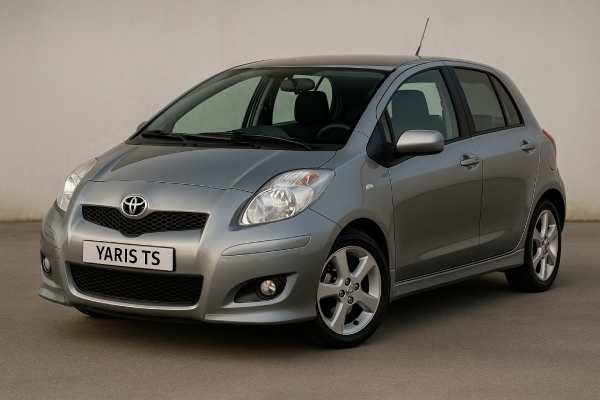
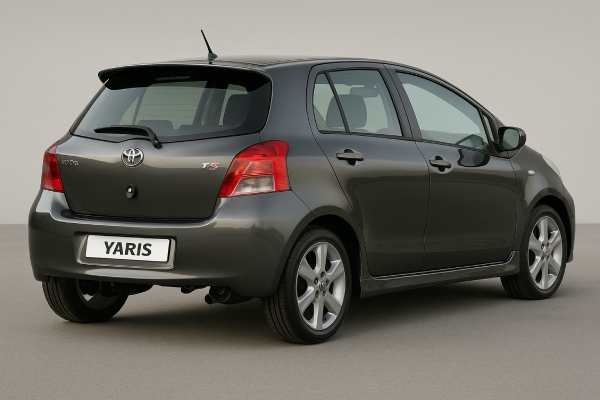
The Toyota Yaris TS (ZSP90) is the “hotter” end of the XP9 Yaris family. Using the 2ZR-FE 1.8-litre Dual VVT-i engine with 133 hp, it turns the normally sensible Yaris into a genuinely quick warm hatch while keeping Toyota’s typical reliability and easy ownership. Compared with regular 1.3 and 1.5 models, the TS gets more power, a retuned chassis, four-wheel disc brakes, 17-inch wheels and specific styling inside and out.
The 2009–2011 facelift brings updated bumpers and lights plus some trim and equipment tweaks, but the basic package remains the same: a compact body, short wheelbase and a strong naturally aspirated four-cylinder paired with a five-speed manual gearbox. For many enthusiasts it is an interesting alternative to more obvious small hot hatches, combining subtle looks with a very robust powertrain. This guide focuses on European-spec Yaris TS 1.8 models based on the ZSP90 chassis, especially facelift cars, and covers specs, reliability patterns, maintenance planning and how it stacks up against rivals.
Fast Facts
- 2ZR-FE 1.8 Dual VVT-i delivers about 133 hp and 173 Nm, giving real warm-hatch pace in a small shell.
- TS-specific suspension, quicker steering rack, rear disc brakes and 17″ wheels make it significantly sharper than standard Yaris versions.
- Common age issues are coolant leaks, suspension wear and oil seepage; many cars have also been modified, so originality and workmanship matter.
- Sensible service rhythm: engine oil and filter every 8,000–10,000 km (5,000–6,000 miles) or 6–12 months, with regular gearbox oil and coolant replacement on older examples.
Section overview
- Toyota Yaris TS ZSP90 role
- Yaris TS 1.8 technical facts
- TS equipment levels and safety
- Real world reliability and fixes
- Ownership maintenance and buying guide
- Driving performance and track feel
- How Yaris TS stacks up
Toyota Yaris TS ZSP90 role
Within the XP9 Yaris range, the TS sits at the top as the sporty flagship. Where the regular 1.3 and 1.5 variants focus on economy and simplicity, the TS is aimed at drivers who want something more engaging but still usable every day. It is powered by the 2ZR-FE 1.8-litre Dual VVT-i engine, an all-aluminium inline-four with 16 valves, variable valve timing on both cams and a timing chain instead of a belt. In Yaris TS tune it produces about 133 hp at 6000 rpm and 173 Nm at 4400 rpm.
Rather than turning the Yaris into a hardcore track car, Toyota positioned the TS as a refined warm hatch. The chassis is lowered by around 8 mm, springs and dampers are stiffer, and the electric power steering is about 12% quicker than the regular Yaris rack. Four-wheel disc brakes with larger front rotors, standard 17-inch alloy wheels and 205/50 tyres give noticeably more grip and stopping power.
The 2009–2011 facelift changes the front and rear bumpers, headlamps and rear light clusters and introduces some trim updates, but mechanically the TS remains very similar to earlier cars. Most examples are three- or five-door hatchbacks with a five-speed manual gearbox driving the front wheels; automatic versions are rare to non-existent in many markets.
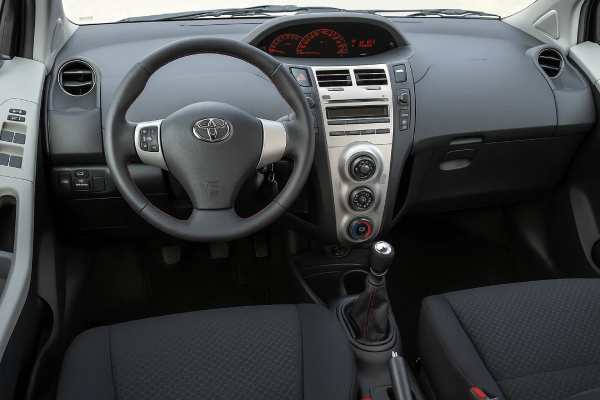
Inside, the TS package usually adds sports seats with extra bolstering, unique cloth or part-leather trim, a leather steering wheel and gear knob, and specific instrument graphics. Compared with more extreme rivals, it keeps a fairly upright seating position and practical rear seats, so it can still function as a sensible daily driver.
For today’s buyer, the TS is interesting because it combines Toyota’s durability with a more characterful engine and chassis than the mainstream Yaris models. It is also a relatively rare car in many countries, giving it some enthusiast appeal without the price inflation seen on some more famous hot hatches. The flip side is that many surviving cars have been modified; understanding what is still stock and how upgrades were done is key when shopping for one.
Yaris TS 1.8 technical facts
This section gathers the core technical data for a typical European-spec Yaris TS 1.8 hatchback. Figures can vary by market and year, so always verify against your VIN and local documentation, especially for towing limits and emissions standards.
Engine and performance
| Item | Value |
|---|---|
| Engine code | 2ZR-FE |
| Layout | Inline-4, transverse, DOHC, 16-valve, Dual VVT-i |
| Displacement | 1.8 l (1798 cc) |
| Bore × stroke | 80.5 × 88.3 mm |
| Compression ratio | ~10.0:1 |
| Induction | Naturally aspirated |
| Fuel system | Multi-point EFI |
| Max power | 133 hp (98 kW) @ 6000 rpm |
| Max torque | 173 Nm (127.5 lb-ft) @ 4400 rpm |
| Timing drive | Chain with hydraulic tensioner and guides |
| Recommended fuel | Unleaded; typically RON 95 in Europe |
| Emissions standard | Euro 4 in most markets |
| Official economy (urban) | ~9.2 l/100 km (25–26 mpg US) |
| Official economy (extra-urban) | ~5.8 l/100 km (40–41 mpg US) |
| Official combined | ~7.2 l/100 km (32–33 mpg US) |
| Real-world highway @120 km/h | Typically 6.5–7.5 l/100 km (31–36 mpg US) |
Transmission and driveline
| Item | Specification |
|---|---|
| Gearbox | 5-speed manual (C5x-family) |
| 1st | ~3.54:1 |
| 2nd | ~1.91:1 |
| 3rd | ~1.31:1 |
| 4th | ~0.97:1 |
| 5th | ~0.82:1 |
| Reverse | ~3.25:1 |
| Final drive | Around 4.2:1 (varies slightly by market) |
| Drive type | Front-wheel drive |
| Differential | Open |
Chassis, dimensions and weights (5-door TS)
| Item | Value |
|---|---|
| Front suspension | MacPherson strut with anti-roll bar (TS-specific tuning, ~8 mm lower) |
| Rear suspension | Torsion beam axle with coil springs |
| Steering | Electric power-assisted rack-and-pinion, quick ratio (TS) |
| Turning circle (kerb-to-kerb) | ~10.0 m (32.8 ft) |
| Front brakes | Ventilated discs (approx. 270 mm, market-dependent) |
| Rear brakes | Solid discs |
| Tyre size | 205/50 R17 V on 17″ alloys (common factory fit) |
| Length | ~3750 mm (147.6 in) |
| Width | 1695 mm (66.7 in) |
| Height | 1530 mm (60.2 in) |
| Wheelbase | 2460 mm (96.9 in) |
| Ground clearance | Roughly 125–130 mm in TS form |
| Kerb weight | ~1190 kg (2620 lb) |
| Max authorised mass | ~1545 kg (3400 lb) |
| Boot volume | ~275 l seats up / ~1180 l seats folded (VDA) |
| Fuel tank | 42 l (11.1 US gal, 9.2 UK gal) |
| Roof load | Up to ~70 kg with correct bars |
Performance and capability
| Item | Value (approximate) |
|---|---|
| 0–100 km/h | ~9.3 s |
| Top speed | ~194 km/h (120 mph) |
| 100–0 km/h braking | High-30 m range on quality tyres |
| Permitted trailer load (braked) | Up to ~1050 kg where towing is approved |
| Permitted trailer load (unbraked) | Around 550 kg (market-dependent) |
Fluids, capacities and key torques
| System | Typical spec and capacity |
|---|---|
| Engine oil | 0W-20 or 5W-30 to Toyota/ILSAC spec; ~4.2 l including filter |
| Coolant | Toyota Super Long Life Coolant (pink); ~5.0 l |
| Manual gearbox | API GL-4/GL-5 75W-90; ~2.0 l |
| Brake fluid | DOT 3 or DOT 4 |
| A/C refrigerant | R134a; charge quantity varies by market (typically ~400–500 g) |
| Spark plugs | Long-life iridium, gap ~1.0–1.1 mm |
| Wheel nuts | ~103 Nm (76 lb-ft) |
| Engine drain plug | ~35–40 Nm |
| Spark plugs | ~18–20 Nm in aluminium head |
Electrical
| Item | Typical spec |
|---|---|
| Alternator | Roughly 90–110 A depending on equipment level |
| 12 V battery | Commonly 45–55 Ah DIN-size, maintenance-free |
| Ignition | Individual coil-on-plug, electronic control |
These numbers give a realistic baseline, but there are small variations between three-door and five-door cars and between markets that should always be cross-checked.
TS equipment levels and safety
Because the TS was sold in relatively small numbers, trim structures differ by region. In most of Europe, the Yaris TS was a distinct grade rather than an option pack, sitting at the top of the range. In some markets it was badged TS, in others SR or “TS-Sport”, and in Japan the mechanically similar Vitz RS filled the same role.
Typical TS-specific features include:
- 17-inch alloy wheels with 205/50 tyres
- Sports front and rear bumpers, side skirts and a rear spoiler
- Mesh or honeycomb front grille with TS or “S” badging
- Lowered suspension and retuned electric power steering
- Rear disc brakes and larger front discs compared with non-TS cars
- Sports seats with extra bolstering and fabric unique to the TS
- Leather-trimmed steering wheel and gear knob
- Unique instrument cluster graphics and often aluminium-effect interior accents
Quick identifiers when viewing a car:
- Look for TS badging on the tailgate or grille and the more aggressive bumper design.
- Check the rear brakes – genuine TS should have discs, not drums.
- Confirm the wheel/tyre combination (factory TS cars typically run 17″ wheels) and ride height.
- Inside, TS models usually have a leather steering wheel and sportier seat fabric than mid-spec 1.3/1.5 variants.
Safety equipment largely mirrors well-specified regular Yaris models but with some extras often made standard:
- Dual front airbags and front side airbags are usually standard.
- Curtain airbags and a driver’s knee airbag may be standard or part of a safety pack, depending on market and year.
- ABS with EBD and Brake Assist are standard across almost all XP9 Yaris models.
- Vehicle Stability Control (VSC) and Traction Control (TRC) are more likely to be standard on TS cars, particularly late-facelift examples.
The underlying XP9 Yaris structure achieved a five-star Euro NCAP rating for adult occupant protection in 2005 with a then-record 35-point score. The TS benefits directly from that structure and airbag layout, so crash performance is broadly in line with other well-equipped Yaris variants of the same period.
Child-seat provision is good for a small hatchback. ISOFIX or LATCH anchorages are present on the outer rear seats in most markets, and top tether points are provided. The rear bench is not huge, so fitting large rear-facing seats can compromise front legroom, but the flat floor and tall roofline help.
Advanced driver-assistance systems like autonomous emergency braking, lane-keeping assist or radar cruise control were not available on this generation. The TS relies on its basic but well-tuned safety systems: brakes, structure, airbags and—where fitted—stability control. For many owners this simplicity is a plus, with no radar sensors or cameras to recalibrate after minor repairs.
When inspecting a used TS, confirm:
- The airbag warning light illuminates on ignition and goes out correctly.
- Any safety recall work, including airbag-related campaigns and floor-mat/accelerator updates, has been completed.
- Seatbelts retract cleanly, anchorages show no damage, and child-seat anchors are not bent or corroded.
Real world reliability and fixes
The Yaris TS shares much of its DNA with the ultra-durable mainstream XP9 Yaris, but the 2ZR-FE engine, sport chassis and higher-stress usage bring their own patterns. Overall reliability is strong: with basic care, many 2ZR-FE engines run well past 250,000 km. Still, after more than a decade, certain age- and mileage-related issues are common.
Engine and ancillaries
- Coolant and water pump leaks (common, low–medium cost):
Pink staining or dampness around the water pump and thermostat housing is typical on older 2ZR engines. Left unattended, leaks can worsen and risk overheating. Replacing the pump, gasket and sometimes thermostat housing is a straightforward fix. - Oil consumption and seepage (occasional, severity varies):
Some high-mileage 2ZR-FE units use more oil, especially when driven hard and serviced infrequently. Light consumption can be managed by regular top-ups; heavier use or visible blue smoke under load suggests worn piston rings or valve-stem seals. Mild seepage from cam cover gaskets or the timing chain cover is common; proper resealing usually cures it. - Cartridge oil filter housing issues (low–medium cost):
Many ZR engines use a cartridge-type oil filter with a reusable housing. O-ring mistakes or overtightening during services can lead to leaks or damage. Using the correct tool, torque spec and genuine seals avoids repeat problems. - Intake and ACIS valve concerns (occasional):
The 2ZR-FE typically uses an intake resonance system (ACIS). Sticking actuators or vacuum leaks can lead to flat spots or fault codes. Cleaning the intake, checking vacuum lines and, if required, replacing the actuator usually resolves it. - Ignition coils and plugs (occasional, low cost):
Misfires under load or at idle often trace back to aging coil-on-plug units or overdue spark plugs. A scan tool will usually show which cylinder is affected. The fix is replacing the suspect coil (many owners eventually replace the full set) and fitting fresh iridium plugs.
Driveline and chassis
- Clutch wear (common on enthusiast-driven cars, medium cost):
Spirited use, track days or remapped engines can accelerate clutch wear. Symptoms include slipping under full throttle in higher gears, judder during take-off or a very high bite point. A quality clutch kit, often with a new release bearing, restores normal operation. - Gearbox and linkage (generally robust):
The C5x-family 5-speed is strong. Crunches into second or third gear usually indicate tired synchros or very old oil. A fluid change is inexpensive and can help, but severe cases may need synchro work or a used replacement box. Sloppy gearshifts are more often due to worn linkage bushings. - Suspension and steering wear (common with age):
Stiffer TS suspension and low-profile tyres put more stress on bushes and dampers. Expect to replace front control arm bushes, drop links and rear axle bushes on higher-mileage cars. Electric power steering columns can develop a light knock or rattle; many cases are harmless, but excessive play should be checked. - Brake system (wear and heat-related issues):
With spirited driving and occasional track use, front discs can warp or develop hot spots, leading to pedal pulsation. Quality discs and pads and properly torqued wheel nuts help prevent recurrence. Caliper slider pins need regular cleaning and lubrication, particularly in salty climates.
Body and corrosion
The TS uses the same basic shell as other XP9 Yaris models, so corrosion risk patterns are similar:
- Check rear wheel arches, lower door edges and the tailgate around the latch and number plate lights.
- Inspect front subframe and rear axle for rust, especially near mounting points.
- Look for signs of poorly repaired track or curb damage: bent subframes, cracked welds or distorted jacking points.
Recalls and service actions
Yaris TS models have been included in several general Toyota campaigns over the years (for example, accelerator pedal, floor-mat interference, and airbag inflator replacements in some regions). Because these relate to safety, it is important to:
- Run the VIN through your regional Toyota recall checker or ask a dealer to confirm status.
- Keep documentation of completed campaigns with the service history for future buyers.
Most serious failures on these cars result from neglect rather than design flaws: missed oil changes, long-overdue coolant, or track use on standard fluids and pads. A car with a full history, correct fluids and evidence of preventative maintenance is usually a very safe bet.
Ownership maintenance and buying guide
A clear maintenance plan keeps a Yaris TS enjoyable and predictable. The following schedule sits between Toyota’s official intervals and the needs of older, enthusiast-driven cars.
Suggested maintenance intervals (whichever comes first)
- Engine oil and filter: every 8,000–10,000 km (5,000–6,000 miles) or 6–12 months. Shorter intervals are wise if the car sees track days or mainly short trips.
- Engine air filter: inspect at 20,000 km; replace every 40,000 km or sooner in dusty use.
- Cabin filter: replace every 20,000–30,000 km or every 1–2 years to keep HVAC performance up.
- Coolant: if history is unknown, replace once, then every 5 years or 80,000–100,000 km with Toyota SLLC.
- Spark plugs (iridium): around every 100,000 km, or earlier if misfires or poor economy appear.
- Fuel filter: generally integrated with the in-tank pump module; replace only if there are confirmed fuel delivery issues or while the tank is out.
- Aux/serpentine belt and hoses: inspect annually; replace around 7–10 years or at signs of cracking, glazing or noise.
- Timing chain: no fixed interval; inspect when there is start-up rattle, timing-related fault codes or metal debris in the oil. Replace chain, guides and tensioner as a set if out of spec.
- Manual gearbox oil: change every 60,000–80,000 km with appropriate 75W-90 oil. More frequent changes help if the car does track work.
- Brake fluid: every 2–3 years regardless of distance.
- Brake pads and discs: inspect at least annually; replace pads before minimum thickness, and discs when below spec or heavily grooved/warped.
- Wheel alignment and tyre rotation: rotate tyres every 10,000–15,000 km and check alignment annually. With 17″ wheels and low-profile tyres, proper alignment saves money and improves handling.
- 12 V battery: test yearly after 5 years; plan for replacement about every 5–7 years.
Fluid notes and torque highlights
- Use quality oil that meets Toyota’s specs; 0W-20 aids efficiency, but 5W-30 can be a good choice for high-mileage engines or hot climates if permitted locally.
- Always torque wheel nuts properly after brake or tyre work; over-tightening contributes to disc distortion.
- For spark plugs, use anti-seize sparingly or follow plug maker guidance—over-lubed threads can lead to over-torque in the aluminium head.
Buyer’s inspection checklist
When assessing a used Yaris TS:
- History and documentation
- Look for regular oil changes, coolant replacement and records of clutch, brakes and suspension work.
- Check for proof of recall completions and any major repairs.
- Modifications
- Many TS cars have been tuned: coilovers, intake/exhaust changes, ECU remaps, non-standard wheels. Quality upgrades are fine; poor-quality or undocumented modifications are red flags.
- Watch for removed catalytic converters, loud exhausts or improvised wiring for audio/lighting.
- Engine bay
- Inspect for coolant crust, oil leaks, missing covers and bodged repairs.
- Start from cold if possible: listen for extended chain rattle, knocking or misfires.
- Test drive
- Ensure smooth idle and linear throttle response.
- Check clutch take-up (no slip or judder) and gearbox action (no crunching or reluctance into second/third).
- Listen for suspension knocks, knocks from the steering column and humming wheel bearings.
- Body and interior
- Look for misaligned panels, mismatched paint and overspray indicating accident repairs.
- Check common rust areas and the condition of the tailgate around the spoiler mounts.
- Inside, check all electrics, A/C, heater, instrument backlighting and audio controls.
Which cars to target
- Prefer late facelift cars (2009–2011 where available) with full safety packs and stability control.
- A largely stock, well-maintained TS is usually a safer bet than one with heavy modifications and sparse paperwork.
- If choosing a modified car, prioritise ones built by reputable specialists with invoices and alignment reports rather than improvised driveway builds.
With the right example and a realistic maintenance budget for a 10+-year-old warm hatch, ownership can be very satisfying: everyday usability with just enough edge to be fun on a good road.
Driving performance and track feel
On the road, the Yaris TS feels like a standard Yaris that has been sharpened on every edge. The 2ZR-FE engine is smooth and free-revving, with a noticeable step in urge once you pass about 3500 rpm. Below that it is perfectly usable in town, but the real character appears when you let it spin towards the 6000 rpm power peak. There is no turbo lag to work around, and throttle response is clean and predictable.
The five-speed manual gearbox has ratios chosen to keep the engine in its power band. First and second are short enough for brisk launches and tight hairpins, while third and fourth cover most back-road driving. At motorway speeds the engine sits at moderately high revs in fifth, which helps response but adds some noise compared with longer-legged rivals. Shift action is light and generally precise; fresh bushings and good gear oil make a noticeable difference in feel.
Suspension tuning is where the TS diverges clearly from regular Yaris models. The lower ride height, firmer springs and dampers and 17-inch tyres give significantly flatter cornering and better turn-in. The quicker steering rack makes the car feel more eager to change direction, and once loaded up in a bend it is neutral with a hint of safe understeer. Lift-off mid-corner will tighten your line but rarely feels snappy or nervous, especially with stability control present.
The trade-off is comfort. On smooth roads the TS rides well, but broken city surfaces, deep potholes and sharp speed bumps can feel abrupt, especially if the car is on aftermarket lowering springs or budget tyres. Road noise from the wide tyres is audible at higher speeds, and the engine is more vocal when cruising than a smaller-engined Yaris. However, compared with many contemporary hot hatches, the TS still strikes a relatively civilised balance.
Braking performance is strong for a car of this size thanks to four-wheel discs and decent-sized front rotors. Good pads and tyres are essential if you plan occasional track days; standard components can fade when pushed repeatedly from high speeds, but they cope well with fast road use.
In terms of straight-line metrics, expect:
- 0–100 km/h in roughly 9–9.5 seconds in stock form.
- In-gear pull (80–120 km/h) that is notably stronger than 1.3/1.5 Yaris versions but still more “warm hatch” than “hot hatch”.
Real-world fuel economy is understandably lower than smaller-engined Yaris models, but still reasonable:
- City: 9–10.5 l/100 km (22–26 mpg US) depending on traffic and driving style.
- Mixed: 7.5–8.5 l/100 km (28–31 mpg US).
- Steady highway at 100–120 km/h: around 6.5–7.5 l/100 km (31–36 mpg US) if you resist the temptation to cruise at very high speeds.
On track or during very spirited driving, consumption can climb into the mid-teens in l/100 km, but the engine and gearbox cope well with repeated high-rpm use provided oil and coolant are in good condition. Many owners use slightly more aggressive brake pads and higher-temperature fluid when tracking the car; doing so makes sense if you plan more than occasional circuit days.
Overall, the Yaris TS offers an engaging, approachable driving experience. It will not match the outright pace of more powerful hot hatches, but its combination of light weight, responsive naturally aspirated engine and compact size makes it enjoyable on tight roads and surprisingly capable on track with modest upgrades.
How Yaris TS stacks up
In its era, the Yaris TS had to compete with a range of sporty superminis and warm hatches. On today’s used market it also faces newer, more powerful cars that have depreciated. Understanding its relative position helps clarify whether it suits your priorities.
Versus Suzuki Swift Sport (first generation)
The Swift Sport is often the closest rival in spirit: naturally aspirated, manual-only, light and playful. The Swift typically feels a bit more raw and eager out of the box, with a vocal exhaust note and a slightly more aggressive chassis tune. The Yaris TS counters with a more refined cabin, better long-term parts availability and Toyota’s reputation for durability. For pure back-road fun, many drivers prefer the Swift Sport; for mixed commuting and long-term ownership, the TS can be easier to live with.
Versus Ford Fiesta (Zetec S / warm variants)
Ford’s small warm hatches of the time stand out for steering feel and chassis balance. A well-sorted Fiesta can be more communicative at the limit than a stock Yaris TS. However, Ford’s petrol engines and smaller components can demand more attention as the years pass, and some models are affected by rust or electrical issues. The Yaris TS usually wins on reliability and age-related robustness, but gives up some involvement and cabin polish to the best-specced Fiestas.
Versus Renault Clio and Peugeot 207 warm/hot versions
French hot hatches like the Clio 197/200 sit a step above the Yaris TS in outright performance and track focus. They offer stronger engines, more sophisticated suspensions and often better seats and brakes out of the box. In return, they tend to be thirstier, more expensive to maintain and less forgiving of neglect. For a dedicated enthusiast with budget for upkeep, a Clio RS is a sharper tool; for someone who wants a sporty car that behaves like a normal Yaris on weekdays, the TS is calmer and cheaper to keep.
Versus mainstream 1.5-litre Yaris and similar small cars
Compared with a standard 1.3 or 1.5 Yaris, the TS feels substantially quicker, has far more stopping power and is more stable at motorway speeds. Yet it keeps much of the regular car’s practicality. Rear space and boot volume are almost unchanged, and visibility and manoeuvrability remain excellent. Against other non-sporty B-segment cars, the TS often offers better brakes, stronger engines and more comprehensive safety spec at the cost of slightly higher fuel and tyre bills.
Versus newer turbocharged superminis
Many newer small hatches use downsized turbo engines and dual-clutch or 6-speed gearboxes. They deliver more torque and often better official economy. However, their complexity (turbochargers, direct injection, more advanced emissions equipment and transmissions) can lead to more expensive repairs as they age. The Yaris TS’s relatively simple naturally aspirated engine and conventional 5-speed manual look increasingly attractive to buyers seeking predictable long-term costs rather than the latest technology.
In summary, the Yaris TS is best viewed as a competent, durable warm hatch rather than a track-focused hero. It will not top every comparison chart, but it offers a rare combination of Toyota reliability, usable everyday practicality and enough performance to keep keen drivers interested—especially once you find a well-maintained example and refresh the suspension, brakes and tyres.
References
- 2007 Toyota Yaris TS 2007 (Press Release)
- Toyota Yaris II TS 1.8 (133 Hp) | Technical specs, data, fuel consumption, Dimensions 2025 (Technical Data)
- Toyota ZR series engines 2019 (Engine Technical Overview)
- Yaris Joins Toyota’s Galaxy Of Five-Star Models 2005 (Safety Rating)
- Toyota Yaris | Safety Rating & Report | ANCAP 2005 (Safety Rating)
Disclaimer
This article is provided for general informational purposes only and is not a substitute for professional diagnosis, repair or official service information. Specifications, fluid types, torque values, maintenance intervals and repair procedures can vary by VIN, model year, market, trim level and installed equipment. Always confirm details against your vehicle’s owner’s manual, official workshop documentation and local regulations, and consult a qualified technician before carrying out maintenance or modifications.
If you found this guide helpful, feel free to share it with other enthusiasts or buyers on platforms such as Facebook or X/Twitter—doing so helps support the creation of more detailed, independent technical content.