
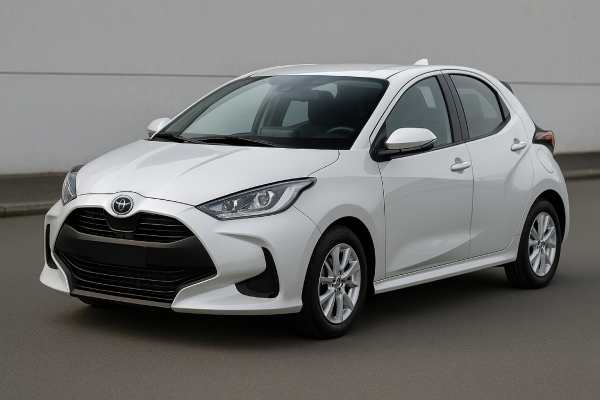
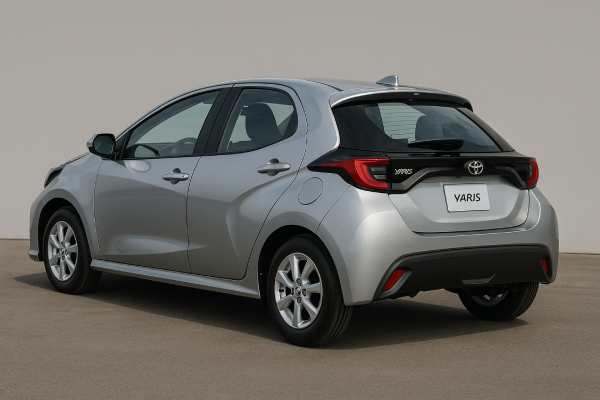
The fourth-generation Toyota Yaris in MXPA11 form is the “pure” petrol 1.5, sitting between the entry-level 1.0 and the popular hybrid. Built on Toyota’s GA-B platform, it combines a light, rigid body with the high-efficiency M15A-FKS three-cylinder engine. On paper it delivers around 92 kW (120–125 hp depending on rating standard), modest weight, and fuel use in the low-5 L/100 km range, so owners get grown-up performance with supermini running costs.
For buyers who do not want hybrid complexity but still care about economy and emissions, this Yaris is a useful sweet spot. It keeps a straightforward driveline (manual gearbox in most MXPA11 cars, CVT in related variants), generous safety kit, and a compact footprint that works well in cities yet feels stable on the motorway. This guide walks through specs, performance, ownership costs, reliability notes, and how the MXPA11 1.5 compares with rivals and with other Yaris versions.
Key Takeaways
- M15A-FKS 1.5 three-cylinder gives roughly 120–125 hp with real-world fuel use near 5.0–5.5 L/100 km in mixed driving when driven sensibly.
- GA-B platform brings a stiff body, low weight (around 980–1000 kg) and strong crash performance with a modern five-star rating in independent tests.
- Toyota Safety Sense with autonomous emergency braking and lane support is standard in most markets, but finer ADAS features can still vary by trim and year.
- Direct-injection petrol and a gasoline particulate filter prefer good-quality fuel and regular motorway runs; repeated short trips can lead to soot loading.
- Plan routine servicing every 12 months or about 10,000 miles (15–16,000 km), including oil and filter, checks of brakes, fluids, and cabin filter.
Start here
- Toyota Yaris MXPA11 in detail
- Yaris MXPA11 technical specs
- MXPA11 trims and safety package
- MXPA11 reliability and known issues
- Maintenance plan and buying guide
- Driving experience and efficiency
- How this Yaris 1.5 compares
Toyota Yaris MXPA11 in detail
The MXPA11 Yaris is the fourth-generation non-hybrid 1.5-litre petrol hatchback, sold in Europe and other markets from 2020. It sits on Toyota’s GA-B architecture, the same basic platform as the Yaris Hybrid and GR Yaris. That means a very stiff shell, extensive use of high-strength steels, and suspension geometry tuned for comfort and agility rather than just low cost.
Under the bonnet is the M15A-FKS, a three-cylinder “Dynamic Force” engine designed for high thermal efficiency. Compared with older 1.5s, it uses a long stroke, high compression ratio and variable valve timing to squeeze more work out of each drop of fuel. Output is around 92 kW, often quoted as 120 hp in some catalogues and 125 PS/125 hp in others depending on rating method and market.
Most MXPA11 cars are front-wheel drive with a 6-speed manual gearbox. Closely related CVT versions exist (often documented under MXPA10 codes), and much of this guide still applies to them, but when we talk about performance and maintenance we have the manual-transmission hatchback in mind. The car weighs just under a metric ton in basic trims, which helps both performance and fuel economy.
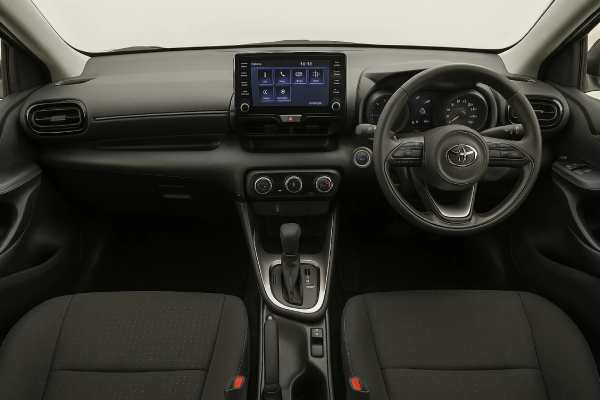
Inside, the MXPA11 has a more upmarket cabin than older Yaris generations: a wide dashboard with a central touchscreen, decent seat adjustment, and a driving position that suits taller drivers better than previous models. Rear space is adequate for two adults on shorter trips; three across the back is tight, which is typical for this class. Boot volume is in the mid-200-litre range, enough for weekly shopping or two carry-on suitcases, and the rear seat backs fold to expand the load area.
On the road the 1.5 Yaris feels more substantial than its size suggests. The steering is light but accurate, the suspension filters small bumps well, and high-speed stability is good for a short-wheelbase car. Owners who step up from the 1.0-litre Yaris or many older superminis will notice that the MXPA11 feels more refined and secure at motorway speeds while still being easy to park and thread through narrow streets.
Yaris MXPA11 technical specs
Engine and performance (M15A-FKS)
| Item | Data |
|---|---|
| Engine code | M15A-FKS |
| Configuration | 1.5 l inline-3, DOHC, 4 valves per cylinder |
| Displacement | 1,490 cc |
| Bore × stroke | 80.5 × 97.6 mm |
| Compression ratio | Around 13.0:1 in common European calibrations |
| Induction | Naturally aspirated |
| Fuel system | Modern multi-port or combined injection with advanced valve timing (Dynamic Force family) |
| Max power | Approx. 120 hp @ 6,600 rpm (often quoted as 92 kW / 125 PS in data sheets) |
| Max torque | Around 145 Nm @ 4,800–5,200 rpm |
| Timing drive | Chain-driven camshafts |
| Emissions standard | Euro 6d / equivalent local standard |
| WLTP combined | About 5.1 L/100 km (≈46 mpg US, 55 mpg UK) for 6-MT hatchback |
| Real-world highway @120 km/h | Typically 5.5–6.0 L/100 km when driven smoothly |
| Aerodynamics | Drag coefficient around 0.32 with small frontal area |
In day-to-day use, the engine is happiest above 2,000 rpm, with a noticeable step in pull from around 3,000 rpm upward. The long stroke helps mid-range torque, so it feels stronger than older 1.3 and 1.33 Yaris engines despite having only three cylinders.
Transmission and driveline
| Item | Data |
|---|---|
| Transmission | 6-speed manual (most MXPA11); CVT in some related 1.5 variants with different codes |
| Gearbox notes | Close-ratio lower gears for response, taller 6th for low-rpm cruising |
| Drive type | Front-wheel drive |
| Differential | Open front diff; stability control brakes an inside wheel to simulate torque vectoring |
| Clutch | Single-plate dry clutch (manual) |
Chassis and dimensions
Figures below are representative for European 1.5 6-MT hatchbacks.
| Item | Data |
|---|---|
| Platform | GA-B (Toyota New Global Architecture) |
| Front suspension | Independent MacPherson strut |
| Rear suspension | Torsion beam with coil springs |
| Steering | Electric power steering, rack-and-pinion |
| Front brakes | Ventilated disc, ABS and stability control standard |
| Rear brakes | Drums on most lower trims; discs on some higher grades/markets |
| Length | 3,940 mm |
| Width | 1,695 mm (excluding mirrors) |
| Height | ~1,500 mm |
| Wheelbase | 2,550 mm |
| Ground clearance | About 145 mm |
| Turning circle | Around 9.6 m kerb-to-kerb |
| Kerb weight | Roughly 980–1,000 kg depending on trim |
| GVW | Around 1,275 kg |
| Max payload | Typically 275–295 kg |
| Fuel tank | 40 l (≈10.6 US gal, 8.8 UK gal) |
| Boot volume | Mid-200-litre range with seats up (VDA) |
Performance and capability
Typical independent test figures:
| Item | Data |
|---|---|
| 0–100 km/h (0–62 mph) | Around 9.0–9.5 s (6-MT) |
| Top speed | Around 180 km/h (112 mph) |
| 100–0 km/h braking | Mid-30-metre range on quality tyres and dry tarmac |
| Towing (braked) | Often not type-approved or set very low; check local documents |
| Roof load | Typically 50–75 kg with approved bars; verify in owner’s manual |
Fluids and service capacities
| Fluid | Specification and Notes | Approx. Capacity |
|---|---|---|
| Engine oil | 0W-16 or 0W-20 API SN/ILSAC GF-5/6, low-viscosity fuel-saving oil | About 3.4 l including filter |
| Engine coolant | Toyota long-life ethylene glycol coolant | Around 4.9 l |
| Manual gearbox oil | Low-viscosity GL-4 75W manual transmission oil | About 2 l |
| Brake fluid | DOT 3 or DOT 4, as specified | Fill to reservoir mark; full system around 0.7–1.0 l |
| A/C refrigerant | R-134a or R-1234yf depending on market/year | Quantity printed on under-bonnet label |
Electrical
| Item | Data |
|---|---|
| Alternator | Compact alternator sized for stop-start operation |
| 12 V battery | Small AGM or flooded lead-acid; capacity around 35–45 Ah |
| Spark plugs | Long-life iridium, service interval commonly around 90,000–100,000 km |
Safety and driver assistance (headline)
The 2020 Yaris range, including non-hybrid variants on the same body, achieved a five-star rating in Euro NCAP testing with strong adult, child and Safety Assist scores. Key systems (market- and trim-dependent) include:
- Pre-collision system with car/pedestrian detection and AEB
- Adaptive or conventional cruise control
- Lane departure alert with steering assist and, on higher trims, lane-keeping and centring functions
- Road sign assist and automatic high beam
- On some grades, blind-spot monitoring and rear cross-traffic alert
Details on which features are standard or optional are covered in the next section.
MXPA11 trims and safety package
Trims for the MXPA11 1.5 vary by country, but the pattern is similar across Europe: an entry “utility” or “Active/Business” grade, one or two mid-level trims (often called Icon/Design or similar), a high “comfort/luxury” trim (Excel, Lounge, Style), and in some markets a GR Sport-branded variant with sporty aesthetics.
On the mechanical side, all MXPA11 trims use the same basic engine and manual gearbox. Differences come mainly from wheel and tyre size, brake configuration and suspension tuning:
- Lower trims usually have 15-inch wheels with higher-profile tyres and rear drum brakes.
- Mid- and high-trims often move to 16-inch or 17-inch alloys; some of these receive rear disc brakes.
- GR Sport and similar grades may add slightly firmer dampers and specific steering calibration, but still retain the same powertrain.
From a safety and equipment perspective, Toyota Safety Sense is a core selling point. Even base trims typically include:
- Autonomous emergency braking with pedestrian and cyclist detection in defined conditions.
- Lane departure alert with steering assist.
- Traffic sign recognition and intelligent speed warning.
- Automatic high beam.
Mid and top trims add convenience and advanced ADAS features:
- Adaptive cruise control that can follow traffic down to low speeds in some configurations.
- Lane trace assist (a more active lane keeping function), especially on cars with CVT.
- Blind-spot monitoring and rear cross-traffic alert on upper trims.
- Parking sensors and, on some versions, a reversing or 360° camera.
Interior differences between trims are straightforward but important when choosing a used car. Base cars often have fabric seats, a simple instrument display and a smaller touchscreen. Mid trims add nicer upholstery, leather-trimmed steering wheel, upgraded audio and more USB/phone integration. High trims can include climate control instead of manual A/C, LED headlights, keyless entry and more comprehensive ambient lighting. GR Sport-style variants typically add sports seats, contrasting trim and unique wheels without fundamentally changing practicality.
Year-to-year changes over 2020–2023 mainly affected infotainment and driver-assistance software. Early cars have a simpler multimedia system; later ones adopt improved smartphone integration and sometimes a larger centre screen. Toyota also rolled out incremental Safety Sense updates, such as expanding the operating range of AEB and refining lane-keeping behaviour. When shopping used, it is worth checking the exact build year and asking a dealer which software and calibration updates are available for that car’s VIN.
For child-seat users, ISOFIX/LATCH anchor points are fitted on the outer rear seats, with top tether points behind the backrests. The rear bench shape and door opening make it realistic to fit two child seats side by side; three across will usually be difficult. Yaris models tested by Euro NCAP performed well in child-occupant tests, but you should always confirm your exact seat’s compatibility with the vehicle.
MXPA11 reliability and known issues
Because the MXPA11 1.5 is a relatively new car and built in modest numbers compared with the hybrid, long-term data is still emerging. Early signs, however, are broadly positive. The M15A-FKS engine belongs to Toyota’s latest Dynamic Force family and has not attracted widespread reports of catastrophic failures. Most owner issues so far are minor annoyances rather than fundamental design flaws.
Engine and fuel system
The main watch-points relate to the characteristics of a modern high-compression petrol engine with advanced injection and a gasoline particulate filter (GPF):
- Short-trip use and GPF – Many very short journeys, especially in cold climates, can prevent the exhaust from reaching temperatures needed for efficient soot burn-off. Over time this can lead to higher back-pressure and warning lights. Regular longer drives (20–30 minutes at steady speed) help the regeneration process.
- Carbon build-up – Like many modern petrol engines, there is potential for intake valve deposits over high mileage, especially with low-quality fuel and extended oil-change intervals. Symptoms include rough idle and hesitation. Intake cleaning is the standard remedy if issues arise.
- Fuel quality sensitivity – The high compression ratio and advanced ignition timing expect good-quality unleaded. Persistently using poor fuel can increase knock-correction activity, reducing performance and potentially stressing components in the long term.
Oil consumption is generally low when correct oil is used and changes are on schedule. However, as with any small, high-revving engine, extended running at high rpm or very long drain intervals can provoke consumption. Checking the dipstick between services is still good practice.
Cooling, driveline and chassis
No widespread cooling-system weaknesses have surfaced so far. Hoses, water pump and radiator are typical wear items rather than specific failure points. Likewise, the 6-speed manual gearbox has a conventional layout and, provided the oil is clean and the clutch is not abused, tends to be durable. Any crunching into gears or reluctance to select gears when cold warrants inspection for worn synchros, linkage issues or low oil.
Because the MXPA11 is relatively light, suspension and brake components are not heavily stressed during normal use. However, city cars often meet potholes and kerbs, so pay attention to:
- Clunks over bumps (possibly drop links or top mounts).
- Uneven tyre wear (alignment issues or worn bushings).
- Vibration under braking (warped discs or pad deposits – more likely on higher-trim cars with disc rears).
Electronics and infotainment
Electronics issues tend to be software- rather than hardware-driven:
- Frozen or slow infotainment systems, sometimes cured by software updates.
- Occasional false alerts from lane-keeping or collision-warning systems when cameras need recalibration after a windscreen replacement or front-end repair.
Any ADAS warning after bodywork changes should be checked by a workshop with the correct calibration equipment.
Recalls and service campaigns
Toyota has issued various recalls and service campaigns across the XP210 Yaris range, some related to hybrid components, others to safety-critical items such as airbags or seatbelt pretensioners. Not every campaign covers the MXPA11 1.5, and coverage varies by market. The safest approach is:
- Use the official Toyota recall/VIN-check tool for your region.
- Ask a dealer to print out the “campaign history” for the specific car you are considering.
For a used purchase, insist that any open recalls are completed before delivery; there is no cost to the owner for recall work.
Maintenance plan and buying guide
Practical maintenance schedule (typical guidance)
Always confirm intervals with your local service schedule, but for the MXPA11 1.5 a sensible baseline is:
- Engine oil and filter – Every 12 months or 10,000 miles (15–16,000 km), whichever comes first, using the specified low-viscosity synthetic oil.
- Engine air filter – Inspect every service, replace about every 30,000–40,000 km or more often in dusty conditions.
- Cabin (pollen) filter – Replace every 2 years or sooner if airflow is weak or smells.
- Spark plugs – Iridium plugs typically last 90,000–100,000 km; check condition from around 60,000 km if you drive mainly short trips.
- Coolant – Long-life coolant is usually first changed at a high mileage/long time interval, then at shorter intervals; follow your market’s guidance.
- Brake fluid – Every 2–3 years regardless of mileage.
- Manual gearbox oil – Often “filled for life” on paper, but changing around 90,000–120,000 km can improve shift feel and longevity.
- Aux/serpentine belt – Inspect from 90,000 km or 6 years; replace if cracked or noisy.
- Timing chain – No fixed interval; listen for rattles on cold start and check for timing correlation codes – replace chain and guides only if out of spec.
- Tyre rotation and alignment – Rotate every 10–15,000 km and check alignment after impacts or if wear is uneven.
- 12 V battery – Expect 5–7 years in typical use. Many modern, small batteries give little warning before failure; periodic load testing is wise.
Because this is not a hybrid, there is no high-voltage battery service. Some advice you may read that relates to hybrid cooling systems or traction batteries does not apply here.
Fluids and torque notes for DIY-minded owners
- Engine oil – Choose a quality 0W-16 or 0W-20 oil meeting the latest API/ILSAC rating Toyota specifies in your region. Drain-plug torque on small Toyota engines is typically in the mid-30-Nm range, but always confirm in official literature.
- Wheels – Wheel-nut torque is usually around 100–110 Nm on small Toyotas; verify the exact figure from the owner’s documentation.
- Spark plugs – Use the correct heat range and follow tightening torque carefully (often around 18–22 Nm on modern 14 mm plugs with gasket).
If in doubt, defer to the workshop manual; guessing torque values on alloy components can be expensive.
Buying guide: what to look for
When assessing a used Yaris MXPA11 1.5:
- Service history – Prefer cars with annual services recorded, even at low mileage. Skipped oil changes are more harmful on high-efficiency, long-stroke engines.
- Recall and campaign status – Ask for a VIN print-out showing all completed campaigns.
- Cold start behaviour – Engine should start promptly and settle to a clean idle without rattles or knocking. Listen for timing-chain noise.
- Warm test drive – Check for smooth power delivery, clean revving to the redline, and precise gear changes without crunching.
- Brakes and suspension – No pulling under braking, no persistent steering vibration, and no clunks over rough surfaces.
- Tyres – Mismatched or cheap tyres can hide or create handling and NVH problems; budget for quality tyres if needed.
- Body and corrosion – The XP210 shells generally resist rust well, but check wheel arches, sills, door edges and the underside for damage and poor repairs.
- Interior wear – Excessive wear on pedals, steering wheel and seat bolsters versus the odometer reading can hint at clocking or very hard use.
In general, a well-maintained MXPA11 1.5 should be capable of high mileage with modest running costs. It suits buyers who want something simple, efficient and safe without committing to hybrid ownership.
Driving experience and efficiency
The MXPA11 Yaris feels quite different from earlier Yaris generations. The GA-B platform gives it a solid, planted character that inspires confidence at speed. On a typical drive the car combines light controls with a surprisingly “grown-up” feel.
Ride, handling and refinement
On 15-inch wheels the ride is comfortable, soaking up sharp edges and speed bumps well for a small car. 16- and 17-inch packages look better and sharpen steering response, but they also introduce more impact harshness over broken urban roads. Body roll is well controlled, and grip levels are high for a supermini.
The steering is light at parking speeds and weights up progressively as speed rises. It is not especially communicative in an enthusiast sense, but it is accurate and consistent. Straight-line stability is very good given the short wheelbase; crosswinds do not upset the car as much as on many older superminis.
Noise levels are reasonable. You will hear the three-cylinder note under hard acceleration and some tyre roar on coarse surfaces, but engine and wind noise are well contained at a 120 km/h cruise. Compared with many competitors, the Yaris feels relaxed rather than busy on the motorway.
Powertrain character
The M15A-FKS is smooth for a three-cylinder and likes to rev. Below 2,000 rpm it feels modest, but once past 3,000 rpm it pulls willingly to the redline. Driven briskly, it can feel quite lively thanks to the low kerb weight. Gear ratios are well spaced; 1st and 2nd gears give good response in town, and 6th is tall enough to keep revs low on the highway.
Because it is naturally aspirated, there is no turbo lag, but you do need to use the gearbox to stay in the power band. Drivers used to small turbo engines may initially feel the Yaris is flat if they try to short-shift at very low rpm. Once you adapt, it rewards a slightly more rev-happy driving style.
CVT-equipped relatives behave differently: they keep the engine in a narrow rev band under acceleration and feel smoother but less “mechanical.” The manual MXPA11 offers more driver involvement and slightly better efficiency when driven carefully.
Real-world efficiency
Official WLTP figures around 5.1 L/100 km combined are achievable in mixed use if you drive smoothly and anticipate traffic. On a steady, warm-weather motorway run at 110–120 km/h, many owners report figures in the mid-5s; urban stop-start conditions push consumption into the 6–7 L/100 km range, particularly on short, cold journeys.
Translated into mpg:
- City – roughly 34–38 mpg US (41–46 mpg UK) depending on congestion.
- Mixed – roughly 39–44 mpg US (47–53 mpg UK).
- Gentle highway – up to the mid-40s mpg US (high-50s mpg UK) is realistic in ideal conditions.
Cold weather, short trips and roof racks all have a noticeable effect. Compared with the Yaris Hybrid, fuel consumption is higher, especially in city driving, but maintenance is simpler and there is no traction battery to consider.
Traction and load
With front-wheel drive and modest power, the Yaris 1.5 has no trouble putting its torque down in the dry. In the wet, the stability and traction systems intervene smoothly and early if you ask too much from tight junctions. Snow performance depends heavily on tyres; winter or all-season tyres make a bigger difference than any factory setting.
The car is not designed as a serious tow vehicle, and towing limits (where type-approved) are low. Carrying four adults and luggage is possible but will eat into performance; you feel the extra mass more readily than in a larger hatchback. For regular heavy loads or towing, a larger car or the hybrid variant with stronger low-rpm assistance may be more suitable.
How this Yaris 1.5 compares
In the crowded B-segment, the MXPA11 Yaris 1.5 competes with cars like the Ford Fiesta 1.0 EcoBoost (where still sold), Volkswagen Polo 1.0 TSI, Renault Clio 1.0/1.3 TCe, Peugeot 208 1.2 PureTech, and of course its own hybrid sibling and the Yaris Cross.
Versus rivals
Compared with many turbocharged three-cylinder rivals:
- Performance is broadly similar; the Yaris 1.5’s naturally aspirated engine trades low-rpm shove for linear response and simpler hardware.
- Efficiency is competitive, particularly on longer runs where the efficient combustion and low weight help. In heavy urban use, turbo rivals and mild hybrids can close the gap or surpass it.
- Reliability expectations lean in the Yaris’s favour, given Toyota’s reputation and the absence of a turbocharger and complex aftertreatment beyond the particulate filter.
- Interior and tech are solid but not class-leading; some rivals offer flashier screens and more ambient features, while the Yaris focuses on simple layouts and good ergonomics.
Safety is a strong point. The Yaris’s independent crash-test scores and the breadth of Toyota Safety Sense mean that even modest trims often carry more standard driver-assistance tech than equivalent rivals of similar age.
Versus the Yaris Hybrid
If you are choosing between the MXPA11 1.5 and the Yaris Hybrid:
Yaris 1.5 MXPA11 advantages
- Lower purchase price on the used market compared with similarly aged hybrids.
- Simpler powertrain: no traction battery, e-CVT, or high-voltage components to consider.
- Lighter overall weight and a more traditional manual-gearbox driving feel.
- Less complex cooling and fewer specialised hybrid service operations.
Yaris Hybrid advantages
- Substantially lower fuel consumption in urban driving and stop-start traffic.
- Very smooth and quiet operation at low speeds.
- Ability to creep in EV mode in car parks and traffic queues.
- Often better resale value in markets that strongly favour hybrids.
If you mostly do short city trips and fuel economy is your priority, the hybrid wins. If you prefer a manual gearbox, drive more mixed or motorway miles, or want lower complexity, the MXPA11 1.5 is the more suitable choice.
Overall verdict
The Toyota Yaris MXPA11 1.5 is a well-balanced small car: efficient, safe, and pleasant to drive, with few serious reliability red flags so far. It is not the absolute most refined or spacious option in the class, nor is it the most frugal in urban driving, but it offers a strong combination of simplicity, engineering quality and real-world usability.
For owners who want a modern, well-equipped supermini without hybrid hardware, the MXPA11 1.5 makes a strong case. Choose a car with a full service history, avoid neglected examples, and it should deliver many years of dependable use.
References
- Toyota Yaris (XP210) 1.5 (120 Hp) | Technical specs, data, fuel consumption, Dimensions 2025 (Technical Specifications)
- Official Toyota Yaris 2020 safety rating 2020 (Safety Rating)
- Take a closer look at the specifications of Toyota Yaris 2025 (Manufacturer Specifications)
- Toyota Yaris service intervals: all models covered – Toyota UK Magazine 2023 (Service Intervals)
- Toyota Service, MOT, & Repairs | Toyota UK 2025 (Servicing Guidance)
Disclaimer
This article is for informational purposes only and is not a substitute for professional diagnosis, repair, or official service information. Specifications, torque values, maintenance intervals and procedures can vary by VIN, model year, market and equipment level. Always confirm details against your vehicle’s owner’s manual, official workshop literature, and current manufacturer data before carrying out any work or making purchase decisions.
If you found this guide useful, you are welcome to share it on social platforms such as Facebook or X/Twitter to help other owners and support our work.