
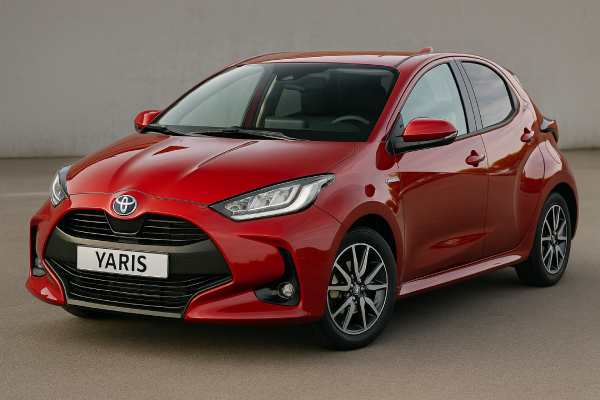
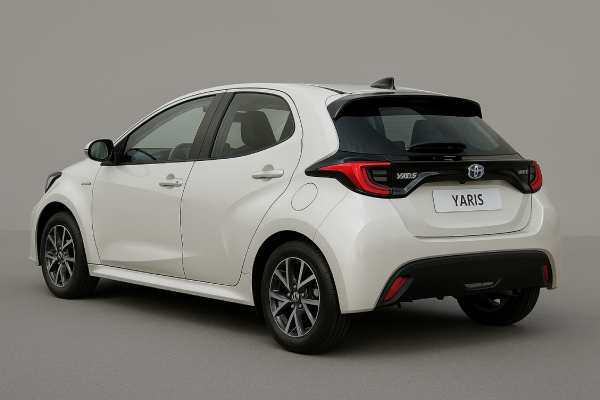
The Toyota Yaris Hybrid (MXPH11) is the full-hybrid member of the fourth-generation Yaris range. It combines the M15A-FXE 1.5-litre three-cylinder petrol engine with an electric motor and compact lithium-ion battery, producing a system output of about 116 hp. Built on Toyota’s GA-B platform, it brings big-car safety and refinement to a supermini footprint, while returning fuel consumption figures that many diesel hatchbacks struggle to match.
For owners, the appeal is a mix of very low urban fuel use, strong safety scores, and Toyota’s track record with hybrid durability. The e-CVT powertrain is designed to be simple to operate and smooth in traffic, and there is no plugging-in or charge-planning to think about. At the same time, the MXPH11 keeps the practical advantages of a normal Yaris hatchback: compact size, usable rear seats, and a boot that works for everyday family use. This guide covers the key specs, ownership experience, maintenance, and how the Yaris Hybrid compares with its rivals.
Fast Facts
- Full-hybrid 1.5-litre system with about 116 hp, capable of real-world consumption near 3.8–4.5 L/100 km in mixed driving.
- GA-B platform, discs all round and a 5-star Euro NCAP rating give the car strong active and passive safety for its size.
- Toyota Safety Sense driver assistance is standard, but specific ADAS features and screen size still vary by trim and year.
- Hybrid system prefers regular use and correct servicing; long storage and very infrequent driving are best avoided.
- Recommended service interval is typically every 12 months or 10,000 miles (around 15–16,000 km), whichever comes first.
Guide contents
- Inside the Yaris Hybrid MXPH11
- Yaris Hybrid MXPH11 specs
- Hybrid trims, options and safety
- MXPH11 hybrid reliability notes
- Hybrid maintenance and buying guide
- Driving the Yaris Hybrid MXPH11
- Yaris Hybrid versus competitors
Inside the Yaris Hybrid MXPH11
The MXPH11 Yaris Hybrid is the core hybrid variant of the fourth-generation Yaris (XP210 series) sold from 2020. It uses Toyota’s GA-B small-car platform, which is much stiffer than the previous generation and allows for better crash performance and more precise suspension tuning. Compared with earlier Yaris hybrids, this generation feels less “city car” and more like a downsized family hatchback, both in refinement and handling.
At the heart of the MXPH11 is the M15A-FXE petrol engine, a three-cylinder 1.5-litre unit operating on an Atkinson cycle. It is paired with an electric traction motor (MG2) and a compact lithium-ion high-voltage battery mounted under the rear bench. The combination drives the front wheels through an e-CVT transaxle (P910), giving seamless blending of petrol and electric power. In European tune the engine produces about 91 hp by itself, with the hybrid system delivering a combined maximum of around 116 hp.
The packaging is neat for a full hybrid. There is no external charging port, and from the driver’s seat the car behaves like an automatic. You select D, press the accelerator, and the power electronics decide how to mix petrol and electric power. The lithium-ion pack is air-cooled rather than liquid-cooled, which simplifies maintenance and helps keep weight down. System voltage is high enough to allow meaningful electric assistance at motorway speeds, not just at low speed.
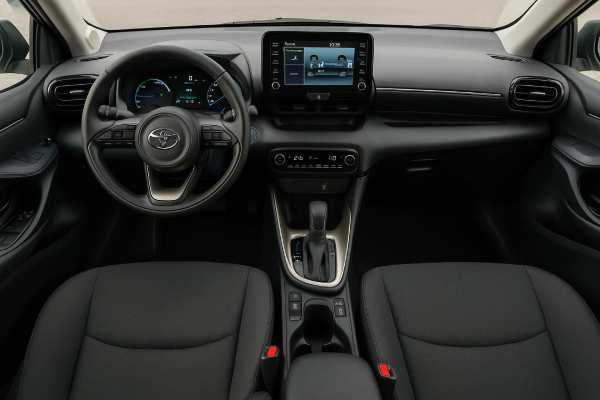
Inside, the cabin builds on the standard Yaris but adds hybrid-specific instrumentation. Most cars have a digital power gauge instead of a traditional rev counter, along with energy-flow graphics on the central screen. The driving position is better than in older Yaris models, with a lower seat and more steering-wheel adjustment, which taller drivers will appreciate. Rear space is fine for two adults on shorter trips and perfectly adequate for children; three across is a squeeze, as in most B-segment cars.
Boot volume for the hybrid is quoted at around 280–286 litres depending on trim. The floor is fairly square, and the rear seats split-fold to extend the load area. Because the battery is under the rear seat rather than in the boot, there is no dramatic loss of luggage room compared with non-hybrid versions. For everyday use, the car remains a practical small hatchback with the added benefit of very low fuel consumption in town.
Yaris Hybrid MXPH11 specs
Powertrain and efficiency
| Item | Data |
|---|---|
| Engine code | M15A-FXE |
| Type | 1.5-litre inline-3, Atkinson cycle |
| Valvetrain | DOHC, 12-valve with VVT-iE (intake) and VVT-i (exhaust) |
| Displacement | 1,490 cc |
| Bore × stroke | 80.5 × 97.6 mm |
| Compression ratio | 14.0:1 |
| Fuel system | Direct multipoint injection petrol |
| Engine max power | About 90–91 hp (67 kW) @ 5,500 rpm |
| Engine max torque | Around 120 Nm @ 3,600 rpm |
| Electric motor type | Permanent-magnet synchronous (MG2) |
| Electric motor max power | 59 kW |
| Electric motor max torque | 141 Nm |
| Hybrid system max power | 116 hp (85 kW) combined |
| High-voltage battery | Lithium-ion, 177.6 V, 4.3 Ah |
| System voltage (MG2) | Up to 580 V |
| WLTP combined fuel use | Roughly 3.8–4.3 L/100 km (62–55 mpg US; 74–66 mpg UK) depending on wheels/trim |
| WLTP CO₂ | Around 87–98 g/km |
| Real-world highway @ 120 km/h | Often 4.5–5.0 L/100 km when driven smoothly |
Because the engine runs an Atkinson cycle and uses high compression, it is tuned for efficiency rather than outright power. The electric motor fills in low-rpm torque and allows the petrol engine to operate in its most efficient range as often as possible. In town, the car can glide on electric power at low speeds or under light throttle, with the engine cutting in unobtrusively when more power is needed.
Transmission and driveline
| Item | Data |
|---|---|
| Transmission | e-CVT (P910 hybrid transaxle) |
| Drive type | Front-wheel drive (MXPH11) |
| Differential | Integrated in transaxle; open type with brake-based torque control |
| Final drive ratio | Approx. 2.83:1 in many specs |
| Drive modes | Normal, Eco, Power; EV mode for short electric-only running |
The e-CVT is not a belt-and-pulley transmission but a planetary gearset combining engine and motor power. There are no conventional shift points; instead, the control software chooses engine speed for efficiency and performance.
Chassis and dimensions
Data below is representative for European Yaris Hybrid hatchbacks on 16- or 17-inch wheels.
| Item | Data |
|---|---|
| Platform | GA-B (Toyota New Global Architecture) |
| Front suspension | MacPherson strut |
| Rear suspension | Torsion beam |
| Steering | Rack-and-pinion with electric power assistance |
| Turns lock-to-lock | About 2.73 |
| Front brakes | Ventilated discs with ABS and stability control |
| Rear brakes | Solid discs |
| Overall length | 3,940 mm |
| Overall width | 1,745 mm |
| Overall height | 1,500 mm |
| Wheelbase | 2,560 mm |
| Ground clearance | About 140–145 mm depending on spec |
| Minimum turning radius (body) | About 5.5 m |
| Kerb weight | Approx. 1,085–1,160 kg depending on trim and wheels |
| Gross vehicle weight | Around 1,615 kg |
| Fuel tank capacity | 36 l (9.5 US gal, 7.9 UK gal) |
| Boot capacity | Around 286 l seats up (VDA) |
Performance and capability
| Item | Data |
|---|---|
| 0–100 km/h (0–62 mph) | About 9.7 s |
| Top speed | Around 175 km/h (109 mph) |
| 100–0 km/h braking | Typically mid-30-metre range on good tyres |
| Range (WLTP combined) | Roughly 900–950 km on one tank in favourable conditions |
| Towing capacity braked | Around 450 kg in markets where towing is approved |
| Towing capacity unbraked | Around 450 kg |
Fluids and service capacities
| Fluid | Specification and notes | Approx. capacity |
|---|---|---|
| Engine oil | 0W-16 or 0W-20 low-viscosity synthetic meeting Toyota’s latest specification | About 3.6 l including filter |
| Engine coolant | Toyota long-life ethylene glycol coolant for hybrid engines | Just under 5 l total (engine loop) |
| Hybrid transaxle oil | Toyota LV automatic transmission/hybrid fluid (filled for life on paper) | Around 3–4 l |
| Brake fluid | DOT 3 or DOT 4, as specified | Roughly 0.7–1.0 l for full flush |
| A/C refrigerant | R-134a or R-1234yf depending on market/year | Charge amount on under-bonnet label |
Electrical and hybrid system
| Item | Data |
|---|---|
| High-voltage battery type | Lithium-ion, 48 cells |
| Nominal HV battery voltage | 177.6 V |
| 12 V battery | Conventional small AGM or lead-acid, typically 35–45 Ah |
| Generator (MG1) | Integrated into transaxle; manages engine starts and charging |
| Spark plugs | Long-life iridium, usually 90–100,000 km service interval |
Safety and driver assistance
The fourth-generation Yaris, including hybrid variants, achieved a five-star Euro NCAP rating under the updated test regime introduced around 2020. Adult occupant, child occupant and Safety Assist scores are strong for a B-segment hatchback, thanks in part to the use of centre airbags and sophisticated crash structures.
Standard or widely available features, depending on market and trim, include:
- Autonomous emergency braking with vehicle, pedestrian and cyclist detection
- Lane departure alert with steering assist and lane-keeping functions
- Speed-limit recognition and intelligent speed assistance
- Adaptive cruise control (full-speed on many versions)
- Automatic high beam
- Optional blind-spot monitoring and rear cross-traffic alert on higher trims
Hybrid trims, options and safety
Trims for the Yaris Hybrid vary between regions, but the pattern in Europe and many other markets is broadly similar. You typically see a functional base grade (often called Icon, Active or similar), mid-level trims (Design, Dynamic, Trend) and more premium or sporty versions (Excel, Style, GR Sport). All of them share the same basic MXPH11 hybrid powertrain.
From a mechanical perspective, the main differences between trims are wheel/tyre packages and corresponding brake and suspension details:
- Base and mid trims often use 16-inch wheels with 195/55R16 tyres. These cars already have disc brakes at the rear and are tuned for ride comfort.
- Higher trims and GR Sport bring 17-inch alloys with 205/45R17 tyres, slightly firmer damping and sometimes different steering calibration. Grip improves, but impact harshness increases and WLTP fuel consumption rises slightly.
- Towing and payload limits remain similar across grades, though local homologation can tweak the exact numbers.
In terms of equipment, the Yaris Hybrid is generous on core safety kit even at entry level. Most cars leave the factory with Toyota Safety Sense as standard, including:
- Pre-collision system with autonomous emergency braking
- Lane departure alert and steering assist
- Road-sign assist and automatic high beam
- At least conventional cruise control, often adaptive cruise as well
Mid- and high-grade trims add layers of convenience and driver assistance:
- Full-speed adaptive cruise control with stop-and-go capability on some versions
- Lane trace assist (centres the car in its lane when cruise control is active)
- Blind-spot monitor, rear cross-traffic alert and parking sensors
- Reversing camera or 360° camera systems in better-equipped models
Lighting is another key differentiator. Base models can have halogen headlights, but many markets quickly moved to LED units even on lower trims. Top versions offer full LED headlights with adaptive beam patterns, improving night-time visibility and often scoring better in safety-test headlight assessments.
Inside, you will notice trim-level differences in seat upholstery, steering-wheel finish, instrument cluster style and infotainment. Entry cars may use cloth seats and a simpler digital cluster, while upper trims feature sports or half-leather seats, larger colour displays and more adjustment. Infotainment hardware evolved over the 2020–2023 period: early cars used Toyota’s older multimedia system, while later builds gained a faster processor, crisper graphics and improved smartphone integration (Apple CarPlay and Android Auto, sometimes wireless).
Year-to-year, Toyota made running updates to Safety Sense functions as well. Software revisions improved lane-keeping smoothness, refined acceleration and braking under adaptive cruise, and expanded the operating range of autonomous emergency braking. Some of these updates can be retro-applied through dealer software campaigns, so when you shop for a used Yaris Hybrid, it is worth asking whether the latest calibrations are installed.
Overall, whichever trim you choose, the Yaris Hybrid MXPH11 brings a strong baseline of safety and driver assistance. Higher trims mainly enhance comfort, style and digital features rather than fundamentally changing the underlying protection.
MXPH11 hybrid reliability notes
Toyota has a long track record with hybrid systems, and the M15A-FXE plus P910 transaxle continue that lineage. As of the 2020–2023 production window, the Yaris Hybrid MXPH11 has not generated widespread reports of systemic failure. However, like any sophisticated car, there are patterns and watch-points that owners and buyers should understand.
Engine and hybrid system
The 1.5-litre M15A-FXE engine runs an efficient Atkinson cycle with high compression, so it is tuned more for economy than power. It generally proves robust if serviced correctly, with quality low-viscosity oil changed on time. Known engine-side watch-points include:
- Short-trip use – Because hybrids often shut the engine off in town, oil can see more cold starts and shorter warm cycles. Regular annual changes are important even at low mileage.
- Carbon build-up – As with many modern petrol engines with advanced injection, long-term intake deposit formation is possible, especially with low-quality fuel and long service intervals. Symptoms include rough idle or hesitation; cleaning of the intake and throttle body can resolve this when it appears.
- Cooling – No major cooling-system flaws are widely reported, but clogged radiators or low coolant level can stress both engine and power electronics. Pay attention to coolant changes and leaks.
The hybrid system itself – including the P910 e-CVT and lithium-ion battery – is closely related to hardware already widely used in other Toyota hybrids. Typical issues are rare but may include:
- Hybrid warning lights caused by weak 12 V batteries, particularly after long periods of disuse. A healthy 12 V battery is essential for the high-voltage system to wake up correctly.
- Battery cooling – The Yaris uses cabin air to cool the HV battery. Blocked intake vents (for example, by luggage or debris) can reduce cooling efficiency. Keeping vents clear and cabin filters fresh is important.
- Inverter/ECU software – Toyota occasionally issues software updates for hybrid control units to refine drivability and address rare fault patterns. These are usually installed at dealers as part of service campaigns.
Driveline, chassis and brakes
The e-CVT transaxle itself tends to be very durable if its fluid remains clean and the car is not abused. Harsh jolts, frequent full-throttle launches on cold fluid or ignoring fault warnings are more damaging than simple mileage. Some owners choose to have the transaxle fluid changed around 100,000 km even if Toyota does not list it as routine; it can be a sensible preventative measure when done properly.
Suspension wear is typical for a light hatchback used on urban roads:
- Front drop links and top mounts can develop knocks over sharp bumps.
- Rear torsion-beam bushes usually last well but should still be checked on higher-mileage cars.
- Steering systems are generally robust, but any play or noise when turning should be inspected.
Because hybrids use regenerative braking, mechanical brake components often last a long time. The downside is that pads and discs can rust or glaze if the car is driven very gently and never asked to brake hard. Regular firm braking from safe speeds helps keep discs clean. As the car ages, pay attention to seized caliper sliders and corroded backing plates, especially in damp climates.
Electronics and software
Infotainment issues are mostly minor: occasional frozen screens, slow boot times or Bluetooth pairing glitches. Software updates from Toyota can improve stability and bring new features. Driver-assistance systems rely heavily on a forward-facing camera and, in some specs, radar; any windscreen replacement or significant front-end repair should be followed by proper camera/radar calibration, otherwise lane-keeping and AEB performance may suffer.
Recalls and service actions
Over the life of the fourth-generation Yaris, Toyota has issued a number of recalls and service campaigns across different markets. Some relate to hybrid components, others to airbags, seatbelt systems or ECU software. Not every campaign applies to the MXPH11, and eligibility can depend on VIN and build date.
Before buying or when servicing your car, it is wise to:
- Run the VIN through your region’s official Toyota recall checker.
- Ask a dealer to confirm that all applicable recalls and service campaigns have been completed.
Recall work is carried out free of charge. Having a clean recall history is a good sign that previous owners have maintained contact with official service channels.
Hybrid maintenance and buying guide
Maintenance schedule essentials
Exact service intervals can vary by market, but for the Yaris Hybrid 1.5 a typical schedule is:
- Engine oil and filter – Every 12 months or 10,000 miles (about 15–16,000 km), whichever comes first. Hybrids often accumulate fewer engine hours per mile than non-hybrids, but the oil still ages over time.
- Engine air filter – Inspect at each service; replace roughly every 30–40,000 km or sooner in dusty conditions.
- Cabin filter – Replace every 2 years or sooner if airflow drops or odours appear. A clean cabin filter also helps hybrid battery cooling.
- Spark plugs – Long-life iridium plugs usually last 90–100,000 km; check condition if misfires or starting issues appear.
- Coolant (engine and hybrid circuits) – First replacement is often around 10 years or 160,000 km, then at shorter intervals; follow your market’s official schedule.
- Brake fluid – Replace every 2–3 years to protect the ABS and brake-by-wire systems from moisture contamination.
- Transaxle fluid – Commonly specified as “lifetime,” but proactive replacement around 90–120,000 km can be beneficial if done with the correct fluid and procedure.
- Auxiliary belt – Inspect from around 90,000 km or 6 years; change if cracked, noisy or contaminated.
- Tyre rotation and alignment – Rotate every 10–15,000 km and check alignment after pothole impacts or uneven wear.
- 12 V battery – Test every service from around year 4 onward; replace when capacity or starting voltage drops.
High-voltage components are generally maintenance-free. The hybrid cooling system and insulation are checked during scheduled hybrid health checks, which many dealers include as part of routine servicing.
Fluid specifications and torque notes
For DIY-minded owners:
- Use an engine oil viscosity and specification that match your owner’s manual; for this engine it is usually 0W-16 or 0W-20 meeting the latest Toyota and API/ILSAC ratings.
- Replace filters with genuine or high-quality equivalents to maintain correct filtration and flow.
- Wheel-nut torque on small Toyotas is typically around 100–110 Nm; always confirm the exact figure in official documentation.
- Spark-plug torque on aluminium heads needs care; follow the stated value closely to avoid thread damage.
If you are not comfortable with hybrid-system safety procedures, leave work involving the high-voltage system (orange cables, inverters, battery, and hybrid coolant loops) to trained technicians.
Buyer’s checklist
When inspecting a used Yaris Hybrid MXPH11, consider the following:
- Full service history – Ideally annual stamps with hybrid health checks. Skipped services on a hybrid are more concerning than slightly higher mileage.
- Mileage and usage pattern – Hybrids like regular driving. Very low-mileage cars that have spent long periods parked may have more issues with 12 V batteries and brakes.
- Cold start and hybrid readiness – The car should power up quickly with no warning lights. Engine starts should be smooth; any rattles on start-up, harsh vibrations or persistent warning lamps need investigation.
- Test drive behaviour – Check for smooth transitions between electric and engine power, stable e-CVT behaviour without surging, and quiet operation at urban speeds.
- Brakes and suspension – Listen for clunks or squeaks, feel for steering pull under braking, and check the discs for heavy corrosion ridges.
- Tyres – Uneven wear can indicate suspension or alignment issues. Budget for quality tyres; low-rolling-resistance designs help preserve the car’s excellent economy.
- Bodywork and corrosion – Inspect wheel arches, sills, and suspension mounting points. The GA-B platform resists rust well, so significant corrosion may hint at poor accident repairs or unusual use.
- Hybrid and recall paperwork – Ask for copies of hybrid health reports and recall campaign printouts. A car maintained at a Toyota dealer will often have a clear digital record.
Long-term durability outlook
Based on Toyota’s broader hybrid experience and early field data, the Yaris Hybrid MXPH11 should be capable of high mileages with moderate running costs, provided routine maintenance is observed. The combination of a well-proven hybrid architecture, relatively low vehicle mass and modest power output is favourable for durability. As always, cars used for harsh short-trip patterns or neglected on servicing will age faster, but a cared-for example should serve as a reliable daily driver for many years.
Driving the Yaris Hybrid MXPH11
The driving experience is where the Yaris Hybrid distinguishes itself most clearly from non-hybrid superminis. Around town, it behaves more like an electric car that occasionally starts an efficient petrol engine, rather than a conventional hatchback with start-stop.
Ride, handling and refinement
The GA-B platform gives the Yaris Hybrid a surprisingly grown-up feel. Body rigidity is high, allowing the suspension to be tuned for both agility and comfort. On 16-inch wheels, the car rides bumps and speed humps with good control and only modest thumps; the 17-inch packages sharpen steering response but introduce a little more impact harshness and road noise.
Steering is light at low speeds, making parking and tight manoeuvres easy, but it weights up nicely as speed builds. Straight-line stability on the motorway is solid for a short car, with the hybrid’s slightly higher kerb weight contributing to a planted feel. In corners, the Yaris turns in keenly and holds its line well, aided by a low centre of gravity thanks to the battery location.
Noise levels are well managed. There is some characteristic hybrid “flare” of engine revs under hard acceleration, but Toyota has tuned the latest system to feel more natural than older e-CVT setups. At steady speeds, engine noise drops away and wind and tyre noise become the main sources; they are noticeable on coarse surfaces but never overwhelming for the class.
Powertrain character
The hybrid system’s goal is smoothness and efficiency rather than sporty response. In Normal mode, the car pulls away in near-silence on electric power if the battery has charge and demand is gentle. Press the accelerator more firmly and the M15A-FXE fires up quickly, blending in without a jolt. Because the engine is Atkinson-cycle and relatively modest in power, the electric motor’s torque is important for low- to mid-range punch.
Acceleration to urban speeds feels lively enough; the quoted 0–100 km/h time under 10 seconds reflects a respectable level of performance for a small hybrid hatch. Eco mode softens throttle response and encourages the system to stay in electric mode more often, while Power mode holds revs higher and makes the car feel more eager, at the cost of fuel economy and some additional engine noise.
The e-CVT’s behaviour takes a short time to get used to if you are coming from a manual. Under hard acceleration, engine revs climb and stay near the power peak while road speed catches up. Driven more gently, the control software mimics stepped “virtual gears” to make the relationship between sound and acceleration feel more conventional.
Efficiency and range in the real world
In urban and suburban driving, the Yaris Hybrid can deliver fuel use that many diesels struggle to match. With a warm engine and battery, figures around or below 4.0 L/100 km (roughly 59 mpg US, 71 mpg UK) are achievable in light traffic. Stop-start conditions play to the hybrid system’s strengths, as the car can move off and creep using only the electric motor, saving fuel that would otherwise be spent idling.
On the open road, economy remains strong but the hybrid advantage narrows. At 100–110 km/h, expect around 4.0–4.5 L/100 km under favourable conditions; at 120–130 km/h, figures move closer to 4.5–5.0 L/100 km depending on gradient, load and wheel size. Cold weather, short journeys and roof racks can all increase consumption noticeably.
The 36-litre tank may sound small, but because the car is so efficient, realistic ranges around 800–900 km between fills are possible on gentle mixed driving. Energy recovery through regenerative braking also reduces wear on the conventional brakes, particularly in city use.
Traction, load and towing
With front-wheel drive and modest system power, traction issues are rare in the dry. In wet or low-grip conditions, stability control and traction control intervene smoothly. The hybrid system’s ability to meter torque precisely through the e-CVT often makes the car feel more secure than a conventional small petrol hatchback when pulling away on slippery surfaces.
Carrying four adults and luggage is well within the Yaris Hybrid’s capabilities, though you will notice the extra mass in uphill acceleration and fuel use. Towing is possible only within modest limits and may not be type-approved in all markets; even where it is allowed, the car is best thought of as suitable for very light trailers rather than heavy caravans. For regular towing, a larger hybrid or non-hybrid model is more appropriate.
Yaris Hybrid versus competitors
In the B-segment hybrid and efficient-petrol space, the Yaris Hybrid MXPH11 competes with models such as the Renault Clio E-Tech Hybrid, Honda Jazz (Fit) Hybrid, Hyundai i20 and i20 N Line, Kia Rio, Peugeot 208 and various mild-hybrid or small-turbo rivals.
Against other small hybrids
Compared with the Renault Clio E-Tech and Honda Jazz Hybrid, the Yaris positions itself as the sportier-feeling option in terms of styling and chassis tuning. The Jazz offers more rear space and clever interior packaging, while the Clio provides a more softly sprung ride and a different hybrid philosophy using a multi-mode gearbox. The Yaris Hybrid often leads for pure efficiency in stop-start urban driving and has a particularly strong safety-equipment story, but it is not the most spacious choice.
Reliability perception is an important differentiator. Toyota’s long experience with full-hybrid systems and the previous generations of Prius, Auris/Corolla and Yaris hybrids gives buyers confidence that the MXPH11’s hardware is mature. While no car is immune to issues, the Yaris Hybrid’s mechanical layout is simpler than some rivals that use complex dual-clutch hybrid transmissions.
Against efficient non-hybrid superminis
Many small cars now offer mild-hybrid or efficient turbocharged petrol engines. These can match or even beat the Yaris Hybrid on motorway economy, especially when combined with tall gearing. However, they rarely approach the Yaris’s fuel consumption in town, where engine-off operation and strong regeneration give the Toyota an advantage.
The trade-offs are:
- Purchase price – A Yaris Hybrid typically costs more than a comparable non-hybrid Yaris 1.0 or 1.5 and some rival turbo-petrol superminis when new.
- Complexity – There is more hardware on board: high-voltage battery, inverters and an e-CVT transaxle. That said, hybrid components are designed for durability and usually carry robust warranties.
- Running costs – Fuel savings and potentially longer brake life offset higher insurance or tyre costs in some markets. Servicing for the hybrid adds a few specific checks but is otherwise similar in price to well-equipped non-hybrid rivals.
Internal comparison: Yaris Hybrid vs non-hybrid Yaris
Within the Yaris range itself, the choice for many buyers is between the MXPH11 Hybrid and the MXPA11 1.5-litre non-hybrid.
- Choose the Yaris Hybrid if most of your driving is urban or suburban, you value low fuel bills and automatic-like ease of use, and you are happy with an e-CVT’s driving character.
- Choose the non-hybrid 1.5 if you prefer a manual gearbox, do more long-distance motorway driving, or simply want a lower-priced car with slightly simpler hardware.
Both share the same GA-B platform, safety structure and general interior layout, so much of the daily experience is similar. The difference comes down to how you like your power delivered and where you do most of your driving.
Overall verdict
The Toyota Yaris Hybrid MXPH11 is one of the most rounded small hybrids on the market. It combines excellent urban efficiency, mature safety technology and Toyota’s hybrid experience in a package that is easy to live with and park. It is not the roomiest or most luxurious car in its class, and the e-CVT’s character will not suit everyone, but for many drivers it offers a compelling blend of low running costs and everyday usability.
For buyers seeking a small, safe, and economical hatchback with minimal fuss, the Yaris Hybrid deserves a place near the top of the shortlist.
References
- TOYOTA YARIS TECHNICAL SPECIFICATIONS 2021 (Technical Specifications)
- Official Toyota Yaris 2020 safety rating 2020 (Safety Rating)
- Toyota Yaris Specifications and Equipment 2024 (Manufacturer Specifications)
- Toyota Yaris servicing: all you need to know 2022 (Service Intervals)
- Toyota Yaris service intervals: all models covered – Toyota UK Magazine 2022 (Service Guidance)
Disclaimer
This article is provided for informational purposes only and is not a substitute for professional diagnosis, repair or official workshop information. Specifications, torque values, maintenance intervals and procedures can vary by VIN, model year, market and equipment level. Always verify details against your vehicle’s owner’s manual, official service documentation and current manufacturer data before carrying out any work or making purchase decisions.
If you found this guide helpful, please consider sharing it on platforms such as Facebook or X/Twitter so that other owners and buyers can benefit from the information and support our work.