
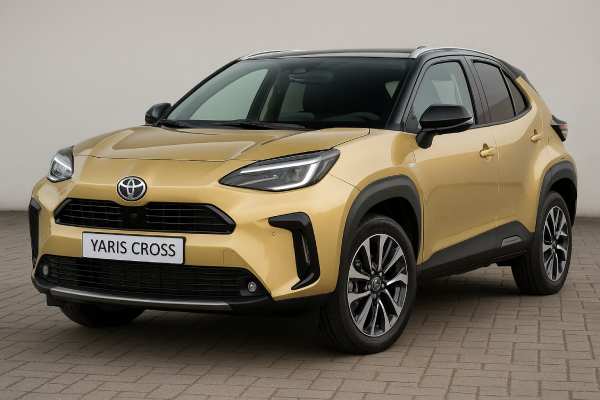
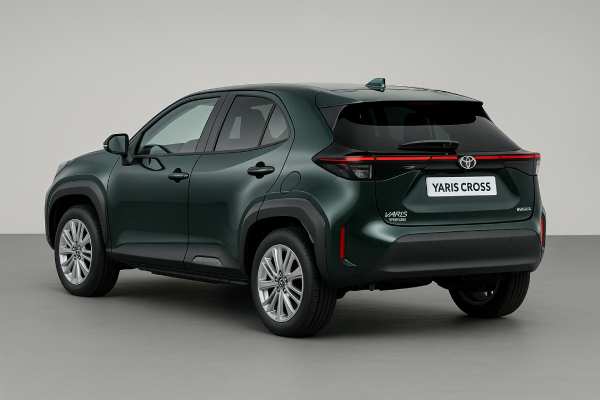
The facelifted Toyota Yaris Cross FWD Hybrid (MXPJ10, often called “Hybrid 115”) takes the successful 2021–2023 recipe and layers on more refinement, technology, and safety. It keeps the proven 1.5-litre M15A-FXE full-hybrid powertrain with 116 hp system output, and it remains front-wheel drive, which is the most efficient and affordable configuration for most owners.
For 2024 onward, Toyota has focused on making the Yaris Cross feel more grown-up: a quieter cabin, more powerful digital instruments, a sharper multimedia system, and an expanded Toyota T-Mate driver-assistance package. At the same time, the car’s compact footprint, light steering, and hybrid smoothness still make it an easy companion for tight streets and daily commuting. This guide looks specifically at the facelifted FWD Hybrid 115, exploring its specifications, performance, reliability expectations, maintenance needs, and how it compares to competitor small SUVs.
Quick Specs and Notes
- 1.5-litre three-cylinder full-hybrid with 116 hp and e-CVT, tuned for low fuel use in city and mixed driving
- GA-B platform with MacPherson front and torsion-beam rear suspension for stable motorway behaviour in a small footprint
- Facelift introduces larger digital displays, improved sound insulation, and the latest Toyota T-Mate safety technologies
- Hybrid system is mechanically robust but depends on correct oil, coolant, and e-CVT fluid changes at 15,000 km / 12-month intervals
- High-voltage battery is designed for vehicle life; long storage or very short-trip use still warrants periodic health checks
Section overview
- Facelift Yaris Cross FWD story
- MXPJ10 hybrid facelift specs
- Facelift trims equipment and safety
- Long-term reliability and service items
- Ownership costs and buyer guide
- On-road feel and efficiency
- Facelift FWD Yaris Cross rivals
Facelift Yaris Cross FWD story
The 2024-onwards facelift of the Toyota Yaris Cross keeps the fundamentals of the original MXPJ10 hybrid but refreshes the car around modern expectations for connectivity and refinement. The FWD Hybrid 115 remains the core powertrain, while a more powerful “Hybrid 130” version is offered in some trims above it. The facelift does not radically alter the body shell or dimensions, but the interior and technology feel notably more up to date.
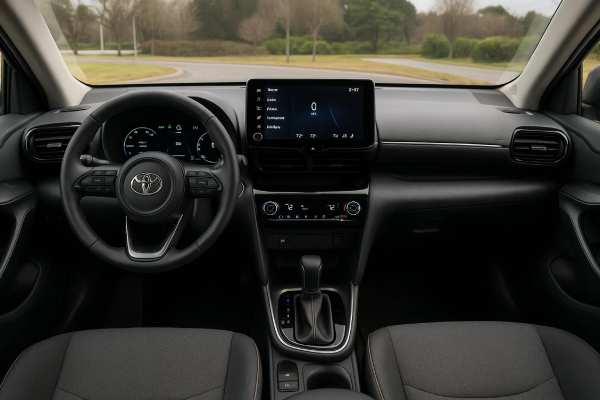
Exterior changes typically include revised lighting signatures, new alloy wheel designs, and additional paint and bi-tone colour options. These tweaks are evolutionary rather than dramatic, so you can recognise a Yaris Cross instantly but tell the facelift apart by details in the lamps and trim. Inside, the difference is much more obvious: the car now offers a 7- or 12.3-inch fully digital instrument cluster (depending on trim) and a 9- or 10.5-inch central touchscreen with faster processing and improved graphics.
The latest multimedia system brings over-the-air map updates, enhanced smartphone integration, and an improved voice assistant triggered by a “Hey Toyota” command in many markets. It responds more quickly than the earlier system and is easier to use while driving, which matters for a car that many owners will use as their main family and commuting vehicle.
Refinement was a key target for the facelift. Toyota increased sound insulation with thicker glass, revised engine mounts, and a multi-layer dash silencer. Road, wind, and engine noise are all better controlled, especially at motorway speeds. It does not turn the Yaris Cross into a luxury SUV, but the cabin is less tiring on longer journeys than in the pre-facelift car.
Underneath, the car still uses the GA-B platform shared with the Yaris hatchback, with a low centre of gravity and stiff structure. Suspension tuning continues to prioritise secure, predictable behaviour rather than sporty sharpness. For owners, that translates into an easy-driving, confidence-inspiring small SUV that feels composed on a motorway and friendly in town.
MXPJ10 hybrid facelift specs
This section focuses on the 2024–present Yaris Cross FWD Hybrid 115 (MXPJ10). Figures can vary a little by market, wheel size, and trim, so always verify against local specification sheets and your vehicle identification.
Powertrain and efficiency (Hybrid 115 FWD)
| Item | Detail |
|---|---|
| Engine code | M15A-FXE (Dynamic Force series) |
| Layout and cylinders | Inline-3, DOHC, 4 valves per cylinder |
| Displacement | 1.5 L (1490 cc) |
| Induction | Naturally aspirated, Atkinson cycle |
| Fuel system | Multi-point or combined direct/port injection, market-dependent |
| Compression ratio | High (around 14:1) for efficiency |
| Max engine power | About 67 kW (≈91 hp) @ ~5500 rpm |
| Max engine torque | Around 120 Nm @ ~3800–4800 rpm |
| Front electric motor (MG2) | Permanent-magnet motor, around 59 kW (≈79 hp), approx. 141 Nm |
| System output | 116 hp (85 kW) combined |
| Timing drive | Chain-driven camshafts |
| Emissions standard | Euro 6d-Final or equivalent in EU markets |
| Official combined fuel use | Typically around 4.5–5.0 L/100 km WLTP depending on trim and wheels |
| CO₂ (WLTP combined) | Usually around 101–115 g/km |
In real-world use, many drivers see:
- Around 3.8–4.5 L/100 km in city-heavy driving if they drive smoothly
- About 4.3–4.8 L/100 km in mixed suburban and ring-road conditions
- Roughly 5.0–5.8 L/100 km at a steady 120 km/h with normal loads
Cold climates and repeated short trips will push those numbers upward because the engine must warm up fully for emissions control and cabin heating.
Transmission and driveline
| Item | Detail |
|---|---|
| Transmission | e-CVT hybrid transaxle (planetary gearset) |
| Drive type | Front-wheel drive only (MXPJ10) |
| Final drive | Fixed ratio in the transaxle (mid-3s range, market-dependent) |
| Differential | Open front differential with brake-based traction aids |
| Drive modes | Eco, Normal, Power; separate EV mode button for low-speed electric running |
The e-CVT blends engine and electric motor torque without conventional gear steps. There are no clutch packs in regular use, which reduces wear points. Smoothness is governed mainly by software, throttle inputs, and the state of charge of the hybrid battery.
Chassis and dimensions
Typical dimension and chassis data for the FWD Yaris Cross Hybrid:
| Item | Detail |
|---|---|
| Platform | TNGA GA-B |
| Front suspension | MacPherson strut with coil springs and anti-roll bar |
| Rear suspension | Torsion-beam axle with coil springs |
| Steering | Electric power-assisted rack and pinion |
| Front brakes | Ventilated discs |
| Rear brakes | Solid discs (on most trims) |
| Length | About 4180 mm |
| Width (mirrorless) | Around 1765 mm |
| Height | Around 1590 mm |
| Wheelbase | 2560 mm |
| Ground clearance | Typically around 170–180 mm |
| Turning circle | Around 10.8–11.2 m kerb-to-kerb |
| Kerb weight | Roughly 1230–1300 kg depending on grade |
| Fuel tank | Approximately 36 L |
| Boot volume | Around 397 L seats up (VDA) with underfloor storage on many trims |
Performance and capability
| Metric | Approximate value (Hybrid 115 FWD) |
|---|---|
| 0–100 km/h | Around 11.2–11.4 s depending on trim and wheels |
| Top speed | About 170 km/h (105 mph) |
| 80–120 km/h | Roughly 9–10 s in Power mode on level road |
| Braked towing capacity | Typically 750–1000 kg depending on market |
| Unbraked towing | Around 550–600 kg where towing is permitted |
| Roof load | Usually around 50–75 kg including bars, per local spec |
These figures place the Hybrid 115 squarely in the “sufficient but not sporty” bracket. It is fine for European-speed motorways and mountain routes as long as you use the hybrid’s torque intelligently and plan overtakes.
Fluids and service capacities (guideline level)
Exact values and specifications vary by market; consult your service documentation for VIN-accurate data.
Typical fluids:
- Engine oil: 0W-16 or 0W-20 synthetic meeting the latest API and ILSAC standards; capacity roughly 3.5–4.0 L with filter
- Engine coolant: Toyota Super Long Life Coolant (pink); capacity roughly 5–6 L in the engine loop
- Hybrid transaxle fluid: Toyota ATF WS or equivalent; drained volume often in the 3–4 L range
- Brake fluid: DOT 3 or DOT 4, changed on a time basis (about every 2–3 years)
- A/C refrigerant: R-1234yf in most recent EU cars; charge typically in the mid-300 g range
Key torque ranges (always confirm exact values):
- Wheel nuts: generally around 100–110 Nm
- Engine oil drain plug: often around 30–40 Nm
- Spark plugs: low torque values typical of aluminium heads and fine-thread plugs
Electrical
- 12 V battery: compact unit (often 35–45 Ah) located at the rear or under the boot floor, feeding conventional systems
- High-voltage battery: NiMH pack placed under the rear seats, air-cooled via cabin ducting
- There is no alternator; a DC-DC converter steps down HV voltage to charge the 12 V system
Safety and driver assistance snapshot
The original Yaris Cross achieved five stars under earlier Euro NCAP protocols and later four stars under stricter 2026 protocols while maintaining strong percentages for adult, child, and vulnerable road users. The facelift continues with this robust base and adds an expanded Toyota T-Mate safety package.
Typical features include:
- Pre-Collision System with pedestrian, cyclist, and often motorcycle detection
- Improved junction support, including cross-traffic and turn-across-path scenarios
- Lane Departure Alert with steering assist and Lane Trace Assist
- Adaptive Cruise Control with smoother acceleration and braking logic
- Road Sign Assist and Intelligent Speed Limiter integration
- Proactive Driving Assist and low-speed acceleration suppression on some trims
Higher grades can add Safe Exit Assist, Rear Cross Traffic Brake, and more sophisticated parking assist functions.
Facelift trims equipment and safety
Trim names and exact feature bundles vary by country, but the facelift Yaris Cross FWD Hybrid 115 typically follows a ladder of basic, mid-range, sporty or style-focused, and high luxury or “Premiere” trims. The Hybrid 115 is usually available on a broad set of trims, while the Hybrid 130 is concentrated at the top end.
Trims and key options (FWD Hybrid 115 focus)
Entry-level trims generally include:
- 16-inch steel or simple alloy wheels with higher-profile tyres
- Fabric seats, manual or single-zone automatic climate control
- Smaller digital instrument display (e.g., 7-inch)
- 9-inch central touchscreen with smartphone integration
- Reversing camera and core Toyota Safety Sense functions
Mid-range trims tend to add:
- 17-inch alloys, privacy glass, roof rails in some markets
- Dual-zone climate control and more extensive soft-touch interior surfaces
- Better seat fabrics or part-synthetic upholstery
- Extra USB ports, sometimes wireless phone charging
- Front and rear parking sensors and more complete Toyota T-Mate functions
High and special trims (often including GR-themed or Premiere editions):
- 18-inch wheels with distinct designs
- Bi-tone paint schemes with contrasting roof colours
- 12.3-inch digital instrument cluster and 10.5-inch central display
- Upgraded upholstery (e.g., partial leather or synthetic leather with stitching)
- Ambient lighting, more advanced keyless and connected services
- The more powerful Hybrid 130 powertrain (though this article focuses on Hybrid 115)
Mechanically, all FWD Hybrid 115 trims share the same basic engine and hybrid transaxle. Differences come from wheel and tyre sizes, minor suspension tuning tweaks on sport-oriented editions, and weight and equipment changes.
Safety ratings
The Yaris Cross platform continues to perform well in independent crash tests. The earlier five-star result under 2020 protocols and a later four-star rating under tougher protocols both show strong structure and restraint systems, with high scores for child occupants and active safety assistance.
Key structural and passive-safety features typically include:
- Multi-load-path front structure and strong safety cell
- Front, side, curtain, and often central airbags (between front seats)
- ISOFIX/LATCH mountings on outer rear seats with top tether points
- Seatbelt pre-tensioners and load limiters on front seats and, in some markets, outer rear seats
Child seats and family use
For families, the Yaris Cross offers:
- A relatively upright rear bench that makes child-seat installation easier than in a low hatchback
- Door openings that are tall enough for carrying infants in and out without excessive stooping
- ISOFIX points that are straightforward to access, though larger rear-facing shells may still require the front seats to be moved forward slightly
Safety systems and ADAS calibration
The facelift’s more capable ADAS suite depends on accurate camera and radar alignment:
- Windscreen replacement, front bumper repair, or significant suspension changes should be followed by proper camera/radar calibration
- Parking sensors and blind-spot radars require correct bumper positioning and appropriate repainting practices (overly thick paint can affect sensor performance)
- Software updates can refine behaviour; owners should allow dealers to apply recommended updates during regular services
When buying used, it is wise to ask about any body repairs and whether ADAS calibration documentation is available.
Long-term reliability and service items
Because the facelift Yaris Cross is based on a powertrain and platform already used in earlier Yaris and Yaris Cross models, there is a strong base of reliability experience. While the facelift itself is relatively new, the underlying hybrid hardware is well-proven.
Hybrid system and engine
Expected behaviours that are normal rather than faults:
- Engine starting and stopping frequently in town driving, especially as the car warms up
- Engine revs temporarily rising higher than you might expect for the speed when you press the accelerator firmly (e-CVT behaviour)
- Cooling fans and pumps running after the car is turned off as the system manages temperatures
Potential longer-term issues if maintenance is neglected:
- Cooling system ageing: Delayed coolant changes, use of incorrect fluid, or low coolant levels can lead to deposits, restricted flow, and eventual water pump or heater core issues.
- Oil quality problems: Extending oil intervals significantly beyond one year or 15,000 km, or using incorrect viscosity, can accelerate timing-chain wear, sludge formation, and oil consumption.
- Blocked PCV and intake deposits: Mainly an issue if poor-quality fuel and oil are used and trips are very short, allowing condensation and oil vapour to build up.
With correct servicing, serious engine or hybrid-component failures are rare. Toyota often backs hybrid components with extended warranties in many regions when regular hybrid health checks are performed.
High-voltage battery and electrics
The NiMH high-voltage battery is designed to live within a moderate state-of-charge window, avoiding full charge and deep discharge. This reduces stress and helps the pack outlast many of the car’s other components. Practical considerations:
- Cars driven regularly, with a mix of urban and highway use, tend to have the healthiest HV batteries
- Cars parked for months with a low 12 V battery can accumulate fault codes; avoid long periods of inactivity without occasional long drives or a stabilising charger on the 12 V system
- Keeping interior filters and ducts clear ensures good battery cooling airflow
The smaller 12 V battery is more likely to cause day-to-day issues than the HV battery, especially in vehicles with frequent short trips, strong use of accessories, or long standing periods. Regular testing and pre-emptive replacement around year six to eight is sensible.
Driveline and chassis
The hybrid transaxle is mechanically simpler than a traditional automatic. The most important factors for longevity are:
- Fresh, correct-spec ATF in the unit (even where not strictly mandated, midlife fluid changes are inexpensive insurance)
- Correct tyre sizes and matching rolling radius per axle
- Avoiding frequent overloading or towing beyond rated limits
Suspension and chassis wear points are similar to other small SUVs:
- Front wishbone bushes and anti-roll bar links can develop play and cause knocking noises over bumps
- The torsion beam at the rear is robust but bushings can age, especially on rough roads
- Wheel bearings can wear prematurely if wheels are frequently kerbed or if very low-profile tyres are used on poor roads
Corrosion areas
The Yaris Cross uses modern corrosion protection, but in heavy-salt regions owners should periodically inspect:
- Rear subframe and its mounting points
- Inner sills and jacking points
- Fuel tank straps, brake lines, and exhaust brackets
Underbody washes after winter and occasional cavity protection treatments in harsh climates will help long-term durability.
Recalls, TSBs, and software updates
As with most modern cars, there may be:
- Safety recalls for specific components or systems
- Service campaigns or technical service bulletins for software improvements or part updates
- Multimedia, navigation, and ADAS software updates applied during servicing or over-the-air
Prospective buyers should check recall status via official Toyota channels for their region, and ask sellers for evidence of completed campaigns and hybrid health checks. Keeping software and campaigns up to date not only improves safety but can also refine driveability and infotainment stability.
Ownership costs and buyer guide
Practical maintenance schedule
While exact schedules vary by country, a realistic baseline for Yaris Cross FWD Hybrid 115 is:
Every 15,000 km or 12 months (whichever comes first)
- Engine oil and filter replacement
- General visual inspection: brakes, steering, suspension, exhaust, underbody
- Tyre rotation and pressure check
- Check of coolant level, auxiliary drive belt, and visible hybrid components
- Hybrid system health check if the dealer offers it as part of routine service
Every 30,000 km or 24 months
- Cabin pollen filter replacement
- Brake fluid change (in many markets, every two years)
- More detailed inspection of brake hoses, fuel lines, and underbody coating
Every 45,000–60,000 km
- Engine air filter replacement
- Wheel alignment check if tyre wear patterns suggest it
- Closer inspection of suspension joints and anti-roll bar links
Around 90,000–120,000 km (or according to local schedule)
- Engine coolant replacement according to Toyota Super Long Life recommendations
- Hybrid transaxle fluid drain and refill, especially for vehicles with heavy city use or frequent towing
- Detailed hybrid battery cooling-duct inspection and cleaning
- Comprehensive brake service, including cleaning or replacing discs and pads as needed
Time-based items
- Wiper blades typically every 1–2 years
- 12 V battery testing annually after year four or five; replacement when capacity is noticeably reduced
- Spark plugs (long-life Iridium) usually between 150,000 and 180,000 km, or per local manuals
Fluids and torque values for decision-making
From an ownership-planning standpoint:
- Always use the specified low-viscosity engine oil; thicker oil can harm efficiency and timing-chain life
- Stick to known-quality filters and fluids; marginal savings on parts can be outweighed by long-term wear
- If doing any DIY work (like wheel changes), use a torque wrench and follow the wheel-nut torque values in the owner’s manual to avoid warped discs or stressed studs
Buyer’s guide checklist
When inspecting a facelift Yaris Cross FWD Hybrid 115:
- Exterior and structure
- Look for consistent panel gaps, no paint overspray, and no poorly repaired plastic bumpers
- Check alloys for excessive kerb damage, which may hint at rough city use or alignment problems
- Interior and electronics
- Test both the digital instrument cluster and the main screen for dead pixels, glitches, or unresponsive touch areas
- Check that all cameras (rear, and 360° if fitted) display clear images
- Pair a phone and ensure Bluetooth, Android Auto/Apple CarPlay, and, where available, connected services work as expected
- Safety and driver assistance
- On a safe test route, verify that Adaptive Cruise Control, Lane Trace Assist, and Road Sign Assist function normally
- Confirm no persistent warning lights for pre-collision, lane-keeping, or hybrid system errors
- Driving feel and noises
- Listen for knocks over sharp bumps (suggesting suspension bush wear)
- Pay attention to any whining or rumbling that changes with speed (possible wheel bearings or tyre cupping)
- Check that the transition between EV and engine operation is smooth and that there are no harsh vibrations at idle once warm
- History and documentation
- Prefer cars with stamped or digital service history matching manufacturer intervals
- Ask for hybrid battery health reports if available
- Check for recall clearance using official channels and keep printouts or screenshots for your records
Durability outlook
With correct maintenance, the facelift Yaris Cross FWD Hybrid 115 should provide:
- Long hybrid powertrain life with minimal major repairs
- Predictable wear on consumables such as brakes, suspension bushes, and dampers
- Low fuel and tax costs relative to many similarly sized crossover rivals
As the model matures, more long-term data will emerge, but the combination of existing Yaris/Yaris Cross experience and robust Toyota dealer support gives a strong basis for confidence.
On-road feel and efficiency
Ride, handling, and comfort
The Yaris Cross FWD Hybrid sits at the comfortable end of the small-SUV spectrum rather than the sporty edge. On 16- or 17-inch wheels with sensible tyre sidewalls, it deals calmly with speed bumps, potholes, and patched tarmac. Larger 18-inch wheels sharpen response but bring extra firmness over rough surfaces.
At motorway speeds, the car feels secure and tracks straight without constant steering corrections. The facelift’s enhanced sound insulation reduces the booming and wind rush that could make earlier B-segment SUVs tiring on long trips. You still hear some tyre noise on coarse asphalt, but the overall impression is of a small car that punches above its size in long-distance comfort.
Steering and braking
Steering assistance is light at parking speeds, making tight manoeuvres and parallel parking effortless. As speed rises, the steering weights up enough to feel stable, though it remains tuned for ease rather than rich feedback. The front end responds predictably, and the car resists sudden lane-change drama as long as you are not asking too much from the tyres.
Braking blends regeneration through the electric motor with traditional friction brakes. The pedal feel is slightly different from a non-hybrid at the very top of its travel, but once you are used to it, the system is consistent and confidence-inspiring. The car is happy to shed speed repeatedly on downhill sections without fade, especially if you use “B” mode to increase engine braking and reduce heat load on the discs.
Powertrain character
Around town, the hybrid powertrain shines. The car pulls away smoothly in EV mode when conditions allow and can stay electric over short distances at low speeds. The 1.5-litre engine starts and stops frequently but does so with modest vibration once warm. Throttle response is crisp at low and moderate demands thanks to electric torque.
On faster roads, pressing the accelerator harder raises engine revs quickly, giving the familiar e-CVT “flare” under heavy load. The facelift’s extra sound insulation and revised tuning make this less intrusive than older Toyota hybrids, but it is still noticeable. Using Normal or Eco mode and anticipating gradients allows you to keep revs lower, only dipping into Power mode for short overtakes or steep ramps.
Real-world economy and range
In mixed daily use, many owners can expect:
- Low 4s L/100 km if their driving is mostly in urban and suburban environments with gentle inputs
- Mid 4s to high 4s L/100 km with a mix of town and dual-carriageway driving
- Around 5–5.8 L/100 km on motorways at 120 km/h, depending on load and weather
With a fuel tank around 36 litres, a realistic range between fills will usually be 650–800 km. In very cold conditions with mainly short urban journeys, expect that range to fall because the engine must run more often for cabin heating and emissions control.
Traction and towing behaviour
As a front-wheel-drive crossover, this MXPJ10 variant is not intended for heavy off-roading, but:
- Traction control and finely metered electric torque help the car pull away cleanly on wet or slightly slippery surfaces when fitted with suitable tyres
- The raised ride height and short overhangs give a little extra confidence on gravel tracks and unpaved access roads
Towing within the rated limit is manageable, but the combination of modest power and hybrid gearing means the engine will work hard on long climbs. Fuel consumption will rise significantly and you should use lower gearing (B mode) on long descents to keep brake temperatures under control.
Overall, the facelifted Yaris Cross FWD Hybrid 115 is a car you drive smoothly rather than aggressively. Treated that way, it rewards you with a calm, efficient, and largely fuss-free experience.
Facelift FWD Yaris Cross rivals
The Yaris Cross FWD Hybrid 115 competes with a wide range of small SUVs and crossovers, many of which rely on turbocharged petrol engines with mild-hybrid systems rather than full hybrids.
Main rivals include
- Renault Captur E-Tech and related small crossovers
- Hyundai Kona and Kia Stonic or similar B-segment SUVs with hybrid or small turbo engines
- Volkswagen T-Cross, Taigo, and related MQB-A0-based crossovers
- Honda HR-V e:HEV and other full-hybrid compact SUVs
Where the Yaris Cross stands out
- Hybrid depth and efficiency
The Yaris Cross runs as a genuine full hybrid with frequent engine-off driving in town. It often beats mild-hybrid rivals in real-world fuel use, especially in heavy traffic, without needing to be plugged in. - Safety and driver assistance coverage
Toyota’s T-Mate and Safety Sense packages give the car a broad set of ADAS features. In many markets, a high level of active safety is standard, rather than hidden in option packs. - Compact size, SUV stance
The Yaris Cross is genuinely easy to park but still delivers a higher seating position, good visibility, and a practical boot floor. Owners moving from a small hatchback usually adapt quickly. - Brand reputation and dealer network
Toyota’s hybrid track record and service network can be a deciding factor for buyers planning to keep the car for a long time or cover substantial mileage.
Where rivals may be stronger
- Performance and refinement at high speed
Some turbocharged or plug-in rivals offer stronger mid-range acceleration and lower engine revs at high speed, which can feel more relaxed in countries with very fast motorways. - Cabin width and rear space
A few competitors built on slightly larger platforms provide more elbow room and legroom, especially across the rear bench. - Infotainment flair
Some brands lean more into large, high-contrast screens and novel interfaces. Toyota’s layout is improving but still leans toward functional rather than flashy.
Ideal buyer profile
The facelifted Yaris Cross FWD Hybrid 115 is particularly well suited to:
- Drivers who do most of their mileage in cities and suburbs but still want comfort and stability for longer trips
- Owners who value predictable low running costs, strong reliability, and comprehensive safety equipment more than outright power or premium-brand image
- Households where plug-in charging is impractical, but a lower CO₂ footprint and strong fuel economy are important
For this audience, the 2024–present Toyota Yaris Cross FWD Hybrid 115 (MXPJ10) offers a balanced package: a compact SUV with mature refinement, a proven hybrid system, and a well-judged mix of practicality and technology.
References
- New Yaris Cross: More Power and Technology with Added Style for Toyota’s Segment Leading Compact SUV 2023 (Press Release)
- Toyota Yaris Cross | Specifications 2024 (Specifications)
- Toyota Yaris Cross 2021 2021 (Safety Rating)
- Toyota Yaris Cross 2025 (Safety Rating)
- Toyota Service Packs 2024 (Service Interval Guidance)
Disclaimer
This article is for informational purposes only and is not a substitute for professional diagnosis, repair, or official technical documentation. Specifications, torque values, maintenance intervals, and procedures can vary by VIN, model year, market, trim level, and equipment. Always confirm critical data against your vehicle’s official owner’s manual, service manual, and local Toyota documentation, and follow the guidance of qualified technicians when performing inspections or repairs.
If you found this guide helpful, you are welcome to share it on platforms such as Facebook or X/Twitter to help other owners and support independent, technically focused content.