
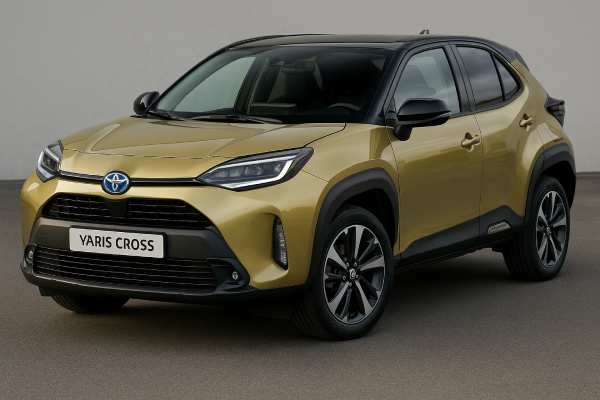


The facelifted Toyota Yaris Cross AWD-i with the Hybrid 130 powertrain is aimed at drivers who want small-car running costs with the traction and confidence of all-wheel drive. Built on Toyota’s TNGA-B platform, it blends a compact footprint with a raised driving position, improved refinement, and significantly upgraded digital tech compared with the pre-facelift model.
The latest Hybrid 130 setup increases system output to around 130 hp and improves torque delivery, giving the AWD-i version a more relaxed feel in everyday driving while still focusing on efficiency. Updated safety systems, a new digital instrument cluster, and larger central displays help the Yaris Cross feel more like a “scaled-down RAV4” than a traditional supermini-based crossover.
This guide walks through the AWD-i 130 facelift in detail: how the hybrid system works, real-world economy and performance, reliability expectations, maintenance planning, and how it stacks up against rival compact hybrids and crossovers.
Owner Snapshot
- Strong all-weather traction from the AWD-i system with a compact footprint that still fits easily in tight city spaces.
- Hybrid 130 powertrain delivers more responsive acceleration than the earlier 116 hp version while keeping real-world fuel use low.
- Cabin tech upgrade (larger touchscreen, digital cluster, improved cameras) brings the 2024–present Yaris Cross closer to larger Toyota SUVs.
- Watch for correct tyre choice and regular wheel alignment checks; bad alignment or budget tyres noticeably hurt refinement and economy.
- Plan for annual servicing or roughly every 15,000 km (10,000 miles), whichever comes first, to keep the hybrid system and brakes in good health.
What’s inside
- Yaris Cross AWD-i 130 essentials
- AWD-i 130 specs and dimensions
- Equipment levels and safety systems
- Reliability, weak points and fixes
- Maintenance planning and buyer tips
- Driving feel and real-world economy
- Competition and market positioning
Yaris Cross AWD-i 130 essentials
The facelifted Toyota Yaris Cross AWD-i with the Hybrid 130 system sits at the top of the Yaris Cross range in terms of power and traction. It keeps the same basic recipe as the original model: a 1.5 litre three-cylinder Atkinson-cycle petrol engine paired with Toyota’s fourth-generation hybrid components and an e-CVT, plus a small electric motor on the rear axle to provide on-demand all-wheel drive.
Compared with the earlier 116 hp hybrid, the Hybrid 130 variant uses revised engine and motor tuning to raise combined output to around 130 hp. The key real-world benefit is stronger mid-range pull and slightly quicker 0–100 km/h acceleration, especially noticeable on motorway slip roads or when climbing grades with passengers. Importantly, the changes are made with efficiency in mind, so WLTP fuel consumption remains in the high-4 to low-5 L/100 km range depending on wheel size and specification.
Externally, the facelift focuses on sharper lighting signatures, detail changes to bumpers and grille, and new wheel designs. It is still a compact B-segment crossover, roughly 4.2 m long, but the ride height and squared-off body shape give it a more “mini SUV” stance than many rivals. For owners in mixed climates, the AWD-i system is a major attraction: it is light and mostly decoupled in normal driving, yet can send torque to the rear axle quickly on slippery or loose surfaces.
Inside, the big changes for 2024–present cars are the new digital instrument cluster (on most mid/high trims) and larger central touchscreen, alongside updated Toyota Smart Connect software. Graphics, menu speeds, and voice control are noticeably better than early Yaris Cross models, and over-the-air update capability helps the car stay current.
Practicality remains a strong point for the size. The AWD-i hardware slightly reduces underfloor space versus FWD models, but you still get a usable, square boot, a split-fold rear bench, and a cabin big enough for four adults on shorter trips. Combined with a reputation for reliability and strong residual values, the AWD-i 130 facelift targets buyers who want a small yet capable all-rounder that should be inexpensive to run over a long ownership period.
AWD-i 130 specs and dimensions
Powertrain and efficiency
| Item | Specification (typical EU AWD-i 130) |
|---|---|
| Engine code | M15A-FXE |
| Engine layout | Inline-3, DOHC, 4 valves/cyl |
| Bore × stroke | ~80.5 × 97.6 mm |
| Displacement | 1.5 L (1490 cc) |
| Induction | Naturally aspirated (Atkinson cycle) |
| Fuel system | Port and direct injection (multi-point with high tumble design) |
| Compression ratio | ~14.0 : 1 |
| Max engine power | ~91 hp (67 kW) @ 5,500 rpm |
| Max engine torque | ~141 Nm @ 3,600–4,800 rpm |
| Front electric motor | Permanent magnet synchronous motor |
| Front motor output | ~79 hp (59 kW), 141 Nm |
| Rear electric motor (AWD-i) | Induction motor, ~3.9 kW, 52 Nm |
| System output (Hybrid 130) | ~130 hp (96 kW) |
| High-voltage battery | Lithium-ion, ~177.6 V, 48 cells |
| Emissions standard | Euro 6d or later (market-dependent) |
| WLTP combined consumption | Approx. 4.7–5.2 L/100 km (50–60 mpg UK, 42–47 mpg US) depending on wheels/trim |
| WLTP CO₂ | Typically around 106–120 g/km |
| Real-world highway (120 km/h) | Roughly 5.5–6.2 L/100 km (38–43 mpg US) when driven sensibly |
Figures vary slightly by market and wheel size, but this gives a realistic picture for most AWD-i 130 facelift cars.
Transmission and driveline
| Item | Specification |
|---|---|
| Transmission type | e-CVT (electronically controlled CVT) |
| Final drive (front) | Approx. 3.22 : 1 |
| Rear drive ratio (AWD) | Approx. 10.49 : 1 |
| Drive type | Electric on-demand AWD-i (front-biased, rear axle engages when needed) |
| Differential | Open front and rear, electronic brake-based torque control |
The AWD-i system is designed more for traction and stability than for hardcore off-roading. It can send torque rearward from rest and at low to moderate speeds, and it works seamlessly with stability and traction control.
Chassis and dimensions
| Item | Specification (approx.) |
|---|---|
| Platform | TNGA-B |
| Front suspension | MacPherson struts with coil springs |
| Rear suspension (AWD-i) | Double wishbone with coil springs |
| Steering | Electric power steering, rack-and-pinion |
| Front brakes | Ventilated discs (≈ 278 mm) |
| Rear brakes | Solid discs |
| Wheels/tyres (typical) | 215/55 R18 or 215/60 R17 (market-dependent) |
| Length | ≈ 4,180–4,185 mm |
| Width | ≈ 1,765 mm |
| Height | ≈ 1,590 mm |
| Wheelbase | 2,560 mm |
| Ground clearance | Around 160–170 mm |
| Turning circle (kerb-to-kerb) | ≈ 10.8–11.2 m |
| Kerb weight (AWD-i 130) | Roughly 1,320–1,370 kg depending on trim |
| Fuel tank | ≈ 36–42 L (market and homologation vary) |
| Cargo volume (seats up, VDA) | Around 380–390 L for AWD-i |
| Cargo volume (seats folded) | Around 1,050–1,100 L |
Performance and capability
| Item | Figure (typical AWD-i Hybrid 130) |
|---|---|
| 0–100 km/h (0–62 mph) | Roughly 11–11.5 seconds |
| Top speed | Around 170 km/h (106 mph) |
| Braking 100–0 km/h | ~36–38 m on quality all-season tyres |
| Braked towing capacity | Typically up to 1,250–1,300 kg (check local homologation) |
| Unbraked towing capacity | Usually 500–750 kg |
| Maximum roof load | Around 75 kg |
Fluids and service capacities (typical values)
These are indicative; always confirm for your exact VIN and market:
| System | Specification (typical) | Capacity (approx.) |
|---|---|---|
| Engine oil | 0W-8 or 0W-16, meeting Toyota and API SP/ILSAC GF-6B specs | ~3.5–3.8 L with filter |
| Engine coolant | Toyota Super Long Life Coolant (pink), 50:50 mix | ~4–5 L |
| e-CVT / transaxle | Toyota CVT FE or equivalent Toyota hybrid transaxle fluid | ~3–4 L |
| Rear differential oil | 75W-90 GL-5 gear oil (where specified) | ~0.6–0.8 L |
| A/C refrigerant | R1234yf (most EU models) | ~350–450 g |
| A/C compressor oil | ND-OIL 12 (hybrid-compatible, quantity per spec) | Typically 70–90 ml |
Electrical
| Item | Specification |
|---|---|
| High-voltage battery | Li-ion, ≈ 177.6 V, 48 cells |
| DC-DC converter | Integrated into inverter assembly |
| 12 V battery | 12 V AGM or EFB, ≈ 35–45 Ah, compact form factor |
| Spark plugs | Long-life iridium, factory gapped; replacement typically at 150,000 km in many markets |
Safety and driver assistance (hardware)
Safety and ADAS content varies by market and trim, but the facelifted Yaris Cross AWD-i typically offers:
- Multiple airbags (front, side, curtain, driver’s knee; some markets add centre airbag between front seats).
- ISOFIX / i-Size mounting points on the outer rear seats.
- Toyota Safety Sense suite with:
- Pre-Collision System with pedestrian and cyclist detection.
- Adaptive Cruise Control (often full-speed on higher trims).
- Lane Departure Alert and Lane Tracing Assist.
- Road Sign Assist.
- Emergency Steering Assist (market-dependent).
- Blind Spot Monitor and Rear Cross Traffic Alert on selected grades.
- Optional or standard parking aids: front/rear sensors, reversing camera, and in higher trims a panoramic or 360° camera system.
Equipment levels and safety systems
Trim names and exact bundles vary strongly between countries (for example, Icon/Design/Excel/Premiere Edition in the UK, or similar grade structures elsewhere), but the pattern for AWD-i Hybrid 130 facelift models is broadly similar.
Entry/mid trims with AWD-i 130
These usually include the key mechanical package (Hybrid 130 with AWD-i) plus:
- Fabric seats, manual seat adjustment.
- Smaller alloy wheels (often 17-inch) that slightly favour comfort and efficiency.
- Standard digital instrument cluster in many markets, or a mixed analogue-digital layout in others.
- Central touchscreen in the 9–10.5-inch range, with wireless Apple CarPlay and Android Auto on most new cars.
- Basic reversing camera plus rear parking sensors.
- Full Toyota Safety Sense with adaptive cruise, lane-keeping and pre-collision braking.
For buyers who mainly care about drivetrain, safety and running costs, these mid-level trims are usually the value sweet spot.
High trims and “launch” or “premiere” editions
Upper grades add comfort, visual and tech features, for example:
- 18-inch alloys with more premium tyre packages.
- Bi-LED or matrix LED headlights with enhanced beam control.
- Heated front seats and steering wheel, often part-synthetic or leather upholstery.
- Dual-zone climate control, ambient lighting, rear privacy glass.
- Larger central display and fully digital 12.3-inch instrument cluster in some markets.
- More advanced camera systems and parking assist features.
- Upgraded audio (branded systems in some regions).
On these high trims the AWD-i system is often standard rather than optional, helping to position the Yaris Cross AWD-i 130 as a “junior RAV4” in terms of feeling.
Safety ratings
The original Yaris Cross achieved a strong Euro NCAP result under the 2021 protocols, with five stars overall and solid adult, child and safety-assist scores. Under later, tougher protocols applied from 2025 onwards to the updated model, its rating has dropped numerically, but this reflects stricter scoring rather than a major step backwards in safety hardware.
The important takeaways for owners:
- Structural integrity is good for a small crossover.
- Child occupant protection and ISOFIX usability are strong.
- Toyota’s active safety and ADAS package is broad for this segment, with continuing software improvements.
Always check which safety systems are standard on the trim and market you are considering. Some items such as Blind Spot Monitor, Rear Cross Traffic Alert, or more capable LED headlights may only appear on higher grades or in option packs.
Child-seat and practical safety
The wide rear door opening and fairly upright rear bench help when loading child seats, even if absolute rear legroom is modest. Two ISOFIX points on the outer rear seats are the norm; a third (for the front passenger seat) may be available depending on local regulations. Soft ride tuning in most trims and a relatively high driving position contribute to a feeling of security in urban driving.
Reliability, weak points and fixes
Because the 130 hp AWD-i facelift is still relatively new, most reliability insight comes from the closely related 116 hp Yaris Cross and the broader family of Toyota hybrids using the M15A-FXE engine and similar hybrid components.
Powertrain and hybrid system
Toyota’s small-capacity hybrid drivetrains have a strong track record for durability when serviced on time. The M15A-FXE engine uses a timing chain (not a belt), and there are no known widespread issues with timing chain stretch when oil changes are kept on schedule with the correct grade.
Potential issues and checks:
- Rough starting or misfire under light load (rare): Often linked to ageing spark plugs, coil packs or poor fuel quality. Remedy is straightforward ignition component replacement and software checks for stored fault codes.
- Hybrid warning lights or reduced power: Usually relate to sensor faults, HV battery cooling airflow problems (blocked vents), or inverter / DC-DC converter issues. In most cases, a dealer software update or targeted component replacement resolves it. Keeping the cabin and luggage-area vents clear is important.
- e-CVT or driveline noise: A light whine is normal in Toyota hybrids. New or sudden growling noises, especially on overrun, should be investigated to rule out bearing issues or tyre noise.
The AWD-i system has a small, separate electric motor and reduction gear at the rear. It is mechanically simple and tends to be dependable, but:
- Listen for clicking or grinding from the rear during tight, low-speed manoeuvres, which could suggest issues with the rear drive coupling or bearings.
- Confirm that the correct fluid type and capacity have been used after any work on the rear drive unit.
Chassis and body
Common wear points on early Yaris Cross models that are also relevant to the facelift:
- Front suspension top mounts and drop links: Can develop clunks over sharp bumps after high mileage or rough roads. Replacement parts are straightforward and not unusually expensive.
- Rear suspension bushes: May show play with age in harsh climates; caught during periodic inspections.
- Wheel alignment: The car is sensitive to toe settings; poor alignment quickly leads to uneven tyre wear and extra rolling noise. Insist on a proper four-wheel alignment if you notice wandering or a steering wheel that is off-centre.
Corrosion protection is generally good, but for cars used in heavy winter salting, check:
- Inner wheel arches and seam areas behind plastic liners.
- Rear suspension arms and subframe.
- Exhaust mounting points and brackets.
Electronics and infotainment
The new digital cockpit and larger touchscreen introduce more software complexity but also bring over-the-air update capability in many markets. Early reports from facelift cars suggest:
- Occasional Bluetooth or smartphone integration glitches, generally addressable via software updates or resetting the multimedia system.
- Camera calibration issues after windscreen or bumper replacement; advanced driver-assistance sensors must be properly calibrated using the correct Toyota procedures.
Recalls and service campaigns
As with any modern vehicle, minor recalls or service campaigns can arise over time (for example, software updates for the pre-collision system, or component checks in the fuel or brake systems). Before purchase, ask the dealer to:
- Check the VIN against the official national recall database.
- Confirm that all open campaigns and service actions have been completed, with documentation in the service history.
For a used facelift AWD-i 130, a complete service record from an authorised dealer or reputable independent specialist is a strong positive sign.
Maintenance planning and buyer tips
The Yaris Cross AWD-i 130 is designed for low running costs, but it still benefits from a clear maintenance plan and careful pre-purchase checks.
Practical maintenance schedule (typical EU pattern)
Always adapt to your local schedule, but a sensible baseline for this hybrid is:
- Engine oil and filter: Every 15,000 km or 12 months (whichever comes first), using the correct 0W-8 or 0W-16 oil.
- Engine air filter: Inspect every service; replace around 30,000–45,000 km or earlier in dusty conditions.
- Cabin (pollen) filter: Replace every 15,000–30,000 km or annually if you drive in urban pollution.
- Spark plugs (iridium): Around 150,000 km or 10 years, sooner if misfires or poor fuel quality occur.
- Coolant: Toyota long-life coolant can often go 10 years/160,000 km before first change, then at shorter intervals; check official guidance for your market.
- Hybrid transaxle (e-CVT) fluid: Many official schedules consider it “lifetime”, but a preventive change around 100,000–120,000 km is popular among long-term owners.
- Rear drive unit / differential oil: Change around 90,000–120,000 km if specified in local maintenance plans.
- Brake fluid: Every 2–3 years regardless of mileage; moisture and corrosion protection are critical in hybrids because regen braking means mechanical brakes may sit unused.
- Brake pads and discs: Inspect annually. Hybrids often go many tens of thousands of kilometres on a set of pads, but city driving and corrosion can still wear components.
- Tyre rotation and alignment: Rotate every 10,000–15,000 km; do a full four-wheel alignment if you notice uneven wear or steering pull.
- 12 V battery: Hybrid 12 V batteries tend to last 5–8 years. Test regularly from year 4 onwards.
- HV battery and cooling system: Periodic checks of the battery cooling intake, fans and ducting, especially in cars carrying pets or lots of luggage.
For AWD-i models, it is also worth asking the workshop to visually check the rear motor assembly and wiring during scheduled services.
Fluid specs and torque values (decision-level guidance)
When comparing workshops or planning DIY jobs, ensure they can meet:
- Correct low-viscosity engine oil with the right approval.
- Hybrid-safe A/C service using the correct refrigerant and compressor oil (non-conductive, hybrid-compatible).
- Proper torque for wheels and key fasteners: wheel nuts/bolts typically around 100–110 Nm; spark plugs around 18–25 Nm; always confirm for your VIN.
Buyer’s checklist for a Yaris Cross AWD-i 130**
If you are considering a new or nearly new example:
- Service history: For demonstrator or early-registration cars, ensure running-in and first service were done on time.
- Tyres: Check that all four tyres are the same reputable brand and size, with good tread and no uneven wear. Cheap mismatched tyres can undermine both refinement and safety systems.
- Panel and glass: Inspect for any signs of crash repair, especially around the rear quarters where the AWD hardware sits; confirm that ADAS cameras in the windscreen are clear and that any replaced windscreen has been properly calibrated.
- AWD operation: On a test drive in a safe area, accelerate briskly from rest on damp or loose surfaces and feel for smooth, drama-free take-off; no loud clunks from the rear.
- Electronics: Test the touchscreen, smartphone connectivity, cameras, parking sensors and all safety warning lights. They should illuminate at key-on and go out after start.
Which trims to seek?
For most owners, a mid-grade car with AWD-i 130, LED headlights and a decent infotainment setup is ideal. Top trims add luxury touches but can be significantly more expensive when new or used. Avoid cars with incomplete software update histories or evidence of poor body repairs.
Long-term, a well-maintained Yaris Cross AWD-i 130 should be capable of high mileages with relatively modest running costs, especially if driven smoothly and serviced on time.
Driving feel and real-world economy
On the road, the facelifted Yaris Cross AWD-i 130 feels familiar if you know Toyota hybrids, but clearly stronger than the earlier 116 hp version.
Powertrain character
In normal driving, the car usually starts and creeps in electric mode, especially in low-speed urban conditions. The Atkinson-cycle three-cylinder engine cuts in smoothly once a little more power is requested. With the Hybrid 130 tune, you get:
- Noticeably better mid-range response; the car feels less strained when joining motorways or overtaking at 80–120 km/h.
- Slightly shorter 0–100 km/h times, but the real benefit is reduced need to “floor it”.
- Familiar e-CVT behaviour: engine revs rise under heavy throttle, but software tuning and extra power help reduce the sense of “flare”.
In Eco or Normal modes, the car prioritises efficiency and smoothness. Sport mode mainly adjusts throttle mapping and, in some markets, steering weight rather than transforming the fundamental character.
Ride, handling and NVH
The TNGA-B platform delivers decent torsional stiffness, which helps both ride and handling:
- Ride quality: Generally comfortable at urban speeds, especially on 17-inch wheels. 18-inch wheels look good but can introduce a firmer edge over potholes.
- Handling: Mildly eager turn-in with safe understeer at the limit. The AWD-i system helps stabilise the car when accelerating out of tight or slippery corners, but this is not a performance AWD system.
- Noise: Engine noise is well-managed at gentle throttle; it becomes more noticeable when you ask for full power. Tyre and wind noise are typical for the class; premium tyres and correct pressures make a real difference.
AWD-i behaviour and traction
The rear electric motor is there to help with traction, not to provide constant four-wheel drive. It will:
- Assist when pulling away from rest.
- Engage in slippery conditions (rain, snow, gravel) to reduce wheelspin and keep the car more stable.
- Work together with stability control and brake-based torque vectoring to keep the car safely on line.
On steep, slippery hills or snow-covered roads, owners should notice a meaningful advantage over FWD hybrids with the same tyres. Winter or all-weather tyres further enhance this.
Real-world fuel economy
Because the rear motor is small and usually idle, the penalty for choosing AWD-i over FWD is modest:
- City driving: Many owners will see figures close to or even better than WLTP in dense urban conditions (around 4.5–5.0 L/100 km) if they drive smoothly.
- Mixed use: Expect roughly 5.0–5.8 L/100 km (40–47 mpg US, 48–56 mpg UK) depending on climate, routes and load.
- Motorway at 120 km/h: Typically 5.5–6.2 L/100 km (38–43 mpg US), with strong crosswinds or roof boxes worsening consumption.
Cold weather, short trips, roof boxes, heavy loads and aggressive driving can increase fuel use by 20–30%. The hybrid system is most efficient once all fluids are warm and the HV battery is operating in its ideal temperature range.
Towing and load behaviour
With moderate towing capacities and a focus on efficiency, the Yaris Cross AWD-i 130 is better seen as a light-duty tow car (small trailers, light campers, bikes) than a full-fat hauler. When towing:
- Expect the engine to work harder on long motorway climbs.
- Monitor coolant and hybrid system warning messages, especially in hot weather.
- Factor in a noticeable increase in fuel consumption, often 30–50% depending on speed and trailer profile.
For occasional towing within the rated limits, the combination of AWD traction and hybrid torque at low speeds works well.
Competition and market positioning
The Yaris Cross AWD-i 130 competes in a very crowded segment of compact crossovers, but relatively few rivals offer a similar blend of full-hybrid power and all-wheel drive in such a small footprint.
Key rivals
- Renault Captur / Arkana hybrid (mostly FWD): These focus on efficiency and style but generally lack an AWD option. In regions where only FWD hybrid is offered, the Yaris Cross AWD-i stands out for winter traction and light off-road tracks.
- Honda HR-V e:HEV: A slightly larger, more premium-positioned hybrid that is FWD only in many markets. The Honda offers a very refined hybrid system and a spacious cabin; the Toyota counters with AWD and typically lower running costs.
- Hyundai Kona Hybrid and Kia Niro Hybrid: Well-equipped, refined and efficient, but usually FWD in hybrid form. Their plug-in or full-electric variants can rival the Yaris Cross on total cost of ownership if you can charge at home.
- Suzuki Vitara Hybrid / S-Cross Hybrid with AllGrip: These offer mild-hybrid or full-hybrid powertrains and mechanical AWD systems. They can be stronger for frequent towing or rougher tracks but may not match Toyota’s hybrid efficiency in urban driving.
Where the Yaris Cross AWD-i 130 wins
- Compact size with AWD: If you live in a city but regularly drive to mountain or rural areas, the Yaris Cross is easier to park than many rivals while still offering genuine extra traction.
- Efficiency without plug-in complexity: The full-hybrid system recovers energy automatically and does not demand charging infrastructure; ideal for apartment dwellers.
- Resale and ownership stability: Toyota hybrids typically hold their value well and attract a wide used-market audience, including taxi and fleet buyers in some regions.
Where it is weaker
- Space versus larger crossovers: Rear legroom and boot space are fine for the class but cannot match larger C-segment SUVs. Families with teenagers or bulky prams may outgrow it.
- High-trim pricing: Fully loaded AWD-i 130 models can be expensive relative to some FWD rivals or lightly-used larger SUVs.
- Performance enthusiasts: While the 130 hp tune is stronger than before, this is still an efficiency-oriented crossover, not a hot hatch.
For many buyers, especially those in dense European cities with mixed weather and occasional long trips, the Yaris Cross AWD-i 130 facelift hits a useful balance: small enough to live with, secure in bad conditions, frugal, and backed by a strong reliability reputation.
References
- Owner Manuals | Toyota Europe 2024 (Owner’s Manual) ([Scribd][1])
- Toyota Yaris Cross | Discover Our Range 2024 (Model Overview)
- Toyota Yaris Cross Specifications 2024 (Specifications)
- Toyota Yaris Cross | Euro NCAP 2021–2025 (Safety Rating)
- Toyota YARIS CROSS TECHNICAL SPECIFICATIONS 2021 (Technical Data) ([Toyota Media Site][2])
Disclaimer
This article is for informational purposes only and is not a substitute for professional diagnosis, repair, or official maintenance planning. Specifications, torque values, fluid types, service intervals, and available equipment vary by VIN, market, model year, and individual vehicle configuration. Always confirm any repair procedure, setting, or specification against your official Toyota service documentation and local dealer guidance before work is carried out.
If you found this guide useful, you are welcome to share it on social platforms such as Facebook or X/Twitter to help other Toyota Yaris Cross owners and to support our work.