
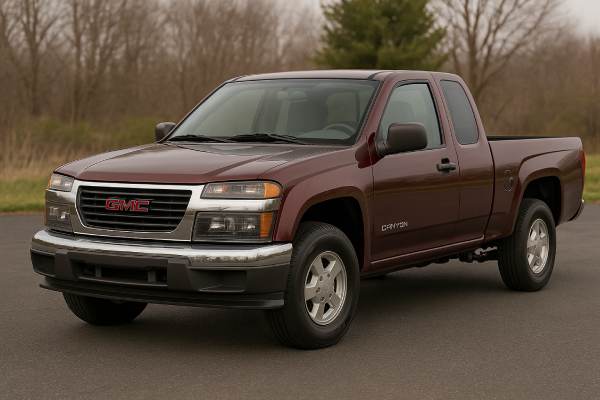

The 2004–2006 GMC Canyon 4WD with the 3.5-liter L52 inline-five is the “do-everything” version of the first-generation Canyon. It combines the compact footprint of the GMT355 platform with a strong, modern Atlas-family engine and a capable part-time four-wheel-drive system. With 220 hp and 225 lb-ft of torque, the 3.5 l Vortec 3500 delivers more punch than most older compact-truck V6s, while keeping weight and fuel use reasonable for a body-on-frame pick-up.
Four-wheel drive adds year-round usability for snow, muddy job sites, and gravel roads, especially when combined with the optional locking rear differential. The trade-offs are extra complexity, slightly higher fuel consumption, and more components to service over time. This guide looks beyond brochure numbers and walks through what owning one of these trucks is really like: the detailed specs, strengths, weaknesses, maintenance needs, and how the 3.5L 4WD Canyon compares to rivals like the Tacoma, Frontier, Ranger, and its Chevrolet Colorado twin.
Key Takeaways
- 3.5 l L52 inline-five makes 220 hp and 225 lb-ft, giving noticeably better acceleration and towing than the 2.8 l four-cylinder.
- Part-time 4WD with low range adds real off-road and winter capability, especially with the G80 locking rear differential.
- Known weak spots include early L52 cylinder-head issues, front suspension wear, and rust in harsh climates.
- Oil and filter changes every 5,000–7,500 miles (8,000–12,000 km) and regular 4WD/axle fluid service are key to long-term reliability.
Section overview
- GMC Canyon 3.5L 4WD in detail
- Engine, 4×4 system and specs
- 4WD trims, equipment and safety
- Long-term reliability and known issues
- Maintenance strategy and buying advice
- On-road, off-road and towing performance
- Canyon 3.5L 4WD versus competitors
GMC Canyon 3.5L 4WD in detail
The first-generation GMC Canyon debuted for 2004 as a replacement for the Sonoma, sharing its GMT355 platform and most hardware with the Chevrolet Colorado. The 3.5L L52 inline-five sits in the middle of the original Canyon engine range, above the 2.8L four-cylinder and below the later 3.7L and 5.3L V8 options. For many owners, it represents an ideal balance of output, cost, and complexity.
In 4WD form, the Canyon uses a part-time, truck-style system with a two-speed transfer case. Under normal conditions you drive in 2HI (rear-wheel drive). When traction drops, you can select 4HI for a locked front and rear output, and 4LO for additional gear reduction off-road or when pulling heavy loads at low speed. This simple layout is robust and familiar to most truck technicians, and it avoids the complexity of full-time or on-demand systems.
Cab and bed configurations typically include:
- Extended cab 4WD: Four “suicide” rear half-doors, small rear seats, and a longer bed; often chosen by tradespeople.
- Crew cab 4WD: Four full-size doors, three-passenger rear bench, slightly shorter bed; a good compromise for family use.
The 3.5L 4WD trucks are heavier than their RWD counterparts by roughly 100–150 kg (220–330 lb), thanks to the transfer case, front differential, and half-shafts. This extra mass, plus the added rotating components, slightly hurts fuel economy but gives the truck a more planted feel on loose surfaces.
Target owners for the 3.5L 4WD Canyon include:
- Drivers in snow-belt or rural regions who need dependable winter traction.
- Outdoor enthusiasts who tow small campers, ATVs, or boats and drive on unpaved roads.
- DIYers wanting a manageable-size truck that still has real low-range capability.
The key to a good ownership experience is understanding the L52 engine’s quirks, keeping the 4WD system serviced, and inspecting for corrosion and suspension wear as the truck ages.
Engine, 4×4 system and specs
This section focuses on the 3.5L L52 4WD Canyon in 2004–2006 crew and extended-cab configurations.
Engine and performance
| Item | Specification |
|---|---|
| Engine code | L52 (Vortec 3500) Atlas inline-five |
| Layout, valvetrain | DOHC inline-5, 4 valves per cylinder, VVT on exhaust side |
| Displacement | 3.5 l (3,460 cc) |
| Bore × stroke | 93.0 mm × 102.0 mm (approx. 3.66 × 4.02 in) |
| Compression ratio | About 10.0:1 |
| Induction | Naturally aspirated |
| Fuel system | Multi-port fuel injection (MPFI) |
| Max power | 220 hp @ 5,600 rpm |
| Max torque | 305 Nm (225 lb-ft) @ 2,800 rpm |
| Redline | ~6,300 rpm |
| Timing drive | Chain (no scheduled replacement, condition-based) |
| EPA combined economy (typical) | Around 17–19 mpg combined for 4WD models |
The L52 uses an all-aluminum block and head, coil-on-plug ignition, and variable valve timing, making it more advanced than the older pushrod truck engines it replaced.
Transmission and four-wheel drive
Most 3.5L 4WD Canyons are fitted with the 4-speed Hydra-Matic 4L60-E automatic, though some extended-cab trucks came with a 5-speed manual gearbox.
| Item | Specification |
|---|---|
| Transmission | 4L60-E 4-speed automatic or 5-speed manual |
| Transfer case | Part-time 2-speed (2HI, 4HI, 4LO) |
| Drive type | 4×4 with manually or electronically selected modes |
| Typical axle ratios | Commonly 3.42 or 3.73 (varies by tow package and trim) |
| Rear differential | Open or G80 automatic locking differential (option-dependent) |
The transfer case allows shifting between 2HI and 4HI on the move at moderate speeds; 4LO requires a stop and shift to neutral. The G80 locker, when fitted, automatically engages under low-speed wheelspin to improve traction in mud, snow, or uneven terrain.
Chassis and dimensions (3.5L 4WD)
Representative values from extended and crew-cab models:
| Item | Extended cab 3.5 4WD | Crew cab 3.5 4WD |
|---|---|---|
| Body style | 4-door extended cab pick-up | 4-door crew-cab pick-up |
| Overall length | 5,260 mm (207.1 in) | 5,260 mm (207.1 in) |
| Width | 1,742 mm (68.6 in) | 1,742 mm (68.6 in) |
| Wheelbase | ~3,198 mm (125.9 in) | similar range |
| Curb weight | ~1,780 kg (3,924 lb) | ~1,860 kg (4,100 lb) |
| GVWR | ~2,404 kg (5,300 lb) | ~2,404 kg (5,300 lb) |
| Suspension (front) | Independent, torsion bar | Independent, torsion bar |
| Suspension (rear) | Solid axle, leaf springs | Solid axle, leaf springs |
| Steering | Rack-and-pinion, power assisted | Rack-and-pinion, power assisted |
| Brakes | Front discs, rear drums, ABS | Front discs, rear drums, ABS |
| Fuel tank | ~76 l (20 US gal) | ~76 l (20 US gal) |
| Bed volume (typical) | up to ~1,243 l (43.9 cu ft) | around 1,039 l (36.7 cu ft) |
Performance and capability
| Metric | Typical value (3.5L 4WD) |
|---|---|
| 0–60 mph (0–97 km/h) | Around 9.0–9.5 s (unladen, automatic) |
| Top speed (governed) | Roughly 95–100 mph (153–161 km/h) |
| Max towing capacity (properly equipped) | 4,000 lb (1,814 kg) |
| Payload | Up to ~1,600 lb (725 kg) depending on configuration |
Tow and payload figures vary by cab style, axle ratio, and options, so always confirm against the specific truck’s door sticker and owner’s manual.
Fluids, capacities and electrical (typical)
| System | Specification and notes |
|---|---|
| Engine oil | 5W-30 API SL/SM or Dexos-appropriate; ~5.0–5.6 l (5.3–5.9 qt) |
| Coolant | Dex-Cool OAT; ~10–12 l (10.5–12.7 qt) |
| Automatic trans | Dexron VI ATF; ~11–12 qt for full overhaul fill |
| Front differential | 75W-90 GL-5 gear oil; ~1.0–1.2 l |
| Rear differential | 75W-90 GL-5; ~2.0–2.5 l; friction modifier if limited-slip |
| Transfer case | GM Auto-Trak II or approved equivalent; capacity per service info |
| A/C refrigerant | R-134a; charge weight from under-hood label |
| Alternator | Typically ~100–125 A depending on trim |
| 12V battery | Group 78 or similar; ~600+ CCA |
4WD trims, equipment and safety
In 3.5L 4WD form, the Canyon was usually sold in mid- to upper-level trims, often labeled SLE or Z71. The exact naming and standard equipment vary by year and market, but several patterns are common.
Trims and 4WD equipment differences
Typical 3.5L 4WD combinations:
- Extended cab SLE / Z71 Off-Road
- 3.5L L52, often with 4L60-E automatic; some manual trucks exist.
- Longer bed and smaller rear seating.
- Z71 package may include firmer shocks, all-terrain tires, skid plates, and G80 locker.
- Crew cab SLE / Z71
- 3.5L L52 with automatic transmission as the dominant configuration.
- Four full doors and more comfortable rear seats; shorter bed.
- Frequently chosen as a family plus adventure truck.
Mechanical differences by package can include:
- Axle ratio changes (3.42 vs 3.73), which affect acceleration and towing.
- Presence or absence of the G80 locker, crucial for off-road or winter performance.
- Skid plates and tow hooks on off-road-oriented packages.
Quick identifiers:
- RPO code sticker (glovebox) reveals engine, axle ratio, G80 locker, and Z71 equipment.
- Z71 trucks often have unique wheels, decals, and a slightly taller stance.
Interior and feature levels
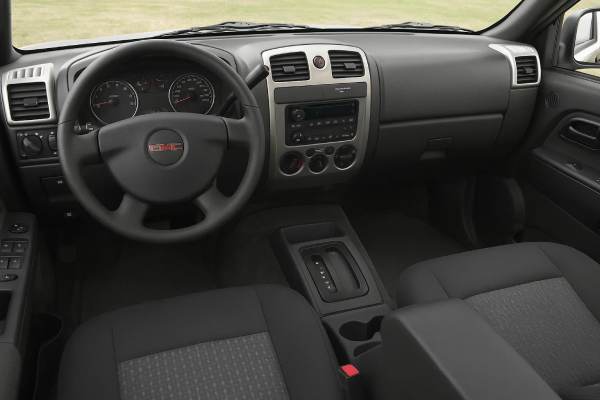
Most 3.5L 4WD models came reasonably equipped for the time:
- Power windows, locks, and mirrors on SLE and higher.
- Cloth seats, with optional upgraded audio and convenience packages.
- Available sliding rear window and bedliner.
Infotainment and connectivity are basic by modern standards (single-DIN or early double-DIN head units, limited integration), but the simple electrical architecture makes aftermarket upgrades straightforward.
Safety ratings
Because the Canyon is mechanically identical to the Colorado, crash-test data from the Colorado applies.
- Moderate-overlap front crash tests for extended-cab models generally score well and show strong structural performance.
- Side-impact tests of comparable crew-cab trucks without side airbags can be weak, reflecting the limitations of small-pickup structures of that era.
- Roof strength and head restraints tend to be average to marginal by modern standards.
Side curtain airbags were optional on many 2004–2006 trucks, and became more common later. Stability control and advanced driver-assistance systems (AEB, lane-keeping, etc.) were not yet fitted.
Safety systems and child-seat practicality
Standard or common equipment includes:
- Dual front airbags.
- Four-wheel ABS.
- Three-point belts at all outboard seating positions.
- Rear LATCH/ISOFIX-compatible anchors in crew cabs for child seats.
For family use:
- A crew cab with optional curtain airbags (if available in your market) is the safer choice.
- Always verify airbag and ABS warning lights on start-up; they should illuminate briefly then go out.
- Check for open airbag or seat-belt recalls by VIN before purchase.
Long-term reliability and known issues
The 3.5L 4WD Canyon can be durable when maintained properly, but there are known weak spots that any owner or buyer should understand.
L52 engine concerns
1. Cylinder-head and valve-seat issues (common, moderate-to-high cost)
Early L52 engines have a reputation for valve-seat recession and cracking in certain conditions. Symptoms include:
- Rough idle and misfire on a single cylinder, especially when warm.
- Persistent misfire codes that do not respond to coils or plugs.
- Low compression on one cylinder during testing.
If confirmed by compression and leak-down tests, the fix is typically a replacement or remanufactured cylinder head, ideally with updated design changes similar to those found on the later LLR 3.7L.
2. Timing-chain wear (occasional, medium cost)
The chain itself has no fixed replacement interval, but:
- Long oil-change intervals with poor-quality oil can accelerate wear.
- Symptoms include rattle on cold start, correlation codes, or timing-related drivability problems.
When in doubt, a top-end inspection and, if necessary, replacement of chain, guides, and tensioner is appropriate.
3. Oil leaks (common, low to medium cost)
Valve-cover gaskets, oil-pan gaskets, and crankshaft seals can leak with age. Most are straightforward repairs if spotted early, but long-term leaks can foul mounts and bushings.
Transmission, 4WD system and axles
4. 4L60-E automatic transmission wear (common at high mileage)
Recurring issues across many GM trucks include:
- Harsh or delayed shifts, especially 2–3 upshift flare.
- Slipping under heavy throttle or when hot.
Regular fluid and filter changes (30,000–50,000 miles / 50,000–80,000 km) and avoiding overheating when towing extend life. If slipping is advanced, rebuild or replacement is the realistic fix.
5. Transfer case and differential neglect (occasional, medium cost)
Failure to change transfer-case and axle oils can lead to:
- Bearing noise and whine at speed.
- Rough engagement of 4HI/4LO or shudder on tight turns.
Fresh fluids using the correct spec (Auto-Trak II or equivalent for the transfer case, 75W-90 GL-5 in diffs) and checking for leaks help prevent expensive repairs.
Suspension, steering and frame
- Front ball joints, control-arm bushings and tie rods wear over time, leading to clunks and poor alignment.
- Rear leaf-spring bushings and shackles can rust and loosen in salty climates.
- Frame and brake-line corrosion is a serious issue in rust-belt areas; inspect rear frame rails, crossmembers, and lines running along the frame.
Electrical and body
Typical age-related problems include:
- Instrument-cluster stepper motors failing (erratic gauges).
- Power-window switches and door-lock actuators wearing out.
- Blower-motor resistor failure, giving limited fan speeds.
These issues are common across many GM trucks of the era and have well-documented repair procedures and aftermarket parts.
Recalls, TSBs and extended coverage
The 2004–2006 Colorado/Canyon family has been subject to multiple recalls over the broader 2004–2012 production span, including items related to seat-belt anchorage and other safety systems.
To protect yourself:
- Run the VIN through the official recall database and GMC/GM online tools.
- Ask for dealer printouts or invoices showing recall and service campaign completion.
- Retain documentation for resale and insurance purposes.
Maintenance strategy and buying advice
With 4WD hardware and an overhead-cam all-aluminum engine, the 3.5L Canyon rewards proactive maintenance. The basic schedule below is a practical starting point; always adjust for severe use and verify against your owner’s manual.
Practical maintenance schedule
| Item | Typical interval (time/distance) |
|---|---|
| Engine oil and filter | 5,000–7,500 miles / 8,000–12,000 km or annually |
| Engine air filter | 30,000 miles / 50,000 km; inspect annually |
| Cabin filter (if fitted) | 15,000–20,000 miles / 25,000–30,000 km |
| Spark plugs | 100,000 miles / 160,000 km |
| Coolant (Dex-Cool) | 5 years or 100,000 miles; then every 3 years / 50,000 miles |
| Automatic-transmission fluid and filter | 30,000–50,000 miles / 50,000–80,000 km |
| Manual-transmission fluid | 60,000 miles / 100,000 km |
| Front and rear differential oil | 50,000–60,000 miles / 80,000–100,000 km (or after heavy towing) |
| Transfer-case fluid | 50,000 miles / 80,000 km |
| Brake fluid | Every 2–3 years |
| Serpentine belt | Inspect yearly, replace 90,000–120,000 miles |
| Hoses and cooling lines | Inspect yearly, replace as needed |
| 12 V battery | Test yearly after 4 years; expect 5–7-year lifespan |
| Tire rotation and alignment | Rotate every 5,000–7,500 miles; align annually or as needed |
Timing chains remain inspection-based; chain noise, correlation codes or obvious sludge are your cues to investigate.
Fluid selection and key torque guidance
Use:
- Full- or semi-synthetic 5W-30 engine oil meeting GM Dexos or equivalent API specs.
- Genuine Dex-Cool or equivalent OAT coolant (do not mix with conventional green coolant).
- Dexron VI ATF in the 4L60-E, which supersedes older Dexron III recommendations.
Example torque values (always confirm in official literature):
- Wheel lug nuts: about 140 Nm (100 lb-ft).
- Spark plugs: about 20–25 Nm (15–18 lb-ft).
- Differential cover bolts and drain plugs: follow factory specs to avoid stripped threads.
Buyer’s checklist for a 3.5L 4WD Canyon
When evaluating a used truck:
- Cold start and test drive
- Listen for chain rattle and check idle smoothness.
- Watch for misfire, MIL illumination, or rough running when warm.
- 4WD system function
- Shift between 2HI, 4HI, and 4LO; ensure the indicator lights work and engagement is smooth.
- On a loose surface, confirm front-axle engagement by feeling for hop or tight turning in 4WD.
- Transmission and driveline
- Check for delayed engagement, flares between gears, or shudder under load.
- Listen for whine or clunk from diffs or transfer case.
- Frame and underside
- Inspect frame rails, crossmembers and brake lines for heavy rust, flaking, or repairs.
- Suspension and steering
- Drive over rough roads and at highway speed; note any wandering, tramlining, or clunks.
- Paperwork
- Look for documented fluid changes (engine, transmission, diffs, transfer case).
- Confirm recall and TSB work via VIN lookup and service records.
Well-maintained examples with modest modifications and no rust are worth paying more for. Avoid trucks with substantial lifts and oversized tires unless you are prepared for accelerated wear on driveline components and steering.
On-road, off-road and towing performance
The 3.5L 4WD Canyon is not a hardcore rock crawler out of the box, but it is a genuinely capable all-rounder with the right tires and a careful driver.
Everyday driving and highway behavior
On pavement, the 3.5L L52 feels stronger than its displacement suggests. With peak torque at about 2,800 rpm, it delivers good mid-range pull and adequate passing power, especially in 4L60-E trucks with the shorter 3.73 axle ratio.
- Throttle response: Linear and predictable, thanks to electronic throttle control.
- NVH: The inline-five has a slightly unusual exhaust note but is smoother than old-school four-cylinder truck engines. At highway speeds, wind and tire noise dominate more than engine sound.
- Ride quality: Leaf springs and torsion-bar front suspension give a firm, sometimes choppy ride when unladen; ride improves with some weight in the bed.
Steering is reasonably direct for a body-on-frame pickup of this era. Body roll is present but well-controlled, particularly on Z71 models with firmer shocks.
Fuel economy and range
Real-world fuel use for 3.5L 4WD trucks typically falls around:
- City: 14–16 mpg (14.7–16.8 L/100 km).
- Highway (60–70 mph / 100–115 km/h): 18–22 mpg (10.7–13.1 L/100 km).
- Combined: mid- to high-teens.
With a roughly 20-gallon tank, expect 280–360 miles (450–580 km) of practical range between fills, depending on load, speed, and driving conditions.
Off-road and winter use
The Canyon 3.5L 4WD is most at home on:
- Forest roads, gravel, and mild to moderate trails.
- Snowy or icy roads where 4HI and good tires dramatically improve control.
Strengths:
- Low-range gearing for steep climbs and controlled descents.
- Optional G80 locker that helps keep you moving when a rear wheel lifts or loses traction.
Limitations:
- Ground clearance is decent but not extreme; watch for breakover on deeply rutted trails.
- Long overhangs compared with dedicated off-road rigs reduce approach and departure angles.
- No factory front or rear lockers on many trims (apart from G80 automatic rear locker).
Upgrades that meaningfully improve capability include better all-terrain tires, mild suspension lifts, and skid plates, but avoid extreme lifts or huge tires unless you are willing to tackle the resulting driveline and steering stress.
Towing and hauling
With a rated maximum tow capacity of about 4,000 lb when correctly configured, the 3.5L 4WD Canyon handles:
- Small travel trailers and pop-up campers.
- Single-axle utility trailers with ATVs, motorcycles, or yard equipment.
- Small boats and personal watercraft.
Towing impressions:
- Power is adequate; expect frequent downshifts on hills.
- Transmission and diff temperatures stay manageable if you respect speed, use tow/haul modes where fitted, and keep fluids fresh.
- Fuel economy can drop into the low-teens or even high single digits mpg with a tall, heavy trailer.
Payload with 4WD is still healthy enough for tools, materials, or camping gear, but remember that tongue weight counts against payload, so avoid overloading the rear axle.
Canyon 3.5L 4WD versus competitors
In the early-to-mid 2000s compact and midsize truck space, the 3.5L 4WD Canyon faced strong rivals.
Versus Toyota Tacoma
- Power: The L52’s 220 hp and 225 lb-ft are competitive with Tacoma’s V6 of the era, and stronger than many four-cylinder Tacomas.
- Reliability: Tacoma generally enjoys a better overall reputation, but certain model years suffer from severe frame rust, which can be an expensive problem.
- Comfort and refinement: Tacoma cabins feel slightly more refined; Canyon’s driving position and steering are modern but interior materials are more utilitarian.
- Price: Used Tacomas often command a premium; a well-kept Canyon can offer better value for similar capability.
Versus Nissan Frontier and Ford Ranger
- Nissan Frontier: Strong V6 options and solid off-road packages make the Frontier a close competitor. The Canyon’s Atlas five-cylinder offers similar real-world punch with a different character. Frontier has its own known issues, so each platform has trade-offs.
- Ford Ranger (older generation): The Ranger is simpler and in many trims less powerful; it appeals to buyers who value basic, proven mechanicals. The Canyon offers a more modern chassis, multi-valve engine, and better crash performance in some configurations.
Versus Chevrolet Colorado
Mechanically, the Canyon and Colorado are twins:
- Same engines, transmissions, 4WD hardware and frames.
- Differences are primarily styling, trim mixes, and branding.
From a rational standpoint, shopping both expands your pool of candidate trucks. Some buyers prefer the Canyon’s styling and slightly more upscale image; others just buy the cleanest, best-maintained example regardless of badge.
Where the 3.5L 4WD Canyon fits best
Choose the 3.5L Canyon 4WD if you:
- Need real 4WD and low range but want a truck smaller than a full-size Sierra/Silverado.
- Prefer a modern DOHC engine over older pushrod designs.
- Are comfortable doing or commissioning preventative maintenance and keeping an eye on known L52 issues.
Look elsewhere (for example, a Tacoma or later 3.7L Canyon/Colorado) if you:
- Want the absolute strongest long-term reliability record and are willing to pay a premium.
- Live in an area where rust completely destroys frames in a decade and you cannot store the truck indoors or treat it regularly.
For informed buyers, a carefully chosen 3.5L 4WD Canyon remains a capable, good-value work-and-adventure truck, provided you factor in the cost of catching up on fluids, suspension, and any engine issues early in ownership.
References
- GMC Canyon I Extended cab 3.5 (220 Hp) 4WD | Technical specs, data, fuel consumption, Dimensions 2024 (Technical Specs)
- GMC Canyon I Crew cab 3.5 (220 Hp) 4WD Automatic | Technical specs, data, fuel consumption, Dimensions 2024 (Technical Specs)
- Manuals and Guides | Vehicle Support – Experience GM 2024 (Owner’s Manual Portal)
- Used 2004 GMC Canyon Specs & Features 2024 (Specs and Capacities)
- 2004 Chevrolet Colorado Extended cab pickup 2024 (Safety Rating)
Disclaimer
This article is for informational purposes only and is not a substitute for professional diagnosis, repair, or manufacturer service information. Specifications, torque values, fluid capacities, and maintenance intervals can vary by VIN, model year, market, and equipment level. Always verify critical data against your official owner’s manual, factory service documentation, and local regulations before performing any inspection, modification, or repair.
If you found this guide useful, please consider sharing it with other owners or enthusiasts on Facebook, X/Twitter, forums, or within your local truck community. Your support helps justify the time and care required to create and maintain in-depth resources like this.