
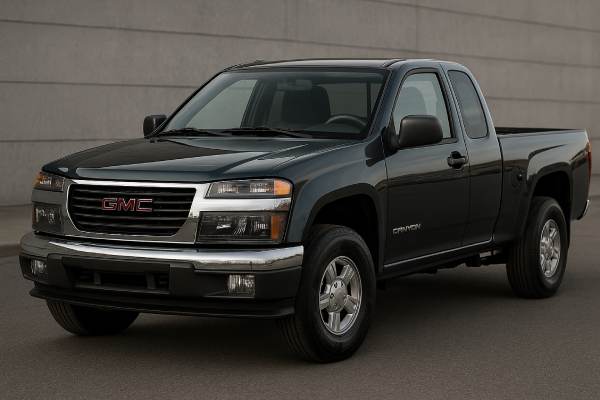
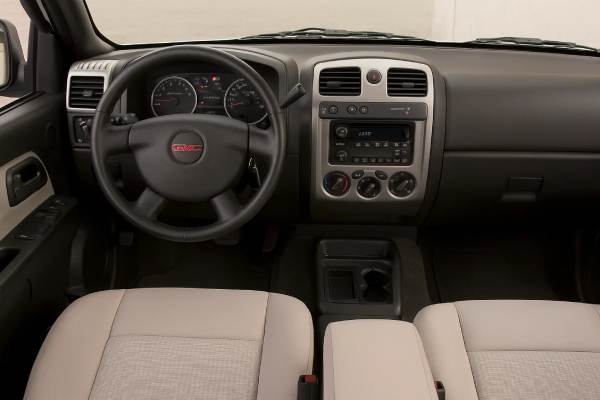
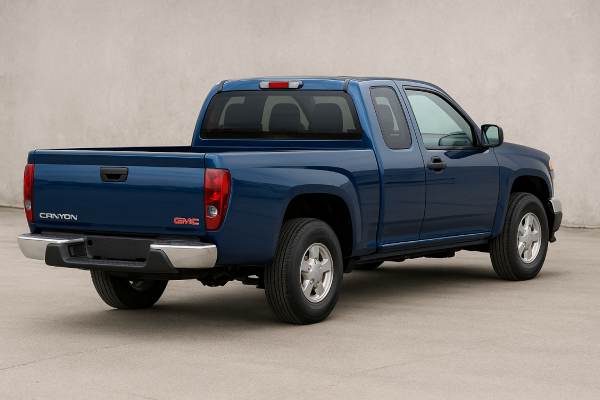
The facelifted GMC Canyon RWD with the LLV 2.9 litre four cylinder engine sits in a sweet spot between honest work truck and efficient daily driver. Produced from 2007 to 2012, this version brought updated styling, a revised powertrain and incremental refinements that made it more liveable without losing its compact truck simplicity. With 185 horsepower, a stout ladder frame and rear wheel drive, it suits owners who need a light duty pickup that can tow, haul and still fit in older garages or tight city streets.
This guide focuses specifically on the 2.9 litre LLV RWD Canyon, explaining how it is built, what it can realistically tow and carry, where it tends to wear with age and how it compares to rivals like the Toyota Tacoma, Ford Ranger and Nissan Frontier. If you are shortlisting one of these trucks or already own one and want to look after it properly, this article is written for you.
Core Points
- 2.9 litre LLV inline four offers 185 hp and a useful 190 lb ft of torque, adequate for light towing and daily use.
- RWD layout, simple suspension and compact footprint make the Canyon easy to manoeuvre and relatively efficient for a body on frame truck.
- Common ageing issues include front suspension wear, frame rust in salted regions and occasional electrical niggles around the instrument cluster.
- Engine oil and filter changes every 5,000–7,500 miles (8,000–12,000 km) with quality 5W-30 and a good filter help these engines reach high mileage.
Contents and shortcuts
- GMC Canyon LLV RWD summary
- LLV 2.9 RWD specifications
- Facelift Canyon trims and safety
- Common LLV issues and fixes
- Service schedule and purchase tips
- Driving impressions and real world economy
- How this Canyon compares
GMC Canyon LLV RWD summary
The facelifted GMC Canyon RWD with the LLV 2.9 litre engine replaced the earlier 2.8 litre LK5 four cylinder and became the base petrol engine in many markets from 2007 onward. It retained the GMT355 ladder frame platform shared with the Chevrolet Colorado, but brought updated front end styling, new wheel designs and a revised interior with better materials and features.
The LLV is a 2.9 litre inline four with dual overhead cams and variable valve timing. Power rises to around 185 hp and torque to about 190 lb ft, both delivered lower in the rev range than the older 2.8 litre. In everyday use that means less downshifting on grades and more relaxed acceleration with light trailers or a loaded bed. The engine drives the rear wheels through either a five speed manual or, more commonly, a four speed automatic.
The Canyon line targeted owners who wanted more comfort and safety than old compact trucks without paying full size pickup prices. Compared with a half ton, the Canyon is easier to park, lighter on fuel and often cheaper to keep on the road. Compared with a car based crossover, it offers a proper ladder frame, a separate cargo bed and meaningful tow and payload ratings.
Cab choices include regular, extended and crew cab layouts depending on year and market. Most RWD 2.9 trucks were sold as work oriented trims with vinyl or cloth interiors, simple infotainment and relatively small wheels, but higher trims added alloy wheels, better audio and power convenience features. This mix makes the LLV powered Canyon attractive to budget buyers today: the mechanicals are proven, and you can often find lightly optioned trucks that have led straightforward lives as personal or light commercial vehicles.
LLV 2.9 RWD specifications
This section focuses on the typical 2WD regular or extended cab GMC Canyon with the 2.9 litre LLV engine from roughly 2009 to 2012. Details can vary slightly by year, cab and market, so always confirm against the specific truck’s build data.
Engine and performance
| Item | Value |
|---|---|
| Engine code | LLV |
| Configuration | Inline 4, DOHC, 4 valves per cylinder |
| Displacement | 2.9 l (2,921 cc) |
| Induction | Naturally aspirated |
| Fuel system | Sequential multi port fuel injection |
| Compression ratio | Approx. 10.0:1 |
| Max power | 185 hp @ ~5,600 rpm |
| Max torque | ~190 lb ft @ ~2,800 rpm |
| Timing drive | Chain driven camshafts |
| Emissions standard (US) | Tier 2 Bin level, OBD II compliant |
| Recommended fuel | Regular unleaded petrol |
Factory 0–60 mph times are not highlighted for these trucks, but in stock form with the automatic you can expect around 9–10 seconds unladen. Top speed is more academic on a work truck, but it comfortably cruises at modern highway speeds with some reserve.
Transmission and driveline
| Item | Value |
|---|---|
| Transmission options | 5 speed manual or 4 speed automatic (4L60E family) |
| Drive type | Rear wheel drive |
| Rear axle | Solid axle on leaf springs |
| Differential | Open; limited slip available/optional by trim |
| Typical final drive | Around 3.73 or 4.10 depending on tow package |
Manual trucks are rare and usually more basic in trim, but they allow better use of the 2.9 litre’s torque band and slightly lower running costs. The 4 speed automatic is simple, well known to transmission shops and can last if serviced regularly.
Chassis, dimensions and capacities
Figures below are typical for a 2WD regular cab short bed Canyon with the LLV engine; crew and extended cabs will be longer and heavier.
| Item | Value |
|---|---|
| Frame type | Ladder frame |
| Front suspension | Independent, coil spring, torsion bar or coil over (by year) |
| Rear suspension | Leaf spring solid axle |
| Steering | Power assisted rack and pinion |
| Brakes | Front disc, rear drum with ABS |
| Overall length | About 192–205 in (4,880–5,210 mm) |
| Width | Around 68–68.5 in (≈1,730–1,740 mm) |
| Height | Around 65 in (≈1,650 mm) |
| Wheelbase | ≈ 111–126 in (2,820–3,200 mm) |
| Curb weight (2WD 2.9) | ≈ 3,350–3,500 lb (1,520–1,590 kg) |
| GVWR | ≈ 4,850–5,300 lb (2,200–2,400 kg) |
| Max payload | Around 1,400–1,500 lb (635–680 kg) |
| Fuel tank capacity | About 19 gal (72 l) |
| Towing capacity (properly equipped) | Up to ≈ 5,500–6,000 lb (2,500–2,720 kg) |
Fluids and service capacities (typical)
Always verify for your specific year and transmission:
- Engine oil: about 4.5–5.0 l (4.8–5.3 qt) with filter, 5W-30 meeting GM spec.
- Cooling system: roughly 11–12 l (11.5–12.5 qt) of long life coolant premix.
- Automatic transmission: in the region of 9–10 l total fill; 4–5 l on a drain and refill.
- Rear axle oil: usually 75W-90 synthetic; capacity around 1.5–2.0 l.
Fuel economy (2WD 2.9 l)
Official US figures for a 2WD 2.9 litre automatic Canyon are around:
- City: about 18 mpg US (≈ 13.1 l/100 km)
- Highway: about 25 mpg US (≈ 9.4 l/100 km)
- Combined: roughly 21 mpg US (≈ 11.2 l/100 km)
In mixed real world use, many owners report high teens to low twenties in mpg US depending on load, speed and driving style.
Facelift Canyon trims and safety
The LLV 2.9 litre engine shows up across a wide spread of trims and cab styles, especially in work oriented RWD models. Exact trim names differ slightly by year and market, but a typical line up for a 2009–2012 Canyon includes:
- Work Truck / Base: Vinyl or cloth seats, manual windows and locks, steel wheels and minimal chrome. Often regular cabs or extended cabs in fleet colours. These are the most common 2.9 RWD trucks on the used market.
- SLE / mid level trims: Cloth interior, power windows and locks, alloy wheels, upgraded audio and often cruise control. Extended and crew cabs with the 2.9 were sold this way.
- Appearance or value packages: Chrome packages, colour keyed bumpers, fog lights and different wheel designs. Some also bundle limited slip differentials or tow packages.
Mechanically, the LLV powered RWD Canyon stays fairly consistent across trims: same basic engine, rear drive layout and braking hardware. Differences that matter to buyers include:
- Rear axle ratio: Trucks with tow packages may have a shorter (numerically higher) gear ratio that improves towing but raises highway revs slightly.
- Differential type: Limited slip rear differentials are valuable in wet, gravel or light off road use. Many base trucks have open differentials.
- Wheel and tyre packages: Larger alloys look better but may ride more firmly and cost more to replace.
From a safety standpoint, the facelift Canyon adds standard features that were optional or absent on older compact trucks. Typical equipment includes:
- Front airbags for driver and passenger.
- Available head curtain airbags on many trims, especially later years.
- Anti lock brakes (ABS) as standard on most models.
- Stability control phases in during this generation; later model years are more likely to have it.
Crash performance for this generation Canyon is mixed but generally acceptable for its era. Institute and government testing shows decent frontal protection, with somewhat weaker performance in side impact unless the truck is equipped with side airbags. This is one reason to seek out later facelift trucks or those with confirmed curtain airbag fitment.
Advanced driver assistance systems such as automatic emergency braking, lane keeping or adaptive cruise were not offered. Safety depends largely on fundamental structure, passive restraints, tyre grip and the driver’s attention rather than electronics. However, the truck’s moderate size and relatively low beltline do give better outward visibility than many later high bodied pickups and SUVs.
When shopping, it is worth decoding the VIN or checking the build sticker to confirm airbag configuration, axle ratio and presence of tow and handling packages. These details can materially change how the truck behaves on the road and in an emergency.
Common LLV issues and fixes
The GMC Canyon with the 2.9 litre LLV engine has a generally good reputation for durability if serviced on time, but age and mileage are now catching up with many examples. Thinking in terms of “prevention and patterns” is the best way to approach reliability.
Engine and fuel system
Symptoms: Rough idle, misfires under load, or hesitation around 2,000–3,000 rpm.
Likely causes: Ageing ignition coils, worn spark plugs, dirty throttle bodies or injectors starting to clog.
Remedy: Replace plugs with correct iridium units, test and replace weak coils and clean the throttle body. A professional injector clean or replacement on very high mileage trucks can restore smoothness.
The LLV timing chain system is more robust than some other designs, but:
- Neglected oil changes and low oil can accelerate chain and tensioner wear.
- Rattling at cold start or timing correlation codes are warning signs.
Seeping cam cover gaskets and front crank seals are also common as the rubber ages. These are usually oil leak annoyances rather than catastrophic failures, but should be handled before oil reaches belts or mounts.
Cooling and HVAC
Radiators, heater cores and hoses are all susceptible to corrosion if coolant is ignored. Typical issues:
- Small radiator leaks at plastic tank crimp joints.
- Heater performance dropping because of partial core blockage.
- Failing thermostat causing overcooling or overheating.
Flushing the cooling system and replacing old hoses every decade or so is cheap insurance. Blower motor resistors and fan speed switches also age and can cause the HVAC fan to work only on certain speeds; the parts are inexpensive and straightforward to change.
Driveline and suspension
On RWD Canyons, pay attention to:
- Front suspension: Upper and lower ball joints and control arm bushings wear, leading to vague steering, clunks and uneven tyre wear.
- Steering racks and tie rod ends: Free play or knocking on rough surfaces indicate wear.
- Rear leaf spring shackles and bushings: Rust and movement here can cause noises and alignment issues.
- Driveshaft and universal joints: Vibration under load or on overrun may point to worn U-joints or an out of balance shaft.
Most of these are predictable high mileage service items. Parts availability is good and many general garages are familiar with the platform.
Frame and body
In rust belt areas, the GMT355 frame can suffer:
- Surface rust on rails and crossmembers, sometimes progressing to perforation at rear spring hangers or around the spare tyre.
- Brake line corrosion along the frame rails.
- Rust starting at cab corners, rocker panels and bed seams.
A thorough underside inspection is essential, ideally with the truck on a lift. In some markets there have been recalls or technical service bulletins dealing with brake lines or other corrosion related issues, which should be checked against the VIN.
Electrical and instrumentation
Ageing Canyons sometimes exhibit:
- Cluster issues: intermittent gauges, backlighting faults or dead pixels.
- Door lock and window switch problems due to wear or moisture.
- Airbag warning lights triggered by seat or clock spring wiring problems.
Many of these faults are nuisance issues rather than total failures, but diagnostic time can add up. When buying, verify that all cluster functions work correctly, warning lights cycle as expected and no codes are stored.
Service schedule and purchase tips
Because these trucks are now well out of warranty, a clear and practical maintenance plan matters more than ever. Below is a reasonable baseline for a 2.9 litre RWD Canyon, assuming mostly mixed driving:
Core maintenance intervals (approximate)
- Engine oil and filter: Every 5,000–7,500 miles (8,000–12,000 km) or annually, whichever comes first. Shorter intervals for heavy towing or lots of short trips.
- Engine air filter: Inspect every 15,000 miles (25,000 km); replace around 30,000 miles (50,000 km) or sooner in dusty conditions.
- Cabin air filter (if fitted): Every 20,000–25,000 miles (30,000–40,000 km) or 2 years.
- Spark plugs: Around 100,000 miles (160,000 km) for long life plugs, but earlier replacement is cheap insurance on high mileage trucks.
- Coolant: Replace every 5 years or 100,000 miles (160,000 km), then every 3–5 years.
- Automatic transmission fluid: Drain and refill every 40,000–60,000 miles (65,000–100,000 km) if towing or working the truck hard; otherwise at least once by 100,000 miles.
- Manual transmission and axle oils: Around every 60,000 miles (100,000 km) or when contamination is suspected.
- Brake fluid: Every 2–3 years regardless of mileage.
- Serpentine belt and hoses: Inspect annually from 10 years onwards; replace when cracking, fraying or glazing appears.
- Alignment and tyre rotation: Rotate every 5,000–7,500 miles with oil changes; check alignment annually to protect tyres and steering components.
- 12 volt battery: Test yearly after about 4–5 years of age; typical life is 5–7 years.
The timing chain is designed for the life of the engine, but any signs of rattle, correlation codes or metal in the oil demand investigation. Chains, guides and tensioners should be replaced if out of specification.
Fluid choices and torque values (indicative)
- Use a quality 5W-30 that meets the relevant GM standard for the year.
- For differentials and manual gearboxes, synthetic 75W-90 gear oil is a safe starting point; always confirm with the manual.
- Wheel lug nuts typically tighten around 135–150 Nm (100–110 lb ft), but verify for your year. Over tightening can warp brake rotors.
Buyer’s inspection checklist
When evaluating a used Canyon 2.9 RWD:
- Frame and underside: Look for scaling rust, especially near rear spring mounts, crossmembers and brake lines. Walk away from trucks with significant perforation.
- Front suspension and steering: Check for play, clunks, uneven tyre wear and wandering on a straight road. Budget for bushings and ball joints on higher mileage trucks.
- Engine behaviour: Cold start, idle and warm acceleration should be smooth and quiet. Avoid trucks with heavy knocking, chain rattle or persistent misfires.
- Transmission: Automatic shifts should be clean without flares, harsh bangs or delay when selecting drive or reverse. Manual gearboxes should not crunch or pop out of gear.
- Electrics: Verify that all gauges, lights, windows, locks and HVAC controls operate normally. Look for airbag and ABS lights that remain on.
- History: Prefer trucks with documented oil changes, coolant and transmission services, and proof of recall and technical bulletin work where applicable.
Overall durability for a well looked after Canyon LLV is good. Many examples reach 200,000 miles (320,000 km) and beyond with original engines and transmissions, provided fluids are changed and rust is kept under control.
Driving impressions and real world economy
The RWD GMC Canyon with the 2.9 litre LLV engine does not pretend to be a sports truck, but it covers core driving tasks with a reassuringly straightforward character.
Ride, handling and refinement
On the road, the Canyon feels narrower and more manoeuvrable than modern mid size pickups. The steering is light but stable, making low speed turns and parking easy. With an empty bed, the rear suspension can be a little bouncy over patched surfaces, as you would expect from leaf springs tuned for cargo, but the ride settles nicely with a few hundred pounds in the back.
Body roll is moderate and predictable. It is not a canyon carver despite its name, yet it tracks cleanly through sweeping bends and feels secure at legal highway speeds. Cabin noise is acceptable for the era: some road and wind rustle around the mirrors and windscreen pillars, plus a bit of engine growl under load. Later facelift trucks with better door seals and tyres often feel quieter than early GMT355s.
Braking performance is adequate, with front discs and rear drums doing their job. Fade resistance is reasonable when driven sensibly, though repeated heavy downhill braking with a trailer will push the system to its limits more quickly than on a larger truck with bigger brakes.
Powertrain character
The 2.9 litre LLV is smoother and stronger than the earlier 2.8 litre, especially in the low and mid range. It pulls confidently from around 1,800 rpm and feels happiest between 2,500 and 4,000 rpm. At higher revs the engine becomes noisier but remains composed.
The four speed automatic is geared for relaxed cruising, with overdrive keeping revs modest at highway speeds. Kickdown is not instantaneous by modern standards, but it is predictable. Drivers who use the truck for mixed city and highway work often appreciate the simplicity: there are no complex multi gear shift strategies to confuse.
With modest loads and sensible driving, the truck feels willing rather than fast. Fully loaded or towing near its rated limit, you will use more of the rev range, but the engine remains tractable and temperatures stable if the cooling system is in good order.
Efficiency and towing behaviour
Real world economy for a 2.9 litre RWD Canyon typically lands close to:
- 18–19 mpg US (12.4–13.1 l/100 km) in mixed commuting with light loads.
- 21–24 mpg US (10–11.5 l/100 km) on steady highway runs around 60–70 mph (100–115 km/h).
Aggressive driving, large roof loads, wide tyres or towing can drop figures into the mid teens. When towing a moderate trailer in the 3,000–4,000 lb (1,360–1,815 kg) range, expect fuel consumption to worsen by 25–40 percent depending on terrain and speed.
The chassis copes well with loads within the stated ratings. The relatively long wheelbase of extended and crew cab trucks helps stability, while the ladder frame and rear leaf springs resist sag. Using a weight distributing hitch for heavier trailers and ensuring trailer brakes are in good order will keep the combination composed during emergency stops and in crosswinds.
How this Canyon compares
When new, the GMC Canyon with the LLV 2.9 litre engine competed directly with compact and mid size pickups like the Toyota Tacoma 2.7, Ford Ranger 3.0 and 4.0 litre models, and Nissan Frontier 2.5 and 4.0 versions. On today’s used market, it still sits in that group in price and capability.
Versus Toyota Tacoma
The Tacoma carries a strong reputation for long term durability and resale value. Its 2.7 litre four cylinder is similarly modest in power but backed by a wide owner and aftermarket ecosystem. However:
- Comparable Tacomas usually cost more to buy used than a Canyon of the same age and mileage.
- Frames on some Tacoma years have had substantial rust issues, often handled via recalls, but still a factor to check.
A clean Canyon LLV can therefore offer better value if you plan to keep the truck and maintain it yourself.
Versus Ford Ranger (old generation)
The older body on frame Ranger is simpler still, with a broad parts supply and basic mechanicals. Its 3.0 and 4.0 litre engines typically use more fuel than the Canyon’s 2.9 litre for similar performance. Interiors feel more dated, even by the standards of a 2007–2012 truck.
If low entry price and extreme simplicity are the main goals, a Ranger makes sense. If you want a more modern driving position, slightly better efficiency and a more contemporary cabin, the Canyon is usually the nicer daily companion.
Versus Nissan Frontier
The Frontier 2.5 litre four cylinder sits slightly below the Canyon in torque and can feel more strained under load. The 4.0 litre V6 models offer strong performance but at a clear fuel consumption penalty. Interior quality and rust resistance are similar ballpark considerations to the Canyon; condition matters more than badge.
Where the Canyon LLV stands out
- Value: Typically cheaper than a Toyota equivalent, with similar capability for light work.
- Right sized footprint: Easier to live with in cities than many newer mid size trucks that have grown significantly.
- Known simple mechanicals: LLV engines, 4L60E automatics and GMT355 suspension components are familiar to independent shops.
On the downside:
- Rust protection is only average; neglected trucks in harsh climates can look tired underneath.
- Safety and technology lag far behind modern trucks; there is no advanced driver assistance and crash performance reflects mid 2000s design.
For buyers who prioritise straightforward engineering, acceptable running costs and realistic used prices over modern gadgets, a well maintained GMC Canyon RWD with the LLV 2.9 litre engine remains a sensible and capable choice.
References
<a href="https://www.gmc.com/content/dam/gmc/na/us/english/index/vehicles/2011_trucks/canyon/brochure/2011-gmc-canyon-brochure.pdf">2011 GMC Canyon Brochure</a> 2011 (Brochure)<a href="https://www.fueleconomy.gov/feg/bymodel/2010_GMC_Canyon.shtml">Fuel Economy of 2010 GMC Canyon 2WD</a> 2010 (Fuel Economy Data)<a href="https://www.motortrend.com/cars/gmc/canyon/2010/specs">2010 GMC Canyon Specs and Features</a> 2010 (Specifications)<a href="https://www.jdpower.com/cars/2010/gmc/canyon/regular-cab-sle/specs">2010 GMC Canyon Regular Cab SLE Specs</a> 2010 (Specifications)<a href="https://www.nhtsa.gov/vehicle/2010/GMC/CANYON">2010 GMC Canyon Safety Ratings</a> 2010 (Safety Rating)
Disclaimer
This article is for informational purposes only and is not a substitute for professional diagnosis, repair advice or official service documentation. Specifications, torque values, service intervals and procedures can vary by VIN, model year, market, axle ratio and installed equipment. Always confirm critical data against the official owner’s manual, factory service information and current technical bulletins for your specific vehicle, and consult a qualified technician before performing repairs.
If you found this guide useful, please consider sharing it with other owners or enthusiasts on social platforms such as Facebook or X/Twitter. It helps support the continued creation of detailed, independent technical content like this.