
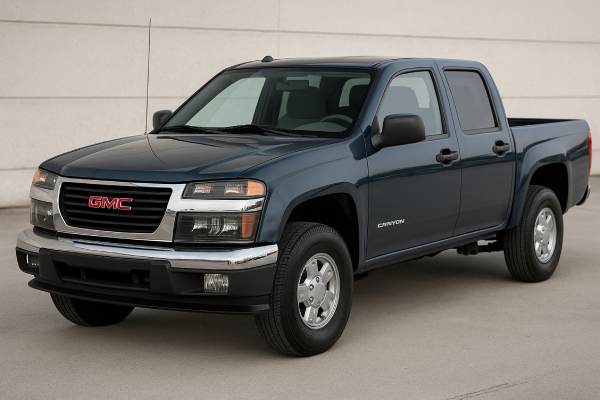
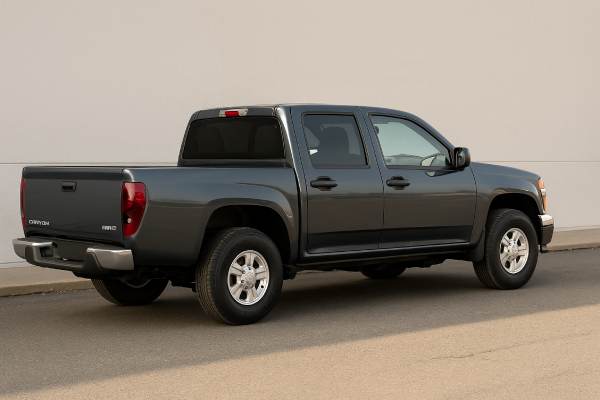
The facelifted GMC Canyon 4WD with the 2.9 litre LLV inline-four sits in a sweet spot for owners who want a compact truck with real work capability but lower running costs than a V6 or V8. Built on the GMT355 platform and updated for the 2007–2012 model years, this Canyon combines a relatively simple powertrain with a robust ladder frame and part-time four wheel drive.
For buyers today, the appeal is a blend of manageable size, decent towing capacity, and the ability to tackle winter roads or light trails without the complexity of newer midsize trucks. At the same time, these trucks are now old enough that corrosion, deferred maintenance, and a few known weak points matter more than brochure figures. This guide walks through specs, performance, reliability patterns, maintenance planning, and how the Canyon 2.9 4WD stacks up against rivals so you can judge whether a particular truck is worth your time and money.
Top Highlights
- Compact footprint with true body-on-frame strength and part-time 4WD with low range.
- 2.9 litre LLV four cylinder offers simpler service and lower fuel use than the optional five cylinder or V8.
- Payload and towing capability are competitive for a four cylinder midsize pickup when properly equipped.
- Watch for frame, brake line, and underbody corrosion on trucks that have seen salted winter roads.
- Plan engine oil and filter changes about every 5,000 miles / 8,000 km or 6 months under mixed use.
Navigate this guide
- GMC Canyon 2.9 LLV background
- Specifications and technical data
- Trims, equipment and safety
- Reliability and common issues
- Maintenance and buyer’s guide
- Driving experience and performance
- How the Canyon compares to rivals
GMC Canyon 2.9 LLV background
The facelifted GMC Canyon 4WD with the LLV 2.9 litre engine arrived as part of a mid-cycle update to the first generation Canyon and its Chevrolet Colorado twin. From 2007 onward, the 2.9 replaced the earlier 2.8 four cylinder, bringing more displacement, better refinement and a bump in power to around 185 horsepower while keeping the same basic engine family and architecture.
On the chassis side, the Canyon remained firmly a traditional pickup: separate ladder frame, front double wishbone suspension, and a solid rear axle with leaf springs. Four wheel drive models used an independent front suspension with a front differential and a part-time transfer case. This means the truck behaves like a rear drive pickup in normal conditions, then adds front axle drive when you select 4HI or 4LO on the dash switch. For most owners, that provides all the traction needed for snow, mud, boat ramps and rough tracks without the fuel penalty of full time all wheel drive.
Body configurations in this period typically included regular cab, extended cab and crew cab, with short or longer box lengths depending on market. The 2.9 4WD powertrain was most commonly paired with the extended cab and crew cab trucks, where the modestly sized four cylinder could still haul a family, tools and light trailers without overpowering the chassis.
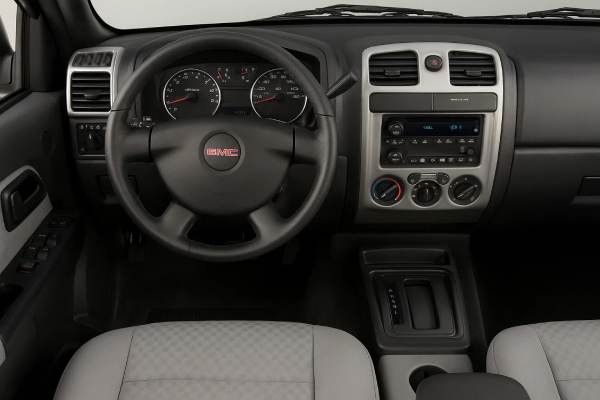
Inside, the Canyon is basic by modern standards but straightforward to live with. You will see hard plastics, simple gauges and relatively small infotainment units (or just a radio), but also large physical controls and good outward visibility. The facelift brought small tweaks to trim and options rather than a full redesign. Safety equipment reflects its era: front airbags are standard, but side airbags and more advanced driver assistance systems are limited or absent.
For current buyers, the 2.9 4WD Canyon is attractive because it offers usable capability with simpler mechanicals than later turbocharged or high output engines. That simplicity is a real advantage if you plan to keep the truck a long time or do some maintenance yourself. The main trade-offs are age-related wear, limited crash protection by today’s standards, and performance that is adequate but not quick when compared to newer midsize pickups.
Specifications and technical data
This section focuses on the facelifted GMT355 GMC Canyon 4WD powered by the LLV 2.9 litre four cylinder, covering the engine, driveline, chassis, performance figures and key service capacities. Numbers may vary slightly by cab, bed, transmission and market, so always verify for a specific VIN.
Engine and performance
| Item | Value |
|---|---|
| Engine code | LLV |
| Configuration | Inline 4 cylinder, DOHC, 16 valves |
| Displacement | ~2.9 L (≈ 2,921 cc) |
| Bore × stroke | ≈ 95.5 mm × 102.0 mm (≈ 3.76 in × 4.02 in) |
| Induction | Naturally aspirated |
| Fuel system | Sequential multi-port fuel injection |
| Compression ratio | Around 10.0 : 1 |
| Maximum power | ≈ 185 hp (≈ 138 kW) @ ~5,600 rpm |
| Maximum torque | ≈ 190 lb-ft (≈ 258 Nm) @ ~2,800 rpm |
| Timing drive | Chain driven dual overhead cams |
| Emissions standard (US) | Tier 2 / LEV equivalent, varies by state |
| Rated fuel economy (typical 4WD auto) | Roughly 17–18 mpg US city, 22–23 mpg US highway |
| Approximate highway use at 120 km/h | Around 10–11 L/100 km (21–24 mpg US), depending on load and gearing |
The LLV engine is an evolution of GM’s Atlas four and five cylinder family, designed for trucks rather than passenger cars. Compared with the smaller 2.8, it offers more low-end torque and smoother running, which helps when pulling a small trailer or driving at highway speeds with a full load.
Transmission and driveline
Most 4WD 2.9 litre Canyons use a four speed automatic, with a smaller share built with a five speed manual depending on year and market.
| Item | Value |
|---|---|
| Transmission (common) | 4 speed automatic (4L60E family) |
| Optional transmission | 5 speed manual (certain years and cabs) |
| Drive type | Part-time 4×4 (2HI / 4HI / 4LO) |
| Transfer case | Two speed, electronically shifted |
| Typical final drive ratios | Around 3.73 or 4.10, depending on axle and tow package |
| Differentials | Open front and rear; limited slip or locking rear available with tow/off-road packages |
Lower gearing and 4.10 axles improve towing and off-road crawling but increase revs and fuel consumption at highway speeds. Trucks with taller 3.73 gearing feel more relaxed on long journeys.
Chassis, dimensions and capacities
Exact dimensions vary by cab and bed, but the figures below reflect a typical extended or crew cab 4WD with the 2.9 engine.
| Item | Value (approximate) |
|---|---|
| Platform | GMT355 body-on-frame pickup |
| Front suspension | Independent double wishbone with coil springs and stabilizer bar |
| Rear suspension | Solid axle with semi-elliptic leaf springs |
| Steering | Power assisted rack and pinion |
| Brakes | Front ventilated discs, rear drums (most trims) |
| Wheelbase | ≈ 2,827–3,200 mm (≈ 111–126 in), cab-dependent |
| Overall length | ≈ 5,175–5,250 mm (≈ 204–207 in) |
| Width (without mirrors) | ≈ 1,720–1,740 mm (≈ 68–69 in) |
| Height | ≈ 1,650–1,700 mm (≈ 65–67 in) |
| Ground clearance | Around 200 mm (≈ 8 in), slightly higher on off-road packages |
| Turning circle (kerb-to-kerb) | Roughly 12.5–13.0 m (≈ 41–43 ft) |
| Curb weight | Around 1,750–1,950 kg (≈ 3,850–4,300 lb) depending on cab/bed |
| GVWR | Typically 2,540–2,720 kg (≈ 5,600–6,000 lb) |
| Fuel tank capacity | ≈ 79 L (≈ 21 US gal) |
| Cargo box volume | Roughly 1,000–1,300 L (≈ 35–46 ft³) depending on bed length |
Performance and capability
| Item | Value (typical ranges) |
|---|---|
| 0–60 mph (0–97 km/h) | Roughly 9–11 seconds for 4WD 2.9, load and gearing dependent |
| Top speed (governed) | Typically around 95–100 mph (≈ 153–160 km/h) |
| Braking 100–0 km/h | Expect stopping distances in the 40–45 m range for a healthy truck on good tyres |
| Maximum towing (properly equipped) | Around 1,600–2,000 kg (≈ 3,500–4,400 lb) |
| Payload | Often 550–700 kg (≈ 1,200–1,550 lb), check door-jamb sticker |
| Roof load | Generally modest (think light racks and gear rather than heavy tents; confirm in manual) |
Fluids, service capacities and key torque values
Values vary by drivetrain and model year; always confirm against a service manual for a specific vehicle.
| System | Specification and capacity (approximate) |
|---|---|
| Engine oil | 5W-30 meeting GM specifications; ≈ 4.7–5.0 L (≈ 5.0–5.3 US qt) with filter |
| Engine coolant | Long life OAT coolant; roughly 9–10 L (≈ 9.5–10.5 US qt) total system |
| Automatic transmission | Dexron-VI automatic transmission fluid; several litres for a pan service, 8–10 L for a full rebuild fill |
| Manual transmission | GM-specified manual gearbox oil; capacity typically 2–3 L |
| Front differential | Gear oil meeting GL-5; around 1–1.5 L |
| Rear differential | GL-5 gear oil; around 1.6–2.0 L, limited slip additive if fitted |
| Transfer case | GM-specified transfer case fluid; usually around 1.5–2.0 L |
| A/C refrigerant | R-134a in most markets and years; exact charge listed under hood |
| Critical torque examples | Wheel nuts, suspension arms, and steering components must follow factory torque charts—do not guess |
Electrical and safety basics
| Item | Value |
|---|---|
| Alternator | Typically 100–125 A output, depending on equipment |
| 12 V battery | Conventional lead-acid; capacity suited to starting and accessory loads, often around 600+ CCA |
| Spark plugs | Long life plugs, often iridium; replacement interval commonly around 100,000 miles (160,000 km) under normal use |
| Basic safety equipment | Dual front airbags; some trucks add side curtain airbags; ABS and stability control present on many later facelift models |
Trims, equipment and safety
During the 2007–2012 facelift period, the Canyon 2.9 4WD was offered in several trim levels that varied by market and year. Common trims included a work focused base trim, mid-level SLE style grades, and off-road or appearance packages on certain models. The 2.9 four cylinder was typically the entry or mid level engine, with higher trims often pairing with the 3.7 inline-five or, later, the 5.3 V8.
For the 2.9 4WD specifically, you most often see extended cab and crew cab trucks. A base or work trim will usually have cloth seats, manual air conditioning, basic audio, steel wheels and minimal chrome. Mid-grade trucks add alloy wheels, power windows and locks, upgraded audio, cruise control and more interior storage and convenience features. Some markets offered special appearance packages with unique wheels, body-colour bumpers, flares and step bars.
Mechanically, trim level can affect axle ratio, tow rating, and suspension details. Trucks optioned with towing or off-road packages might have:
- Deeper axle ratios (for example 4.10 instead of 3.73)
- Limited slip or locking rear differential
- Heavier duty cooling and alternator
- Different tyre and wheel combinations, sometimes all-terrain tyres
These details matter because they change how the truck feels on the road and what it can safely tow. When buying used, it is worth decoding the RPO (Regular Production Option) sticker in the glovebox to understand exactly which axle, differential, and suspension components a specific truck carries.
On the safety side, the Canyon’s age shows. Basic front airbags are standard, but side airbags and curtain airbags may not be present on all trucks, especially earlier facelift years. Anti-lock brakes are common; electronic stability control is more prevalent on later models. Modern driver assistance systems such as automatic emergency braking, adaptive cruise control, lane keeping and blind spot monitoring were not widely fitted, so you should not expect them.
Crash test performance for this generation is serviceable but not at the level of the latest midsize pickups. The structure and restraint systems reflect design work from the early 2000s. That does not mean the truck is unsafe, but it is worth keeping in mind if you are cross-shopping against much newer vehicles, particularly if you carry children regularly.
Child seat installation relies on the usual seatbelt routing and lower anchors in the rear bench of the crew cab. Extended cab models offer more limited rear seating, and fitting bulky child seats there can be challenging. Always test fit your seats and check for anchor locations before committing to a particular truck.
For buyers who value safety strongly, the most sensible approach is to focus on the newest facelift years with the best equipment you can find: look for side curtain airbags, stability control and four wheel ABS, and then pair that with a careful inspection of tyres, brakes and suspension condition. These elements together matter just as much as the original factory specification.
Reliability and common issues
The 2.9 litre LLV powered Canyon generally has a better reputation than some of the more complex or heavily stressed engines in other trucks of the same era, but age and use patterns now matter a lot. You should expect wear and tear consistent with a working pickup that is more than a decade old.
Broadly, problems fall into a few categories: engine and driveline, electrical and electronics, suspension and steering, and corrosion.
Engine and driveline
Common, but usually manageable, issues include:
- Timing chain noise and wear (occasional). High mileage engines that have seen infrequent oil changes may develop chain rattle on cold start or timing correlation codes. The root cause is often wear in the chain, guides or tensioner due to dirty or degraded oil. Remedy is inspection and, where necessary, replacement of the chain set and tensioner, plus stricter oil change discipline.
- Oil leaks (common). Valve cover gaskets, front crank seals and oil pan gaskets can seep with age. Symptoms are oil on the block, crossmember or driveway. These are usually medium complexity repairs rather than catastrophic failures but should not be ignored.
- Cooling system wear (common). Radiators, hoses and water pumps are now old enough to leak or lose efficiency. Overheating under load points to clogged cores, sticky thermostats or weak pumps. Flushes, new components and correct coolant are the remedy.
- Automatic transmission wear (occasional to common depending on use). The 4L60E family transmission is durable if serviced, but towing heavy loads with old fluid can cause shift flare, shudder or delayed engagement. Regular fluid and filter changes, plus addressing any stored codes early, help extend life. Severe issues may require a rebuild.
Electrical, interior and body
- Blower motor resistors and fan speeds (common). Loss of low fan speeds with high still working is a classic sign of a failed resistor pack. Replacement parts are inexpensive and the repair is straightforward.
- Instrument cluster and switchgear quirks (occasional). Ageing solder joints or worn switches can cause intermittent gauge behaviour or inoperative steering wheel buttons, where fitted. Some issues can be repaired; others require module replacement.
- Lighting and ground faults (common). Rust at ground points or aged connectors can cause dim lights or warning lamps. Cleaning and re-securing grounds is a simple but important step in diagnosis.
Suspension, steering and brakes
- Front suspension wear (common). Ball joints, control arm bushings and tie rods can loosen with mileage, especially on trucks used heavily on rough roads. Symptoms are clunks, uneven tyre wear and vague steering. Replacement brings a noticeable improvement in stability and braking feel.
- Steering intermediate shaft clunk (occasional). A familiar GM issue where the steering column develops a clunk over bumps. Lubrication kits or shaft replacement are typical fixes.
- Brake line and underbody corrosion (significant in salt regions). Rust can affect steel brake lines, fuel lines and the frame itself. Soft pedal feel, visible crusted lines or dampness along a line demand immediate attention.
Corrosion hotspots
In climates where roads are salted, pay special attention to:
- Frame rails and crossmembers, especially near spring mounts and fuel tank straps
- Rear bumper brackets and spare wheel area
- Brake and fuel line runs along the frame
- Cab mounts and body seams
Rust that is merely cosmetic can be cleaned and treated. Structural rust, especially near suspension mounting points, is costly to repair and should be a reason to walk away from a candidate truck.
Finally, always check for completed recalls and service bulletins using an official VIN lookup and dealer history. These can cover items such as airbag wiring, brake lamp switch concerns or other safety related issues. Ensuring they are up to date removes a number of potential headaches before they start.
Maintenance and buyer’s guide
Because the Canyon 2.9 4WD is now an older vehicle, a sensible maintenance plan and careful purchase inspection matter more than the exact trim level. A well maintained truck with a basic specification is far better than a feature-loaded example that has been neglected.
Practical maintenance schedule (typical guidelines)
Always adapt to your specific market, manual and usage.
- Engine oil and filter: Every 5,000–7,500 miles (8,000–12,000 km) or 6–12 months, depending on use and oil quality. Severe service (short trips, heavy towing, dusty work) favours the shorter interval.
- Engine air filter: Inspect at least annually; replace every 20,000–30,000 miles (32,000–48,000 km) or sooner in dusty conditions.
- Cabin air filter (if fitted): Replace roughly every 15,000–20,000 miles (24,000–32,000 km) or every two years.
- Coolant: Replace long life coolant about every 5 years or 100,000–150,000 miles (160,000–240,000 km).
- Spark plugs: Long life plugs often have a 100,000 mile (160,000 km) service interval; replace sooner if misfires, poor economy or age over 10 years.
- Fuel filter: Where serviceable, every 40,000–60,000 miles (64,000–96,000 km) or per manual. Many later trucks integrate the filter with the fuel pump, making proactive replacement more involved.
- Timing chain: No fixed replacement interval, but listen for noise, check for timing codes and inspect if high mileage or poor oil history is suspected.
- Serpentine belt and hoses: Inspect annually; replace belts every 60,000–90,000 miles (96,000–145,000 km) or if cracking, glazing or noise is present. Coolant hoses should be replaced if swollen, soft, or more than a decade old.
- Automatic transmission fluid: For mixed use, a fluid and filter change every 50,000–60,000 miles (80,000–96,000 km) is a sensible baseline. Towing or heavy use can justify shorter intervals.
- Manual transmission oil: Replace around every 60,000–75,000 miles (96,000–120,000 km).
- Differentials and transfer case: Change fluids roughly every 50,000–60,000 miles (80,000–96,000 km), sooner if submerged or used heavily off-road.
- Brake fluid: Replace every 2–3 years to maintain corrosion protection and pedal feel.
- Brake pads and rotors: Inspect at least annually; replace pads when friction material is low or when rotors are heavily grooved, warped or below minimum thickness.
- Tyre rotation and alignment: Rotate tyres every 5,000–7,500 miles (8,000–12,000 km); check alignment if you see uneven wear or steering pull.
- 12 V battery: Test annually after four years of age and replace proactively if weak, particularly in cold climates.
Buyer’s inspection checklist
When viewing a used Canyon 2.9 4WD, focus on:
- Frame and underbody: Use a torch to inspect frame rails, crossmembers, spring mounts and brake lines for rust, holes or heavy scaling. Walk away from structural corrosion.
- Engine health: Cold start the engine and listen for chain rattle, knocks or heavy ticking. Look for blue smoke, fuel smells in oil, and coolant contamination.
- Transmission and 4×4 system: Check that shifts are smooth, with no harsh engagement, flare or slipping. Engage 4HI and 4LO on a loose surface and ensure the truck moves without grinding or warning lights.
- Cooling system: Allow the engine to reach operating temperature and watch for overheating, fans not operating, leaks or sweet coolant smells.
- Suspension and steering: Drive over bumps at low speed and at highway speed. Note clunks, wandering or vibration. Inspect tyres for uneven wear which can indicate alignment or component issues.
- Brakes: Perform firm stops from moderate speed. The truck should track straight with no pulsing, grinding or pulling.
- Interior and electrics: Test all windows, locks, HVAC modes and blower speeds, lights and wipers. Look for water leaks, mould smells or damaged wiring.
- History: Ask for service records, including oil changes, transmission and differential services, and proof of recall completion.
Which years and configurations to favour
Within the 2007–2012 facelift window, the newest, lowest rust trucks with documented maintenance are usually the safest bet. Crew cab 4WD models with moderate equipment often hold value well and are easier to resell. Extended cab trucks can be slightly lighter and simpler if you do not need a full rear bench.
In terms of engine choice, the 2.9 makes sense for buyers who prioritise fuel economy and lower purchase price over maximum towing. If you plan to pull near the upper end of the Canyon’s tow ratings regularly, a truck equipped from new with a stronger engine and tow package may be a better long-term choice. For mixed commuting, light hauling and occasional towing, a well cared for 2.9 4WD can be a very reasonable compromise.
Driving experience and performance
On the road, the 2.9 litre Canyon 4WD feels like what it is: a compact, body-on-frame pickup with a work oriented four cylinder. It is not a quick truck, but it is competent, predictable and easy to place, which matters more for many owners than outright speed.
Ride and handling
The independent front suspension and leaf sprung rear axle are tuned more for utility than plush comfort, but the relatively low curb weight keeps the ride from being punishing. Unladen, the rear can feel bouncy over sharp bumps or expansion joints, particularly with stiff load-rated tyres. Add some weight in the bed and the truck settles noticeably, riding more smoothly and feeling more planted.
Steering effort is light to moderate with a reasonable on-centre feel. This makes low speed manoeuvres and parking straightforward. On the highway the truck tracks well if the suspension and alignment are in good order, though it will not feel as tied down as a modern SUV. Wind noise is moderate, and road noise depends heavily on tyre choice: aggressive all-terrain tyres will be noisier than highway tread patterns.
Powertrain character
The LLV four cylinder is smooth for a truck engine, with most of its useful torque available in the low to mid range. Throttle response is linear rather than snappy. In everyday driving, you will typically use moderate throttle openings and let the automatic transmission shift around 2,500–3,000 rpm. Under heavy acceleration or on long grades, the engine will rev higher and the automatic will hold lower gears to keep power available.
With the automatic, kickdown for passing is adequate rather than urgent; plan your overtakes and accept that this is not a performance truck. The manual transmission, where fitted, gives more direct control and can make the truck feel livelier if you are comfortable rowing your own gears.
In 4HI, the truck feels stable on slippery surfaces, with the front axle pulling you through snow or mud. 4LO is mainly for slow, technical terrain, boat ramps or recovering the truck when stuck. Because the system is part-time, you should avoid using 4HI on dry, high-grip pavement to prevent driveline wind-up.
Efficiency and range
Real-world fuel consumption for a 2.9 4WD Canyon depends heavily on driving style, axle ratio, tyre size and load. As a rough guide:
- City driving: Many owners see mid teens mpg US (around 14–17 mpg US, 14–17 L/100 km) with stop-start traffic.
- Highway at 60–70 mph (100–115 km/h): High teens to low twenties mpg US (around 9–12 L/100 km) are typical when lightly loaded.
- Mixed use: Expect somewhere in between, often around 17–19 mpg US (12–14 L/100 km).
Adding a canopy, roof rack, aggressive tyres or significant weight in the bed will increase consumption. Towing near the rated limit can raise fuel use by 30–50 percent, so plan fuel stops accordingly.
Towing and load behaviour
With the correct hitch, wiring and tow package, the 2.9 4WD Canyon can handle small to medium trailers—things like a pair of dirt bikes, a small camper, a compact boat or a utility trailer. The key is to respect the truck’s limits: keep within the published tow rating, mind tongue weight, and make sure the cooling system, brakes and tyres are in top condition.
When towing, you will notice more gear hunting on hills with the automatic transmission, especially if you use overdrive. Many owners find it more comfortable to lock out the highest gear when towing and let the engine run a bit higher in the rev range to keep transmission temperatures in check.
Under load, brake feel remains consistent if the braking system is healthy, but you should leave more distance and reduce speed compared with running empty. Trailer brakes are strongly recommended as trailer mass approaches the upper end of the truck’s rating.
Overall, the driving experience is best described as honest and functional. If you expect the refinement of a modern unibody crossover, you will be disappointed. If you want a straightforward, compact 4×4 pickup that does what it says on the tin, the Canyon 2.9 4WD can still deliver.
How the Canyon compares to rivals
When new, the GMT355 Canyon competed directly with other compact and midsize pickups such as the Toyota Tacoma, Nissan Frontier, Ford Ranger of that era, and its Chevrolet Colorado twin. On today’s used market, those same trucks form its core competition, along with some early examples of newer generation models.
Against the Toyota Tacoma
The Tacoma has a very strong reputation for durability and resale value. Its four cylinder engine is similarly modest in power, and the V6 options outperform the Canyon’s 2.9 in towing and acceleration. However, Tacomas typically command a higher price on the used market, sometimes significantly so.
Pros for the Canyon compared with the Tacoma include:
- Often lower purchase price for similar age and mileage
- More straightforward access to some components for maintenance
- Availability of a broad range of GM parts and aftermarket support
Areas where the Tacoma usually leads are long term corrosion resistance, perceived interior durability, and availability of factory off-road packages with locking differentials and skid plates in some trims.
Against the Nissan Frontier
The Frontier of this period offers strong V6 performance and decent off-road packages, particularly in Pro-4X form. However, four cylinder Frontiers feel similar in performance to the Canyon 2.9 and can be just as utilitarian inside.
The Canyon’s advantages are often in ride comfort and steering feel, while the Frontier may appeal more to buyers who prioritise a strong V6 option and do not mind an older interior design. Rust and maintenance history are just as important checks on a Frontier as on a Canyon.
Against the Ford Ranger (last compact generation)
Older Ford Rangers are simple, robust trucks with a loyal following. They often feel more basic than the Canyon inside, and the driving position and cabin layout are more “old school”. Powertrains vary widely; some engines are underpowered, while others (such as certain V6 options) can be thirsty.
Compared with a Ranger, the Canyon 2.9 4WD typically offers:
- A slightly more modern cabin and ergonomics
- A smoother four cylinder, particularly at highway speeds
- Different styling that some buyers may prefer
Rangers may have an edge in parts availability in certain regions and a very well understood repair landscape owing to their long production run.
Within its own family
It is also worth comparing the 2.9 four cylinder Canyon to the inline-five and V8 engined versions of the same truck. The five cylinder and V8 offer stronger acceleration and higher tow ratings but at the cost of more fuel use and a slightly heavier front end. If you rarely tow heavy and value lower running costs, the 2.9 can be the more rational choice. If you live in hilly country or tow regularly, stepping up to a stronger engine may be worth the fuel penalty.
In summary, the Canyon 2.9 4WD is rarely the absolute best in any single category, but it occupies a balanced middle ground. For the right buyer—someone who values a compact size, real 4×4 capability, a manageable engine and a reasonable purchase price—it can be an excellent alternative to more expensive or more complex rivals, provided the individual truck has solid bones and a verifiable service history.
References
- Gas Mileage of 2009 GMC Canyon 2019 (Fuel Economy Data)
- Vehicle Information – Florida Department of Management Services 2023 (Vehicle Specification Sheet)
- 2009 GMC CANYON 4WD 2024 (Recall and Safety Information)
- 2007 GMC CANYON 4WD 2024 (Recall and Safety Information)
Disclaimer
This article is intended for informational purposes only and does not replace professional diagnosis, repair advice or official service documentation. Specifications, fluid types and capacities, torque values, maintenance intervals and procedures can vary by VIN, model year, market, trim level and installed equipment. Always confirm critical information against the official owner’s manual, factory service information and local regulations, and consult a qualified technician before carrying out repairs or modifications.
If you found this guide useful, please consider sharing it with other enthusiasts and owners on platforms such as Facebook, X (Twitter) or your favourite forums. Your support helps keep detailed, independent technical content available to more readers.