
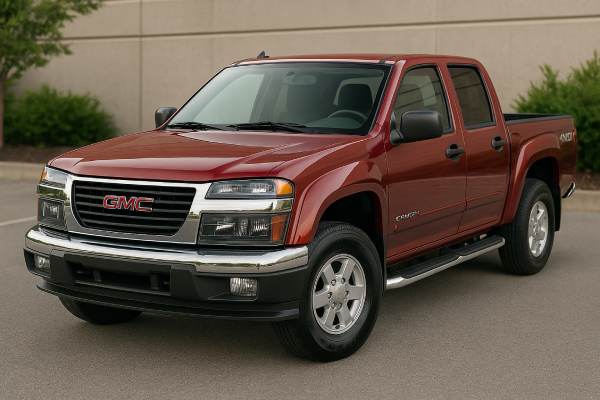
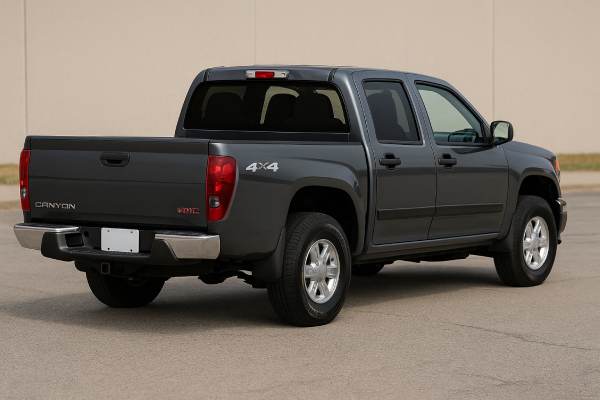
The 2007–2012 GMC Canyon 4WD with the 3.7-liter LLR inline-five sits in a sweet middle ground between light-duty runabout and serious work truck. You get 242 hp, proper low-range four-wheel drive, and a compact footprint that still fits in older garages and tight city spaces. It is a traditional body-on-frame pickup with a live rear axle, leaf springs, and a two-speed transfer case, so it behaves more like a “real truck” than many modern lifestyle pickups.
This guide focuses on the facelifted GMT355 Canyon configured as 4WD, 3.7 LLR, 242 hp, covering specifications, dimensions, performance, off-road ability, reliability patterns, crash and safety ratings, maintenance strategy, and how it stacks up against rivals. The aim is to give you practical insight: what the truck does well, where it falls short, what to check before buying, and how to service it so it remains a dependable partner on rough roads, winter trips, and light towing duty.
Fast Facts
- 3.7 L LLR inline-five delivers 242 hp and solid low-to-mid-range torque, paired with a simple 4-speed automatic and a two-speed 4×4 transfer case.
- True 4WD hardware with low range makes the Canyon surprisingly capable on trails, in deep snow, and on muddy access roads when shod with the right tires.
- Fuel economy is modest (around 13–15 L/100 km mixed; high-teens mpg US), and front crash performance is better than its side-impact and roof-strength scores.
- Watch for timing-chain noise, valvetrain/head issues, exhaust manifold cracking, and age-related rust in frame and suspension hardware.
- As a working used truck, a sensible baseline is engine oil and filter every 8,000 km / 5,000 miles or 6 months, with driveline and coolant services around 80,000–100,000 km if history is unclear.
Navigate this guide
- GMC Canyon 4WD 3.7 in Detail
- Engine Specs and 4WD Hardware
- Safety Equipment in Canyon 4WD Trims
- Long-Term Reliability and Fixes
- Maintenance Plan and Buying Advice
- On-Road and Off-Road Driving
- Canyon 4WD Compared with Rivals
GMC Canyon 4WD 3.7 in Detail
The facelifted 2007–2012 Canyon 4WD 3.7 sits on GM’s GMT355 platform, shared with the Chevrolet Colorado and related global variants. In this configuration you get:
- 3.7-liter LLR inline-five (Atlas family), 242 hp and 328 Nm (242 lb-ft).
- Four-wheel drive with a two-speed, electronically controlled transfer case.
- A 4-speed 4L60-E automatic in most retail trucks.
- Extended-cab and crew-cab bodies with short beds suited to daily use.
Compared with the 2.9 four-cylinder, the 3.7 brings noticeably better torque for towing and highway merging. Compared with the 5.3 V8, it is simpler, lighter, and easier on fuel, while still offering real 4×4 usefulness for forest roads, winter conditions, and light overlanding.
The facelift brought modest exterior and interior updates and, more importantly for many buyers, the widespread availability of stability control and side curtain airbags in later years. Mechanically, the 3.7-liter engine carried on with incremental calibration changes rather than big redesigns, which helps with parts availability and troubleshooting.
In extended-cab 4WD form, overall length is around 5,260 mm (207 in) with a wheelbase near 3,200 mm (126 in). Curb weights typically fall between about 1,790 and 1,900 kg (≈3,950–4,200 lb) depending on cab and equipment. Many crew-cab 4WD 3.7 trucks with automatic transmission are rated to tow up to 2,495–2,722 kg (5,500–6,000 lb) when properly equipped with the right axle ratio and tow package; always confirm your exact rating on the door-jamb label and in the manual.
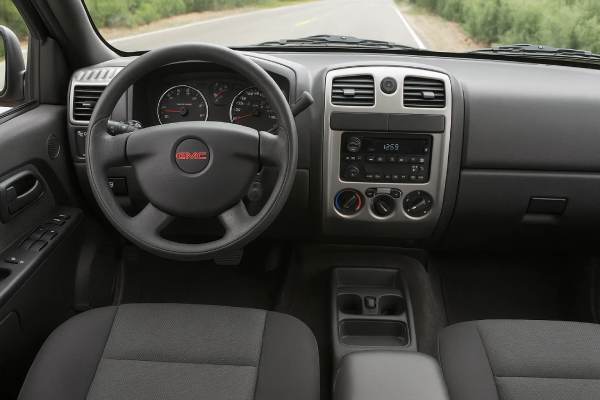
On the road, the Canyon feels narrow and easy to place compared with newer midsize trucks, which have grown significantly. Inside, materials are basic but durable, and the cabin layout is straightforward to understand even for first-time owners. The trade-off is that it lacks modern connectivity and driver-assist technology, so buyers coming from newer SUVs may find it spartan.
From an ownership perspective, the Canyon 4WD 3.7 is best thought of as a compact, honest working truck. It rewards regular maintenance and sensible use. Neglected service, repeated overloading, or poorly executed suspension lifts can quickly erode its durability margins.
Engine Specs and 4WD Hardware
Engine and performance (LLR 3.7 inline-five)
The LLR engine is part of GM’s Atlas inline family:
| Item | Specification |
|---|---|
| Engine code | LLR |
| Layout | Inline-5, DOHC, 4 valves per cylinder, variable intake timing |
| Displacement | 3.7 L (3,654 cc) |
| Bore × stroke | 95.5 × 102.0 mm (3.76 × 4.02 in) |
| Compression ratio | About 10.0:1 |
| Induction | Naturally aspirated |
| Fuel system | Sequential multi-port injection |
| Max power | 242 hp @ 5,600 rpm |
| Max torque | 328 Nm (242 lb-ft) around 2,800–4,600 rpm |
| Timing drive | Chain |
| Fuel | Regular unleaded petrol/gasoline |
In use, the LLR delivers a broad plateau of torque rather than a big top-end rush. It pulls adequately from low revs in low range off-road and feels strongest from about 2,500–4,000 rpm on-road. The engine’s character is smoother than a four-cylinder but a little more vocal than a typical V6.
Efficiency and fuel use
For a 2009 GMC Canyon 4WD with the 3.7 and automatic, U.S. EPA ratings show:
- City: 16 mpg US (≈14.7 L/100 km).
- Highway: 21–22 mpg US (≈10.7–11.2 L/100 km).
- Combined: 18 mpg US (≈13.1 L/100 km).
Real-world mixed driving typically lands in the 13–15 L/100 km range (15–18 mpg US) for a healthy truck on stock-size tires, with a modest penalty for heavy loads, winter fuel, or roof racks. At 120 km/h (75 mph), it is realistic to see 14–15 L/100 km (15–17 mpg US) in a crew-cab 4WD.
Transmission, transfer case, and axles
Most 4WD 3.7 Canyons are fitted with the 4L60-E automatic and a part-time 4×4 system:
| Item | Specification |
|---|---|
| Transmission | 4L60-E 4-speed automatic |
| Typical gear ratios | 1st 3.06, 2nd 1.63, 3rd 1.00, 4th 0.70, reverse 2.29 |
| Transfer case | Electronically controlled, 2-speed (2HI, 4HI, 4LO) |
| 4LO ratio | ~2.64:1 low-range reduction (varies slightly by case) |
| Drive type | Part-time 4×4 with manual/electronic selection |
| Front axle | Independent front suspension with front differential and CV shafts |
| Rear axle | Solid axle with leaf springs; open diff or optional automatic locker (G80) |
With part-time 4×4, you must use 2HI on dry pavement to avoid driveline binding. 4HI is for loose surfaces like gravel, snow, or mud, and 4LO is for steep grades, crawling, or pulling heavy loads at low speeds.
Common axle ratios in 3.7 4WD trucks include 3.42:1 and 3.73:1. Deeper gears (numerically higher ratio) help towing and off-road response at the cost of slightly higher revs and fuel use at highway speeds.
Chassis, dimensions, and capacities (typical 4WD extended/crew cab)
Approximate values for a 4WD extended-cab 3.7 automatic:
| Item | Specification (approx.) |
|---|---|
| Length | ~5,260 mm (207.1 in) |
| Width | ~1,742 mm (68.6 in) |
| Height | ~1,720–1,750 mm (67–69 in), depending on tires/suspension |
| Wheelbase | 3,200 mm (126 in) |
| Ground clearance | Often around 200–230 mm (8–9 in) in stock 4WD trim |
| Curb weight | ~1,790–1,900 kg (3,950–4,200 lb) |
| GVWR | Around 2,404–2,540 kg (5,300–5,600 lb), depending on cab and options |
| Fuel tank | ~72 L (19 US gal) |
| Bed length | ~1,830 mm (72 in) for extended-cab long bed; ~1,550–1,560 mm (≈61 in) crew-cab short bed |
Towing and payload (typical crew-cab 4WD 3.7 with tow package):
- Maximum towing: up to about 2,495–2,722 kg (5,500–6,000 lb).
- Payload: usually 500–550 kg (1,100–1,200 lb), including passengers and cargo.
Always verify your specific truck’s numbers on its certification label; options, cab style, and axle ratio all affect ratings.
Fluids, capacities, and key items
These are typical, high-level figures; always confirm with the official manual:
- Engine oil: 5W-30 meeting GM specifications, roughly 5.7 L (≈6.0 qt) with filter.
- Coolant: 50/50 mix of clean water and DEX-COOL long-life coolant.
- Automatic transmission: Dexron-VI ATF for the 4L60-E.
- Transfer case and differentials: 75W-90 gear oil meeting GL-5 spec (type and friction modifiers can vary; check axle codes).
- A/C system: R-134a era; capacity on the under-hood label.
Critical torque values (wheel nuts, suspension bolts, head bolts, etc.) must always be taken from the factory service manual for your exact year and drivetrain.
Safety Equipment in Canyon 4WD Trims
Trims and equipment for 4WD 3.7 trucks
For the facelift era, 4WD 3.7-liter trucks mainly show up in:
- Work Truck / Base 4×4:
- Often 2.9-liter, but some fleets specify the 3.7.
- Vinyl or basic cloth seats, manual windows/locks on early trucks.
- 4×4 hardware but minimal comfort equipment.
- SLE / SLE1 / SLE2 4WD:
- The most common private-owner trims with the 3.7.
- Power accessories, upgraded cloth, alloy wheels, and more sound insulation.
- Many are crew-cab 4WD with short bed and tow package.
- SLT / Z71 / off-road-oriented packages (where offered):
- May add leather, special wheels, and appearance items.
- Z71 Off-Road package can bring slightly different suspension tuning, skid plates, and all-terrain tires, boosting off-road robustness.
Key option codes to look for on the glovebox RPO label:
- LLR – confirms the 3.7-liter engine.
- G80 – automatic locking rear differential (highly desirable in a 4WD truck).
- Suspension and appearance codes related to Z71 and other packages.
Passive safety and structure
From a crash-protection standpoint, this generation Canyon performs reasonably in moderate frontal impacts but poorly in side impacts without side airbags:
- IIHS frontal moderate-overlap tests on extended-cab models: Good overall, with good structure and generally low injury measures.
- Crew-cab frontal tests: typically Acceptable overall, with some footwell intrusion and marginal structural ratings at the lower front.
- Side-impact tests on crew-cab models without side airbags score Poor overall, with high loads to the driver’s torso and pelvis.
- Later tests on vehicles with side curtain airbags improve head protection but still show weak structure in certain scenarios.
Government (NHTSA) ratings for similar 4-door trucks indicate:
- Frontal: up to 5 stars for driver and front passenger on some crew-cab configurations.
- Side: mixed but generally mid-pack for the era, depending on airbags and cab style.
- Rollover: typically 4 out of 5 stars for 4WD models.
The structural cabin is solid in straightforward frontal crashes but less impressive in severe side impacts and rollovers compared with newer midsize pickups.
Active safety and driver aids
The Canyon 4WD’s safety technology is basic by modern standards:
- ABS: standard across the range.
- Traction control: introduced and expanded across more trims in the facelift years.
- Stability control (StabiliTrak): widely available on later facelift models and highly recommended if you regularly drive in poor weather.
- TPMS: fitted in accordance with regulations in most markets.
There is no factory automatic emergency braking, lane-keep assist, adaptive cruise, or blind-spot monitoring. For buyers coming from a modern crossover, this is a significant step back in electronic protection.
Airbags, child seats, and cabin safety
Airbag fitment depends heavily on year and options:
- Front airbags: standard for driver and front passenger.
- Side curtain airbags: optional early on and later more common, especially on higher trims. Prefer trucks with curtains if you regularly carry passengers.
- Child-seat provisions: crew-cab models offer LATCH/ISOFIX anchors on rear positions. A rear-facing child seat will fit, but legroom for front occupants can be tight; extended-cab jump seats are less suitable for regular child-seat use.
If safety is a priority, the best choice is a later facelift crew-cab 4WD 3.7 with side curtain airbags and stability control. Always verify airbag presence visually (labels on pillars) rather than assuming from trim name.
Long-Term Reliability and Fixes
The 3.7-liter Canyon 4WD can run well past 300,000 km (≈200,000 miles) when maintained, but several recurring issues are worth understanding. Below is a high-level map by system.
Engine: common issues and remedies
Cylinder-head and valve-seat wear (Atlas family)
- Prevalence: occasional to common on high-mileage engines.
- Typical mileage: often beyond 160,000 km / 100,000 miles, especially with extended oil intervals.
- Symptoms: persistent misfire on one cylinder (often with a P030x code), rough idle, reduced power, sometimes hard starting.
- Likely cause: valve-seat recession or poor sealing in the affected cylinder, known in technical bulletins for Atlas engines.
- Remedy: compression and leak-down tests. If leakage is through valves, the proper fix is head removal and valve/seat repair or replacement, often with updated parts and revised procedures.
Timing-chain wear and tensioner issues
- Prevalence: occasional; risk rises sharply with poor oil-change history.
- Symptoms: rattling at cold start or hot idle, cam timing errors, and associated fault codes.
- Cause: timing chain stretch and guide/tensioner wear from dirty or low oil.
- Remedy: replace chain, guides, and tensioner; follow factory procedures carefully to secure lower timing gears during head removal.
Exhaust manifold cracking
- Prevalence: relatively common on older trucks in cold climates.
- Symptoms: ticking exhaust noise on cold start that softens as the manifold expands, exhaust odor near the firewall, and sometimes visible cracks.
- Remedy: manifold replacement (often with updated or aftermarket part), new hardware, and checking for warped mating surfaces.
Cooling system and thermostat
- Radiators and thermostats can age out, leading to slow warm-up or intermittent overheating. Regular coolant changes and timely replacement of failing thermostats and caps are key to avoiding bigger problems.
Driveline and 4×4 system
4L60-E automatic
- Common behavior: relatively smooth shifts when healthy; holds gears under load in tow/haul mode.
- Issues: harsh shifts, flares, shudder, or delayed engagement, especially after heavy towing or if fluid has never been changed.
- Remedies:
- Early-stage issues sometimes improve with a proper fluid and filter change using Dexron-VI.
- Severe symptoms usually point to worn clutches or valve-body problems; rebuild or replacement is then needed.
Transfer case and front axle
- Regular fluid changes are often neglected. Lack of service can cause bearing wear, noise, or sticking engagement.
- 4×4 that refuses to engage/disengage can stem from actuator faults, wiring corrosion, or internal case issues; diagnosis starts with electrical checks, then mechanical.
Rear axle and G80 locker
- The automatic locker is mechanically robust but can become noisy or inconsistent if fluid is old or contaminated. Correct gear oil and change intervals help keep it operating properly.
Suspension, steering, and corrosion
- Front suspension: ball joints, control-arm bushings, and sway-bar links commonly wear, causing clunks and wandering steering feel.
- Rear leaf springs and shackles: can rust in salt-belt regions; squeaks or visible rust near shackle mounts warrant closer inspection.
- Steering racks/gear: on high-mileage trucks, play around center and fluid seepage are not rare.
- Frame and underbody: pay special attention to the rear frame rails, crossmembers, and bed-to-frame mounts in wet or salted climates.
Recalls, campaigns, and technical bulletins
Over its life, the Canyon/Colorado platform has seen:
- Recalls for various items (e.g., brake-light switches, wiring, and other detail components).
- Technical bulletins and special coverages around Atlas engine head/valve issues and updated timing-gear service procedures.
For any specific truck:
- Run the VIN through your region’s official recall lookup (such as NHTSA for U.S. vehicles).
- Ask a dealer to print a service history/recall completion report.
- Confirm whether major engine or transmission work has been done and if factory parts/procedures were used.
Taken as a whole, the Canyon 4WD 3.7 is not problem-free, but most issues are well understood. Trucks with documented maintenance, quiet cold starts, clean shifting, and minimal rust are generally safe bets for long-term use.
Maintenance Plan and Buying Advice
Practical maintenance schedule (used 4WD 3.7)
These intervals are a conservative guide for a used Canyon 4WD 3.7 of unknown history. Always fine-tune based on your manual, usage, and local conditions.
Engine
- Engine oil and filter: every 8,000 km / 5,000 miles or 6 months, shorter if you tow, idle heavily, or drive short trips.
- Engine air filter: inspect every 20,000 km; change around 40,000 km or sooner in dusty conditions.
- Spark plugs (iridium): around 160,000 km / 100,000 miles is typical; many owners choose 100,000 km / 60,000 miles for a used truck.
- Fuel filter: if externally serviceable, 80,000–100,000 km.
Cooling and belts
- Coolant (DEX-COOL 50/50): every 5 years or 160,000 km. For a new-to-you truck with unknown history, make coolant flush a priority.
- Thermostat and cap: consider replacement around 10+ years or during a major cooling service.
- Serpentine belt: inspect annually, replace at the first sign of cracking or noise, or around 100,000 km.
- Hoses: squeeze-test yearly and replace if soft, swollen, or visibly cracked.
Transmission and 4×4 system
- Automatic transmission (4L60-E): fluid and filter every 60,000–80,000 km / 40,000–50,000 miles.
- Transfer case fluid: about every 80,000–100,000 km or sooner if you frequently use 4LO.
- Front and rear differentials: change gear oil every 80,000–100,000 km; shorter intervals if towing or off-roading in water/mud.
Brakes and chassis
- Brake fluid: flush every 2–3 years.
- Pads, rotors, and drums: inspect at each tire rotation; renew in axle pairs.
- Tire rotation: every 10,000–12,000 km (6,000–7,500 miles), with alignment checks at least every second rotation.
- Suspension and steering: inspect ball joints, tie-rod ends, and bushings annually.
Electrical and climate control
- 12 V battery: test annually after year 4–5; plan replacement every 4–6 years depending on climate.
- Cabin air filter (if fitted): every 24–36 months.
- A/C system: if performance drops, pressure test and inspect for leaks rather than simply topping up refrigerant.
Buyer’s checklist for a used Canyon 4WD 3.7
When evaluating a candidate truck:
- Paperwork and history
- Look for evidence of regular oil changes, coolant service, and any drivetrain fluid changes.
- Confirm completion of recalls and any major engine or transmission repairs.
- Cold start and idle
- Listen for timing-chain rattle or loud ticking on cold start.
- Check for exhaust leaks at the manifold.
- Once warm, idle should be smooth with no persistent misfire.
- Test drive
- Verify smooth engagement of 2HI → 4HI → 4LO and back.
- Drive at city and highway speeds; shifts should be predictable, not flaring or banging.
- On a gentle brake test, the truck should track straight with no steering wheel vibration.
- Underside and body
- Inspect frame rails, crossmembers, rear spring mounts, and brake lines for corrosion.
- Check bed seams, cab corners, and rocker panels for rust bubbles.
- Look for evidence of off-road abuse (deep scrapes on crossmembers or transfer-case skid plates).
- Tires and alignment
- Uneven wear often signals alignment or suspension issues; budget for front-end work if tires are badly cupped or feathered.
- Safety features
- Confirm presence of side curtain airbags and stability control in later trucks if these are important to you.
Which years and specs to target
- 2009–2012 trucks tend to be the sweet spot: they benefit from incremental improvements and wider availability of stability control and side curtains.
- Look for crew-cab or extended-cab 4WD 3.7 with G80 locker and tow package if you plan to tow or drive regularly in poor weather.
- Avoid heavily modified trucks with tall lifts, extreme tires, or evidence of hard off-road use unless you can thoroughly inspect the work and factor in upgrade/repair costs.
With the right example and a structured maintenance plan, a Canyon 4WD 3.7 can be a durable, versatile truck for mixed city, highway, and off-pavement use.
On-Road and Off-Road Driving
Powertrain feel and everyday use
On pavement, the 3.7-liter inline-five offers adequate rather than dramatic performance. In everyday driving:
- Throttle response is smooth, with enough low-end torque for city traffic.
- The engine feels strongest between 2,500 and 4,000 rpm, where passing and merging are comfortable.
- The 4L60-E upshifts fairly early in normal mode to save fuel; using “3” instead of “D” can make the truck feel more responsive in hilly or city terrain.
Typical performance for a crew-cab 4WD 3.7 automatic is:
- 0–100 km/h (0–62 mph): around 10–11 seconds.
- Top speed: near 160–170 km/h (100–105 mph), electronically limited.
It is not a sports truck, but it has no trouble maintaining highway speeds with passengers and light cargo.
Ride, handling, and noise
The Canyon’s suspension tuning reflects its work-truck roots:
- Unladen ride is firm and can feel choppy on broken pavement, especially at the rear.
- With 200–300 kg (400–600 lb) of load in the bed, the ride smooths out and axle hop is reduced.
- Steering is relatively slow but predictable, with good straight-line stability on the highway.
Noise levels are typical for a mid-2000s body-on-frame pickup:
- Engine and induction noise are noticeable under heavy throttle.
- Wind noise around mirrors and door seals increases at higher speeds.
- Tire noise depends heavily on tread type; aggressive all-terrains are loud on coarse asphalt.
Off-road and winter use
Where the Canyon 4WD 3.7 shines is on rough or slippery surfaces:
- 4HI provides good traction in snow, gravel, and wet grass when combined with decent tires.
- 4LO and the 3.7’s torque allow controlled crawling over rocks, ruts, or steep property tracks.
- An optional G80 locker in the rear axle is a major advantage when one wheel loses traction.
Off-road, the main limitations are:
- Ground clearance and breakover angle on long-wheelbase crew-cab trucks.
- Vulnerable components if the truck lacks skid plates.
- Cooling and transmission temperatures when towing heavy loads up long grades in hot weather.
For winter driving, a set of dedicated snow tires on factory-size wheels transforms grip and braking performance. The narrow body and relatively light weight also make the truck easier to place on narrow or unplowed roads than some modern, wider pickups.
Real-world efficiency and range
In mixed driving, most owners of stock 4WD 3.7 Canyons report:
- City: 15–17 L/100 km (14–16 mpg US).
- Highway at 100–110 km/h (60–70 mph): 12–13 L/100 km (18–20 mpg US).
- Highway at 120 km/h (75 mph) or with moderate loads: 13–15 L/100 km (15–18 mpg US).
With a roughly 72-liter (19-gallon) tank, practical range with a comfortable reserve is commonly 430–500 km (270–310 miles), depending on driving style and conditions.
Towing and load behavior
When properly equipped, the Canyon 4WD 3.7 is rated to tow up to around 2,500–2,700 kg (5,500–6,000 lb). In practice:
- Ideal trailer weight is often closer to 1,500–2,000 kg (3,300–4,400 lb) for relaxed performance, especially in hilly country.
- The truck feels stable with a correctly loaded trailer and functioning trailer brakes.
- Transmission temperatures and braking distances are the main constraints; regular ATF changes and good trailer-brake setup are essential.
Under maximum payload, the rear suspension squats but remains reasonably controlled if shocks and leaf springs are healthy. Carefully distributing cargo forward of the rear axle and avoiding exceeding rated capacities makes a big difference to stability and component life.
Canyon 4WD Compared with Rivals
When new, the Canyon 4WD 3.7 competed mainly with:
- Toyota Tacoma (2.7 four-cylinder and 4.0 V6).
- Nissan Frontier (2.5 four-cylinder and 4.0 V6).
- Ford Ranger (last compact generation in North America).
- Its sibling, the Chevrolet Colorado.
Where the Canyon 4WD 3.7 is strong
- Manageable size with genuine 4×4 hardware
- Narrow body and relatively short overall length make it easier to maneuver and park than many modern midsize trucks.
- Real two-speed transfer case and available rear locker give it impressive traction in rough or snowy conditions.
- Straightforward mechanical layout
- Naturally aspirated engine, conventional automatic, and simple part-time 4×4 system are easier to understand, diagnose, and service than complex modern drivetrains.
- Parts availability is good thanks to shared components with Colorado and other GM products.
- Used-market value
- Purchase prices are generally lower than comparable Tacomas or Frontiers of similar age and mileage.
- For buyers who prioritize function over a fancy interior, the Canyon can be a cost-effective work or adventure truck.
Where rivals do better
- Crash safety and structural performance
- Tacoma and later Frontier generations typically post stronger side and roof scores, plus better overall safety reputations.
- The Canyon’s poor side-impact ratings for crew cabs without side airbags are a significant downside if you often carry family.
- Refinement and interior quality
- Materials, seat comfort, and noise isolation lag behind some rivals, particularly newer models.
- Infotainment and connectivity features are basic; many owners retrofit aftermarket head units.
- Fuel economy
- While not dramatically worse than similar-era competitors, the 3.7-liter five-cylinder is not especially efficient for its output.
- Buyers focused on fuel use may prefer a four-cylinder Tacoma or a more modern midsize truck entirely.
Who should consider a Canyon 4WD 3.7
This truck suits owners who:
- Need a true 4×4 in a compact package for rural property, winter commuting, fishing, or trail access.
- Are comfortable following a proactive maintenance plan and budgeting for age-related repairs.
- Prioritize value and mechanical simplicity over the latest technology.
Shoppers who are most concerned about top-tier crash protection, advanced driver aids, and modern comfort may be better served by a newer generation Canyon, a Tacoma, or even a unibody SUV-based pickup. For those who appreciate an honest, straightforward small truck and are willing to maintain it properly, the 4WD 3.7 Canyon can still be a very satisfying choice.
References
- Manuals and Guides | Vehicle Support 2024 (Owner’s Manual)
- Gas Mileage of 2009 GMC Canyon 2024 (Fuel Economy Data)
- 2009 GMC Canyon 2013 (Safety Rating)
- 2009 GMC Canyon extended cab pickup 2013 (Safety Rating)
- GMC Canyon I Extended cab 3.7 (242 Hp) 4WD Automatic 2024 (Specifications)
Disclaimer
This article is provided for informational purposes only and does not replace professional diagnosis, repair advice, or official service documentation. Specifications, torque values, service intervals, towing and payload ratings, and feature availability can vary by VIN, model year, market, trim level, and installed options. Always confirm critical data against your vehicle’s official owner’s manual, factory service information, and current technical bulletins, and consult a qualified technician before performing maintenance, repairs, or modifications.
If this guide helped you understand the GMC Canyon 4WD 3.7 better, you are welcome to share it on social platforms such as Facebook or X/Twitter to support accurate, practical automotive information for other owners and shoppers.