
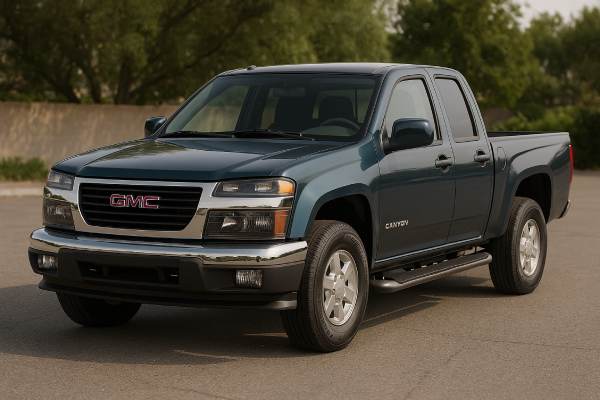
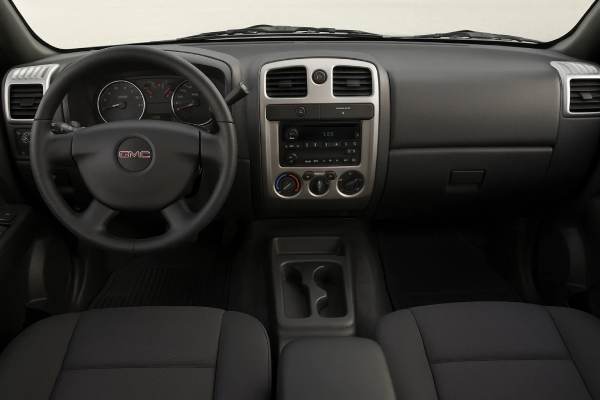
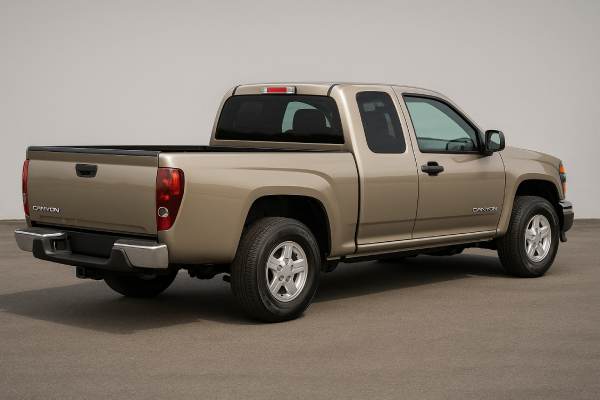
The 2010–2012 GMC Canyon RWD with the LH9 5.3-liter V8 is one of the most unusual versions of the first-generation Canyon. It combines a compact midsize body with a full small-block V8, rear-wheel drive, and towing figures that start to overlap lighter full-size pickups. For buyers who like the idea of a smaller truck but do not want to give up V8 torque, this configuration is especially appealing.
Under the hood sits the LH9 5.3-liter Vortec V8 with variable valve timing and flex-fuel capability, rated at 300 hp and 320 lb-ft. It is paired with the proven 4L60-E four-speed automatic and a robust rear axle, typically with a 3.73:1 ratio when ordered with tow or sport packages. The result is a Canyon that accelerates with authority, tows confidently when set up correctly, and still fits into the same parking spaces as the four- and five-cylinder versions. This guide explains how it is built, how it performs, what commonly fails, and how to maintain or shop for one intelligently.
Top Highlights
- Rare LH9 5.3-liter V8 option gives the Canyon RWD strong, effortless acceleration and up to roughly 2,700 kg (6,000 lb) of towing when properly equipped.
- Compact GMT355 chassis and rear-wheel drive layout make the truck easier to park and more engaging to drive than many larger full-size V8 pickups.
- Fuel use is heavy for a midsize truck (EPA around 14/20 mpg US for 2WD V8), and rear-wheel traction on wet or snowy roads demands good tires and careful throttle use.
- For long-term durability, a sensible baseline is engine oil and filter every 8,000 km / 5,000 miles or 6 months, with transmission and axle fluids refreshed around 60,000–80,000 km on working trucks.
What’s inside
- GMC Canyon 5.3 RWD profile
- Technical specs for 5.3 V8
- Model grades and protection features
- Reliability problems and key fixes
- Service intervals and buyer checks
- Performance feel and real economy
- How the 5.3 Canyon compares
GMC Canyon 5.3 RWD profile
The V8-powered Canyon RWD is a niche configuration built near the end of the first-generation GMT355 run. While most Canyons left the factory with four- or five-cylinder engines, a small number were ordered with the LH9 5.3-liter V8, usually in better-equipped SLE or SLT trims. This puts it in rare company: a compact, body-on-frame pickup with a full small-block V8 and rear-wheel drive only.
Mechanically, the truck still rides on the same ladder frame as other Canyons, with independent front suspension, a leaf-sprung solid rear axle, and hydraulic power steering. What changes is the drivetrain and some of the hardware attached to it. The LH9 V8, related to other Gen IV LS-family engines, brings 300 hp and 320 lb-ft, plus variable valve timing and flex-fuel capability (E85 where available), but no cylinder-deactivation system. That last point is attractive to owners who want to avoid the lifter issues associated with some Active Fuel Management engines in other GM trucks.
A four-speed 4L60-E automatic is standard with the V8. Rear-drive models typically use a 3.73:1 rear axle ratio when paired with Z71 High-Stance Off-Road or certain tow packages, giving a useful blend of towing ability and highway rpm. Factory ratings show maximum trailer weights up to roughly 2,700 kg (6,000 lb) for well-specified 2WD V8 trucks, assuming proper equipment, correct hitching, and trailer brakes on heavier loads.
Visually, most V8 RWD Canyons look similar to other SLE/SLT models: body-colour bumpers on some packages, alloy wheels, and subtly different badging. The easiest way to confirm the V8 is to check under the hood or decode the VIN and RPO label for engine code LH9. Many examples also include tow-related equipment such as a receiver hitch, trailer wiring, and heavier cooling.
For owners, the main appeal is how much truck you get in a relatively compact footprint. It can tow a car hauler, ski boat, or medium camper while remaining easy to park and drive in town. The trade-offs are straightforward: fuel economy is closer to a light full-size V8 pickup than to a modern four-cylinder midsize, and rear-wheel drive makes tire choice, load in the bed, and driving style more important in poor weather.
Technical specs for 5.3 V8
Engine and performance (LH9 Vortec 5.3 V8)
The LH9 is a Gen IV small-block V8 adapted for the GMT355 trucks. It adds variable valve timing and flex-fuel capability over the earlier LH8, but does not use Active Fuel Management.
| Item | Specification (LH9 V8) |
|---|---|
| Engine code | LH9 Vortec 5.3 V8 |
| Layout | 90° V8, pushrod OHV, 2 valves per cylinder |
| Displacement | 5.3 L (325 cu in) |
| Bore × stroke | 96.0 × 92.0 mm (3.78 × 3.62 in) |
| Compression ratio | ~9.6–9.7:1 (varies slightly by year) |
| Induction | Naturally aspirated |
| Fuel system | Sequential multi-port fuel injection, flex-fuel capable |
| Max power | 300 hp @ 5,200 rpm |
| Max torque | 320 lb-ft (≈434 Nm) @ 4,000 rpm |
| Timing drive | Chain |
| Firing order | 1–8–7–2–6–5–4–3 (typical Gen IV LS-family) |
| Recommended fuel | Regular unleaded; E85 compatible in many markets |
In the Canyon, this engine gives a strong mid-range and a relaxed highway character. Torque is available early enough that the truck feels eager with modest throttle, especially unladen. Compared with the 3.7-liter inline-five, the V8 is noticeably stronger in towing and highway passing, with a smoother and more refined sound.
Transmission and rear-drive hardware
| Item | Specification (typical V8 RWD) |
|---|---|
| Transmission | 4L60-E 4-speed automatic |
| Gear ratios | 1st 3.06, 2nd 1.63, 3rd 1.00, 4th 0.70, reverse 2.29 |
| Drive type | Rear-wheel drive (2WD) only in this configuration |
| Rear axle | Solid axle with leaf springs |
| Common axle ratio | ~3.73:1 with many V8/tow or Z71 packages |
| Differential | Open or automatic locking (G80) depending on RPO codes |
Without a transfer case or front differential, the V8 RWD Canyon is mechanically simpler than its 4WD counterpart, with fewer parts to service. The trade-off is traction: on wet, snowy, or loose surfaces, an open-diff RWD truck can struggle unless it has good tires and some weight over the rear axle. The optional locking differential is a valuable upgrade.
Chassis, dimensions, and weights (typical crew/extended-cab RWD V8)
Exact numbers vary by cab and trim, but typical V8 RWD figures are:
| Item | Approximate value |
|---|---|
| Overall length | ~5,260 mm (≈207 in) |
| Width | ~1,740–1,780 mm (≈69–70 in) |
| Height | ~1,680–1,720 mm (≈66–68 in) |
| Wheelbase | 3,200 mm (126 in) for crew and extended cabs |
| Curb weight | ~1,800–1,900 kg (≈3,970–4,200 lb) in V8 RWD crew cabs |
| GVWR | ~2,400–2,540 kg (≈5,300–5,600 lb) |
| Fuel tank | ~72 L (19 US gal) |
| Bed length | ≈1,560 mm (61.4 in) crew cab; ≈1,830 mm (72 in) extended-cab long bed |
Suspension is by double wishbones and coil springs at the front, plus a leaf-sprung solid axle at the rear. Many V8 trucks come with Z71 High-Stance Off-Road or ZQ8 sport suspension packages, which alter ride height, shock valving, and wheel/tire packages.
Performance, economy, and capacities
Factory data and period tests indicate:
- 0–100 km/h (0–62 mph): roughly 7.5–8.5 seconds for a crew-cab V8 RWD.
- Top speed: typically limited to around 170 km/h (105 mph).
- Maximum towing: up to about 2,700 kg (6,000 lb) when properly equipped with the 5.3 V8, correct axle ratio, and tow package.
EPA-estimated fuel economy for 2WD V8 models is about 14 mpg city / 20 mpg highway (≈16.8 / 11.8 L/100 km). Real-world mixed driving usually falls in the 14–17 L/100 km range (13–17 mpg US), depending on load, driving style, and tire choice.
Typical service-fill capacities (always verify for your exact VIN):
- Engine oil: roughly 5.7–6.0 L (≈6 qt) of 5W-30 meeting GM specs.
- Coolant: DEX-COOL long-life coolant in a 50/50 mix; capacity around 11–13 L (≈12–14 qt).
- Automatic transmission (4L60-E): Dexron-VI ATF; pan-drop refill around 4–5 L, full overhaul fill higher.
- Rear axle: 75W-90 GL-5 gear oil; capacity around 1.6–2.0 L depending on axle.
Electrical basics include an alternator output typically around 125–150 A and a standard 12 V lead-acid battery sized for truck duty.
Model grades and protection features
Trims that typically carry the 5.3 V8 RWD
The LH9 5.3-liter V8 was available only in better-equipped versions of the Canyon and mostly in the North American market. You are most likely to see it in:
- SLE crew-cab 2WD
- SLE or SLT extended-cab 2WD
- Selected trucks ordered with Z71 High-Stance Off-Road or ZQ8 sport suspension packages.
The engine option itself is coded by RPO LH9, and the V8 brings associated supporting hardware such as upgraded cooling, a stronger rear axle, and sometimes different wheel and tire packages. Tow-related options can include:
- Receiver hitch and 7-pin or combined 4/7-pin trailer wiring.
- Heavy-duty cooling (often linked to tow package).
- Axle ratios tuned to towing rather than pure economy (commonly 3.73:1 for V8 2WD).
Interior and convenience equipment varies by trim:
- Work Truck with V8 (rare): basic cloth or vinyl, manual seats, fewer comfort features but strong drivetrain.
- SLE: power windows and locks, better cloth seat fabrics, improved audio, and more storage options.
- SLT: can add leather seating, fog lamps, upgraded wheels, and extra trim details.
Quick identifiers include V8 badging on some trucks, dual exhaust outlets on certain packages, and the VIN/RPO labels confirming LH9 and axle codes.
Safety equipment and ratings
Facelift-year Canyons benefited from expanded standard safety equipment. By 2011–2012, most configurations included:
- Head curtain side airbags across the range.
- Stability control (StabiliTrak) and traction control as standard.
- ABS on all models.
- OnStar with crash notification and assistance on many trims.
Crash-test data from the Insurance Institute for Highway Safety (IIHS) shows:
- Extended-cab Canyon (2004–2012):
- Moderate-overlap frontal test: Good.
- Head restraints and seats: Marginal.
- Crew-cab Canyon (2004–2012):
- Moderate-overlap frontal test: Acceptable overall.
- Side-impact test: Poor.
- Roof strength and head restraints: Marginal.
Because these ratings are based on the underlying structure and body shell, they apply broadly to V8 as well as four- and five-cylinder versions. Side-impact performance is a known weakness, especially for crew cabs, although side curtains help with head protection compared with trucks that lack them.
Child-seat and interior safety notes
Crew-cab models provide:
- Rear outboard seating positions with LATCH/ISOFIX anchors for child seats.
- Enough legroom for forward-facing child seats and most boosters, although very large rear-facing seats may crowd front occupants.
Extended cabs, with their smaller rear area and jump seats, are much less suitable as daily family haulers, though they may work for occasional use with careful installation.
Given the modest crash scores, buyers who expect to carry passengers regularly should prioritize:
- Crew-cab or extended-cab trucks with side curtain airbags, and
- The latest facelift years (2011–2012) with full stability control and updated safety feature sets.
Reliability problems and key fixes
The LH9 V8 Canyon RWD inherits many of the strengths of GM’s Gen IV small-block family: a strong bottom end, well-understood parts, and wide aftermarket support. It also sidesteps some of the cylinder-deactivation issues seen on other 5.3 variants because it does not use Active Fuel Management. Nonetheless, there are recognizable patterns of wear and failure across engine, transmission, and chassis.
Engine-related issues
Exhaust manifold bolts and leaks
- Prevalence: common on older LS-family truck engines.
- Symptoms: ticking noise on cold start that fades as the engine warms, occasional exhaust smell near the firewall.
- Cause: broken or corroded manifold bolts, sometimes warping the manifold.
- Remedy: replace broken bolts and, if needed, the manifold; use new gaskets and hardware.
Oil leaks (oil pan, rear main, valve covers)
- Prevalence: occasional to common after 10+ years.
- Symptoms: oil drips under the rear of the engine or transmission, burnt-oil smell on hot components, oily bellhousing.
- Remedy: reseal the affected components. Rear main seal and oil pan resealing are more labour-intensive; many owners combine them with transmission service or clutch work on other platforms.
Cooling system wear
- Radiators, water pumps, and thermostats can age out around the 10–15-year mark, leading to small leaks, erratic temperature behaviour, or overheating in high-load towing.
- A proper DEX-COOL flush and timely replacement of aging hoses and thermostats help prevent more serious damage.
Overall, catastrophic bottom-end failures are relatively rare when the correct oil is used and changes are kept reasonable. Neglect, overheating, or low oil levels are the common threads behind severe engine damage.
Transmission and driveline
The 4L60-E is widely used and reasonably durable, but known weak points show up if service has been ignored or the truck has been used hard for towing:
- Shift flare or harshness: can be due to worn clutches, valve-body wear, or solenoid problems.
- Delayed engagement into drive or reverse: often a sign of internal wear or low fluid level.
- Torque-converter shudder: may improve with fresh Dexron-VI fluid, but persistent issues call for deeper diagnosis.
Preventive servicing every 60,000–80,000 km with a proper fluid and filter change greatly improves longevity.
The rear axle is generally robust. Wheeled hard, trucks can develop:
- Differential whine or rumble: often bearing wear; loud noises on coast or load transitions warrant inspection.
- Locker (G80) behaviour issues: if fitted, old or contaminated fluid can cause clunky engagement; correct oil and regular changes are critical.
Suspension, steering, and corrosion
Common chassis issues mirror other GMT355 trucks:
- Front upper and lower ball joints, control-arm bushings, and sway-bar links wear and produce clunks, wandering steering, and uneven tire wear.
- Steering-rack or gearbox play develops in some high-mileage trucks, felt as looseness around centre on the highway.
- Leaf springs and shackles at the rear can rust and squeak; in severe cases, shackle failure is a risk in heavy corrosion regions.
Corrosion hotspots include:
- Rear frame rails and crossmembers.
- Bed-to-frame mounting points.
- Brake lines in salt-heavy climates.
Recalls, TSBs, and service actions
Over its life, the Canyon platform has had recalls and technical bulletins regarding items such as brake-light switches, electrical connections, and specific component failures. For a specific truck:
- Run the VIN through your region’s official recall database (e.g., NHTSA in the U.S.).
- Ask a GMC dealer to check for outstanding recalls or special coverage programs.
Because the powertrain is shared with other GM vehicles, some software updates and calibration changes may exist for engine and transmission control modules. When diagnosing driveability issues such as rough idle, shifting anomalies, or fault codes, checking for updated calibrations is a sensible step before replacing hardware.
In summary, a well-maintained Canyon RWD 5.3 with evidence of regular fluid changes and little rust is capable of high mileage. The most expensive fixes tend to involve transmission rebuilds, heavy rust remediation, or major engine resealing, so those areas deserve special attention during inspection.
Service intervals and buyer checks
Practical maintenance schedule for the V8 RWD Canyon
For a used truck with unknown history, the safest approach is to establish a fresh baseline. The following intervals are conservative guidelines; always adjust with the official manual and your usage.
Engine
- Oil and filter: every 8,000 km / 5,000 miles or 6 months, sooner with frequent towing, short trips, or heavy idling.
- Engine air filter: inspect every 20,000 km; replace around 40,000 km or earlier in dusty conditions.
- Spark plugs (iridium): around 160,000 km / 100,000 miles under ideal conditions; many owners reduce that to 100,000 km on older trucks.
- Throttle body and MAF cleaning: inspect and clean around every 60,000–80,000 km if idle quality deteriorates.
Cooling system and belts
- Coolant (DEX-COOL): every 5 years or 160,000 km; for a new-to-you truck, flush sooner if age is uncertain.
- Thermostat and cap: consider replacement at 10+ years or during major cooling work.
- Serpentine belt: inspect annually; replace at the first signs of cracking, glazing, or noise.
- Hoses: squeeze-test once or twice a year and replace anything soft, swollen, or cracked.
Transmission and axle
- Automatic transmission (4L60-E): fluid and filter every 60,000–80,000 km (40,000–50,000 miles).
- Rear differential: change gear oil every 80,000–100,000 km; shorten interval if towing or carrying heavy loads frequently.
Because this is a rear-drive truck, there is no transfer case fluid to service, which slightly simplifies the schedule compared with 4WD models.
Brakes, steering, and suspension
- Brake fluid: flush every 2–3 years.
- Pads and rotors: inspect at each tire rotation; replace in axle sets.
- Steering and suspension: inspect ball joints, tie-rod ends, and bushings annually, and after any serious off-road use or heavy impact.
- Tire rotation and alignment: rotate every 10,000–12,000 km and align at least every second rotation or after suspension work.
Electrical and climate
- 12 V battery: test yearly after year 4; plan replacement every 4–6 years depending on climate.
- Cabin air filter (if equipped): every 24–36 months.
- A/C service: investigate gradually declining performance with leak-detection and proper repair, not repeated top-ups.
For torque-sensitive fasteners like wheel nuts, refer to the factory service manual; many GM mid-size trucks specify wheel nut torque in the region of 135–150 Nm (100–110 lb-ft), but the correct value can vary by model year, wheel type, and region.
Buyer checklist for the 5.3 RWD
When evaluating a used Canyon RWD 5.3, focus on:
- Verification of configuration
- Confirm V8 engine code LH9 via VIN decode and RPO label.
- Check for factory tow package, Z71 or ZQ8 suspension codes, and the rear axle ratio.
- Service history
- Look for evidence of regular oil changes and at least one transmission and axle-fluid service.
- Check for documented cooling system work (radiator, pump, thermostat) on higher-mileage trucks.
- Cold start and engine sound
- Listen for exhaust manifold tick, deep knocks, or timing-chain noise.
- After warm-up, idle should be smooth, with no misfires or fuel smells.
- Transmission behaviour
- On test drive, shifts should be decisive but not harsh; no slipping, banging, or long delays into gear.
- At highway speed, lock-up should engage cleanly without hunting.
- Underbody and frame
- Inspect frame rails, crossmembers, leaf-spring mounts, brake lines, and bed rails for corrosion.
- Surface rust is normal; flaking or perforation is a red flag.
- Suspension and tires
- Check for uneven tire wear, indicating alignment or suspension issues.
- Listen for clunks over bumps and feel for steering play or wandering.
- Safety and crash history
- Confirm presence of head curtain side airbags and stability control in the equipment list.
- Inspect for overspray, misaligned panels, or frame repairs that might indicate a significant past collision.
In terms of years and specs, all 2010–2012 V8 RWD trucks share broadly similar hardware. Focus more on rust condition, maintenance records, and the presence of desirable features (locker, tow package, appropriate suspension) rather than one specific year within that range.
Performance feel and real economy
Powertrain character
The LH9 5.3 V8 transforms the Canyon from a modestly powered compact pickup into a genuinely brisk truck. In everyday driving:
- Light throttle is enough to keep up with traffic; the engine stays quiet and relaxed below 2,500 rpm.
- Moderate throttle produces strong, linear acceleration, with useful passing power from 80–120 km/h (50–75 mph).
- Full-throttle acceleration is brisk for a midsize pickup; 0–100 km/h times in the 7–8 second range are realistic for lighter RWD configurations.
The 4L60-E automatic prefers early upshifts in normal driving to save fuel. When towing or in hilly terrain, manually holding “3” instead of “D” often reduces hunting and keeps the engine in a more responsive rpm band. Tow/haul logic, where fitted, adjusts shift points and torque-converter behaviour to help manage heat and engine braking.
Ride, handling, and noise
Being a body-on-frame midsize truck with leaf-sprung rear suspension, the Canyon RWD 5.3 rides firmly when unladen:
- Ride: can be choppy over rough pavement when the bed is empty; adding 100–200 kg (200–400 lb) of load smooths things out noticeably.
- Handling: steering is light and somewhat slow but predictable. ZQ8 sport suspension versions sit lower and feel more tied-down at the expense of some ride comfort.
- Noise: V8 sound is present but not overwhelming under heavy throttle; wind and tire noise are typical for trucks of this era.
Compared with a full-size truck, the Canyon feels narrower and easier to place, especially in tight urban spaces and parking garages. Compared with four- and five-cylinder Canyons, the V8 adds some front-end weight but also improves straight-line stability when towing.
Real-world fuel use and range
Official figures for a 2WD 5.3 V8 Canyon are about 14 mpg city / 20 mpg highway (≈16.8 / 11.8 L/100 km). In practice, owners commonly report:
- City driving: 17–20 L/100 km (12–14 mpg US), depending on traffic and driving style.
- Highway at 100–110 km/h (60–70 mph): 12–14 L/100 km (17–20 mpg US) with stock tires.
- Mixed use with some towing or heavy loads: 15–18 L/100 km (13–16 mpg US).
With a ~72 L (19-gallon) tank, practical range is often 400–500 km (250–310 miles) before refuelling, depending on conditions and how much reserve you prefer.
Aggressive driving, oversized tires, roof racks, or high-speed highway running can push consumption well above those averages. Conversely, steady-state cruising at moderate speeds and disciplined throttle use can bring the truck closer to its official highway rating.
Towing and load behaviour
The V8’s main functional advantage over the smaller engines appears under load:
- Moderate-size camping trailers, car haulers with compact cars, or loaded utility trailers feel well within the truck’s capabilities when within rated limits.
- Acceleration up on-ramps and sustained climbs is more confident than in four- or five-cylinder models, often with fewer downshifts.
- Stability is good with a properly set up trailer and correct tongue weight; sway-control hitches are still recommended for taller or heavier trailers.
Under heavy towing, transmission and coolant temperatures are the limiting factors. Using tow/haul mode where available, staying within the rated trailer weights, and adhering to conservative fluid-change intervals go a long way to keeping the truck healthy.
How the 5.3 Canyon compares
When new, the V8 RWD Canyon competed against a mix of midsize and full-size trucks:
- Toyota Tacoma with 4.0 V6.
- Nissan Frontier with 4.0 V6.
- Ford Ranger (last compact generation in North America) with 4.0 V6.
- Full-size half-ton trucks like GMC Sierra 1500 or Chevrolet Silverado 1500 with entry-level V8s.
Advantages versus midsize rivals
- V8 power in a compact footprint
- While Tacoma and Frontier offered strong V6 engines, the Canyon’s 5.3 V8 delivers a different character: more low-end torque and a relaxed feel at highway speeds and under tow.
- The compact GMT355 body makes it more maneuverable than contemporary full-size trucks, with easier parking and better fit in older garages.
- Simple, proven small-block architecture
- The Gen IV small-block family has a long track record, deep parts support, and extensive aftermarket knowledge.
- The LH9 avoids cylinder-deactivation hardware, simplifying long-term reliability compared with some other 5.3 variants.
- Value on the used market
- V8 Canyons are rare but often priced below equivalent-year Tacomas or Frontiers, even though they offer comparable or better towing and performance.
- For buyers willing to maintain an older truck, this can be an efficient way to get V8 capability without stepping up to a full-size chassis.
Where rivals and full-size trucks do better
- Crash safety and active driver aids
- Tacoma and some later Frontier generations generally achieve stronger side-impact and roof-strength ratings.
- Newer full-size trucks offer modern driver-assistance features like automatic emergency braking, adaptive cruise, and blind-spot monitoring, which the first-generation Canyon lacks.
- Interior space and comfort
- Full-size trucks supply more cab space, wider seats, and better rear legroom for adults or multiple child seats.
- Interior materials and noise insulation in newer generations of midsize and full-size trucks surpass the mid-2000s-era design of the GMT355.
- Fuel economy
- Some later V6 or turbo-four midsize trucks deliver better fuel economy with similar towing figures.
- If fuel cost is a primary concern, a four-cylinder or smaller V6 pickup may make more sense than a V8 Canyon.
Who the 5.3 RWD Canyon suits best
The 2010–2012 GMC Canyon RWD with the LH9 5.3 V8 is well-suited to:
- Owners who want V8 towing and passing performance but prefer the size and feel of a compact or midsize truck.
- Drivers who appreciate mechanical simplicity, can follow a structured maintenance plan, and do not require the newest technology or driver-assistance systems.
- Enthusiasts interested in a V8 platform for light performance work or engine tuning, starting from a relatively light, rear-drive truck.
Buyers who place top priority on the latest safety tech, highest crash scores, and modern infotainment may be happier with a newer-generation Canyon or a different midsize truck entirely. But for those who value an honest, compact V8 pickup and are prepared to keep up with maintenance, the V8 RWD Canyon remains a distinctive and capable choice.
References
- Manuals and Guides | Vehicle Support 2024 (Owner’s Manual)
- 2011 GMC Canyon Owner Manual M 2011 (Owner’s Manual)
- Gas Mileage of 2011 GMC Canyon 2011 (Fuel Economy Data)
- 2011 GMC Canyon 2013 (Safety Rating)
- Chevy LH9 Engine Specs 2019 (Engine Specifications)
Disclaimer
This article is intended for informational purposes only and does not replace professional diagnosis, repair advice, or the use of official service information. Specifications, torque values, service intervals, towing and payload ratings, and available equipment can vary by VIN, model year, market, trim level, and installed options. Always confirm critical details against your vehicle’s official owner’s manual, factory service documentation, and current technical bulletins, and consult a qualified technician before performing maintenance, repairs, modifications, or towing near the vehicle’s limits.
If you found this guide useful, please consider sharing it on platforms such as Facebook or X/Twitter to help other owners and shoppers make better-informed decisions while supporting high-quality independent technical content.