
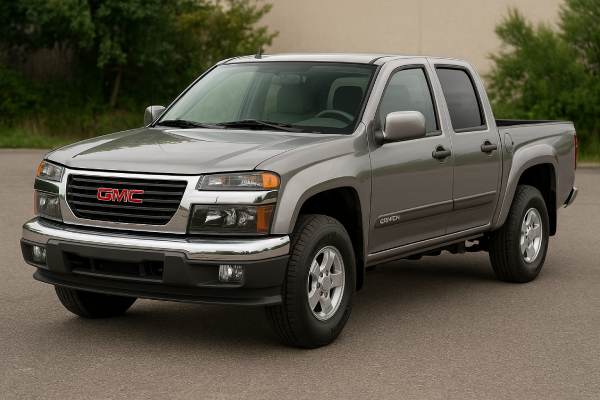
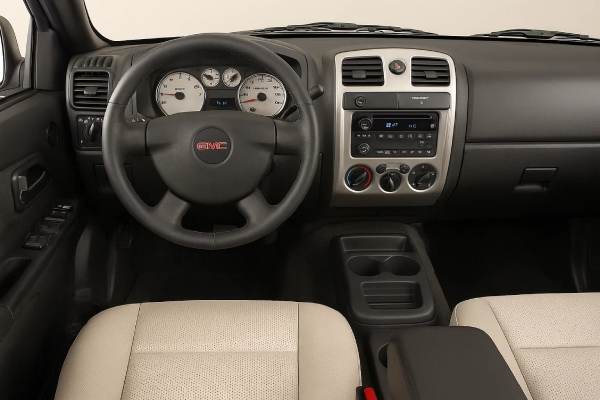
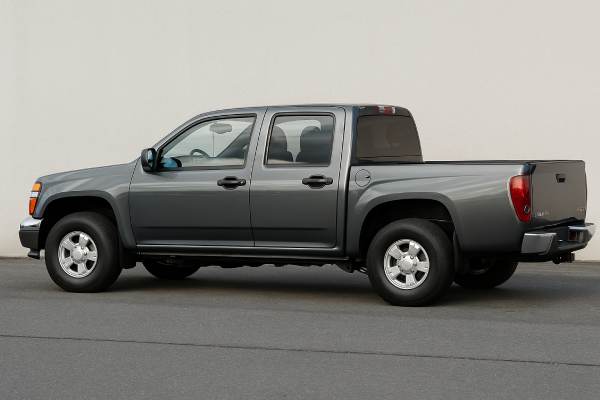
The 2010–2012 GMC Canyon 4WD with the LH9 5.3 litre V8 is a niche but very desirable version of GM’s first-generation midsize pickup. It blends the smaller footprint of the GMT355 platform with the torque and character of a full-size truck engine and a proper low-range four-wheel-drive system. For buyers who want to tow, haul, or tackle winter roads without stepping up to a Sierra, this configuration is often the sweet spot.
In this guide, we will walk through the technical specifications, real-world performance, reliability patterns, and ownership costs specific to the V8 4WD facelift trucks. You will also find a practical maintenance roadmap and a buyer’s checklist aimed at used-market shoppers. The goal is to help you understand not just the numbers on paper, but what the LH9 Canyon 4WD feels like to drive and what it is likely to demand from you in service over the next decade.
Owner Snapshot
- Strong 5.3 litre V8 with around 300 hp and 320 lb-ft gives full-size-like pulling power in a smaller truck.
- 4WD, low range, and available Z71 off-road suspension make this Canyon surprisingly capable on trails and in deep snow.
- Tows up to about 6,000 lb when properly equipped, which covers most small campers, boats, and car trailers.
- Watch for 4L60E transmission wear and frame rust in older northern trucks; fluid changes and inspections are important.
- Plan on engine oil and filter every 8,000–10,000 km (5,000–6,000 miles) or 12 months, whichever comes first, for long-term engine health.
Section overview
- GMC Canyon 4WD 5.3 fundamentals
- Technical data for LH9 4WD
- Trims, equipment, and safety tech
- Reliability issues and service fixes
- Maintenance planning and buying tips
- Driving experience and off-road use
- Canyon 5.3 4WD versus rivals
GMC Canyon 4WD 5.3 fundamentals
The 2010–2012 GMC Canyon 4WD with the LH9 5.3 litre V8 arrived late in the first-generation truck’s life. By then, the GMT355 platform was proven, and the facelift added standard head curtain airbags and stability control, addressing earlier safety gaps. The LH9 V8 itself is a Gen IV all-aluminium small-block, closely related to 5.3 engines used in GM’s full-size pickups, but tuned for 300 hp and roughly 320 lb-ft of torque. It uses variable valve timing and is flex-fuel capable in most markets, but does not employ cylinder-deactivation, which many enthusiasts see as a reliability advantage.
In the Canyon, the V8 was offered mainly in Extended Cab and Crew Cab models, tied to higher-content trims and almost always with automatic transmission and four-wheel drive. The 4WD system is a part-time, shift-on-the-fly setup with 2HI, 4HI, and 4LO modes, suitable for snow, gravel, and light to moderate off-road use. With the correct tow package, the V8 4WD Canyon is rated to tow around 6,000 lb, matching what many half-ton trucks could do a few years earlier.
Compared with four- and five-cylinder versions, the 5.3 4WD trades some fuel economy for significantly stronger acceleration and relaxed cruising. The front end is heavier, but the truck remains compact enough to park easily and navigate tight job sites. For owners who frequently tow, climb mountain passes, or drive in deep snow, the 5.3 4WD configuration is arguably the most rounded version of the first-generation Canyon.
Technical data for LH9 4WD
This section focuses on typical specifications for a 2010–2012 GMC Canyon 4WD with the LH9 5.3 V8, Extended or Crew Cab, and automatic transmission. Exact values vary slightly by cab, bed length, axle ratio, and market, but the tables below give a realistic baseline.
Engine and performance
| Item | Value |
|---|---|
| Engine code | LH9 Vortec 5300 |
| Layout | 90° V8, aluminium block and heads |
| Valvetrain | OHV, 2 valves per cylinder, pushrod |
| Displacement | 5.3 L (5,327 cc) |
| Bore × stroke | 96.0 × 92.0 mm (3.78 × 3.62 in) |
| Compression ratio | ~9.6:1 |
| Induction | Naturally aspirated |
| Fuel system | Sequential multi-port fuel injection |
| Max power | 300 hp @ ~5,200 rpm |
| Max torque | ~320 lb-ft (≈ 435 Nm) @ ~3,900 rpm |
| Fuel type | Unleaded petrol; many are flex-fuel |
| Timing drive | Chain, hydraulic tensioner |
| Emissions / standard | U.S. Tier 2 / LEV-type, market-dependent |
| Rated economy (4WD V8, approx.) | ~14 mpg city / 19–20 mpg highway (US) |
| Real-world mixed use | Roughly 13–17 mpg US (18–14 L/100 km) |
Transmission and driveline
| Item | Value |
|---|---|
| Transmission | 4-speed automatic (4L60E family) |
| Gear ratios (approx.) | 1st 3.06, 2nd 1.63, 3rd 1.00, 4th 0.70, Rev 2.29 |
| Transfer case | Part-time 4×4 with 2HI / 4HI / 4LO |
| Final drive ratios | Commonly 3.73 or 4.10 |
| Drive type | 4WD, front-engined longitudinal |
| Rear differential | Open or locking (G80 automatic locker on some) |
Chassis and dimensions
Values below represent a typical Crew Cab 4WD short-box V8; Extended Cab and regional models may vary.
| Item | Value |
|---|---|
| Platform | GMT355 body-on-frame |
| Front suspension | Short/long arm independent with torsion bar or coil-over (by package) |
| Rear suspension | Solid axle with leaf springs |
| Steering | Rack-and-pinion with hydraulic assist |
| Front brakes | Ventilated discs |
| Rear brakes | Drums |
| Wheelbase | ~3,200 mm (126.0 in) |
| Overall length | ~5,260–5,400 mm (≈207–213 in) |
| Overall width | ~1,715–1,720 mm (≈67–68 in, excluding mirrors) |
| Overall height (4WD) | ~1,650–1,700 mm (≈65–67 in) |
| Curb weight (V8 4WD) | Roughly 1,850–1,950 kg (4,080–4,300 lb) |
| GVWR (typical V8 4WD) | Around 2,400–2,500 kg (5,300–5,500 lb) |
| Fuel tank capacity | ≈74 L (19.6 US gal) |
| Ground clearance (off-road pkg) | Can exceed 200 mm (≈8 in) |
Performance and capability
| Item | Value (typical range) |
|---|---|
| 0–100 km/h (0–62 mph) | Mid 7 to low 8 seconds (unloaded) |
| 0–60 mph | High 6 to mid 7 seconds |
| Top speed (limited) | ~170–180 km/h (105–112 mph) |
| Braked towing capacity | Up to ~2,720 kg (6,000 lb) with tow package |
| Payload | ~500–650 kg (1,100–1,400 lb) by configuration |
| Roof load | Typically 75–100 kg (check roof rack rating) |
Fluids and electrical (typical, verify per VIN)
| System | Specification and capacity (approximate) |
|---|---|
| Engine oil | 5W-30 dexos-approved; ~5.7–6.0 L (6.0–6.3 US qt) |
| Coolant | Dex-Cool OAT; mix ~50/50; capacity ≈10–12 L |
| Automatic transmission | Dexron-VI ATF; pan service ≈5–6 L; dry more |
| Transfer case | Auto-Trak II or equivalent; ~1.4–1.6 L |
| Front differential | 75W-90 synthetic gear oil; ~1.0–1.3 L |
| Rear differential | 75W-90 synthetic; additive if G80 locker; ~1.5–2.0 L |
| A/C refrigerant | R-134a; charge and oil by label |
| Alternator | Around 125–145 A, trim-dependent |
| 12 V battery | Group size similar to 48 / 78; 600+ CCA typical |
| Spark plugs | Long-life iridium; gap ~1.0–1.1 mm (0.040–0.044 in) |
Safety and driver assistance
These trucks predate modern ADAS suites; safety is mainly passive and basic electronic support.
- Front airbags plus head curtain airbags (front and rear outboard seating).
- Four-wheel ABS with electronic brake-force distribution.
- StabiliTrak stability control and traction control.
- Tyre pressure monitoring system.
- OnStar with automatic crash notification on most trims.
Crash-test performance is mixed: extended cab versions scored better overall than crew cabs in some tests, and side impact and roof strength ratings lag behind modern pickups. If safety is a top priority, factor this into your decision and consider cab style and seat usage carefully.
Trims, equipment, and safety tech
The 5.3 V8 4WD Canyon was not available in every trim, which simplifies the shopping list but also makes these trucks rarer. Depending on market, you will most often see the V8 4WD in better-equipped SLE and SLT trims, usually with Crew Cab or Extended Cab bodies and either the Z71 Off-Road or Z85 “standard” suspension packages.
Typical trim relationships for V8 4WD models:
- SLE 4WD
- Cloth interior, power windows and locks, keyless entry.
- 16–17 inch alloy wheels, often with all-terrain tyres in Z71 spec.
- Manual air conditioning, basic audio with optional Bluetooth and XM.
- V8 usually optional, bundled with higher towing hardware and axle ratio.
- SLT 4WD
- Leather-trimmed seating, power driver seat, upgraded audio.
- Available heated seats, auto-dimming mirror, steering wheel controls.
- Cosmetic upgrades (chrome accents, body-colour bumpers) and more sound insulation.
- V8 engine and tow package more commonly fitted, especially in Crew Cabs.
Off-road options matter for capability:
- Z71 Off-Road brings higher-riding suspension, different dampers, skid plates in some markets, and more aggressive tyres.
- The G80 automatic locking rear differential (RPO G80) is a key mechanical upgrade, improving traction in mud, deep snow, and on uneven surfaces. Look for the RPO sticker in the glovebox or decode the VIN/build sheet to confirm it.
On safety and driver assistance, the Canyon was updated over its lifecycle:
- Airbags: By the facelift years, head curtain side airbags became standard, covering front and rear outboard occupants.
- Stability control: StabiliTrak became standard, pairing with ABS and traction control to manage slides and wheelspin.
- Child restraints: Rear outboard positions in Crew Cabs have provisions for LATCH/ISOFIX-style child seat anchors; Extended Cabs use jump seats that are less ideal for regular child transport.
- Lighting: Halogen headlamps only; beam performance is acceptable by older standards but not competitive with modern projector or LED systems. Many owners retrofit better bulbs or auxiliary lighting, but such changes should be done carefully to avoid glare.
Safety ratings from crash-test organisations show acceptable to marginal performance depending on cab type and test, reflecting the age of the design. You do not get advanced aids like autonomous emergency braking, lane-keeping, or adaptive cruise control; good tyres, correct loading, and driver attention remain central to safety.
Reliability issues and service fixes
The LH9-powered Canyon 4WD has two major sides to its reliability story: the engine and the truck platform around it. The LH9 itself is generally robust when maintained, with a strong bottom end, no cylinder-deactivation hardware, and a simple pushrod layout. However, the surrounding systems—transmission, cooling, and chassis—still require attention.
Common or noteworthy items:
- 4L60E automatic transmission wear
- Symptoms: Flare or slip on 2–3 shift, harsh engagement into Drive or Reverse, delayed upshifts under load.
- Causes: Heat and age, towing with old fluid, or low ATF level.
- Remedy: Regular ATF and filter services (every 50,000–80,000 km / 30,000–50,000 miles), add auxiliary cooler if towing regularly, and address early shift issues before they become full rebuilds.
- Cooling system and Dex-Cool neglect
- Symptoms: Overheating under load, rusty coolant, heater performance issues, external leaks at water pump or radiator.
- Causes: Coolant left in service far beyond recommended intervals, air pockets after improper bleeding.
- Remedy: Flush and refill with correct Dex-Cool mixture, replace aging hoses and radiator caps, inspect water pump and thermostat housing at higher mileages.
- Front suspension and steering wear
- Symptoms: Clunks over bumps, vague steering, uneven tyre wear, and wandering on the highway.
- Causes: Worn upper and lower ball joints, control arm bushings, tie-rod ends, and idler/pitman components. Rough roads and larger tyres accelerate wear.
- Remedy: Full front-end inspection, replace worn components with quality parts, and align the truck afterward.
- 4WD system and differential issues
- Symptoms: Delayed engagement into 4HI/4LO, grinding noises, binding when turning on dry pavement in 4HI, or whining from front or rear axle.
- Causes: Old transfer case fluid, neglected differential oil, or misuse of 4WD on high-grip surfaces.
- Remedy: Regular fluid changes for transfer case and differentials, verify proper use (2HI on dry pavement), and address bearing or gear noise early.
- Frame and body corrosion
- Symptoms: Scale rust on frame rails and crossmembers, rusty brake and fuel lines, rot near cab mounts and rear leaf spring shackles.
- Causes: Road salt and poor underbody washing in winter climates.
- Remedy: Thorough underside inspection, rust treatment and coating while problems are early, and replacement of critically corroded lines and structural parts.
- Electrical and sensor faults
- Symptoms: Check Engine light for EVAP or O2 sensors, intermittent ABS or stability control lights.
- Causes: Aging sensors, wiring corrosion at connectors, or dirty grounds.
- Remedy: Proper scan-tool diagnosis, targeted sensor replacement, and cleaning or re-terminating grounds.
Service bulletins and recall campaigns over this generation have addressed issues like brake-lamp switches, seatbelt components, and specific corrosion or fuel line concerns in certain regions. A careful buyer should:
- Run the VIN through official recall databases.
- Ask the seller for proof of completed recalls and campaigns.
- Confirm regular oil, coolant, and transmission services, especially if the truck has been used for towing.
When maintained well and not severely abused, the LH9 V8 and drivetrain can cover high mileages with relatively predictable maintenance. Trucks that have lived with heavy trailers and minimal servicing, however, can arrive at the used market needing transmission work, front suspension rebuilds, and rust repairs all at once.
Maintenance planning and buying tips
Planning maintenance around the needs of a V8 4WD Canyon is the best way to keep costs stable and avoid big surprises.
A practical baseline schedule (always verify against the owner’s manual and local conditions):
- Engine oil and filter: Every 8,000–10,000 km (5,000–6,000 miles) or 12 months; shorten to 5,000 km / 3,000 miles for heavy towing or extreme heat.
- Engine air filter: Inspect annually; replace every 30,000–40,000 km (18,000–25,000 miles) or sooner in dusty use.
- Cabin air filter (if equipped): Replace every 20,000–25,000 km (12,000–15,000 miles) or 2 years.
- Spark plugs: Iridium plugs typically last 160,000 km (100,000 miles), but consider replacement earlier on older trucks to avoid seized plugs.
- Coolant (Dex-Cool): Replace roughly every 5 years or 160,000 km (100,000 miles), then more often on an older truck.
- Automatic transmission fluid/filter: 50,000–80,000 km (30,000–50,000 miles), shorter if towing frequently or running in hot climates.
- Transfer case fluid: Around every 50,000–60,000 km (30,000–37,000 miles).
- Differential oil: Every 80,000–100,000 km (50,000–60,000 miles); more often with repeated towing or off-road work.
- Brake fluid: Flush every 2–3 years.
- Serpentine/aux belts and hoses: Inspect yearly, typically replace around 100,000–150,000 km (60,000–90,000 miles) or when cracked or noisy.
- Alignment and tyre rotation: Rotate every 10,000–12,000 km (6,000–7,500 miles); check alignment yearly or after suspension work.
- 12 V battery: Test annually after year 4–5; many will need replacement in the 5–7 year range.
Because the LH9 uses a timing chain rather than a belt, there is no fixed replacement interval, but chain noise, cam/crank correlation codes, or metal in the oil are signs that a timing set inspection is needed.
Buyer’s checklist for a used Canyon 4WD 5.3:
- Frame and underbody:
- Inspect frame rails, crossmembers, cab mounts, rear spring hangers, and brake/fuel lines for corrosion.
- Drivetrain:
- Confirm smooth operation of the 4WD selector (2HI, 4HI, 4LO) on loose ground.
- Check for shudder, slippage, or delay in the automatic transmission.
- Engine health:
- Listen for cold-start knocks or ticking that persist when warm.
- Look for oil leaks around valve covers, rear main seal, and oil pan.
- Suspension and steering:
- Test for clunks and looseness over bumps, and inspect front ball joints and control arm bushes.
- Brakes and tyres:
- Look for uneven pad wear, warped rotors (steering vibration), and mismatched or old tyres.
- Interior and electronics:
- Verify that all windows, locks, gauges, 4WD indicators, and audio/OnStar features function correctly.
Recommended choices:
- Preferred: Lower-mileage, rust-free trucks with documented fluid changes, especially transmission and differential services, and with G80 locker and Z71 suspension if you plan off-road or winter use.
- Caution: High-mileage ex-work trucks that have towed heavy loads, show neglected fluids, and have visible frame rust. These can still be good buys if priced for upcoming repairs, but budget for transmission and suspension work.
Long-term, a well-maintained Canyon 4WD 5.3 can be a durable work and leisure truck, with parts availability benefited by extensive LS-family engine support.
Driving experience and off-road use
On the road, the LH9 5.3 V8 is the defining feature of this Canyon. Compared with the five-cylinder trucks, throttle response is stronger and more immediate, especially from low rpm. The engine pulls smoothly through the mid-range, making merging, overtaking, and towing feel relaxed. You do not need to push the engine hard to keep up with traffic, which many owners appreciate for long highway drives.
The 4L60E automatic is an older design and only has four forward gears, so the truck will sometimes hunt between third and fourth on grades. With the right axle ratio (3.73 or 4.10) and tow/haul mode engaged, it manages grades and trailers competently, though it never feels as modern as later six-speed and eight-speed transmissions. Kickdown response is adequate, but not instantaneous; manual shifting via the selector can help when descending steep hills with a trailer.
Ride quality depends heavily on suspension package and tyre choice:
- Standard/Z85 suspension: More compliant, best for mixed commuting and light towing.
- Z71 Off-Road: Firmer, with more control over large bumps and rough tracks, but can feel busier over broken pavement.
Noise levels are in line with other midsize pickups of the era: wind and tyre noise are present at highway speeds, and engine sound is noticeable under heavy throttle, though the V8 has a pleasant, subdued rumble in steady cruise.
Fuel economy is the main trade-off. In gentle mixed driving, some owners see high-teens mpg (US), but frequent short trips, city traffic, and towing can easily pull averages into the low-teens. At 120 km/h (75 mph), expect consumption to rise compared to lower speeds; adding a high-cap roof rack, lift, or larger tyres will further hurt efficiency.
Off-road and in poor weather, the Canyon 4WD V8 feels confident:
- 4HI works well for snow-covered roads, muddy tracks, and gravel.
- 4LO gives the low gearing required for steep climbs, controlled descents, and tight manoeuvres with a trailer on rough terrain.
- When equipped, the G80 rear locker engages automatically when one rear wheel spins, improving traction in ruts and on uneven obstacles.
The truck’s relatively narrow body helps on wooded trails, but overhangs and approach/departure angles are not as aggressive as a dedicated off-roader. Skid plates (where fitted) and sensible tyre upgrades go a long way. Clearance is adequate for light to moderate off-roading; deep ruts or large rocks require careful line choice.
When towing at or near the 6,000 lb rating, the Canyon remains stable if the trailer is correctly set up and the load is balanced. Expect a noticeable fuel-consumption penalty—often 30–50 percent higher than solo driving—and keep transmission temperatures in mind on long grades.
Canyon 5.3 4WD versus rivals
In the 2010–2012 timeframe, the GMC Canyon 4WD 5.3 sat in a competitive midsize pickup field that included the Toyota Tacoma, Nissan Frontier, Ford Ranger (last of the old generation in North America), and mechanically similar Chevrolet Colorado. Each competitor had its own strengths, and the Canyon’s appeal depended on what you valued most.
Against the Toyota Tacoma
- Pros for Canyon:
- More powerful V8 option; significantly stronger straight-line performance and towing muscle than most Tacoma V6s of the era.
- Often cheaper on the used market for similar equipment levels.
- Cons:
- Tacoma’s frame and rust resistance (in updated models) and off-road packages are widely regarded as more robust.
- Toyota’s long-term reliability record and resale value are stronger overall.
Against the Nissan Frontier
- Pros for Canyon:
- LS-family engine support means excellent parts availability and tuning options for the V8.
- Flex-fuel capability on many LH9 engines, plus a more compact footprint than some Frontier variants.
- Cons:
- Frontier V6 models offer competitive power with simpler packaging and, in some cases, better stock braking and payload numbers.
Against the old-generation Ford Ranger
- Pros for Canyon:
- More modern cabin, available crew cab, and stronger powertrain choices.
- Better crash safety structure in most configurations.
- Cons:
- The Ranger’s simple, rugged design can be easier to maintain for basic work use.
Against the Chevrolet Colorado
- Mechanically, the Colorado and Canyon are twins, sharing the GMT355 platform and powertrains. The main differences are styling, equipment mixes, and brand positioning.
- The GMC badge often corresponds to slightly more upscale trims and interiors, which may matter if you want leather, better sound systems, and additional features.
Where the Canyon 4WD 5.3 really carves out its niche is for buyers who want:
- More towing and passing power than four-cylinder or five-cylinder midsize trucks.
- A 4WD system with low range and an available locking rear differential.
- A truck that is smaller and easier to manoeuvre than full-size pickups, but still able to tow a decent-size camper or car trailer.
If you prioritise the latest safety tech, the quietest cabin, or the best fuel economy, newer generations of midsize pickups or full-size models with modern transmissions may serve you better. But for a compact-footprint truck with a strong, proven V8 and relatively simple mechanicals, the 2010–2012 GMC Canyon 4WD with the LH9 engine remains an attractive, enthusiast-friendly choice.
References
- Manuals and Guides | Vehicle Support | GMC 2025 (Owner’s Manual Portal)
- 2011 GMC Canyon 2010 (Brochure)
- 2010 CANYON 2009 (Brochure)
- Gas Mileage of 2011 GMC Canyon 2011 (Fuel Economy Data)
- 2011 GMC Canyon 2011 (Safety Rating)
Disclaimer
This article is for informational purposes only and is not a substitute for professional diagnosis, repair, or safety advice. Specifications, torque values, service intervals, and repair procedures can vary by VIN, model year, market, and equipment level. Always confirm critical data and procedures using the official service information, owner’s manual, or a qualified technician before performing work on your vehicle.
If you found this guide useful, please consider sharing it on your preferred social platforms (such as Facebook or X/Twitter) to help other GMC Canyon owners and support our work.