
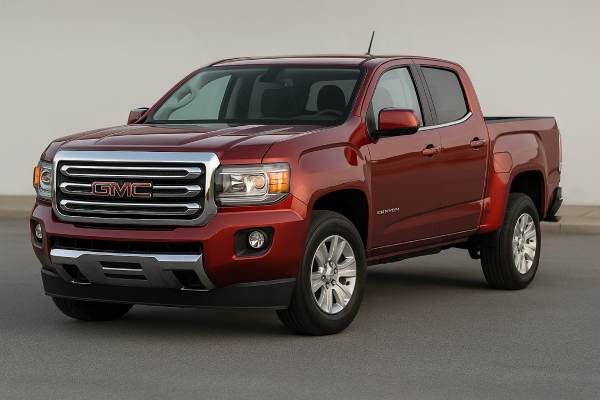
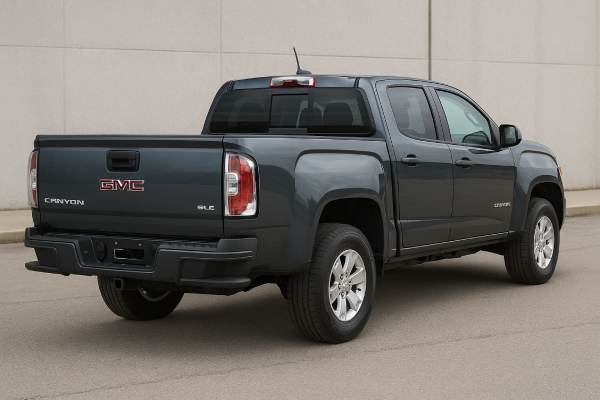
The 2015–2020 GMC Canyon 4WD with the 2.5 litre LCV inline-four sits at an interesting point in the mid-size pickup world. It combines modern crash structure, a relatively efficient direct-injected engine, and a compact footprint with the genuine capability of a low-range four-wheel-drive system. For many owners, it covers weekday commuting and weekend trail or towing duty in a single truck without the bulk and thirst of a full-size pickup.
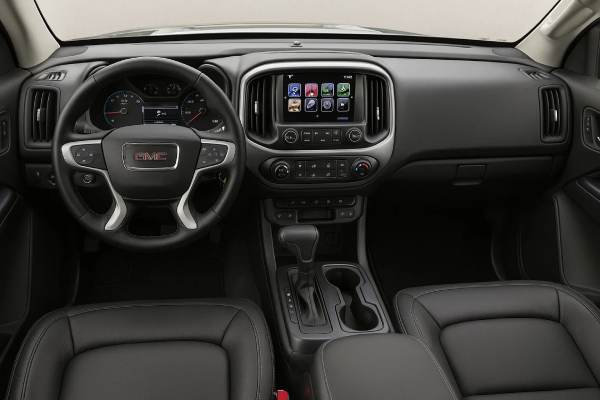
This generation GMT31XX Canyon brought a much more refined cabin, better noise insulation, and car-like driving manners compared with the earlier GMT355 models. In 2.5 4WD form, it is not the quickest configuration in the lineup, but it is simpler than the V6 and diesel alternatives and can be cheaper to buy and run. This guide walks through the key specifications, strengths and weaknesses, known issues, and what to look for if you are considering a used Canyon 4WD with the 2.5 LCV engine.
Quick Specs and Notes
- 2.5 litre LCV direct-injected four-cylinder with about 200 hp and a robust timing chain
- Proper part-time 4WD with low range and good all-weather traction for light off-road use
- Real-world combined fuel economy typically around 21–22 mpg US (11–12 L/100 km) for 4WD trucks
- Known issues include occasional transmission shift quality complaints and recalls on early brake and steering components
- Engine oil change interval of 7,500 miles / 12,000 km or 12 months is a sensible maximum for mixed use
What’s inside
- Canyon 2.5 4WD role and use
- 4WD LCV 2.5 technical data
- 4WD trims, equipment and safety
- Reliability of the 2.5 4WD Canyon
- Service planning and buying tips
- On road and off road behaviour
- Canyon 2.5 4WD versus competitors
Canyon 2.5 4WD role and use
The GMC Canyon 4WD with the 2.5 litre LCV engine targets drivers who need genuine truck utility but do not tow at the upper end of the platform’s capability. It shares its GMT31XX underpinnings with the Chevrolet Colorado and focuses on balancing everyday drivability with work-ready features like a boxed frame, leaf-spring rear suspension, and a two-speed transfer case.
In this configuration, the 2.5 L four-cylinder is paired mainly with a 6-speed automatic transmission and a part-time 4WD system. The engine produces around 200 hp and enough torque for light to moderate loads, but it is the least powerful of the Canyon engines, sitting beneath the 3.6 V6 petrol and later 2.8 diesel. That makes it best suited to buyers who value fuel economy and price over outright acceleration or maximum tow ratings.
For daily use, the 4WD system is a major differentiator from the 2WD version. It adds security in snow, on muddy access roads, or when launching a small boat, and the low-range mode reduces driveline stress when crawling on rough tracks. It does, however, add weight and parasitic losses, so fuel consumption is higher than an equivalent 2WD Canyon.
Cab and bed configurations vary by year, but the 2.5 4WD is most commonly found in extended cab and crew cab short-box forms. That gives enough interior space for four adults and everyday family duties, while still fitting in most urban parking spaces. Compared with a full-size Sierra, the Canyon is easier to park, turns in a tighter circle, and feels less intimidating to maneuver in city traffic.
Owners often choose the 2.5 4WD model as a multi-purpose “do everything” truck: commuting, weekend DIY hauling, camping trips, and light towing of small campers, utility trailers, or bikes. The payload and towing limits (typically up to around 3,500 lb / 1,588 kg braked when properly equipped) are more than enough for these tasks, but if you regularly tow near the maximum rating, the V6 or diesel versions are a better fit.
Overall, the Canyon 2.5 4WD fills the niche for buyers wanting a mid-size pickup with real four-wheel-drive hardware, but without the higher running costs and complexity of the larger engines.
4WD LCV 2.5 technical data
This section focuses on the technical specification for the GMC Canyon GMT31XX 4WD equipped with the 2.5 LCV four-cylinder engine for the 2015–2020 model years. Figures may vary slightly by model year, cab style, and market, so always confirm against the exact VIN and official documentation.
Engine and performance
| Item | Specification |
|---|---|
| Engine code | LCV |
| Type | Inline-4, aluminium block and head |
| Valvetrain | DOHC, 4 valves per cylinder, variable valve timing |
| Displacement | 2.5 L (2,457 cc approx.) |
| Bore × stroke | ~92.0 mm × 96.0 mm (3.62 in × 3.78 in) |
| Induction | Naturally aspirated |
| Fuel system | Direct injection petrol |
| Compression ratio | Approx. 11.3:1 |
| Max power | ~200 hp (about 149 kW) @ ~6,300 rpm |
| Max torque | ~191 lb-ft (approx. 259 Nm) @ ~4,400 rpm |
| Timing drive | Chain driven cams |
| Recommended fuel | Regular unleaded (check regional guidance) |
| Emissions standard | U.S. Tier 2 / LEV-equivalent for the era |
From official fuel-economy data, a 2015 Canyon 4WD with the 2.5 automatic is rated around 19 mpg city, 24 mpg highway and 21 mpg combined (US), which converts to roughly 12.4 / 9.8 / 11.2 L/100 km. In real use, owners often report figures in the 18–22 mpg US combined range depending on driving style, load and terrain.
Transmission and driveline
| Item | Specification |
|---|---|
| Transmission | 6-speed automatic (6L50) in most 4WD 2.5 models |
| Drive type | Part-time 4WD with 2H / 4H / 4L modes |
| Transfer case | Electronically controlled, two-speed |
| Final drive ratio | Typically around 4.10:1 (varies by axle and package) |
| Differential | Open front, open or locking rear depending on package |
| 4WD engagement | Dash-mounted rotary selector, shift-on-the-fly into 4H |
Chassis and dimensions (typical crew cab short box 4WD)
| Item | Specification (approximate) |
|---|---|
| Platform | GMT31XX body-on-frame |
| Front suspension | Independent coil-over, twin-tube dampers |
| Rear suspension | Leaf spring solid axle |
| Steering | Electric power-assisted rack-and-pinion |
| Front brakes | Ventilated disc |
| Rear brakes | Disc (on most trims) |
| Length | ~5,400 mm (212–213 in) depending on cab/box |
| Width (without mirrors) | ~1,880–1,885 mm (74–74.2 in) |
| Height | ~1,780 mm (70 in) |
| Wheelbase | ~3,260 mm (128.3 in) for crew cab short box |
| Ground clearance | Around 211 mm (8.3 in) |
| Turning circle | Roughly 12.6 m (41–42 ft) curb-to-curb |
| Curb weight | Typically 1,850–1,950 kg (4,080–4,300 lb) depending on spec |
| GVWR | Around 2,700–2,800 kg (5,950–6,200 lb) |
| Fuel tank | ~80 L (21 US gal, 17.5 UK gal) |
Performance and capability (typical)
| Item | Value (approximate) |
|---|---|
| 0–100 km/h (0–62 mph) | High 9s to low 10s seconds unloaded |
| Top speed | Limited in the ~175 km/h (108–110 mph) range |
| Braked towing capacity | Around 1,587 kg (3,500 lb) when properly equipped |
| Payload | Often in the 600–700 kg (1,300–1,550 lb) window depending on trim |
Fluids, electrical and torque specifications must be taken from the correct owner’s manual or service literature for the model year and engine variant; General Motors’ online manuals portal is the best starting point.
4WD trims, equipment and safety
Across 2015–2020, the Canyon 2.5 4WD was offered mainly in work-oriented and mid-level trims, with the more luxurious Denali branding reserved for higher-content trucks usually powered by the V6 or diesel. Exact trim names vary by market and year, but in North America you will most commonly see Base/SL, SLE, and sometimes SLT level 2.5 4WD trucks.
Base and SL-type trims usually pair the 2.5 with simpler cloth interiors, manual-adjust seats, basic audio systems, and smaller wheel packages (16-inch steel or alloys). These are popular as fleet or work trucks and may omit some comfort and technology items, but they remain fully functional 4WD vehicles with low-range capability. The mid-grade SLE combines the 2.5 4WD powertrain with alloy wheels, improved infotainment, and available options such as remote start and upgraded audio.
Mechanical differences by trim revolve mainly around wheels, tyres, and axle options. Some 4WD trucks include an automatic locking rear differential, which is worth seeking out if you regularly drive on loose or slippery surfaces. Off-road oriented appearance packages typically bring all-terrain tyres and different wheel designs rather than fundamental suspension changes.
On the safety side, the Canyon platform introduced modern crash structures, side-curtain airbags and improved restraint systems compared with the previous generation. Standard safety equipment on 2015–2020 4WD models typically includes:
- Front, side and curtain airbags
- Electronic Stability Control
- Traction control
- ABS with brake assist
- Tyre pressure monitoring
Advanced driver-assistance systems (ADAS) appear gradually. Early model years offer relatively limited assistance options, such as a lane departure warning or forward collision alert on higher trims. Later years expand this with additional camera-based features, but you should not expect the full suite of adaptive cruise, lane-keep assist, or automatic emergency braking found on newer vehicles.
Official crash ratings for the closely related Colorado/Canyon family show respectable overall performance, with good scores in several NHTSA and independent tests where the vehicles were evaluated. Side-impact protection is generally strong, reflecting the truck’s height and structural reinforcements, while frontal small-overlap performance may vary by year and configuration.
When shopping, pay attention not only to the trim name but to the actual option content. Two SLE trucks may differ significantly in terms of airbags (for example, front-seat side airbags), rear-camera quality, and availability of safety alerts if one was heavily optioned and the other ordered as a price leader. Where possible, inspect the build sheet or window sticker, and verify the presence of any ADAS features you consider essential.
Reliability of the 2.5 4WD Canyon
The LCV 2.5 four-cylinder and GMT31XX chassis have a generally solid reputation when maintained properly, but a number of recurring issues and recalls are worth understanding, especially on early build years.
From a powertrain perspective, the 2.5 LCV is chain-driven and avoids the belt-change intervals associated with some rivals. With regular oil changes using the correct specification, timing chain stretch is uncommon. Neglected oil or extended intervals can, however, lead to chain rattle on cold starts and cam-phaser wear. If you hear prolonged rattling on start-up or see timing correlation codes, plan for further diagnostics.
The direct-injection system can suffer from intake valve carbon build-up over higher mileages, especially with lots of short-trip use. Symptoms include rough idle, misfires under load, and a drop in fuel economy. Walnut-shell blasting of the intake ports and valves is the usual remedy. High-pressure fuel pump and injector issues are less widespread but not unheard of; they tend to show up as hard starting, long cranking and lean-running codes.
Transmission behaviour is a frequent talking point among owners. The 6L50 automatic can exhibit harsh shifts, flare between gears, or shudder under light throttle. General Motors has released technical bulletins and calibration updates to address some of these concerns on various applications, and where software updates are available they should be applied before assuming a mechanical failure. Fluid condition is also critical; old or degraded ATF can aggravate shift quality problems.
On the chassis side, rust is not as severe as it can be on some older full-size trucks, but vehicles exposed to road salt can still develop corrosion on the frame, underbody seams, and brake lines. Early 2015 models were subject to recalls for front brake calipers and for power-assist steering issues that could increase the risk of loss of assist. Any prospective truck should be checked to ensure all open recalls have been completed.
Other occasional issues include:
- Electrical gremlins such as intermittent infotainment screen failures or backup camera problems
- Air-conditioning performance losses due to refrigerant leaks at known weak points
- Front suspension wear (ball joints and bushings) on trucks driven frequently on rough roads or carrying heavy front-axle loads
In terms of cost, the most serious potential expenses tend to be transmission rebuilds and advanced corrosion repairs. Engine-related problems are often addressable with cleaning, sensors or moderate-cost components unless the truck has been run low on oil or severely overheated.
Reliability overall is competitive for the segment, especially when compared with some turbocharged rivals. A Canyon 2.5 4WD that has seen regular maintenance, full recall compliance and periodic fluid changes can comfortably cover high mileages without major component replacement.
Service planning and buying tips
A sensible maintenance plan is essential to keep the Canyon 2.5 4WD reliable, especially as these trucks age into high-mileage daily drivers. Always treat the official schedule in the owner’s manual as the baseline and then adjust intervals if your usage is particularly severe (lots of towing, very short trips, or dusty conditions).
Below is a practical, conservative schedule for typical mixed use:
- Engine oil and filter: Every 7,500 miles / 12,000 km or 12 months, whichever comes first; shorten to 5,000 miles / 8,000 km for heavy towing or mostly short journeys.
- Engine air filter: Inspect annually, replace around 30,000–40,000 miles / 50,000–65,000 km, sooner in dusty environments.
- Cabin air filter: Replace every 20,000–25,000 miles / 30,000–40,000 km or every two years.
- Spark plugs: Iridium plugs often last 60,000–100,000 miles / 100,000–160,000 km; many owners choose around 80,000 miles as a compromise.
- Coolant: Replace roughly every five years or 100,000 miles (160,000 km), then every 3–5 years depending on condition and manufacturer guidance.
- Automatic transmission fluid: Even if labelled “filled for life,” a 50,000–60,000 mile (80,000–100,000 km) drain and fill is wise, especially if the truck tows.
- Transfer case and differentials: Change oil every 50,000–60,000 miles / 80,000–100,000 km or sooner with extensive 4WD or towing use.
- Brake fluid: Flush every 2–3 years regardless of mileage.
- Serpentine belt and hoses: Inspect annually; many owners replace the belt around 90,000–100,000 miles (145,000–160,000 km) as preventative maintenance.
- Alignment and tyre rotation: Rotate tyres every 5,000–7,500 miles / 8,000–12,000 km; check alignment at least every two years or after significant pothole impacts.
- 12 V battery: Test annually after year four; many OE batteries last 4–6 years.
Fluid specifications (oil viscosity, coolant type, transmission and gear oils) must match the exact GM approvals listed in the manual. Using generic fluids may create shifting or noise issues, particularly in the automatic transmission and differentials.
For buyers, a structured inspection plan helps avoid unpleasant surprises:
- History and paperwork – Look for a complete service history with regular oil changes, documented recall work, and any transmission or driveline repairs.
- Corrosion check – Inspect frame rails, crossmembers, rear spring mounts, brake lines and body seams for rust, especially in snow-belt trucks.
- Driveline behaviour – On the test drive, evaluate shifts in all gears, check 4H and 4L engagement, and listen for whining or clunking from the axles and transfer case.
- Engine operation – Confirm smooth idle, quiet cold starts and absence of warning lights. A pre-purchase scan for stored codes is highly recommended.
- Suspension and steering – Feel for looseness or clunks over rough roads and during parking-lot manoeuvres, which can indicate worn ball joints or bushings.
- Electrical and interior – Test all windows, locks, infotainment functions and the backup camera; intermittent faults here can be annoying and sometimes expensive to fix.
From a value standpoint, well-maintained 2.5 4WD trucks in mid-level trims can make excellent long-term workhorses. Heavily rusted trucks, those with unresolved transmission complaints or a history of neglect are best avoided unless priced low enough to justify the required reconditioning.
On road and off road behaviour
On the road, the Canyon 2.5 4WD feels more like a modern crossover from the driver’s seat than an old-school pickup. Steering effort is light at parking speeds and firms up predictably at highway pace. The electric power steering is not especially communicative, but it is accurate and makes the truck easy to place in town.
Ride quality is generally good for a body-on-frame truck. Unladen, the rear leaf springs can allow some jiggle over sharp bumps or expansion joints, but the damping is controlled and far more settled than many older compact pickups. With a few hundred kilograms of load in the bed, the truck rides even more smoothly. Noise levels are respectable thanks to better sealing and insulation introduced with this generation.
Performance from the 2.5 L engine is adequate rather than brisk. Around town, the engine pulls cleanly and the 6-speed automatic does a good job of keeping revs in the useful mid-range. Full-throttle acceleration, particularly up long highway grades or when fully loaded, will not match the V6, and drivers moving from a larger-engined truck will notice the difference. However, for normal commuting and moderate loads, it feels competent.
Real-world fuel economy usually tracks close to official ratings for mixed driving. Many owners see mid-20s mpg US (around 9–10 L/100 km) on steady highway trips at legal speeds, and high teens to low 20s mpg US (11–13 L/100 km) in city or mixed use, assuming sensible driving habits and properly inflated tyres. Winter conditions, short trips and heavy use of 4WD will push consumption higher.
Off-road, the Canyon 4WD is limited more by tyres and ground clearance than by its basic hardware. The two-speed transfer case and low range give it the gearing it needs for slow, controlled progress over rough tracks. Approach and departure angles are adequate for light trail work and accessing campsites, although serious rock-crawling will quickly expose the limitations of its front overhang and relatively modest suspension travel.
Traction control and, where fitted, an automatic locking rear differential help in muddy or snowy conditions. The stability system is tuned to be reasonably permissive for a pickup, allowing some wheel-slip before intervening, but it will still cut power if you are aggressive on loose surfaces. Switching to higher-profile all-terrain tyres can significantly improve off-road competence and ride on rough roads, at the expense of some fuel economy and cabin noise.
Towing moderate loads is well within the truck’s comfort zone as long as you respect the 2.5’s power limits and the rated tow weight. The 4WD system adds confidence on slippery boat ramps or wet grass, but you should pay attention to transmission temperatures on long climbs and consider a conservative fluid change interval if you tow regularly.
Canyon 2.5 4WD versus competitors
When cross-shopping the Canyon 2.5 4WD against other mid-size pickups of the same era, its strengths and compromises become clearer.
Compared with its Chevrolet Colorado twin, the differences are primarily styling, branding and trim content. Under the skin, they share engines, transmissions and chassis. Buyers often choose between the two on interior design and dealer network rather than mechanical reasons.
Against Japanese rivals such as the Toyota Tacoma and Nissan Frontier, the Canyon offers a more modern cabin and typically better on-road refinement in this generation. Steering and ride quality are generally more car-like, and the seating position suits long-distance driving. The 2.5 four-cylinder’s power output is competitive with the base engines in these competitors, but the Tacoma’s reputation for long-term durability and off-road variants like the TRD models can sway buyers who prioritise ruggedness and resale value over comfort.
Full-size pickups such as the GMC Sierra and Chevrolet Silverado provide more space, higher tow ratings and, often, stronger engines. They also cost more to buy, fuel and park. For many private owners who tow only modest loads and use their truck as a daily driver in urban or suburban areas, the Canyon’s smaller footprint and lighter weight are significant advantages.
Within the Canyon lineup itself, the 2.5 4WD sits as the value-oriented four-wheel-drive choice. The 3.6 V6 offers much stronger performance and higher tow ratings, and the diesel option (where available) delivers superior torque and fuel economy for frequent towing. In exchange, the 2.5 typically has a lower purchase price on the used market, slightly simpler maintenance, and avoids some of the complexity and cost associated with the higher-end powertrains.
If your usage profile involves:
- Daily commuting plus occasional light towing (small campers, bikes, utility trailers)
- Regular bad-weather driving or unpaved road access where 4WD is genuinely useful
- A desire for a mid-size footprint and more efficient engine
…then the Canyon 2.5 4WD is a strong candidate. If you routinely tow close to the platform’s maximum rating, or you expect effortless highway passing at full load and altitude, stepping up to the V6 or diesel is advisable.
Overall, the 2015–2020 GMC Canyon 4WD with the 2.5 LCV engine offers a compelling mix of usability, refinement and capability, provided that you are realistic about its performance envelope and choose a well-maintained example with a clean recall and service history.
References
<a href="https://www.gmc.com/en/owners/manuals">Owner's Manuals & Guides | GMC</a> 2024 (Owner’s Manual Portal)<a href="https://www.fueleconomy.gov/feg/bymodel/2015_GMC_Canyon.shtml">2015 GMC Canyon</a> 2015 (Fuel Economy Data)<a href="https://static.nhtsa.gov/odi/rcl/2015/RCRIT-15V278-0176.pdf">Recall Bulletin</a> 2015 (Brake Caliper Safety Recall)<a href="https://static.nhtsa.gov/odi/rcl/2015/RCONL-15V157-8710.pdf">IMPORTANT SAFETY RECALL</a> 2015 (Power Steering Recall Notice)
Disclaimer
This article is intended for informational purposes only and does not replace professional diagnosis, repair advice, or official manufacturer guidance. Specifications, torque values, maintenance intervals and procedures can vary by VIN, model year, market and installed equipment. Always confirm critical data against the official owner’s manual, service documentation and current technical bulletins for your specific vehicle, and consult a qualified technician before carrying out repairs or modifications.
If you found this guide useful, please consider sharing it with other enthusiasts and owners on social platforms such as Facebook or X/Twitter. It helps support the work that goes into producing detailed, independent coverage of vehicles like the GMC Canyon.