
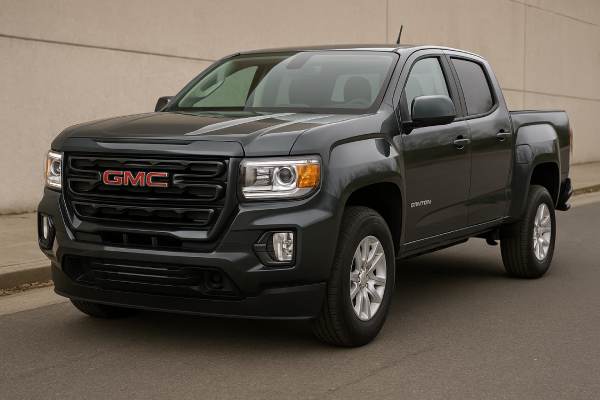
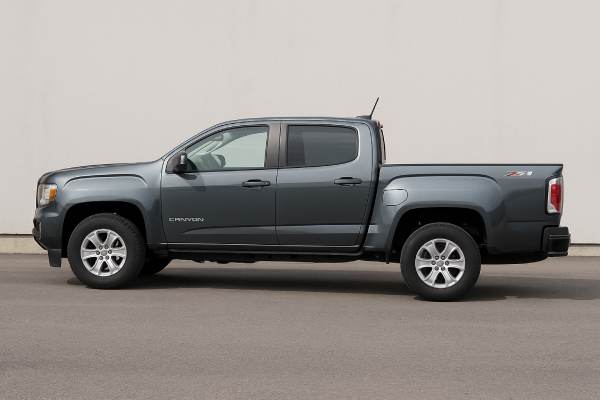
The 2021–2022 GMC Canyon with the 2.8 L Duramax LWN diesel is a niche but appealing truck: a midsize pickup with full-size torque and long-range highway manners. As a rear-wheel-drive (RWD) GMT31XX-platform model, it blends compact exterior dimensions with serious towing ability, making it attractive to owners who tow campers, boats, or work trailers but do not want a bulky half-ton.
This final-run diesel Canyon offers 181 hp and a stout torque curve, paired with a 6-speed automatic and a 21-gallon tank for strong highway range. It sits at the end of the second-generation truck, just before the all-new 2023 redesign and the switch to a 2.7-liter turbo gas-only lineup.
For shoppers, that means a mix of strengths and compromises: excellent towing and fuel economy for its class, but relatively basic driver-assistance tech and a cabin that feels older than the newest rivals. This guide walks through specs, reliability patterns, maintenance needs, safety ratings, and how the diesel Canyon stacks up against alternative midsize pickups.
Fast Facts
- Strong towing for a midsize: up to 7,700 lb (properly equipped 2WD crew cab, short bed, diesel).
- High torque and relaxed highway cruising from the 2.8 L Duramax turbo-diesel, with real-world economy often in the low- to mid-20 mpg (US) range.
- Ownership caveat: emissions and fuel-system components (EGR, DPF, injectors, turbo) can be costly if neglected or if contaminated fuel is used.
- Key interval to budget for: timing belt replacement around 150,000 mi / 240,000 km (or earlier if age or usage demands).
- Typical fuel filter change interval is about every 37,500 mi / 2 years on pickup applications.
What’s inside
- GMC Canyon 2.8 Diesel 2021–2022
- Canyon 2.8 Diesel Specs and Data
- Canyon Diesel Trims, Safety Tech
- Reliability Issues and Service Actions
- Maintenance Schedule and Buying Tips
- Driving Performance and Real Economy
- GMC Canyon Diesel Versus Rivals
GMC Canyon 2.8 Diesel 2021–2022
The 2021–2022 GMC Canyon diesel represents the last chapter of GM’s midsize diesel pickup experiment in North America. From 2016 through 2022, the LWN-code 2.8 L Duramax four-cylinder was offered in the Canyon and its twin, the Chevrolet Colorado. It delivered 181 hp and 369 lb-ft of torque, emphasizing torque and efficiency over outright horsepower.
By 2021, the truck had received a styling refresh, with a more upright grille and trim-specific fascias, but the underlying GMT31XX platform dated back to 2015. The diesel engine continued largely unchanged, paired with the 6L50 six-speed automatic and available in both rear-wheel-drive and four-wheel-drive configurations. Our focus here is the RWD crew-cab short-box version, which is common among buyers who prioritize fuel economy and towing on paved roads.
The real attraction is the powertrain. The inline-four turbo-diesel uses high-pressure common-rail injection and a variable-geometry turbo to provide strong low-rpm thrust, ideal for towing and steady highway use. Compared with gas V6 versions, the diesel trades some acceleration for a flatter torque curve and noticeably better fuel economy on long trips, especially when loaded.
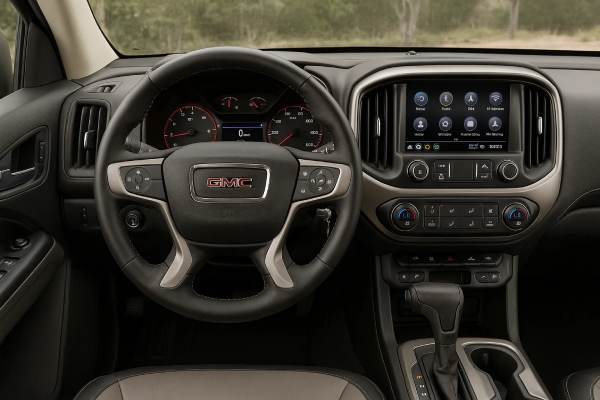
However, being a late-life model shows in other areas. The cabin design and materials lag newer rivals, rear-seat legroom is modest in the crew cab, and advanced driver-assistance systems (ADAS) are limited to basic lane-departure and forward-collision warnings on most trims, with no adaptive cruise control or automatic emergency braking.
From an ownership standpoint, the 2.8 L Duramax is capable of high mileages when maintained, but it adds complexity: emissions hardware (EGR, DPF, SCR/DEF) and a timing belt instead of a chain. That makes adherence to maintenance schedules—and careful use of clean diesel fuel—more important than with a simple gas engine.
Overall, the 2021–2022 Canyon 2.8 L diesel is best viewed as a specialist tool: excellent for long-distance commuting, light commercial use, and frequent towing where you value torque and range over cutting-edge tech or plush ride quality.
Canyon 2.8 Diesel Specs and Data
This section assumes a typical configuration: 2022 GMC Canyon Elevation Crew Cab, Short Box, 2WD, 2.8 L Duramax LWN diesel with 6L50 automatic. Figures vary slightly by trim and equipment.
Engine and Performance (2.8 L Duramax LWN)
| Item | Value | Notes |
|---|---|---|
| Engine code | LWN | Duramax turbo-diesel I4 |
| Layout and valvetrain | Inline-4, DOHC, 4 valves/cyl | Aluminum head, cast-iron block |
| Displacement | 2.8 L (2,776 cc) | 94 mm × 100 mm bore × stroke |
| Induction | Variable-geometry turbocharger with intercooler | Water-cooled VGT |
| Fuel system | High-pressure common-rail direct injection | Modern diesel injection |
| Compression ratio | 16.5:1 | High for efficiency |
| Max power | 181 hp (135 kW) @ 3,400 rpm | Factory rating |
| Max torque | 369 lb-ft (500 Nm) @ 2,000 rpm | Broad low-rpm plateau |
| Timing drive | Gear-driven cams; toothed timing belt from crank | Belt replacement ~150,000 mi / 240,000 km |
| Emissions system | EGR, DOC, DPF, SCR (DEF) | Meets contemporary U.S. and Canadian standards |
| Official economy (2WD diesel) | ~20 mpg city / 30 mpg hwy (US) ≈ 11.8 / 7.8 L/100 km | EPA-rated; trim-dependent |
| Real-world mixed | ~22–25 mpg US (26–30 mpg UK) | Based on test and owner reports |
| 120 km/h (75 mph) cruise | Typically 8.5–9.0 L/100 km (26–28 mpg US) | Light load, RWD setup |
| Aerodynamics (est.) | Cd ~0.42, frontal area ~2.8 m² | Typical for midsize crew-cab pickup |
Transmission and Driveline
| Item | Value | Notes |
|---|---|---|
| Transmission | Hydra-Matic 6L50 6-speed automatic | Diesel-only pairing |
| Gear ratios | 1st 4.06, 2nd 2.37, 3rd 1.55, 4th 1.16, 5th 0.85, 6th 0.67, Rev 3.20 | Wide-ratio for towing and highway |
| Final drive ratio | Typically 3.42:1 (diesel) | Check axle RPO for exact ratio |
| Drive type | RWD | Traditional front-engine, rear-drive |
| Differential | Automatic locking rear (G80) on many tow/off-road packages | Open diff on some base trims |
Chassis and Dimensions
| Item | Value | Notes |
|---|---|---|
| Platform | GMT31XX | Shared with Chevy Colorado |
| Front suspension | Independent coil-over, twin-tube dampers | Unequal-length control arms |
| Rear suspension | Solid axle with 2-stage leaf springs | Pickup-typical |
| Steering | Electric rack-and-pinion | Light effort, about 12.6 m turning circle |
| Brakes | 4-wheel discs; front 12.2 in, rear 12.75 in rotors | ABS standard |
| Wheels / tyres | 18×8.5 in alloys, 265/60R18 all-season | Elevation-type trim |
| Ground clearance | 8.4 in (213 mm) | Unladen, RWD |
| Length | 212.4 in (5,395 mm) | Crew-cab short box |
| Width (w/o mirrors) | 74.3 in (1,887 mm) | Body only |
| Height | ~70.7 in (1,796 mm) | Varies slightly by tyre/suspension |
| Wheelbase | 128.3 in (3,259 mm) | Short-box crew |
| Kerb (curb) weight | ~4,200 lb (1,905 kg) | Approx., varies by trim; diesel is heaviest engine option |
| GVWR | ~5,800 lb (2,631 kg) | Configuration-dependent |
| Fuel tank | 21.0 gal (79 L) | All cabs/beds |
| Cargo volume | ~41.3 ft³ (≈1,170 L) short box | ~49.9 ft³ (≈1,413 L) long box |
Performance and Capability
| Metric | Value | Notes |
|---|---|---|
| 0–60 mph (0–97 km/h) | ~9.0–9.5 s | Depends on axle, tyres, load |
| 0–100 km/h | ~9.5–10.0 s | Approximate |
| Top speed | ~110 mph (177 km/h) | Limited; not a high-speed truck |
| Braking 100–0 km/h | Around 39–42 m (128–138 ft) | Test- and tyre-dependent |
| Max towing (diesel) | 7,700 lb (3,493 kg) 2WD crew-cab short box; 7,550 lb (3,425 kg) for 4WD | Requires trailering package |
| Payload | Up to ~1,578 lb (716 kg) for 2WD crew short box | Falls slightly with options |
| Roof load | Typically 165–220 lb (75–100 kg) | Check crossbar system rating |
Fluids and Service Capacities (Key Items)
| System | Spec and Capacity | Notes |
|---|---|---|
| Engine oil | 5.6 L / 6.0 qt with filter; dexos2-approved 5W-30 diesel oil | Drain plug around 24 Nm (18 lb-ft) |
| Coolant | GM-approved Dex-Cool, typically 50/50 mix; capacity ≈10–11 L | Confirm by VIN; refill/bleed per manual |
| ATF (6L50) | Dexron-VI; capacity ~9–10 L for full service | Check temperature and level procedure |
| Rear axle | 75W-90 synthetic gear oil; capacity ~1.6–2.0 L | Change sooner with heavy towing |
| DEF tank | Typically 4–5 gal | DEF use roughly 2–3% of fuel by volume |
| A/C refrigerant | R-134a; charge and oil specified by HVAC label | Use certified equipment for service |
Electrical
| Item | Value | Notes |
|---|---|---|
| Alternator | ~150 A on most diesel trims | Higher output with tow/aux packages |
| 12 V battery | ~70–80 Ah AGM or flooded lead-acid | Group size varies by market/equipment |
| Glow plugs | 4, one per cylinder | Critical for cold starts |
| Spark plugs | Not applicable | Diesel ignition by compression |
Safety and Driver Assistance (Hardware Overview)
| Feature | Availability (2021–2022 Canyon diesel) | Notes |
|---|---|---|
| Airbags | Front, front side, side-curtain | Coverage for both rows |
| ABS, ESC, traction control | Standard | Baseline stability systems |
| Rear-view camera | Standard | Required equipment in this era |
| Forward collision alert | Optional on most trims; standard on Denali | Warning only—no automatic braking |
| Lane departure warning | Optional | Audio/visual alert, no active lane-keeping |
| Blind-spot monitoring | Generally not available on this generation | Market/trim dependent |
| Parking sensors | Rear, available or standard by trim | Helpful with tall bed sides |
| Headlights | Halogen projectors; rated weak by many tests | Limited reach in dark rural use |
Canyon Diesel Trims, Safety Tech
In 2021–2022, the 2.8 L Duramax diesel was an optional engine on several Canyon trims rather than a stand-alone model. Exact availability can vary by market, but in North America it was typically offered on Elevation, AT4, and Denali, with both 2WD (RWD) and 4WD drivetrains.
Trim and options overview (diesel-eligible trims):
- Elevation / Elevation Standard
- More basic exterior and interior, cloth seats, smaller wheels on base trims.
- Diesel option mainly about tow rating and efficiency; suspension and brakes similar to gas models.
- Quick ways to spot: simpler grille and wheel designs, fewer chrome details, analog gauge cluster.
- AT4 (off-road-oriented)
- Available with diesel; adds off-road suspension tune, all-terrain tyres, skid plates, and often an automatic locking rear differential.
- Tow ratings remain high, but real-world payload can be slightly lower due to heavier hardware.
- Visual tells: dark trim, red tow hooks, AT4 badging, all-terrain tyres.
- Denali (top trim)
- Diesel option pairs with luxury-leaning equipment: leather, larger wheels, more chrome, premium audio, and extra comfort features.
- Same basic drivetrain; tuning focuses on refinement rather than extra power.
- Quick identifiers: Denali-specific grille, bright exterior trim, wood-style interior accents.
Within each trim, packages such as trailering, appearance, and convenience groups add hardware like integrated trailer brake controllers, bed lighting, tonneau covers, and step bars. For the diesel, the trailering package is key, as it unlocks the maximum 7,700-lb rating on 2WD crew-cab short-box trucks.
VIN and RPO (Regular Production Option) codes on the glovebox or door jamb can confirm diesel status (LWN), axle ratios (such as GU6 for 3.42), and whether you have the locking differential (G80) or specific tow/off-road packages.
Safety ratings
- IIHS (crew-cab Canyon / Colorado)
- Crashworthiness: mostly top “Good” scores, but weaker performance in some small-overlap tests.
- Headlights: rated below average on most trims.
- Front crash prevention: optional system rated at a basic level, with no pedestrian detection.
- NHTSA
- Overall rating: 4 out of 5 stars, with strong side-impact results but only average rollover resistance typical for pickups.
These ratings apply to the platform as a whole, not specifically to diesel vs gas engines. The diesel’s heavier front end can slightly change crash dynamics, but official tests do not separately rate it.
Safety and ADAS equipment evolution
Through 2021–2022, the Canyon line remained relatively conservative in driver-assistance tech compared with newer rivals:
- Standard: ABS, stability control, traction control, rear-view camera, multiple airbags.
- Available or trim-dependent:
- Forward collision warning (visual/audible only).
- Lane departure warning.
- Rear parking sensors.
- Not available from factory on this generation:
- Adaptive cruise control.
- Automatic emergency braking.
- Lane-keeping or lane-centering assist.
After collision repairs or windshield replacements, radar and camera alignment is simpler than on feature-heavy newer trucks, but forward-collision and lane-departure systems should still be calibrated when their sensors or mounting points are disturbed. For diesel trucks, note that front-end repairs also interact with intercooler, DEF lines, and other cooling components, so collision shops should follow OEM repair procedures closely.
For child seats, crew-cab models include LATCH/ISOFIX anchors on the rear outboard seats, with top tether points on the rear wall. Some owners and testers find the anchors a bit hard to access, so a careful physical check with the exact child seat in question is wise.
Reliability Issues and Service Actions
Overall, the 2.8 L Duramax Canyon has a mixed but not terrible reliability picture. Many owners report high mileages with routine maintenance, but a minority experience expensive failures—especially in emissions and fuel-system components. Owner forums and independent diesel specialists highlight several recurring themes.
Common to occasional issues
- Emissions-system concerns (common, medium to high cost)
- Symptoms: Check-engine lights, limp mode, frequent regens, reduced power, poor fuel economy.
- Likely causes: EGR valve and cooler clogging, DPF ash loading, NOx sensor or DEF injector faults.
- Remedy: Proper diagnosis with scan data; forced regen or DPF cleaning, replacing faulty sensors or EGR components. Sticking strictly to low-ash oil, correct fuel, and highway driving helps reduce buildup.
- Turbocharger wear or failure (occasional, high cost)
- Symptoms: Whining or siren noise, loss of boost, smoke, overboost/underboost codes.
- Root cause: Oil contamination, long oil change intervals, or foreign-object damage.
- Remedy: Replace turbocharger assembly after confirming there is no upstream oil starvation; verify oil supply and return lines are clean and unrestricted.
- Fuel-system sensitivity (occasional, high cost if ignored)
- Symptoms: Hard starting, misfires, excessive injector correction values, rail-pressure codes.
- Root cause: Contaminated or poor-quality diesel, water in fuel, overdue fuel filters.
- Remedy: Replace filters, test injectors, check high-pressure pump and rail. Always drain water separator when prompted and avoid running the tank very low.
- Timing belt neglect (risk increases beyond 150,000 mi)
- Symptoms: Noise from belt area, visible cracking or glazing, or in worst cases, sudden no-start with internal engine damage.
- Root cause: Exceeded belt interval; age-related deterioration.
- Remedy: Preventive replacement of belt, tensioner, idlers, and water pump around 150,000 mi / 240,000 km (or earlier if severe service), following factory procedure.
- Chassis and corrosion (common in salted regions, low to medium cost)
- Symptoms: Rust on frame, rear leaf-spring shackles, brake lines, and bed seams.
- Remedy: Underbody inspection; rust treatment or component replacement, plus regular undercoating and washing for trucks in snow-belt climates.
Severity tiers and mileage bands
- 0–60,000 mi (0–100,000 km):
- Typically sees minor issues: software updates, occasional sensor failures, early EGR/DPF complaints in short-trip usage.
- Many engines remain very trouble-free in this range if driven regularly on the highway.
- 60,000–120,000 mi:
- More frequent EGR/DPF and injector-related complaints.
- Timing-belt planning starts, especially for 5–7-year-old trucks.
- Suspension wear (bushings, shocks) and wheel-bearing noise can appear with work use.
- 120,000+ mi:
- High-mileage examples reveal the difference between well-maintained and neglected trucks.
- Some owners report severe failures (seized engines or major internal damage), often tied to overextended oil changes, hard use without maintenance, or unresolved overheating or low oil-pressure events.
Recalls, TSBs, and extended coverage
- A 2022 recall covers front passenger manual seats that may have an improperly welded hook attachment, which can allow separation from the seat track in a crash. The fix involves inspection and, if necessary, seat-frame replacement at no cost.
- Various software updates address driveability, emissions diagnostics, and transmission shifting behaviour. Dealers can check for outstanding calibration updates via GM’s service tools.
- For any used truck, verify recall and service-campaign completion using the official VIN lookup on the manufacturer’s site or the national safety agency in your market.
Pre-purchase reliability checks
When evaluating a used Canyon diesel:
- Request full service records, focusing on oil changes (correct oil spec), timely fuel-filter replacements, and coolant or ATF services.
- Confirm timing belt status; an undocumented belt on a high-mileage truck should be treated as due.
- Scan the engine and transmission modules for stored or pending codes, not just active ones.
- Inspect DEF and emissions components for signs of tampering; trucks with deleted emissions systems can be illegal for road use and risky to own.
- If feasible, have a diesel-savvy shop perform a pre-purchase inspection including injector balance, rail-pressure behaviour, and boost tests.
Maintenance Schedule and Buying Tips
The Canyon 2.8 L diesel uses an oil-life monitoring system, but owners often prefer a structured schedule for budgeting and long-term reliability. The table below blends factory guidance with conservative best practice for mixed use; always verify against the exact owner’s manual and market.
Practical maintenance schedule (typical use)
| Item | Interval (distance / time) | Notes |
|---|---|---|
| Engine oil and filter | When OLM requests, or ~7,500 mi / 12,000 km or 1 year | Use dexos2-approved 5W-30 diesel oil |
| Fuel filter | 37,500 mi / 60,000 km or 2 years | Shorten if poor fuel quality likely |
| Engine air filter | 45,000 mi / 72,000 km or 4 years (earlier in dust) | Inspect annually |
| Cabin air filter | 22,500–30,000 mi / 36,000–50,000 km or 2 years | More often in polluted or dusty areas |
| Coolant (Dex-Cool) | 150,000 mi / 240,000 km or 5 years | Replace hoses as needed |
| Timing belt kit (with water pump) | 150,000 mi / 240,000 km or around 10 years | Critical, interference engine |
| Serpentine belt | 150,000 mi / 240,000 km or when cracked or noisy | Often done with timing belt |
| ATF (6L50) | 45,000–60,000 mi / 72,000–100,000 km | Shorter if towing or in hot climates |
| Rear axle oil | 45,000 mi / 72,000 km (severe) or 90,000 mi (normal) | Sooner with towing or off-road use |
| Brake fluid | 3 years regardless of mileage | Use DOT 3 or DOT 4 as specified |
| Brake pads and rotors | Inspect every 12 months or 12,000 mi | Watch for rust in salted climates |
| Tyre rotation and alignment | 6,000–7,500 mi / 10,000–12,000 km | Essential on all-terrain tyres |
| 12 V battery | Test annually after 4 years; replace around 6–7 years | Diesel glow cycle stresses battery |
| Differential and driveline inspection | At each oil change | Look for leaks, torn boots, loose joints |
For trucks used heavily for towing, commercial work, or short, cold trips, shortening oil, fuel-filter, and ATF intervals is sensible.
Fluid and torque notes
- Stick to dexos2-approved oils in the correct viscosity; they are formulated for DPF-equipped diesels with low-ash additives to protect the emissions system.
- When changing the timing belt, use OE-quality or OEM components and follow the locking and torque procedures carefully; incorrect timing can cause engine damage.
- A key torque to know is the oil drain plug at roughly 24 Nm (18 lb-ft)—overtightening can strip the pan threads or distort the sealing surface.
Buyer’s guide: what to look for
- Ideal years and trims
- The 2021–2022 diesel Canyon benefits from late-run refinements and the refreshed styling. Elevation and AT4 trims offer a good balance of equipment and price; Denali suits buyers who want luxury and do not mind larger wheels and additional features.
- Preferred configurations
- For towing and highway use, a 2WD crew cab short box with 2.8 L diesel and trailering package is efficient and easy to manoeuvre.
- For mixed off-road use, a diesel AT4 with the off-road package and locking rear differential is attractive, though some buyers may prefer 4WD rather than RWD for traction.
- Items often needing reconditioning on used trucks
- Tyres (often original all-seasons or worn all-terrains).
- Shocks or struts around 80,000–100,000 mi.
- Rear leaf-spring bushings and sway-bar links if the truck has carried heavy loads.
- Brake rotors and lines in high-corrosion areas.
- Inspection checklist
- Check for rust on frame rails, bed supports, rear bumper brackets, and brake lines.
- Inspect for oil or coolant leaks around the front cover, water pump, and cooler lines.
- Listen for turbo noise, and watch boost or rail-pressure behaviour during a test drive.
- Verify that the DEF system works properly (no warnings, normal consumption).
- Confirm that all recalls and campaigns are complete via a VIN check with a dealer or official database.
If you want a long-term workhorse, prioritise trucks with documented timing belt service, frequent oil and fuel-filter changes, and no history of emission-system tampering.
Driving Performance and Real Economy
On the road, the Canyon diesel drives differently from its gas-powered siblings. The 2.8 L Duramax is not quick off the line in absolute terms, but it produces a solid wave of torque from low rpm. Around town, it pulls steadily from just above idle, and on highways it settles into sixth gear with low engine speeds and relaxed noise levels.
The 6L50 automatic generally shifts smoothly and makes good use of the torque band. In light driving it tends to upshift early to keep revs low, while in tow or haul mode it holds gears longer and downshifts more readily on grades. Occasional “gear hunting” can occur on rolling hills, especially without tow or haul engaged, but the diesel’s torque usually keeps this in check.
Ride quality is typical midsize-truck: firm, with some jiggle over broken pavement when unladen. Large bumps can feel sharp, especially on 18- or 20-inch wheels, but the truck feels more composed with a moderate load or trailer attached. Steering is light and consistent, with good straight-line stability but modest feedback. Wind and road noise are well controlled by class standards, though the diesel’s clatter is noticeable at idle and low speeds; it smooths out at cruise.
Braking performance is adequate rather than outstanding. Pedal feel can be somewhat soft, and repeated hard stops, such as when towing in mountains, will benefit from downshifting and engine braking to keep rotor temperatures in check.
Real-world efficiency
In mixed owner and test reports:
- City driving: Often in the 18–22 mpg US (13.0–10.7 L/100 km) range, depending on traffic, climate, and how frequently the DPF regenerates.
- Highway at 100–120 km/h (60–75 mph): Commonly 26–30 mpg US (9.0–7.8 L/100 km) in RWD form on stock tyres, with best figures at moderate speeds and gentle throttle.
- Towing moderate loads (3,500–5,000 lb): Expect roughly a 20–35% increase in fuel consumption, bringing highway figures into the high-teens mpg (US).
In cold climates, frequent short trips can reduce economy and increase DPF regens. Using an engine block heater where available and planning occasional longer drives helps keep the emissions system cleaner.
Load and towing behaviour
With the diesel and appropriate tow package, the Canyon feels confident towing travel trailers, car haulers, or equipment trailers within its rating. The combination of strong low-rpm torque and a relatively long wheelbase for its size gives good stability, provided:
- Tongue weight is kept in the recommended 10–15% range.
- Trailer brakes are properly adjusted and controlled via an in-cab brake controller.
On long grades, coolant and transmission temperatures are generally well managed, though it is wise to downshift early and avoid forcing the truck to hold top gear at very low rpm. Owners who regularly tow near the 7,000–7,700 lb limit should stick to aggressive maintenance on ATF, axle oil, and the cooling system.
GMC Canyon Diesel Versus Rivals
When comparing the 2021–2022 GMC Canyon diesel to other midsize pickups, it is important to separate powertrain advantages from platform age.
Key rivals in this era:
- Toyota Tacoma 3.5 L V6
- Ford Ranger 2.3-liter EcoBoost I4
- Nissan Frontier 3.8 L V6
- Honda Ridgeline 3.5 L V6 (unibody)
Where the Canyon diesel shines
- Towing and torque in a midsize footprint
- The diesel Canyon’s maximum 7,700-lb tow rating matches or exceeds many rivals and does so with lower engine speeds and less drama, especially where long grades or headwinds are involved.
- Highway fuel economy and range
- Few midsize pickups of this generation can match 30 mpg-class highway economy while towing as well as the Canyon diesel. For frequent highway commuters or long-distance travellers, the combination of a large fuel tank and efficient engine is a real advantage.
- Compact size vs full-size trucks
- Compared with half-ton diesels or large gas trucks, the Canyon is easier to park and manoeuvre while still handling many of the same tasks—ideal for urban tradespeople and RV owners who do not need a full-size rig.
Where rivals have the edge
- Safety and ADAS features
- Newer designs, especially recent Tacoma, Ranger, and Ridgeline models, often include standard automatic emergency braking, lane-keeping assistance, and adaptive cruise control, features unavailable on this generation of Canyon. That is a significant differentiator for safety-conscious buyers.
- Ride and cabin refinement
- The Honda Ridgeline in particular feels more like a crossover in ride and interior quietness. Updated versions of the Frontier and Ranger also offer more modern infotainment and driver-display tech than the pre-2023 Canyon.
- Reliability perceptions and ownership costs
- The diesel Canyon’s advanced emissions and fuel system add complexity and potential repair costs. Gas-powered Tacomas and some other rivals have simpler powertrains with strong long-term reputations, even if they use more fuel.
Who should choose the Canyon 2.8 L diesel?
It makes the most sense if you:
- Regularly tow or haul moderate loads but want to avoid a full-size truck.
- Cover high annual mileage, particularly on the highway, where diesel efficiency pays off.
- Are comfortable following a diesel-specific maintenance plan and working with a shop that understands modern emission-controlled diesels.
By contrast, if you mainly drive short trips in urban traffic, want the latest driver-assistance tech, or prefer minimal complexity, a newer gas-powered midsize pickup—or a late-model Canyon with the 3.6 L V6—may be a better match.
References
- 2022 GMC Canyon Features, Specs and Options 2022 (Brochure)
- 2020 Chevrolet and GMC Duramax Diesel 2.8L Owner Manual Supplement 2020 (Owner’s Manual)
- 2022 Engine Oil Capacities (With Filter) – U.S. and Canada 2022 (Service Bulletin)
- 2022 GMC Canyon Crew Cab Pickup 2022 (Safety Rating)
- Vehicle Detail Search – 2022 GMC Canyon 2022 (Recall Database)
Disclaimer
This article is for informational purposes only and is not a substitute for professional diagnosis, repair, or official service information. Specifications, torque values, fluids, and maintenance intervals can vary by VIN, model year, market, and installed equipment. Always confirm data against the official owner’s manual, factory service documentation, and current technical bulletins for your specific vehicle.
If you found this guide helpful, consider sharing it with other owners or shoppers on social media (Facebook, X/Twitter, forums) to support our work and help more people make informed decisions.