
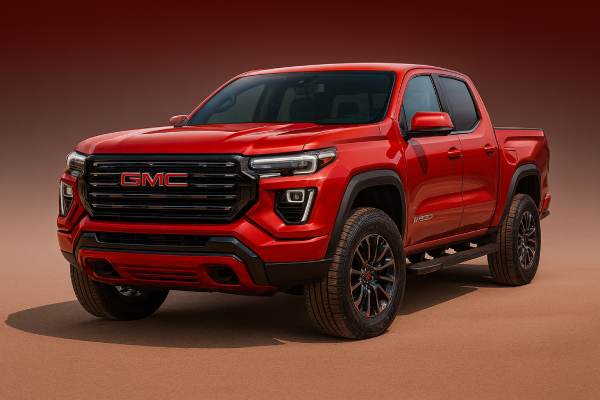
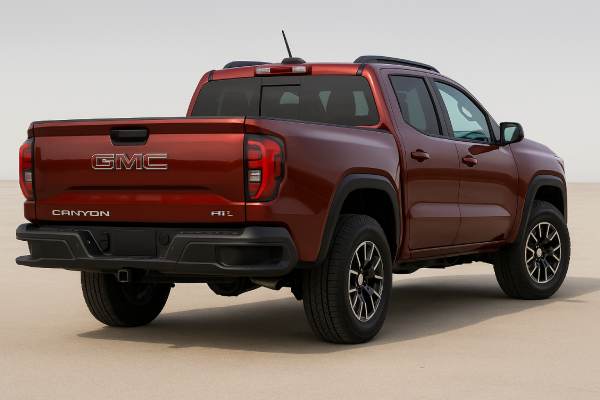
The 2023–present GMC Canyon 4WD with the L3B 2.7 litre turbo engine is a modern take on the midsize pickup. It moves away from the old V6 toward a high-output four-cylinder that delivers strong torque, better towing, and improved packaging. Every new Canyon is now crew cab, short bed, and this 4WD layout is aimed at drivers who split time between daily commuting and serious weekend use.
Underneath, the GMT31XX-2 platform brings revised suspension, more ground clearance on off-road trims, and upgraded electronics. The cabin gains better materials, a large central touchscreen, and a more advanced driver-assistance suite than the previous generation. At the same time, the truck keeps a traditional ladder frame, a proper low-range transfer case, and a rated tow capacity up to 7,700 lb, making it more than a lifestyle pickup. This guide walks through the technical details, real-world running costs, reliability patterns, and how the Canyon 4WD compares with its main rivals.
Top Highlights
- Strong 2.7 litre turbo with 310 hp and 430 lb-ft gives confident towing and highway passing.
- 4WD with low range, available AT4 and AT4X hardware, and good ground clearance suit mixed on-road and off-road use.
- Crew-cab-only layout with modern interior, large touchscreen, and useful camera views improves daily usability.
- Known early recall for unexpected automatic emergency braking means software and sensor updates are important to verify.
- Engine oil and filter changes are typically best done every 7,500–10,000 km or 6–12 months under mixed use, sooner for heavy towing.
Contents and shortcuts
- GMC Canyon 4WD Turbo Profile
- L3B 2.7 4WD Technical Data
- 4WD Trims Equipment and Safety
- Reliability Issues and Service Actions
- Maintenance Schedule and Buying Advice
- Driving Dynamics and Real-World Performance
- Canyon 4WD Versus Rival Pickups
GMC Canyon 4WD Turbo Profile
For the 2023 model year, GMC redesigned the Canyon on the updated GMT31XX-2 architecture and made the 2.7 litre L3B turbo four-cylinder standard across the line. In 4WD form, this means every Canyon gets a full-time body-on-frame layout, a two-speed transfer case, and a crew cab with a short box. There is no regular cab or long-bed configuration in this generation, so GMC clearly positions the truck as a dual-purpose daily driver and adventure tool rather than a bare-bones workhorse.
The L3B engine is the same basic unit used in several GM full-size trucks, tuned here to produce 310 hp and a substantial 430 lb-ft of torque. That torque arrives low in the rev range, which is important for towing and steep off-road climbs. An eight-speed automatic transmission and electronic 4WD system with low range are standard. Tow ratings up to 7,700 lb and payload around 1,600–1,700 lb (depending on trim and equipment) put the Canyon near the top of the midsize class for capability.
GMC offers several 4WD-oriented trims, including Elevation, AT4, luxury-focused Denali, and the more extreme AT4X. All ride on a 131.4 inch wheelbase with a crew cab and roughly 5-foot 2-inch bed. Ground clearance and suspension travel increase as you move toward AT4 and AT4X, along with all-terrain tyres, skid plates, and locking differentials on specific versions. The design emphasises a tall stance, short overhangs, and pronounced wheel arch cladding to signal off-road intent.
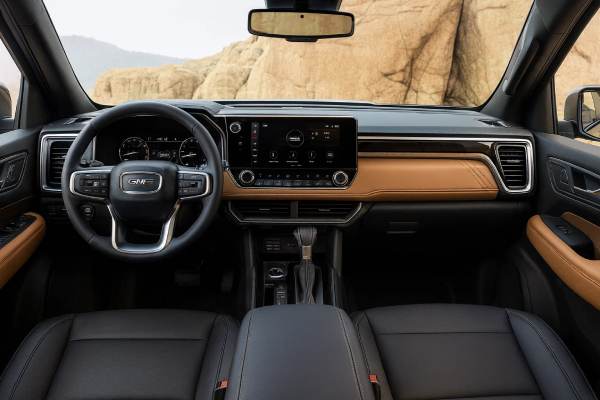
Inside, the Canyon finally steps into a more modern era. A large central touchscreen (typically 11.3 inches) pairs with a configurable digital driver display on most trims. Switchgear is more logically grouped around drive modes, transfer case selection, and camera functions. Even in work-focused trims, the cabin layout favours ergonomics and connectivity, with widely available wireless Apple CarPlay and Android Auto, better sound insulation, and more storage options.
Overall, the Canyon 4WD 2.7 Turbo aims at buyers who want a truck that can be driven every day, tow a mid-size camper or boat, and still feel secure when the road ends. It is more refined than the previous generation, but, especially in AT4 and AT4X form, it keeps a genuine off-road backbone.
L3B 2.7 4WD Technical Data
This section focuses on the key specifications for the 2.7 litre L3B-powered 4WD Canyon in its 2023–present form. Figures can vary slightly by trim and market, so always check the door sticker and local specifications for exact numbers.
Engine and Performance (L3B 2.7 Turbo)
| Item | Specification |
|---|---|
| Engine code | L3B 2.7L Turbo High-Output inline-4 |
| Layout and valvetrain | Inline-4, DOHC, 4 valves per cylinder |
| Displacement | 2.7 L (2,726 cc approx.) |
| Induction | Single twin-scroll turbocharger, intercooler |
| Fuel system | Direct injection, petrol/gasoline |
| Compression ratio | Around 10:1 (high for a turbo gas truck engine) |
| Max power | 310 hp (approx. 231 kW) |
| Max torque | 430 lb-ft (approx. 583 Nm) |
| Timing drive | Chain-driven dual overhead camshafts |
| Emissions standard | EPA / Tier 3 compliant for North America |
| Rated combined economy (typical 4WD) | Around mid-teens to low 20s mpg US, depending on trim and use |
| Aerodynamics | Midsize pickup profile; Cd is not usually published, but frontal area is large due to ride height and stance |
Real-world highway consumption for the 4WD Canyon often sits in the 9–11 L/100 km range (about high teens to low 20s mpg US) when lightly loaded at 110–120 km/h, with city numbers higher due to the truck’s weight and boxy shape.
Transmission and Driveline
| Item | Specification |
|---|---|
| Transmission | 8-speed automatic, electronically controlled |
| Drive type | Part-time 4WD with 2H, 4H, and 4L (and Auto 4WD on some trims) |
| Transfer case | Two-speed, electronically shifted, low-range reduction |
| Front differential | Open differential (AT4X adds front locker) |
| Rear differential | Open or automatic locking; selectable locking rear differential on off-road trims |
| Final drive ratio | Varies by trim but optimised for towing and off-road use |
Chassis and Dimensions
| Item | Specification |
|---|---|
| Platform | GMT31XX-2 midsize body-on-frame |
| Suspension (front) | Independent short/long arm with coil-over shock and stabiliser bar |
| Suspension (rear) | Solid axle with leaf springs (tuning varies by trim) |
| Brakes | Four-wheel disc brakes with ABS and stability control |
| Wheelbase | 131.4 in (3,338 mm) |
| Overall length | About 213.2 in (5,415 mm) in crew cab short box form |
| Bed (length at floor) | ~61.7 in (1,568 mm) |
| Bed (width at floor / between wheel housings) | ~61.2 in / 45.2 in (1,554 / 1,148 mm) |
| Ground clearance | ~9.6 in on many 4WD models; more on AT4X |
| GVWR | Around 6,250 lb (varies with trim) |
| Maximum payload | Around 1,600–1,700 lb depending on configuration |
| Fuel tank | ~21.5 US gal (81+ L) |
Performance and Capability
| Item | Specification |
|---|---|
| 0–60 mph (typical) | Roughly mid-to-low 6-second range for many trims |
| Top speed (governed) | Typically just over 100 mph (varies by market) |
| Maximum towing | Up to 7,700 lb with the right tow package and configuration |
| Typical roof load | Suitable for moderate racks and tents; check owner’s manual and rack rating |
Fluids, Service Capacities and Key Torque Notes
Exact fluids and capacities depend on transmission and axle options. As a general guide:
- Engine oil: Dexos1-approved 0W-20 or 5W-30 (depending on market) with capacity around 5.5–6.0 US qt including filter.
- Coolant: Long-life Dex-Cool type; pre-mixed or 50/50 with distilled water, capacity typically in the 10–12 L range for engine and radiator.
- Automatic transmission fluid: GM-approved ATF (e.g., DEXRON specification for this unit); capacity varies but can be more than 8 L in a full service.
- 4WD transfer case and axles: GM-approved gear oils; often 75W-90 synthetic in differentials and specific fluid in transfer case.
- A/C system: R-1234yf refrigerant with a small oil charge; service requires proper recovery equipment.
Critical fasteners such as wheel lug nuts, suspension arms, and prop-shaft bolts have specific torque values in the service manual and should always be torqued with a calibrated wrench rather than guessed.
Electrical and Safety Notes
The Canyon 4WD uses a modern electrical architecture with:
- High-output alternator sized for accessories and towing loads.
- AGM or enhanced flooded 12 V battery on many trims.
- Multiple camera views, radar and camera sensors for driver assistance.
IIHS testing of the redesigned Canyon (using 2023 AT4 and Elevation 4WD crew cabs) reports top “Good” crashworthiness ratings in the updated small overlap and side tests, with headlights typically rated Acceptable and advanced front crash prevention systems available or standard on many trims. NHTSA testing has also yielded strong overall scores for this generation of Canyon.
4WD Trims Equipment and Safety
Although equipment varies by market and model year, the 2.7 Turbo 4WD Canyon line in North America generally revolves around four main personalities: Elevation, AT4, Denali, and AT4X. All share the same core powertrain, but differ significantly in suspension, tyres, driver assistance, and interior trim.
Elevation 4WD is the more affordable entry into the 4WD range. It typically includes:
- Crew cab, short bed, 4WD with low range.
- Cloth or mid-grade upholstery.
- Standard large central touchscreen with smartphone integration.
- Basic all-season tyres and simpler suspension tuning.
You can often add tow packages, all-terrain tyres, and key safety upgrades as options, making Elevation a good blank canvas if you want to customise.
AT4 is the primary off-road trim:
- Raised ride height and off-road tuned suspension.
- Underbody skid plates and recovery hooks.
- All-terrain tyres and specific wheel designs.
- Enhanced drive modes for off-road and terrain use.
AT4 balances capability with day-to-day comfort and tends to be a sweet spot for owners who genuinely use their 4WD system but still drive mostly on pavement.
Denali focuses on comfort and amenities:
- Unique grille and brightwork, larger wheels with more on-road oriented tyres.
- Upgraded interior materials, leather seating, more sound insulation.
- Higher-grade audio, navigation, and larger instrument display.
Denali trims sometimes trade maximum off-road ruggedness for quieter cruising and a more premium feel, but they still retain full 4WD hardware.
AT4X (where offered) is the more extreme factory off-roader:
- Further suspension travel and specific high-performance dampers.
- Front and rear locking differentials.
- Aggressive tyres, additional protection, and off-road camera views.
This trim is aimed at owners who tackle more serious trails and rock crawling but still want a warrantied, factory-engineered package.
From a safety and driver-assistance standpoint, the Canyon’s generational update is significant. Typical features across the 4WD range can include:
- Multiple airbags, including side curtain airbags covering both rows.
- Electronic stability control, traction control, and trailer sway control.
- Automatic emergency braking with vehicle and pedestrian detection on most trims.
- Lane departure warning and lane-keeping assistance on many versions.
- Available blind-spot monitoring, rear cross-traffic alert, and rear park assist.
- Optional surround-view or multi-view camera systems, which are extremely helpful when off-roading or hitching trailers.
IIHS ratings based on tests of 2023 4WD crew cab models show “Good” crashworthiness in both driver and passenger small overlap tests and “Good” in the updated side impact test, with an Acceptable headlight rating and solid marks for front crash prevention. This is an appreciable step up from the previous generation, which had some weaker passenger-side results.
For child seats, the Canyon provides rear ISOFIX/LATCH anchors in the outboard positions. The crew cab layout offers adequate rear legroom for front-facing seats and boosters, but bulky rear-facing infant seats may require moving the front seats forward, so it is worth test-fitting your specific seats before purchase.
Overall, trim selection in the 4WD Canyon range shapes the balance between daily comfort, off-road capability, and luxury, but all versions share the same strong engine, ladder-frame underpinnings, and broadly similar safety shell.
Reliability Issues and Service Actions
Because the L3B-powered Canyon 4WD is a newer generation, long-term data is still developing, but several patterns and early issues have emerged from field reports, service bulletins, and recalls.
Engine and powertrain
The 2.7 litre L3B has already seen service in full-size GM trucks, so some experience carries over:
- Carbon and injector concerns: As a direct injection petrol engine, the L3B can be prone over time to carbon build-up on intake valves, especially with many short trips. Symptoms include rough idle and reduced performance. Remedies generally involve using high-quality fuel, sticking to regular oil changes, and, at higher mileages, intake cleaning if symptoms appear.
- Oil leaks and consumption: A small number of owners report minor oil seepage at gaskets or seals as mileage builds. Routine checks between services are recommended; most issues are handled under warranty with updated seals or fastening procedures.
- Turbo and charge-air plumbing: Any modern turbo engine relies heavily on intact hoses and intercooler joints. Whistling noises, loss of boost, or underboost codes can point to loose clamps or split hoses, which are usually straightforward to repair if caught early.
The eight-speed automatic has benefitted from incremental updates; most reports of harsh shifts or shudder are handled through updated fluid, adaptive relearn, or control-module calibration updates. Drivers should note any persistent flares, hard shifts, or delayed engagement and have them checked while under warranty.
4WD system and chassis
The Canyon’s 4WD hardware is conventional but electronically controlled:
- Transfer case and selector issues: Infrequent but possible concerns include delayed engagement or unwanted mode changes, often due to software or actuator problems. Updated transfer case control software or actuator replacement is the usual fix.
- Suspension components: AT4 and especially AT4X trucks that see heavy off-road use will wear bushings, ball joints, and dampers faster than pavement-only trucks. Listen for clunks, steering play, or uneven tyre wear and address early to avoid further damage.
Rust resistance on the new platform is improved over early generations, but frame rails, crossmembers, and body seams still need regular washing if you live in a road-salt region. Pay attention to the underside of the rear frame arches and mounting points for leaf springs and fuel tank straps.
Electronics and ADAS
One of the most notable early issues was a recall involving unexpected automatic emergency braking activation on certain 2023 Canyon and related models. The remedy includes updated software and, where necessary, sensor checks or replacements. Any truck you consider should have all recall and campaign work completed.
Beyond that, typical concerns include:
- Erratic lane-keeping or false alerts if cameras are dirty, misaligned after windshield replacement, or not calibrated correctly.
- Parking sensors or radar modules affected by impact or aftermarket accessories (e.g., bull bars, winches, or thick bumper coatings).
After any windshield replacement, front bumper work, or suspension height change, ADAS calibration may be required using proper dealer or specialist tools.
Recalls, TSBs, and extended coverage
Key actions to look for when checking a used 4WD Canyon include:
- Completion of any AEB/forward collision system recall.
- Software updates for the engine and transmission control modules to improve driveability and shift quality.
- Any service actions on fuel system or engine management components, especially if the truck had stalling, hesitation, or no-start complaints.
Use the official VIN lookup through GMC/GM or your national safety authority to confirm that all recalls and campaigns are completed. Dealer service histories are very helpful; a Canyon with documented regular servicing and completed campaigns is generally a lower risk.
Pre-purchase reliability checks
For a used example, ask for or verify:
- Full service records with regular oil changes and correct fluids.
- Differential, transfer case, and transmission services done on schedule if mileage is high.
- Evidence of recall completion and any major TSB-related work.
- A thorough inspection of the underbody for rust, damage from off-road use, or poorly executed modifications.
Taken as a whole, the Canyon 4WD 2.7 Turbo has the makings of a solid long-term truck if maintained, but it is still early in its lifecycle. Keeping software up to date and performing regular fluid and system checks are particularly important on this generation.
Maintenance Schedule and Buying Advice
A sensible maintenance plan is the best way to keep the Canyon’s 4WD system and turbocharged engine reliable. Always default to the official maintenance schedule for your market, but the following intervals are a practical starting point for mixed use:
Core engine and fluids
- Engine oil and filter: Every 7,500–10,000 km (5,000–6,000 miles) or 6–12 months, whichever comes first. Shorten to 5,000 km/3,000 miles for heavy towing, dusty off-road use, or frequent cold starts.
- Engine air filter: Inspect at least every 20,000 km; replace every 30,000–40,000 km, sooner in dusty conditions.
- Cabin air filter: Replace every 20,000–30,000 km or every 1–2 years to keep HVAC performance and air quality up.
- Coolant: Long-life coolant can often go 5 years/150,000 km before a full change, but inspect level and condition at least every service.
- Spark plugs: On turbo direct-injection engines, fresh plugs are important; plan for replacement roughly every 100,000 km or earlier if misfire codes or rough running appear.
- Fuel system: Use quality fuel, and consider periodic injector cleaner if permitted in the manual. For high mileage, professional cleaning can help if there are drivability complaints.
Driveline and brakes
- Automatic transmission fluid: Many manufacturers list “filled for life,” but for long-term ownership, a drain-and-fill around 80,000–100,000 km is wise, especially if you tow.
- Transfer case and differentials: Change fluids roughly every 60,000–80,000 km, more often for heavy towing or off-road use.
- Brake fluid: Replace every 2–3 years regardless of mileage to maintain pedal feel and corrosion protection.
- Brake pads and rotors: Inspect at every service; towing and off-road use will wear them faster.
- Tyres and alignment: Rotate every 10,000–12,000 km, check pressures monthly (and before towing trips), and have alignment checked after impacts or uneven wear.
Belts, hoses and electrical
- Serpentine/auxiliary belt: Inspect yearly after the first few years; replace at the first sign of cracking or noise.
- Hoses: Check for bulges, leaks, or soft spots at every major service.
- 12 V battery: Test annually after year three; many modern truck batteries last 4–6 years depending on climate and use.
Because there is no timing belt (the L3B uses timing chains), there is no fixed belt replacement interval, but chains should be monitored via noise, oil analysis, or timing correlation codes. If you hear rattling at start-up or see relevant fault codes, do not ignore them.
Buyer’s guide tips
When shopping for a GMC Canyon 4WD 2.7 Turbo:
- Check for off-road abuse: Look underneath for dents in skid plates, bent suspension arms, or damaged exhaust. A few scrapes are normal; deep structural damage is not.
- Inspect towing history: A factory tow package is a plus, but ask how often and how heavily the truck towed. Look for transmission, differential, or cooling system service if it regularly hauled near the 7,700 lb limit.
- Drive all modes: Engage 4H and 4L on a suitable surface, listening for unusual noises or error messages.
- Test electronics and ADAS: Confirm that cameras, sensors, and driver aids work as expected and that there are no warning lights.
- Rust and leaks: Examine frame rails, crossmembers, and bed supports, especially in salt-belt regions. Check for any coolant, oil, or ATF leaks.
In terms of trims, AT4 and AT4X make sense if you use the added capability; otherwise, Elevation or Denali 4WD may prove cheaper to run due to more road-biased tyres and softer suspension tuning. A truck with complete records, unmodified engine calibration, and all recalls completed is usually a better long-term bet than a heavily tuned or lifted example, unless you can verify professional installation and careful use.
Driving Dynamics and Real-World Performance
On the road, the Canyon 4WD 2.7 Turbo feels notably more modern than the old V6 trucks. The turbocharged four-cylinder delivers strong low-end and mid-range torque, so everyday driving happens at modest engine speeds. Pulling away from a stop or merging onto a highway rarely requires high revs, and the truck tends to feel more muscular than the displacement suggests.
The eight-speed automatic usually manages shifts smoothly, especially after a short learning period where it adapts to your driving style. In normal driving modes, it prioritises efficiency and low engine speeds. Switching to tow/haul mode holds gears longer and sharpens response, helping maintain speed on grades and improving engine braking on descents. Some drivers may notice occasional hesitation or hunting between gears in mixed urban driving, but recent calibrations have improved this behaviour.
Ride quality depends heavily on trim and tyre choice. Elevation and Denali, with more road-biased tyres and slightly softer springs, feel settled and composed on broken pavement, with the typical mild jiggle of a body-on-frame truck but good straight-line stability. AT4 and especially AT4X ride more firmly over sharp bumps at low speeds but often feel more controlled on rough dirt or gravel roads, where their dampers and tyre sidewalls can work.
Noise levels are respectable for a midsize pickup. Wind and tyre noise increase with off-road-oriented tyres and roof racks, but the new cab structure and improved sealing help keep highway noise within comfortable limits. Under hard acceleration, the four-cylinder’s sound is present but not coarse, though it lacks the traditional six-cylinder note some owners may expect.
Off-road, the Canyon 4WD benefits from:
- A proper low-range transfer case.
- Decent ground clearance in 4WD trims, with AT4X adding more.
- Shorter front and rear overhangs than many full-size trucks.
- Available front and rear lockers (AT4X), which make steep or cross-axle obstacles much easier.
Stability and traction control systems work in the background, and specific off-road modes adjust throttle, shift mapping, and traction thresholds. On loose climbs, the abundant turbo torque is helpful but requires a careful right foot; using low range and appropriate drive modes helps keep wheelspin in check.
When towing, the Canyon 4WD with the L3B feels confident up to moderate trailer weights. The combination of strong torque, tow/haul mode, and integrated trailer sway control provides a stable experience if you respect tongue weight and axle load limits. Expect fuel consumption to increase significantly when pulling near the maximum 7,700 lb rating, often by 30–50 percent compared with solo highway cruising.
In daily use, the Canyon’s size strikes a reasonable balance: more manoeuvrable and easier to park than a full-size truck, yet still offering a useful bed and enough towing capacity for many owners. The turning circle and high seating position help in tight urban environments, and camera systems on higher trims make parking and off-road positioning much easier.
Overall, the GMC Canyon 4WD 2.7 Turbo feels like a well-resolved middle ground: powerful, reasonably efficient for its capability, and comfortable enough to serve as a single vehicle for commuting, family use, and weekend work.
Canyon 4WD Versus Rival Pickups
In the midsize 4WD pickup segment, the Canyon’s main rivals include its sibling Chevrolet Colorado, the Toyota Tacoma, Ford Ranger, Nissan Frontier, Jeep Gladiator, and Honda Ridgeline. Each has a slightly different focus, so it is useful to see where the Canyon 4WD 2.7 Turbo fits.
Compared with the Chevrolet Colorado, the Canyon shares most of its mechanicals but positions itself a bit more upscale in appearance and interior finish, especially in Denali and AT4X forms. If you prefer a more premium look and feel from the factory, the Canyon often justifies its price premium; if you plan heavy modification, a Colorado may be a cheaper starting point with similar bones.
Against the Toyota Tacoma, the Canyon has the advantage in engine torque and towing capacity in this generation, along with a more modern interior and crash structure. The Tacoma counters with a very strong reputation for long-term durability and an enormous aftermarket. Buyers who plan to keep the truck for a decade or more in harsh conditions might still lean toward Tacoma, but the Canyon now competes far more closely on capability and safety.
Versus the Ford Ranger, the Canyon’s 2.7 Turbo offers competitive or superior power and torque compared with many Ranger configurations. Towing capacities are similar, and both offer advanced driver assistance. Your decision may come down to brand preference, dealer support, and which interior layout you prefer. The Ranger’s newer generation also improves its cabin and tech, narrowing the gap.
The Nissan Frontier is a simpler truck with a naturally aspirated V6 and a reputation for straightforward mechanicals. It generally lacks the same level of advanced driver assistance and interior tech as a well-optioned Canyon, but some buyers value its conservative design and simplicity. If you want a more feature-rich, refined cabin and advanced safety systems, the Canyon pulls ahead.
Compared with the Honda Ridgeline, the Canyon 4WD is a more traditional truck with body-on-frame construction and low range, while the Ridgeline is a unibody with an all-wheel-drive system and no transfer case. For serious off-road use, heavy towing near the top of the midsize class, or significant aftermarket suspension work, the Canyon is the better tool. The Ridgeline responds with superior on-road refinement and under-bed storage but cannot match the Canyon’s trail and tow credentials.
Finally, against the Jeep Gladiator, the Canyon offers better fuel economy and often a more comfortable daily-driving and parking experience, while the Gladiator emphasises removable roof, solid axles, and extreme aftermarket modification potential. If rock crawling and open-air driving are core priorities, Gladiator is unique; if you want a more conventional truck that still has real off-road capability, the Canyon AT4/AT4X is a more rounded choice.
In summary, the GMC Canyon 4WD 2.7 Turbo now sits firmly among the class leaders for power, towing, and safety, while offering a more refined and tech-rich interior than many rivals. Its trade-offs are typical of a modern turbo truck: attention to maintenance, awareness of software and recall updates, and careful selection of trim based on how you really drive.
References
<a href="https://www.gmc.com/trucks/canyon/features-specs">2024 GMC Canyon Features and Specs</a> 2024 (Manufacturer Specifications)<a href="https://www.gmfleetorderguide.com/NASApp/domestic/proddesc.jsp?year=2024&modelid=36045&normal=1®ionID=1&divisionID=3&vehicleID=25740&type=0">2024 GMC Canyon Specifications - GM Fleet Order Guide</a> 2024 (Manufacturer Specifications)<a href="https://www.iihs.org/ratings/vehicle/gmc/canyon-crew-cab-pickup/2024">2024 GMC Canyon Crew cab pickup</a> 2024 (Safety Rating)<a href="https://www.nhtsa.gov/vehicle/2023/GMC/CANYON/CREW%252520CAB%2525204WD">2023 GMC Canyon Crew Cab 4WD NHTSA Vehicle Rating</a> 2023 (Safety Rating)<a href="https://contentdelivery.ext.gm.com/bypass/gma-content-api/resources/sites/GMA/content/staging/MANUALS/8000/MA8804/en_US/1.0/GTK_2023_GMC_Canyon_AT4X_86821956_A.pdf">2023 Canyon AT4X Getting to Know Your Vehicle Guide</a> 2023 (Owner’s Manual)
Disclaimer
This article is for general informational purposes only and does not replace professional diagnosis, repair advice, or official service information. Specifications, torque values, fluid types, capacities, and maintenance intervals can vary by VIN, model year, market, trim level, and installed equipment. Always confirm details against your vehicle’s owner’s manual, official service literature, and manufacturer technical bulletins before performing any work or making purchasing decisions.
If you found this guide useful, please consider sharing it with other owners or shoppers on platforms like Facebook, X/Twitter, or forums. It helps support the continued creation of detailed, independent technical content.