
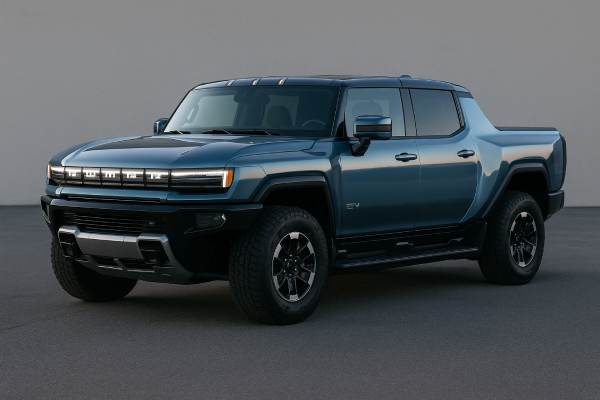
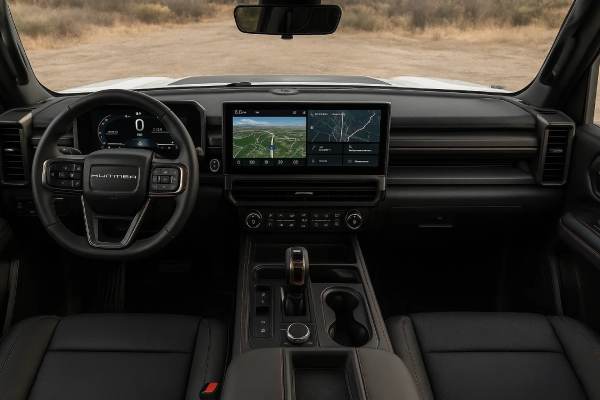
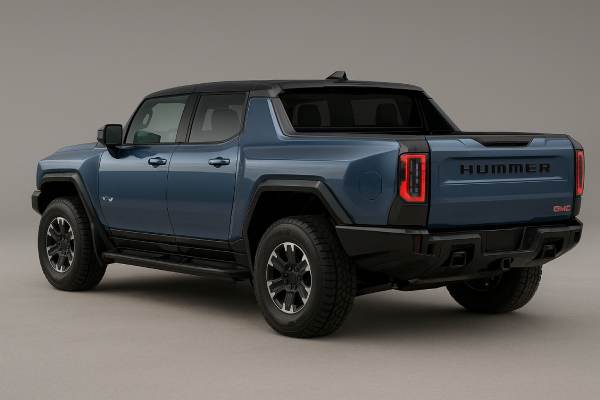
The tri-motor GMC HUMMER EV Pickup 3X with 830 hp is the “middle” high-performance configuration in the Hummer EV truck family. It keeps the headline off-road hardware and fast charging of the 1,000 hp Edition 1, but pairs them with a slightly smaller 20-module Ultium battery pack and a lower price point. For many buyers, that makes it the most rational version of a very extreme off-road EV.
This guide focuses on the 2023–present HUMMER EV Pickup 3X tri-motor with the 830 hp, 20-module Ultium pack. You will also see notes where an optional 24-module pack or later updates change range, charging, or performance. We will walk through specs, real-world efficiency, reliability and recalls, maintenance expectations, and how the tri-motor 3X compares with rivals like the Rivian R1T, Ford F-150 Lightning, and Tesla Cybertruck.
By the end, you should know if this particular Hummer EV configuration fits your use case, budget, and charging situation.
Core Points
- Tri-motor Ultium e4WD with 830 hp, 20-module pack, and up to roughly 500+ km of EPA range in 3X form, depending on wheels and tyres.
- Heavy-duty capability: adaptive air suspension, four-wheel steering with CrabWalk, and strong towing capacity when properly equipped.
- Ownership caveat: very high mass and large tyres make real-world consumption high and range drops sharply when towing, driving fast, or off-roading.
- Plan on tyre rotation and full EV inspection (brakes, coolant, charge port, suspension) about every 20,000 km or 12 months, or sooner if you tow or off-road regularly.
Navigate this guide
- Tri-Motor GMC Hummer EV Outline
- Hummer EV 830 hp Specs Summary
- Hummer EV 3X Variants and Safety
- Reliability and Service Actions Tri-Motor
- Maintenance Schedule and Buyer Guide
- Driving Performance of Tri-Motor Hummer EV
- Tri-Motor Hummer EV Against Rivals
Tri-Motor GMC Hummer EV Outline
The tri-motor HUMMER EV Pickup 3X sits near the top of the BT1 platform range. It uses three Ultium Drive permanent-magnet motors (one on the front axle, two on the rear) to deliver 830 hp and a GM-quoted “up to 11,500 lb-ft of torque” using a wheel-torque marketing calculation. In practical driveline terms, it still delivers massive axle torque and effortless acceleration for a full-size pickup.
The key difference versus the 1,000 hp Edition 1 pickup is the battery pack. The 3X 830 hp configuration typically uses a 20-module Ultium pack of around 170 kWh gross capacity, whereas the 24-module pack used on 1,000 hp versions is much larger. The 3X’s smaller pack trims weight and cost but still offers around the high-200 to low-300-mile EPA range depending on wheel/tyre package and off-road options.
The truck rides on GM’s BT1 architecture, shared with the Chevrolet Silverado EV and GMC Sierra EV. That means a body-on-frame-style e-truck with the Ultium battery forming a structural element between the frame rails, independent suspension all around, and the ability to operate at both 400 V and 800 V for DC fast charging. It remains a full-size pickup by any standard, with a wheelbase just over 3,440 mm (135.6 in) and overall length around 5,505 mm (216.8 in).
Owner-facing highlights on the tri-motor 3X include:
- Four-wheel steering with CrabWalk diagonal driving at low speeds, plus later software updates that enhance rear-steer authority on some model years.
- Adaptive air suspension with a special Extract Mode that can temporarily raise the vehicle by several inches to clear deep ruts, rocks, or snow.
- An available Extreme Off-Road package adding underbody armor, 35-inch mud-terrain tyres, rear e-lockers by brake control, and additional underbody cameras.
- A multi-function onboard power system that can export AC power for tools, camping, or emergency use.
The cost of all this hardware is weight: tri-motor pickups are typically well above 4,100 kg (9,000 lb), pushing toward or past heavy-duty regulatory thresholds. That mass influences braking distances, tyre wear, road impact, and real-world range, and it is a central theme for ownership and safety discussions.
Hummer EV 830 hp Specs Summary
This section focuses on the tri-motor HUMMER EV Pickup 3X with the 20-module Ultium battery. Values vary slightly by model year and options; always check your specific VIN data and owner’s documentation.
Powertrain, Battery, and Efficiency
| Item | Specification | Notes |
|---|---|---|
| Powertrain code | e4WD tri-motor (EV3X) | Three Ultium Drive units |
| Motor layout | 1× permanent-magnet front, 2× permanent-magnet rear | Independent motor control |
| System voltage | ~400 V nominal, up to ~800 V for DC fast charge | Switchable architecture for DC charging |
| Battery type | Ultium lithium-ion, nickel-rich chemistry | Pouch cells in modules |
| Traction battery capacity | Around 170 kWh gross (20-module pack) | Usable capacity slightly lower |
| Max power | 830 hp (≈619 kW) | Tri-motor 3X configuration |
| Max torque | “Up to 11,500 lb-ft” (marketing figure) | Represents wheel torque equivalent |
| Thermal management | Liquid-cooled pack, drive units, and power electronics | Heat pump supports cabin and pack conditioning on many builds |
| EPA-rated efficiency | Typically mid-30s to high-30s kWh/100 km | Large frontal area and tyres dominate |
| EPA-rated range | Roughly 298–314 miles (480–505 km), depending on tyres and off-road hardware | Off-road tyres reduce range |
| Real highway estimate @ 120 km/h | Often 45–50 kWh/100 km | Usable range can drop to 250–275 miles in steady fast driving |
| Aerodynamics | High drag coefficient with large frontal area | Efficiency falls quickly with speed |
Driveline and Charging
| Item | Specification | Notes |
|---|---|---|
| Transmission / drive unit | Single-speed reduction gear on each e-axle | No multi-speed gearbox |
| Final drive ratios | Not widely published | Geared for strong low-speed torque and modest top speed |
| Drive type | e4WD | Front and rear motor groups |
| Differentials / torque distribution | Electronic control; rear e-lockers with Extreme Off-Road package; brake-based torque vectoring | Software simulates locking behavior |
| AC charging connector | J1772 (North America) via CCS combo inlet | 19.2 kW onboard AC charger on many 3X builds |
| DC fast-charging connector | CCS1 (North America) | Adapter support to NACS may appear by model-year updates |
| Charging port location | Driver-side rear quarter | Convenient for many public DC chargers |
| AC onboard charger | Up to 19.2 kW | 0–100% in roughly 10–12 hours on strong Level 2 |
| DC fast-charge peak | Up to roughly 300 kW on 20-module pack | Higher peak on some 24-module variants |
| Typical DC curve | High power from about 10–50% SOC; then taper to 80–90% | Fastest to run between 10–80% |
| DC 10–80% time | Around 30–40 minutes on a powerful DC charger in good conditions | Colder packs or weaker chargers take longer |
| AC 0–100% time | Around 10–12 hours at 19.2 kW; significantly longer at 7 kW | Ideal for overnight home charging |
| Battery preconditioning | Triggered by navigating to a DC charger or certain drive modes | Helps reach advertised DC rates in cold weather |
| Bidirectional capability | Vehicle-to-load style AC export via onboard outlets | Useful for tools, camping, or emergency backup |
Performance and Capability
| Item | Specification | Notes |
|---|---|---|
| 0–60 mph (0–96 km/h) | Around mid-3-second range with Watts to Freedom active | Extremely quick for a full-size pickup |
| Top speed | About 170 km/h (≈106 mph) | Electronically limited |
| Braking distance (indicative) | Longer than lighter EV pickups | Mass, tyre choice, and conditions matter greatly |
| Towing capacity | Up to roughly 3,855 kg (8,500 lb) when properly equipped | Check your specific door-jamb label |
| Payload | Often around 550–600 kg (1,200–1,300 lb) | Heavier options reduce payload |
| Roof load | Modest due to glass roof and removable panels | Use approved racks and observe limits |
Chassis and Dimensions
| Item | Specification | Notes |
|---|---|---|
| Suspension (front/rear) | Independent, adaptive air suspension | Multiple ride heights and Extract Mode |
| Steering | Electric power steering with four-wheel steer | Much tighter turning circle than size suggests |
| Brakes | Large four-wheel discs with integrated regen and electronic parking brake | Good hardware but working hard due to mass |
| Wheels/tyres | 22-inch all-terrain tyres or 18-inch with 35-inch mud-terrain tyres (Extreme Off-Road) | Tyres strongly influence comfort and range |
| Ground clearance | Substantial, further increased in Extract Mode | Check per-mode specs in manual |
| Approach/departure/breakover | Off-road oriented on Extreme Off-Road models | Skid plates protect key areas |
| Length / width / height | Roughly 5,505 mm L / 2,201 mm W / about 2,008 mm H | Mirrors add to overall width |
| Wheelbase | 3,444 mm (135.6 in) | Very long wheelbase for stability |
| Turning circle | Made much smaller by rear steer | Big benefit in car parks and on trails |
| Curb weight | Commonly over 4,100 kg (9,000+ lb) | Among the heaviest EV pickups |
| GVWR | Often above 4,536 kg (10,000 lb) | Heavy-duty territory in many regions |
| Cargo volume | Short bed, under-bed storage, plus front trunk (frunk) | Exact volume depends on options |
Safety and Driver Assistance (Hardware Overview)
| Item | Specification | Notes |
|---|---|---|
| Crash ratings | No full IIHS or Euro NCAP program yet | Meets regulatory standards but not widely crash-tested independently |
| Headlights | LED units with signature pattern | Performance will depend on test body but is designed for wide coverage |
| Airbags | Multi-stage front, side, curtain; front center airbag on many builds | Coverage for both rows |
| ADAS suite | Automatic emergency braking, pedestrian detection, lane-keep assist, blind-spot monitoring, rear cross-traffic alert, rear auto braking, surround-view cameras | Availability depends on trim and market |
| Highway automation | Super Cruise available with mapped-road hands-free driving and automatic lane change on some trims | Requires active subscription after trial period |
Electrical
| Item | Specification | Notes |
|---|---|---|
| Traction battery | Around 170 kWh gross, 20-module Ultium; 400/800 V capable | Larger pack on some other tri-motor variants |
| HV architecture | Main HV bus feeds drive units, chargers, thermal system, and power export features | Redundant contactors and isolation monitoring |
| DC–DC converter | High-output converter supplying 12 V network | Handles heavy accessory and ADAS loads |
| Inverters | Integrated with each Ultium Drive unit | Liquid-cooled |
| 12 V battery | Conventional 12 V battery | Critical for startup, control, and safety systems |
| OTA updates | Many systems can be updated over the air, including charging behavior and some ADAS functions | Keep software current for best reliability |
Fluids and Service Capacities (High-Level)
GM does not publish every service fluid capacity in consumer brochures, but in practice owners and technicians will encounter:
- Drive unit / reduction gear oil: long-life synthetic, usually only changed if opened or contaminated.
- Battery and power electronics coolant: EV-specific long-life coolant, changed per official schedule or campaigns.
- Brake fluid: DOT 3 or DOT 4, replaced every few years.
- A/C refrigerant: modern low-GWP refrigerant; charge mass listed on underhood label.
- Washer fluid: large reservoir, relevant mainly for long winter trips.
Critical torque values for wheel nuts, suspension components, and HV connectors must always come from the current service literature.
Hummer EV 3X Variants and Safety
The 830 hp tri-motor powertrain is tied to the EV3X level in the Hummer EV pickup lineup. Within that, equipment and range can vary significantly.
Common configurations include:
- Standard 3X with 20-module pack: 830 hp, strong range on road-biased tyres, four-wheel steer, adaptive air suspension, and Super Cruise availability.
- 3X with Extreme Off-Road package: Same tri-motor base hardware but with 35-inch mud-terrain tyres, underbody armor, extra off-road cameras, and rock rails. Range is lower and tyre wear and noise are higher.
- 3X with larger 24-module pack (on certain markets/years): Higher battery capacity and range, but also extra weight and often higher cost.
From a buyer’s perspective, the 3X with 20-module pack is often the sweet spot if you want tri-motor performance and off-road hardware but do not need the absolute maximum battery size. It is still massive and extremely capable, but slightly more manageable in weight and price than the biggest pack allows.
Trim identifiers and build clues
- Exterior badging usually shows “HUMMER EV3X”.
- The window sticker and Monroney label list the EV3X trim and major option packages.
- The Extreme Off-Road package is visible via the combination of 18-inch wheels, 35-inch tyres, skid plates, and rock rails.
Safety ratings and real-world safety
As of now, there are no widely published full IIHS or Euro NCAP crash scores for the HUMMER EV pickup. That means owners must lean on regulatory compliance, GM’s internal crash engineering, and the vehicle’s safety equipment list. The truck’s extreme mass may offer strong self-protection for occupants in many crash scenarios while simultaneously raising concerns about energy transfer to smaller vehicles.
What matters most in everyday safety is:
- Maintaining good tyres with adequate tread and load rating.
- Keeping brakes and suspension in top condition to handle emergency manoeuvres.
- Ensuring ADAS systems (especially AEB, lane-keeping, and blind-spot monitoring) are correctly calibrated and free of faults.
Safety systems and ADAS evolution
Over its life, the Hummer EV has received software updates that:
- Refine Super Cruise behavior on mapped highways.
- Adjust lane-keeping and adaptive cruise-control behavior.
- Enhance steering and CrabWalk modes on certain model years.
After any glass replacement, collision repair, or major suspension work, sensor calibrations must be performed with factory tools. If ADAS alerts or Super Cruise reliability seem poor after body work, that can be a sign that calibration steps were skipped or incomplete.
Reliability and Service Actions Tri-Motor
The HUMMER EV pickup is still young, so long-term reliability stories are just forming. However, several important themes are already clear.
High-voltage battery and sealing recalls
Some early Hummer EVs, including pickups, were subject to recalls involving improper urethane sealing of the high-voltage battery pack enclosure. If the sealant was not applied correctly, water could enter the pack under certain conditions. Symptoms ranged from warning messages and loss of propulsion to a no-start condition.
The remedy typically involves:
- Inspection of the high-voltage battery pack.
- Replacement of the pack with an updated design if leakage risk is present.
For a tri-motor 3X, this is not optional: verify by VIN that all battery-related recalls are complete. For trucks that received a replacement pack, ask for documentation of the new pack’s serial information and mileage at installation.
Common early issues and patterns
Beyond high-profile recalls, owners and technicians have seen patterns similar to other large EVs:
- Charge port and onboard charger (OBC) issues:
- Symptoms: failed AC or DC sessions, intermittent connection messages, or limited charging speed.
- Likely causes: damaged or contaminated charge port, OBC module faults, software misalignment.
- Remedies: connector cleaning or replacement, updated OBC hardware, and software updates.
- Thermal management and coolant problems:
- Symptoms: warning messages, reduced DC fast-charge speeds, or fans running loudly for long periods.
- Possible causes: coolant leaks, valve malfunctions, blocked radiators after off-road use.
- Remedies: pressure testing, component replacement, careful bleed procedures.
- Drive unit noises and bearing wear:
- Symptoms: whines or growls that change with vehicle speed, often not tied directly to motor torque.
- Diagnosis: road testing, listening with chassis ears, wheel-bearing checks, and sometimes fluid analysis.
- Brake corrosion and uneven use:
- Because the truck relies on regenerative braking, the friction brakes may see light use in gentle driving. Rotors can corrode, and pads may glaze.
- Regular brake inspections and occasional deliberate use of friction brakes help keep hardware healthy.
Software updates and calibrations
Ultium-based EVs depend heavily on software, particularly:
- Battery Management System (BMS) calibrations for reliable state-of-charge and fast-charging behavior.
- Drive-unit and inverter updates for torque control and traction behavior.
- Infotainment and ADAS updates that improve stability and reduce false warnings.
Owners should treat software updates as part of their maintenance routine, just like tyre rotations or brake inspections. Many feature improvements are delivered through over-the-air updates, but recall-related reflashes may require a dealer visit.
HV safety and isolation
High-voltage isolation faults can occur after water ingress, collision damage, or improper repair work:
- Symptoms: persistent HV system warnings, restricted power, or a refusal to start.
- Approach: technicians use insulation resistance tests and visual inspection to locate compromised components or wiring. Repairs are performed under strict safety procedures with the vehicle powered down and isolated.
Pre-purchase reliability checks for a used 3X
For any used 830 hp HUMMER EV 3X, ask for:
- A complete dealer service history, including recall and software campaign completion.
- Evidence of any battery pack or high-voltage component replacements.
- A documented battery health or range assessment, ideally under controlled conditions.
- A thorough underbody inspection for off-road damage, including skid plates, rock rails, and battery mounts.
A truck with clean documentation, up-to-date software, and a healthy pack is a far better bet than one with unknown history and visible underbody damage.
Maintenance Schedule and Buyer Guide
Although the HUMMER EV tri-motor pickup eliminates engine oil changes, it still needs careful, regular maintenance due to its size, complexity, and performance.
Practical maintenance schedule (baseline)
Use the following as a planning aid alongside official schedule information:
- Every 12,000 miles / 20,000 km or 12 months
- Rotate tyres and check pressures, including the spare if equipped.
- Inspect suspension components, steering joints, and air-suspension bags.
- Inspect friction brakes for pad thickness, rotor condition, and corrosion.
- Perform an EV health check: scan for codes, verify that all HV systems and cooling loops show normal readings.
- Every 24,000–30,000 miles / 40,000–50,000 km
- Check alignment, particularly if you frequently use off-road modes or have hit potholes, rocks, or curbs.
- Inspect underbody armor and skid plates; re-torque fasteners where required.
- Inspect charge port seals and bed power outlets for dirt, water ingress, or damage.
- Every 3–5 years
- Replace brake fluid.
- Replace cabin air filter (more often in dusty climates).
- Test the 12 V battery and replace proactively if it shows weakness.
- Every 8–10 years or as specified
- Service the battery and power-electronics coolant loops if the official maintenance schedule calls for it.
Drive-unit oil and many driveline fluids are typically considered lifetime fills unless contamination or leakage occurs, but some owners may choose preventive changes at high mileage using factory fluids and torque specs.
Fluids, specs, and torque values
Because the HUMMER EV carries huge loads:
- Wheel-nut torque is substantially higher than on a passenger car and must be followed carefully.
- Suspension and subframe fasteners must be torqued accurately to avoid clunks, alignment drift, or component damage.
- Coolant and brake fluids must match GM specifications; mixing incompatible fluids can cause corrosion or reduced performance.
When in doubt, professional service with access to official torque charts and procedures is the safest route, especially for work touching high-voltage systems or air suspension.
Buyer’s guide: evaluating a used tri-motor 3X
1. Traction battery health
- Ask the seller or dealer for a battery health or capacity report if the tool is available.
- Compare reported range at a set state-of-charge against what other owners typically observe. Large deviations can indicate pack issues or out-of-date software.
- Observe a test drive that includes a moderate DC fast-charge stop if possible. Slow or erratic charging may point to pack or cooling problems.
2. Charging hardware
- Inspect the CCS inlet for bent or discolored pins and damaged seals.
- Confirm that Level 2 home-style charging works reliably.
- Check that all supplied cables and adapters are present and in good shape.
3. Cooling and HVAC systems
- Look under the front end for damaged radiators, missing ducting, or coolant traces.
- Check that cabin heating, air conditioning, and defogging work normally.
- In cold conditions, verify that preconditioning and heated features (steering wheel, seats) operate correctly.
4. Chassis, steering, and brakes
- Inspect tyres for uneven wear and ensure they are correct load rating and type.
- Listen for knocks, clunks, or grinding noises when turning and braking.
- Verify that the parking brake holds firmly on inclines and releases cleanly.
5. Electronics and OTA history
- Confirm that warning lights are off and that there are no persistent faults in the cluster.
- Test key ADAS functions: adaptive cruise control, lane assist, blind-spot monitoring, parking cameras, and parking sensors.
- Ask if OTA updates are enabled and whether the vehicle has received recent feature updates.
6. Options, years, and what to seek or avoid
- If you mostly drive on-road, look for a 3X without 35-inch mud-terrain tyres. You will gain quieter ride, better range, and lower tyre costs.
- For serious off-road use, prioritise the Extreme Off-Road package and check that underbody protection is intact and not heavily bent or missing.
- Trucks that have had battery packs replaced under recall, with documentation, can be attractive if the rest of the vehicle is in good condition.
Long-term durability outlook
With a large, thermally managed battery and conservative power demands in daily driving, the tri-motor 3X should show moderate degradation when used sensibly. The main long-term risks are:
- Wear and tear on suspension and steering components due to mass and off-road use.
- Corrosion in harsh climates if the underbody is not cleaned and protected regularly.
- High-cost HV components (pack, drive units) failing outside warranty, which reinforces the value of good documentation and extended coverage where available.
Driving Performance of Tri-Motor Hummer EV
The tri-motor Hummer EV 3X delivers a very different experience from a traditional pickup.
Ride, handling, and NVH
On the road, the adaptive air suspension balances control and comfort better than you might expect:
- In normal modes, the truck rides with a controlled, slightly firm feel that suits its heavy-duty character.
- On smooth highways, it feels composed and stable, aided by the long wheelbase and low battery mass.
- On broken pavement, the mass and large tyres can make sharp impacts noticeable, but the suspension quickly settles.
Noise depends heavily on tyre choice:
- All-terrain tyres generate a steady hum but remain acceptable for long trips.
- Mud-terrain tyres add a low-pitch roar and more vibration, especially on concrete or coarse asphalt.
Four-wheel steering transforms maneuverability. At low speeds, the rear wheels counter-steer, cutting the turning circle dramatically for parking and tight urban streets. At higher speeds, they steer in phase with the fronts to enhance lane-change stability.
Powertrain character and regenerative braking
With three motors and 830 hp, the HUMMER EV 3X has more power than most owners will ever fully exploit. In everyday driving:
- The calibration keeps launches smooth and linear, so the truck does not feel twitchy despite its power.
- Passing thrust from 50–80 mph (80–130 km/h) is strong and immediate, with no downshifts to wait for.
Watts to Freedom mode unlocks maximum acceleration. It preconditions the battery and motors, drops the suspension, and lets you experience supercar-like acceleration in a huge pickup. It is a party trick and an engineering showcase, but not something most owners will use frequently.
Regenerative braking offers several levels, including one-pedal driving. Once you get used to it, you can drive almost entirely with the accelerator in town. The system blends regen and friction braking; transitions are generally smooth, though the very low-speed feel can change slightly depending on temperature, SOC, and road surface.
Real-world efficiency and range
In practice, real-world energy use depends on speed, tyre type, temperature, and load:
- In gentle city and suburban driving on road-biased tyres, you might see consumption in the mid-30s kWh/100 km and achieve useful ranges close to official ratings.
- At 100–120 km/h (60–75 mph) on the highway, especially with off-road tyres, consumption usually climbs into the mid-40s or higher kWh/100 km, and range drops accordingly.
- Cold weather, strong headwinds, roof loads, or roof boxes further reduce efficiency.
Towing a high-profile trailer or driving for long periods in technical off-road conditions can roughly halve your effective range. For trip planning, it is wise to assume conservative energy use and to arrive at DC fast chargers with a comfortable buffer.
Charging performance in the real world
Charging behavior is strongest when:
- You arrive at a DC fast charger with a warm battery and 10–30% SOC.
- You use chargers that support at least 150–300 kW.
The truck can hold high charging power through much of the mid-SOC range before tapering. For long trips, planning segments between roughly 10–80% is usually the fastest approach. At home, a 240 V Level 2 charger rated around 11–19 kW makes overnight charging straightforward, even after long days.
Traction, control, and behavior under load
Off-road, the tri-motor Hummer EV combines:
- Instant torque for controlled crawling over rocks and steep grades.
- Air-suspension height changes for obstacle clearance.
- Four-wheel steer and, where fitted, rear e-lockers for tricky climbs and tight turns.
On loose surfaces, traction and stability systems modulate torque quickly to keep the truck pointed where you intend. In snow and rain, the truck can feel secure but you must still respect physics: mass and momentum mean braking distances are long, and winter tyres remain essential in cold climates.
Under load or with a trailer:
- The air suspension can help maintain rake and headlight aim.
- Range drops substantially at highway speeds; planning charges more frequently is part of the experience.
- Heat build-up in motors and battery is managed by the cooling system, but on long grades in hot weather the truck may limit power to protect itself.
Tri-Motor Hummer EV Against Rivals
When cross-shopping the HUMMER EV Pickup 3X tri-motor with 830 hp, the obvious benchmarks are the Rivian R1T, Ford F-150 Lightning, and Tesla Cybertruck.
Versus Rivian R1T
- The R1T is smaller, lighter, and more efficient, with better urban maneuverability and easier parking.
- Quad-motor R1T variants deliver thrilling performance and high towing numbers but use a smaller pack, so range when towing can be similar or lower.
- The Hummer leans more into extreme off-road theatrics—CrabWalk, Extract Mode, and huge tyres—while the Rivian balances off-road ability with everyday usability.
Versus Ford F-150 Lightning
- The Lightning feels more like a conventional full-size truck with an electric powertrain; bed dimensions and cab layout closely mirror the standard F-150.
- It typically offers lower peak performance but good towing ability and a wide dealer network.
- The Hummer EV is more bespoke and dramatic, with a greater focus on off-road and tech features but higher weight, higher consumption, and a more specialised role.
Versus Tesla Cybertruck
- High-spec Cybertruck variants offer very strong performance and range in a different design philosophy, with a stainless exoskeleton and a more minimalist interior.
- The Cybertruck emphasizes efficiency and a low coefficient of drag, while the Hummer is unapologetically blocky and emphasises off-road clearance.
- Repairability, service access, and aftermarket ecosystem will differ significantly, with GM’s dealer network versus Tesla’s vertically integrated model.
Who should choose the 830 hp 3X Hummer EV?
This configuration fits best if:
- You want the full “electric super-truck” experience with tri-motor power, off-road hardware, and unique features like CrabWalk.
- You can charge at home and plan around the truck’s high consumption on long trips.
- You value presence, capability, and tech more than efficiency and parking ease.
If maximum range, city practicality, or the lowest running costs are your top priorities, alternatives like the Rivian R1T, F-150 Lightning, or a large electric SUV might suit you better. But if you are drawn to the idea of an electric off-road flagship with genuine trail capability and highway comfort, the 830 hp HUMMER EV Pickup 3X remains one of the most distinctive options on the market.
References
- HUMMER EV PICKUP 2024 FEATURES, SPECS AND OPTIONS 2024 (Owner’s Manual/Brochure)
- 2026 HUMMER EV Truck | Electric Pickup Truck | GMC 2025 (Official Model Page)
- Part 573 Safety Recall Report 22V-771 2023 (Safety Recall Report)
- High Voltage Battery Pack Improper Urethane Sealing – Safety Recall N222380031 2023 (Recall Communication)
Disclaimer
This article is for informational purposes only and is not a substitute for professional diagnosis, repair, or official service documentation. Specifications, capacities, torque values, maintenance intervals, and available features can vary by VIN, model year, market, and installed equipment. Always verify details against your vehicle’s owner’s manual, workshop information, and current technical bulletins, and have high-voltage work carried out only by properly trained and equipped technicians.
If you found this guide useful, please consider sharing it on platforms such as Facebook or X/Twitter to help other owners and support the continued creation of detailed EV guides.