
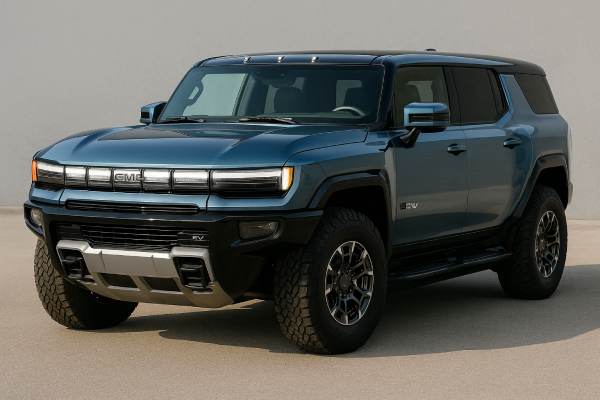
The GMC Hummer EV SUV 2X takes the familiar Hummer attitude and rebuilds it around GM’s Ultium battery platform. With a dual-motor e4WD layout, a huge battery pack, and up to 570 hp on tap, it’s one of the most capable and extreme electric SUVs on sale.
Yet under the theater—CrabWalk diagonal driving, adaptive air suspension, four-wheel steering, and a video-game-style cabin—there is a serious tool for towing, overland travel, and heavy-duty daily use. The SUV adds practicality versus the pickup with a shorter wheelbase, enclosed cargo area, and easier parking while keeping a 10,000 lb tow rating.
This guide focuses on the dual-motor 2X SUV (BT1 platform) from 2023 onward, covering its specs, performance, running costs, reliability trends, and how it stacks up against rival electric SUVs. If you are considering buying, leasing, or towing with one, the goal is to give you enough engineering context and ownership insight to decide whether this massive EV fits your life.
At a Glance
- Dual-motor Ultium 2X SUV delivers up to 570 hp, 800 V-class DC fast charging to around 300 kW, and roughly 300–315 miles (480–505 km) of rated range depending on year and configuration.
- Air suspension, four-wheel steering with CrabWalk, and robust 4×4 hardware make it unusually capable off-road for a production EV SUV.
- Major trade-off is efficiency: expect roughly 37 kWh/100 km (about 600 Wh/mi) in mixed driving—far higher energy use than most electric SUVs.
- Early Hummer EVs have seen several high-voltage battery and sealing recalls; checking recall completion and battery health is essential before purchase.
- Plan on tyre rotation, brake and suspension inspection about every 12,000 miles or 20,000 km, or annually, with brake fluid roughly every 3–5 years (severe towing/fast-charge use may shorten these intervals).
Explore the sections
- GMC Hummer EV SUV Overview
- Ultium Powertrain Specs and Data
- Trims, Equipment and Safety Tech
- Reliability, Issues and Service Actions
- Maintenance Schedule and Buyer Guide
- Driving Experience and Real Performance
- GMC Hummer EV Versus Rivals
GMC Hummer EV SUV Overview
The Hummer EV SUV 2X is built on GM’s BT1 electric truck platform and shares much of its hardware with the Hummer EV pickup and Chevrolet’s future large EVs. It uses a large Ultium battery pack mounted under the floor, driving two Ultium permanent-magnet motors—one on each axle—for e4WD with sophisticated torque control.
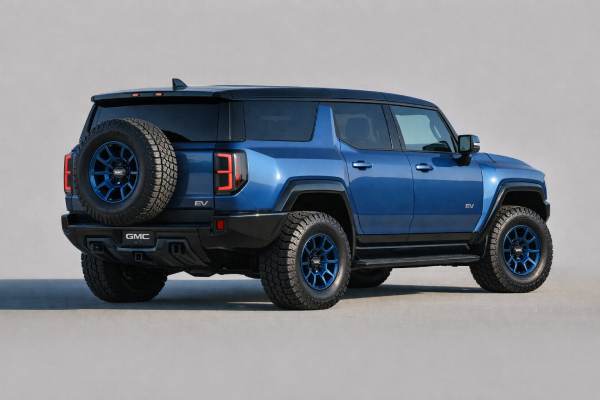
Compared with the pickup, the SUV has a 126.7-inch wheelbase and overall length of about 196.8 inches without the rear spare (around 206.7 inches with it). That makes it roughly 20 inches shorter and more maneuverable, especially when combined with the standard four-wheel steering system that can tighten the turning circle to roughly 10.8 m (35.4 ft).
The dual-motor 2X is the “entry” configuration for the SUV in North America but is hardly modest. GMC quotes up to 570 hp and 7,400 lb-ft of wheel torque, with an EPA-type range around 303–315 miles depending on model year and options. Independent spec compilations suggest a usable battery capacity in the mid-170 kWh range and official efficiency near 37 kWh/100 km, confirming that the truck trades energy efficiency for brute power and mass.
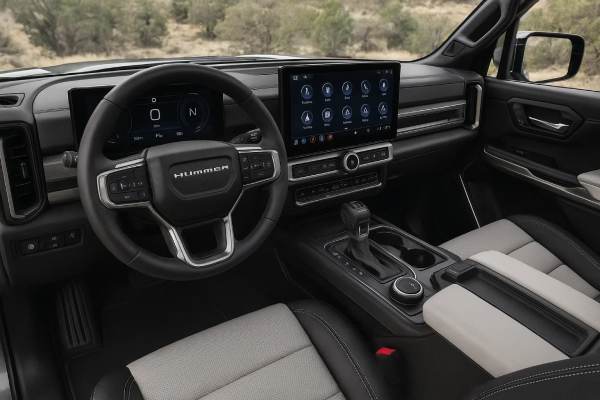
The cabin seats five with generous legroom and headroom, and the SUV format allows roughly 1,000–2,300 L (36–82 ft³) of cargo space behind the seats, plus a front e-Trunk. Inside, a 13.4-inch central touchscreen and 12.3-inch digital cluster run a modern infotainment stack with strong graphics and over-the-air update capability.
The Hummer EV SUV is aimed at buyers who want extreme off-road capability, towing up to 10,000 lb (4,536 kg), and a high-image halo vehicle. It is not the right tool if you prioritize efficiency or compact city maneuverability, but it offers a mix of features—CrabWalk diagonal driving, Extract Mode ride height, and available Super Cruise hands-free highway driving—that few other EV SUVs combine in quite the same way.
Ultium Powertrain Specs and Data
Below are core technical figures for the dual-motor GMC Hummer EV SUV 2X (570 hp) for 2023–present. Values may vary slightly by year, market, and options.
Powertrain, Battery, and Efficiency
| Parameter | Value | Notes |
|---|---|---|
| Platform / code | BT1 platform; Hummer EV SUV 2X dual-motor | Shared with Hummer EV pickup and other GM large EVs |
| Motor layout | 2 × Ultium permanent-magnet motors, 1 front + 1 rear | e4WD torque-vectoring |
| System voltage | 800 V-class architecture, can reconfigure for 400 V charging | Ultium high-voltage system |
| Battery chemistry | Li-ion NCMA (nickel-cobalt-manganese-aluminum) | Used across Ultium packs |
| Traction battery | Approx. 180+ kWh gross, ~170+ kWh usable | 20-module pack under floor |
| Max power | Up to 570 hp (~425 kW) | GMC estimate for 2X SUV |
| Max torque | Up to 7,400 lb-ft at wheels (manufacturer wheel-torque metric) | Not directly comparable to crank torque |
| Thermal management | Liquid-cooled battery and drive units; available heat pump for cabin and battery conditioning | Critical for fast charging and cold-weather range |
| Official efficiency | Around 37.3 kWh/100 km (≈600 Wh/mi) EPA combined | Based on range and usable capacity |
| Rated range | Roughly 488 km (303 mi) EPA; up to the low-300-mile range depending on options | Range drops with off-road packages and 35-inch tyres |
| Real-world highway @ 120 km/h (75 mph) | Typically 45–50 kWh/100 km (720–800 Wh/mi), 280–320 km (175–200 mi) of usable highway range | Approximate, based on early testing and owner reports |
| Aerodynamics | Cd not officially published; very large frontal area (~3.1–3.3 m²) inferred from dimensions | Boxy profile prioritizes off-road clearance over aero efficiency |
Driveline and Charging
| Parameter | Value | Notes |
|---|---|---|
| Transmission / drive unit | Single-speed reduction gear on each e-axle | Standard for Ultium trucks |
| Drive type | Full-time e4WD (AWD), electronic torque distribution | Supports CrabWalk and off-road modes |
| Differential / torque distribution | Electronic clutch-based torque vectoring plus brake-based control | Enables diagonal CrabWalk and tight-radius turns |
| AC charging connector | CCS1 Type 1; up to 19.2 kW onboard charger where equipped | Requires 80 A home circuit for full rate |
| DC fast-charge connector | CCS1; up to around 300 kW at 800 V | Around 150 kW when limited to 400 V |
| Port location | Left rear quarter; integrated charge-port door | Shared with pickup |
| DC charging curve | High peak early, then tapering after ~55–60% SOC; average 10–80% power around 150–170 kW in real use | Sensitive to temperature and charger rating |
| DC 10–80% time | Roughly 40–45 min under ideal conditions on a 250–300 kW charger | Real-world estimate, not an official spec |
| AC 0–100% time | ~9–10 h at 19.2 kW; ~14–16 h at ~11 kW home charger | Large battery dominates charge time |
| Battery preconditioning | Available when a DC fast charger is set as a destination in navigation or specific drive modes are selected | Heats or cools pack for faster charging |
| Bidirectional capability | Announced for some Ultium applications; availability on specific Hummer EV SUV years may vary | Confirm per VIN, as policies evolve |
Performance and Capability
| Parameter | Value | Notes |
|---|---|---|
| 0–100 km/h (0–62 mph) | Approx. 3.9–4.4 s depending on tyres, weight, and Watts-to-Freedom launch mode | Extremely quick for a heavy SUV |
| 0–60 mph | Roughly 3.7–4.3 s | Launch modes and conditions matter |
| Top speed | About 170–180 km/h (105–112 mph), electronically limited | Market-dependent |
| Towing capacity | Up to 4,536 kg (10,000 lb) braked | 2X SUV; verify by tow package and market |
| Payload | Typically around 600–700 kg (1,300–1,500 lb) | Check door-jamb label for exact figure |
| Roof load | Generally limited; check manual before fitting roof tents or heavy racks | Removable panels and high CG are factors |
Chassis and Dimensions
| Parameter | Value | Notes |
|---|---|---|
| Suspension (front/rear) | Double wishbone with adaptive air suspension front and rear | Height-adjustable; Extract Mode adds significant lift |
| Steering | Electric rack-and-pinion with four-wheel steering | Includes CrabWalk mode |
| Brakes | Ventilated discs front and rear with integrated regen blending | Multiple off-road brake modes |
| Wheels / tyres | Typically 22″ wheels with 305/55 R22 all-terrain tyres; 35″ tyres in Extreme Off-Road Package | Larger tyres impact range |
| Ground clearance | Approx. 259–406 mm (10.2–16.0 in) across suspension modes | Extract Mode at upper end |
| Approach / departure / breakover | Up to roughly 49.6° / 49° / mid-20s to mid-30s degrees depending on mode | Very strong off-road geometry |
| Length / width / height | About 196.8–206.7 in L, 86.5 in W (without mirrors), 77.8 in H | Length varies with rear spare |
| Wheelbase | 126.7 in (3,218 mm) | Shorter than pickup; improves breakover |
| Turning circle | Around 10.8 m (35.4 ft) | Tight for the size thanks to 4WS |
| Curb weight | Around 3,900+ kg (8,600+ lb) | Varies by trim and options |
| GVWR | Heavy-duty class, over 10,000 lb | See certification label for exact rating |
| Cargo volume | Roughly 1,017–2,317 L (36–82 ft³) rear; modest frunk | Seats-up vs seats-down configurations |
Electrical and Fluids (Service-Relevant)
High-voltage architecture, DC-DC converter ratings, and detailed fluid capacities are still emerging in public documentation. Practical takeaways:
- HV battery: very large 800 V-class pack with dedicated coolant loop and numerous sensors; HV isolation tests and leak checks are now part of standard diagnostic procedures.
- 12 V system: conventional 12 V battery plus DC-DC converter; a weak 12 V battery can lead to no-start conditions even with a healthy traction pack.
- Coolants and oils: GM uses specific long-life coolants for HV battery/drive unit loops and dedicated e-axle fluids. Capacities and torque specs must always be confirmed in current GM service information for the exact VIN.
Trims, Equipment and Safety Tech
The dual-motor configuration appears as the Hummer EV SUV 2X in North America and similar naming globally. Above it sit the three-motor 3X and limited Edition 1 or Omega Edition variants.
Trim overview (SUV, 2023–present)
- Hummer EV SUV 2 – In some markets, a lower-spec dual-motor trim with fewer luxury and off-road features.
- Hummer EV SUV 2X (focus of this guide) – Dual-motor e4WD, air suspension, four-wheel steering with CrabWalk, Ultium 20-module pack, and available Extreme Off-Road package. In many markets, this is the only dual-motor SUV trim.
- Hummer EV SUV 3X – Tri-motor setup (one front, two rear) with up to about 830 hp and slightly different tow ratings and range.
- Edition 1 / Omega Edition – Launch and limited-run halo variants with distinctive paint, graphics, wheel designs, and often fully loaded equipment.
Mechanical differences between the 2X dual-motor and tri-motor trims include motor count, maximum power, and, in some cases, tyre/wheel combinations and drive calibrations. The 2X often carries the higher tow rating because its output is easier to manage thermally when towing.
Quick identifiers
- Dual-motor 2X SUVs generally carry “2X” badging on the body and in digital cluster graphics.
- Options such as the Extreme Off-Road Package bring 35-inch mud-terrain tyres, additional underbody cameras, beadlock-capable wheels, and heavy-duty underbody protection—easy visual tells versus standard 22-inch all-terrain tyres and more road-biased trim.
- Build codes and VIN options for 2X vs 3X are detailed in dealer ordering guides and can be decoded by a GMC dealer.
Safety ratings
Public crash-test ratings for the GMC Hummer EV SUV are still limited. As of this writing, major agencies have not yet published full star ratings for all configurations. That may change as volumes increase, so checking the latest data from NHTSA, IIHS, or equivalent regional bodies is important if top-tier crash-test scores are a priority.
Passive safety and structure
- Large, heavy structure with substantial crumple zones and a rigid passenger cell surrounding the underfloor battery.
- Extensive airbag coverage including front, side-impact, and curtain airbags; some markets may offer additional front-center airbags.
- ISOFIX/LATCH anchorages for child seats in the rear outboard positions.
Safety systems and ADAS
Standard or available systems, depending on trim and region, typically include:
- Forward collision warning with automatic emergency braking (often including pedestrian and cyclist detection).
- Lane-keep assist and lane-departure warning, with lane-centering on some models.
- Blind-spot monitoring and rear cross-traffic alert.
- Adaptive cruise control, with GM’s Super Cruise hands-free driving on supported highways on certain trims.
- Surround-view camera system with underbody views in off-road modes.
- Parking sensors and available automatic parking assist.
- Trailer-specific aids such as trailer blind-spot monitoring and tow-mode stability assistance.
After glass replacement, bodywork, or suspension repairs, cameras and radar units may require calibration. This usually involves a scan tool and specific procedures or calibration drives; skipping these steps can degrade ADAS performance.
Reliability, Issues and Service Actions
The Hummer EV SUV is still relatively new, so long-term data is limited, but early experience from the Hummer EV family highlights several important themes.
High-voltage battery and enclosure sealing
Early safety recalls addressed improper sealing of the high-voltage battery pack enclosure. Water ingress could lead to warning messages, a no-start condition, or loss of propulsion; the remedy involved inspecting the pack and, in some cases, replacing the complete HV battery assembly.
Another campaign dealt with internal pack connections that could be out of position or incorrectly welded, risking loss of drive power. Owners should confirm that all HV-related recalls and field-service actions are completed through an official VIN check before purchase.
There are also service bulletins for corrosion at high-voltage connectors, which can allow moisture or coolant intrusion into the pack or drive units. Symptoms can include “Service High Voltage System” warnings, limited-power modes, failure to charge, or loud contactor noises.
Coolant and HV isolation issues
Technical bulletins describe checks for coolant levels in the battery surge tank and procedures to vacuum- and pressure-test the HV battery coolant circuit for leaks. Coolant intrusion into drive units or the battery pack can trigger HV isolation faults. Depending on severity, repairs may range from hose and seal replacements to replacement of drive units or even the complete battery pack.
Airbag and safety-system recalls
Later Hummer EV pickups and SUVs have seen recalls related to passenger airbag wiring or connectors that could affect deployment. The fix typically involves installing a jumper harness or reworking wiring. This underlines the need to check not only powertrain but also safety-system recalls on any prospective vehicle.
Common issue themes
From early owner reports and repair histories, patterns include:
- High-voltage isolation faults due to moisture in connectors or the pack.
- Charge-port and onboard-charger faults causing intermittent or failed charging sessions.
- Coolant leaks in HV cooling circuits leading to warning lights and reduced performance.
- Water leaks into the cabin or body control modules from roof, pillar, or tailgate seals, causing window, mirror, or lock malfunctions.
- Occasional electronic glitches in infotainment or ADAS systems, often fixed with software updates or module resets.
Prevalence and cost tiers
- Common, low–medium cost: Minor software bugs, infotainment lag, rattles, and trim noises; generally fixed with updates or small repairs.
- Occasional, medium–high cost: Charge-port replacements, onboard charger repairs, 12 V battery failures, and ADAS sensor replacements after minor collisions.
- Rare but high-impact: Full HV battery pack replacements, significant HV isolation failures, or major drive-unit replacements. These are expensive but usually covered under the 8-year/100,000-mile (or market-equivalent) battery and electric-drive warranty if the vehicle is within coverage and properly maintained.
Recalls, TSBs, and extended coverage
Owners should:
- Use official NHTSA or regional databases plus GMC’s own tools to run VIN-based recall and service-campaign checks.
- Request documentation from dealers showing completion of HV battery, coolant, and airbag-related campaigns.
- Ask about any extended warranties or customer-satisfaction programs covering the battery, drive units, or charging systems.
Pre-purchase checks to request
When evaluating a used Hummer EV SUV:
- Complete service history printout, including software updates and HV-system repairs.
- Proof that all open recalls and important TSBs are addressed.
- Records of coolant service and any HV coolant leak or isolation tests.
- A recent traction-battery state-of-health report and any historic pack or module replacement records.
- Documentation of charge-port, onboard-charger, or drive-unit repairs where relevant.
Maintenance Schedule and Buyer Guide
EVs like the Hummer EV SUV have fewer wear components than combustion trucks, but the mass, tyres, and complex HV systems make disciplined maintenance important. Always verify intervals for your exact year and market in the official owner’s manual or service information; the schedule below is a practical starting point.
Practical maintenance schedule (approximate)
- Every 12,000 mi / 20,000 km or 12 months
- Tyre rotation and pressure check; inspect for cupping and uneven wear.
- Brake pads and rotors inspection; check sliding surfaces for corrosion, as regen braking can reduce regular use of friction brakes.
- Suspension and steering inspection: ball joints, bushings, tie rods, and shocks.
- Underbody inspection, including battery casing, skid plates, and fasteners.
- Visual inspection of high-voltage cables and connectors for damage.
- Every 24,000–30,000 mi / 40,000–50,000 km or 2 years
- Replace cabin air filter.
- Check wheel alignment, especially if you tow, off-road, or run heavy wheel/tire packages.
- Inspect charge-port seals, door operation, and any signs of corrosion.
- Brake fluid
- Replace approximately every 3–5 years, or sooner in severe climates or heavy towing use. Moisture accumulation can reduce boiling point and impact brake feel.
- Coolants and drive-unit fluids
- HV battery and drive-unit coolant: often rated to roughly 150,000 mi (240,000 km) or 10 years under normal conditions; follow the latest GM guidance and shorten intervals if instructed for severe duty.
- E-axle or reduction-gear oil: some units are “filled for life,” others have service intervals; always consult current service literature.
- 12 V battery
- Test annually after year three; plan for preventive replacement around years 4–6.
- Software and OTA updates
- Many drivability and charging improvements arrive via software. Ensure the vehicle stays current either via OTA or dealer programming.
Fluid specifications and torque values
This truck uses specialized coolants and HV-safe fluids. When planning DIY work or independent-shop servicing, ensure:
- Only GM-approved coolant for the HV battery loop is used. Mixing types can reduce corrosion protection or insulation resistance.
- E-axle fluids match GM specifications; incorrect viscosity or additives can damage seals and gears.
- Wheel-lug torques, suspension fastener torques, and HV-service fasteners are set strictly according to the latest GM service data. Many suspension and HV fasteners are torque-to-yield and must not be reused.
Buyer’s guide: inspection checklist
- Traction battery health
- Request an official state-of-health report and compare indicated range at a moderate SOC with the original rating.
- During a test drive, note how quickly power reduces at low SOC and whether any HV-system warnings appear.
- If possible, perform a short DC fast-charge session to observe whether the vehicle reaches expected power levels and maintains them into mid-SOC.
- Charging hardware
- Inspect the charge port for damage, corrosion, or water marks; verify the locking mechanism and door work smoothly.
- Confirm AC charging at home voltage and test DC fast charging if feasible.
- Check the condition of all included charging cables and adapters.
- Cooling and thermal management
- Look for any dried coolant residue under the vehicle or around hose joints.
- Verify that cabin heating and cooling respond quickly and that preconditioning modes work.
- Listen for abnormal fan or coolant-pump noises during fast charging.
- Chassis and body
- Look underneath for off-road damage: scraped skid plates, bent control arms, damaged underbody panels, or gouged battery shields.
- Inspect wheel wells, frame rails, and battery mounts for rust, especially if the truck has lived in road-salt regions.
- Check roof seals, removable panels, and rear tailgate area for signs of water intrusion.
- Electronics and OTA history
- Test all ADAS features, including lane-keep assist, adaptive cruise (and Super Cruise if fitted), parking cameras, and 360° views.
- Confirm infotainment responsiveness, Bluetooth and smartphone integration, and that navigation data is reasonably current.
- Ask whether OTA updates have been installed regularly or whether the vehicle has required dealer reprogramming for major issues.
Recommended years/trims/options
- Later-build Hummer EV SUV 2X models with complete recall history and current software are generally the safest bet.
- Choosing all-terrain rather than extreme off-road tyre packages can improve range and ride noise for daily driving.
- If you frequently tow near limits, prioritize tow packages, cooling upgrades, and camera/tow assist options.
Long term, the large pack and robust cooling should support good battery life when recalls and campaigns are addressed, but you should budget for high tyre and brake costs and be prepared for the possibility of expensive HV component repairs outside warranty.
Driving Experience and Real Performance
Despite its size and weight, the Hummer EV SUV 2X feels closer to an oversized performance vehicle in a straight line. Instant torque means it lunges off the line, especially in Watts-to-Freedom mode, where pre-conditioning and launch animations accompany a sub-4–4.5-second 0–60 mph run depending on tyres and load.
Ride, handling, and NVH
At everyday speeds, the air suspension and heavy mass deliver a surprisingly comfortable ride. In standard height, it absorbs most road imperfections, though sharp potholes and expansion joints can still send a thump through the cabin, especially with 35-inch off-road tyres.
Four-wheel steering dramatically reduces the turning circle, making U-turns, tight parking, and trail switchbacks easier than the truck’s dimensions suggest. Steering is light at low speeds, gaining weight at highway speeds; feedback is modest but predictable.
The battery’s position in the floor keeps the center of gravity low, improving stability. There is still noticeable body roll in tight corners simply because of the mass, but it is well controlled. Cabin noise at 70–75 mph consists mostly of tyre roar and some wind around the large mirrors and roofline; overall, conversations remain easy without shouting.
Braking performance blends strong regenerative deceleration with conventional friction brakes. One-pedal driving is available and works well once you adapt; it is useful in traffic and off-road crawling. Occasionally you may notice a change in pedal feel as the system transitions between regen and friction braking at very low speeds or on rough surfaces.
Real-world efficiency and range
In mixed driving with some highway use, many owners see consumption around 37–42 kWh/100 km (600–675 Wh/mi), close to but sometimes higher than the official combined rating.
On long highway runs at 120 km/h (75 mph), a realistic planning figure is 45–50 kWh/100 km (720–800 Wh/mi), yielding roughly 280–320 km (175–200 mi) between charges if you are willing to run the pack from about 10% to 80%. Cold weather, large off-road tyres, roof cargo, and heavy towing can easily raise consumption by 20–40%, reducing range accordingly.
In city use, efficiency improves because regen braking can recover more energy, but the truck still consumes more energy than smaller EVs due to its mass and frontal area.
Charging performance
At a strong DC fast charger, the Hummer EV SUV can accept very high power at low SOC, adding significant range in a single stop. When the battery is properly preconditioned, it can briefly reach around 300 kW, then taper down as SOC rises. Many owners see a 10–80% charge in about 40–45 minutes under good conditions.
At home, an 11–19 kW AC charger is enough to refill typical daily use overnight. Because the pack is large, most owners treat the battery like a “long-range tank,” topping up from, for example, 30–80% daily rather than performing frequent 0–100% cycles. That pattern is also gentle on battery longevity.
Traction, control, and towing
Off-road, the combination of e4WD, torque vectoring, four-wheel steering, and high ground clearance makes the Hummer EV SUV very capable. It can tackle steep climbs, deep ruts, and technical rock sections with careful driving. Drive modes adjust throttle mapping, regen strength, and traction control logic for different surfaces.
On wet or snowy roads, stability and traction systems smoothly manage torque delivery to avoid wheelspin. The truck feels planted, although physics still apply: stopping distances are longer than a smaller SUV, and you need to leave extra following distance.
When towing near the 10,000 lb limit, the Hummer EV SUV remains stable thanks to its own mass and wheelbase. However, range can drop by 40–60% depending on trailer weight and aerodynamics. Planning charging stops on long towing trips is essential, and you may need to think in terms of distance between DC fast chargers rather than nominal battery capacity.
GMC Hummer EV Versus Rivals
The Hummer EV SUV 2X occupies a unique niche: a huge, luxury-priced electric SUV with serious off-road intent and heavy-duty tow ratings. Its main electric rivals include the Rivian R1S, Tesla Model X, and high-end Mercedes EQE/EQS SUVs, but none matches its combination of size, clearance, and off-road theatrics.
Against Rivian R1S
The Rivian R1S is smaller, lighter, and significantly more efficient. With various battery and motor combinations, it can achieve similar or better range using a much smaller pack. The R1S is also easier to park, offers clever storage solutions, and has strong off-road capability in its own right.
The Hummer counters with more extreme ground clearance, the CrabWalk party trick, a higher tow rating in some configurations, and a bolder, more aggressive design. Choosing between them often comes down to priorities: efficiency, agility, and more subtle styling (R1S) versus sheer presence and maximum off-road and towing hardware (Hummer).
Against Tesla Model X and luxury EV SUVs
Compared with a Tesla Model X, the Hummer EV SUV is vastly heavier and less efficient, and its range is lower despite a bigger pack. The Model X wins on charging-network convenience, efficiency, and on-road dynamics. The Hummer, however, is far more capable off paved roads, has a much higher tow rating in most trims, and offers features aimed squarely at adventure and off-road use.
Mercedes EQE and EQS SUVs focus more on comfort, refinement, and efficiency. They deliver quieter cabins, easier urban maneuvering, and typically better charging efficiency at moderate speeds. They do not, however, offer rock-crawling features, extreme approach/departure angles, or the off-road tire and protection packages that define the Hummer EV SUV.
Who the Hummer EV SUV suits
The Hummer EV SUV 2X is well suited to:
- Buyers who want an electric alternative to heavy-duty off-road and towing rigs, and who value extreme capability as much as daily practicality.
- Owners with reliable home charging and access to a robust DC fast-charging network along their regular routes.
- Enthusiasts who enjoy cutting-edge technology, are comfortable keeping up with software campaigns and recalls, and accept higher running costs and energy consumption.
If your priorities are low running costs, compact exterior dimensions, or top-tier crash-test ratings already published by multiple agencies, rivals like the Rivian R1S or smaller luxury EV SUVs may be a better fit. The Hummer EV SUV is best viewed as a flagship EV truck for drivers who genuinely use or value its capabilities.
References
<a href="https://www.gmc.com/electric/hummer-ev/suv">2026 HUMMER EV SUV | Electric SUV | GMC</a> 2025 (Vehicle Overview)<a href="https://www.gmc.com/content/dam/gmc/na/us/english/index/about/download-brochures/2024-models/GMTH23CT000-2024-HUMMER-EV-SUV-FO-031924.pdf">2024 HUMMER EV SUV Brochure</a> 2024 (Model Specs and Dimensions)<a href="https://www.gmc.com/support/vehicle/manuals-guides">Manuals and Guides | Vehicle Support | GMC</a> 2024 (Owner’s Manuals Portal)<a href="https://static.oemdtc.com/Recall/22V771/RCRIT-22V771-5868.pdf">Product Safety Recall N222380031 High-Voltage Battery Pack Enclosure Sealing</a> 2023 (Recall Bulletin)<a href="https://static.nhtsa.gov/odi/rcl/2023/RCRIT-23V367-3362.pdf">Safety Recall N232404441 HV Battery Loss of Propulsion</a> 2023 (Recall Bulletin)
Disclaimer
This article is for informational purposes only and is not a substitute for professional diagnosis, repair, or official service information. Specifications, torque values, service intervals, and procedures can change by VIN, model year, market, and equipment level. Always confirm details against your vehicle’s official owner’s manual and current GM service documentation, and consult a qualified technician before performing any work on high-voltage systems.
If you found this guide useful, you are welcome to share it with other enthusiasts and potential owners on social platforms such as Facebook or X/Twitter to help support our work.