
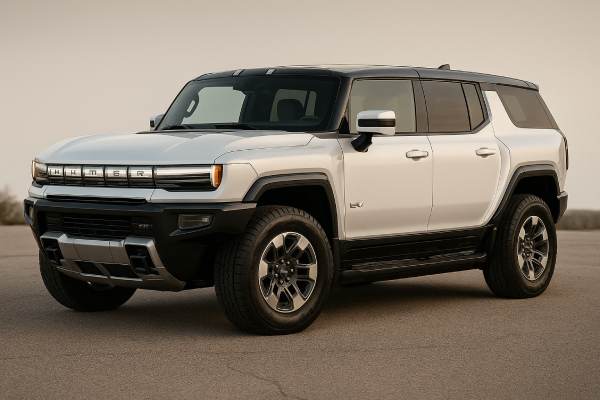
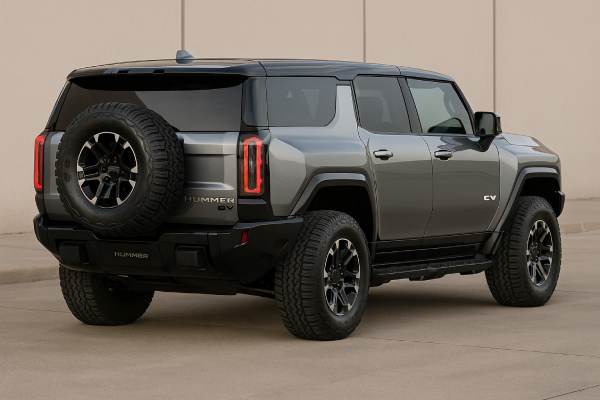
The GMC Hummer EV SUV EV3X takes everything extreme about the Hummer idea and adds one more motor. With three Ultium drive units, up to 830 hp and an EPA-estimated 314 miles of range on standard 22-inch wheels, it is one of the most dramatic electric SUVs on sale.
Unlike the pickup, the SUV’s shorter wheelbase and enclosed cargo area make it easier to live with day to day, while still offering genuine off-road ability, four-wheel steering with CrabWalk, and serious towing credentials. The trade-off is weight and efficiency: this is a heavy, energy-hungry EV that rewards thoughtful charging and maintenance planning.
This guide focuses on the tri-motor Hummer EV SUV EV3X on the BT1 platform from its launch through current model years. The aim is to give you both the technical detail and ownership insight you need to decide whether this ultra-capable electric SUV fits your usage, budget, and roads.
Key Takeaways
- Tri-motor Hummer EV SUV EV3X delivers up to 830 hp and 11,500 lb-ft (at the wheels) with an Ultium 20-module pack and torque-vectoring e4WD.
- EPA-estimated range is about 314 miles on 22-inch wheels or roughly 298 miles with the Extreme Off-Road Package and 35-inch tyres.
- Four-wheel steering, air suspension with Extract Mode, and dense underbody protection give it rare off-road ability for such a large EV.
- Early Hummer EVs have had high-voltage battery recalls related to enclosure sealing and internal connections, so VIN-based recall checks are essential.
- Plan for tyre rotation, brake and suspension checks roughly every 12,000 miles or 20,000 km, with brake fluid replacement around every 3–5 years depending on use.
What’s inside
- Hummer EV SUV 3X Profile
- Hummer EV 3X Specs and Systems
- 3X Trims, Packages and Driver Aids
- Reliability Patterns and Fixes
- Ownership Care and Buyer Guide
- Road Manners and Performance
- How Hummer EV 3X Stacks Up
Hummer EV SUV 3X Profile
The EV3X tri-motor Hummer EV SUV is the top performance configuration of GMC’s electric SUV line. It uses three Ultium permanent-magnet motors (one front, two rear) with performance torque-vectoring on the rear axle. Power output reaches up to 830 hp, and GMC quotes a striking 11,500 lb-ft of wheel torque, a number that reflects gearing multiplication rather than crank torque but still hints at the truck’s brutal thrust.
The SUV shares the BT1 body-on-frame EV architecture with the Hummer EV pickup and other large GM electric trucks. The 20-module Ultium battery pack is mounted in the floor between the frame rails, contributing to a very low center of gravity for such a tall, wide vehicle. Wheelbase is 126.7 inches and overall length is about 196.8 inches, so the SUV is roughly 20 inches shorter than the pickup, which helps with breakover angles and parking.
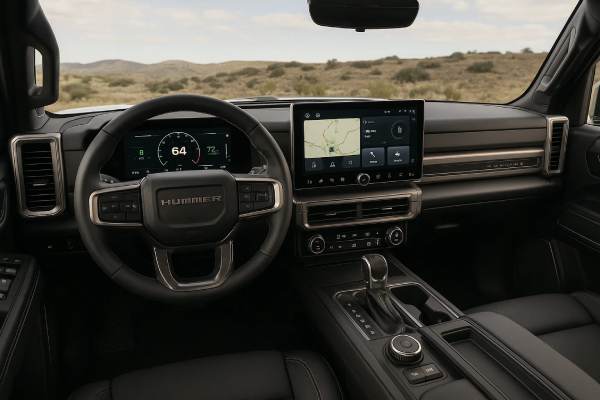
Visually, EV3X SUVs are easy to spot. Most feature 22-inch wheels as standard, while the optional Extreme Off-Road Package adds 35-inch mud-terrain tyres, beadlock-capable rims, and extra underbody armor. The signature H-shaped lighting, illuminated grille bar, and chunky wheel arches are shared with the rest of the Hummer EV family. Inside, a 13.4-inch central touchscreen pairs with a 12.3-inch digital instrument cluster and heavily themed graphics, animations, and off-road widgets.
GMC positions the EV3X as the “everything” Hummer EV SUV: the highest-output powertrain, most aggressive off-road hardware, available Super Cruise hands-free driving assistance, and a near-luxury interior. Five-passenger seating comes standard with a generous second row and flexible cargo space. With the rear seats up, you have roughly 1,020 litres (about 36 cubic feet) of cargo volume; fold them and you get more than 2,300 litres (around 82 cubic feet). A front e-Trunk under the hood provides additional secure space and is sized to store the removable roof panels.
This configuration is aimed at buyers who want a halo vehicle—something capable on trails, dramatic to drive, and able to tow, yet still electric. It is less appealing if you are focused on efficiency, compact size, or low running costs. Understanding those trade-offs is key before you sign for one.
Hummer EV 3X Specs and Systems
Below are core technical figures for the tri-motor GMC Hummer EV SUV EV3X (830 hp). Always confirm exact specs for your model year and region.
Powertrain, Battery, and Efficiency
| Parameter | Value | Notes |
|---|---|---|
| Platform / code | BT1, Hummer EV SUV EV3X | Tri-motor SUV configuration |
| Motor layout | Three Ultium permanent-magnet motors (1 front, 2 rear) | Performance torque-vectoring rear axle |
| System voltage | 800 V-class, can reconfigure to 400 V for some charging situations | Split-pack architecture |
| Battery chemistry | Ultium lithium-ion, high-nickel NCMA | Shared across GM Ultium trucks |
| Traction battery | 20-module pack, roughly high-170 to 180 kWh usable | Floor-mounted between frame rails |
| Max power | Up to 830 hp (~620 kW) | SUV-specific output |
| Max wheel torque | About 11,500 lb-ft (manufacturer wheel-torque metric) | Reflects gearing |
| Thermal management | Liquid-cooled battery and drive units; integrated heat-pump HVAC | Enables preconditioning and efficient cabin heating |
| Official test cycle | EPA combined | SUV EV3X ratings |
| Rated efficiency | Roughly 35–36 kWh/100 km (about 570–580 Wh/mi) | Calculated from pack and range |
| Rated range | ~314 miles (505 km) with 22″ wheels; ~298 miles (480 km) with Extreme Off-Road Package | Differences driven by tyres and aero |
| Real-world highway @ 120 km/h (75 mph) | Typically 42–47 kWh/100 km (675–760 Wh/mi); 260–310 km (160–190 mi) between 10–80% | Sensitive to tyre choice and weather |
| Aerodynamics | Very boxy profile, frontal area around 3.1–3.3 m² | Cd not officially published; drag dominated by size |
Driveline and Charging
| Parameter | Value | Notes |
|---|---|---|
| Drive units | Single-speed reduction gear on each motor | No multi-speed gearbox |
| Drive type | e4WD with tri-motor torque vectoring | Full-time all-wheel drive |
| Torque distribution | Independent rear torque vectoring plus brake-based control | Key for CrabWalk and off-road modes |
| AC connector | CCS1 / J1772 Type 1 inlet; onboard AC charger up to 19.2 kW (80 A) when equipped | Requires suitable home circuit |
| DC fast-charge connector | CCS1; capable of up to around 300 kW on 800 V chargers | High peak at low SOC |
| Charging port location | Left rear quarter | LEDs indicate status |
| DC charging curve | Very high power below ~30% SOC; gradual taper after ~55–60% | Preconditioning improves results |
| DC 10–80% time | Roughly 40–45 minutes on a capable 250–300 kW charger | Under favorable conditions |
| AC 0–100% time | Around 9–10 hours at 19.2 kW; 13–15 hours at ~11 kW | Typical home overnight fill |
| Battery preconditioning | Automatic when a DC fast charger is set as a nav destination or specific modes selected | Adjusts coolant and pack temperature |
| Bidirectional charging | Ultium platform is designed for future vehicle-to-home and vehicle-to-load support; availability varies by model year | Confirm feature set for your VIN |
Performance and Capability
| Parameter | Value | Notes |
|---|---|---|
| 0–60 mph | Around 3.5 s with Watts to Freedom launch mode | Conditions and tyres matter |
| 0–100 km/h | Roughly 3.7–4.0 s | Extremely quick for size |
| Top speed | About 170–180 km/h (105–112 mph), electronically limited | Market-dependent |
| Towing capacity (SUV) | Up to ~7,500 lb (3,400 kg) braked | Varies by options and market |
| Payload | Typically around 1,300–1,500 lb (590–680 kg) | Check door-jamb label |
| Roof load | Modest due to removable roof and high center of gravity | Consult manual before roof tents or racks |
Chassis and Dimensions
| Parameter | Value | Notes |
|---|---|---|
| Suspension | Independent, double wishbone with adaptive air suspension front and rear | Height-adjustable; Extract Mode adds around 6 in |
| Steering | Electric power steering with four-wheel steering | Enables tight turning circle and CrabWalk |
| Brakes | Large ventilated discs front and rear with integrated regen blending | Electronic parking brake |
| Wheels / tyres | 22″ all-terrain tyres standard; 35″ mud-terrains with Extreme Off-Road Package | Off-road tyres increase drag and noise |
| Ground clearance | Approx. 259–406 mm (10.2–16.0 in) across modes | Highest in Extract Mode |
| Approach / departure / breakover | Approach near 50°, departure high 40s, breakover in low 30s in Extract | Depends on tyres and ride height |
| Length / width / height | ~196.8 in L, ~86.5 in W, ~77.8 in H | Without rear spare |
| Wheelbase | 126.7 in (3,218 mm) | Shorter than pickup, improves agility |
| Turning circle | Around 35.4 ft (10.8 m) | Very tight for the size |
| Curb weight | Roughly 9,000–9,600 lb (4,100–4,350 kg) depending on equipment | Among the heaviest SUVs sold |
| Cargo volume | ~36 ft³ (1,020 L) seats up; ~82 ft³ (2,320 L) seats down | Plus small frunk |
Safety and Driver Assistance (Hardware-Level)
GMC equips the Hummer EV SUV with:
- Multiple airbags including front, side, and curtain coverage.
- Rigid passenger cell surrounding the underfloor battery.
- ISOFIX/LATCH points for rear outboard seats.
- ADAS sensors including front radar, camera array, and ultrasonic sensors for parking and low-speed maneuvers.
Formal crash-test scores for the SUV have been slower to appear due to its mass and relatively low volume, so potential buyers should check for updated ratings from relevant regional agencies as they become available.
3X Trims, Packages and Driver Aids
Within the Hummer EV SUV family, the tri-motor EV3X trim sits above dual-motor variants and below limited editions only in terms of rarity. From an equipment standpoint, it is the most comprehensively configured series model.
Trim structure
Typical SUV trims in many markets include:
- Hummer EV SUV 2X – Dual-motor e4WD, air suspension and four-wheel steering, slightly lower tow rating on some configurations, and lower power output.
- Hummer EV SUV EV3X – Tri-motor e4WD with performance torque vectoring, higher power, and available Special Edition or Omega Edition packages.
- Edition 1 / Omega Edition – Highly optioned limited-run variants based on EV3X hardware with unique colors, graphics, and curated option bundles.
For the EV3X SUV, key mechanical features that are standard or commonly fitted include:
- Three Ultium motors with performance torque-vectoring e4WD.
- Adaptive air suspension with modes for load leveling, Off-Road, and Extract.
- Four-wheel steering including CrabWalk diagonal driving mode.
- 20-module Ultium battery pack with DC fast charging up to around 300 kW and a 19.2 kW AC onboard charger (in many markets).
Options and packages
The most critical package choice for an EV3X buyer is usually the Extreme Off-Road Package. It typically adds:
- 18-inch wheels with 35-inch mud-terrain tyres.
- Heavy-duty underbody armor and skid plates.
- Front e-locker or advanced traction modes tuned for rock crawling.
- Additional off-road cameras underneath the body.
The off-road package is ideal for genuine trail work but reduces rated range from roughly 314 to about 298 miles and introduces more road noise. For buyers who mainly drive on paved roads, the standard 22-inch all-terrains deliver better efficiency and comfort.
Other option areas include:
- Premium audio and interior trim upgrades.
- Appearance packages and special paints.
- Roof crossbars and cargo systems.
- Towing aids and trailer camera integrations.
Quick identifiers
- EV3X badging usually appears on the exterior and in vehicle menus.
- Tri-motor SUVs often have the more aggressive wheel and tyre packages, and many are configured with the off-road appearance packages.
- VIN decoding through a GMC dealer can confirm whether the vehicle has the EV3X tri-motor powertrain and which battery and equipment packages are installed.
Safety ratings and equipment
At the time of writing, complete crash-test ratings for the Hummer EV SUV remain limited due to its heavy-duty classification and relatively small sales volume. However, the vehicle includes a broad set of active safety and driver-assistance features. Standard or available systems by trim typically include:
- Forward collision alert with automatic emergency braking, often including pedestrian and cyclist detection.
- Lane-departure warning, lane-keep assist, and on some trims, lane-centering assist.
- Blind-spot monitoring and rear cross-traffic alert.
- Rearview and surround-view camera systems with off-road views.
- Parking assist, including front and rear parking sensors and automatic steering in some configurations.
- Trailer-focused features such as trailer blind-spot monitoring, tow/haul modes, and trailer brake integration.
One of the headline technologies is Super Cruise, GM’s hands-free highway driving assist. When available on an EV3X SUV, it allows supervised hands-free driving on pre-mapped divided highways, automatically handling steering, lane position, and, in newer implementations, some lane changes. The system relies on cameras, detailed maps, and driver-attention monitoring, and it may require recalibration or software updates after certain repairs.
Post-repair sensor calibration is important. Windshield replacement, bumper work, or suspension changes may require radar, camera, and wheel-alignment calibrations to restore ADAS performance to specification.
Reliability Patterns and Fixes
The Hummer EV SUV EV3X is still young in the market, so long-term data are limited, but enough service bulletins, recalls, and early-owner experiences exist to identify key themes. Since the SUV shares its core electrical architecture and pack design with the Hummer EV pickup, lessons from the truck apply directly.
High-voltage battery enclosure and connections
Several important safety recalls have targeted the high-voltage battery pack:
- Improper urethane sealing of the battery enclosure, where inadequate sealing allowed water into the pack. Symptoms include warning messages, no-start conditions, or loss of propulsion while driving. The remedy generally involves replacing the entire pack with an updated unit and inspecting for associated corrosion or damage.
- HV battery internal connection issues, where certain connections within the pack may be out of position or inadequately welded. This can result in reduced power, warning messages, or sudden loss of drive. Remedies involve pack-level repairs or replacement.
Although these issues affected a limited population, they underscore the importance of checking that all battery-related recalls and service campaigns have been completed on any Hummer EV, including the EV3X SUV.
Isolation faults, coolant leaks, and moisture ingress
Because of the high system voltage and pack size, the Hummer EV is sensitive to coolant type, volume, and contamination. Documented concerns include:
- Coolant leaks into or near HV components, which can reduce insulation resistance and trigger “Service High Voltage System” messages.
- Moisture ingress at HV connectors or charge-port housing, leading to intermittent charging failures or isolation faults.
Diagnosis usually involves:
- Running high-voltage isolation tests using GM’s service tools.
- Vacuum and pressure testing of the battery coolant circuit.
- Visual inspection and replacement of suspect hoses, seals, connectors, or drive units.
Minor issues may be resolved with seal replacement and module swaps; severe cases can require replacement of drive units or the entire pack.
Electronics, infotainment, and ADAS
As a highly digital vehicle, the Hummer EV SUV depends on numerous control modules, many of which receive over-the-air updates. Early vehicles have seen:
- Infotainment freezes, display glitches, or lag, often improved by software updates.
- Occasional ADAS warnings or temporarily unavailable features after sensor contamination, battery disconnects, or module resets.
- Occasional keyless-entry or digital-key quirks.
Most of these are addressed with software updates, module reprogramming, or, in rare cases, replacement of a specific control unit.
Driveline, chassis, and corrosion
The EV3X’s mass and power put substantial load on tyres, suspension, and brakes:
- Tyre wear can be rapid, especially on aggressive off-road tread patterns and with spirited driving. Uneven wear indicates misalignment, often after a curb hit, pothole strike, or heavy off-roading.
- Suspension bushings, ball joints, and steering components bear high loads and should be inspected regularly, particularly if you drive on rough roads or tow frequently.
- Underbody corrosion is a concern in road-salt regions. The armor, battery skid structures, and fasteners need periodic inspection and, where allowed, rust protection.
Software campaigns and calibration updates
GM has released software updates targeting:
- Improved DC fast-charging behavior and thermal management.
- Refined drive-unit control to reduce noise or harshness.
- Updates to ADAS feature performance and Super Cruise coverage.
Sometimes the official fix for a symptom—slower charging, unusual fan noise, or persistent warning messages—is a software update rather than parts replacement. Buyers should ask for a record of completed software campaigns, not just mechanical repairs.
Pre-purchase reliability checks
When evaluating a used EV3X:
- Run the VIN through official recall tools and request a dealer printout showing every recall and service campaign completed.
- Ask for documentation of HV battery work, including pack replacements, module swaps, coolant leak repairs, and any HV isolation diagnostics.
- Request a recent state-of-health report for the traction battery along with typical range figures the owner sees at their normal charge levels.
- Have a trusted shop or dealer inspect underbody armor, battery housings, and frame components for off-road damage and corrosion.
Ownership Care and Buyer Guide
Owning a tri-motor Hummer EV SUV is less about oil changes and more about caring for tyres, brakes, suspension, and the high-voltage system. A structured approach helps keep running costs and downtime under control.
Practical maintenance schedule (approximate)
Always confirm intervals with the latest GMC service information for your VIN, but as a working guide:
- Every 12,000 miles / 20,000 km or 12 months
- Rotate tyres and check pressures, looking for uneven wear.
- Inspect brake pads, rotors, and parking-brake operation.
- Check suspension joints, bushings, steering links, and shocks for play or leaks.
- Inspect underbody armor, frame, and battery enclosures for damage or corrosion.
- Visually inspect high-voltage cables and connectors for abrasion or impact damage.
- Every 24,000–30,000 miles / 40,000–50,000 km or 2 years
- Replace cabin air filter.
- Perform alignment check, especially after off-road use, towing, or large pothole impacts.
- Inspect charge-port door, latch, and seals; clean and lightly lubricate per GM guidance.
- Brake fluid
- Replace about every 3–5 years, or sooner in high-humidity climates or heavy towing service.
- Coolant and e-axle fluids
- HV battery and drive-unit coolant may have long service intervals (often beyond 8 years or 150,000 miles in early guidance), but follow updated GM instructions; severe-duty use may shorten them.
- Some e-axles are “filled for life,” while others have drain-and-fill procedures. Always confirm fluid spec and interval for your specific drive units.
- 12 V battery
- Test annually from year three; plan to replace between years four and six as preventive maintenance.
Fluid specifications and torque values
For any DIY or independent workshop:
- Use only GM-approved HV coolant; mixing formulas can reduce corrosion protection and insulation resistance.
- Use the specified e-axle fluids; the wrong viscosity or additive package can cause seal and bearing issues.
- Apply correct torque values for wheel nuts, suspension fasteners, and HV service points. Many critical bolts are torque-to-yield and must be replaced, not re-used.
Buyer’s checklist for a used EV3X
- Battery health and range
- Obtain a state-of-health report and compare reported capacity to original.
- Ask the seller what range they typically see at 80–90% charge in mild weather.
- On a test drive, monitor for sudden drops in estimated range or power limiting at moderate SOC.
- Charging behavior
- Test AC charging on a Level 2 station if possible, checking for stable current and no error messages.
- If you have access to a DC fast charger, observe whether the vehicle rapidly ramps to high power at low SOC and maintains reasonable levels past 50%.
- Cooling system
- Look for coolant residue around the front of the vehicle, along battery lines, and under the pack.
- Confirm that preconditioning modes and HVAC respond properly; unusual noises from pumps or fans can signal developing issues.
- Chassis and body
- Inspect underbody components, especially skid plates, control arms, battery protection, and tow hooks, for off-road damage.
- Check for corrosion on frame sections, subframes, and battery mounts in salt regions.
- Look for signs of water leaks at doors, roof seams, and tailgate.
- Electronics and OTA history
- Cycle through all lighting, seats, windows, mirrors, and convenience features.
- Test ADAS features on a safe road: adaptive cruise, lane assist, blind-spot alerts, and, if fitted, Super Cruise.
- Ask whether OTA updates are regularly accepted or whether the vehicle sits offline, which could leave software out of date.
Which EV3X builds to favor
In general, later-build EV3X SUVs with complete recall records and the newest software are the safest bet. For primarily on-road use, 22-inch all-terrain tyres provide better efficiency and range. For buyers who truly plan to off-road frequently, the Extreme Off-Road Package is worth the range penalty, especially when combined with practiced driving and careful underbody inspection.
Road Manners and Performance
The tri-motor Hummer EV SUV EV3X feels like a performance vehicle wrapped in an off-road body. With launch control engaged in Watts to Freedom mode, it can reach 60 mph in around three and a half seconds, accompanied by cabin theatrics and sound design that emphasize the event. Even in normal drive modes, throttle response is immediate and strong.
Ride, handling, and noise
At urban speeds, the air suspension gives a surprisingly compliant ride. It smooths gradual bumps and many potholes, although very sharp impacts still make themselves known, especially with the stiffer 35-inch off-road tyres. The low-mounted battery mass keeps the vehicle stable, but there is still body roll in tight turns simply because of the weight and ride height.
Four-wheel steering is transformative. At low speeds, the rear wheels steer opposite the fronts, dramatically shrinking the turning circle and making parking garages and tight streets much easier to manage. At higher speeds, the rear wheels steer in phase with the fronts for stability when changing lanes or cornering.
Cabin noise at highway speed is dominated by tyre roar and some wind around mirrors and roof. The overall sound level is acceptable for a vehicle with this tyre footprint, but quieter, more efficiency-focused EVs will feel more hushed.
Braking and regenerative feel
Regenerative braking is strong and can enable near one-pedal driving in aggressive settings. Blending between regen and friction is mostly smooth, though you may feel some mild step changes as the system transitions below walking speed or when the battery is full and regen is limited. Heavier wheels and tyres mean braking distances are longer than lighter EVs; leaving extra space is wise.
Efficiency and range in the real world
In mixed use with a balance of city and highway driving, many owners see consumption in the mid-30s to low-40s kWh/100 km (roughly 550–650 Wh/mi), depending on wheel choice, temperature, and driving style.
At freeway speeds of 65–75 mph (105–120 km/h), a realistic planning number is around 42–47 kWh/100 km (675–760 Wh/mi), which yields around 160–190 miles of practical 10–80% range. Cold weather, strong headwinds, roof loads, and off-road tyres can all push consumption higher, while mild temperatures and careful driving help.
Charging experience
On a powerful DC charger, a well-preconditioned EV3X can reach very high charging power at low state of charge, making meaningful range additions in the first 15–20 minutes of a stop. As SOC rises past around 55–60%, power tapers progressively to protect the battery. Trip planning is easier if you think in terms of sequences of 10–70 or 10–80% charges rather than pushing to 100% each time.
At home, an 11–19 kW Level 2 setup can comfortably replenish daily use overnight. Many owners adopt a routine of keeping the pack between about 20 and 80% for everyday driving and reserving full charges for long trips.
Traction, stability, and towing
On pavement, traction control deftly manages the immense torque, particularly in wet or snowy conditions. Tri-motor torque vectoring on the rear axle can shuffle power between rear wheels, helping with corner exit grip and stability. Stability control intervenes relatively early when you push hard on slippery surfaces, but given the truck’s mass, that conservatism is appropriate.
Off-road, the combination of torque vectoring, air suspension, four-wheel steering, and large tyres allows the EV3X to tackle steep climbs, ruts, and rock steps that would stop many other SUVs. CrabWalk can be genuinely useful for sidestepping around obstacles on narrow trails, not just a party trick.
When towing up to around 7,500 lb, the EV3X feels stable thanks to its own weight and wheelbase. However, range can drop significantly—often by 40–60% depending on trailer size and speed. For long towing trips, careful route planning around DC chargers and an understanding that you will be charging more frequently than when unladen are crucial.
How Hummer EV 3X Stacks Up
The Hummer EV SUV EV3X lives in a small but growing niche of high-performance, off-road-capable electric SUVs. Its closest peers in spirit, if not size, include the Rivian R1S, certain versions of the Mercedes G 580 electric G-Class, and upcoming heavy luxury EVs such as the Cadillac Escalade IQ.
Versus Rivian R1S
The Rivian R1S, especially in quad-motor form, matches or even surpasses the Hummer EV 3X’s off-road hardware in a more compact body. It is much lighter, significantly more efficient, and easier to park. The Hummer counters with a more dramatic presence, larger interior volume, and a very different design language. If you prioritize efficiency, agility, and subtlety, the Rivian usually comes out ahead; if you want maximum theater, presence, and a full-size footprint, the Hummer is the more imposing choice.
Versus luxury road-focused EV SUVs
Compared with luxury EV SUVs such as the Mercedes EQE or EQS SUV, the Hummer EV 3X trades refinement and efficiency for raw capability and character. The Mercedes models offer quieter cabins, sleeker aerodynamics, and better energy consumption, making them easier recommendations for dense urban or long-distance highway use where off-road detours are unlikely.
The Hummer EV SUV, by contrast, is built for buyers who genuinely value ground clearance, tow ratings, and rugged styling. It will feel oversized and thirsty in crowded cities but at home on wide highways, large parking areas, and trails.
Versus future heavy luxury EVs
Vehicles like the Cadillac Escalade IQ bring similar Ultium technology into even more luxury-focused packages, often with large batteries and strong power but without the rock-crawling emphasis. If your use case involves highway trips, family hauling, and light dirt roads, something like the Escalade IQ or similar large EVs may provide the comfort and interior focus you want.
The Hummer EV EV3X remains the more adventurous choice: it is the one you take to a trailhead down a rutted road, tow a heavy boat with, or simply enjoy for its distinctive design and performance.
Who should consider the EV3X SUV
This tri-motor Hummer suits drivers who:
- Have reliable home charging and access to high-power public chargers on longer routes.
- Want a vehicle that can tow, off-road, and still deliver the instant torque and quiet running of an EV.
- Understand that tyres, brakes, and electricity use will be above-average and budget accordingly.
- Appreciate its bold styling and are comfortable with its physical size and weight.
For buyers focused on efficiency, compact dimensions, and straightforward urban living, smaller EV crossovers or lighter off-road EVs are better aligned. For those who genuinely use large SUV capability and want it in electric form, the Hummer EV SUV EV3X is one of the most distinctive options currently available.
References
<a href="https://www.gmc.com/electric/hummer-ev/suv">2026 HUMMER EV SUV | Electric SUV | GMC</a> 2025 (Vehicle Overview)<a href="https://www.gmc.com/content/dam/gmc/na/us/english/index/about/download-brochures/2024-models/GMTH23CT000-2024-HUMMER-EV-SUV-FO-031924.pdf">HUMMER EV SUV 2024 FEATURES, SPECS AND OPTIONS</a> 2024 (Model Specs and Options)<a href="https://www.gmc.com/support/vehicle/manuals-guides">Manuals and Guides | Vehicle Support</a> 2024 (Owner’s Manuals Portal)<a href="https://static.nhtsa.gov/odi/rcl/2022/RCRIT-22V771-9162.pdf">Product Safety Recall N222380031 Improper Urethane Sealing - High Voltage Battery Pack</a> 2022 (Recall Bulletin)<a href="https://static.nhtsa.gov/odi/rcl/2023/RCRIT-23V367-3362.pdf">Safety Recall N232404441 HV Battery Loss of Propulsion</a> 2023 (Recall Bulletin)
Disclaimer
This article is intended for general informational purposes and does not replace professional diagnosis, repair advice, or official service documentation. Specifications, torque values, service intervals, and procedures can vary by VIN, model year, market, options, and running changes. Always confirm details against your vehicle’s official owner’s manual and the latest GMC service information, and consult a qualified technician before working on high-voltage or safety-critical systems.
If you found this guide helpful, you are welcome to share it with other drivers and enthusiasts on platforms such as Facebook or X/Twitter to support our work and help more owners make informed decisions.