
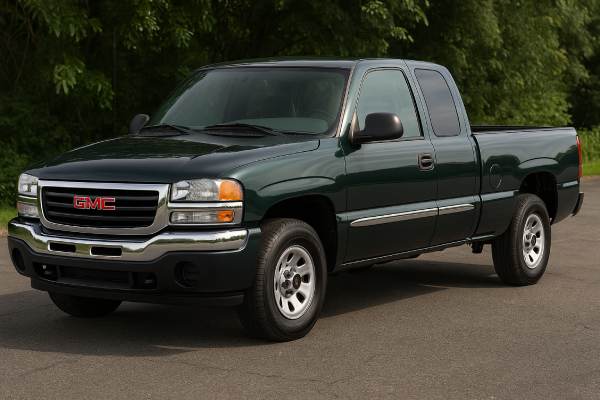
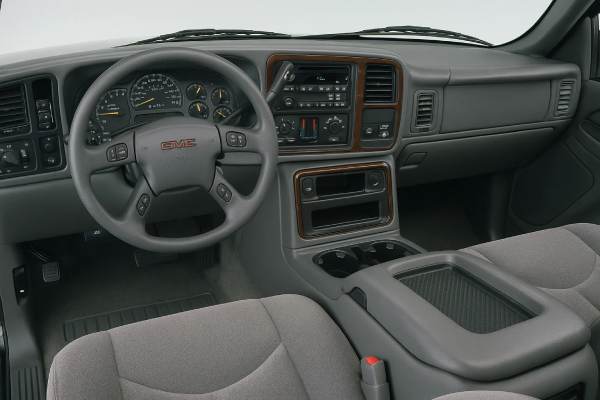
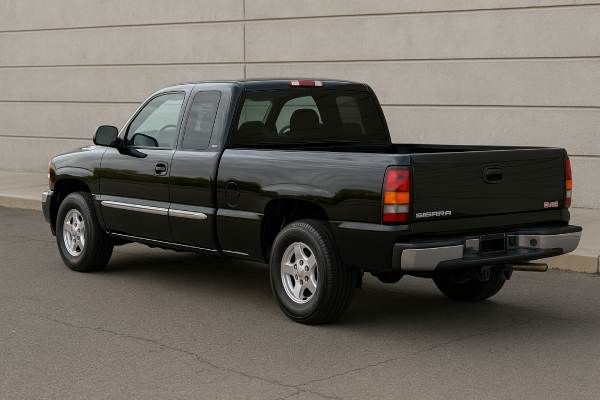
The 2000–2006 GMC Sierra 1500 RWD with the LR4 4.8 litre V8 sits in a sweet spot of the GMT800 lineup. It combines a modern LS-based V8 with simple rear-wheel-drive running gear and a robust ladder-frame chassis. For owners, that means a truck that feels familiar and easy to work on, yet has more refinement and safety than the older C/K series it replaced.
In this configuration the Sierra is aimed at drivers who spend most of their time on pavement, tow moderate loads, and want full-size capability without the cost and complexity of four-wheel drive. The LR4 4.8 gives you enough power for daily use and weekend towing while sharing many parts with the more powerful 5.3 and 6.0 engines. That makes repairs and upgrades straightforward and affordable.
This guide walks through what the Sierra 1500 RWD 4.8 actually offers: key specifications, towing and performance, real-world reliability patterns, maintenance priorities, and how it compares to rival half-ton trucks from the same era.
Fast Facts
- LR4 4.8 litre V8 is an LS-family engine with strong longevity and excellent parts support.
- RWD layout is lighter and simpler than 4WD, helping fuel economy and reducing driveline wear.
- Common age-related issues include frame and brake line rust, front-end wear, and instrument cluster faults.
- A practical service interval is engine oil and filter every 5,000 miles / 8,000 km or 6 months for mixed or severe use.
On this page
- GMC Sierra 4.8 RWD overview
- Technical data for Sierra 4.8
- RWD trims, equipment and safety
- Reliability record and known faults
- Service schedule and purchase tips
- On-road behaviour and performance
- Sierra 4.8 versus competitors
GMC Sierra 4.8 RWD overview
Within the GMT800 family, the GMC Sierra 1500 RWD with the LR4 4.8 litre V8 is the “step-up” engine above the 4.3 V6 and below the more common 5.3 litre V8. Under the hood is the Vortec 4800: an iron-block, aluminium-head V8 from the LS engine family. It uses a cam-in-block (pushrod) layout with two valves per cylinder and hydraulic roller lifters, favouring durability and low-end torque over complexity.
Depending on model year and calibration, output for the LR4 in half-ton applications typically sits around 270 hp and roughly 285 lb-ft of torque. That is enough for brisk everyday driving, relaxed highway cruising and sensible towing when the truck is correctly geared. Compared with the 5.3 litre, the 4.8 trades some torque for slightly better economy and a lower purchase price, while still feeling clearly stronger than the base V6.
In rear-wheel-drive form the Sierra loses the transfer case and front differential of 4×4 models, which reduces weight, friction and the number of expensive components that can wear out. For drivers in milder climates who rarely need low-range off-road traction, RWD can be a smart long-term ownership choice, especially when combined with good tyres and, ideally, the optional locking rear differential.
The 4.8 RWD configuration was available across regular cab, extended cab and some crew cab models, with standard (6.5 ft) and long (8 ft) beds. Most retail trucks use the 4L60-E four-speed automatic transmission; a manual gearbox existed early on but is rare in the used market. Because the LR4 shares architecture and many parts with other LS engines, the Sierra 1500 RWD 4.8 is also popular as a base for performance or “LS swap” projects.
Technical data for Sierra 4.8
This section uses a representative 2003–2004 GMC Sierra 1500 RWD with the LR4 4.8 V8 and 4L60-E automatic. Exact values vary slightly by year, cab, bed and axle ratio, so always confirm against your VIN and manual.
Engine and performance (LR4 Vortec 4800)
| Item | Specification |
|---|---|
| Engine code | LR4 Vortec 4800 V8 |
| Displacement | 4.8 l (293 cu in) |
| Configuration | 90° V8, iron block, aluminium heads |
| Valvetrain | OHV, 2 valves per cylinder, hydraulic roller lifters |
| Bore × stroke | 96.0 × 83.0 mm (3.78 × 3.27 in) |
| Compression ratio | Around 9.4:1 |
| Induction | Naturally aspirated |
| Fuel system | Sequential multi-port fuel injection |
| Maximum power | Approx. 270 hp @ ~5,200 rpm (varies by year) |
| Maximum torque | Approx. 285 lb-ft (≈ 386 Nm) @ ~4,000 rpm |
| Timing drive | Chain |
| Recommended fuel | Regular unleaded (87 AKI) |
Typical fuel economy for a RWD Sierra 4.8 automatic is:
- City: roughly 13–15 mpg (US)
- Highway: roughly 17–20 mpg (US)
- Combined: roughly 14–17 mpg (US), depending on gearing, load and driving style
In metric terms that corresponds to approximately 14–18 l/100 km in mixed driving.
Transmission and driveline
| Item | Specification |
|---|---|
| Transmission | 4L60-E 4-speed automatic with overdrive |
| Gear ratios | 1st 3.06, 2nd 1.62, 3rd 1.00, 4th 0.70, Reverse 2.29 |
| Drive type | Rear-wheel drive (RWD) |
| Differential | Open as standard; optional automatic locking (G80) on many trims |
| Typical axle ratios | Around 3.23, 3.42 or 3.73, depending on options |
Shorter (numerically higher) final drive ratios improve towing and acceleration at the cost of higher rpm at cruise. For mixed use, 3.42 is a common compromise, while 3.73 is preferred by many owners who tow regularly.
Chassis, dimensions and weights
Numbers below are representative for a 2WD extended cab standard-bed truck:
| Item | Specification |
|---|---|
| Platform | GMT800 full-size pickup ladder frame |
| Front suspension | Independent, torsion bar or coil-over type with upper/lower control arms |
| Rear suspension | Solid axle with semi-elliptic leaf springs |
| Steering | Power-assisted recirculating ball |
| Brakes | Front ventilated discs, rear drums with ABS |
| Wheelbase (extended cab, standard box) | ~3,645 mm (143.5 in) |
| Overall length | ∼5,600–5,880 mm (220–231 in, depending on cab/bed) |
| Curb weight | Around 2,150–2,250 kg (≈ 4,740–4,960 lb) |
| GVWR (typical half-ton) | Around 2,900–3,040 kg (6,400–6,700 lb) |
| Fuel tank | ≈ 98 l (26 US gal) |
| Bed length (standard box) | ≈ 1,980 mm (78 in / 6.5 ft) |
Performance and capability
Exact figures depend on configuration, but approximate ranges for a healthy RWD 4.8 Sierra are:
- 0–60 mph (0–97 km/h): mid-8 to mid-9 seconds when unladen
- Top speed: generally limited to around 160–170 km/h (100–105 mph) by speed or tyre rating
- Tow rating (properly equipped): roughly 2,700–3,600 kg (6,000–8,000 lb)
- Payload: typically in the 635–770 kg (1,400–1,700 lb) range
For towing, hitch setup, trailer brakes and axle ratio matter as much as engine output. Always confirm tow ratings and tongue-weight limits for your exact VIN.
Fluids, capacities and key torque examples
Always confirm for your specific year and options:
- Engine oil – 5W-30 to GM spec; about 4.7–5.7 l (5–6 qt) with filter
- Engine coolant – Dex-Cool long-life coolant, roughly 15–16 l for a full system fill
- Automatic transmission (4L60-E) – Dexron-spec ATF; around 9–12 l for a full refill, 4–5 l on a pan drop and filter change
- Rear axle – 75W-90 GL-5 gear oil; capacity around 2.0–2.3 l
- Power steering – GM power steering fluid or compatible
- Spark plug gap – typically about 1.0 mm (0.040 in)
Example torque values (check manual):
- Wheel nuts – roughly 190–210 Nm (140–155 lb-ft)
- Spark plugs – roughly 20–25 Nm (15–18 lb-ft)
RWD trims, equipment and safety
Trims and options
During the 2000–2006 production run the Sierra 1500 RWD 4.8 was offered in several trim levels, with details varying by market:
- Base / Work Truck (WT) – Vinyl or simple cloth bench seat, rubber floor, manual windows and locks, basic audio, steel wheels. 4.8 RWD is very common here, especially in regular cab long-bed fleet trucks.
- SLE – Power windows and locks, cloth seats with better bolstering, improved sound insulation, alloy wheels and additional convenience options. Many extended-cab 4.8 RWD trucks are SLE grade.
- SLT – More often paired with 5.3 or 6.0 V8s, but some rear-drive 4.8s exist with leather, automatic climate control and premium audio.
Important mechanical options:
- G80 locking rear differential – Improves traction on wet surfaces, gravel and light off-road.
- Axle ratio codes (e.g., GU4, GU6, GT4) – Identify 3.08, 3.42, 3.73 and other final drives. Shorter gears improve towing.
- Trailering packages – Add a receiver hitch, wiring, heavy-duty cooling and sometimes different springs or shocks.
- Wheel and tyre packages – Larger wheels and LT-rated tyres can increase load capacity but may stiffen the ride.
Many of these options are listed on the glovebox RPO sticker, making it easier to decode a used truck’s equipment.
Safety features and ratings
By modern standards, safety equipment on GMT800 half-tons is basic:
- Dual front airbags
- Three-point belts for front outboard seats
- Four-wheel ABS
- Daytime running lights
Side airbags, stability control and advanced restraint systems were rare or unavailable for much of this generation. Later trucks added traction control or stability systems in some trims, but they are not universal.
Crash-test data for similar-generation Sierra and Silverado 1500 models show acceptable injury protection in frontal impacts for the time, but structural performance and head-restraint design lag behind later platforms. Side-impact and small-overlap test coverage is limited, and ratings are not directly comparable to modern pickups.
For families and regular passengers, the main safety considerations are:
- Ensuring seatbelts, buckles and pretensioners are working and in good condition
- Adjusting head restraints properly to reduce whiplash risk
- Maintaining brakes, tyres and suspension so the truck can stop and handle as designed
Child-seat and ADAS considerations
Later extended and crew cabs may have LATCH anchors in rear seating positions, but earlier trucks often rely mainly on seatbelts and top tether anchors. Always check the owner’s manual for approved installation locations and weight limits.
No factory advanced driver assistance systems are fitted on these trucks:
- No lane keeping or lane departure warning
- No blind-spot monitoring
- No adaptive cruise or automatic emergency braking
Any reversing cameras, parking sensors or other aids will usually be aftermarket and should be checked individually for correct operation after repairs.
Reliability record and known faults
The Sierra 1500 RWD 4.8 has a generally strong reputation for reliability, especially for the engine and basic driveline. Many examples exceed 200,000 miles with original engines and transmissions when serviced correctly. Age, rust and neglected fluids are now the main threats.
Engine and fuel system
The LR4 engine itself is robust. Pattern issues are mostly age-related:
- Knock sensor and harness failures (common)
Moisture can collect in the valley under the intake manifold, corroding knock sensors and their wiring. Symptoms include stored knock-sensor codes and power loss due to conservative timing. The fix is to remove the intake, replace sensors and harness, and reseal the valley grommets. - Intake and throttle body contamination (common)
High-mileage engines can develop carbon build-up on the throttle plate and intake, causing unstable idle, stumble and poor off-idle response. Cleaning the throttle body and resetting trims often solves the issue. - Fuel pump module wear (occasional–common at high mileage)
In-tank pumps can fail, especially if the truck has frequently been run near empty. Expect long cranking, loss of pressure and intermittent stalling. Replacement requires tank removal or lifting the bed.
Timing chain and bottom-end failures are relatively rare on maintained engines. Light cold piston slap that quickly quiets is common and often considered normal for LS-based truck engines.
Transmission and driveline
The 4L60-E is well understood and capable but has known weak points, especially with heavy towing or poor maintenance:
- Premature 3–4 clutch wear causing slipping in fourth gear
- Failure of the sun shell leading to loss of some gears and reverse
- Converter clutch shudder or harsh shifts when fluid is old or contaminated
Regular fluid and filter services and sensible use of tow/haul mode when towing help extend life. Rear axle assemblies on RWD trucks are simple and durable; common issues include leaking pinion seals and worn axle bearings at high mileage.
Steering, suspension and brakes
As with any older truck, front-end and brake components need attention:
- Idler and pitman arms develop play, leading to vague steering and wander.
- Upper and lower ball joints can wear, especially on trucks driven on rough roads.
- Front hub/bearing units may growl or develop play; they are replaced as complete hub assemblies.
- Brake lines on GMT800 trucks are known to corrode in salt climates, especially along the left frame rail and above the rear axle. Sudden line failure can cause loss of hydraulic pressure, so inspection and replacement with coated or stainless lines is important.
Rear drum hardware and parking brake mechanisms can seize or wear, leading to poor parking brake performance and uneven rear braking if not adjusted and serviced periodically.
Body, frame and interior
- Frame and crossmember rust – Pay special attention to rear frame sections, bed crossmembers, spare-tyre carrier and spring hangers. Severe flaking rust can compromise strength.
- Rocker panels and cab corners – These frequently rust from the inside out in wet and salted regions.
- Instrument cluster stepper motors – Erratic or stuck gauges (speed, fuel, tachometer) are usually due to failing stepper motors in the cluster; repair requires rebuilding or replacing the cluster.
- Power window regulators – Cables and plastic guides wear and break, particularly on high-use driver doors.
Recalls and service actions
Over the GMT800’s life, various recalls and bulletins addressed issues such as:
- ABS behaviour on low-speed stops in rust-belt vehicles
- Seat-belt anchorage and seat mounting issues
- Steering-shaft clunk and associated feel problems
Because campaigns vary by year and market, always run the VIN through official recall tools and ask for dealer printouts or invoices confirming completion. Trucks with documented recall and TSB work are easier to trust.
Service schedule and purchase tips
Practical maintenance schedule
The official manuals give detailed “normal” and “severe” service schedules. In reality, most trucks see conditions closer to severe use: short trips, stop-and-go traffic, towing, or dusty roads. A sensible baseline:
- Engine oil and filter – Every 5,000 miles / 8,000 km or 6 months. Shorten intervals for heavy towing or mainly short trips.
- Engine air filter – Inspect annually; replace every 30,000–40,000 miles (50,000–65,000 km) or sooner in dusty conditions.
- Cabin filter – If fitted, check yearly and replace every 2 years; many GMT800 pickups do not have a cabin filter as standard.
- Spark plugs – Replace around 60,000–80,000 miles (100,000–130,000 km), even if long-life plugs are rated for more.
- Coolant (Dex-Cool) – Replace at about 5 years / 100,000 miles (160,000 km) or when testing shows depletion.
- Automatic transmission fluid and filter – Service every 50,000–60,000 miles (80,000–100,000 km). Flushing very dirty fluid may cause issues; pan drops and filter changes are often safer.
- Differential fluid – Change around 60,000–80,000 miles; more often for heavy towing or G80 locker use off-road.
- Brake fluid – Flush every 3 years to reduce internal corrosion.
- Serpentine belt and hoses – Inspect at each oil change; replace belts showing cracks or glazing and hoses that are soft, swollen or cracked.
- Tyre rotation and alignment – Rotate every 6,000–8,000 miles (10,000–13,000 km); align annually or when you see uneven wear.
- 12 V battery – Load-test yearly beginning around year 4–5; many last 5–7 years.
The LR4 uses a timing chain with no fixed replacement interval. Treat it as a lifetime component unless there is noise, timing-related fault codes or the front of the engine is being opened for other major work.
Fluid choices and capacities
For planning and parts ordering:
- Use quality 5W-30 oil that meets the relevant GM specifications for your model year.
- Consider modern Dexron-VI ATF for improved temperature resistance and oxidation protection, if approved for your model year.
- Stick with Dex-Cool or compatible OAT coolants designed to mix correctly; do not mix conventional green coolant with Dex-Cool without a complete flush.
Always double-check capacities in the manual; over- or under-filling can cause damage.
Buyer’s checklist
When shopping for a Sierra 1500 RWD 4.8:
- Rust and structure
- Crawl under the truck and inspect frame rails, crossmembers, rear spring hangers and the spare-tyre support.
- Check brake and fuel lines for bubbling rust or wet spots.
- Inspect rocker panels, cab corners and floor pans.
- Engine and driveline
- Cold start: listen for knocks or ticking that persists when warm.
- Check for leaks around the rear main seal area, valve covers and oil pan.
- Test drive long enough to get fully up to temperature; feel for smooth shifts and no slipping in any gear.
- Steering, suspension and brakes
- Look for steering play, wandering, clunks over bumps and brake pulsation.
- Inspect front tyres for cupping or uneven wear that could indicate alignment or component issues.
- Electrical and interior
- Confirm that all gauges behave normally.
- Test all windows, locks, mirrors, lights, wipers and HVAC modes.
- Check the condition of seats, dash and door panels for signs of water leaks or poor repairs.
- History and paperwork
- Prefer trucks with documented oil changes and transmission services.
- Ask for evidence of any major work (brake lines, hubs, steering components).
- Verify recall completion via official channels.
A slightly more expensive, rust-free truck with good history is often cheaper over time than a bargain example needing major brake, suspension and corrosion work.
On-road behaviour and performance
Ride and handling
On the road, the Sierra 1500 RWD 4.8 feels very much like a traditional full-size pickup: tall seating position, long wheelbase stability, and a bed that likes a bit of weight in it. Unladen, the rear suspension can be choppy over broken pavement and expansion joints, especially with stiff tyres or heavy-duty springs. Add 200–300 kg (400–600 lb) of cargo and the ride smooths out noticeably.
The independent front suspension gives the truck better turn-in and straight-line stability than older straight-axle designs. Steering is light thanks to power assistance, and once the front-end components are in good condition, the truck tracks confidently at highway speeds. Excessive play, wandering or pulling usually indicates wear in idler or pitman arms, ball joints or alignment rather than a design flaw.
Braking performance is solid when the system is properly maintained. Front discs and rear drums provide consistent stopping power for a half-ton, but rusted lines, glazed pads or out-of-adjustment rear drums can quickly degrade pedal feel. A healthy Sierra should stop straight with a firm, predictable pedal and minimal fade under normal use.
Powertrain feel
The LR4 4.8 V8 has a smooth, free-revving character compared with many older truck V8s:
- At low rpm it pulls steadily but not aggressively; it feels stronger than the 4.3 V6 but less muscular than the 5.3.
- Midrange response is good; the engine is happy between about 2,000 and 4,500 rpm, which suits highway merging and overtaking.
- The exhaust note is subdued in stock form, with a gentle V8 burble under load.
With the 4L60-E automatic, the truck generally upshifts early for economy and drops into overdrive quickly on level roads. Tow/haul mode alters shift timing to keep the engine in a more favourable part of the power band, especially under load. When you ask for full throttle, the transmission typically drops one or two gears and the 4.8 pulls strongly enough to handle most everyday tasks.
Fuel economy and range
In mixed use, many owners report:
- Around 14–17 mpg (US) combined depending on driving style, tyre choice and load
- Around 17–20 mpg on long, steady highway trips at moderate speeds
- Low-teens mpg in heavy city traffic, short trips or with significant idling
With a roughly 26-gallon tank, a realistic highway range of 350–450 miles (560–725 km) between fill-ups is achievable on a healthy truck.
Oversized tyres, lift kits, roof racks, aggressive driving and heavy towing can all reduce economy and may require recalibration of the speedometer and odometer to reflect true distance and fuel use.
Load and towing behaviour
Within its rated limits and when set up correctly, the Sierra 1500 RWD 4.8 is a competent tow vehicle:
- Long wheelbase and rear-drive layout give good straight-line stability.
- Properly adjusted trailer brakes and weight distribution keep braking distances reasonable.
- Transmission and cooling systems must be in good condition; auxiliary coolers are highly recommended for regular towing.
Expect fuel consumption to worsen significantly when towing, often dropping into the 8–12 mpg (US) range depending on trailer weight and aerodynamics. Downshift early on grades, avoid lugging at low rpm in high gear, and use tow/haul mode to reduce heat and prevent gear hunting.
On wet or slick surfaces, an open rear differential and unloaded bed can limit traction. The optional locking differential and quality all-season or winter tyres greatly improve behaviour. Sandbags or other ballast over the rear axle can help in winter but must be secured properly.
Sierra 4.8 versus competitors
Against other GMT800 Sierras
Compared with the 4.3 V6:
- The 4.8 offers clearly better acceleration, more relaxed towing and easier highway passing.
- Fuel economy is often only slightly worse in real-world use because the V8 does not need to work as hard.
- Resale value and buyer appeal are typically stronger with a V8 badge.
Compared with the 5.3 V8:
- The 4.8 sacrifices some torque, especially at low rpm, so a 5.3 will feel stronger with heavy loads or on steep grades.
- The 4.8 can be marginally more economical in gentle driving, though the difference is small in many cases.
- Purchase prices for 4.8 trucks are often lower, making them attractive as budget buys.
If you tow near the maximum half-ton ratings regularly or live in mountainous terrain, the 5.3 may be the better choice. For mostly unladen commuting, light hauling and occasional towing, the 4.8 is usually sufficient.
Versus rival half-tons
Compared with same-era Ford F-150, Dodge Ram 1500 and Toyota Tundra:
- Power outputs are broadly similar among smaller V8 options. The LR4’s main advantage is being part of the LS family, which is renowned for durability and has broad aftermarket and parts support.
- Interior quality and refinement vary; some F-150 and Tundra trims feel more modern inside, while the Sierra’s cabin is simple and easy to work on.
- Rust patterns differ by brand and region, but GMT800 brake-line and frame corrosion in harsh climates are well-known issues that must be checked carefully.
Who the Sierra 4.8 RWD suits best
This truck is a good fit if you:
- Want a full-size pickup with a proven V8 and simple RWD layout.
- Plan to keep the truck long-term and value ease of maintenance and parts availability.
- Tow moderate trailers or haul loads within half-ton limits, but do not need heavy-duty grades or off-road low-range capability.
- Are considering a future LS-based performance or restomod build and want a solid starting point.
You may be better served by another configuration if you:
- Frequently tow near or above 3,000 kg (6,600 lb) or in mountainous terrain (a 5.3 or 6.0, or a heavy-duty truck, would be more relaxed).
- Live off-grid or in very snowy regions where 4×4 traction is essential.
- Prioritise modern crash safety, advanced driver aids and the quietest possible cabin; in that case, a newer-generation truck may justify its higher cost.
For many owners, however, a clean, well-maintained GMT800 Sierra 1500 RWD 4.8 strikes a satisfying balance between cost, capability and long-term durability.
References
- LR4 4.8L Engine Specs: Performance, Bore & Stroke, Cylinder Heads, Cam Specs & More 2019 (Engine Guide)
- Used 2003 GMC Sierra 1500 MPG & Gas Mileage Data 2024 (Fuel Economy Summary)
- 2003 GMC Sierra 1500 Specifications 2024 (Specification Sheet)
- 2003 GMC Sierra 1500 Extended cab pickup 2024 (Safety Rating)
- Manuals and Guides | Vehicle Support 2024 (Owner’s Manual Portal)
Disclaimer
This article is for informational purposes only and is not a substitute for professional diagnosis, repair or safety advice. Specifications, torque values, capacities and service intervals can vary by VIN, model year, market and installed equipment. Always confirm critical data and procedures using the official owner’s manual and factory service information for your specific vehicle, and consult a qualified technician before carrying out repairs or towing near rated limits.
If you found this guide helpful, please consider sharing it with other owners and enthusiasts on Facebook, X/Twitter or your preferred forums. It helps more people make informed decisions and supports the work involved in producing detailed technical content like this.